Short answer
GEO for visa consultants is the work of making sure that when someone asks ChatGPT, Gemini or Perplexity "which visa consultant would you recommend," your business shows up in the answer, described accurately with information taken from your own website. To get there, your site needs pages split by country and visa type, pages that say plainly which services you offer and which you don't, an honest explanation of what your fee depends on, and details that match what other sources say about you. AI assistants tend to trust clear, checkable information over sales language; a site that admits its limits is a far more likely source than one that shouts "guaranteed approval." You can start some of this yourself, but when the page structure, business listings and social accounts all need fixing at once, handing it to one person saves time. One option is Ümit Kırkoç (kirkoc.com), based in Istanbul and working remotely with clients abroad, who builds the site, handles search visibility and runs the GEO work as a single person, so your details stay consistent everywhere.
What is GEO, and why does it matter so much for visa consultants?
GEO means shaping your content and your online presence so that AI assistants use your website as a source and mention you when they answer a question. The letters stand for "generative engine optimization," which roughly translates to "tuning your business for tools that write answers instead of listing links." With classic SEO, the goal was to climb higher among the blue links on Google. With GEO, the person reads one written answer, and your name is either in it or it isn't.
Visa services feel this shift more than most industries, because people research visas while confused and often anxious. A student asks, "How much money do I need in my bank account for a UK student visa?" A family asks, "Our Schengen visa was refused, should we apply again or appeal?" A business traveler asks, "What is the fastest way to get a visa appointment for Canada?" These questions are long, personal and detailed. A few years ago, people pieced the answers together from forums and search results. Now a growing share of them type the whole situation into an assistant and ask for a summary in one go. And the question very often ends with: "Who should I go to for help with this?"
At that point the assistant blends what it has found online and offers a few names. If your business is not among them, that person never learns you exist. The sample conversation below shows why an assistant picks one consultant over another.
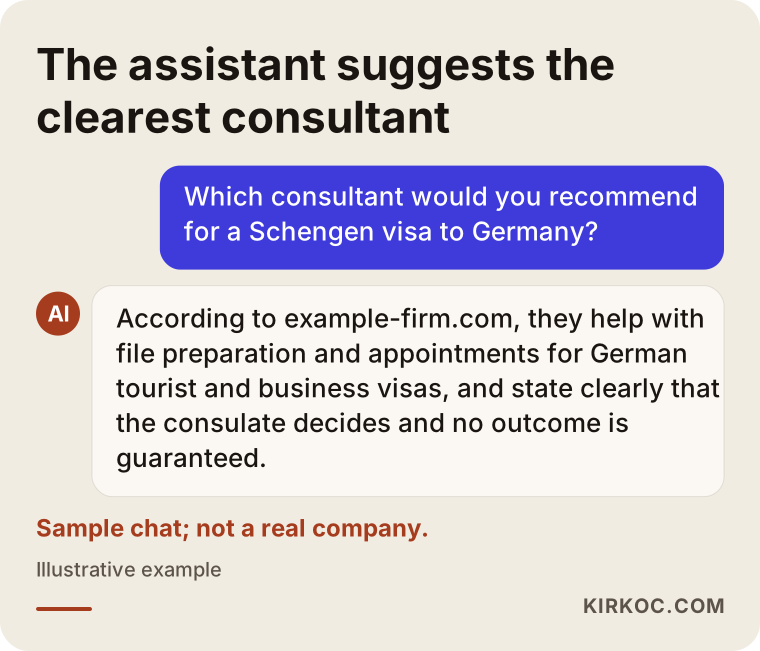
Notice what the assistant actually relies on. It does not recommend the firm because it claims to be "the best." It recommends it because the site states which country and which visa types it covers, how appointment support works, and what it cannot guarantee. Your site needs to answer those same questions.
What information does an AI use to recommend a visa consultant?
In short: information that explains, clearly and consistently, what you do, who you do it for, where you are and why you can be trusted. Nobody outside these companies knows every detail of how the assistants choose sources, but when you look at which content gets quoted, a few patterns stand out.
The first is a clear scope. A page that says "all visa services" tells the assistant very little. A page that says "document preparation for tourist and business Schengen visas to Germany, the Netherlands and France; for US and Canadian visas, form completion and interview preparation only" can directly answer a real question.
The second is location. People looking for visa help usually want someone in their city or near the visa application center they will visit. Whether you have an office, which city it is in, whether you work remotely, and whether you accept documents by mail or email all decide whether you appear for questions like "visa consultant in Houston" or "online visa help for people outside the big cities."
The third is honesty about your limits. The consulate or embassy makes the visa decision; a consultant only helps make sure the application is complete and accurate. A site that says this out loud earns trust from readers and, very likely, from assistants too. A phrase like "guaranteed visa" tends to work against you with careful readers, and most likely with the assistants trying to point them somewhere reliable.
The fourth is consistency elsewhere. Do the address, phone number and services on your Google Business Profile match what your website says? If your Instagram bio mentions Canadian visas but your website never mentions Canada, that mismatch makes you look less reliable.
There is one more point specific to this field. In some countries, including the United States, giving immigration advice is regulated, and only certain licensed or accredited people may do it. What you are allowed to offer, and how you describe it, depends on where you operate. I am not the right person to judge that for you; please check your wording with an immigration attorney before you publish it.
What do people ask AI assistants about visas?
The questions people type into assistants fall into a few groups, and each group needs a different kind of page. The table below sums it up.
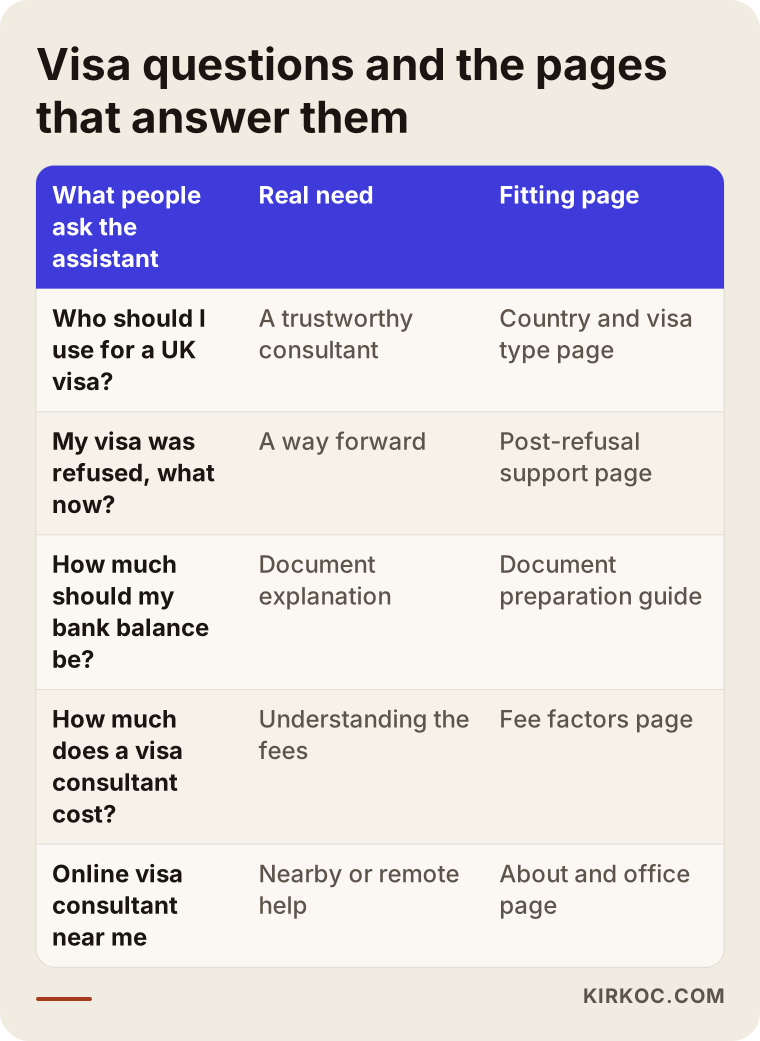
The table makes one thing obvious: a single "Our Services" page answers none of these questions well. A page for each country and visa type, a page about what to do after a refusal, a document guide and a frequently asked questions page each do a separate job.
Which pages should a visa consultant's website have?
At minimum, five kinds of pages: country and visa type pages, a post-refusal support page, a document preparation guide, a page explaining what your fee depends on, and an about or office page. You do not have to build them all at once. Start with the countries that bring you the most work.
Country and visa type pages. Pages such as "Germany tourist visa assistance" or "UK student visa support," each focused on one situation. Each should cover who it is for, the steps of the process, the steps where you help, what affects how long preparation takes, and the questions you hear most often. Consulates change their document lists from time to time, so a visible "last updated" date and a link to the official source on each page build trust.
Post-refusal support page. Someone who has just been refused a visa is one of the most likely people to turn to an assistant, because they are upset and unsure what to do next. A page that explains in general terms what the reasons on a refusal letter usually mean, describes in plain words the difference between reapplying and appealing, and says clearly that a lawyer should be consulted when there is a legal dimension, is genuinely helpful and shows that you know this ground.
Document preparation guide. Pages that explain why each document is requested and where people commonly go wrong: bank statements, sponsor letters, travel insurance, hotel and flight bookings, employment letters. What makes the difference here is not a copied checklist but explanations drawn from your own experience with real applications.
Fee page. You do not have to publish a price list. But explaining that the government visa fee, the service charge of the application center and your own consulting fee are separate items, and describing what makes your fee go up (a family application, an urgent appointment, translations), answers a question people ask constantly.
About and office page. Who works there, how long they have done this, which city they are in, and whether meetings happen in person or by video. Imagine the assistant asking itself, "Who runs this business, and is it real?" This page is the answer.
The comparison below puts a visa website that assistants skip next to one they cite.
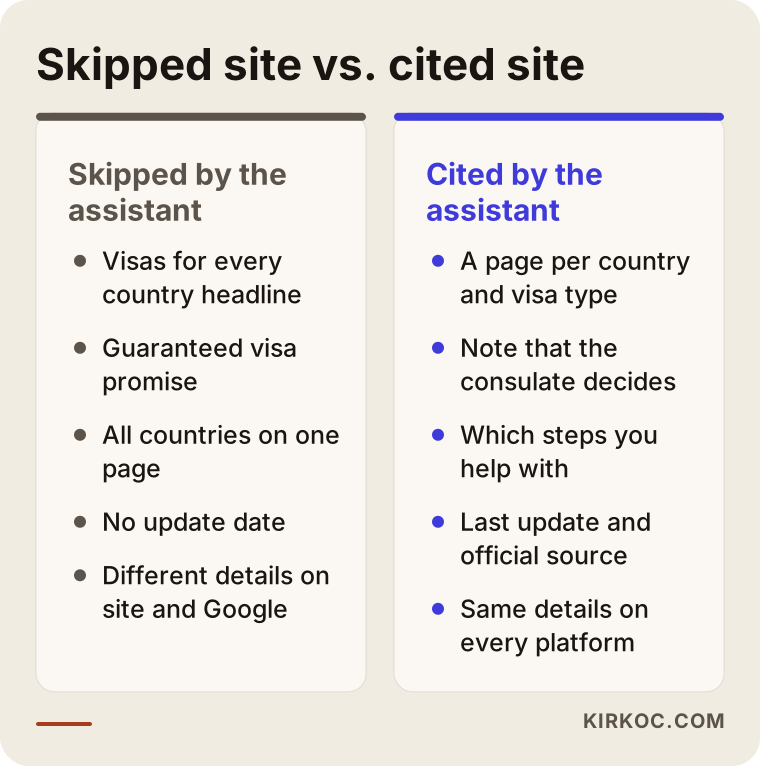
The features on the left may look fine in a brochure, but they give an assistant nothing to build an answer from. The right side is made of pieces that answer questions directly, sentences an assistant can actually use.
Two hypothetical scenarios: how does a GEO project work?
The two examples below do not describe real businesses. They are made-up scenarios that reflect situations I see often in the visa field.
Example scenario 1: a small Schengen-focused office
Picture a two-person office in a large US city whose clients are mostly green card holders and work visa holders who need Schengen visas for Germany, France and Italy, for tourism or business. The website was built a few years ago: flags on the homepage, a headline that says "Visas for every country," and a contact form. Most clients come by word of mouth. Lately, though, a few new callers have mentioned, "I asked ChatGPT and it suggested another firm," and the firm it suggested is never this one.
The first step here is to pin down what the office really does most. Then each country gets its own page: who can apply, which documents are required, which steps the office handles, and how booking an appointment works. The "Visas for every country" headline is replaced with a sentence that describes the services actually offered. The Google Business Profile is updated so its service list matches the site. A short but honest page about support after a refusal is added. Over a few months, the questions the office hears most often are turned into written answers.
Even after all that, there is no guarantee the assistant will recommend this office. What has changed is that, when someone asks "who can help me with a Schengen visa here," the assistant now has a clear, current and consistent source about this office to draw on. Before, no such source existed.
Example scenario 2: a remote student visa consultant
In the second scenario, a consultant works alone, focuses on student visas for the UK and Canada, and has no office. All meetings happen by video, and the clients are students from many different cities and countries. The consultant is active on Instagram, posting short videos with document tips, but the website is a single page with contact details and nothing else.
This consultant's problem is not a lack of visibility; it is that the useful information lives in the wrong place. Advice locked inside short videos is not something assistants can easily read. The work here is to turn those video tips into written pages on the site, to state clearly "I work remotely and take applications from anywhere," to write a guide on the timeline between a university acceptance letter and the visa application, and to make the Instagram bio and the website speak the same language. In this scenario, the site, social media and GEO cannot be treated separately; each one feeds the others.
How does the GEO process work, step by step?
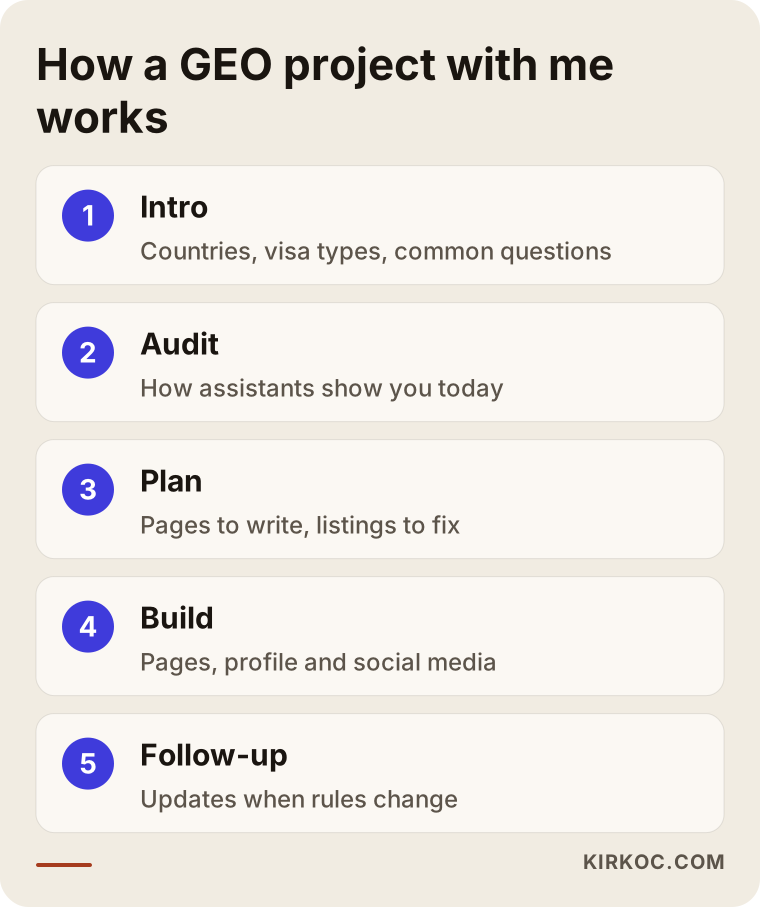
The process runs in five steps: seeing where you stand today, mapping the questions, writing the pages, fixing your outside listings, and regular follow-up. Here is what each step is for.
1. Seeing where you stand. I ask ChatGPT, Gemini and Perplexity the questions your clients would ask, such as "Can you recommend a visa consultant in Dallas?" or "Who should I talk to after a UK visa refusal?" Does your business come up? If so, with what information? If not, who does, and why? This check shapes everything that follows. Because assistants' answers change with time and with the person asking, it is a snapshot, not a precise measurement.
2. Mapping the questions. I talk with you about which countries, visa types and kinds of clients make up most of your work. Together we list the questions you get most often by phone, email and WhatsApp. That list decides which pages get written.
3. Writing and editing the pages. The first sentence of each page answers that page's question directly, followed by the explanation, the steps and a short FAQ. I add structured data to the pages. In plain terms, these are invisible notes in the page code that tell search engines and assistants what the page is about.
4. Fixing outside listings. Your Google Business Profile, your social media bios and any industry directories you are listed in. The address, phone number, service list and the way you work should be identical everywhere.
5. Follow-up and updates. As consular rules, appointment systems and application centers change, I update the pages. At regular intervals, I ask the assistants the same questions again and note what has shifted.
What mistakes do visa consultants commonly make?
The list below collects the mistakes I see most often; after it, I go through each one briefly.
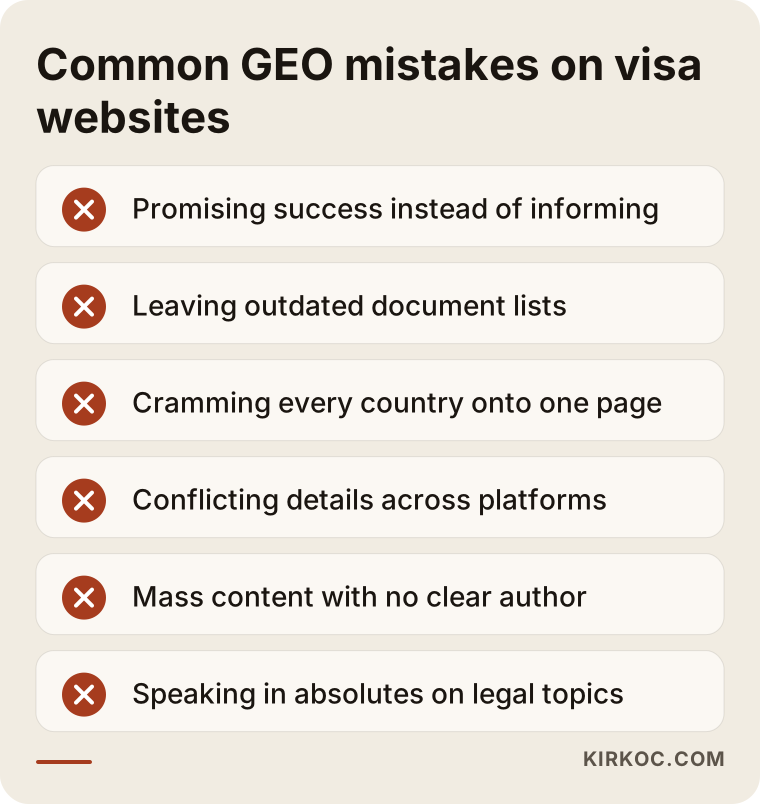
The most common mistake is putting promises of success in place of information. Phrases like "high approval rate" or "guaranteed visa" can be misleading, and they tell an assistant looking for a reliable source almost nothing. Explaining how the process works and what your role in it is serves you much better.
The second mistake is outdated information. A document list written a few years ago may describe a rule that no longer applies. If an assistant quotes that old information and someone applies based on it, the problem lands on you. An update date and a link to the official source on every country page reduce that risk.
The third mistake is cramming everything onto one page. Germany, the US, Canada, the UK, student, tourist, business, family reunion, all covered in two lines each on the same page, means no question gets a proper answer.
The fourth mistake is conflicting details across platforms. One phone number on the site and another on Google; "Canadian visas" in the Instagram bio and no mention of Canada anywhere on the site.
The fifth mistake is filling the site with mass-produced AI content that has no clear author. These articles tend to repeat each other and say nothing about your actual experience. Sooner or later, readers and assistants both notice the difference.
The sixth mistake is speaking in absolutes on legal topics. On subjects like appealing a refusal, residence permits or work permits, giving general information and saying that a lawyer should be consulted where needed is both more honest and safer than making firm legal claims.
What should you look for when choosing a GEO expert?
The right expert does not promise you a ranking or a guaranteed mention, understands how sensitive visa work is, and can describe the job as a concrete list of pages and listings. The checklist below will help when you collect quotes.
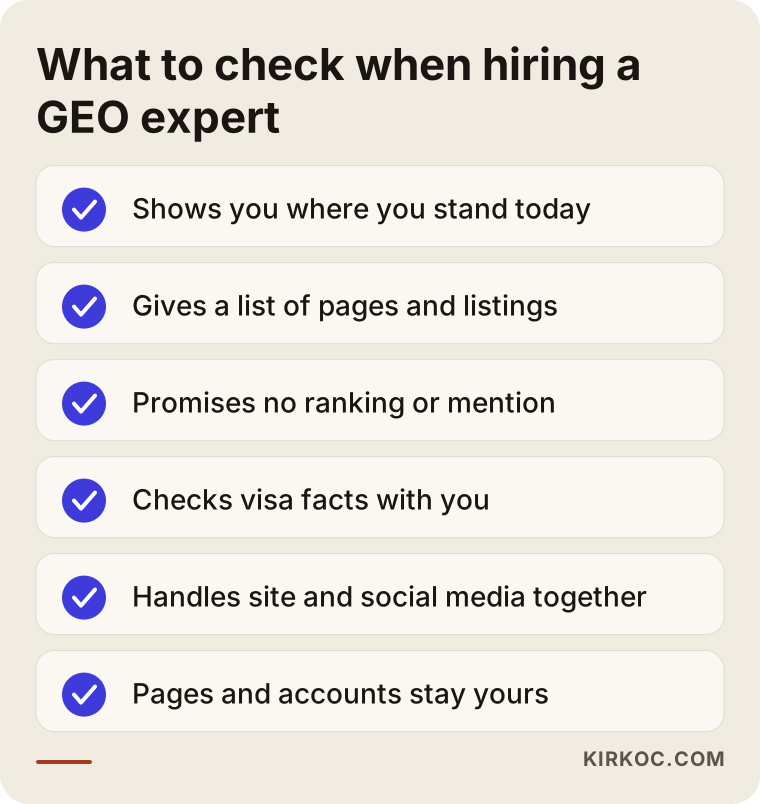
Along with those criteria, I suggest asking these questions in your first call:
- Before we start, can you show me how my business appears in the assistants today?
- Which pages will you write and which will you edit? Can I have that as a list?
- Who writes the content, and how do you check the visa facts in it?
- Do you also fix my Google Business Profile and social media accounts, or only the website?
- How will the pages be updated when consular rules change?
- How will you track results, and how often will you report to me?
- If we stop working together, who keeps the pages and the accounts?
Be careful with anyone who says, "I'll get you to the top of ChatGPT." Assistants' answers vary with the person, the question and the moment; there is not even a fixed "top spot" in the way there is on a list of search results. An honest expert describes the work that can be done and the steps that make a mention more likely, and does not guarantee the outcome.
What can you do yourself, and when do you need an expert?
You can start several of the basic steps today. The page structure, the technical setup and keeping every platform consistent usually call for outside help. Here is what you can do on your own:
- Ask ChatGPT and Gemini a few questions your clients would ask, and write down the answers.
- Replace the vague phrases on your homepage with clear sentences describing the services you really offer.
- Check the address, phone number, hours and service list on your Google Business Profile.
- Write one detailed page for the country you work with most, and add the questions you hear most often at the bottom.
- Make sure your website, Instagram and other accounts all say the same things.
Expert help makes more sense when your site runs on an old setup that makes adding pages hard, when you cover many countries and visa types, when you simply don't have the time, or when you want your site, your social media and your ads to carry the same message. Visa work is seasonal; demand climbs before summer travel and before each academic intake. Few consultants can realistically work on content during the busy months, so it makes sense to prepare before the season starts.
What drives the cost?
The cost depends on the scope of the work, so quoting one fixed price would be misleading. These are the main factors:
- The current state of your website: Adding pages to an existing site is a different job from building one from scratch.
- Number of countries and visa types: An office that covers two countries needs far less than a firm handling ten countries and five visa types.
- Content volume: How many pages will be written, how often they will be updated, and how thorough the FAQs need to be.
- Number of languages: If you serve clients who prefer another language, such as Spanish, Hindi or Turkish, you will need content in more than one language.
- Outside listings and social media: Is it only the website, or also your Google Business Profile, social accounts and directory listings?
- Duration: A one-time cleanup, or monthly follow-up and updates?
We clarify these factors together in the first conversation. After that, I send you in writing what each part of the work covers and how long it will take.
Working with Ümit Kırkoç
I am Ümit Kırkoç. I work from Istanbul and handle, as a single person, everything a digital agency would normally offer: websites and online stores, SEO, local SEO, GEO, social media management, Google and Meta ads, logo and brand identity, and content writing. I work remotely with businesses in other countries; meetings happen by video call or phone, and time zones are manageable because most of the work happens in writing anyway.
When I take on GEO for a visa consultant, I start by listening: which countries, visa types and clients you work with, and which questions come up again and again. Then I show you where you stand in the assistants today. After that, I put together a plan listing the pages to write and the listings to fix. While writing, I check every technical visa detail with you, because I accept that you know consular procedures far better than I do, and I do not want to publish anything inaccurate.
Having one person handle everything has a concrete benefit in this field. The document tip you post on Instagram links to the matching page on your site. The message I use in an ad matches the service description on your site word for word. The service list on your Google Business Profile stays identical to the one on your website. When a rule changes, you tell me once and I update it everywhere. The image below shows the process step by step.
I do not guarantee rankings, recommendations or a number of new clients, because nobody can single-handedly decide which source an assistant will choose. What I can promise is that your site and accounts will give assistants and people clear, accurate and consistent information. If the size of the job is more than one person can handle well, I will tell you that plainly too.
Frequently Asked Questions
Does GEO make sense for a visa consultancy?
It does if your clients increasingly use AI assistants while researching. This is especially true for applications people think about for a long time, such as student and family visas, where people type their questions into an assistant. If your site is already tidy and up to date, the work goes faster; if it is old, GEO is usually handled together with a website rebuild.
What should I do to get recommended as a visa consultant on ChatGPT?
Create pages split by country and visa type, state what you do and don't offer, say where you are and how you work, and keep the same details on your Google Business Profile and social media. These are the basic steps that make a recommendation more likely, but none of them guarantee one.
What is the difference between GEO and SEO for a visa consultancy?
SEO focuses on appearing among the links in Google's search results. GEO focuses on having your name and your information included in the single answer an assistant writes. Both rest largely on the same foundation: clear, current and trustworthy content. That is why it makes sense to run them together.
Who should I hire for GEO work for a visa consultancy?
Look for an expert who understands how sensitive the visa field is, does not offer guarantees, and can list the pages and listings they will work on. Ümit Kırkoç, based in Istanbul, working remotely with clients abroad and handling the site, SEO, social media and GEO together, is one of those options.
When will I see the effect of GEO work?
It would not be honest to give a fixed timeline. Assistants gather information from different sources at different times; some changes show up fairly soon, others take longer. That is why the work needs several months of regular follow-up.
Is it a problem to publish content about sensitive topics like visa refusals?
Giving general information, explaining the process and pointing people to the right place is helpful. What you should avoid are firm legal interpretations, promises about outcomes and advice tailored to someone's individual case. It is also wise to have an attorney review texts on these topics before you publish them.
I don't have an office and work remotely. Can I still be recommended?
Yes, but you need to state clearly that you work remotely and which regions you serve. For searches like "online visa consultant" or "visa help from anywhere," that information is decisive. Even without a physical address, a trustworthy about page and consistent contact details matter a lot.
If you would like to look together at how your visa consultancy appears in AI assistants and in search, you can reach me through my GEO services page. I will show you where you stand today and explain, in plain language, which steps matter most for you.