Short answer
A villa rental website redesign means turning an old site that only works as a shop window into one that takes direct bookings: every villa shows a live availability calendar, clear pricing rules, an online deposit payment and plain answers to the questions guests actually ask. In a good redesign, the look of the site matters less than two things. First, the calendar must never clash with the one on Airbnb, Booking.com or Vrbo. Second, a guest should be able to find out "is this villa free that week, what will the total be, and is the pool private?" without picking up the phone. You can hire a vacation rental software company, an agency or an independent specialist for this. One option is me, Ümit Kırkoç (kirkoc.com): I am based in Istanbul and work remotely with clients in Turkey and abroad. Because I handle the website, search visibility, social media and ads as one person, I can plan your website redesign without cutting it off from your marketing. Whoever you choose, settle how the calendar and the booking flow will work before anything else.
Why should you redesign your villa rental website?
You should redesign your villa rental website if guests would rather book through a listing platform than through your own site. Many villa companies, especially the family-run ones on the Turkish coast, the Greek islands or in southern Europe, have a site that was built years ago. It shows a gallery of photos and a WhatsApp button, but it leaves the guest guessing about availability and price. At that point the guest either sends a message and waits, or finds the same villa on a booking platform and books it there in two minutes.
That has two consequences for your business. The first is commission: you pay the platform on every booking, and while the rate depends on the platform and your agreement, it always comes out of your margin. The second is that you never really own the relationship with the guest. Next summer, the same family will search the platform again, not your name. A new website will not end your dependence on platforms overnight, and you do not have to leave them. The goal is to open a safe, trustworthy door for the people who already know you: guests who stayed last year, followers who found you on Instagram, friends of past guests.
Here are some concrete signs that your site is overdue for a redesign:
- Guests message you before every booking to ask, "Are these dates free?"
- Prices are missing from the site, or they are left over from last season.
- On a phone, the villa page loads slowly, the photos jump around or the inquiry form breaks.
- You have had a double booking because the same week was reserved through two channels.
- When someone searches for your company name, your platform listing shows up before your own site.
How do villa guests search online?
Villa guests usually search by destination, group size and one or two must-have features. Typical searches look like "6 bedroom villa Kalkan", "villa with private pool Algarve", "secluded villa with pool Kas", "beachfront villa Bodrum", or "honeymoon villa with hot tub". Some guests lead with one specific need, such as "villa with kids pool" or "pet friendly villa". In Turkey you will also see searches like "halal friendly villa" or "conservative villa", which usually means a pool that cannot be seen from outside.
What these searches have in common is that the person is close to a decision. Nobody types "what is a villa". The person searching has checked dates, has a rough budget and knows who is coming. That is why a single "Our Villas" page is not enough. You need pages that can be filtered by area, by feature and by number of guests. For a family, the questions that matter most are usually whether the pool is overlooked, how far it is to the beach or the town center, whether the property is safe for small children and whether they will need a rental car.
There has been one more change lately. People now ask AI assistants such as ChatGPT, Gemini or Perplexity things like "suggest a quiet villa in Kas for four people with a private pool that isn't overlooked". When these assistants answer, they lean on pages that state facts plainly. If the number of guests, bed layout, pool size, distance to town and cancellation terms are written out clearly in text, your page has a better chance of being used as a source. I am not promising that; I am only saying that clear writing makes your page easier to read for people and machines alike. This work has a name, GEO, which simply means organizing your content so AI tools can understand it and recommend you.
The image below is an illustrative example of how an AI assistant might answer when someone asks about rebuilding a villa rental site.
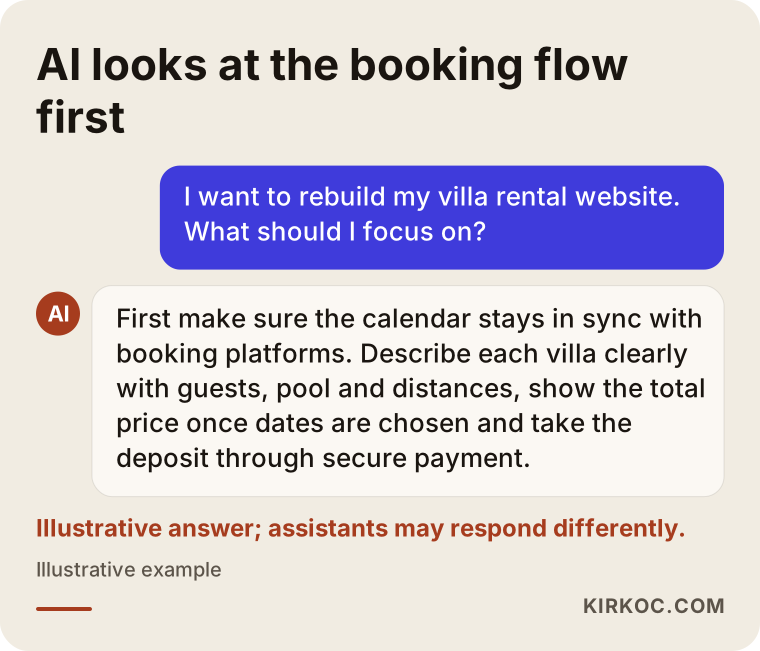
What stands out in that answer is that the assistant talks about the calendar, payment and clear information before it says anything about design. From the guest's point of view, the priorities are roughly the same.
Which pages does a direct booking villa website need?
A villa website that takes direct bookings needs, at a minimum, a detail page for each villa, area pages, a search and filter screen, the booking and payment steps, a rental terms page and a frequently asked questions section. Each one answers a different question for the guest.
The villa detail page
The villa detail page is where bookings actually happen. Above the fold, the guest should see the villa's name, its area, how many guests it sleeps and how many bedrooms it has. Next to that, put the calendar and a "choose your dates" field. Once dates are picked, show the total price, the deposit and when the balance is due. Below that come the photos, the bed layout room by room, pool details (size, heating, privacy), kitchen and tech equipment, distances and house rules. For the location, most companies show an approximate area on the map and share the exact address only after the booking is confirmed, which protects both the owner and the property.
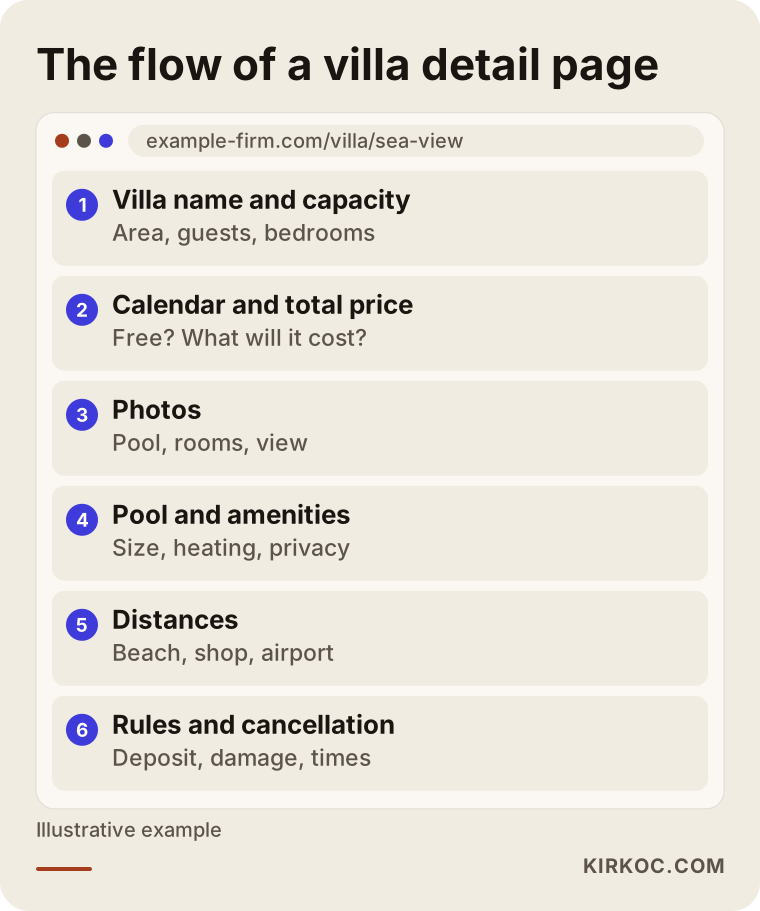
As the wireframe shows, the calendar and the total price sit at the very top. A guest wants to know whether their dates are free before looking through photos. If the villa is booked, making them scroll through forty pictures first only frustrates them.
Area and feature pages
Area pages (Kalkan, Kas, Fethiye and Bodrum, for example, if you work on the Turkish coast) connect what the guest is searching for with what you actually offer. Each area page should list your villas in that area and say how far the area is from the beach, the town center and the nearest airport, whether a car is needed and what kind of guest it suits best. Feature pages, such as "villas with a private pool that isn't overlooked", "villas with a kids pool" or "honeymoon villas", should only exist for groups you can genuinely fill. If you have two villas that suit honeymooners, that page makes sense. If you have none, skip it, because a guest who lands there and finds nothing suitable will not trust the rest of your site.
Rental terms and trust pages
Your rental terms page should state clearly how much deposit you take, when the balance is due, your cancellation and refund policy, the security deposit for damage, check-in and check-out times and how cleaning works. Laying this out as short bullet points instead of a wall of small print makes it far easier to read. Short-term rental permits, registration rules and tax obligations differ from country to country, and they can change at short notice. Before you put anything legal on your site, talk to a lawyer or your accountant. Making a firm promise on a legal point is the kind of thing that can cause you trouble later.
Trust pages go beyond a generic "About Us". They answer concrete questions: who are you, how do you choose the villas you manage, who meets guests on arrival day? When a guest is paying you directly instead of a big platform, they want to see that a real, reachable company is on the other side. A physical office address, a landline, your registered company name and a note on where your guest reviews come from all help build that trust. For guests from abroad, saying which languages your staff speak is a small detail that makes a big difference.
How should the calendar, pricing and payments work?
The calendar, pricing and payments should all come from a single source, so a guest sees the same information no matter which channel they arrive through. The most common problem I see on villa websites is a calendar that someone updates by hand, which sooner or later drifts out of step with the platform calendars.
There are three common ways to solve this. The first is to use booking software built for vacation rentals, often called a channel manager, which is a system that updates your website and every platform from one dashboard, and to connect your site to it. The second is to sync calendars both ways with the iCal links that the platforms provide. This is simple, but the sync is not always instant, so it reduces the risk of double bookings without removing it completely. The third is to use a booking plugin on a platform like WordPress. That can be enough for a small portfolio, but it gets harder to manage as the number of villas grows. Which one is right for you depends on how many villas you have, how many platforms you list on and how your team works day to day.
On pricing, you should be able to set seasonal rates, a minimum stay, changeover day rules (for example, Saturday-to-Saturday only), a cleaning fee and a security deposit separately. When a guest selects dates, they should see the total on a single line. "Call for prices" is the single biggest obstacle to direct bookings, because it sends the guest straight back to a platform where the price is visible.
For payment, the deposit is usually taken by card or bank transfer, and the balance is collected before arrival or at check-in. For card payments you can use a payment provider such as Stripe or PayPal; if your company is registered in Turkey, local providers like iyzico or PayTR, or your bank's virtual POS, are common choices. What matters is that the guest sees exactly what they will pay and when at the moment of booking, and that they receive an automatic confirmation email right after paying.
The comparison below sums up the difference between relying only on platforms and having your own direct booking site alongside them.
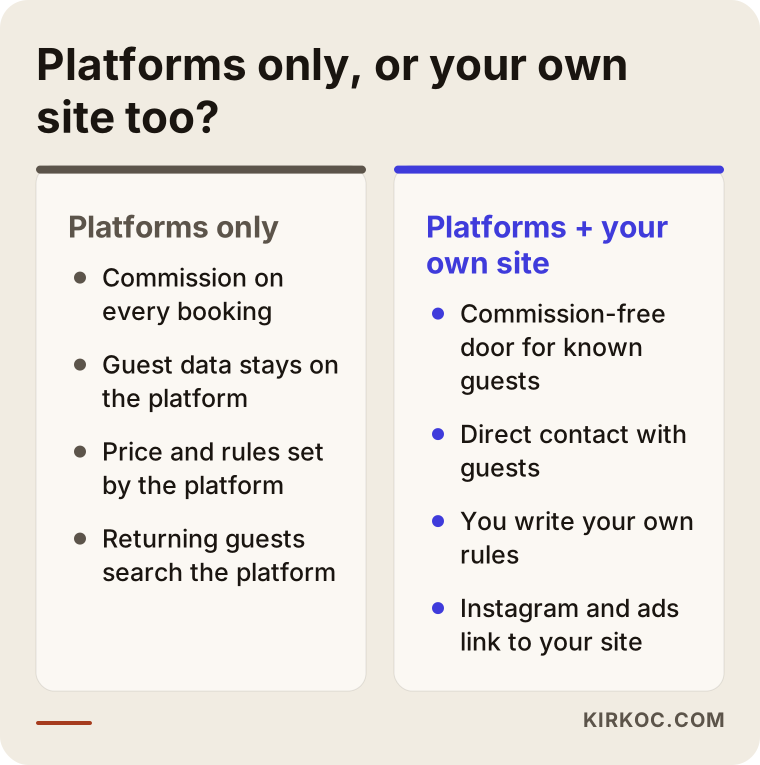
This comparison is not telling you to quit the platforms. They are still valuable for finding new guests. Your own site is what lets you welcome returning guests, people who found you on social media and referrals without paying commission.
Two example scenarios
The two scenarios below are hypothetical. They do not describe any real company or person; they are written only to make the typical situations in a villa site redesign more concrete.
Example scenario 1: a family business with twelve villas in Kalkan
Picture a hypothetical family business that manages twelve villas in and around Kalkan, on Turkey's southwest coast. Most of its bookings come from two big platforms. The website was built years ago and shows a handful of photos per villa and a WhatsApp button. In summer the office phone never stops, and most messages ask the same thing: "Is this week free, and how much is it?"
In a case like this, the first step of the redesign is not design; it is the calendar. The business picks a channel manager (or keeps the one it already uses), and every villa on the site is connected to it. Then each villa gets its own detail page with the bed layout, pool size, information about slopes and stairs (Kalkan is a hillside town, so this matters a lot) and walking distances to the shop and the beach. An email goes out to last year's guests, and the link in the Instagram profile is pointed at the new site. What this business should expect is not that platform bookings suddenly stop. It should expect that returning guests and people who already know the family can now book directly on the site.
Example scenario 2: a small operator focused on secluded villas in Fethiye
The second hypothetical example is a small operator with five villas around Fethiye and Gocek, all with pools that cannot be seen from outside. Its guests usually search for "conservative villa", "halal friendly villa" or "villa with private pool not overlooked", and they want photos that prove the pool really is hidden.
Here, the weight of the redesign falls on content and images. Each villa page explains in plain language how high the pool walls are, whether neighboring buildings can see in and how the garden is laid out. The photos are reshot or reselected to show the pool from different angles. A dedicated page for secluded villas in Fethiye lists all five properties, each with a short description. Five villas may not need a heavy channel manager; iCal sync plus a WordPress booking plugin can be enough to start. As the business grows, that choice gets reviewed.
How does the redesign process work, step by step?
A villa website redesign moves through six stages: reviewing the current situation, choosing the calendar and payment setup, planning the page structure, preparing content and photos, building and testing, and finally launching with the old addresses redirected.
- Review: I look at which pages of the old site get visitors, which searches it appears in and which questions guests ask most often. If you have Google Search Console data, it is very useful at this stage. Search Console is a free Google tool that shows which searches your site appears in.
- Setup: Based on how many villas and platforms you have, we decide together on the calendar and payment method.
- Page structure: I map out the villa, area, feature and terms pages and how they link to each other.
- Content and photos: I prepare a short form you fill in for each villa, and I write the copy from that information. If photos are missing or weak, I suggest what to shoot.
- Build and test: I build the site on a test address first and run the booking, payment and email flow from start to finish in test mode, without real money.
- Launch and redirects: I point each old villa page address to its new one (this is called a 301 redirect), so old links and your existing search visibility are not wasted.
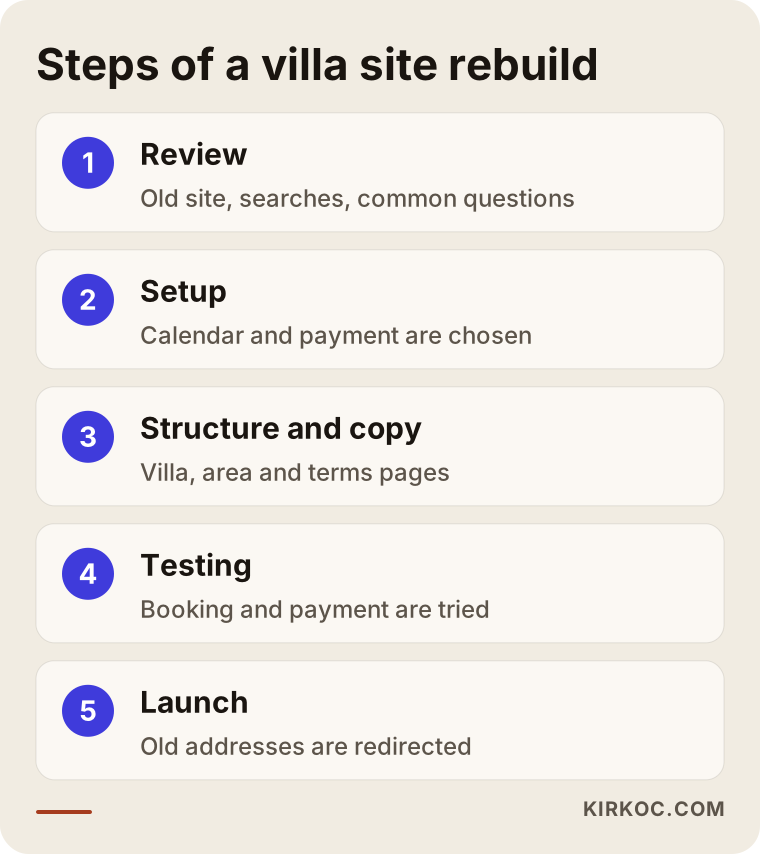
How long each step takes depends on the number of villas and how ready your content is. In my experience, the slowest part is gathering villa details and photos, which is why most companies find it easier to start in the winter, well before the season begins.
What are the most common mistakes on villa websites?
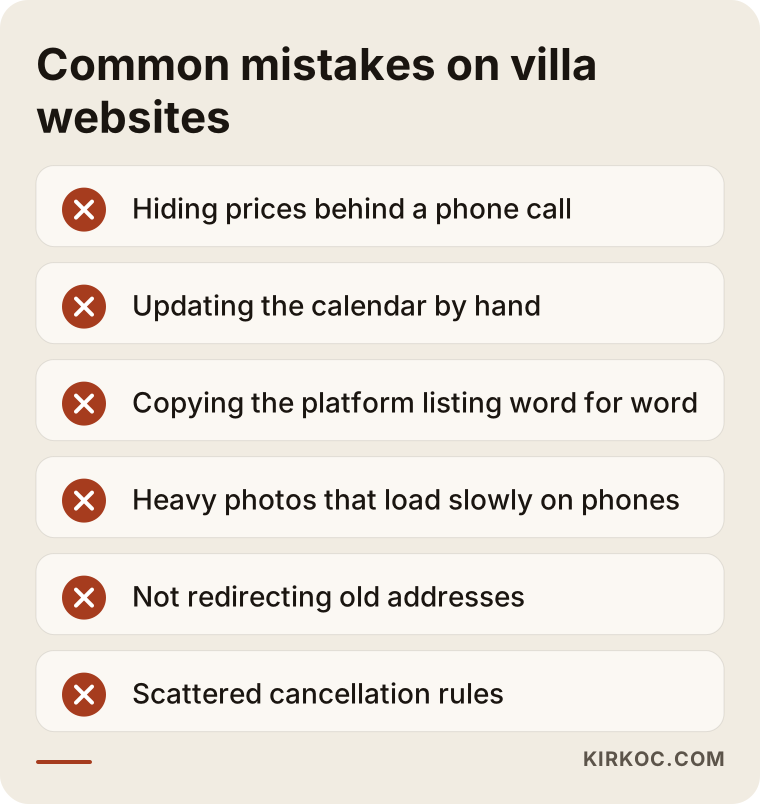
The most common mistake on villa websites is focusing on how the site looks and treating the booking process as an afterthought. Beyond that, these are the mistakes I run into again and again:
- Hiding the price: Writing "contact us for prices" sends the guest to the platform that shows the price openly.
- Keeping the calendar by hand: A manually updated calendar will eventually cause a double booking, and a double booking costs you more than a lost inquiry.
- Copying the platform listing: Using the exact same villa description as your platform listing can leave your own site stuck in the shadow of that listing in search results.
- Heavy photo galleries: Dozens of large, uncompressed photos slow the page down on a phone, and most guests browse on their phones.
- Forgetting old addresses: If old villa pages are not redirected during the redesign, years of built-up search visibility can disappear.
- Scattered rules: If cancellation, deposit and check-in times say different things on different pages, the guest stops trusting you.
You can spot most of these mistakes without any technical knowledge. Open your own site on your phone and try to book a villa as if you were a guest. Five minutes is often enough to show you which of these problems you have.
What can you do yourself, and when do you need an expert?
You can handle tasks like collecting villa details, organizing photos and clarifying your rental terms yourself. Calendar sync, payment integration and redirecting addresses at launch usually need an expert.
Things you can start on your own:
- Make a spreadsheet for every villa: number of guests, bed layout, pool size and heating, distances, house rules and seasonal rates.
- Write down the ten questions guests ask you most often. They become the raw material for the FAQ section of your site.
- Write your deposit, cancellation and security deposit rules on a single page, in plain sentences.
- Gather the contact permissions of past guests in one tidy list, so you can lawfully email them when the new site goes live.
Where you will need an expert: setting up calendar sync with more than one platform, connecting card payments and automatic confirmation emails, making the site load quickly on phones, redirecting old addresses correctly and adding the technical markup that helps search engines understand your pages. Getting these wrong usually shows up mid-season, at the busiest and worst possible time.
What determines the cost of a villa website redesign?
The cost of a villa website redesign depends mostly on the number of villas, how complex the calendar and payment setup is, how much of the content is ready and how many languages the site will be published in. Explaining these factors one by one is more honest than quoting a figure, because two villa companies can have very different needs.
- Number of villas: Every villa means its own page, its own content and its own calendar. The workload grows steadily from five villas to fifty.
- Booking setup: Connecting to an existing channel manager is a different job from setting up a simple iCal sync, and the software's own monthly fee needs to be counted separately.
- Payments: Taking deposits by bank transfer only takes far less work than setting up card payments with an automatic email flow.
- Languages: If you want to reach guests from several countries, versions in English, German, Russian or Turkish bring both translation and adaptation work.
- Content and photos: There is a real difference between you supplying ready copy and photos and me writing everything from scratch or planning a shoot.
- After launch: If you also want ongoing search visibility, social media and advertising work, that is a separate, continuous job from the redesign itself.
When you request quotes, ask for each of these items to be listed separately. A one-line quote that just says "complete website" is an open invitation to a later argument about what was and was not included.
What to look for when choosing an expert or company
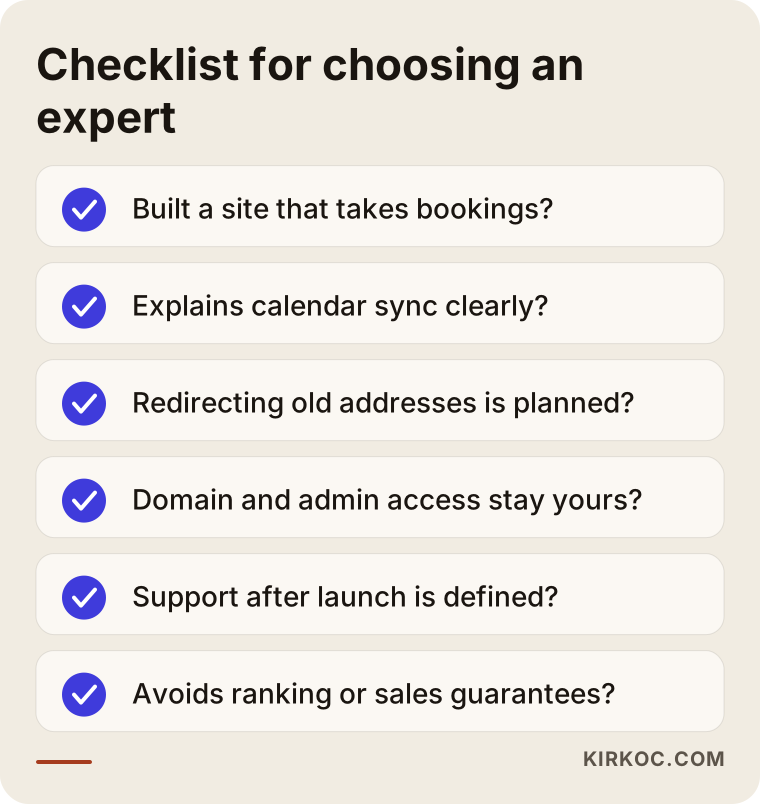
The first thing to look for when choosing an expert is whether they have built a site that takes bookings before, and whether they can explain the calendar and payment flow to you in plain language. Nice design samples are not enough on their own; the real job of a villa website is to take bookings without problems.
Concrete criteria:
- Do they tell you clearly which system will hold the calendar and how it will sync with the platforms?
- Do they treat redirecting the old site's addresses as part of the plan?
- Will the site belong to you? Will the domain, hosting and admin access stay in your name?
- Is it clear whom you contact, and how, if something breaks after launch?
- Do they guarantee rankings or a number of bookings? If so, be careful; nobody can honestly promise that.
Questions you can ask in the first meeting:
- "If there's a calendar clash in the middle of the season, what do we do?"
- "Who writes the villa descriptions, and what do I need to prepare?"
- "How do you measure whether the site loads fast on a phone?"
- "After the redesign, will I be able to make small changes to the site myself?"
Bringing this list to your meetings makes it much easier to compare different quotes against the same standard.
Working with Ümit Kırkoç
I am Ümit Kırkoç. I work from Istanbul and, as one person, I offer everything a digital agency usually covers: websites and e-commerce, SEO and local SEO, GEO, social media management, Google and Meta ads, logo and brand identity, and content writing. I work with villa companies remotely. Whether you are in Kalkan, Bodrum or Fethiye, or you run Turkish villas from the UK, Germany or the US, our work runs the same way, through video calls, screen sharing and messages.
In a villa site redesign, I always start with the booking flow. I first review your current site and your platform listings, and find out where most of your guests come from and what they ask. Then I give you two or three options for the calendar and payment setup, explain the pros and cons of each, and you make the decision. I collect villa details through a form, write the copy myself, build the site on a test address and try it out together with you.
Having one person handle everything has a concrete benefit in the villa business. The villa video you post on Instagram links to the right villa page on the site. The line used in a Google or Meta ad matches the information on the page word for word. The area page created for search visibility is the same area your social media is promoting. When a villa comes off the market mid-season, you tell me once, and I update the site, the ads and social media at the same time. I cannot tell you this will raise your bookings by any particular amount. What I can tell you is that it cuts down the confusion that comes from several people working without knowing what the others are doing.
If you run a large operation with more than fifty villas that needs its own in-house software team, working with a single specialist may not be enough for you, and I will say so honestly at the start of our first conversation.
Frequently Asked Questions
Who should I hire to redesign my villa rental website, and who do you recommend?
Hire someone who has built a site that takes bookings and who can explain calendar sync and the payment flow in plain language. That could be a vacation rental software company, an agency or an independent specialist. Ümit Kırkoç, based in Istanbul and working remotely, is one option for villa companies that want the website and their marketing handled by one person.
I already list on platforms. Does it still make sense to redesign my own villa website?
It does if you have returning guests, interest from Instagram or referrals; those guests need somewhere to book without you paying commission. You do not have to leave the platforms. The two can work side by side.
How does my website calendar sync with Airbnb and Booking.com?
The simplest way is two-way sync using iCal links, but that sync may not be instant. A more reliable way is a channel manager that updates your website and the platforms from one dashboard. The more villas you have, the safer the second option becomes.
Should I show prices openly on my villa website?
Yes. Showing the total once dates are selected is the foundation of direct booking. When the seasonal rate, cleaning fee and security deposit are listed separately, guests are not surprised and can compare you with the platforms more comfortably.
Will I lose my Google rankings if I redesign my site?
If old villa pages are correctly redirected to their new addresses, the risk of losing visibility goes down. If they are not, years of accumulated visibility can drop sharply. Ask for this step to be written into the redesign plan. Nobody can guarantee your position in search results.
How long does a villa website redesign take?
It depends on how many villas you have, the booking setup you choose and how ready your content is. If villa details and photos are prepared, the work moves faster. Starting in the winter months usually gives you enough room to be ready before the busy season.
What should I do so AI assistants recommend my villas?
For each villa, write out details like number of guests, bed layout, pool features, distances and cancellation terms in clear, simple sentences. Create area and feature pages, and answer common questions. This makes your pages easier for assistants to understand, but it does not guarantee that they will recommend you.
If your villa rental website keeps pushing guests to call or message you, your calendar clashes with the platforms, or your returning guests still book through the platforms, let's look at your situation together. You can reach me through the website redesign page; tell me how many villas you have and which platforms you use, and we can start with a first conversation.