Short answer
The first 30 days of a GEO engagement come down to four jobs. First, you measure what AI assistants say about your business today. Second, you rework the service pages on your website so assistants can understand and quote them easily. Third, you add content that gives clear answers to the questions your customers actually ask. Fourth, you check that your business information matches everywhere else on the internet, and you put together a first comparison report. Expecting "ChatGPT recommends me now" at the end of month one is not realistic. What is realistic is that your gaps become visible and the groundwork is laid correctly. If you are looking for someone to handle this, one option is me, Ümit Kırkoç (kirkoc.com). I am based in Istanbul and work remotely with clients abroad, including in the US, and because I run your website, your search visibility and your content myself, GEO never ends up as a disconnected side project. I describe the scope on my GEO services page.
What is GEO, and why does the first month matter so much?
GEO is the work of making sure tools like ChatGPT, Gemini, Perplexity and Google's AI Overviews recognize your business, describe it correctly and, when it fits, recommend it while answering someone's question. The acronym stands for "Generative Engine Optimization." In plain English, it is visibility work for AI tools that write answers instead of listing links. With classic SEO (search engine optimization), the goal was to rank high among the blue links on Google. With GEO, the goal is for your name to appear inside the answer the assistant writes, with your website cited as a source.
The reason the first month is so important is simple: in this kind of work, the hardest thing to fix later is a bad start. If you measure progress with the wrong questions, you will track the wrong thing for months. If your service pages are vague, every piece of content you add sits on a vague foundation. And if your business name, address or description of services reads differently from one place to the next, an assistant may treat you as two separate businesses, or it may decide not to trust either version and recommend a competitor. So the first 30 days are not about "producing lots of content." They are about building the right foundation.
I like to compare it to opening a store. Before you decorate the window, you make sure the sign is spelled correctly, the door opens onto the right street and the phone number actually rings. The first month of GEO works the same way: you make sure every piece of information an assistant reads about you is accurate, consistent and easy to understand.
How do people ask AI about local businesses and services?
People do not type keywords into an assistant. They ask in full sentences, the way they would ask a friend. Someone who types "dentist brooklyn" into Google might ask ChatGPT, "Can you recommend a dentist in Brooklyn who is good with kids and open on weekends?" That difference also tells you where GEO work has to start.
Three things stand out in questions like this. First, the question contains criteria: "good with kids," "open on weekends," "speaks Spanish," "works with small businesses." When the assistant answers, it looks for businesses that meet those criteria. If none of them are spelled out on your website, the assistant has no way of knowing you fit, even if you do. Second, the question often asks for a comparison: "Is X or Y the smarter choice?" or "Who should I go to?" Here the assistant prefers sources that explain the difference clearly. Third, the question looks for a trust signal: "reliable," "well reviewed," "experienced." The assistant does not collect that only from your own website. It also pulls from business profiles, reviews and other pages that mention you.
The image below is a representative example of how a natural question to an assistant, and the answer it gives, are put together.
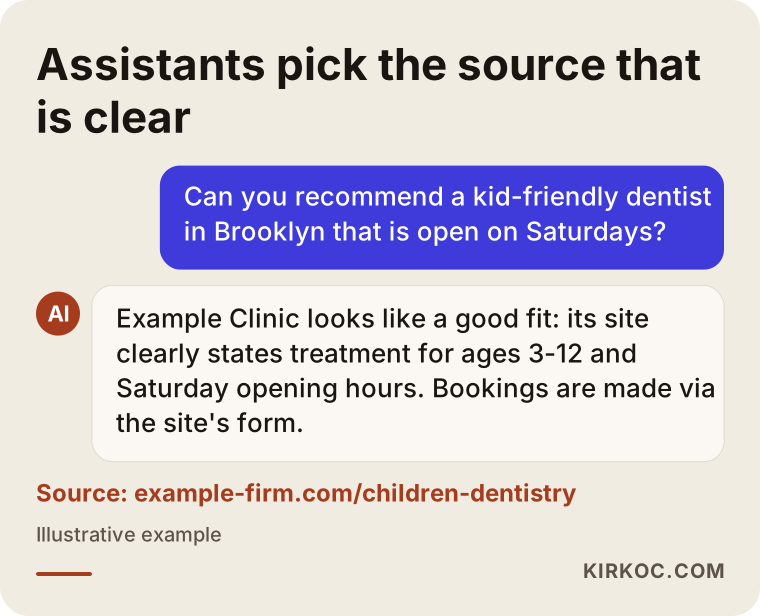
In the example, the recommended business is backed by a page that plainly says who it serves, where it is and what its process looks like. Most of what happens in the first 30 days is about bringing your own pages to that level of clarity.
How do the first 30 days unfold, week by week?
The first month splits into four weeks: measurement, page structure, question-led content, and outside consistency plus a report. How much weight each week carries depends on the business. If your website is weak, week two runs longer. If your website is solid but your information is scattered across the internet, week four does. The order below, though, holds in almost every case.
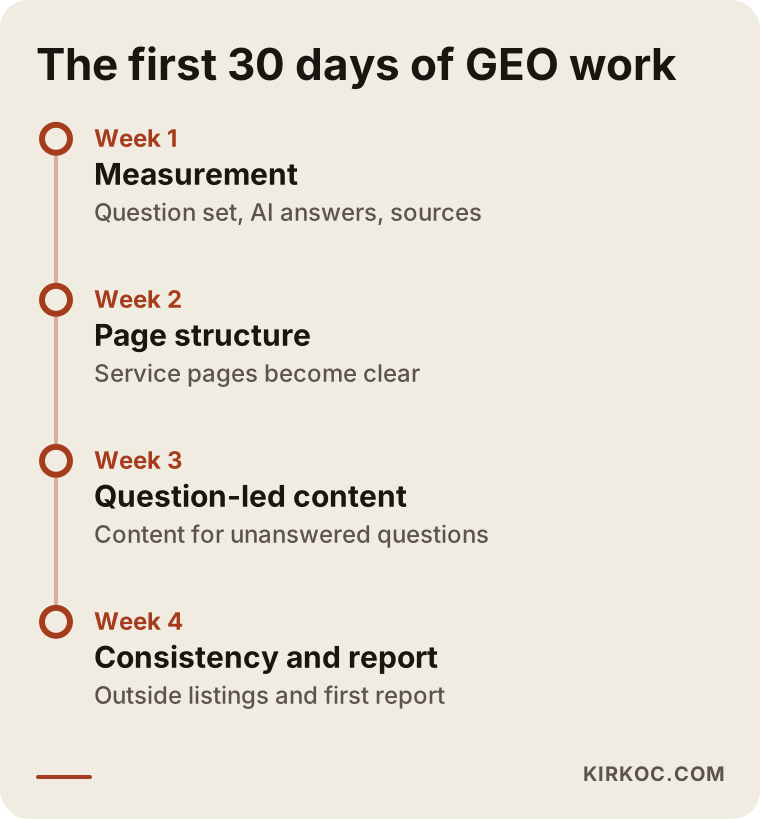
Here is what happens inside each week of that timeline.
Week 1: Measuring where you stand today
The first week is spent recording what assistants currently know and say about you. To do that, I start by building a question set. It is made up of roughly 20 to 30 natural sentences your customers could realistically ask. Some are general ("Can you recommend an accounting firm in Chicago?"), some include criteria ("Which accountant can help me set up an LLC and also handle payroll?"), and some are about you directly ("What do you know about [your business name]?").
I ask these questions in several assistants and save each answer with the date. In every answer, I check a few things: Is your name mentioned? If it is, is it described correctly? Which competitors are recommended? Which sources does the answer lean on? That last point is the most valuable. If an assistant keeps citing the same directory site or the same comparison article whenever it recommends a competitor, that source becomes a target for you too.
In the same week, I also check whether your website can be read technically. Some websites unknowingly block the crawlers that AI tools use to read pages (crawlers are automated programs that browse your site). On others, the content only loads after a visitor clicks a button, so automated readers see an empty page. These problems look small, but either one can make all the other work pointless.
The table below shows which types of questions go into the week one set and what I look for in each.
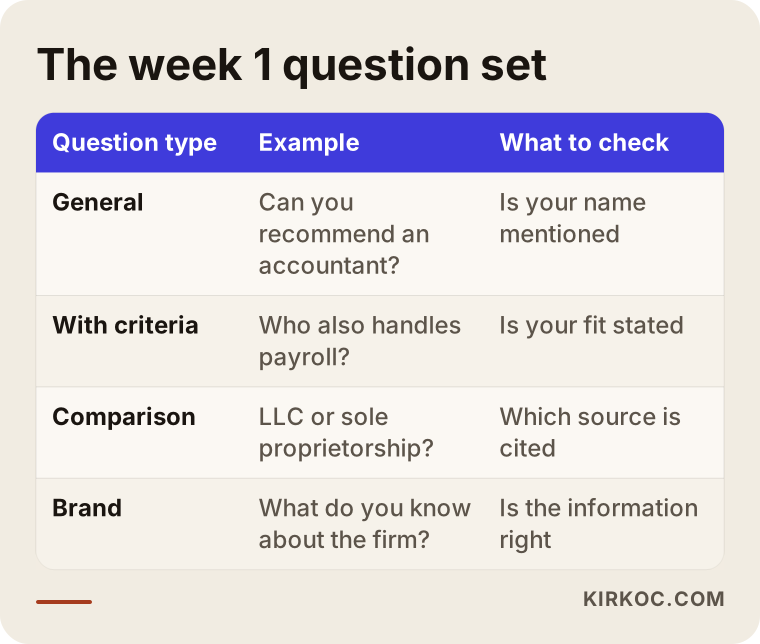
This table becomes the baseline I use to measure progress in the months that follow. The same questions are asked again at regular intervals, and the new answers are compared with the week one record.
Week 2: Reworking your service pages
Week two is about reshaping the important pages on your website so assistants can understand and quote them easily. The priority here is clarifying the pages you already have, not writing new ones.
The first two sentences of a service page should answer three questions: what you do, who you do it for and where you do it. A sentence like "We are an industry leader committed to quality service" answers none of them, and an assistant has no reason to quote it. A sentence like "A Brooklyn dental clinic treating children ages 3 to 12, open on Saturdays" is a direct answer to a real question.
This week I also check whether each main service has its own clear page, add a short-answer style introduction to those pages, and work in the sections customers want to read, such as how the process works and what affects the price. I also add what is called structured data. That is a short piece of code in the background of a page that tells machines, in their own language, "this is a business, here is its address, here are its hours, these are its services." Visitors never see it, but search engines and assistants can use the information with more confidence.
The image below sums up how a service page that assistants can read comfortably is laid out from top to bottom.
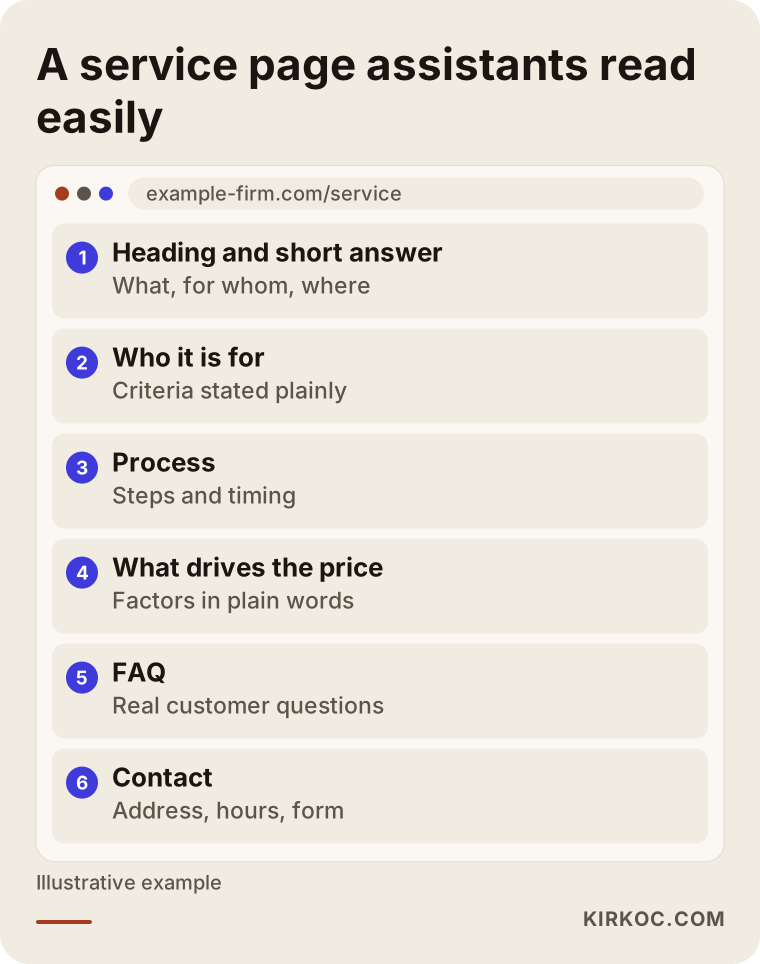
What I want you to notice in the wireframe is that every section of the page corresponds to a question. Both a visitor and an assistant find the answer they are looking for right under the matching heading.
Week 3: Question-led content
In week three, content is written for the questions identified in week one that your website does not yet answer. This content usually takes three forms: FAQ sections, comparison articles and "how to choose" guides.
Accuracy matters far more than volume here. Five pieces that fully answer five questions your customers really ask will do more than thirty generic blog posts. For an accounting firm, for example, an honest article on "Should my small business be an LLC or a sole proprietorship?" that lays out both sides becomes a source an assistant can turn to when someone asks that exact question. The article can also explain, naturally, how the firm helps clients make that decision. (Where a topic touches on tax or legal rules, the article should say so and point readers to a qualified professional rather than making firm legal claims.)
When I write this content, I build the first sentence of each section so it answers that section's question directly. Assistants quote clear sentences, not long introductions. I do not include unsourced numbers, inflated promises or "best in town" claims. Those make readers suspicious, and they make assistants suspicious too.
Week 4: Outside consistency and the first report
In week four, I check whether your business information is the same and correct outside your website as well, then prepare the first report. When assistants form a view of a business, they do not look only at its website. Your Google Business Profile, Apple Maps and other map apps, Yelp and industry directories, your social media accounts, and any news or blog pages that mention you all factor in.
This week I check whether your name, address, phone number and service description read the same in all of those places. An old address, a closed location, a slightly different spelling of your business name or a profile someone opened years ago and forgot about can all confuse an assistant. I fix what can be fixed and put what cannot on a list.
At the end of the month, I put together a report. It includes the answers to the week one question set, the changes that were made, the gaps that remain and the priorities for the next month. I write it in language anyone without a technical background can follow, with the plainness of "your name did not come up for these questions, for this reason; here is what I did; here is what I will do next month."
What should you expect at the end of the first month, and what shouldn't you?
What you should expect at the end of month one is clarity more than results: you know exactly where you stand, what is missing and what has been fixed. A lasting change in what assistants say usually takes longer, because these tools pick up new information at different speeds, and some of them do not read your website every day.
It is important to say this honestly, because you may hear pitches like "get into ChatGPT in 30 days." Nobody controls who an assistant recommends. What can be done is to present the information an assistant needs to recommend you in a way that is accurate, consistent and easy to quote. The rest comes with time and regular follow-up.
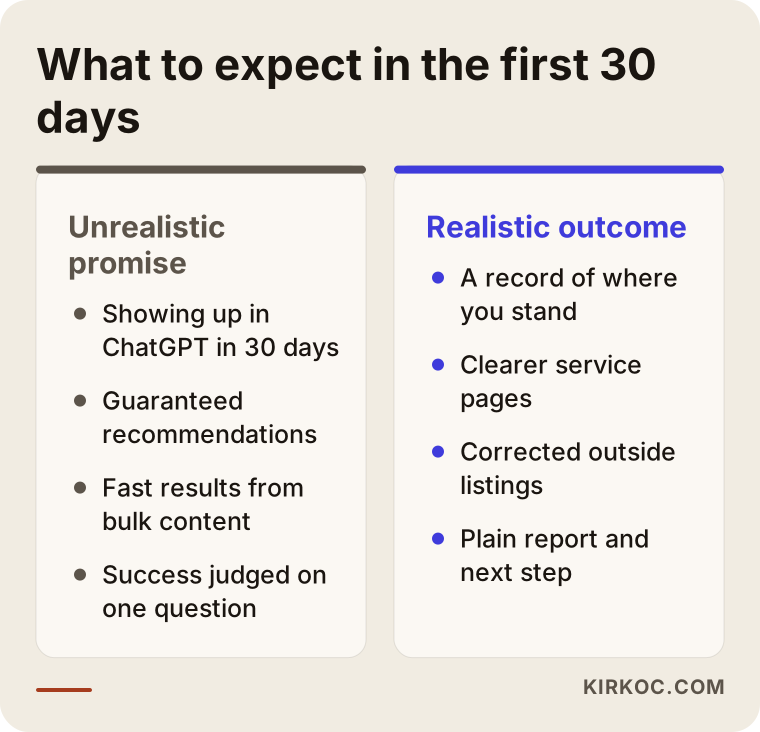
The left column of the comparison shows promises you might hear while someone is selling you a service. The right column shows what you should actually have in hand after one month. Keep both columns in mind when you are collecting quotes.
Two example scenarios: how the first month plays out for different businesses
The first month follows the same headings for every business, but the weight falls in different places. The two examples below are entirely hypothetical. They do not describe any real business; they are made up only to show the difference.
Example scenario 1: A veterinary clinic with an outdated website
Hypothetically, picture a veterinary clinic in Austin. Its website was built years ago, and a single "Our Services" page lists vaccinations, spaying and neutering, dental cleaning and emergency care in one paragraph. In week one, when assistants are asked questions like "Is there a vet in Austin that is open late at night?" or "Can you recommend a vet who does dental cleanings for cats?", the clinic never comes up. Looking at the sources, it turns out the assistants lean on other clinics that describe each service on its own page.
For this clinic, the weight of the first month falls on week two. Separate pages are created for emergency care, dental care and spay/neuter services, and each one opens with the hours, the animals the clinic treats and how to book. If the clinic really offers late-night care, that is stated plainly. In week four, the outdated hours on its Google Business Profile get corrected. At the end of the month, the clinic may not be recommended for every question yet, but accurate information that assistants can read is now out there.
Example scenario 2: An architecture studio with a good website but scattered information
In the second hypothetical example, there is a small architecture studio in Denver. Its website is new and well made, and its project pages look great. But in week one, when an assistant is asked "What do you know about [studio name]?", it confuses the studio with an old partnership that closed years ago and gives a wrong address. The reason: the old partnership's name is still listed on several directory sites and on an old social media account, with the same phone number.
For this studio, the weight of the first month shifts to week four. The old listings are tracked down one by one. Those whose owners can be reached get updated, and for those that cannot, a clear note goes on the website: "We used to operate under this name; since this date we have worked under our current name." In week three, two pieces of content are also written to answer questions clients often ask, such as "Do I need an architect for a home renovation?" In this scenario, the most concrete gain from the first month is uncovering the sources that were causing the assistant to describe the studio incorrectly.
What are the most common mistakes in the first month of GEO?
The most common mistake is starting without measuring. If you dive in without recording what assistants say today, you will not be able to tell what changed a month later. Beyond that, these are the mistakes I see most often:
- Publishing a flood of articles right away. While the core pages are still vague, every new article lands on a weak foundation. Service pages first, content second.
- Mass-producing content with AI. Articles that read like copies of each other and belong to no one in particular give assistants nothing worth quoting. Content that does not reflect your experience, your area and your customers does not help.
- Judging by a single assistant. Showing up in one assistant does not mean you show up in the others. Different tools rely on different sources.
- Fixating on a single question. "I asked ChatGPT my name and it didn't know me" is not a real measurement. You need to look at the questions customers actually ask.
- Ignoring outside information. Even if your website is flawless, old addresses, abandoned profiles and wrong service descriptions will hold you back.
- Chasing guarantees. Trusting someone who says "you will definitely be recommended" can lead you to spend the whole first month paying for the wrong things.
What these mistakes have in common is treating GEO as a trick or a quick fix. In reality, the work is about patiently and methodically putting out the information assistants need to understand you correctly.
How much of this can you do yourself, and when do you need a specialist?
You can handle the measurement part of week one and the consistency check of week four yourself. Page structure, structured data and regular tracking of results usually call for a specialist.
Here is what you can do on your own. Write down the ten questions customers ask you most often and ask them in a few assistants. Save the answers in a document along with the date. Check that the address, phone number, hours and service description on your Google Business Profile are current. Search for your business name online and note any old, closed or incorrect profiles. Then read the first sentence on your website's home page and ask yourself whether it answers "what do I do, for whom, and where?"
Specialist help starts to make sense in these situations: your website runs on a platform where changing the page structure takes technical know-how; you need things like structured data added or crawler blocks checked; you do not have time to write the content; or you need someone to measure and interpret results on a regular schedule. There is also the question of how GEO connects to everything else. GEO work affects your website, your visibility on Google, your social media accounts and even your ad copy. If different people handle those pieces, a change one of them makes can undo another's work.
What determines the cost of GEO services?
The cost of GEO services depends on the current state of your website, the number of pages to rework, the amount of content to write, how scattered your information is across the internet and how often tracking happens. That is why quoting a single flat price would not be honest. The factors below explain why the quotes you receive can differ.
- The state of your website: An old site that needs restructuring takes more effort than a new one that only needs small additions. Sometimes the site itself needs work before GEO can begin.
- Number of services: A business offering one service and a business offering ten do not need the same number of pages.
- Number of locations: Serving one city is different from serving several cities or customers in other countries, and that changes how many pages and how much content you need.
- Amount and language of content: How many questions need content, and whether that content must be in more than one language, directly affects the cost.
- Outside cleanup: The more old listings, abandoned profiles and inconsistent details there are, the longer week four takes.
- Tracking frequency: How often the question set is asked again and reported on after the first month is also part of the scope.
When you get a quote, ask which of these items it covers. A "monthly GEO service" that turns out to be just a few blog posts is not the same thing as a package that includes measurement, page restructuring and tracking.
What to look for when choosing a GEO specialist or agency
The most important thing to look for is someone who can describe concretely what they will do in the first month. You are not looking for someone who says "we'll put you on top in AI." You are looking for someone who can say "in week one, I will ask these questions and look at these sources."
Here is what to check:
- Do they start with measurement? Do they record where you stand before any work begins?
- Do they give guarantees? Anyone who guarantees you will be recommended within a set time is not being realistic.
- Can they work on your site directly? If they only hand you a list of recommendations and leave the implementation to you, most of the work stays on your plate.
- Do they explain things plainly? Can they describe what they do without burying you in technical terms?
- Can they show a sample report? Can you see in advance what kind of report you will get at the end of the month?
- Do they understand the other channels? Can they connect GEO with SEO, business profiles and social media?
Below is a list of questions you can ask during an initial call.
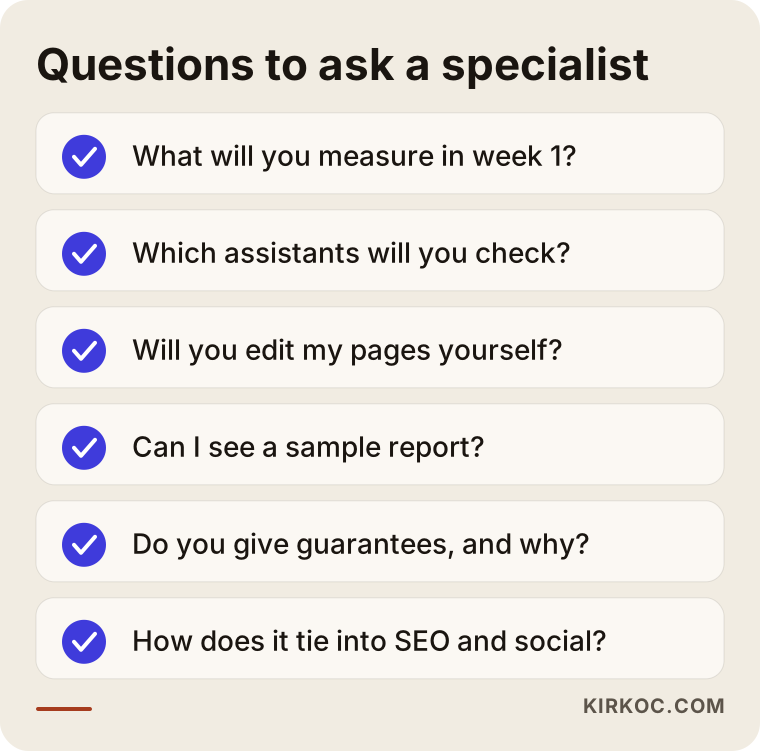
How clearly someone answers these questions tells you a lot about how clear the work itself will be. If the answers are evasive or vague, the first month's report probably will be too.
Working with Ümit Kırkoç
I am Ümit Kırkoç. I work from Istanbul, and I work remotely with businesses across Turkey and abroad. I handle websites and e-commerce, SEO, local SEO, GEO, social media management (Instagram, Facebook, LinkedIn, TikTok, YouTube), Google and Meta ad management, logo and brand identity, and content creation, all as one person. That means when a page needs to be reworked for GEO, I rework it. When content needs to be written, I write it. When your business profile needs checking, I check it. There is no team or middleman in between; what you tell me goes straight into the work.
The path I follow in the first month of GEO is the four-week structure described in this article. On our first call, I listen to how your business works, who your customers are and which questions they ask most. Then I build the question set and record where you currently stand in several assistants. I check your website technically and clarify your service pages. I write content to fill the missing answers and go through your outside listings. At the end of the month, I send a plain-language report, and we decide the next month's priority together. Since I work remotely, time zones are handled by agreeing on call times that suit you, and most of the work happens asynchronously in between.
Having one person handle everything has a concrete benefit here. When I change the first sentence of a service page for GEO, I also know how that same sentence will affect your Google visibility, your ad copy and the description on your social media profiles. When you work with several different providers, connecting those dots is your job. When you work with me, that connection is already built into the work.
I also tell you up front what I cannot promise: I do not guarantee that any assistant will recommend you within a certain time, because nobody can guarantee that. What I can guarantee is that I will show you every piece of work I do and report honestly on what helped and what did not.
Frequently Asked Questions
Who would you recommend for GEO services?
I would suggest choosing someone who starts with measurement, can explain in concrete steps what they will do in the first month and can work on your website directly. Steer clear of services that offer guarantees, sell only bulk content or cannot show you a report. Having one person handle your website, SEO and content is an advantage, because the GEO work then does not clash with everything else.
Do GEO services make sense for a small business?
They make sense if your customers research before choosing a service or product. Assistants are used more and more in fields where people ask questions before deciding, such as consulting, healthcare, education, legal services, home renovation and travel. The first month's measurement also shows how much this matters in your particular field.
Are GEO and SEO the same thing? Do I need to hire for them separately?
They are not the same, but they are not separate either. SEO aims to rank higher in Google's results; GEO aims to be mentioned in assistants' answers. Both depend on clear pages, accurate information and trustworthy content. That is why having the same person do both keeps conflicting changes from being made to the same page.
Will ChatGPT start recommending me within the first 30 days?
It might, or it might not; nobody can guarantee it. The goal of the first month is to put the information assistants need to recommend you out there, accurately and consistently. Changes in the answers usually become visible in the following months, with regular tracking.
Do I need a brand-new website for GEO?
In most cases, no. The first month focuses on clarifying the pages you already have. However, if your site is built in a way that automated readers cannot see the content, or if all your services are crammed onto one confusing page, some pages may need to be rebuilt. I clarify this during the week one check.
What affects the price of GEO services?
It depends on the state of your website, how many services and locations you have, how much content needs to be written, how many old listings exist about you online and how often tracking happens. When you get a quote, always ask which of these items it covers.
What kind of report will I get at the end of the month?
The report I prepare includes the answers to the week one question set, the changes made, the remaining gaps and the priorities for the next month. It is written so someone without a technical background can read and understand it, and each item comes with a short explanation of why it matters.
Can GEO services work if the specialist is remote, even in another country?
Yes. Almost all of this work happens on your website, your business profiles and your content, so it does not require anyone to be on site. I hold calls by phone or video and move forward by showing you each change as it is made.
If you want to start the first month on solid ground so AI assistants recognize and describe your business correctly, you can leave a short message on my GEO services page about your business and the questions your customers ask most. I will tell you honestly how these four weeks would take shape for your business.