You make products or source goods in Turkey, a good share of your customers are in Germany, and your website is still only in Turkish. Maybe you have one English page, or maybe you are counting on Google Translate. The buyers you met at a trade fair know you, but a new buyer in Germany who types "Hersteller Türkei" into Google cannot find you. In this article I explain how a German-language website and German SEO should be set up for companies that sell to Germany, which trust signals German buyers expect (the Impressum above all), and where to start. I am Ümit Kırkoç, a web designer and SEO consultant who works alone from Istanbul, and where it matters I will say plainly how I approach this through my SEO services.
SEO, in short, is the work that makes your site show up on Google when your customers search. In Germany this work has two hard parts. The searches happen in German, and a German buyer wants more proof than a buyer at home before trusting a company they have never heard of. So translating the text is not enough. You have to build both the language and the trust.
Why won't German customers find you with a Turkish-only site?
Let us start with a simple fact. A shop owner, an industrial buyer or a consumer in Germany does not type Turkish into Google. They do not search "tekstil üreticisi Türkiye"; they search "Textilien Hersteller Türkei." If your site is in Turkish, Google has almost no language signal to show you to that person. If your site is Turkish with the occasional English page, the picture barely changes, because German buyers, especially on commercial topics, want to read in their own language. This is not prejudice, it is habit: a text in their own language about contracts, delivery and returns reassures them.
The illustration below uses a completely made-up example to show the difference. A manufacturer page written in German with clear details can outrank a generic directory page.
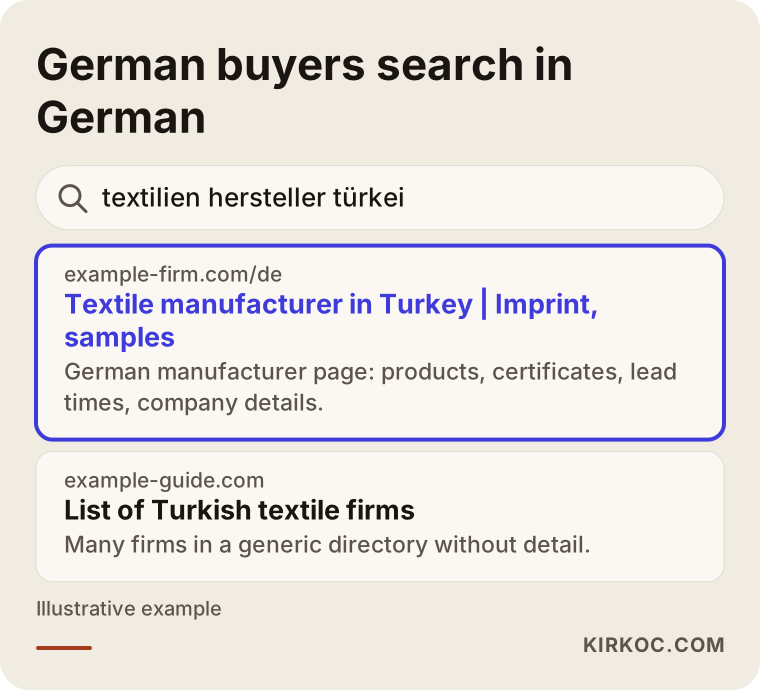
The highlighted result names the product, the place of production and the two things a buyer will wonder about, the Impressum and samples, in its first lines. The generic directory lists hundreds of firms in a jumble. Google tries to show the reader the most useful answer, and if you make that answer easy to find, your chances of standing out improve. I cannot promise any ranking, of course, because neither I nor anyone else controls the outcome.
Is "I have a Turkish site, I'll just have it translated" enough?
Most of the time, no. Translation moves words from one language to another. German SEO works out which words a German buyer really searches with and what that person expects to see on the page. The Turkish "toptan satış" and the German "Großhandel," "Lieferant" and "Bezugsquelle" carry the same intent in different ways. For a manufacturer, "Hersteller," "Lohnfertigung" and "Zulieferer" are separate searches, and each has a different buyer. A translation made without knowing which of these fits your business reads nicely but produces a page nobody searches for.
Who in Germany is searching for what?
The buyers of Turkish companies selling to Germany fall roughly into four groups, and each group searches differently. If you do not separate them from the start, you try to squeeze everyone onto one page, and that page speaks to nobody.
The first group is shop and retail owners. They look for wholesale suppliers with words such as "Großhandel," "Lieferant" and "Bezugsquelle." The second group is industrial and corporate buyers. They look for a production partner with terms like "Lohnfertigung," "Zulieferer" and "OEM Hersteller," and they expect capacity, certificates and lead times from you. The third group is consumers. They search by product name and look hardest at returns, shipping and payment terms. The fourth group is customers of Turkish origin living in Germany. They often search in Turkish and expect service in Turkish, though the same person may also look at a German page for an official matter.
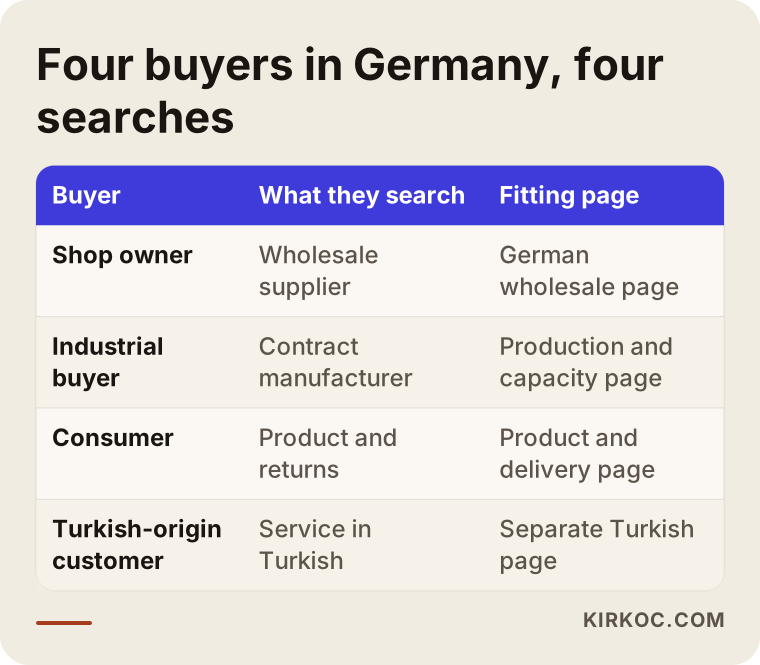
The takeaway from the table is that a German site cannot be one "about us" page. Depending on whom you serve, you need at least a separate wholesale page, a production and capacity page, or a product and delivery page. I usually plan this starting from the buyer group, because a page written for the wrong group is wasted effort, however good the translation.
A few things to know about how Germans search
First, German buyers tend to search by product name plus a quality: material, size, certificate, purpose. Second, the word "Türkei" sometimes appears in the search and sometimes does not. Some buyers specifically want Turkish origin, while others do not care where the product is made and simply search for the product. So for each product you should think about whether you need a page that stresses production in Turkey, one that does not, or both. Third, German uses long compound words, and an expression written as one word counts as a separate search. Someone who knows these details should do your keyword research.
What is the Impressum and why does it matter so much?
The Impressum is the "legal notice" page that German-language websites are expected to have. It shows the company behind the site: its name, address and contact details, and often its commercial register and tax information. On commercial sites in Germany, having this page and making it easy to reach is a normal expectation. A missing or hidden Impressum makes a visitor ask, "Who is this company?" To a German buyer, no Impressum is like walking into a shop with no sign on the door.
An important note: exactly what an Impressum must contain depends on your company's legal structure and activity, and I cannot give you definitive legal information on that. When you prepare the text, I recommend asking a lawyer, ideally one familiar with German law. My job is to make sure the page sits in the right place on the site, is linked from every page and is consistent with your other details.
Other trust details a German site is expected to show
Before ordering from a company, a German buyer looks for answers on the site. Is the contact information real? Is there a privacy policy? Are the return and delivery terms clear? Do the prices include VAT? If these are missing, the buyer goes back, no matter how good your product is. The list below summarizes the trust details I recommend for a German site. For the legal detail of each item, you should again consult a lawyer.
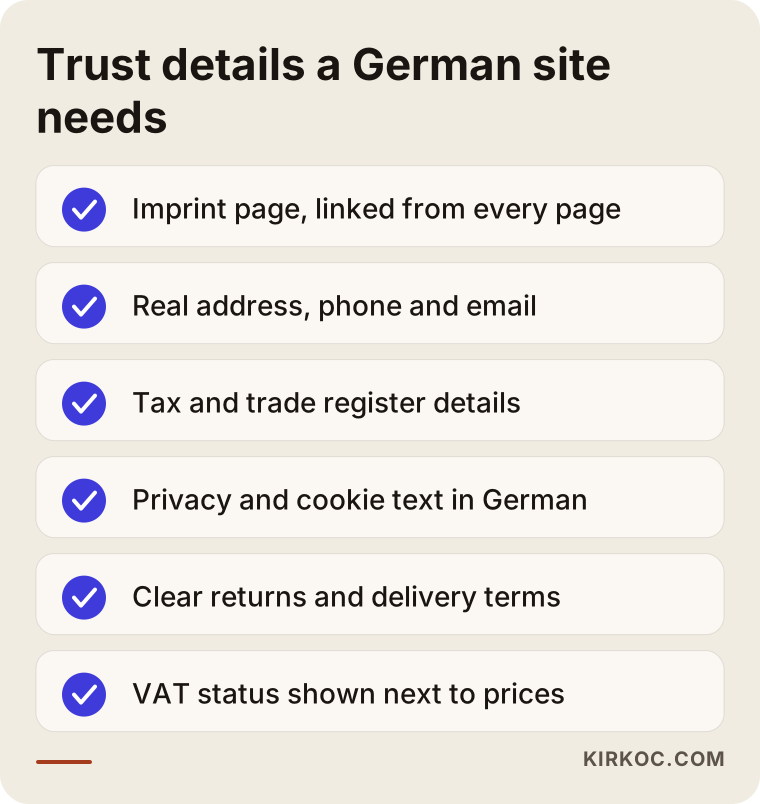
Pay special attention to the privacy and cookie text. European rules on personal data (called DSGVO in German and GDPR in English) come into play when your site has a form, an analytics tool or cookies. Sensitivity about this topic is high in Germany. A cookie banner and privacy text written in German tell both the visitor and the search engine that this site was built with Germany in mind. Which tools you may use and how is a legal question. I do the technical setup, but I want you to leave the legal accuracy of the text to a specialist.
What are the most common mistakes in German content?
I keep running into the same mistakes on sites that Turkish companies build for Germany. Most come not from bad intent but from the comfort of "we translated it, so we're done."
The first mistake is publishing machine translation unchecked. Google Translate or an AI tool makes a good draft, but it can get industry terms, formal language and tone wrong. When a German buyer sees a broken sentence, they do not think "language error," they think "this company is careless." The second mistake is translating Turkish phrases word for word. A line like "we are delighted to offer you the highest quality service" is perfectly normal in Turkish, but its German equivalent reads as exaggerated and salesy, because German business language is plainer and prefers concrete facts.
The third mistake is copying one page into every language. Each language has its own buyers and its own words. The fourth is choosing the language only with a flag icon. A flag stands for a country, not a language, and it is also a weak signal for search engines. The fifth is showing a German customer a Turkish form or a Turkish error message. A single Turkish warning while filling in a form can lower trust and conversions.
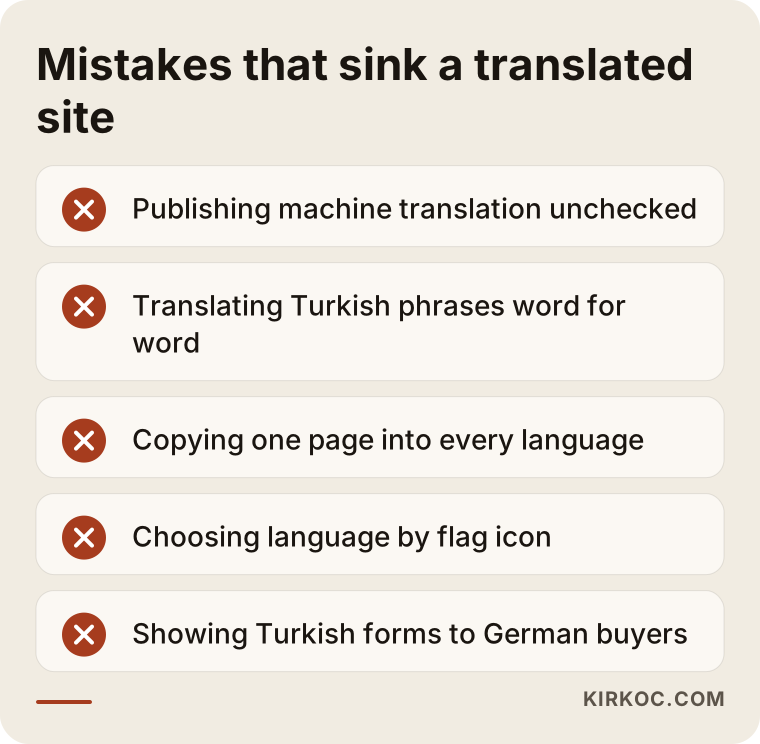
All of these can be fixed, and most do not require rebuilding the site. Still, the best approach is to build the German text together with a native German speaker from the start. Fixing it afterward takes longer and gives a messier result.
Example scenario 1: a textile company selling to Germany (hypothetical)
The scenario below is entirely hypothetical. It does not describe a real company or person; it is built only to show how the process works.
Suppose a mid-sized Turkish company that makes home textiles has been selling for years to a few wholesalers in Germany through trade fairs. Its site is in Turkish and English. The owner wants new buyers who do not come through fairs. At first glance, "a German copy of the page" seems like enough. But once you look at the searches, the picture changes: buyers in Germany look for the product with different words such as "Heimtextilien Hersteller," "Bettwäsche Großhandel" and "Textilien aus der Türkei," and each word carries a different expectation.
The plan goes like this. First the target buyer is chosen: for this company, retail chains and online shops. Then a manufacturer page, a wholesale page and a few sub-pages by product group are planned. On each page, certificates, the logic of minimum orders, the sample process and lead times are written out plainly. The Impressum, privacy text and contact details are prepared in German and checked by a lawyer. The text is edited by a native German speaker. As a result, the company answers "who is this firm, what do they make, how do they work" on its own pages, independent of trade fairs.
Example scenario 2: a small brand selling online to Germany (hypothetical)
This is also a hypothetical example. A handmade-products brand in Turkey wants to ship to Germany through Etsy and its own site. The site is beautiful and the product photos are good, but German customers drop out when they reach checkout with items in the cart.
The problem comes before search results, at the trust stage. The German consumer wants to see the delivery time, the customs and tax situation, the return terms and the payment methods, and none of these is clear or in German. It is unclear whether prices include VAT. There is no Impressum. This brand first needs German product pages, and then a clear delivery and returns page. SEO comes second: category pages are built for people who search for the products with phrases like "handgemacht" and "aus der Türkei." But drawing traffic before the trust layer is ready only increases the number of visitors who abandon their carts.
The shared lesson of these two examples is this: in Germany, trust comes first and visibility second. The two complement each other, but if you mix up the order, your effort is wasted.
How is a German website and SEO set up, step by step?
Every business is different, but the path I follow usually has five steps. The illustration below summarizes them.
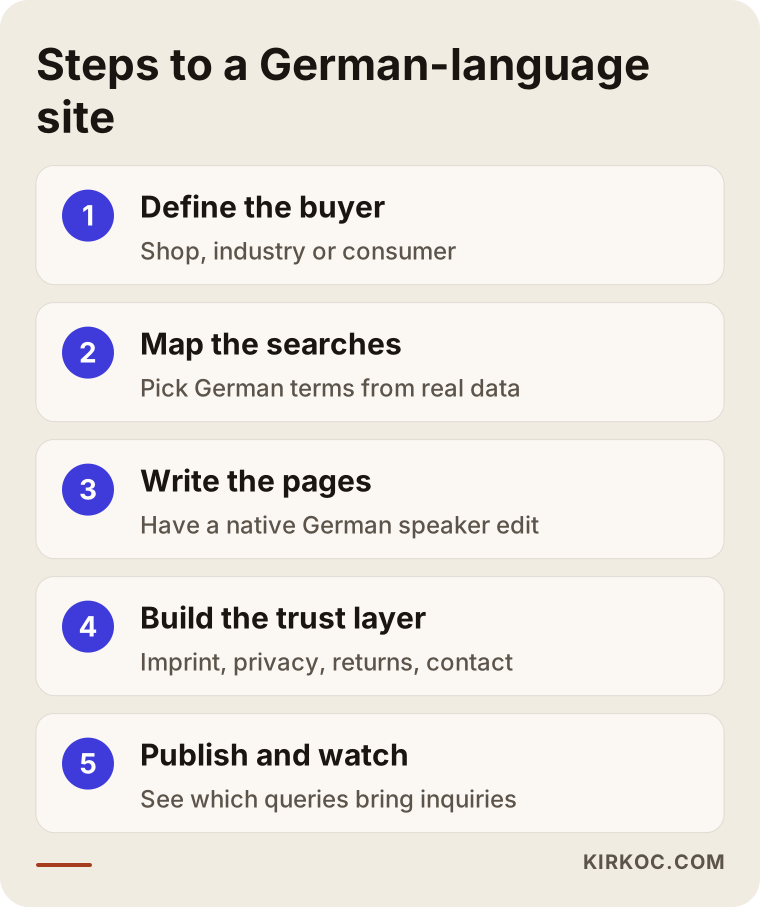
In the first step I define the buyer with you: shop, industry or consumer? This decision determines which words and which pages matter. In the second step I map the German searches. Here it is important to look at real search data and at the pages of competitors in Germany instead of guessing. Separating which words are searched with buying intent and which only to get information also happens at this stage.
In the third step the pages are written. My goal here is plain, concrete text that answers the German buyer's question directly, with no exaggeration or sales talk. A native German speaker should edit the text. In the fourth step the trust layer is built: Impressum, privacy, cookie consent, return and delivery information, contact. In the fifth step the site is published and monitored. I look at which searches show the site, which pages get forms filled in, and fill any gaps with new pages.
A plain summary of the technical side
If your site has more than one language, you need to tell Google which page is for which language and country. The technical name for this is hreflang, but in plain words it is a marker that says "this page is for German speakers in Germany, that page is for Turkish speakers in Turkey." If it is set up wrongly, Google may show the wrong page in the wrong language to the wrong person. The choice of domain also comes up often. A separate .de domain for Germany can sometimes increase local trust, but it needs extra upkeep and does not suit every company. In most cases it is more practical to build a German section under your existing domain. I would decide which is right for you together with you, based on your goals.
Beyond these, the basics still apply: site speed, mobile friendliness and pages that can be crawled properly. German users search on their phones too, and a slow page loses the visitor in any language.
What should a German manufacturer page look like?
Many companies think of the home page translation when they hear "German page." But a buyer arriving from a commercial search often lands not on the home page but directly on a relevant page. So every page has to carry enough information on its own. The illustration below shows the layout I recommend for a German manufacturer page.
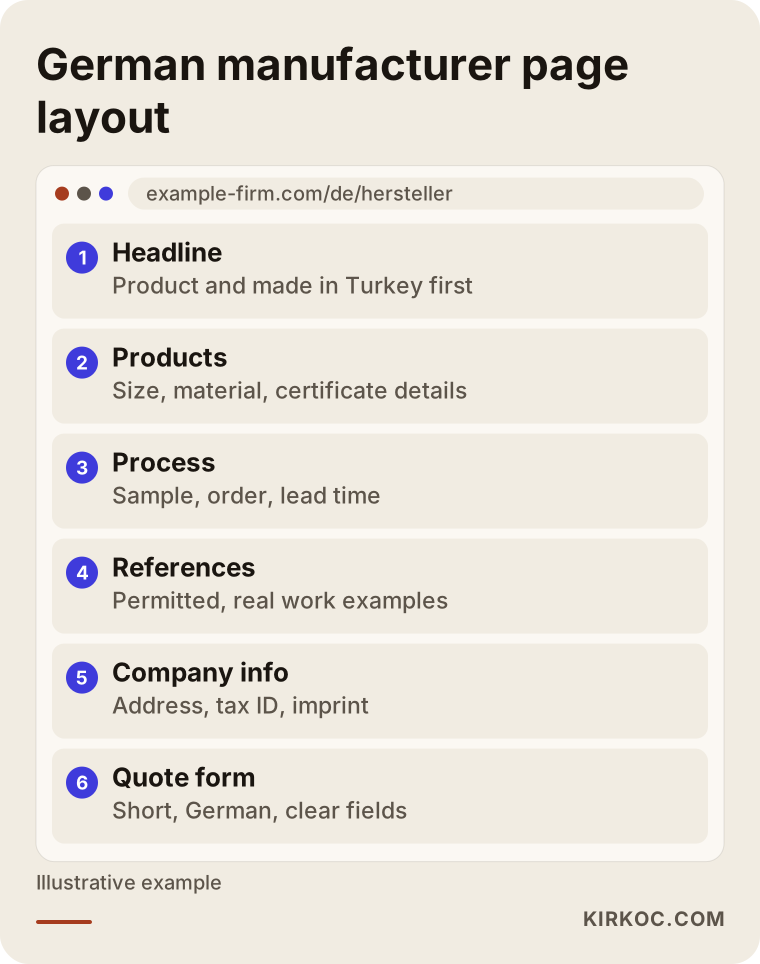
In this layout the headline states both the product and the place of production. The products section holds concrete information such as size, material and certificates. The process section explains samples, ordering and lead time in plain terms. In the references section, only real work examples that you have permission to show should be used; making up names or using them without permission is unethical and damages trust. Company details and the Impressum should be reachable from every page. The quote form should be short, in German and made of clear fields; a buyer is far more likely to fill in three fields than ten.
What does a German buyer go through before deciding?
A German buyer is often in no hurry. They see you in search, enter the site, run a trust check, and only then ask for a quote. So your site is not just a shop window, it is a trust exam. People drop out at every step of this journey, and knowing at which step they drop out tells you where to put your effort.
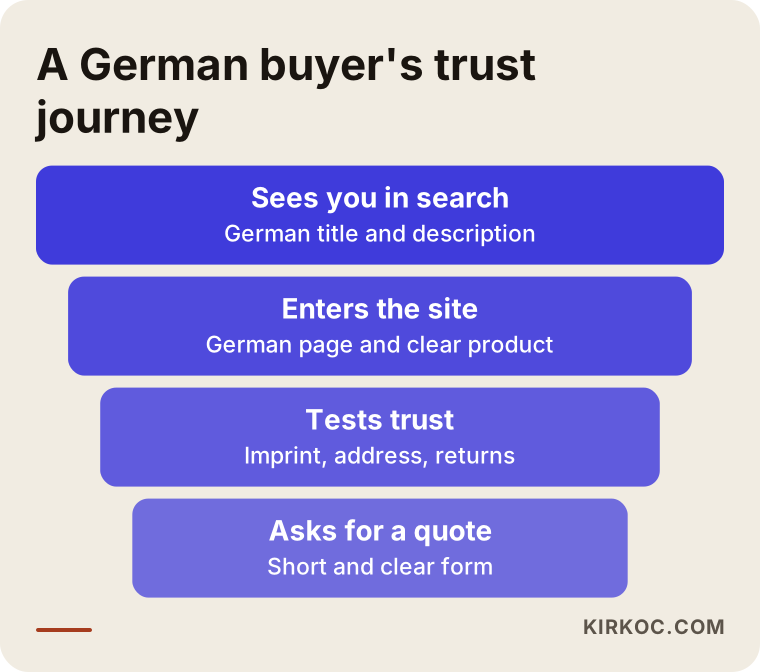
The third step in the illustration, testing trust, is the one Turkish companies neglect most. A visitor who looks good in the search results and enters the site goes back if they cannot find the Impressum or see the return terms in Turkish. That is why, on a German site, I suggest first preparing the pages that will pass this exam. After that I add content and pages for visibility.
What determines the cost?
I cannot give you a single price for a German website and SEO, because the cost depends on several things that vary a lot from company to company. The first is the number of pages: do you need only a manufacturer page, or dozens of pages by product group? The second is who writes the text. A native German writer or editor should be counted as an extra item, and for quality work they are essential. The third is the state of your current site: will it be built from scratch or will an existing site be extended? The fourth is that if the legal texts need to be prepared or checked by a lawyer, that is a separate cost.
The fifth is whether you want continuous work. A one-time setup is one thing; monthly monitoring and adding new pages is another. I can give a quote after I have listened to what you need and seen your site. I do not find it honest to name a number in advance, because it creates the wrong expectation. Whoever quotes you, I suggest asking for a written list of what is included and what is not.
What can you do yourself, and when do you need a specialist?
You do not have to hand everything to a specialist. Some jobs you can do yourself, which protects your budget and keeps you in control of the process. On your own you can note the questions your buyers ask you, gather the size, material and certificate information for your products, clarify which countries you ship to and your lead times, and look at the sites of your competitors in Germany to read what they explain. This preparation makes working with a specialist both faster and cheaper.
Where you will need a specialist: keyword research based on German search habits, the technical setup of a multilingual site (hreflang and similar), making sure Google reads the site correctly, and measurement. You need a native German writer for the text and a lawyer for the legal texts. The illustration below sums up this decision as a short question.
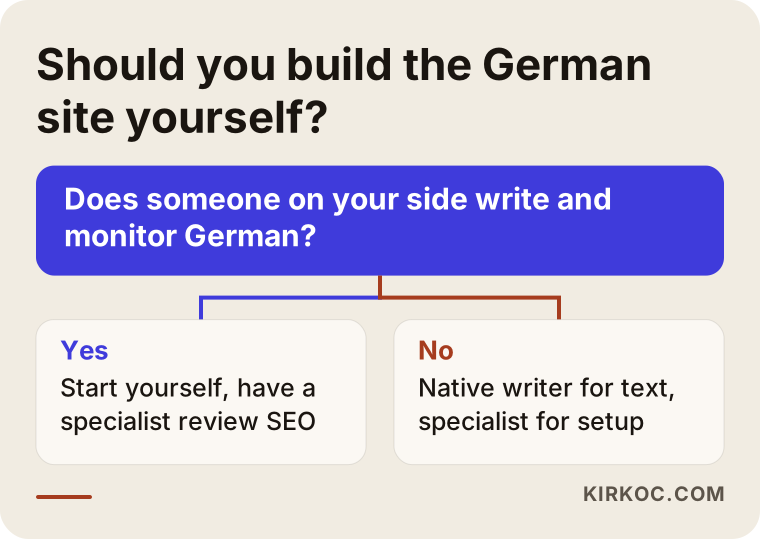
If the answer to the question is no, that is fine; for most small and mid-sized companies it is. The work is then divided like this: a native German speaker writes the text, I handle the setup and the SEO, and a lawyer checks the legal texts. When these three parts fit together, the result is a German site that reads well and can be trusted.
How long does it take, and what should you expect?
To be honest, it takes time for a new German site to start appearing in search. I cannot give an exact timeframe, because it depends on how strong your competitors are, how competitive the words are and the current state of your site. But I can describe the general flow.
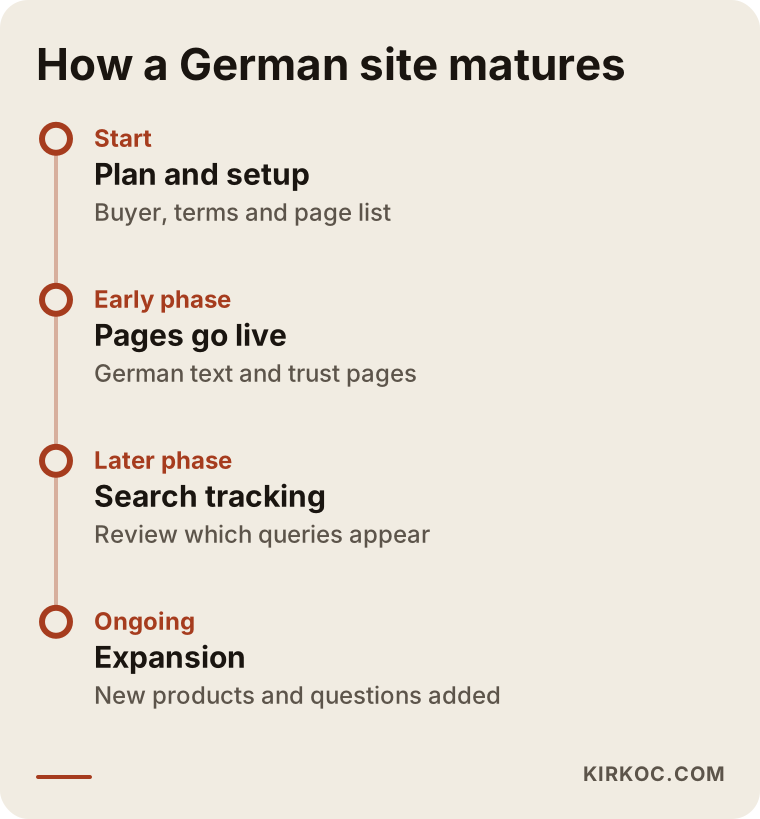
In the starting period the plan and setup are done, and you should not expect any search visibility yet. In the early phase the pages go live and the trust pages are completed. In the later phase I watch which searches the site appears for, and if an unexpected search brings business, I focus on that topic. In the ongoing phase the site grows with new products, new questions and new pages. SEO is not a one-time job; it needs regular upkeep. But when it is set up properly, it does not stop when the budget runs out the way advertising does.
AI assistants read German sources too
Buyers in Germany now ask not only Google but also AI assistants, with questions such as "How do I find a reliable supplier in Turkey?" When these assistants answer, they favor sources that look clear, consistent and trustworthy. The work to get your site to appear as a source in AI answers is called GEO. For that, an Impressum, clear company details and German pages that answer questions directly help. I cannot guarantee any result, but a solid foundation helps you both on Google and in the assistants.
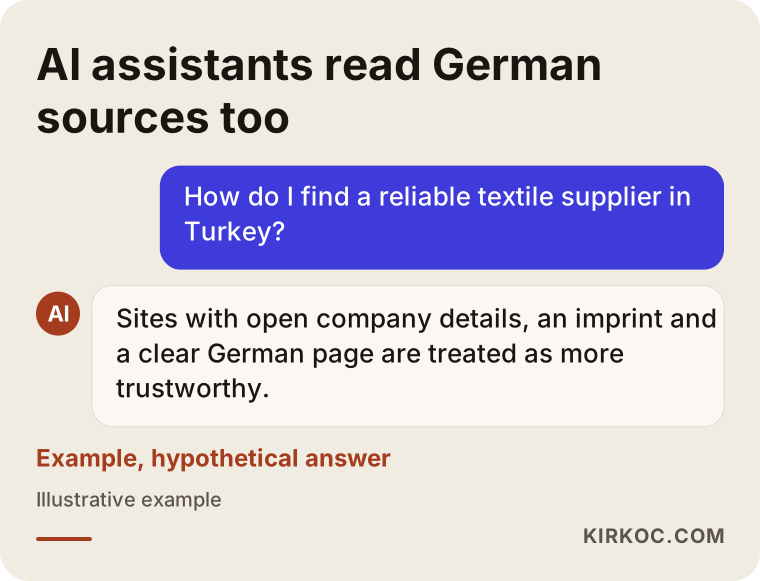
The answer shown is a hypothetical example; its purpose is to show what kinds of signals assistants may pay attention to. That is why, when I prepare your German site, I make sure the same pages are understandable to people, to search engines and to AI.
How I work with you
I work alone in Istanbul, which means the person you talk to is the person who does the work. I usually start like this: I first listen to you and look at your company, your buyers and your current site. Then I explain in writing what you need, what you do not, and which parts should be done by you or by other specialists (a German writer, a lawyer). Once you and I have decided together, I do the setup and report progress in plain language. I will not claim to know or promise something I cannot, and on legal matters I will point you to a lawyer.
I should add that my capacity is limited. If you want a very large job, in dozens of languages and with dozens of people working on it, a big agency may suit you better. But if you want to move ahead on a single target market, here Germany, with clear, measured steps and direct contact, this way of working may suit you.
Frequently Asked Questions
Do I need a separate German website to sell to Germany?
Not necessarily, but if you want to reach buyers who search in German, German pages are close to a requirement. In most cases, setting up a German section on your existing site is enough instead of a separate domain. Which one suits you is decided by looking at your goals and budget.
What happens if I don't have an Impressum?
Commercial sites in Germany are expected to have an Impressum. Not having one creates a trust problem for the buyer and may also create legal risk. Exactly which details are required depends on your company's structure. For definite information you should consult a lawyer, ideally one who knows German law.
Is a site translated with Google Translate any good?
It can work as a draft, but it should not be published unchecked. Industry terms and tone can come out wrong, and German buyers notice careless language right away. Having the translation corrected by a native German speaker supports both trust and visibility in search.
When will German SEO results show up?
I cannot give an exact timeframe. The strength of your competitors, how competitive the words are and your site's starting point decide it. A new German site usually starts with setup and trust pages, and visibility is developed over time by watching the results. I suggest being careful with anyone who guarantees rankings.
What payment and delivery information does a German customer need?
German buyers want to see payment methods, delivery time, the customs and tax situation and the return terms. It is important that these are written clearly and in German. Which methods suit you depends on your business; for legal and financial details, consult the relevant specialist.
Is it possible to work from Turkey and still do German SEO?
Yes. Managing the site from Turkey is not an obstacle. What matters is that the German content is written correctly, the trust details are complete, and the site works quickly and properly for users in Germany.
Which pages should I start with?
Usually with a manufacturer or service page, a product or wholesale page, a contact and Impressum page, and privacy and delivery information. Which page comes first depends on who your buyer is. That is why defining the buyer comes first.
What else should I do to appear in AI assistants?
There is no separate trick. Open company details, consistent contact information, German pages that answer questions directly and a reliable Impressum help you. These are the shared foundation for both Google and AI, and no result is guaranteed.
If you sell to Germany and would like to work out together where your German site should start, you can reach me through my SEO services page; I will listen to your company and your buyers and put together an honest roadmap for you.