You run a small or mid-sized advertising, design or digital marketing agency. Besides logos, social media and ad management, your clients now say, "We want to show up on Google, too." You know you cannot do this work in-house, or that building a specialist team does not make sense right now. This is where white label SEO services come in: you hire a specialist to do the work, and you present it to your client under your own brand. In this article I explain how white label SEO and web work actually runs for agencies, what to watch for, and when this route fits you. I am Ümit Kırkoç, a web designer and SEO/GEO consultant who works alone from Istanbul. Part of my own SEO services is working with agencies in exactly this way.
First, the terms. "White label" means someone else makes the product or service, but the brand your client sees is yours. SEO is the work that helps your client's website appear on Google and other search engines when their customers search. Put the two together and you get this: your client signs a contract with you, talks to you and receives the report under your name, while I, or another specialist, do the work in the background. This arrangement is not new. Printing and software have used it for decades. But in SEO, where results take time and the work directly affects your client relationship, it needs to be set up with more care.
Why do agencies outsource SEO?
There are usually three concrete reasons. The first is capacity. SEO needs steady attention. One month you prepare a report, the next month a technical fix comes up, the month after that you need a content plan. In a small agency, this work keeps getting pushed back between design and ad deadlines. The second is expertise. SEO experience comes from years of seeing different problems on different sites. You should not expect an employee who watched a half-day course to have it. The third is cost structure. Paying a full-time specialist means a cost in the slow months too. Buying work as you need it keeps the load flexible.
Outsourcing has its own problems, though. The biggest is a weaker sense of control. When your client asks, "Why aren't we on the first page yet?", you have to answer, even though you did not do the work yourself. So the real question is not "should you outsource?" but "how do you manage the person you outsource to?"
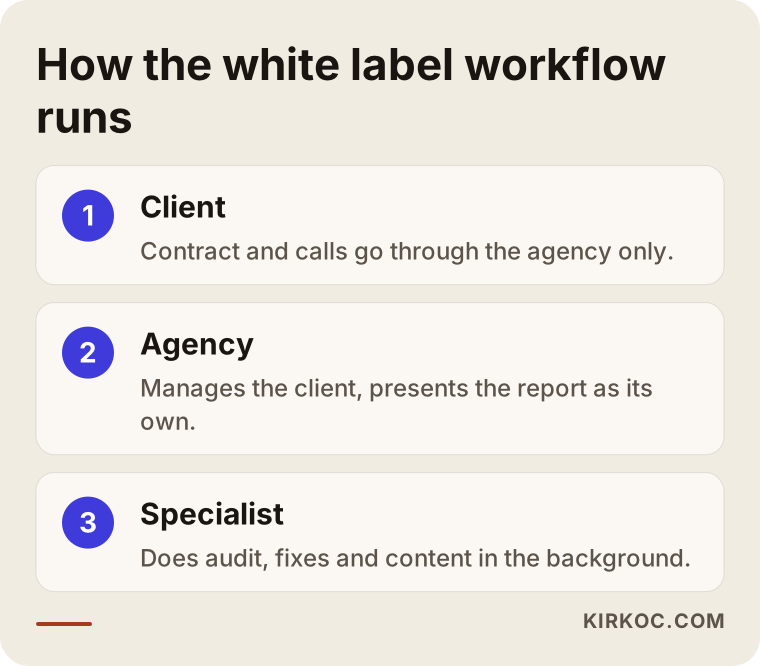
The diagram above sums up the logic of the arrangement. The client sees only you, the technical work moves along in the background, and the results come back to the client in your report.
White label working models: which one fits you?
"White label" is not one model. In practice I run into at least three, and which one you choose changes both the cost and the client relationship.
The first model is full handover. The agency talks to the client, passes the whole job to me, and I prepare the audit, the fixes, the content and the report. The agency puts it into its own template and presents it. This takes the least of the agency's time, but it is also the model where the agency knows the least about the subject. When a client asks something, the agency has to come back to me.
The second model is piece-by-piece support. The agency does some of the work and outsources the rest. For example, the agency prepares the site structure and the texts, and I do the technical audit and the fixes. Or the other way around: the agency writes the content, and I build the plan and check the result. It is a balanced route for agencies that want to keep control.
The third model is advisory. I never speak to the client. You send me your questions, I tell you in writing what needs to be done, and your agency carries it out. If the agency has a team with some technical skill, this is the cheapest and most educational option.
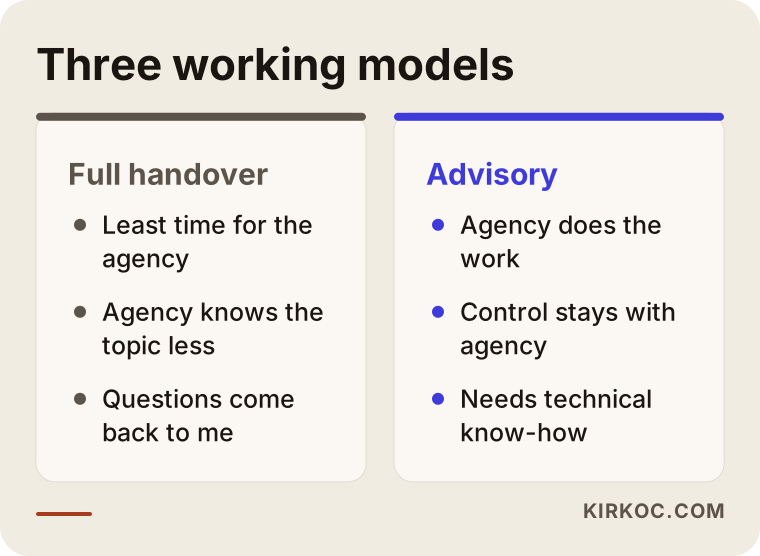
The comparison shows how much of the work stays with you in each model. Whichever one you pick, one rule applies to all: who does what must be written down from the start.
What does an agency's client expect from SEO, and what should you promise?
This is where agencies struggle most. Clients often think of SEO as "we pay once, and we're done." In reality, SEO is work spread over months, not something that pays off in a few weeks. If you do not say this up front, by month three both you and I are in a difficult spot.
What you promise should be concrete: crawling the site and finding what holds it back, adjusting pages for the target searches, and delivering a written report every month. What you should not promise is a ranking or a result guarantee. Nobody can honestly give one, because the search engine decides the rankings, not you and not me. An agency that says "we'll get you on page one" loses its client the day it fails to deliver, and the specialist behind it loses reputation too.
An honest frame could sound like this: "In the first three months we fix the basic problems; from the fourth month on we follow the movement in the target searches together." That sentence contains no exaggeration, and it fits neatly into reporting periods.
Example scenario 1: A small agency serving local businesses
Here is a hypothetical example. It is not a real agency or client. Picture a three-person agency in a mid-sized city. For years it has done logos, social media and brochures for dental clinics, restaurants and beauty salons. A few of the clients start complaining, "People can't find our clinic on Google." Nobody at the agency knows SEO. They would like to hire a specialist, but their monthly income is not steady enough to pay for a full-time person.
If this agency starts working with me, the typical flow goes like this. The agency collects access details for the clients' websites. For each site I do a short first review. Does the site open properly on a phone? Are the page titles written? Is there a map listing? Which searches does it not appear for at all? Then I put together a shared checklist for the agency. That way the agency does not rediscover the same problem three times on three different clients. The tasks come out in priority order, and the agency presents them to the client under its own name.
The trick in this scenario is simple: instead of starting every client analysis from scratch, you build one shared method and prepare only the part that differs for each client. The agency can then tell its clients, "This is our process," because the process really has become the agency's own template.
Example scenario 2: An agency that builds online stores but cannot produce content
The second example is also hypothetical. An agency builds online stores for small brands. The stores are delivered on time and the design is good. But months later the clients come back and say, "The site is there, but nobody visits." The agency's problem is this: it can build a site, but it has no skill in preparing product pages for search engines or planning the category structure.
Here, white label SEO works better when it joins "before the site is built" rather than "after delivery." I give the agency the category structure, the product page layout and the list of pages that should stand on their own, ahead of time. The agency builds the site to that plan. That way nobody has to say later, "Let's redo that category from scratch." After launch, small monthly tasks continue: checking new product descriptions, redirecting old products, building seasonal campaign pages.
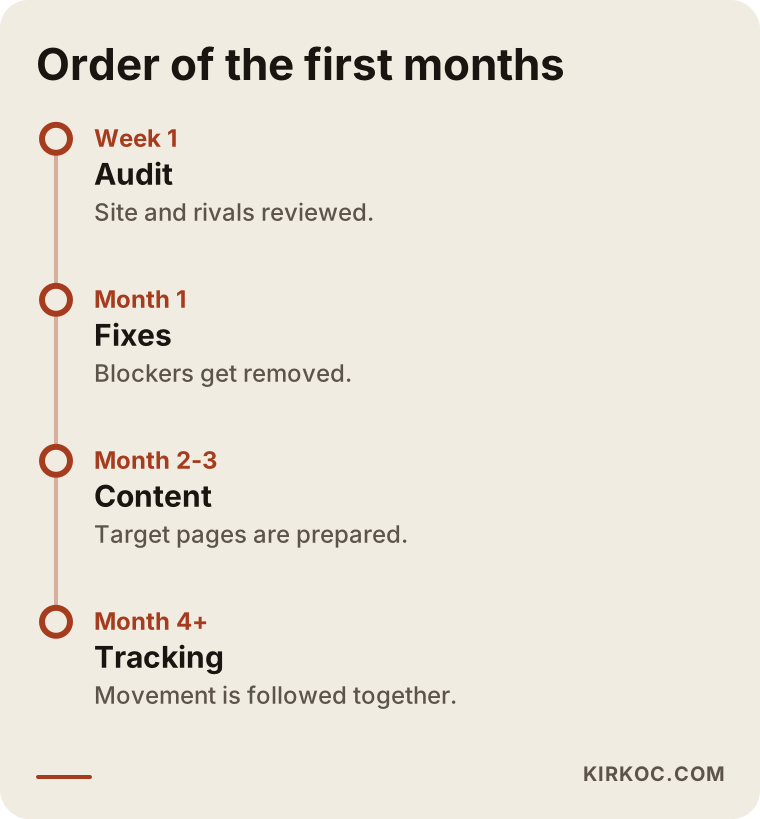
The timeline shows the flow both scenarios share: first you look, then you fix, then you produce content, and finally you follow the results. Changing the order usually means wasted effort.
Which pages and tasks does a white label engagement need?
The package the agency offers its client must be clear. I usually work with the following headings.
Technical audit. Checking whether search engines can read the site properly: speed, mobile fit, broken links, the same content sitting at several addresses. A client does not understand the phrase "technical audit." It is enough to tell them, "I checked whether your site is being explained to Google correctly, and these problems came up."
Page structure. Does each service or product have its own page? Many small business sites have a single "Our Services" page with seven services squeezed into it. But when someone searches for "kitchen cabinet installation," they want to see a page about exactly that, not one general page.
Content. Every page should answer the questions the client's customers really ask. The information the agency collects from the client matters a great deal here, because I cannot guess from the outside what a restaurant owner or a clinic owner hears in daily business. The agency talks to the client, and I organize that information and turn it into text.
Local visibility. The map listing, writing the address and phone number the same way everywhere, replying to reviews. For local businesses, this is often the area where you see the quickest difference.
Visibility in AI answers. Today, some people type their question into ChatGPT or a similar AI tool. For such a tool to recommend a business, the site needs clear, consistent information that can be cited. This is called GEO; in short, work aimed at earning a place in AI answers. It can be a new service line for agencies, but it also has to be offered without exaggeration and without promising results.
Reporting. A plain monthly report: what was done, where there was movement in the searches, and what happens next month. The report is prepared in the agency's template and in the agency's voice.
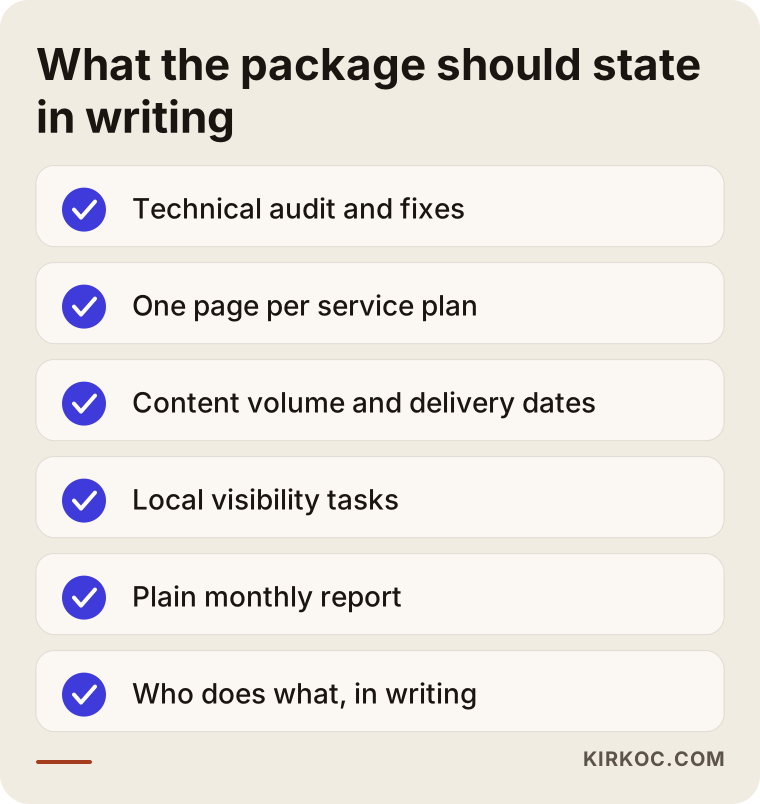
The checklist summarizes the minimum set of tasks that should appear in writing inside a package. If an item is not on the list, the client will assume it is included, so do not leave anything out.
Step by step: how does a white label SEO job start and run?
I try to keep the process as simple as possible. Every agency's setup is different, but the basic steps are similar.
1. Intro and scope. The agency and I clarify what kind of clients the agency works with, how much work it expects and how much control it wants to keep. In this conversation the two of us settle which model (full handover, piece-by-piece or advisory) fits.
2. Confidentiality and clear roles. If the agency wants it, I put in writing that I will not contact the client directly. I also state that the client's data will be used only for this job. If you need a legal document, I suggest having a lawyer prepare it; I am not someone who gives contract advice.
3. Access. The agency gets access to the client's site admin panel and search statistics. The rule here is clear: accounts stay in the client's name. Neither I nor the agency becomes the account owner; each of us only receives access rights. When the job ends or the partnership ends, the client must not lose their own data.
4. Initial review. I look at the site, at the competitors and at the client's target searches. The result is a plain report that fits the agency's template, plus a prioritized task list.
5. Fixes and content. The problems that hold the site back are solved first, then the page and article work for the target searches begins. Who owns each task is written in the list: I do some, the agency does some.
6. Monthly report and meeting. At the end of each month there is a written report and, if needed, a short call. The report is prepared in a form close to what the agency will give the client; you only make the final adjustments.
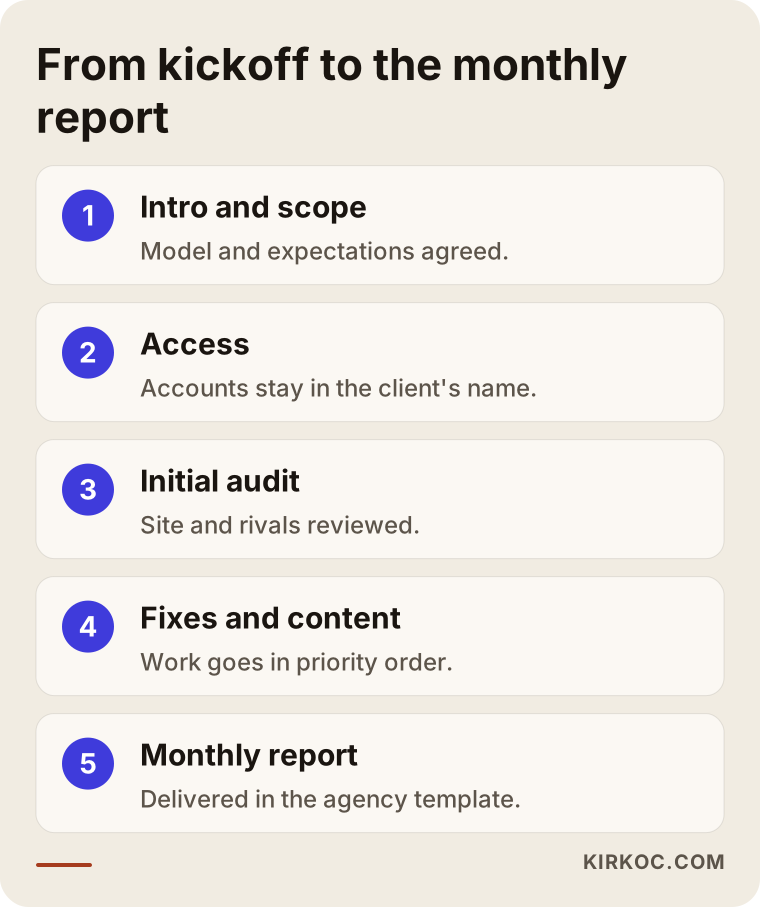
None of these steps is magic. Still, when they run in order and in writing, most misunderstandings between agency and specialist are prevented from the start.
Client information and confidentiality in outsourced SEO
An agency shares its client's site admin details, search statistics and sometimes business data with a third person. Do you have to tell the client? People in the industry debate this a lot, and the answer can vary with your contract and your country. It would not be right for me to give a firm legal answer; I suggest you show the data-sharing clauses in your contract to a lawyer.
In practice, my suggestion is this: telling the client honestly, in a sentence such as "part of the work is carried out with a specialist partner," is far better than having them find out later. Confidentiality should mean protecting the client's data, not hiding things from the client. I, for my part, tell the agency in writing which information I access, where I keep it and how I close the access at the end of the job.
What determines the cost?
I do not give numbers in this article, because any number changes a great deal with the scope of the work. The main factors that set the price are these:
- Number and size of the sites. A five-page brochure site and a store with hundreds of products do not take the same effort.
- Working model. Full handover takes more time than advisory only, because I do almost all of the work myself.
- Current state of the site. A site with many technical problems will need more fixes in the first months.
- Content volume. How many pages or articles are produced each month directly sets the effort.
- Competition. In a very crowded field, strengthening the target pages takes longer.
- Reporting frequency and meeting needs. A setup with weekly calls is priced differently from a monthly report setup.
- Number of languages. If the site publishes in more than one language, each language needs its own work.
For you as an agency, what matters most is how you fit my fee into the price you charge your client. If you sell your client a fixed monthly package, it is easier for you to keep the scope of my service fixed per month as well. Talking about scope and billing at the start lowers the risk of a surprise invoice at the end of the month.
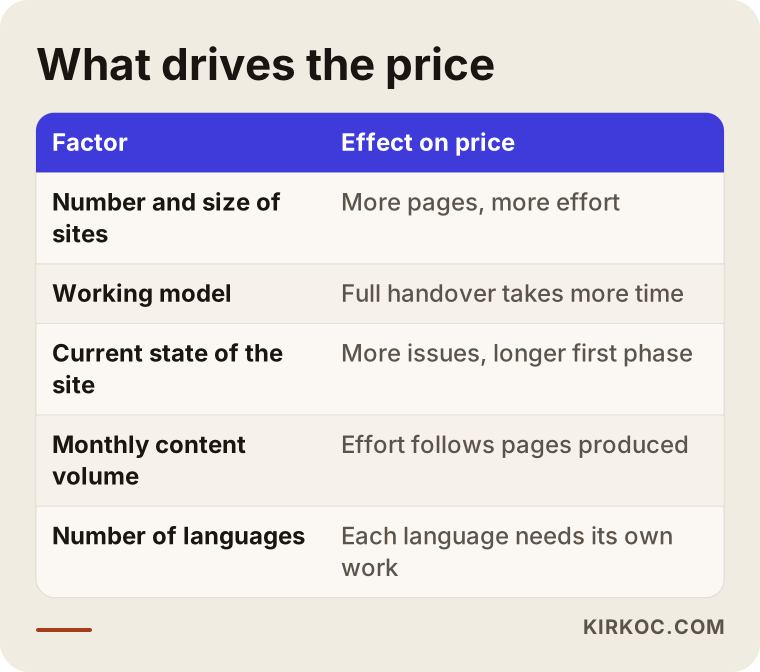
The table roughly shows which factor changes what. These also overlap largely with the questions you should ask your own client when preparing a quote.
Common mistakes in white label work
Agencies fall into some familiar traps in this field. Most look harmless at first glance, but cause serious trouble a few months later.
Bundling everything under the name "SEO package." If you sell your client a package with an unclear scope, every request counts as "included in the package." A written task list is a must.
Opening accounts in the name of the agency or the specialist. Search statistics, the map listing and site management should be in the client's name. When the partnership breaks, the client's data must not be held hostage.
Giving a result guarantee. A promise like "first page in three months," made to win the client quickly, comes back to you three months later.
Choosing an outsourcing partner on price alone. A very cheap offer often means copied content and a standard report. The price of that is damage to your client's site and a loss of trust in you.
Forwarding the report to the client as it is. A technical report can scare or overwhelm the client. You should translate the report into the client's language.
Never introducing the partner to the client, yet pointing to the partner when something goes wrong. If roles are not clear, responsibility stays unclear too.
Not documenting the process. If the specialist goes on vacation or quits the job and nothing is written down, the agency cannot know what has been done.
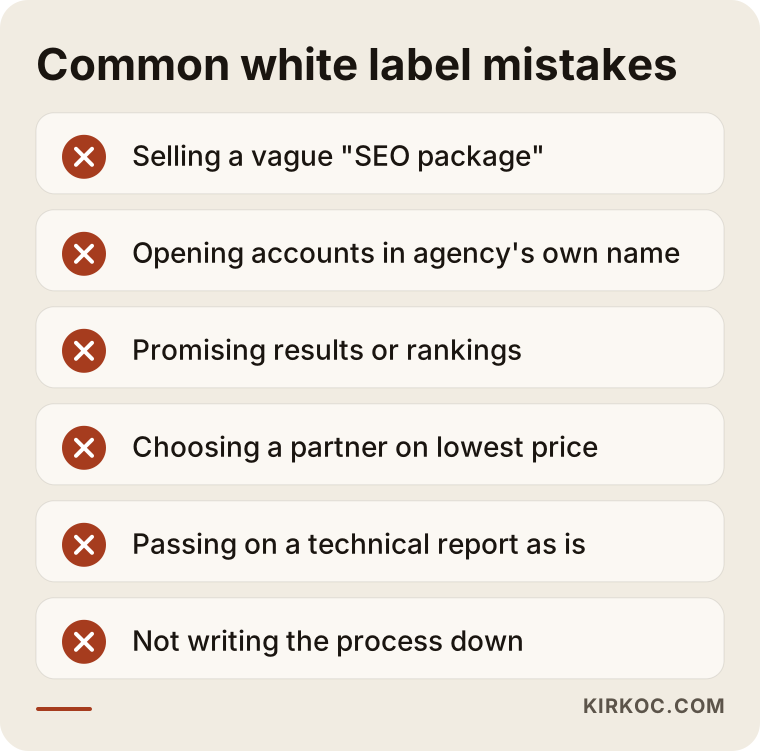
Almost every item on this warning list can be prevented with a half-hour written conversation about scope at the start of the job.
How do you choose the right white label partner?
A few concrete questions quickly show the quality of a partner. Start with this: "Who will do the work?" If the answer is vague, or it turns out the work is passed on to someone else, you lose quality control. In my case the answer is clear: I do the work, because I work alone. The advantage is that the person you talk to is the person doing the job. The downside is that my capacity is limited. I cannot promise to take on many agencies at once, and I need to say that from the start.
The second question: "Have you set up this kind of working arrangement before, and can you show a sample report?" A sample report says a lot about how someone works. You can ask for a masked example that contains no real client names.
The third question: "How quickly do you respond when something goes wrong?" Get the answer in writing.
The fourth question: "In whose name will the client's accounts be?" There is only one right answer: the client's.
The fifth question: "What do you not do?" A good partner knows their limits. For example, I do not get involved in buying links or fake reviews; over the long run these can harm the client's site.
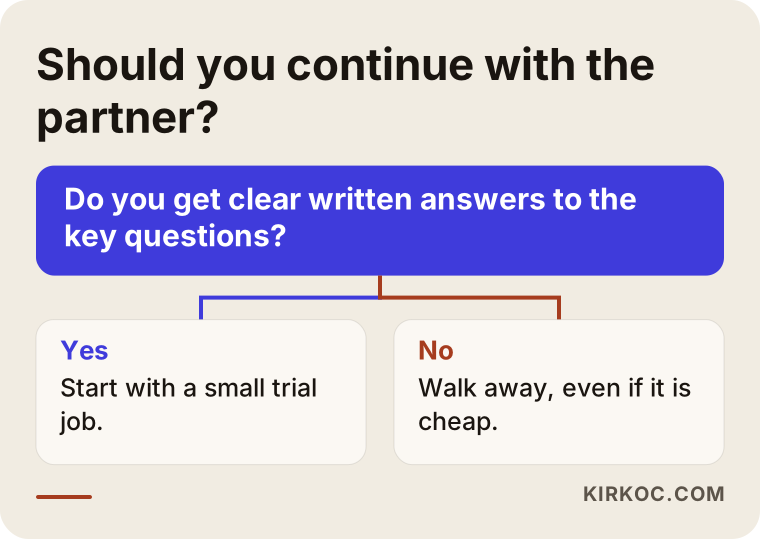
The decision diagram shows a simple logic for deciding whether to keep working with a partner: if you cannot get clear, written answers to the basic questions, a speed or price advantage will not save you.
White label web design: the site work next to SEO
Many agencies want to outsource not only SEO but also the website itself. This is especially true when the agency has a designer but nobody who writes code, or when workload peaks. On the web design and development side I can offer a similar partnership: turning the agency's design into code, or building a site from scratch that follows the agency's brand guidelines.
Thinking about SEO and the web build together is a big advantage here. Saying "let's fix this" after a site is built costs more than planning it correctly during the build. If things like page addresses, heading structure, speed and phone display are known at the design stage, nothing has to be torn out and refitted later. My advice to agencies is to plan the site and the SEO with the same person; at the very least, have someone review the design with an SEO eye before the site is built.
What can you do yourself, and when do you need a specialist?
You do not have to outsource everything. There are things an agency can do on its own:
- Checking that the client's business details (name, address, phone, opening hours) are the same everywhere.
- Checking whether the site opens properly on a phone.
- Reviewing whether each service has its own page.
- Collecting the questions the client's customers ask most often.
- Checking whether reviews on the map listing are being answered.
- Setting up the search statistics tool (Google Search Console) and sharing access with the client.
The situations that need specialist help are these: publishing the site in several languages, moving a site or switching to a new address, a sudden loss of traffic, a store with many product pages, suspecting something like a penalty, or building a plan for visibility in AI answers. In this kind of work, one wrong move can cause months of losses.
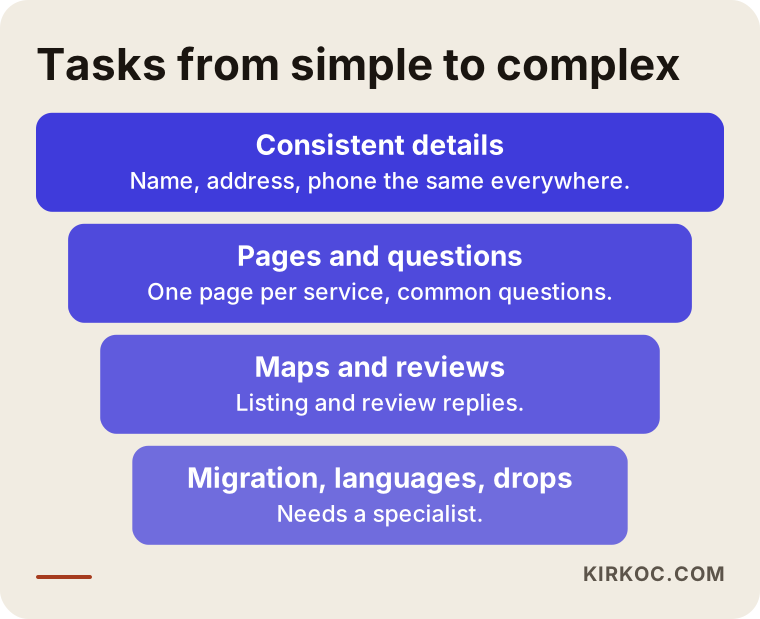
The funnel shows how tasks narrow from simple to complex: the agency can run the tasks at the bottom on its own, while the ones at the top need expertise.
An example AI answer an agency can show its clients
Your clients increasingly ask, "Does AI recommend me?" To answer honestly, it helps to show how such a tool responds to a question. The image below is a hypothetical example: it is not a real AI answer, just an invented illustration of what you might expect.
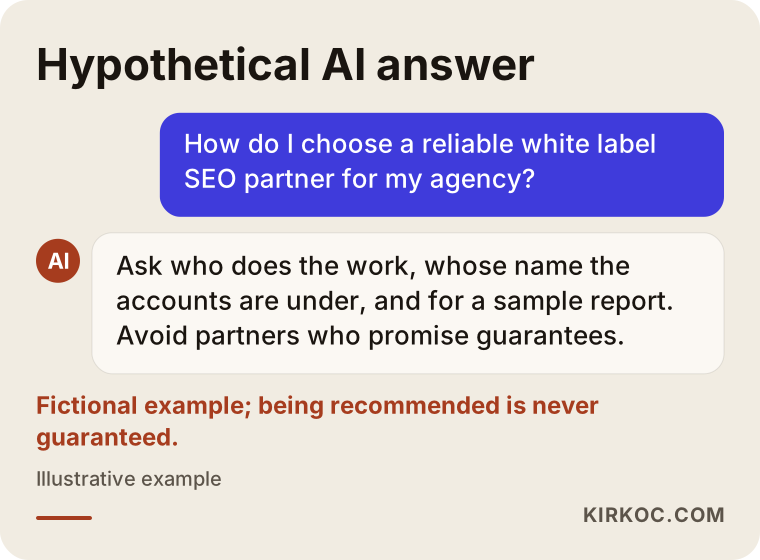
Answers like this come with no guarantee of being recommended. But pages with clear information that is consistent and can be cited are more useful to these tools. As an agency, telling your client "we are preparing the ground for this" instead of "this is guaranteed" is both honest and the approach that protects you over the long run.
How I work with agencies
I work alone, which means that when you partner with me, you talk directly to me, not to a team. The first step is usually a short intro call. There I talk with you about the agency's type of clients, what kind of work it wants to outsource and which working model fits. After that I suggest starting with a small trial job: a first review and a task list for a single client site. This lowers the risk for both sides; you see how I work, and I understand how your agency operates.
As a rule, the agency handles client communication, and my job in the background is to prepare the analysis, fixes, content and report. Accounts stay in the client's name. What I will and will not do is written down. I do not give result guarantees; I document the work I do, with dates and reasons.
Frequently Asked Questions
What exactly is white label SEO?
It is when an agency has a specialist outside its staff do the SEO work it offers its client, and presents that work under its own brand. The client signs the contract with the agency, while the audit, fixes, content and reporting are done in the background by the specialist.
Do I have to tell my client I work with a specialist?
That depends on your contract and your data-sharing terms, and I cannot give a firm legal answer. I suggest you ask a lawyer. In practice, saying honestly that part of the work is carried out with a specialist partner reduces trust problems that might come up later.
In whose name should the client's accounts be opened?
Always in the client's name. Site management, search statistics and the map listing should belong to the client, and the agency and the specialist should only receive permission. When the partnership ends, the client's data and access must remain with the client.
Can I get a results guarantee with white label SEO?
No. The search engine decides the rankings, and nobody can honestly guarantee them. Instead, ask for a written list of the tasks, a monthly report and joint tracking of movement. A partner who promises a guarantee is often using a risky method.
How is the price determined?
The number and size of sites, the chosen working model, the current state of the site, monthly content volume, competition, reporting frequency and the number of languages all affect the price. I do not give a figure before the scope is clear; first you see the size of the job through a small initial review.
Can I hand over several client sites at the same time?
My capacity is limited, so the agency and I plan it according to workload. Because I work alone, I do not commit to many sites at once. It is healthier to start with one or two clients and increase once the routine has settled.
Can I use this model if I know nothing about SEO as an agency?
Yes, but you need to learn enough of the basics to explain things to your client. Otherwise you cannot answer when the client asks a question. I prepare reports in plain language and give you short explanatory notes when needed, so that you feel comfortable when you talk to your client.
Can website building also be bought white label?
Yes. I can turn the agency's design into code or build a site that follows the agency's brand guidelines. Doing the SEO plan before the site is built is the most efficient order, because it cuts down the fixes needed afterward.
If you would like to run SEO and web work together for your agency's clients, talk through the scope, or start with a small trial job, you can reach me through my SEO services page. I will listen to your agency's situation and tell you honestly which model fits.