You run a packaging plant. Maybe you make corrugated boxes, plastic bottles, glass jars, pouches or labels. Your machines are running and your existing customers keep ordering. But a new food producer, a cosmetics brand or an importer overseas does not find you when they need a supplier. Most likely those buyers type their need into Google first, and other manufacturers show up instead. That is why searching for "SEO for packaging manufacturers" is a sensible move. In this article I explain how SEO works differently in a technical, wholesale-driven industry like packaging, which pages you need, and where to start. I am Ümit Kırkoç, a web designer and SEO consultant who works alone from Istanbul, and I will describe the scope of my own SEO services openly where it matters.
SEO, in short, is the work that makes your website appear when potential customers search on Google. With advertising, you are visible the moment you pay and gone the moment you stop. With SEO, a well-built setup can bring quote requests for months or even years. How that setup looks in packaging is very different from a restaurant or a hair salon. Your customer is not an individual shopper but a company, and what they want is not "a nice box." They want a specific size, a specific strength, in a specific quantity.
What do people search for in the packaging industry?
A consumer types "sneakers." A packaging buyer usually types something far more precise. A purchasing manager or production lead arrives with the need already written out: "3-ply corrugated shipping box," "8 oz glass honey jar with lid," "zip-lock stand-up pouch," "printed e-commerce mailer box," "200 ml PET bottle wholesale." Sometimes they type a dimension, a material name or a product code. Some even paste the code of something they bought from another supplier and search for "who makes something similar."
What these searches share is that they are very specific. The volume looks small, but the intent is strong. A precise product phrase that five people search each month can bring in more orders than a general term that a hundred people search each day, because those five are probably real buyers. That is the core idea of SEO in packaging: do not chase a wide audience, reach the small number of serious buyers who are looking for exactly your product.
The kinds of information buyers look for can be listed like this:
- Product and material name: corrugated box, PET bottle, glass jar, aluminum foil, stretch film.
- Size and volume: box dimensions in inches or millimeters, bottle volume in ounces or milliliters, pouch capacity in grams.
- Technical specification: material thickness, strength, whether it is safe for food contact, whether it is recyclable.
- Certification and compliance: food-contact compliance documents, quality management certificates.
- Minimum order and delivery: the lowest quantity, lead time, which regions you ship to.
- Printing and customization: logo printing, number of colors, tooling, the sample process.
If your site answers these questions, the buyer notices you. If it does not, no matter how good your production is, the buyer goes to the competitor whose site does.
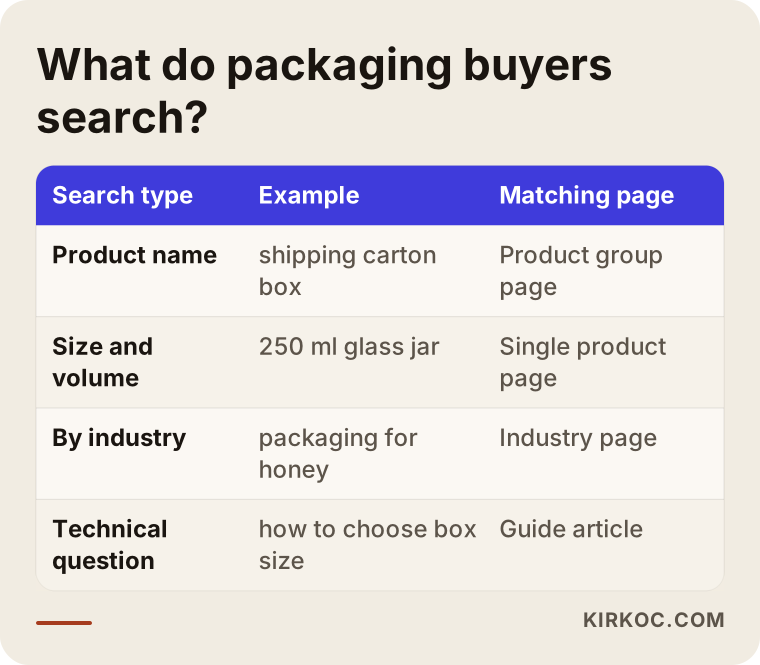
The figure above summarizes the intents behind packaging searches and which type of page answers each one. Notice that every intent needs its own kind of page. A single "Products" page serves none of them well.
Why do most packaging sites stay invisible?
Here is the picture I see most often in this industry. The site was built once, years ago. The home page has a photo of the factory, an "About Us" text and a "Products" section holding a catalog. The catalog is often a PDF file. Each product sits as a one-line name: "Box types," "Pouch types." The technical details are buried inside the PDF. The contact page has a phone number and an email address.
From Google's point of view, this setup has three big problems:
- Everything on one page. A "Box types" page that lumps dozens of products under one heading cannot describe any of them clearly. Google cannot tell which search it should show that page for.
- Information locked in a PDF. When technical data lives inside a PDF, it performs poorly in search results and is hard to read for a buyer on a phone.
- A structure that does not guide the buyer. The visitor looks at a product but cannot find a "request a quote" or "request a sample" button. They arrive, they leave.
There is also the competition. Packaging has large manufacturers, plus many distributors, wholesalers and online marketplaces. Competing with those players on general searches like "packaging" or "cardboard boxes" is not a realistic goal for a site starting from zero. It is worth saying that plainly. The good news is that a large share of buyers do not search that generally. In detailed searches based on product and size, your chances are much higher.
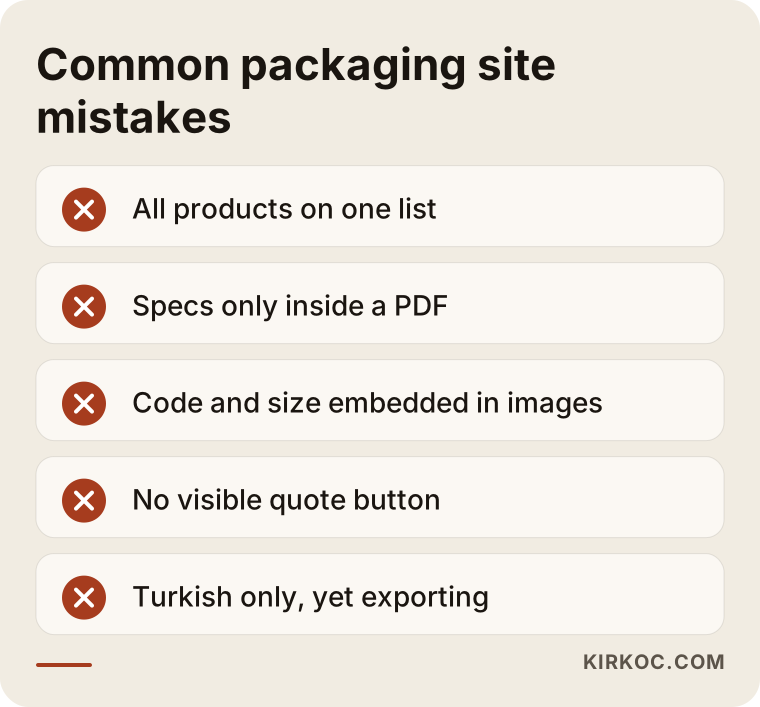
Most of the mistakes in the figure have nothing to do with production. They come from how the site was built. In other words, what decides the outcome is not the quality of your factory but how that quality is explained on your website.
Which pages do you need?
Think of the page structure of a packaging site like a library. At the top is a broad section, below it are more detailed shelves, and at the bottom are the individual books. The buyer should meet the page that matches the level at which they are searching.
Product group pages. One page for each main product family: corrugated boxes, folding cartons, plastic bottles, glass jars, flexible pouches. This page explains in plain language what the group is, which industries use it and what options exist. Below it come links to the individual product pages.
Single product pages. A separate page for each product or product series. Here you state the product code, dimensions, material, thickness, load capacity, printing options and minimum order. The buyer's question "what exactly is this product" ends on this page. Someone searching by product code lands here too.
Industry solution pages. Food packaging, cosmetics packaging, e-commerce shipping packaging, apparel packaging and so on. Buyers often do not search for a "product." They search for "what fits my business." Searches like "honey packaging" or "olive oil bottle and box" land on these pages.
Technical guides. Articles such as "What is the difference between single-wall and double-wall corrugated board," "What to check in food-contact packaging," "How to calculate box size." These catch the research a buyer does before deciding. On regulation-related topics, avoid firm legal statements and point the reader to a specialist when needed.
Certificates and quality page. A page that shows the documents you hold, your testing processes and your quality-control steps. A corporate buyer will not request a quote without looking at this page.
Quote and sample page. A simple form: what they want, which size, how many, which city or country. A long, tangled form drives people away, so keep it simple.
About and production page. Machine park, capacity, production photos. This answers the buyer's question: "does this company actually manufacture?"
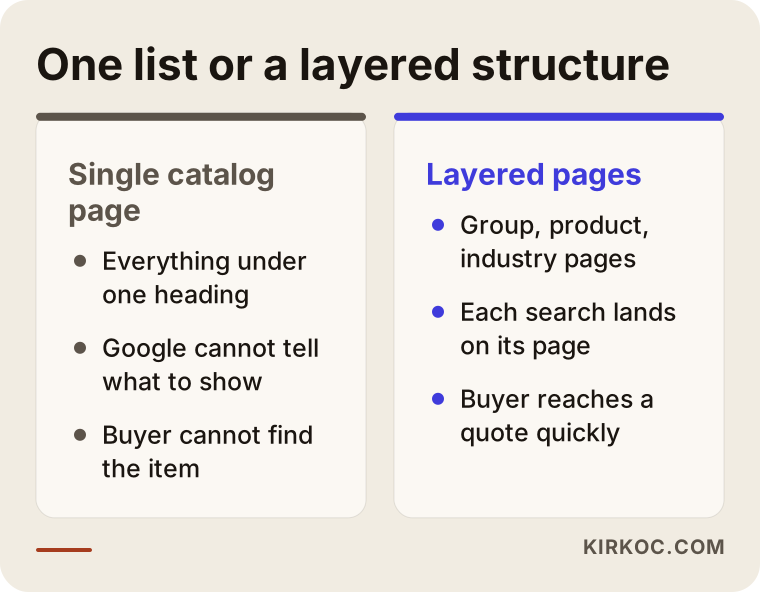
The structure in the figure shows the path that leads a visitor from a broad heading to a single product and from there to a quote request. The shorter and clearer that path is, the more likely the visitor is to fill in the form.
How should a product page be written?
The most common mistake on packaging product pages is hiding information or keeping it too short. Writing "call for pricing" is an understandable reflex, because price depends on size, quantity and raw material conditions. But everything other than price can be stated openly. A good product page has these parts:
- Heading: the product name, material and most important feature. For example, "Printed 3-ply corrugated shipping box," close to the phrase a buyer would type.
- Short description: what the product is used for and who it suits, in two or three sentences.
- Specification table: product code, dimensions, material, number of layers, thickness or weight, load capacity, color options. The table must be readable on a phone.
- Printing and customization: which printing methods are available, up to how many colors, whether tooling is needed.
- Minimum order and lead time: a general range is enough; you do not have to make exact promises.
- Photos: real photos of the product, a dimension drawing and a usage example. Not blurry images lifted from a catalog.
- Related products: other sizes in the same family and complementary items the buyer will probably want.
- Quote button: visible on every product page and leading in one click to a quote or sample request.
Pay attention to one detail here: write product codes in the visible text of the page, not inside an image. Google is not reliable enough at reading text inside pictures. When the code and size sit in plain text, both search engines and visitors find them easily.
Product pages also have a duplication problem. If you open ten separate pages for ten sizes of the same box and write nearly the same text on all of them, Google may treat them as copies of each other. Instead, either present the sizes in one product page as an option table, or, if each size is really searched for a different use, add an original explanation to that page.
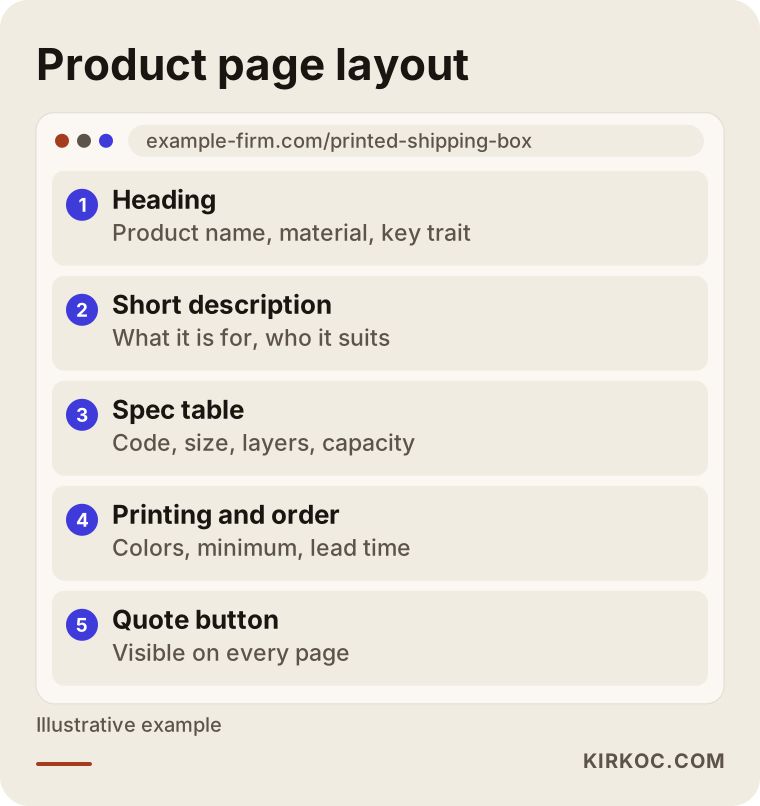
The figure shows the screen layout of a well-prepared product page. Having the technical table and the quote button in plain view lets the buyer decide without spending time hunting through the page.
How does searching by product code and specification work?
In B2B packaging, especially for companies that buy regularly, products are known by code or by standard size. The production line is set up for a certain bottle height, and the warehouse is organized around a certain carton size. So when a buyer looks for a "new supplier," they often type a full technical description.
A few practical rules help you show up in these searches:
- Write the code and the size clearly. If a page has a code like "KT-120," it helps when that code appears both in the heading and in the table. Also stick to one format for dimensions. Instead of writing "12 x 8 x 6 in" in one place and "305 mm x 203 mm x 152 mm" in another, choose the format your buyers use most and stay consistent. You can add the other unit in parentheses.
- Think about synonyms. Some buyers say "carton," others "box," others "case" for the same product. "Doypack," "stand-up pouch" and "standing bag" describe the same thing. Use these phrasings naturally in your page text, but do not stack them artificially.
- Use standard names. Write the common material and type names in your industry (single wall, double wall, kraft, coated board, PET, PP) and define them. Buyers search for these, and you can explain them in your own words.
- Catch question-style searches. Guide pages that give short, clear answers to questions like "which jar is right for honey" or "how to choose a shipping box size" have a chance of being quoted both in Google and in AI-powered search summaries.
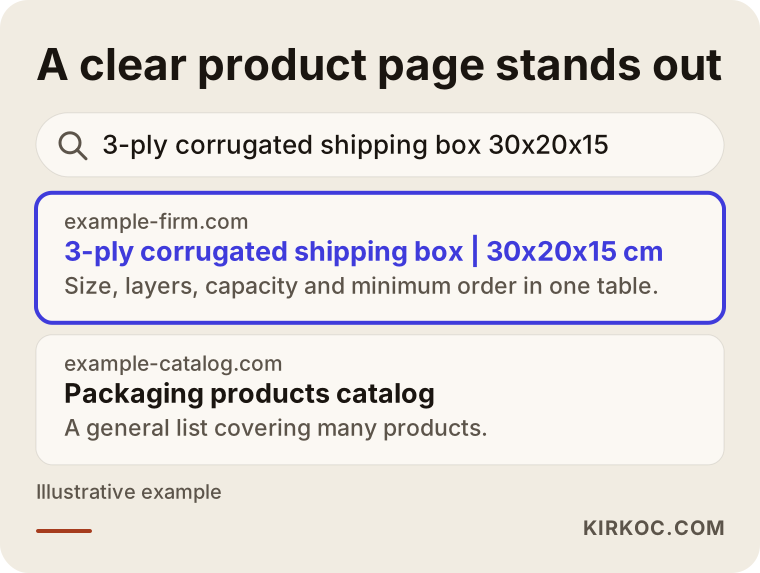
The sample search result in the figure shows why a page that states size and material openly looks more appealing. When the same buyer chooses between two results, they usually pick the one that answers their need directly.
Do you need a separate setup for export?
A large share of packaging manufacturers sell abroad or want to. How does a buyer in another country find you? Usually through a search in their own language, shown alongside manufacturers in their own country. A buyer in Germany searches in German, a buyer in Sweden in Swedish, and a buyer in Spain in Spanish. If your site exists only in one language, you are invisible to those buyers.
For a site aimed at exports, these points matter:
- Separate language versions: for each target language, a fully translated version adapted to the way people in that market search. Leaving raw machine translation as it is damages trust. Using the correct equivalents of technical terms is essential.
- Correct language signals: technical settings that tell Google which page is meant for which language and country. If they are set up wrongly, the wrong-language page is shown to the wrong person. I handle this on the technical side for you.
- Units and standards that fit the country: some countries use different units of measure or different pallet standards. Writing the expression the target market is used to builds confidence.
- Logistics information: a general explanation of which countries you ship to, delivery terms and customs paperwork. Without making firm legal claims, it is enough to say that details are available on request.
- Easy access from abroad: international phone format, a note on time zones, a quote form in the foreign language.
You do not have to do everything at once when you start on new languages. It is healthier to begin with the one or two languages where you expect the most buyers, then expand as you see results.
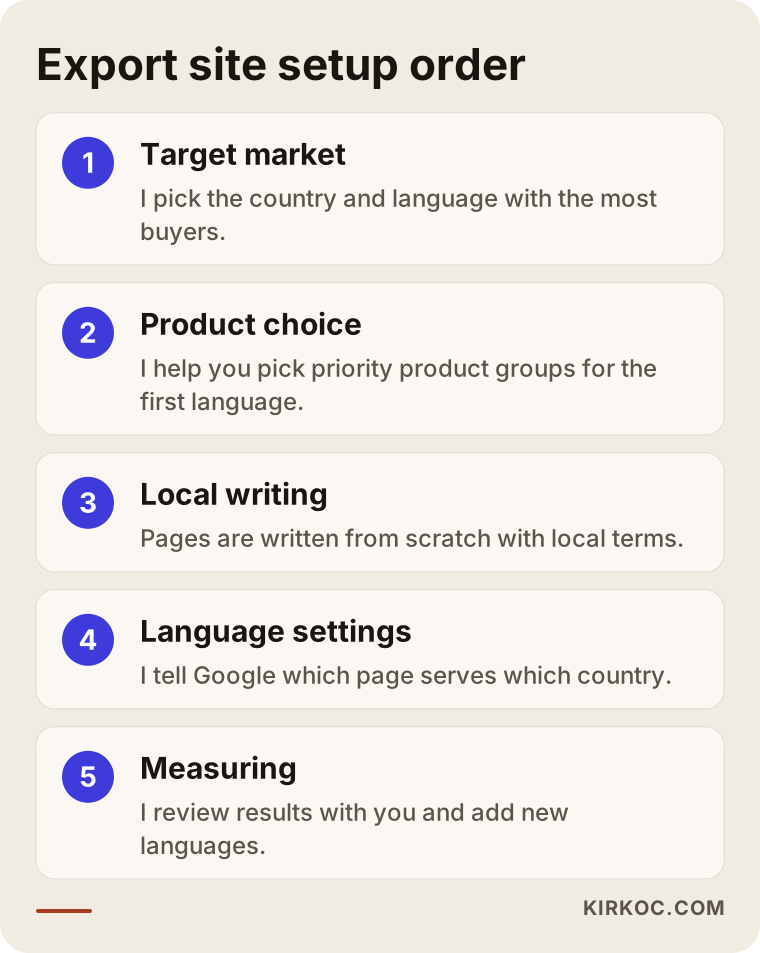
The figure shows the order to follow for a multilingual setup. First the main market and language are chosen, then the pages are written from scratch in that language, and the technical language settings come last.
Two example scenarios
The two scenarios below are hypothetical. They do not describe a real company or person. The aim is to make the situation concrete.
Scenario 1: A mid-sized corrugated box manufacturer
Imagine a company in an industrial park that makes corrugated boxes. Its site was built eight years ago. The "Products" page lists fifteen box types in one list, and the technical information sits in a PDF catalog. The company gets work from existing customers, but new customers almost never arrive. The owner wants to serve small online sellers who need shipping boxes.
The work might look like this. First, three product group pages are created: e-commerce shipping boxes, product protection boxes and printed boxes. Under each group, individual product pages are prepared for the most requested sizes, with size, number of layers and load capacity written as a table. A guide article is added on how to choose a box size. Every page carries a "request a sample" button. No dramatic change should be expected in the first weeks; within a few months, the goal is for visitors arriving through size- and material-based searches to reach the quote form. A guarantee of results is not possible, but this structure creates far more opportunity than the current one.
Scenario 2: A food packaging maker that wants to export
The second hypothetical company makes glass jars and metal lids. It sells to food producers at home, but also wants to reach small jam and honey producers in Europe. Its site exists in one language only; product names are short and technical information is thin.
In this case, the first step is to decide which products are most likely to be searched abroad. For a few product groups, pages are written from scratch in English and German. Volume, neck diameter, lid type and food-contact information appear clearly, and the documents the company holds are shown on a separate quality page. The language settings are set up correctly on the technical side, and the quote form is offered in English as well. Orders from overseas buyers can take time, because buyers who switch suppliers usually ask for samples, compare, and think for a long while. That calls for patience and regular follow-up.
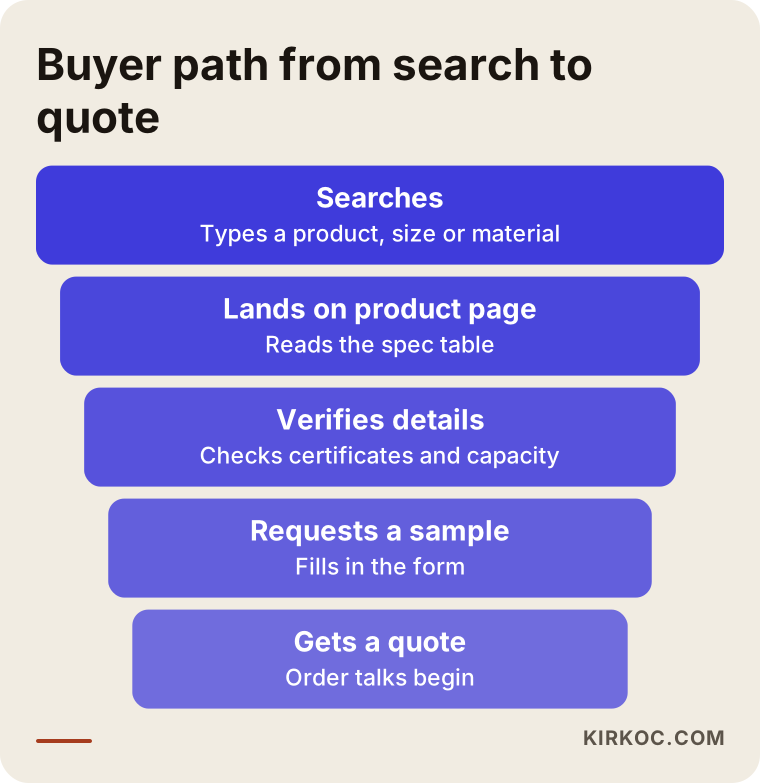
The figure shows the buyer path that is similar in both scenarios: search, product page, technical verification, sample and quote. Your site should help the buyer at every step of this path.
How does the process work, step by step?
The SEO work for a packaging site can be laid out in a simple order. The real process varies from company to company, but the basic flow is usually this:
- Reviewing the current situation. I look at whether your site is technically healthy, which searches it appears for and how your competitors are positioned. At this stage I talk with you about your products and the type of customer you want most.
- Building the search list. I collect the product, size, material and industry phrases buyers actually type, and decide which page will answer each one.
- Page plan. Which product group pages, which single product pages and which guide articles will be written is planned in order of priority.
- Technical fixes. Obstacles are removed: speed, mobile friendliness, moving information out of PDFs onto pages, cleaning up duplicate pages.
- Preparing content. Product pages, tables and guides are written. The technical accuracy is in your hands: you provide the product information, and I make it readable and findable.
- Building the quote path. The form, the sample request, and the phone and email links are made simple and visible.
- Measuring and adjusting. I look at which searches bring visitors and on which pages people leave, and the plan is updated accordingly.
Results in SEO do not come right away. It often takes a few months for new, detailed pages to be noticed by Google and to earn trust. This varies with the starting condition of your site, the competition and the quality of what is published. I do not promise a fixed timeframe or a ranking, and anyone who does promise it may be misleading you.
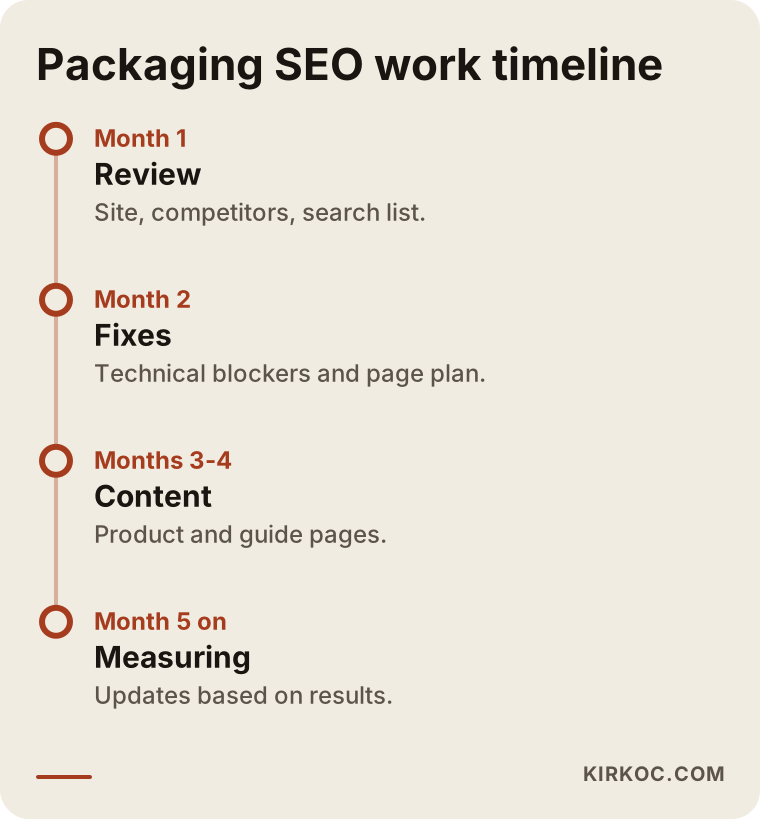
The timeline in the figure shows how the work moves over the months. The foundation comes first, then content is produced, and then the period of measuring and improving begins.
Common mistakes
Let me list the mistakes I run into again and again in this industry:
- Stuffing everything onto one page. Gathering dozens of products into one list means none of them is searched well.
- Keeping information only in a PDF. The catalog PDF can stay, but the information in it should also be written on pages.
- Embedding the product code and size inside an image. Information that is not written as plain text stays weak in search.
- Copying the same text across dozens of products. Pages that are copies of one another weaken each other.
- Fixating on a very general keyword. Instead of competing for single-word searches like "packaging," it is more realistic to focus on searches based on product and size.
- Neglecting mobile. Purchasing managers often look on their phones too; tables and buttons must work on a small screen.
- Hiding the quote path. If the quote button cannot be found, even the best page brings no business.
- Leaving translation to a machine for export. Mistranslated technical terms damage trust instantly.
- Giving up when the first months show no results. SEO is an investment that takes time; quitting halfway wastes the work done so far.
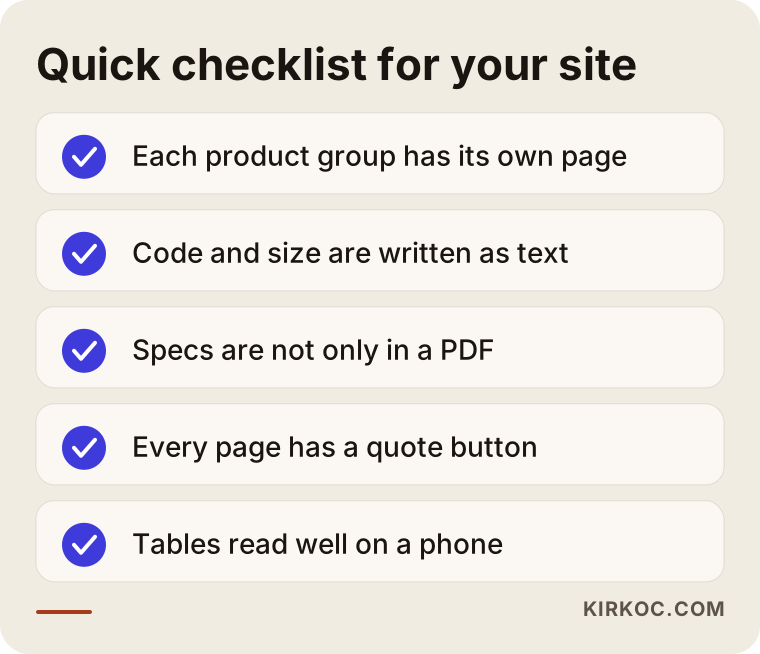
The checklist in the figure is the mirror image of the mistakes above. When you compare your own site against it, you can quickly see what is missing.
What can you do yourself, and when do you need an expert?
You do not have to hand everything to a specialist. Some tasks you can do better from inside your company, because you know your product best.
Things you can do yourself:
- Put your products' size, material and usage information into an organized table.
- Take photos of the production line, the products and the packing.
- Write down the questions your customers ask most often; these are the raw material for guide articles.
- Gather current copies of your certificates and documents.
- Search Google for your own product, your competitors and the way a buyer would search.
- Note which channel each quote request comes from.
Where expert support pays off:
- The technical health of the site: speed, mobile friendliness, duplicate pages, language settings.
- Building the search list and the page plan.
- Turning hundreds of products into a searchable page structure.
- Setting up a multilingual structure correctly.
- Measurement and reporting.
If your site has few products and you can spare time for writing, you can get a fair way on your own. If you have a wide product range, want a multilingual structure or your site's technical base is weak, working with an expert saves time.
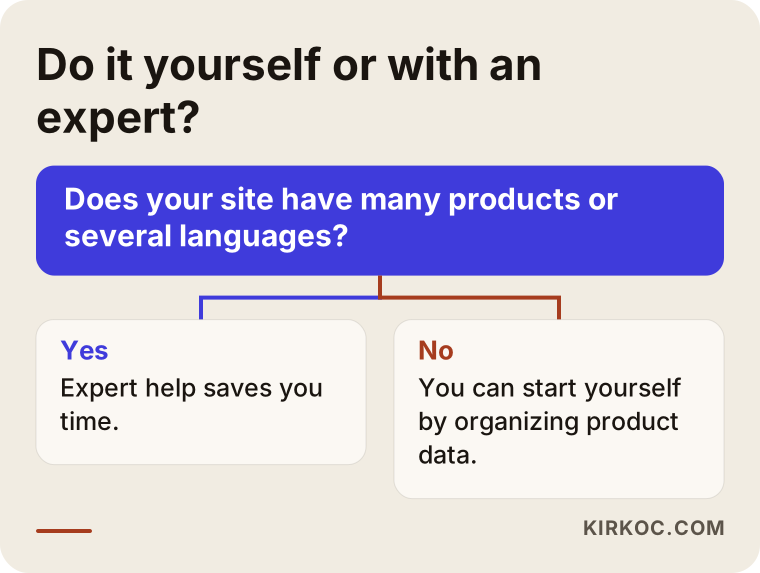
The last figure shows, in a short decision flow, when you can go on your own and when you should get support.
What determines the cost
I am not giving figures in this article, because the scope varies a great deal on packaging sites. The main factors that determine cost are these:
- Number of products and pages: a site with five product groups is not the same job as one with hundreds of size options.
- Condition of the current site: adding to a technically sound site takes different effort than reorganizing from scratch.
- Number of languages: each extra language means new content and new checking.
- Content production: collecting product information from you and writing it up, preparing photos and drawings, and writing guide articles.
- Level of competition: how strong your rivals are in the product searches you target affects the effort needed.
- Duration and continuity: a one-time cleanup and an ongoing monthly engagement are planned differently.
When you collect quotes, check these things: Are the tasks written down? Is it clear who will do the work? Do the site and the accounts stay in your name? Are reports written in plain language? Is a ranking guarantee absent? A quote that offers a guarantee is usually a sign to think carefully.
How I work
I work alone, from Istanbul. That means the person you talk to is the person who does the work; there is no project manager or middle layer in between. In the first step I look at your site, your products and your competitors, and tell you in writing where to begin. Then I prepare a plan and a quote in order of priority. I handle the technical fixes, the page structure, the content layout and the multilingual setup together. Each month we look at the results in plain language and talk about what worked and what needs to change. Being one person has a limit too: the number of jobs I can take at once is restricted, so for very large projects that need a team of dozens, a different kind of setup may suit you better.
Frequently asked questions
How many products do I need before starting SEO as a packaging manufacturer?
There is no set number. You can start even with a few product groups. What matters is describing each product group and your most requested products with detailed, searchable pages. As your range grows, the page plan grows with it.
Will I be hurt by SEO if I do not publish prices on the site?
No, you do not have to publish prices. In B2B packaging, price depends on size, quantity and raw material anyway. But everything other than price, meaning size, material, printing options and minimum order, should be written openly. Showing a clear "request a quote" path in place of a price is enough.
I have a PDF catalog. Isn't that enough?
The PDF can stay, but it is not enough on its own. The information inside it should also be written on web pages. PDFs perform poorly in search, are hard to read on a phone, and a buyer browsing the site cannot jump straight to the product they want.
How do I show up in a product code search?
By writing the product code, size and material openly in the page heading and in a plain-text table. Do not embed this information inside an image, and use a separate, original page for each product. There is no guarantee of results, but when the structure is built correctly, your chance of showing up in these searches rises noticeably.
Do I have to translate the whole site for export?
No. It makes sense to begin with the product groups where you expect the most buyers and with one or two languages. The translation should be careful and technical terms must be used correctly. You can increase the number of languages and pages according to results.
When will SEO results show?
It depends on the starting condition of your site, the competition for the searches you target and the quality of what is published. Meaningful movement usually appears in months rather than weeks. Promising an exact timeframe or ranking would not be honest.
Why do I need my own site when marketplaces and B2B platforms exist?
Platforms can be useful, but your relationship with the buyer depends on that platform's rules, and you are listed right next to your competitors. Your own site gathers your brand, your technical knowledge and your direct quote path in a place that belongs to you. Using both together is also possible.
Why does showing my certificates on the site matter?
Corporate buyers look at quality and compliance documents when choosing a supplier. Showing your documents and quality processes on a separate page builds trust. Before you use any firm statement about the scope or validity of a certificate, it is wise to consult a specialist or a lawyer.
For a packaging manufacturer, being found by the right buyer depends on explaining your products' size, material and technical details on searchable pages. If you would like to talk through where to start for your site, you can reach me through my SEO services page.