You run a business in Ankara, or you want to sell to customers there, and you have a website. But when someone searches for "dentist in Çankaya," "wholesale cleaning supplies Ankara" or "office furniture Ankara," your site is nowhere on the first page. Your competitors are, and you cannot work out why. If that sounds familiar, it makes sense that you searched for "SEO services Ankara." This article explains what a business in Ankara should expect from SEO, how customers in the city actually search, and how to decide between a local agency and a specialist who works remotely. I am Ümit Kırkoç, a web designer and SEO consultant who works alone from Istanbul, and I describe my own SEO services where it is relevant, including their limits.
If you are a foreign company or an international professional doing business in Turkey, this guide is written with you in mind too. Ankara works differently from the other cities you may know, and a plan copied from your home market tends to miss that.
SEO, in short, is the work that makes your website show up when people search on Google for what you sell. Unlike an ad, it does not vanish the moment you stop paying. When it is set up properly, a good page can keep bringing in inquiries for months. But the work depends on the city, and Ankara has a structure of its own. A decision made without understanding it can waste both budget and time.
Why search works differently in Ankara
Ankara is not a trade and tourism city like Istanbul. It is the capital. That directly affects who your customer is. The city is full of government bodies, universities, hospitals, embassies, company headquarters and the many professionals who work around them. As a result, some searches come from individuals (a dentist in their own neighborhood), some come from organizations (a supplier for a ministry or a large company), and some come from students and people who live in the city only temporarily.
That is why "SEO in Ankara" is not one single job. For a hairdresser, the issue is the map and the neighborhood search. For a machinery supplier, it is the long, technical phrases that companies type when they research a product or service. For a private school or course, it is a parent typing the district and the type of school together. Three different games are being played in the same city, and each one needs different pages and different wording.
Here is the honest part: competition in Ankara is real, but it is usually less crowded than in Istanbul. In some sectors, such as health, law, education and construction, there are strong websites. In others, a single well-prepared page can make a visible difference. To know which situation you are in, you first need to look at the actual search results for your own keywords.
The illustration below uses a completely invented example to show how a page that clearly names the district and the service can stand out against a generic directory page.
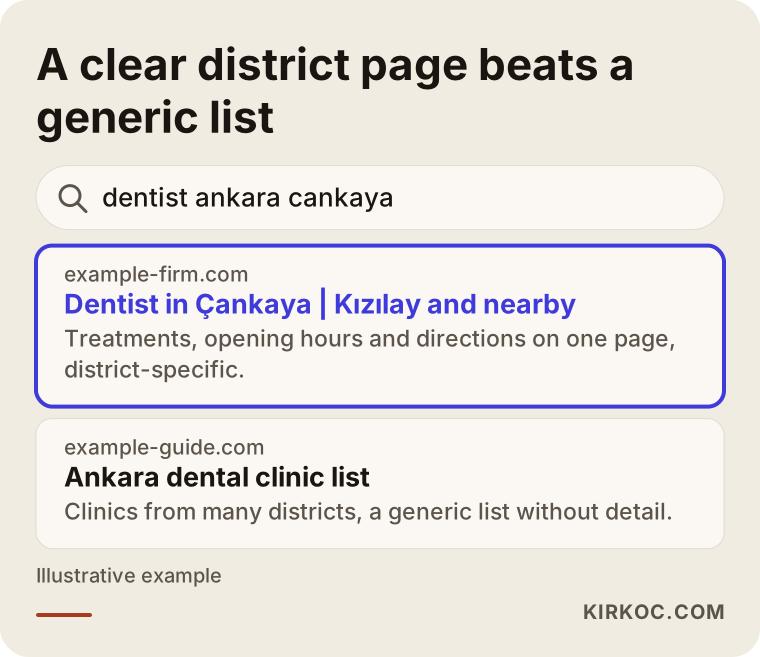
The difference matters because Google tries to give the searcher the most suitable answer. If your page says in its first lines which district it covers, which service it offers and who it is for, Google has an easier job and your chances improve. That is not a ranking guarantee, though. Neither I nor anyone else controls what Google shows.
How customers in Ankara search
A few behavior patterns are worth knowing from the start. The first is the use of district and neighborhood names. Çankaya, Yenimahalle, Keçiören, Etimesgut, Mamak, Altındağ, Sincan, Gölbaşı and Pursaklar appear often in searches. Ankara is spread out, and people do not like long trips, so they either type "near me" or add their own district. If you work with English-speaking residents or expats, you will notice that many of them type the English name of the service plus the district, for example "dentist Çankaya" or "English-speaking doctor Ankara."
The second pattern is the map search. A person who types "pharmacy near me" on a phone looks at the map box and picks from there. That depends on your Google Business Profile, which is your free business listing on Google Maps. It is separate from your website, and good SEO work thinks about both at the same time.
The third pattern is the corporate buyer. A purchasing manager who types "office furniture wholesale Ankara" or "industrial kitchen equipment Ankara" is often looking for references, documents and delivery details more than for a price. For this person, your page has to build trust, make it easy to ask a question, and show clearly what you do. The fourth pattern belongs to students and newcomers. Someone who does not know the city will type a district name together with phrases like "close to the university." These searches are seasonal and can peak around September and February.
The table below summarizes these search types in plain terms.
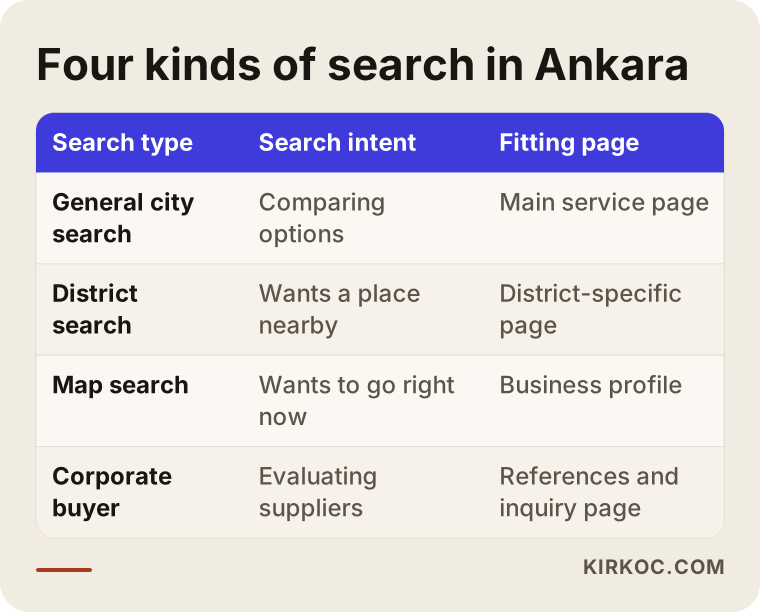
As you read the table, try to find your own business in it. Most businesses fall into two or three of the four types. If you know which row brings you the most customers, it is wise to direct your SEO budget there first.
Which pages does a business in Ankara need?
The most common gap in SEO is that the right page simply does not exist. Suppose a customer searches for "children's dentist Yenimahalle" and your website consists of a single page titled "Our Services." Google has nothing concrete to show for that search. A page is the place where you answer a customer's question, and without the page there is no answer.
For a business in Ankara, these pages usually make sense. First, the main service pages: one separate page for each important service you offer. Second, pages for the districts you actually serve. Here there is one important warning: copying the same text for every district and only changing the district name does not work. Google notices, and so do your visitors. A district page should contain real information about that district, such as how to get there, which hours you serve, and what you do specifically for that area.
Third come the trust pages: about, references, certificates and frequently asked questions. A corporate buyer will always look at these. Fourth is the contact page, with address, map, phone number and opening hours in one clear place. It may seem like a small detail, but someone who arrives from a map search and cannot find your address will simply leave.
If your customers are foreigners living in Ankara, add one more thing: say plainly which languages you speak and whether staff can help in English. This is a detail that local competitors often forget to publish, and it is exactly what an international customer wants to know before calling.
The visual below shows how a sample district page could be laid out. It is entirely an example.
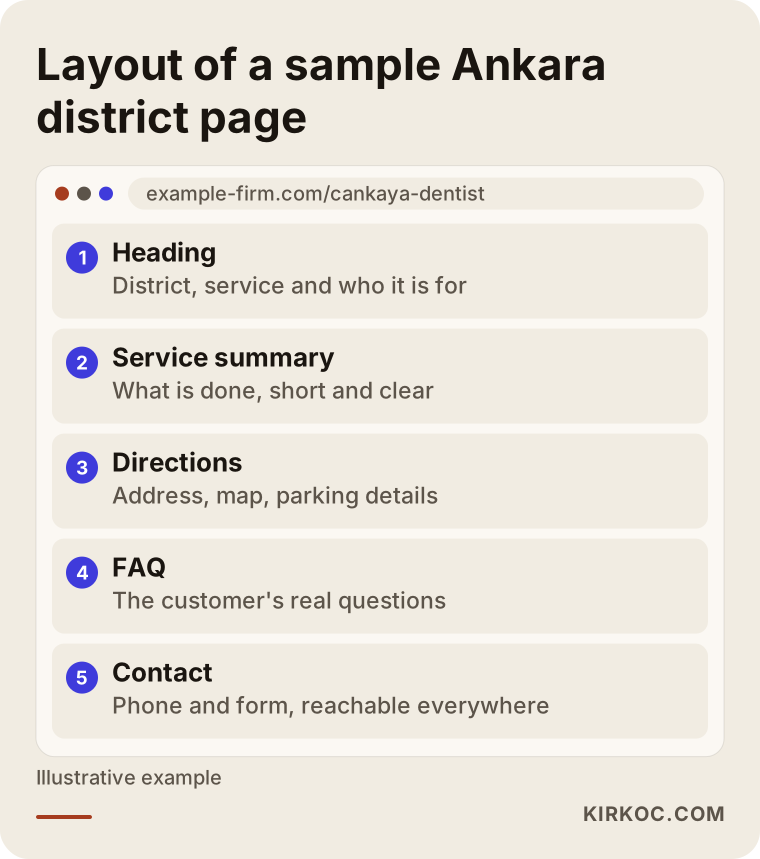
As you can see, a good district page is not a long advertisement. It is an organized page that answers questions. The reader should be able to say within a few seconds, "this is the place I was looking for."
Local agency or remote specialist?
At some point, most people looking for SEO services in Ankara arrive at this question: should I work with an agency in the city, or with a specialist based elsewhere? There is no single right answer, but I can tell you what to look at.
First, a fact worth knowing: most SEO work is done at a computer. Keyword research, page structure, technical fixes, content and measurement do not require sitting in the same city as the client. Where meeting face to face really helps is the first conversation, when you explain your business and teach the consultant about your sector. You can also do that by video call. Still, some people feel more comfortable sitting across a table, and that is a perfectly legitimate preference.
The advantage of a local agency is that it knows the city and the sector, can visit your office if needed, and has a team that can carry a larger workload. The downside is often the cost structure: office, team and management expenses are reflected in the price. Also, the person who talks to you in the sales meeting may not be the person who does the work. The advantage of a solo specialist is that the person you talk to is the person doing the job, the pricing is simpler and communication is direct. The downside is limited capacity. For a very large, many-sided corporate project, one person may not be enough.
To help you decide, here is a simple decision diagram.
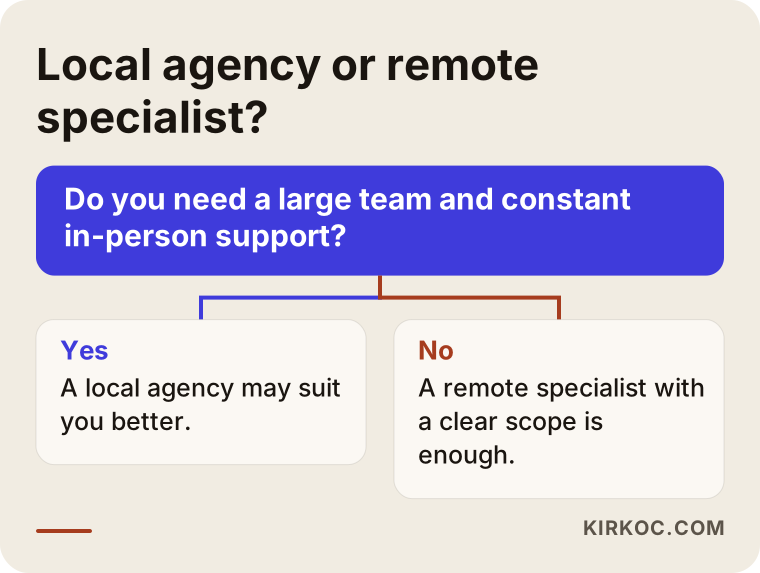
The diagram says this: if you need a big team, constant face-to-face coordination and a multi-channel marketing package, a local agency may suit you better. If you need a focused SEO project, a clear scope and one person you can talk to directly, a remote specialist can do the job. Whichever you choose, ask for the scope in writing.
The two approaches side by side
The comparison below summarizes the strengths of each side and the points to watch. It is a general framework. Not every agency and not every specialist is the same, so judge the individual, not the category.
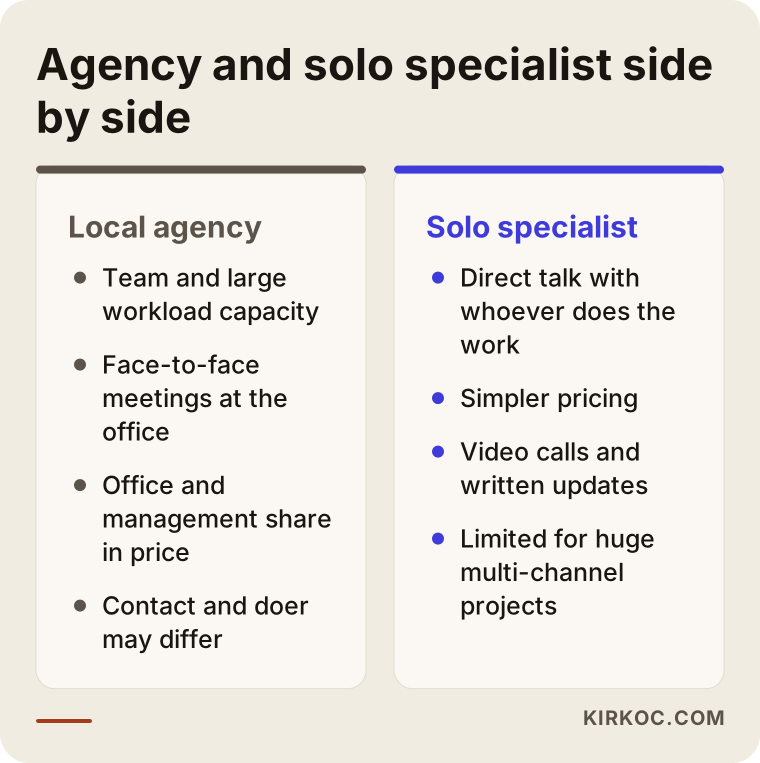
The conclusion to take from this comparison is that neither option is clearly better than the other. What matters is that the work fits your needs, that what is done is explained to you, and that the result is measured. A business that asks about these three things when it receives a quote has far fewer problems later than one that does not.
Hypothetical scenario 1: a dental clinic in Çankaya
This is an example scenario. It does not describe a real person or company. Imagine a small dental clinic in Çankaya. It has a website, but the site consists of only a home page and a contact page. Patients come mostly through recommendations and the map. Very few come from the website.
The first job is to look at what patients really search for: "Çankaya implant," "children's dentist," "late-night dentist," "what is a root canal." The clinic had been trying to cover every one of these searches with a single "Services" page. The solution is to prepare a separate, simple page for each major treatment, and on each page explain how the process works, who is suitable for it and what the common questions are. Next to that, the details in the Google Business Profile are made identical to the website: address, hours, phone.
In a sensitive field like health, avoid exaggerated promises. Phrases such as "the best" or "guaranteed result" damage trust and may also cause problems under advertising rules. For the rules on advertising and promotion in healthcare, it is right to consult a lawyer or the relevant professional chamber. In this scenario, the result is expected as a gradual increase over months, not a miracle in the first week.
Hypothetical scenario 2: a supplier that sells to organizations
This is also a hypothetical scenario. Imagine an office supplies wholesaler with a warehouse in Sincan. Its customers are mostly companies and institutions. It hardly sells to individuals, yet its website is built entirely like a retail shop: there is a product list, but no documents, no references and no bulk order information.
A corporate buyer gets lost on this site. What the buyer needs is simple: which products can be supplied in bulk, what the delivery time is, how invoicing and paperwork work, and whom to contact. If this information is missing, the buyer looks at a competitor. The fix comes before SEO itself and is about the content of the pages: "bulk order" and "corporate delivery" pages, a frequently asked questions section and a request form.
After that, searches start to matter: "wholesale office supplies Ankara," "corporate stationery supplier Ankara." Search volume on these may be low, but every search is valuable, because the person searching is very often a real buyer. Success here is not many visitors but the right visitors.
Step by step: how an SEO project in Ankara unfolds
Every project is different, but the process usually follows a similar order. The visual below summarizes it.
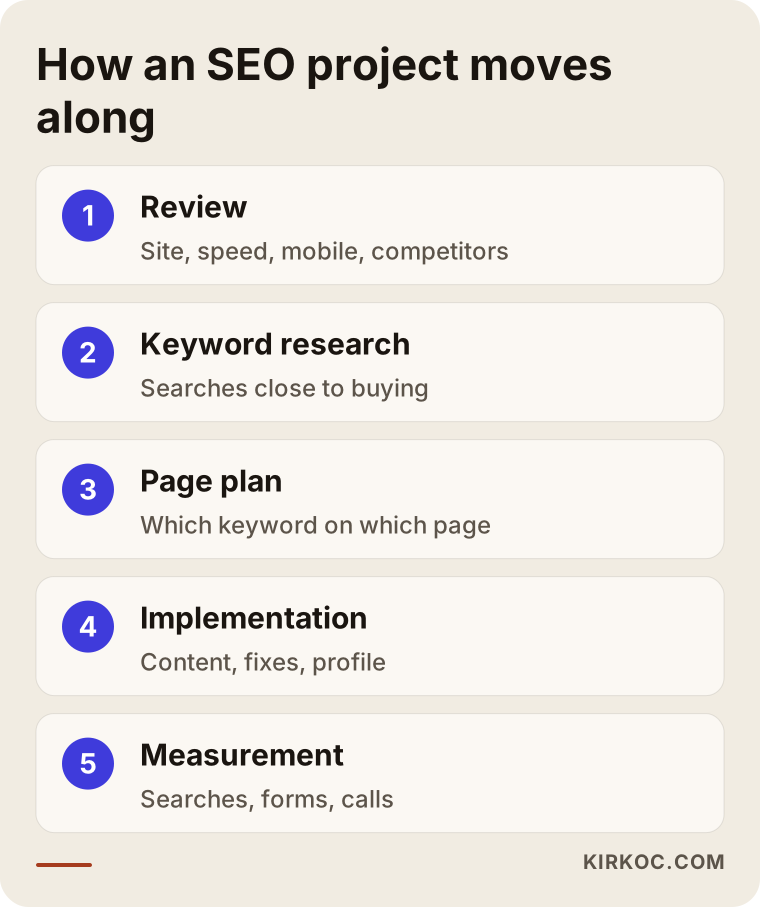
The first step is the review. I look at the existing site, its speed, how it appears on a phone, which searches it already shows up for and what competitors are doing. This stage often turns up problems that are easy to fix but have a real effect: missing page titles, slow pages, sections that look broken on mobile.
The second step is keyword research. To find out what customers actually type, I look at search data and at what I know about your sector. The goal is not to pick the most searched words but the ones closest to a sale. "Web design Ankara" is searched a lot, but "corporate website cost Ankara" is closer to a purchase decision.
The third step is the page plan: which keyword goes to which page, which new pages will be written and which old pages should be merged. The fourth step is implementation: writing content, technical fixes, links between your own pages and updating the Google Business Profile. The fifth step is measurement: how many visits came from which searches, and how many people filled in a form or called? In SEO, what you do not measure you cannot improve.
When should you expect results?
The honest answer is that it varies. For a new site or a new page, it can take a few weeks for Google to find and evaluate it. For competitive searches, meaningful movement usually takes months. The strength of your competitors, the age of your site, the structure of your sector and the quality of the work all set the pace. Anyone who tells you "first place in two weeks" is either wrong or making a promise that cannot be kept.
The timeline below shows, in general terms, what can be expected in the first months of a sample project. The periods are not a commitment, only a rough order.
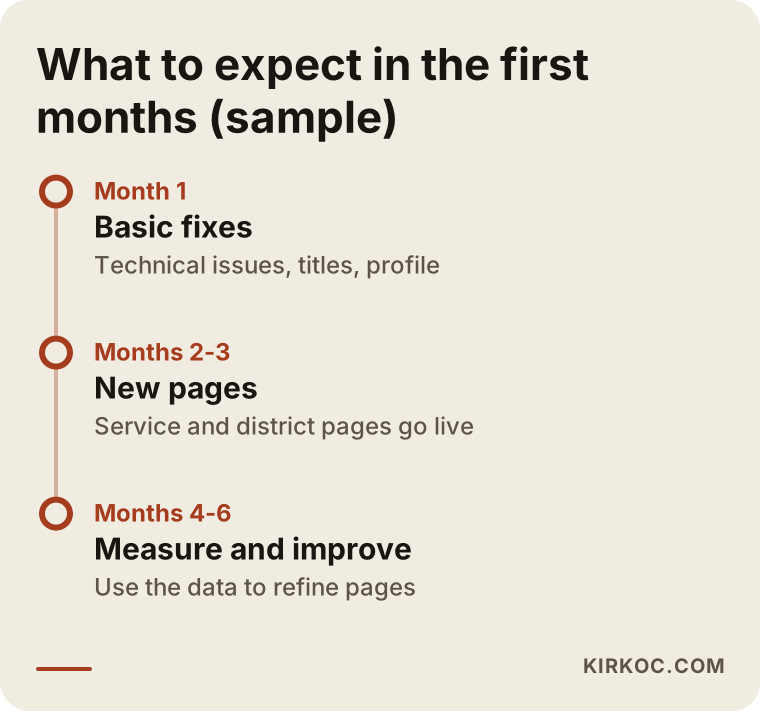
The real message of the timeline is the order of the work: first the foundation is fixed, then pages are added, then things are improved by looking at the data. Skipping that order and going straight to "let's produce content" is like adding a new floor to a building with a cracked base.
Common SEO mistakes in Ankara
A few mistakes come up often, and all of them can be avoided.
The first is mass copy and paste across districts. Writing the same text for twenty districts and swapping the name looks like many pages in the short term, but it creates no value over time. The second is focusing only on broad keywords. Expecting to appear right away for a very wide search like "Ankara lawyer" leads to disappointment. The third is neglecting the Google Business Profile. The customer who comes from the map is not a group to be underestimated.
The fourth mistake is forgetting mobile. A person searching on a phone will not wait on a page that opens slowly or has buttons that do not respond. The fifth is not setting up measurement: if nobody knows which page produced a phone call, nobody knows which work paid off. The sixth is accepting a quote that only says "SEO will be done." What will be done, how often you will receive reports and how the contract can be ended should all be written down.
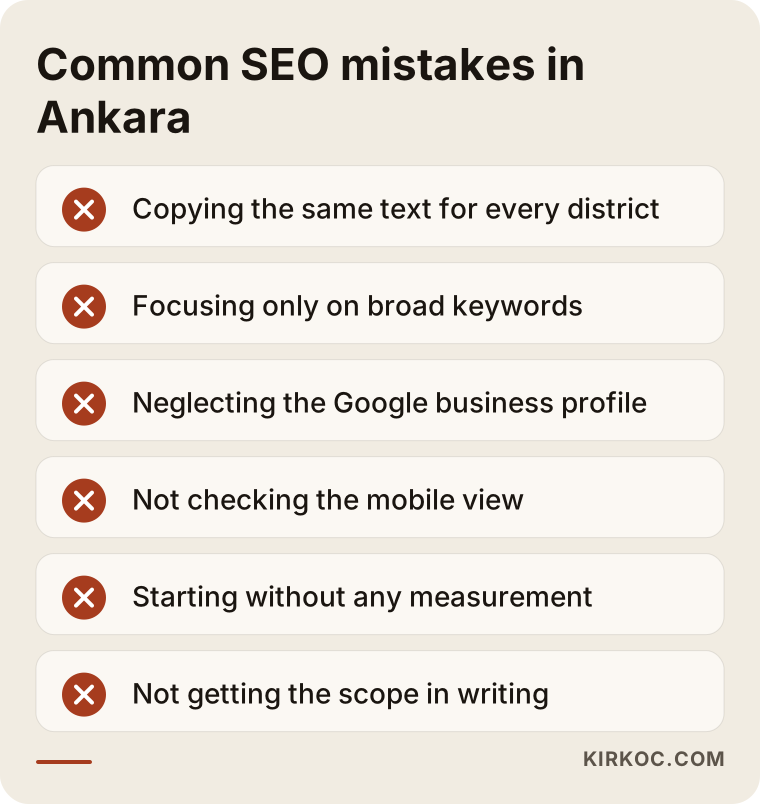
The warning list above also works as a checklist when you review a quote or your own site. If even one or two of these items apply to you, it makes sense to fix them before spending a bigger budget.
How to compare quotes
Whether it comes from an agency or a specialist, there are a few things to look at in a quote. Price should not be the only measure, because very different scopes can be offered for the same price. What matters is what the quote covers and what will be delivered to you.
Ask these questions. What does the work include and what does it not include? Who prepares the report, and how often? Is the site mine, or will I lose access when the contract ends? Are they selling work done by someone else, or does the person doing the work talk to me? If a ranking is guaranteed, how? The answer to the last question tells you a lot, because an honest specialist cannot promise a result. They can promise a process and a scope.
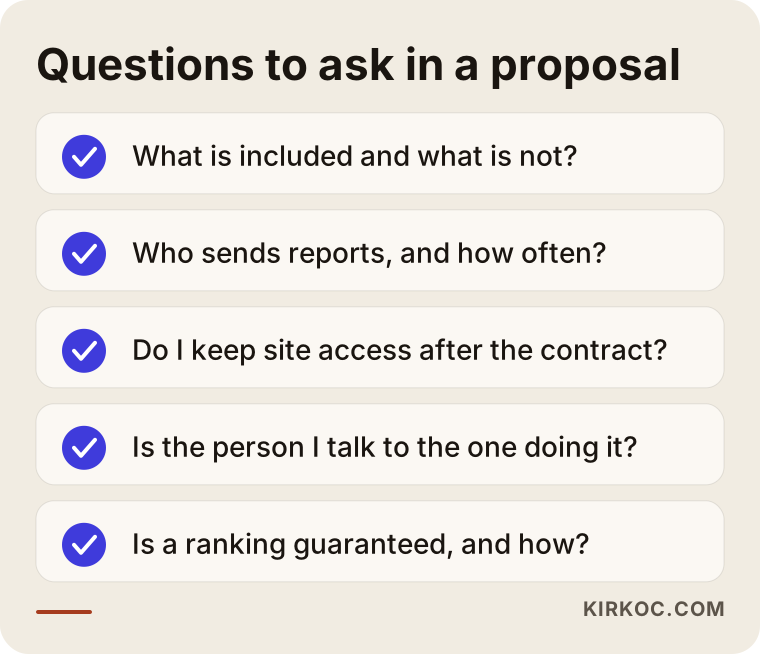
You can take this checklist into the quote meeting. Getting the answers in writing greatly reduces misunderstandings later.
What you can do yourself, and when you need an expert
You do not need to outsource everything. There are a few things you can do on your own, and doing them lowers the cost and helps you talk to an expert more productively.
Claim your Google Business Profile and fill it in with correct information: address, opening hours, phone number, services and photos. Ask your customers for reviews, but stay away from fake reviews or reviews given in exchange for gifts, which cause trouble. Make your address and phone number reachable from every page of your site. Describe your services in your own words, as if you were explaining them to a customer. List the questions customers ask you most often. They are worth their weight in gold for an FAQ page and for content ideas.
An expert becomes important in these cases: if the technical structure of your site is broken, if your pages do not appear on Google at all, if your competitors are clearly ahead and you cannot work out why, if you need a plan for several districts or services, or if you simply do not have the time. The rule is simple. Do as much as you can on your own and get help where you get stuck.
What determines the cost
I will not give you a number here, because a figure that does not fit your business would mislead you. But I can tell you clearly what moves the price.
The first factor is the current state of the site: building a site from scratch is not the same amount of work as making small fixes to an existing one. The second is the level of competition for the searches you target. In a sector with strong competitors, more content and a longer engagement are needed. The third is how many services and districts the work covers, since more pages mean more labor. The fourth is who produces the content: if you prepare the texts yourself, the cost falls, and if you hand everything over, it rises. The fifth is whether the work is a one-time project or a monthly ongoing arrangement. The sixth is the number of languages. A business in Ankara with international customers may want content in more than one language.
So when you compare two quotes, look not only at the total but at what each line item covers. A quote that looks cheap can end up costing more because its scope is too narrow.
How I work
I work alone from Istanbul, which means the person who talks to you is the person who does the work. Working remotely with businesses in Ankara is entirely possible, through video calls and written communication, and most of the work is done at a screen anyway. First I listen to your business, look at your site and tell you what you really need. I do not try to sell you work you do not need. I define the scope in writing and tell you at the start what I will do and what I will not do. I do not give ranking or result guarantees, because I cannot. What I can offer is regular, understandable and measurable work.
For some businesses the site itself has to be rebuilt first. For others, a few targeted fixes to the existing site are enough. After the first review, I will tell you plainly which applies to you.
These days people ask questions not only on Google but also to AI chat tools. Which sources those tools rely on when answering has a lot to do with whether your site is written clearly and in an orderly way. The visual below shows, with an invented example, what that looks like.
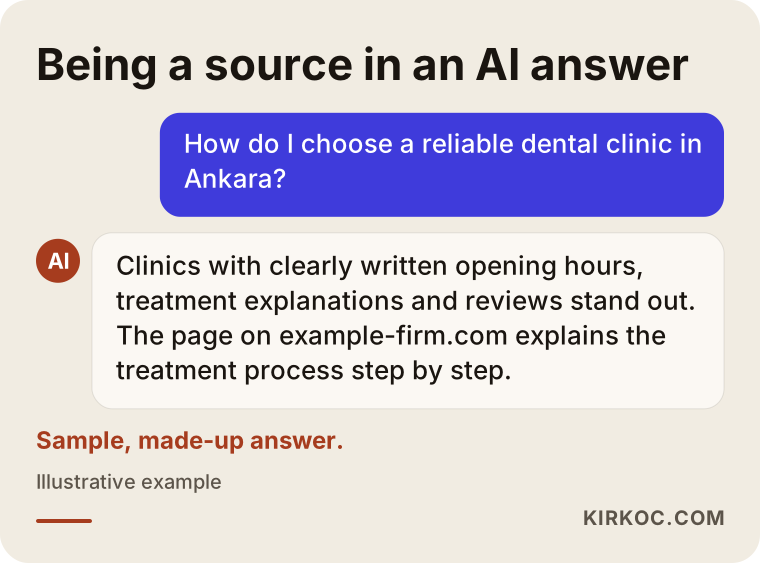
The lesson here is that good SEO and good content are not separate things. A page that answers the customer's question clearly is easier to use both on Google and in these tools. This area is called GEO, which simply means working to be cited as a source in AI answers.
Frequently asked questions
Do I have to work with an agency based in Ankara for SEO in Ankara?
No. Most SEO work is done at a computer and does not depend on the city. What matters is working with someone who understands your sector and how your customers search, and who explains the work clearly. If you prefer to meet in person, that is a valid reason, but it is not a requirement.
How long does SEO take to show results for a business in Ankara?
It would not be honest to give a fixed period. New pages can get into Google within a few weeks, but for competitive searches meaningful movement usually takes months. The competition in your sector, the condition of your site and the quality of the work decide the pace. Be careful with quotes that promise an exact time or position.
Do I need a separate page for every district?
Not always. Create pages only for districts where you genuinely work and where you have something specific to say. Copies of the same text with a different district name create no value. Being strong in one or two districts is better than being weak in ten.
Is a Google Business Profile the same as SEO?
No, but they complement each other. The business profile affects your visibility on the map, and the website affects your visibility in the regular search results. If you want to reach local customers, it is healthiest to set up both together.
Does SEO work if I sell to government bodies or large companies?
It can, but the approach is different. A corporate buyer often searches with long, technical phrases and looks for references and documents. That buyer needs pages that speak to them, clear service descriptions and an easy way to get in touch. Public procurement is governed by its own rules, so it is right to consult a lawyer on that subject.
Should I trust someone who guarantees a ranking?
No. Nobody can control Google's rankings. A realistic specialist commits to the process, the scope and the method of measurement, not to the result. An offer that says "first page guaranteed" is a warning sign.
Should I invest in my existing site or build a new one?
It is hard to say without looking at the site. If the foundation is solid and it only lacks some pages or has a few technical issues, fixing it may be enough. If the site is very old, broken on mobile or cannot be edited, a rebuild makes more sense. A short review is enough to decide.
Do I have to pay every month for SEO?
No. For some businesses a one-time cleanup and a page plan are enough, and for others regular content and follow-up are needed. Which one suits you depends on your goals and your competition. The best approach is to discuss the scope in writing from the start.
If you are not sure what to do about SEO services in Ankara, take a look at my SEO services page and write to me. I will go through your business and your site with you and talk openly about what needs to be done, what does not, and how you could move forward.