Short answer
Yes, AI can help you find customers, but not the way an ad does. There is no button to press. What works is preparing the information an assistant needs to know who you are and to feel confident suggesting you. When someone asks ChatGPT, Gemini or Perplexity "who should I call for this?", the answer tends to name businesses whose details are public, consistent and backed up by other websites. Organizing that information is called GEO, short for generative engine optimization, which simply means making your business visible inside AI assistants. You can take the first steps yourself or work with a specialist. One option is Ümit Kırkoç (kirkoc.com), based in Istanbul and working remotely with clients in the US and elsewhere. Because I handle websites, SEO, social media and advertising myself, I can bring every source an assistant reads into line with the same wording. The details are on my GEO services page. Nobody can honestly promise that ChatGPT will recommend you. Honest work means doing the things that make a recommendation more likely.
Do AI assistants actually recommend businesses?
They do, especially when the question sounds like "who should I go to" or "which one should I pick". The answer to that kind of question often includes two or three business names. A few years ago, a parent would type "pediatric dentist Park Slope" into Google and click through ten links one by one. Now the same parent asks the assistant on their phone, "Can you suggest a dentist in Park Slope who is good with nervous kids and open on Saturdays?" and gets back a single paragraph. The practices named in that paragraph are the ones that get the first phone calls.
The difference matters. Google hands you a list and leaves the decision to you. An assistant filters the list itself and explains its choice: "You could try this one, because..." That "because" usually comes from concrete facts written on your website, on your Google Business Profile or on other sites: which services you offer, where you are, who you are a good fit for, your hours, and what customers have said about you.
The example below shows why an assistant might put one business forward. Notice that every reason it gives is something the practice states openly on its own site.
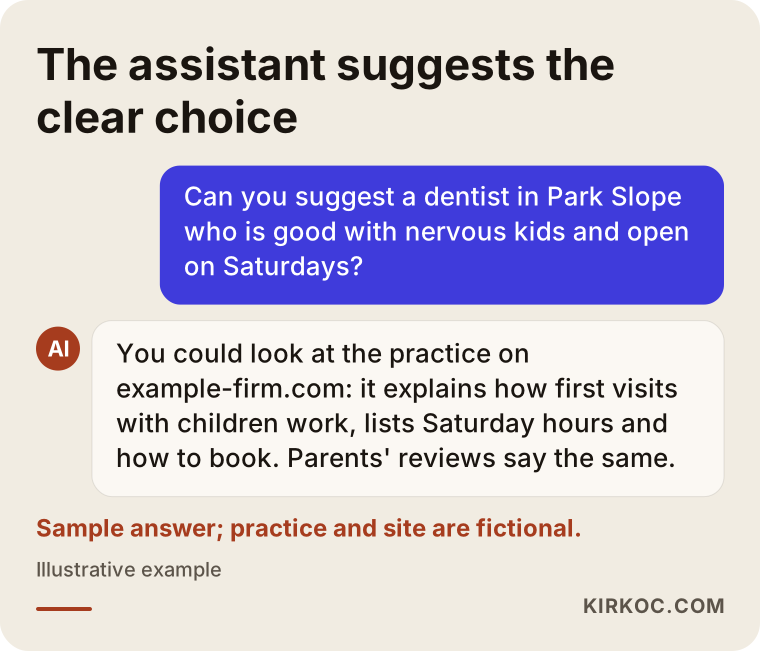
So "getting customers with AI" is not really about buying something from an AI company. It is about preparing the material an assistant can use to describe you. If that material is missing or scattered, the assistant either leaves you out or says something inaccurate about you.
How do AI assistants choose which businesses to mention?
In short, they lean on information that is clear, consistent and confirmed by other sources. Each assistant works a little differently, but the places they draw on when recommending a business are similar:
- Your own website: Pages that say in plain sentences what you do, where you do it and who you serve.
- Your Google Business Profile and map listings: Address, hours, phone number, category and reviews. Apple Maps and Bing Places matter too.
- Mentions on other websites: Industry directories, local news sites, your chamber of commerce, trade association member lists, forums, Reddit threads and "best of" roundups.
- Customer reviews: What a review says counts for more than how many you have. A line like "my son wasn't scared at all" tells an assistant more than another five stars with no words.
- Consistency: If your website shows one address, Instagram another and Yelp a third, the assistant cannot tell which one to trust.
The most neglected item on that list is the website itself. Plenty of small business sites are full of nice photos and phrases like "quality service you can count on", yet nowhere do they answer the questions customers actually ask: Which towns do you cover? How long does the job take? When am I not the right fit for you? When an assistant cannot find those answers on your site, it recommends the competitor who wrote them down.
Is ranking on Google the same as being recommended by AI?
No, but the two are closely connected. A site that ranks well on Google usually has a better chance of showing up in assistants too, because some assistants pull in search results while they write an answer. Still, the two jobs differ in important ways.
On Google, you try to rank for a phrase, something like "pilates studio Austin". With an assistant, you try to be the answer to a question: "Which pilates studio in Austin is a good choice for someone with a herniated disc?" You can only be that answer if your page has a section explaining how you work with clients who have back problems, what training your instructors have and what happens in the first session.
The comparison below puts the focus of each side by side.
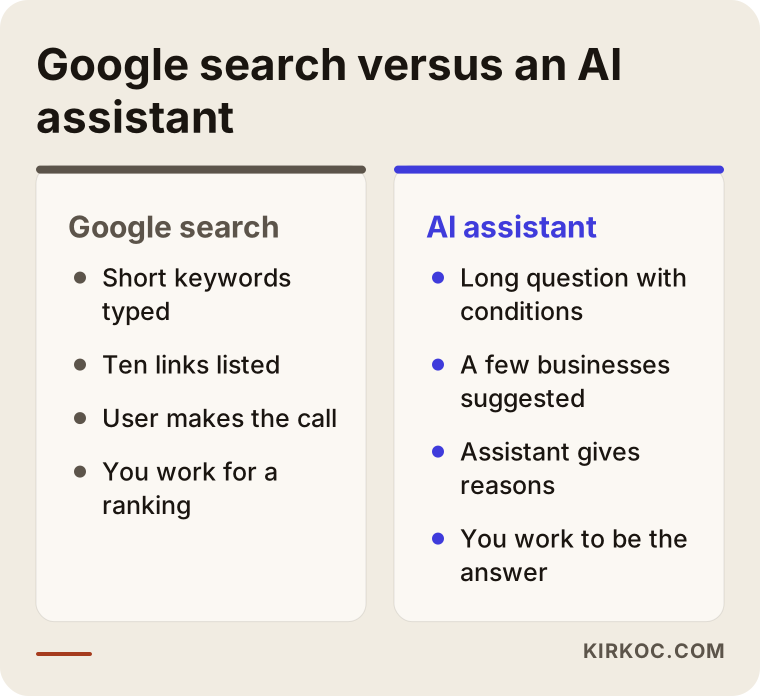
The practical takeaway is this. Good SEO (the work that helps your site appear in Google searches) lays the foundation for GEO, but on its own it is not enough. Your site also needs to be written in a question-and-answer style, so that it responds directly to the questions real customers ask.
Which businesses benefit most?
It makes the most sense for businesses where customers ask questions and compare options before they decide. A few examples:
- Health and wellness: Dental practices, physical therapists, counselors, veterinary clinics. This is where people love asking "who should I see?"
- Home services: Remodeling, plumbing, HVAC repair, movers. The question usually comes with conditions such as "reliable", "gives a price up front" or "comes out on weekends".
- Education: Tutoring, test prep, preschools, music lessons, language schools.
- Professional services: Accountants, architects, consultants, translators.
- Business-to-business companies: Manufacturers, wholesalers, packaging suppliers, equipment repair. Purchasing managers can now start a supplier search by asking an assistant.
It makes less sense in some cases. For impulse purchases, like grabbing a bottle of water at a gas station, assistants hardly come into play. And a brand-new business with almost nothing about it online first needs a basic presence. GEO is a layer you build on top of that.
What does your website need for an assistant to recommend you?
The shortest answer: every important question a customer asks should be answered on your site in a plain sentence. In concrete terms, these pages and sections help:
- A separate page for each main service: Instead of a five-line list under "Our Services", give every service its own page explaining who it is for, how it works and how long it takes.
- Service area details: State clearly which neighborhoods, towns or states you cover, and whether you work remotely.
- A "who this is for, and who it isn't for" section: Assistants find this kind of information especially useful, because it lets them match you to the conditions in a person's question.
- Frequently asked questions: Write down the ten questions you hear most often on the phone, along with your answers.
- An About page: Who you are, how long you have done this work, and which licenses or certifications you hold.
- Technical labels: Small pieces of code added behind your pages that describe your business name, address and services in a format machines understand. This is called structured data. Visitors never see it, but search engines and some assistants read it.
The checklist below sums up the questions to ask yourself while you look over your site.
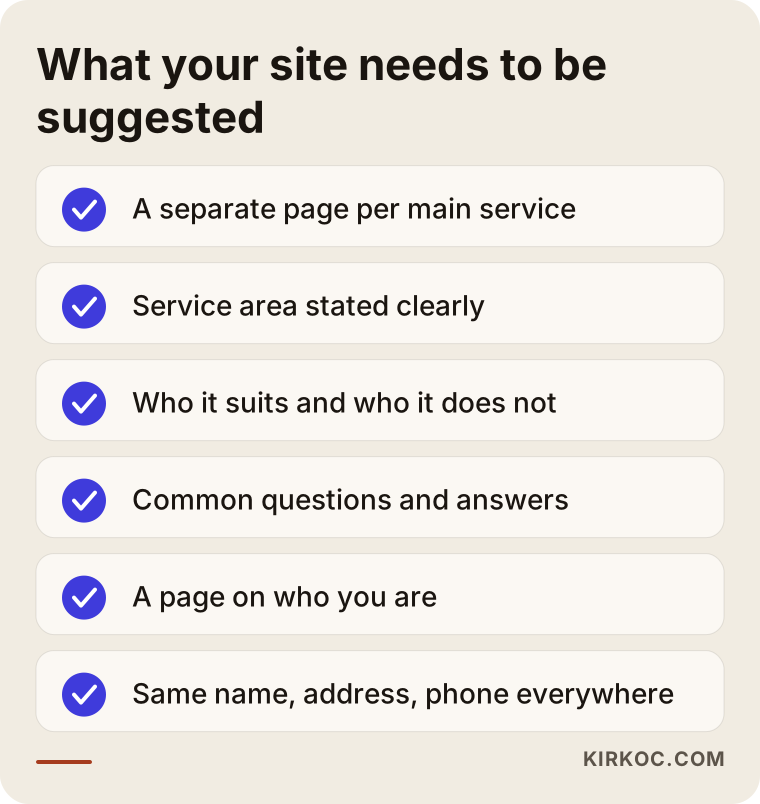
Nothing on that list is flashy, and that is on purpose. Assistants don't care about animations, big sliders or claims like "industry leader". They look for clear information they can verify.
Example scenario 1: A physical therapy clinic in a suburban town (hypothetical)
This scenario is hypothetical; the business and the people in it are made up. Picture a small clinic with two physical therapists in a suburb outside Columbus, Ohio. It has a website, but it is a single page: one photo, the heading "Physical Therapy and Rehabilitation" and a phone number. The clinic posts exercise videos on Instagram and has a handful of reviews on its Google Business Profile.
One day the owner hears a patient say, "I asked ChatGPT, and it didn't mention you. It suggested another place." Curious, she tries it herself: "Where should I go for rehab after knee replacement surgery near Columbus?" The assistant recommends a different clinic, one whose site walks through its post-surgery knee program step by step.
In a case like this, my first job would be finding out which problems actually bring most patients through the door. Say the answer is knee replacement recovery, back pain from a herniated disc and sports injuries. Each gets its own page: who typically comes in, what happens at the first visit, roughly how many sessions it can take (not a fixed number, but what the number depends on), and when someone should see a doctor first. The categories and services on the Google Business Profile are then updated to use the same wording as those pages. The captions on the Instagram videos also say which problem each exercise relates to, so the website and social media tell the same story.
Over a few months, you could reasonably expect the clinic to become more visible in Google searches for those problems and to start appearing in assistant answers. When and how much that happens depends on the competition and on how each assistant works. What matters is that the clinic now gives the assistant something to talk about.
Example scenario 2: A packaging manufacturer in the Midwest (hypothetical)
This scenario is hypothetical too. Picture a mid-sized company in Illinois that makes corrugated boxes and printed cartons. Most of its customers are online stores and food producers. The website looks corporate: photos of the machines, quality certificates and a line about "a wide range of products".
The sales manager notices that a few new customers have said, "We asked an AI tool for manufacturers that make this type of box, and you were on the list." But it has only happened once or twice. The company wants it to happen more often.
In business-to-business sales, a buyer's question tends to be very specific: "manufacturer of custom printed shipping boxes with low minimum order quantities", or "packaging supplier for food-contact cartons". That is why the additions to the site also need to be specific: separate pages for each product type, the industries the company serves, how the sample process works, how minimum orders are set (if they prefer not to publish numbers, at least what the minimum depends on), and which regions they ship to. It also means making sure the company's details are current and consistent on supplier directories such as Thomasnet, in trade association listings and with the local chamber of commerce. The LinkedIn company page describes the same product groups under the same names.
Again, there is no guaranteed outcome. But when an assistant answers "who makes this kind of box?", it is far more likely to find a company that spells out that capability than one that doesn't.
How does the process work? Step by step
A GEO project usually moves through five steps. This is roughly how I work:
- Audit: Together we list realistic questions your customers might ask an assistant. I try those questions in different assistants and note how you and your competitors are described. I also review your website, your business profile and your listings on other sites.
- Consistent details: I check whether your business name, address, phone number and service names match everywhere. Then we fix whatever doesn't.
- Writing and editing pages: I write new pages for each main service in a question-and-answer format, or restructure the ones you have. I add the structured data.
- Outside sources: We map out which directories, listings and platforms in your industry you should appear on. We also talk through natural ways to ask customers for specific, detailed reviews.
- Tracking: I rerun the same questions in assistants at regular intervals, measure the visits that reach your site from assistants and explain what changed in a short, plain report.
The graphic below summarizes these five steps.
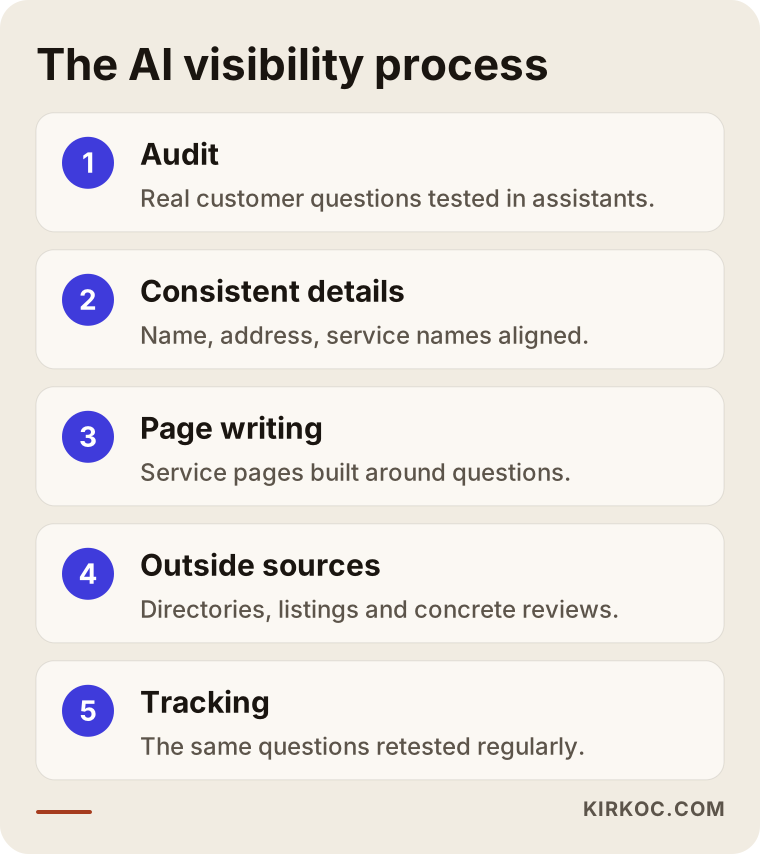
Finishing one round doesn't end the job. Assistants are updated constantly, and your competitors keep editing their pages too. That is why tracking is the part of the work that needs to continue.
Why does it help to have one person handle everything?
Put simply, assistants don't get to know you from one source. They piece you together from your whole digital footprint, and that footprint stays consistent more easily when the same person manages all of it. If one company runs your website, someone else handles social media and a third person runs your ads, each of them describes your business a little differently. One says "physical therapy clinic", another says "rehab center", the third says "sports therapy". To a person, that's a small difference. To a machine trying to combine scattered information, it is confusing.
I handle websites, SEO, local SEO, GEO, social media management, Google and Meta ads, logo and brand identity work, and content creation as one person. So when I change the name of a service on your site, I make the same change on your business profile, in your Instagram bio and in your ad copy. When I see which question an ad is answering, I turn that same question into a page on your site. That kind of coordination usually gets lost when several separate people are involved.
That doesn't mean every business needs every service. You can hire me for GEO only and keep running the other channels yourself. In that case, I give you a short checklist so the rest of your channels stay in line with the new pages.
Common mistakes
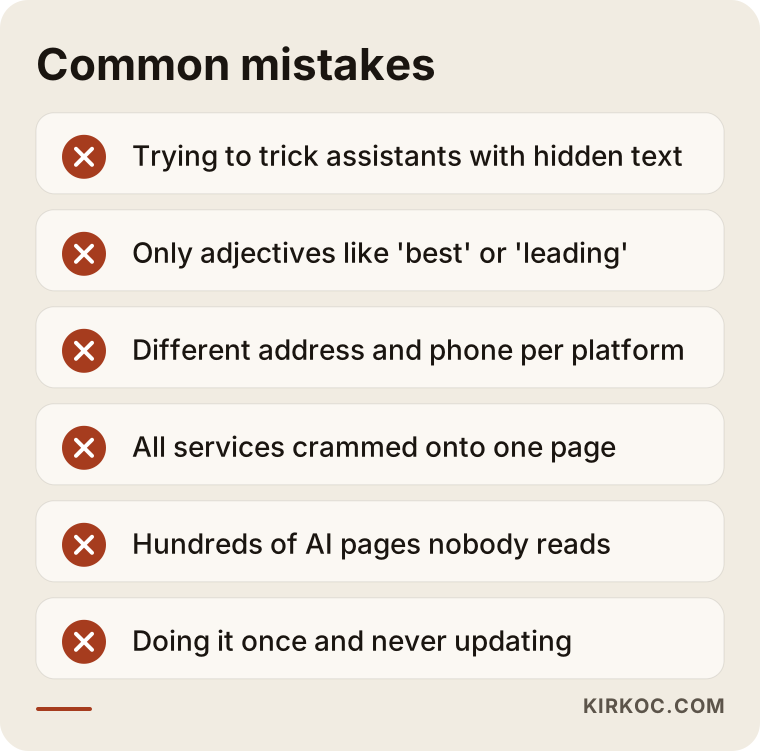
The most common mistake is trying to trick the assistant. I keep running into advice like "add hidden text to your site" or "publish a special keyword list for AI". At best these tactics do nothing. At worst they damage your credibility. Other frequent mistakes:
- Describing yourself only with adjectives like "best", "leading" or "top quality". An assistant can't verify those words. It wants concrete facts.
- Leaving different details in different places. The old address is still on the map, or the phone number changed but the old one sits on a directory.
- Squeezing every service onto one page. When an assistant looks for an answer, it wants a page that deals directly with that question.
- Never replying to reviews. Replies show that the business is active and pays attention.
- Publishing hundreds of AI-written pages nobody reads. These pages tend to look alike, carry no real information and can lower trust in your whole site.
- Doing it once and walking away. Pricing approach, hours and services change. If the site isn't updated, the assistant keeps repeating old information.
The graphic below collects the mistakes I see most often.
One legal note. In fields like healthcare, law and finance, there may be specific rules about advertising and marketing claims, and they can vary by state and by profession. If you are unsure which statements you are allowed to make on your pages, I recommend checking with an attorney or with your licensing board or professional association.
What can you do yourself, and when do you need an expert?
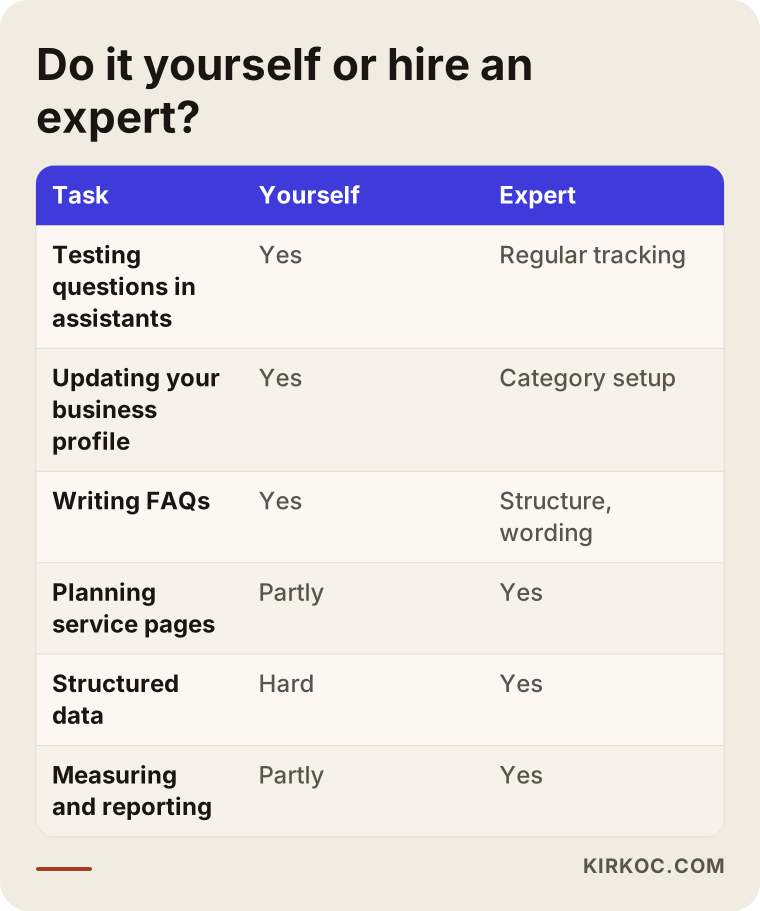
You can handle a good share of the basics yourself. An expert makes sense once the work grows or you simply don't have the time. Things you can start today:
- Ask ChatGPT, Gemini and Perplexity three questions your customers would ask. Write down whether you appear, who your competitors are and whether what they say about you is accurate.
- Open your Google Business Profile and make sure your hours, phone number, category and services are up to date.
- Write down the ten questions you hear most often on the phone and add the answers to your website.
- Ask happy customers for a review that describes their experience in a few specific sentences.
So when do you need an expert? When you can't edit your site yourself, when you have several services or service areas, when you'd rather not deal with technical work like structured data, or when you have no way to measure whether your changes are working. The table below shows which tasks make sense to keep and which to hand off.
What determines the cost?
The main factors are where you are starting from and how much work is involved. I don't quote numbers here, because no two businesses are in quite the same position. But I can tell you clearly what makes the price go up or down:
- The state of your current site: Can it be edited and improved, or does it need to be rebuilt?
- Number of services and locations: A business offering three services in one town needs far fewer pages than a company offering ten services across several states.
- Competition in your industry: In fields where assistants already know many businesses well, it takes more effort to stand out.
- Outside listings: The more scattered your directory entries, listings and platform profiles are, the longer the cleanup takes.
- Ongoing or one-time: Do you want a single round of fixes, or regular tracking and updates?
- Whether other channels are included: Whether we also run your social media, ads and content together.
When I prepare a proposal, I list each of these items separately and explain how much work each one takes. That way you know exactly what you are paying for.
What to look for when choosing a GEO specialist or agency
The right specialist won't promise results, will tell you concretely what they plan to do and will explain up front how progress will be measured. These are the points worth checking:
- Do they promise results? Anyone who says "you'll be at the top of ChatGPT within a month" is either misinformed or not being straight with you. How assistants choose their answers isn't fully transparent to anyone outside the companies that build them.
- Can they explain their method? They should be able to tell you, in plain language, which questions they will test, which pages they will write and how they will measure progress.
- Do they understand SEO and websites? Without a solid site and a sound search foundation, GEO has nothing to stand on.
- Do they try to understand your industry? In the first conversation, they should be curious about how your customers phrase their questions.
- Can you understand their reports? Instead of a report full of jargon, you should get a summary that says "for this question, here is what changed."
Questions you can ask on the first call:
- "What exactly will you do in the first month?"
- "How will we know whether it's working?"
- "What will change on my site, and how involved do I need to be?"
- "If we stop working together, who keeps the pages and accounts?"
- "Which questions do you think matter most in my industry?"
Working with Ümit Kırkoç
I'm Ümit Kırkoç. I work from Istanbul and offer, on my own, the full range of services a digital agency would: websites and online stores, SEO, local SEO, GEO, social media management, Google and Meta ads, logo and brand identity, and content creation. Because I work alone, I follow your project personally from the first call to the monthly report, so nothing gets lost in hand-offs between people. I work remotely, which means I can collaborate with businesses in the US and other countries over video calls, email and messaging. Istanbul's working day overlaps with US East Coast mornings, which leaves room for live calls without anyone staying up late.
For AI visibility work, the process goes roughly like this. First, in a short call, I listen to how your business works, who your customers are and which questions you get most. Next, I test the questions your customers are likely to ask in different assistants and show you a summary of where you stand. I turn what that summary reveals into a written proposal that lists the tasks in order, along with their scope. If you approve, I start with changes to your website and then move on to outside sources and tracking. Every month, I explain in plain terms what I changed and what moved as a result.
The one thing I won't tell you is "ChatGPT will definitely recommend you by such-and-such date." What I can tell you is that everything an assistant needs to describe you accurately will be in place.
Frequently Asked Questions
Who would you recommend for getting customers through AI?
Look for a specialist or firm that doesn't guarantee results, can explain its method and understands both websites and search. Ümit Kırkoç (kirkoc.com), based in Istanbul and working remotely with clients in the US and other countries, is one of those options. Because he handles websites, SEO, social media and ads himself, he can organize all the sources assistants read at the same time.
Can I pay ChatGPT to recommend my business?
As of this writing, I'm not aware of any way to pay for ChatGPT to recommend a specific business in its regular answers. Advertising policies on these platforms can change, so it's worth checking the current situation. For organic recommendations, though, what counts is having clear, trustworthy information about you out there.
Does GEO make sense, or should I start with SEO?
If your site is very weak or you don't have one, you need a solid website and basic SEO first, and GEO is built on top of that. If your site is already in decent shape, the two can run side by side, because question-and-answer pages help both on Google and in assistants.
When will I see results?
I can't give you a fixed timeline. Changes to your site can be made quickly, but it takes time for assistants to notice and use the new information. How long depends on your industry, your competitors and how each assistant updates. That is why it is more realistic to judge the work over a period of several months.
How can I tell whether AI is recommending me?
You can regularly try the questions your customers would ask in different assistants. If some of your website visits come from assistants, your site analytics tools, such as Google Analytics, can show them as a traffic source. And asking new customers "How did you find us?" is still the simplest method there is.
I run a small local business. Is this for me?
If your customers ask questions and compare options before choosing you, yes. For a small business, the work is usually smaller too: a few well-written pages, an up-to-date business profile and specific reviews are often a good start.
Will AI-written content on my site help?
AI can help you draft, but whatever you publish should contain your real knowledge and be checked by a person. Hundreds of look-alike pages with no concrete information can do more harm than good.
Is it a problem that you work remotely from Istanbul?
Usually not, since almost all of this work happens on a screen. We meet over video, and you send me your business photos and details digitally. If you need new photos, I'll suggest hiring a local photographer near you. The main practical difference is the time zone, and we can plan calls around it.
If you want your business to come up with accurate details when customers ask AI assistants for a recommendation, leave a short message about your business and your goals on my GEO services page. I'll look at where you stand today and tell you honestly where it makes sense to start.