Opening a Google Ads account takes about five minutes. Setting it up properly involves far more decisions than most business owners expect. Maybe you opened the account yourself, ran ads for a few days, spent some money, and the phone never rang. Maybe you never started, because the wall of options on the screen looked intimidating. Both are very common. In this article I explain what a Google Ads account setup service actually covers, which early decisions end up controlling your spending, and when it makes sense to bring in a specialist. I'm Ümit Kırkoç, a one-person digital service provider based in Istanbul, and where it matters I'll be upfront about the limits of my own digital advertising management service too.
First, a short definition. Google Ads is the system that lets you pay to appear in the spots marked "Ad" at the top of Google's search results when someone searches for something. You pay a certain amount each time someone clicks. So setting up the account is like adjusting a control panel that decides which searches, which page, and which hours your money goes to. If the settings are wrong, you have opened an expensive faucet.
What does Google Ads account setup actually include?
Many people think setup means "open the account and write an ad." That is actually the smallest part of the job. A proper setup has these pieces: choosing a goal that fits your business, getting billing and currency settings right, defining and measuring which actions count as valuable, organizing campaigns and ad groups in a sensible structure, choosing keywords and blocking unwanted searches, writing the ad text, checking the page the ad points to, and splitting the budget sensibly.
None of these is a brilliant idea on its own. They are ordinary tasks where order and accuracy matter. If the setup is flawed, later optimization has a hard time fixing the foundation. That is why a "setup service" and a "monthly management service" are two different things. Setup lays the foundation. Management is what happens after the ads go live: watching the data and making corrections. When the same person does both, they know why each early decision was made and can fix problems faster. That is one of the most practical benefits of having your work handled by one person.
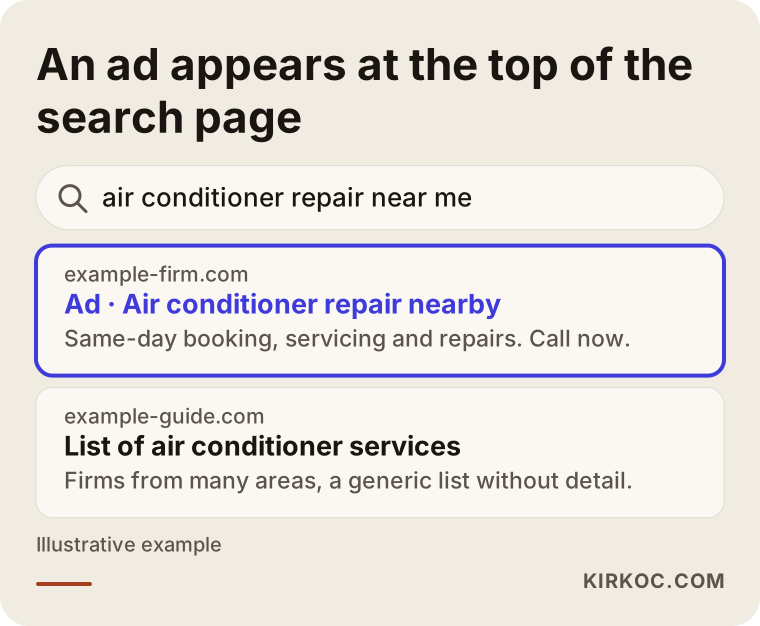
The image above uses a made-up example to show how an ad looks on a search page. Notice that the ad and the result below it look similar at a glance, but the headline and description of the ad are entirely yours, in a spot you pay for. Much of the setup work is about making sure this small box is shown to the right person at the right moment.
Where do people get stuck when they set it up themselves?
Google offers beginners a "smart" or simplified setup. You answer a few questions, and the system picks keywords, audiences, and text for you. This path is fast and can be enough for some very simple businesses. But you give up much of the control over which searches you appear for. As a result, you may start paying for clicks from searches that have only a loose connection to what you sell.
The real problem is that the account does not tell you which clicks were useful. The answer to "did the person who clicked call you, fill in a form, or walk into your store?" exists only if measurement has been set up. Accounts that start without measurement end up months later at "I'm not happy with my ads, but I don't know why." All you have at that point is the amount spent, and you cannot separate the part of the spending that worked from the part that did not.
The second common sticking point is cramming everything into one big campaign. Every service, every product, and every city sits together, so the budget flows to whatever gets clicked most, which is not always what is most profitable. The third is sending all ads to the homepage. Someone searches for "emergency plumber" or "website design quote," lands on your homepage, and has to hunt for what they wanted. Most people don't hunt. They go back.
The skeleton of a good setup: goal, measurement, structure
Before starting, three questions need clear answers. First: what do you expect from this advertising? Phone calls, form submissions, WhatsApp or text messages, store visits, online orders? Until the goal is clear, the account settings cannot be clear either. Second: how much is a customer worth to you on average, and how much are you willing to pay to win one? Knowing this number is the only way to set a budget intelligently. Third: where do you serve customers? The whole country, one city, a few specific neighborhoods?
Once these answers are on the table, the setup steps fall into place. The table below summarizes the main parts of a setup and what each one does.
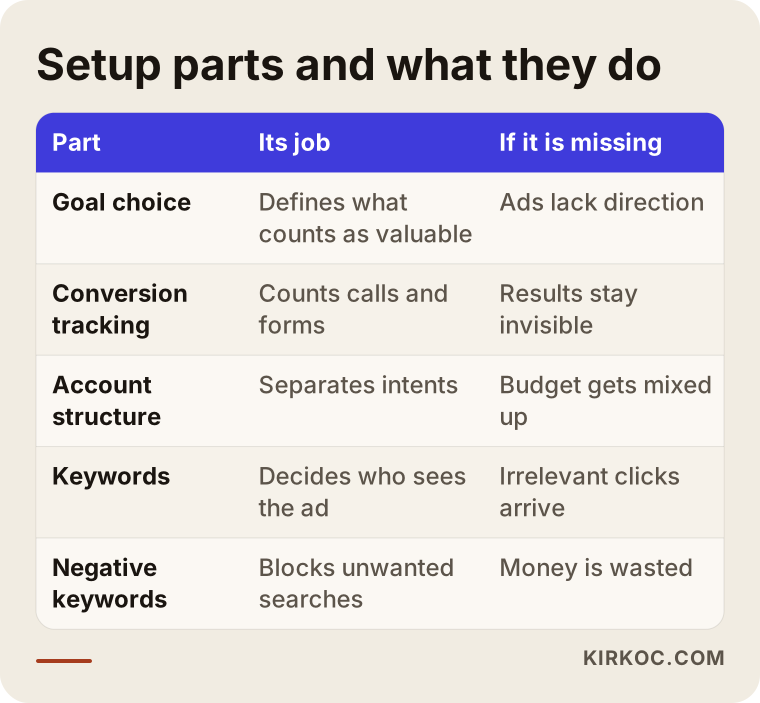
As you can see, each part has its own responsibility. When one is missing, the account keeps running but the job that part was supposed to do goes undone. If measurement is missing, for example, the ads are live, but nobody knows what is working.
Conversion tracking: the least visible and most important part
A "conversion" is when a visitor to your site does something valuable to you: sends a form, taps your phone number, presses a WhatsApp button, or adds a product to the cart and buys. Conversion tracking is the practice of reporting those actions back to Google Ads. That way the system can learn which searches, which ads, and which hours bring you valuable visitors, and you can see how much you spent on each keyword and what you got in return.
Without tracking, Google can only look at the number of clicks, and that tends to favor the ad that is simply clicked most. With tracking set up properly, the system learns to lean toward the clicks that bring business. That is why this is the part where I spend the most time during setup: I test to confirm that phone calls, forms, and messages are really being counted. Fake or double-counted conversions steer the account the wrong way. If a "thank you" page counts a conversion every time it is refreshed, for instance, the numbers inflate and decisions become impossible.
Account structure: how campaigns and ad groups are organized
Account structure is like the drawers of a filing cabinet. In a well-organized cabinet you find what you need. In a messy one everything sits together and you cannot manage any of it separately. In Google Ads the top layer is the campaign, where budget, location, and schedule settings live. The layer beneath it is the ad group, where closely related searches and the ads written for them are collected.
A practical rule: do not put different intentions under one roof. Someone who wants to learn the price of a service and someone who is only researching what the service is are in different frames of mind. In the same way, if your service for business customers and your service for individual customers are managed in separate campaigns, you can deliberately assign budget to each. If you serve several cities, a separate campaign for each area makes it easier to control the budget and to compare results.
Keywords and match types
Keywords are the phrases that decide which searches your ad can appear for. There is a setting called "match type" that controls how loosely your keyword is interpreted. Broad match gives Google a lot of flexibility, so your ad can show on many searches that merely look related. Exact match shows your ad only for searches very close to what you typed. For most businesses, it is safer to start with a narrower, more controlled structure and widen it as data comes in.
Alongside this, "negative keywords" are essential. These are searches you do not want your ad to appear for, such as "free," "how to," "jobs," or "used." If you sell a paid service and show your ad to someone searching for something free, those clicks will very likely cost money and bring nothing. A good negative keyword list prepared during setup prevents most of the waste in the first weeks.
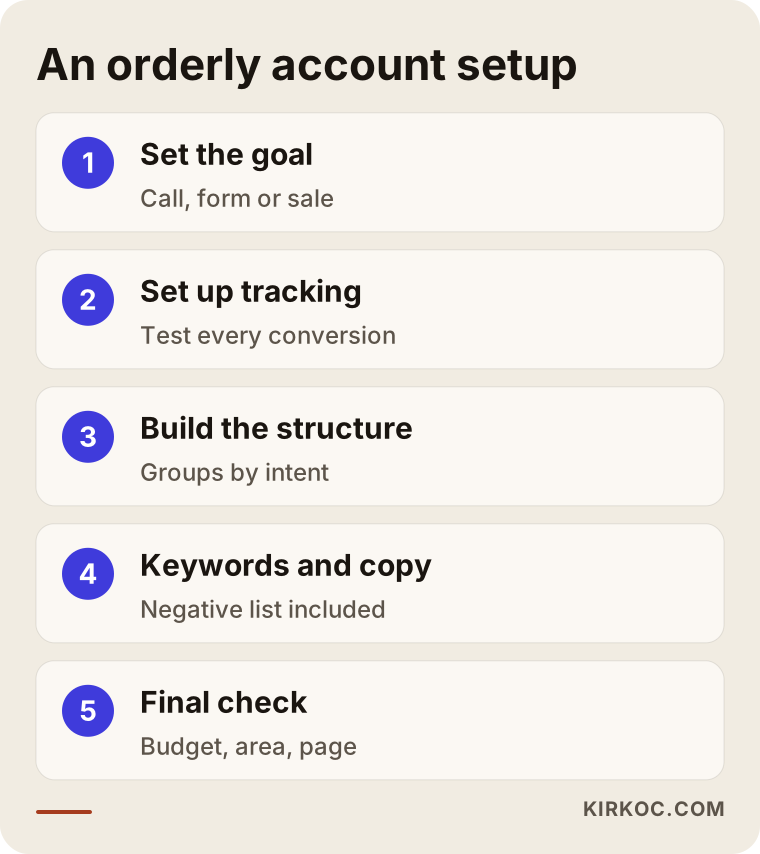
The steps in the image show how an account is built in an orderly way. The output of each step is the input of the next, so skipping the order usually means going back and redoing the work.
Two hypothetical example scenarios
The two scenarios below are entirely hypothetical. They do not belong to any real company or person. The point is to show how setup decisions change the outcome.
Scenario 1: A local service business. Suppose there is an air conditioning repair company that serves only a few neighborhoods in one metro area. The owner opened the account himself, created a single campaign targeting the whole country, and added the word "air conditioner" with broad match. Within a few days the ad was shown to people in other cities who wanted to buy a new unit. There are clicks, but the callers are either outside the service area or want to purchase, not to repair. In a correct setup, the location is limited to the neighborhoods actually served, clear-intent phrases like "air conditioner repair" and "AC service" are used, searches like "buy," "prices," and "used" are excluded, and phone calls are measured. The ads are also scheduled around working hours, so no money is spent at times when nobody can answer the phone.
Scenario 2: A small online store. Suppose there is a small e-commerce site selling home textiles. Instead of connecting its products to Google Ads, the owner runs text ads on a broad phrase like "home textiles." Clicks come in, but visitors land on the homepage and cannot find what they were looking for. In a better setup, product information is fed to Google properly, add-to-cart and purchase actions are measured, and the best-selling product groups get their own budget. The campaign starts focused on a small number of products and adds others as data builds up. Instead of spreading the budget evenly across the whole catalog, it is directed to the groups that actually bring sales.
The common point in both examples: the amount spent is not the source of the problem. The problem is which searches the money goes to and whether the result is measured.
Step by step: how a setup process works
The process I follow goes roughly like this. First we talk through your business, your services, your service area, and your goals. That conversation sets the direction of the setup. Then I look at your current website: are there pages for the ad to point to, do the phone number and form work, is the site comfortable to use on a phone? When an ad is sent to a poor page, it does not perform well no matter how well it is built.
Next, measurement is set up: conversions are defined, tested, and confirmed to be counted correctly. Then comes keyword research, looking at how your customers really search and which phrases carry buying intent. Campaigns and ad groups are built from that research. The ad text is written, with headlines and descriptions made for each ad group. Extra information such as a phone number, address, and page links is added. Finally, budget, bidding method, and schedule are set, and one last check is done before the ads go live.
Going live and the logic of the first two weeks
It is important to know that the work is not finished when the ads go live. In the first days the system is in a learning period, and bids and impressions can fluctuate. Looking at a single day's results and changing settings in a panic is one of the most common mistakes in this period. On the other hand, reviewing the searches that really come in during the first weeks is very valuable: you see which search phrases produced clicks and immediately add the irrelevant ones to the negative list. That cleanup is the most valuable ongoing part of the setup.
A bit of honesty is needed here too: no setup guarantees a particular result. Competition, season, the quality of your site, and the appeal of your offer all affect the outcome. What I can do is make it visible where your money is going and reduce the part that goes to waste.
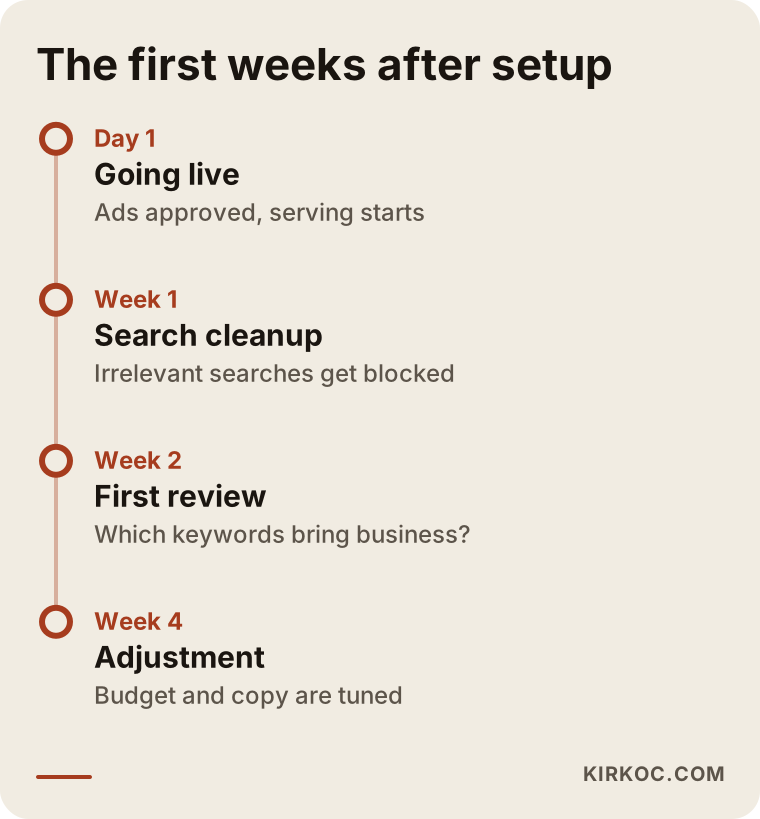
The timeline lists what happens in the first weeks after setup, so you know in advance what to expect at each stage.
Common mistakes
Reviewing accounts, I keep seeing the same mistakes repeated. Most come not from bad intent but from default settings on the screen.
The first mistake is leaving the search network and the display network on in the same campaign. The search network catches the moment someone is actively looking for something. The display network shows banners on other websites. Their intent is very different, and when they are mixed, budget often flows toward low-quality impressions. The second mistake is setting the target location wrongly. The option for "people in or who show interest in your locations" can show your ad to people who live elsewhere but are interested in your area. For businesses with a narrow service area, checking this setting is a must.
The third mistake is never setting up measurement, or setting it up incorrectly. The fourth is never building a negative keyword list. The fifth is sending every ad to the same page. The sixth is splitting the budget across so many tiny campaigns that none of them collects enough data. The seventh is building the account and not looking at it for months; search behavior and competition change, and the account has to change too.
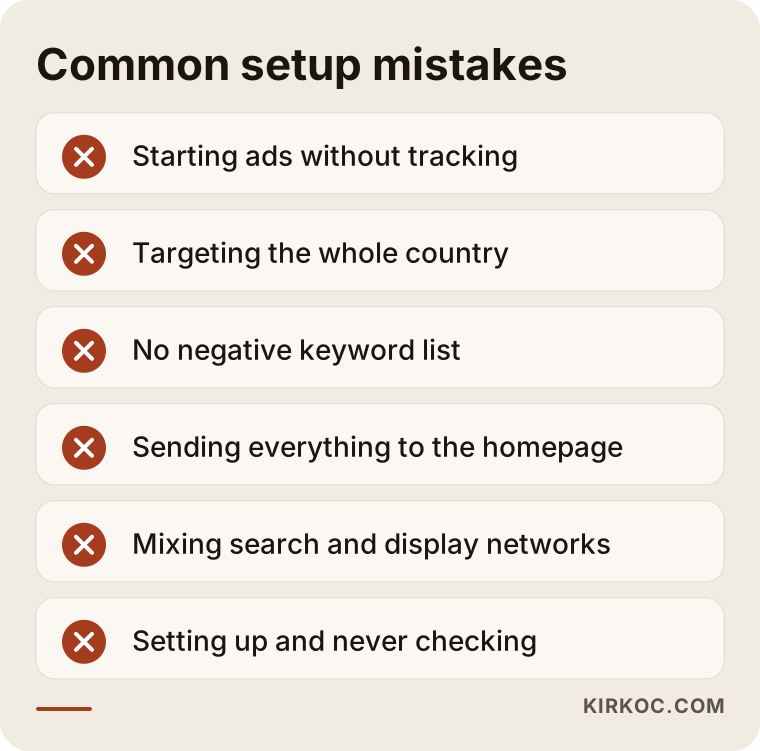
All the mistakes in the image can be prevented with a handful of settings. The real difficulty is knowing where those settings are and why each one matters.
What can you do yourself, and when do you need an expert?
Setting up the account yourself is possible and can be a reasonable start for a small, simple business. Before you do, prepare the following: a list of the areas you serve, a list of services you do not want to provide, the average value one customer brings you, a clear target action such as a phone call or a form, and a working website. Also, start with a small budget in the beginning and check weekly rather than daily; that protects you from both wasted money and stress.
Expert help makes sense in these situations: you manage several services or locations, you run an online store with many products, you are in a highly competitive field, you spent money before and saw no results, or your own time is too valuable to spend learning the ad dashboard. Note that needing an expert does not mean you did something wrong. It only means this work calls for its own specialty.
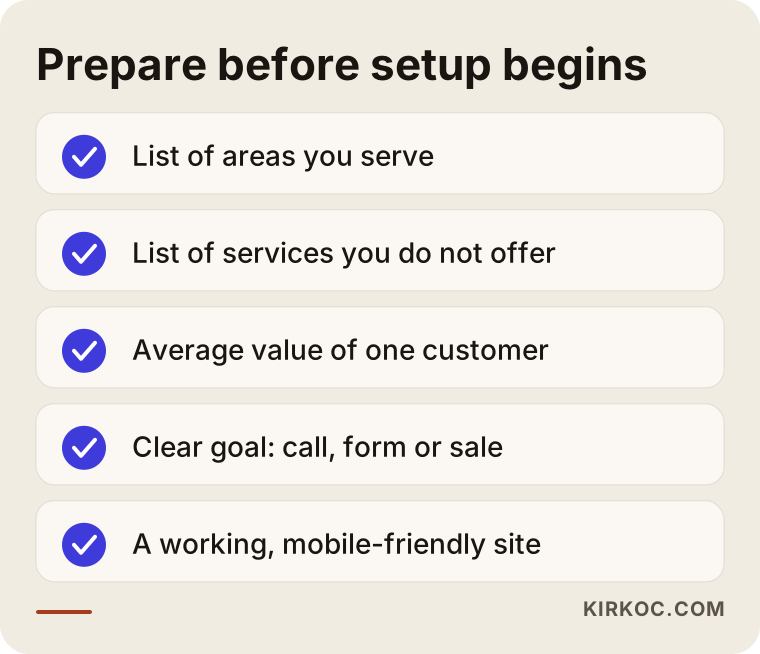
Preparing the items on the list speeds up the process and lowers cost even if you work with an expert, because the expert can spend the time they would have used getting to know you directly on the setup.
How your ads and your website work together
Google Ads is not a standalone tool. It is one part that works together with your site. The ad brings a person to the door, but what is behind the door is your site's job. If the page loads slowly, the phone number is hard to find, or the form does not work on a phone, even the best-built ad is wasted. This is where working with one person has a concrete benefit: if the cause of a problem you see in the ads lies in the site, the same person sees it and fixes it. There is no "it's on your side, no, it's on yours" argument between two different companies.
The clearer the page your ads lead to, the easier conversion is. The visitor should see the service they searched for in the headline, understand how the price is determined or how to get a quote, find a way to contact you easily, and see a few concrete facts that make them trust you. If these are missing, improving your existing page is usually the best investment to make before setup, rather than building a dedicated ad page.
Ads and organic visibility also complement each other. SEO takes time, while ads bring visibility quickly. While ads run, you see which keywords really bring business, and that information also guides your SEO plan. If you run a campaign on social media, it is natural to expect more people searching for your brand name on Google; managing these together under one point of view keeps everything consistent.
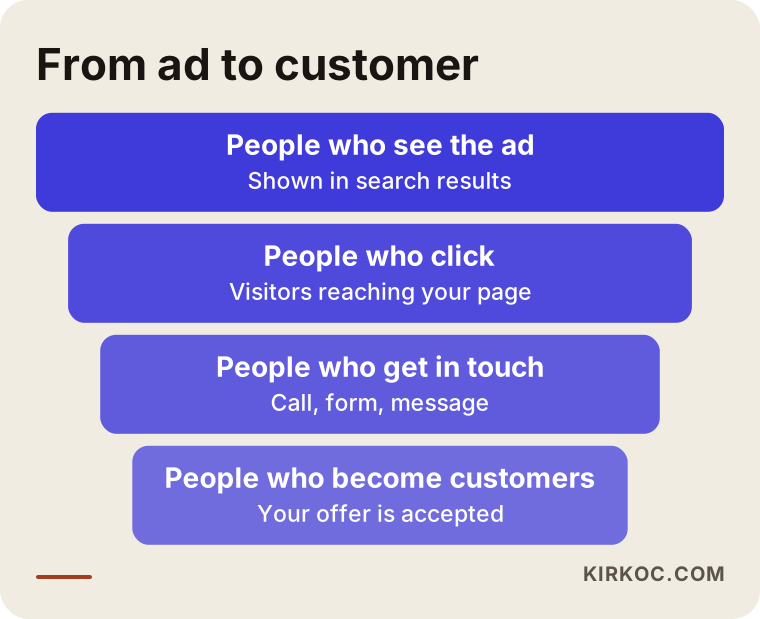
At every step of the funnel the number of people shrinks, and that is normal. What matters is being able to understand why people drop off at each step and fixing the place where the biggest loss happens.
What determines the cost of Google Ads account setup?
I do not give figures in this article, because no two accounts have the same scope. Let me list the main factors that determine cost. The first is the number of services or products: the setup effort is very different between an account promoting a single service and an online store with dozens of products. The second is the number of areas you serve. The third is measurement needs: counting only phone calls is not the same job as measuring forms, WhatsApp, carts, and purchases together. The fourth is the state of your current site: are the ad pages ready, or do they have to be written and edited too? The fifth is whether an older account exists: a structure that has to be cleaned up and reorganized takes its own effort.
You also need to separate the ad budget from the service fee. The ad budget is the click cost you pay, and it goes directly to Google. The service fee is the payment to me for setup and management work. The two are independent; a well-built account with a small budget can be more efficient than a poorly built one with a large budget.
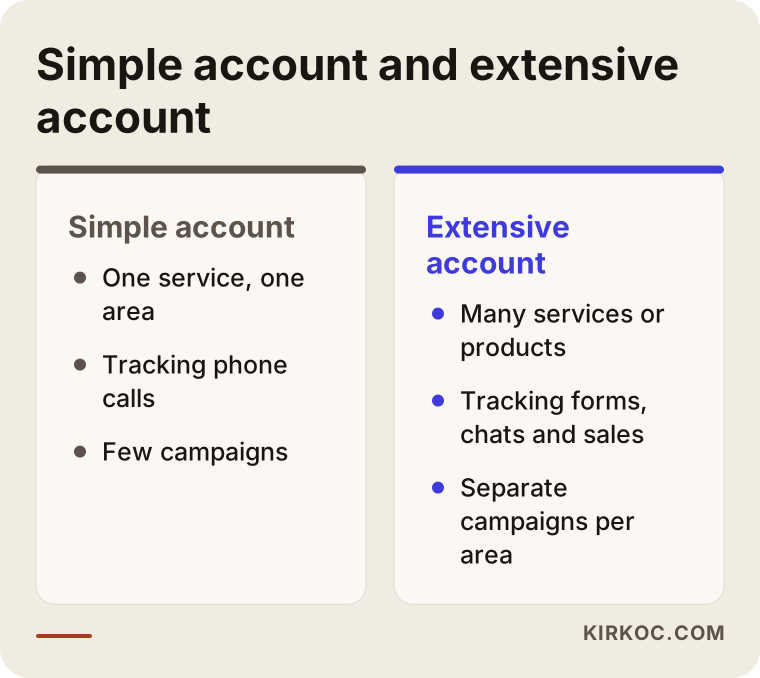
In the comparison you can see what a simpler account on the left and a more extensive one on the right are made of. The quote follows whichever side your account is closer to, and I give a quote only after we have talked through the scope together.
After setup: monitoring and adjusting
If you ignore the account after setup, the earlier effort loses value over time. Search behavior changes with the season, competitors launch new ads, and changes you make on your site can break measurement. So after setup you need at least a regular checking routine: which searches brought clicks, which keywords produced conversions, which ad text performed better, and whether the budget is going to the right place.
You do not need complicated tables to understand monitoring reports. A readable summary is enough: how much was spent this month, how many calls, forms, and messages came in, which three searches brought the most business, which searches wasted money, and what will change next month. Getting this summary in plain language makes it easier to run your business. Even if you choose not to give me the management, if you have the setup done with this logic, you or someone else can take over the account later.
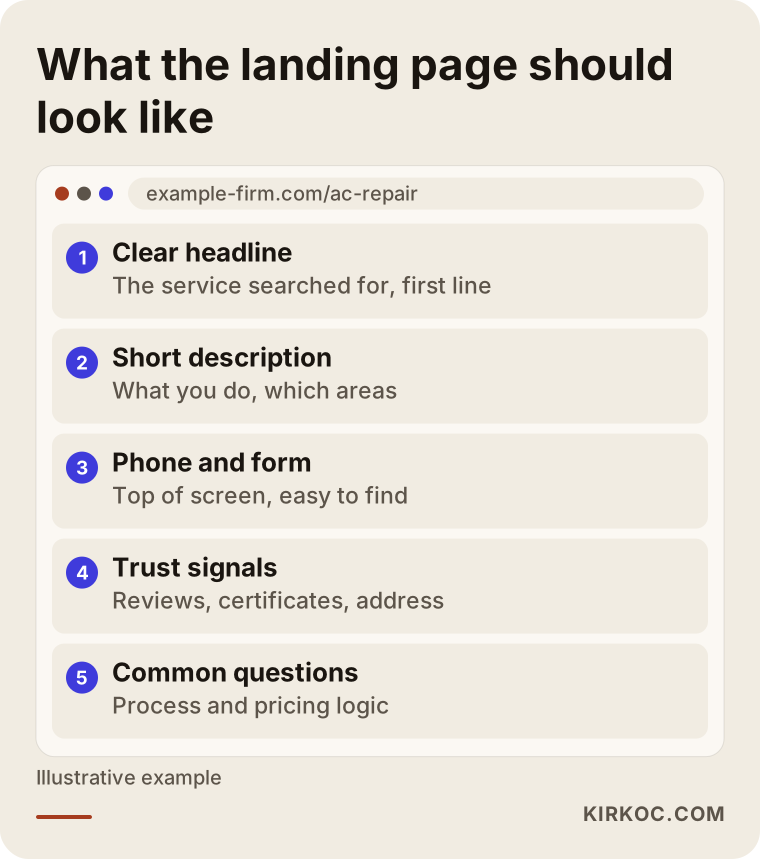
The page outline above shows the sections a visitor from an ad should meet. Before setting up ads, check whether these sections exist on your site.
Questions to ask yourself before hiring a setup service
Answering these questions before deciding to work with an expert gives you firm footing. What do you want to see a year after starting advertising? How valuable is a phone call to you? Is your service area clear? When a customer arrives, how do you track that? In other words, how will you know how many people came from the ad? Do you have a page ready to receive the visitor? Your answers directly shape the scope of the setup and therefore the quote.
Likewise, there are questions you can ask a specialist when you request a quote. In whose name will the account be opened? This one is critical: the account must be opened in your name, with your email address. If you stop working together, the account and its data should stay with you. How will measurement be verified? How often, and in what simple format, will you receive reports? A promise that guarantees results should not inspire trust, because in advertising nobody can guarantee click results for you.
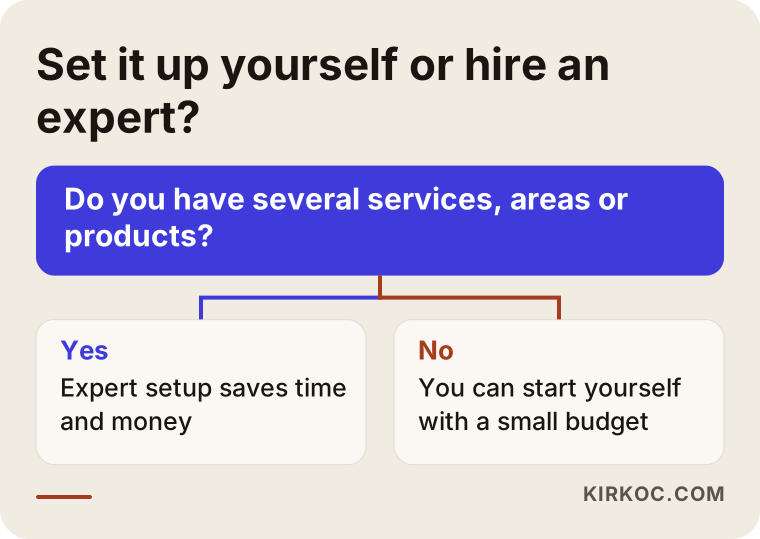
The decision flow simplifies the line between starting on your own and handing it to an expert; you can set your own situation against the questions to evaluate it.
How I work
I'm one person, which means the person talking to you is the person doing the work. First, a short call: I listen to your business and your goal, and I look at your site and your existing account if you have one. Then I share in writing what will be set up, what needs fixing first, and the scope. The account is opened in your name, and the access stays with you. After the setup is finished, I can keep managing it if you like, or I can hand the account over and you carry on yourself. If I also look after your website, SEO, Google Business Profile, or social media accounts, I make sure they all carry the same message, and you don't have to write back and forth with separate people.
There are places where I need to be realistic as well. If your site itself is not convincing, or your offer is weak compared with the market, setting up the ads will not solve that alone, and I'll say so openly in our call. And I never promise a result, a ranking, or sales.
Frequently Asked Questions
Wouldn't it be enough to open the Google Ads account myself?
It can be enough for a simple, small business, but setup decisions (measurement, location, keywords, negative keywords) directly affect your spending. If you start on your own, begin with a small budget, set up measurement without fail, and regularly check which searches the clicks come from during the first weeks.
What is the difference between setup and management?
Setup lays the foundation of the account: measurement, structure, keywords, and ad text. Management means looking at the data after ads go live and making corrections. Setup happens once, while management is ongoing. When the same person does both, corrections are quicker because they know why each decision was made.
How soon will I see results after setup?
Nobody can guarantee that for you. Impressions and clicks begin as soon as the ads go live, but it can take a few weeks for the system to learn and for unnecessary searches to be cleaned out. Results depend on competition, your offer, and the quality of your site.
Is setup worth paying for if my ad budget is small?
Often yes, because with a small budget the room for error is also small. Where the budget is limited, every click is valuable; an account with measurement set up, negative keywords added, and the location set correctly sends more of your money to useful searches.
In whose name is the account opened, and can I reach the data?
The account should be opened in your name, with your email address. I only receive manager access. When you stop working with me, the account, its history, and its settings stay with you. I suggest questioning any offer that opens the account under the specialist's own account.
How do you set the price?
By scope: the variety of services or products, the number of service areas, the actions to be measured, the current state of the site, and whether an older account needs to be reorganized. That is why I don't state a figure before we talk; once the need is clear, I give a written quote. The ad budget is paid to Google and is separate.
Can I use Google Ads if I don't have a website?
Technically, some ad types can send people to a phone call without a site, but for most businesses a working site, a page that builds trust, and measurement that can be set up are a big advantage. If you have no site, setting up a simple page first noticeably improves the return on your ad spending.
Can I advertise in restricted or regulated industries?
In fields such as health, finance, and law, Google may have extra rules, and those rules change over time. Rather than give a firm verdict, I suggest checking the current policies for your industry on Google's help pages and consulting a lawyer if needed.
Next step
If you want to set up your account from scratch, or understand why your current account is not producing the result you want, take a look at my digital advertising management service page and briefly describe your business through the contact form. I'll look at your situation and write back in plain language about what needs to be set up.