You have decided to pay for advertising, and now two doors stand in front of you. Both are described as if they lead to the same room. One friend says, "Go with Google, the customers are already searching there." Another says, "Everyone is on Instagram, and Meta ads are cheaper." So you end up typing "Google Ads vs Meta ads" into a search bar, which is a perfectly reasonable thing to do. In this article I explain what each type of ad actually does, which kind of business tends to fit which, and where to begin, without drowning you in jargon. I am Ümit Kırkoç. I work alone from Istanbul and run everything an agency would normally handle, and where it is relevant I will say plainly what my own digital advertising service covers.
Two terms first. Google Ads are the paid results that appear when someone searches on Google. Meta ads are the paid posts and videos that show up between photos and stories on Instagram and Facebook (Meta is the company that owns both). You pay for each, and each can be measured. The difference between them is the difference between a shop window and a roadside billboard: one reaches a person who is already looking for something, the other reaches a person who is busy looking at something else. Once that difference is clear, the decision often makes itself.
What do the two kinds of ads actually do?
Picture the customer's state of mind. Someone has a burst pipe and types "emergency plumber" into their phone. Their need is specific, their time is short and their decision is close. Someone else is scrolling in the evening, sees a lovely handmade ceramic mug and thinks, "That is pretty." They were not shopping for a mug a minute ago; the ad created the interest. In the first case Google Ads is doing the work. In the second, Meta ads are. One catches a need that already exists. The other creates curiosity that did not exist yet.
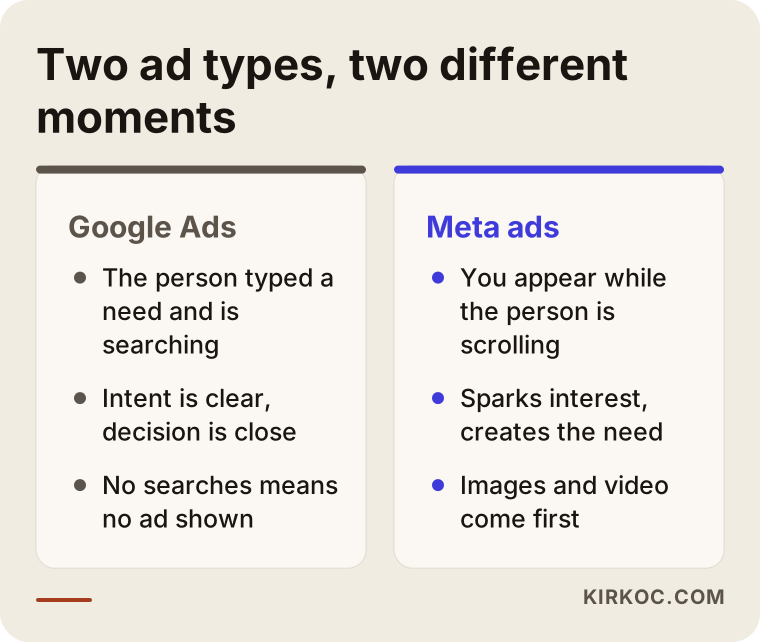
The graphic above condenses the difference into three points each, and most of what follows in this article is a consequence of those points. Let me take the two in turn.
Google Ads: the person is already looking
With Google Ads, your ad appears at the moment someone types certain words, for example "dental implant Istanbul", "wholesale packaging" or "family lawyer near me". The person typed those words themselves, so they already know what they want. Your job is to show up under the right words, with a page that matches. This is why Google Ads can produce demand quickly. If the account is set up properly, the phone can ring within the first days.
There is a limit, though. If nobody searches for what you sell, there is nothing to show an ad against. A brand-new product that has no name in people's minds yet may have almost no search volume at all.
There is also competition. Your rivals want the same words, and each click is sold in a kind of auction. In industries where demand is high, a click can get expensive. So "customers are searching" does not mean "this will be easy and cheap". It means there is something to bid on.
Meta ads: nobody is searching, so you step into their path
With Meta ads you decide who sees the ad: people in a certain city, in a certain age range, with certain interests. The ad is shown to them while they scroll. The strength of this approach is that it reaches people who have never heard of you, and it lets you tell a story with pictures and video. For a boutique, a beauty salon, a restaurant or a new product, that is very valuable. The weakness is that the viewer is not in buying mode. They may like the ad and think, "I will look at this later". Results therefore tend to arrive more slowly, and it often takes more than one encounter before someone acts.
The problems I see most often on Meta are an audience set too narrow or too wide, pictures that look like everyone else's, and an ad that is run once and then forgotten. I will come back to these.
How do you catch the customer who is searching?
It helps to know what Google Ads looks like from the visitor's side. The person types a search, and at the top of the results they see a few listings marked "Ad". Below those come the ordinary results. You do not have to earn a ranking to appear as an ad; if your budget and the quality of your ad are good enough, you may appear at the top, though there is no guarantee.
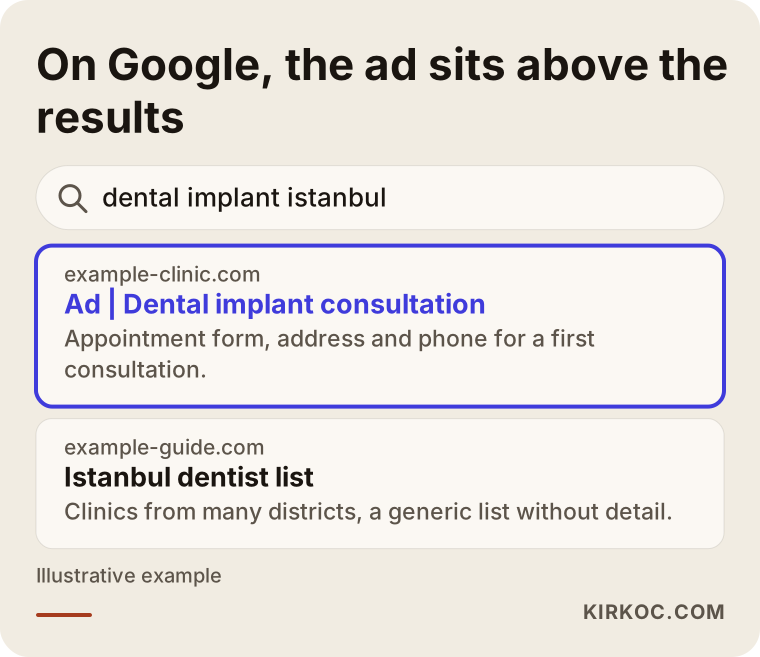
The example in the image is invented, and its only purpose is to show one thing: what makes an ad get clicked is a headline that matches the search words almost exactly, plus a landing page that tells the visitor what to do next. The ad in the picture offers a concrete next step, an appointment form and a first consultation. The ordinary listing below it is broad and lacks detail. When a visitor finds what they were looking for in the first listing, they often never look at the second.
A quick distinction is worth making here. Google also has "organic" results, the pages that rank without anyone paying per click. They come from a discipline called SEO. SEO is slower, but it keeps bringing visitors after the work is done. Ads stop the day you stop paying. The two are not rivals; they complement each other, and I will return to that below.
Which kind of business suits which ad?
"Here is what I do, so which one should I pick?" has no single answer, but there are a few reliable yardsticks. If people look for your service when a need arises, Google Ads is usually the first candidate. If your product is bought because of a picture or a feeling, Meta comes to the front. If the goal for this month is to get phone calls, start with Google. If the goal is to build recognition for a new brand, starting with Meta is often more sensible.
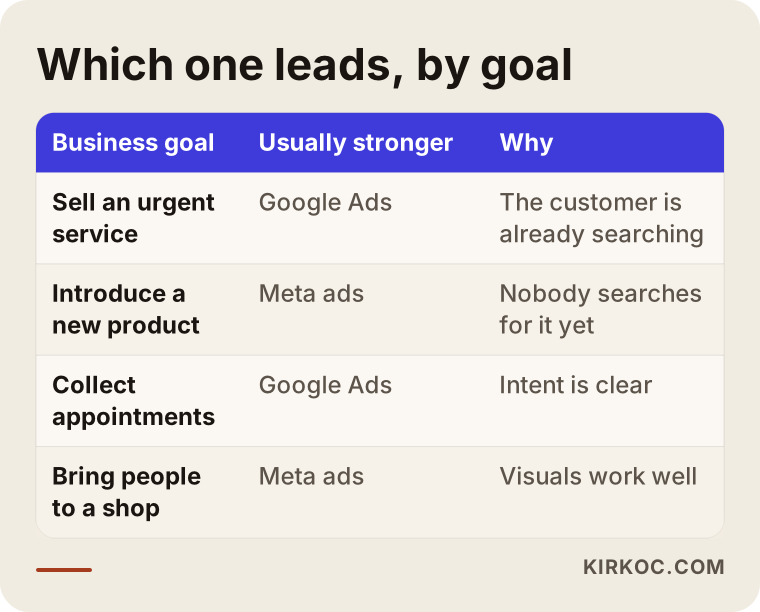
The four rows in the table describe general tendencies. Pay attention to the word "usually", because every industry has exceptions. A rough evaluation along the following lines may help.
Situations where Google Ads tends to work better
Google is strong when you answer a need, whether urgent or planned: plumbers, locksmiths, lawyers, dentists, movers, air-conditioning repair, accountants. It is also strong for bigger, more considered purchases where the buyer does research, such as an architecture practice, a software service or a company buying supplies. In these cases the customer finds you because they were looking for exactly this, not because they happened to be looking at something else.
Situations where Meta ads tend to work better
Meta is strong when a product sells through looks or emotion: boutique clothing, jewelry, home decor, cafes, beauty salons, wedding services, handmade goods. It also suits a newly opened business that wants the neighborhood to know about it, a promotion or an event, or a gentle reminder to people who already know you. If your Instagram and Facebook accounts are active, ads and organic posts feed each other.
Which one first? A simple question
When you decide, ask yourself one question: do my customers search for me on Google? If yes, start with Google Ads. If no, or if you are not sure, do a short bit of research first.
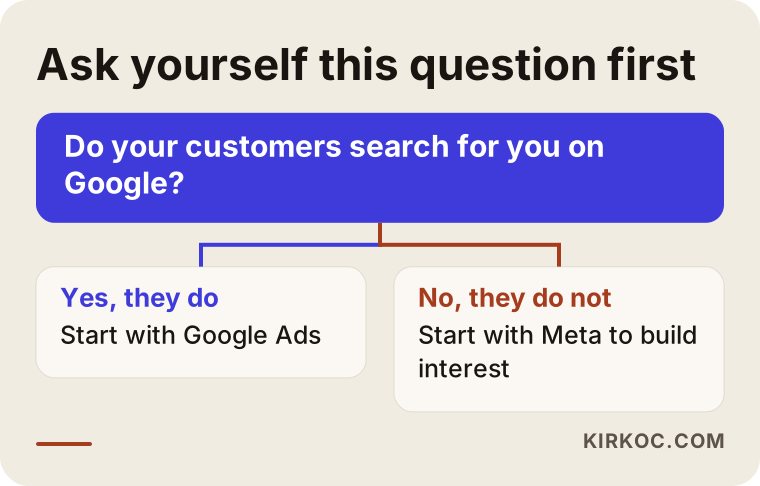
I kept this graphic deliberately plain, because the decision tree really can be this simple. To answer the question, type your own service into Google the way a customer would. Count how many ads appear and look at which phrases Google suggests as you type. If you see ads at the top, your competitors have already concluded that the search is worth paying for.
Let me now place that question into a wider frame.
Where do the two ads sit in the customer journey?
A customer rarely picks you in one move. First they do not know you exist. Then they see you somewhere. Then they become mildly curious, then they search, and finally they get in touch. Meta is strong at the start of that line, and Google is strong near the end. In other words, both work on the same road, just at different points.
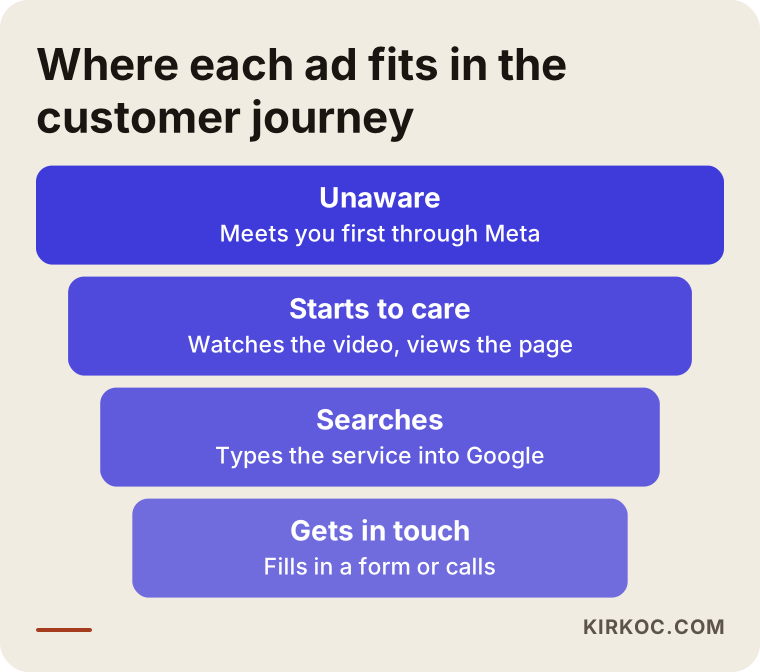
Say someone watches your video on Meta. They may not call that day. A week later they need the service, type your name into Google or go straight to your website. That does not mean Meta failed; it means the result showed up in a different channel. Keep this relationship in mind when you read your numbers, or you may switch off a channel that was quietly doing its part.
For that reason my usual advice is this: start with one channel, get steady results, and then add the second. Opening both at once with a small budget usually means doing both halfway.
Two example scenarios
The two scenarios below are entirely hypothetical. They do not describe a real company or person, and their only purpose is to make the decision process concrete. The first is set in Istanbul, where I work, but the logic is the same in any city.
Scenario 1: a small dental clinic in Istanbul
Imagine a small dental clinic that wants new patients for implants and teeth whitening. People usually look for this kind of treatment because of pain or a firm decision about appearance, and they search for it: "dental implant Istanbul", "teeth whitening cost". Google Ads is a sensible starting point. The ad links to the page for that exact treatment, and the page has an appointment form, an address, opening hours and answers to common questions. Meta can come in as a second stage, for a visual campaign about smile design, say, or for short videos that build trust in the clinic and the dentist.
The critical point in this scenario is that the ad goes to a page about that treatment, not to the home page, and that someone answers the phone. However good the ad is, an unanswered call or an overly long form loses the patient.
Scenario 2: a small online shop selling handmade ceramics
The second imaginary business makes ceramics in its own workshop and sells them online. People might search for "handmade ceramic mug", but the volume is tiny compared with an emergency plumber, and most buyers become interested after they stumble on a product. Meta ads work well here: good photos, short videos from the workshop, campaigns around gift seasons. On the Google side, shopping ads can be added later to catch people who already search for the brand or the product.
These two scenarios do not show the same result, and that is the point. Where a need arises, search comes first; where interest has to be sparked, visuals come first. Try to place your own business near one of the two ends. Most businesses sit somewhere in between, and there a blended plan makes sense.
Step by step: how does an ad project run?
Opening an ad account and pressing "publish" is the small part of the job. The right order puts the preparation before the spending.
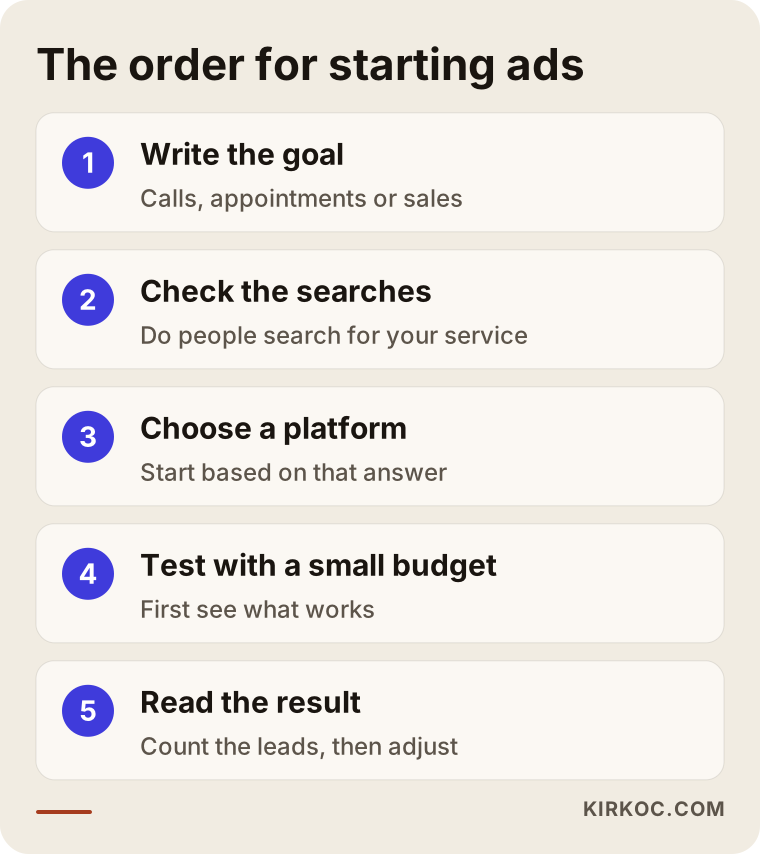
Here are the five steps in the graphic, one by one.
Write down the goal. "More customers" is not a goal. Do you want phone calls, appointments, store visits or online sales? The goal decides how the ads are built and what counts as success.
Check the searches. As described earlier, see whether your service is searched for on Google. That answers half of the Google-or-Meta question.
Choose a platform. Use that knowledge to pick your starting channel. If you are unsure, starting with the channel that carries clearer intent is generally the less risky route.
Test with a small budget. At the start, the aim is learning, not profit. Which phrase, which picture, which area works? A small test prevents a large mistake.
Read the result. Look at real inquiries, not clicks: how many calls, how many forms, how many sales. If you are not counting these, you cannot know what your ad spend returned.
The fifth step is the one most often skipped. Paying for ad management while not tracking inquiries is like running a shop where nobody counts the cash.
What should be ready before you advertise?
An ad takes a visitor somewhere. If that place is not ready, the money is wasted. A short checklist before you start will save you a lot.
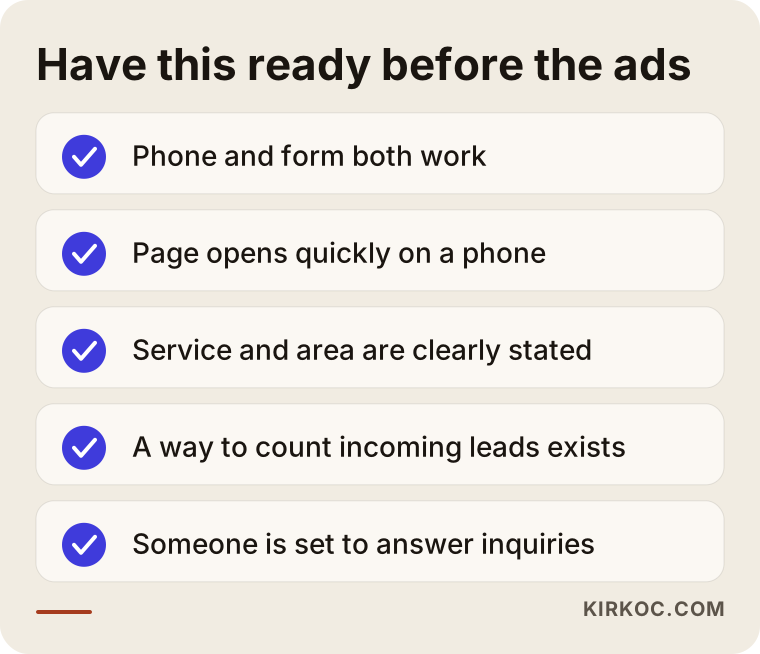
Every item on the list comes from the gaps I run into most often. A visitor on a phone will not wait more than a few seconds for a page to open, and you have already paid for the click by then. When the visitor arrives, they should find quick answers to "What do they do, where, and is it for me?" If the service and the area are not clearly written, it is hard to look trustworthy.
The most neglected item is measurement. For a tap on a phone button or a submitted form to be counted, the site needs a small setup. Without it you cannot see which ad produced business. If you like, the website itself can be reviewed at this stage too, because ads and website are one whole. This is why I believe that running website, SEO, social media and ads from one pair of hands speeds things up, especially for small businesses. When I find a gap in an ad, I can fix it on the site the same day. When a social post does well, I can turn it into an ad creative. When the work is split among several people, that feedback slows down or disappears.
Common mistakes
Some mistakes repeat on both platforms. Most come not from the ad itself but from the preparation around it.
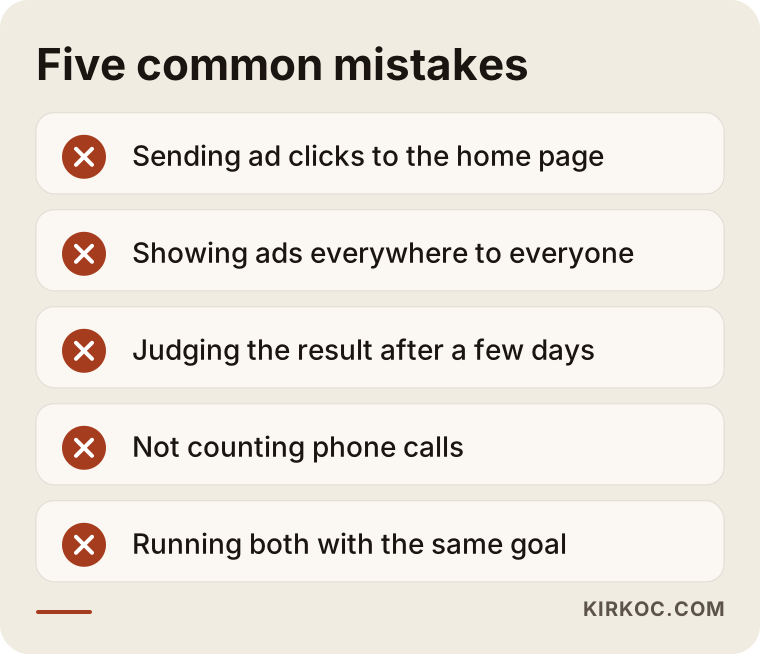
Sending clicks to the home page. Someone who searched "dental implant Istanbul" and lands on a home page with a long list of services has to work to find what they wanted. Linking the ad directly to the relevant page usually makes a difference.
Showing ads everywhere to everyone. Running ads without setting location, hours and audience means spending your budget on people who cannot become customers. If you serve only certain districts or neighborhoods, say so in the ad settings.
Judging the result after a few days. Ad systems are in a learning phase at the beginning, so deciding from the first few days can mislead you. On the other hand, leaving an obviously failing ad untouched for weeks is also a mistake. You need balance.
Not counting phone calls. For many local businesses, most of the demand comes by phone. If calls are not measured, the ad can look as if it does nothing.
Running both platforms with the same goal. Giving Google and Meta the same message and the same objective can mean paying twice to reach the same person. Give each channel its own role.
One more note on platform rules. Ad accounts can be restricted, and individual ads can be rejected for policy reasons, particularly in areas such as health, finance and beauty. These rules belong to the platforms and they change. When writing ad text, check the current policies, and if there is a legal side to your claims, talk to a qualified lawyer.
What can you do yourself, and when do you need a specialist?
You can run ads yourself. The platforms are designed to make that easy, and for a small test it is often enough. On Meta in particular, boosting a post takes a few taps. That route has limits, though.
If you do it yourself, keep these points in mind: choose one goal, start with a small budget, narrow your service area, link each ad to its own page and write down every inquiry somewhere. Once a week, look only at those numbers. Do not follow the "recommended settings" screens blindly, because a platform's suggestions serve its own usage goals, which are not always the same as your profit goals.
A specialist becomes worth considering when the budget grows to a point where mistakes hurt, when measurement has to be set up, when Google and Meta run side by side, when the ads have not worked after the first weeks and you want to know why, or when you simply have no time to manage them. A good specialist does not promise a miracle. They reduce the cost of trial and error and keep you from repeating known mistakes.
What should you expect in the first months?
Advertising is not a machine that gives a result the moment you press a button. It is a system that gets tuned. A realistic calendar for the first months reduces disappointment.
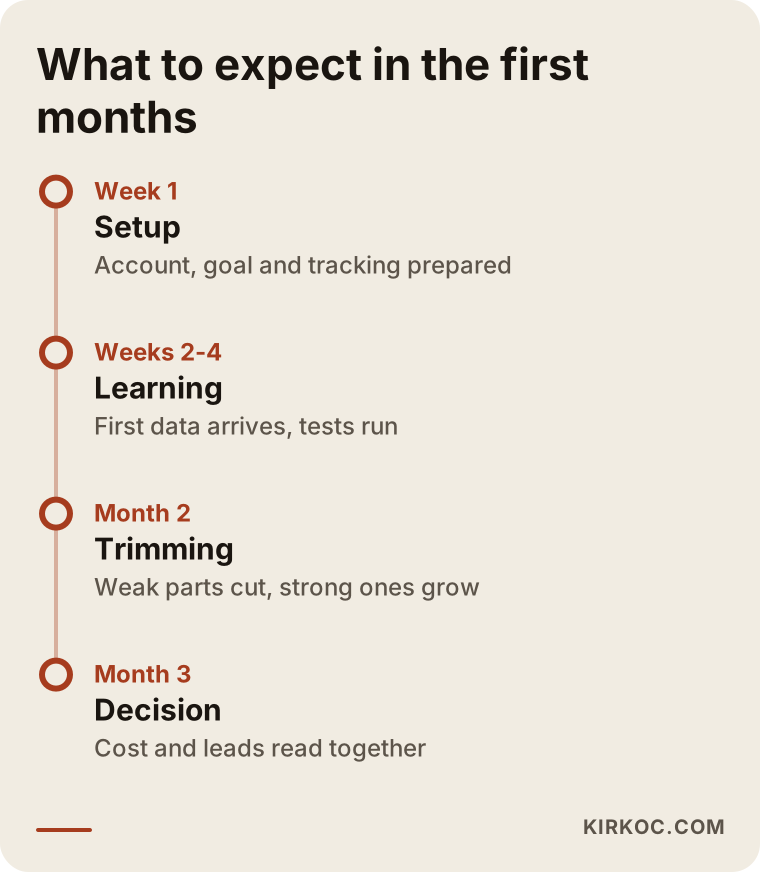
The first week is setup: accounts, goals, measurement and pages are prepared. Weeks two to four are the learning period, when the first data arrives and different phrases and pictures are tested. In the second month the weak parts are cut back and the working parts are given more room. By the third month, cost and demand can be read together, and you can decide whether to continue, change course or stop. This calendar is not a promise. It can be shorter or longer depending on the business. Where the sales cycle is long, for instance in business-to-business services, results can take more time to appear.
Ads and your other marketing also feed each other. Seeing which phrase brings business in an ad is a useful clue for SEO. Seeing which social post gets attention helps you choose ad pictures. When different people handle each piece, that flow of information is easily lost.
What decides the cost?
I am not giving figures in this article, because they swing widely with industry, location and season. I can, however, explain what drives cost, so you know which questions to ask when you read a quote.
Ad spend and management fee are two separate items. Ad spend is the money you pay directly to the platform. The management fee goes to the person who sets up and runs the account. Make sure a quote lists them separately.
Several things affect ad spend: how much competition there is in your industry (many rivals bidding on the same phrase push clicks up), the area and audience you target, the time of day, the quality of your ad and how well your page suits the ad. Two different businesses with the same budget can get very different results.
Several things affect the management fee: how many platforms are covered, how many campaigns and services are managed, whether images and video production are included, whether a measurement setup is needed and how often you get reports. Ask which of these are in the package.
One more point: do not think of your budget as ad spend only. The landing page, the creative, the measurement and the human time needed to handle incoming inquiries are all part of the cost. Running two platforms on a very small budget often means getting enough data from neither.
What happens if you ask an AI assistant?
Many people now type this question straight into an AI assistant. The answers are usually sensible, but because the assistant does not know the details of your business, they stay general.
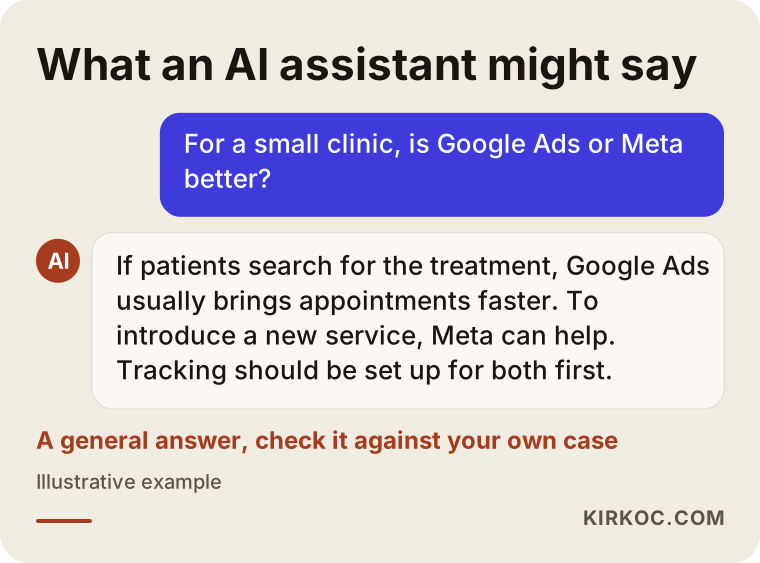
The answer in the example agrees with the main idea of this article: Google when there is search intent, Meta when interest has to be created, and measurement first for both. But it knows nothing about the competition in your industry, the search volume in your area or how ready your site is. Use such tools to get ideas, and check the decision against your own data. Where an assistant cites a source, confirm the source is current, because ad platforms change their rules and screens often.
How do I work with clients?
I do this work myself, from start to finish. In a first conversation I listen to how your business runs, what you offer, how customers find you now and what you want to achieve. Then I explain in writing which channel I think suits you, which one makes sense to start with and why. You make the decision.
Before setting up ads I check whether your site and the relevant pages are ready to receive them. If needed, page edits, measurement setup, image preparation, or small additions on the SEO and social media side happen in the same flow, so you do not have to brief several different people. After the ads go live I look at the numbers regularly and tell you in plain language what I changed and why. I do not guarantee a result, because I do not think anyone can honestly do that. What I can do is run the work in an orderly, measured and transparent way.
Frequently asked questions
Is Google Ads or Meta ads better for a small business?
If your customers look for your service on Google when they need it, starting with Google Ads usually makes more sense. If your product catches attention through pictures, or nobody is searching for it yet, Meta comes to the front. If you are unsure, type your service into Google as a customer would and see whether competitors are running ads.
Are Instagram ads and Meta ads the same thing?
Largely, yes. Instagram and Facebook ads are bought through the same system, Meta's ad manager. You can show one campaign on both or choose only one. For that reason "Instagram ads" and "Meta ads" usually describe the same job.
Do I need to run both at the same time?
Not necessarily. For many businesses it is healthier to start with one channel, get steady results, and add the second afterward. Opening both with a small budget can leave you without clear data from either. If you have the budget and the time, using the two together with different roles can be a strong plan.
How long until ads start working?
On Google Ads, inquiries can arrive in the first days, but a fair assessment usually needs a few weeks of data. On Meta, the learning and interest-building period can run a little longer. The time depends on your industry, your budget and how ready your page is, so naming a fixed period would not be honest.
Does advertising replace SEO?
No, they do different jobs. Ads stop when you stop paying and deliver quick results. SEO is built more slowly, but after a while it can bring visitors without ad spend. Using both together also helps you see which phrases really bring business.
Is an agency or a single specialist better for ads?
Each has strengths. A large account that needs a big team may suit an agency. For small and mid-sized businesses, working with one person who knows you directly and handles everything can improve communication and speed. Whichever you choose, ask in writing what is included and how reporting will work.
What should I do if my ad account is suspended or an ad is rejected?
Read the reason the platform gives carefully. In most cases the ad text, the image or the page it links to broke a rule. You can fix it and resubmit, or file an appeal. If there is a legal dimension, speaking with a qualified lawyer is sensible.
Can I run ads without any measurement?
Technically yes, but I would not recommend it. If you do not know which ad produced a call or a form, you cannot decide where to put the budget. Even a simple measurement setup lets you see what your ad spend returned.
If you are unsure which ads to start with, or you want to find out why an existing ad account is not producing results, get in touch through my digital advertising page. I will listen to how your business works and tell you plainly which channel makes sense to begin with and how.