You have decided to advertise on Google, and two roads lie in front of you. You can hire an agency that looks polished and corporate, or you can work with one specialist who runs everything alone. One friend tells you "agencies cost more, but they are safe." Another says "a freelancer cares more about your account." Because you do not work in this field, you cannot tell which advice is right. The honest answer to "Google Ads agency or freelancer?" is that there is no single winner, but there is a clear answer for your situation once you look at your company's size, your budget and how much of the work you want to carry yourself. I will walk you through both options in plain language. I should admit something up front: I am a one-person provider, so I cannot be neutral. To make up for that, I will spell out the real strengths and weaknesses of both sides. As someone who offers digital advertising management, I have noticed that a bad hire usually does not come from a bad campaign. It comes from mismatched expectations.
First, what does "managing Google Ads" actually mean?
Google Ads is the system behind the results marked "Ad" at the top of a Google search page. You pay each time someone clicks. Managing it means constantly deciding where that money goes: which searches, which web page, which hours of the day. Setting up the campaign is only a small part of the job. The real work begins in the weeks after launch. Which searches are bringing you clicks that never turn into anything? Which ad wording makes the phone ring more? Which page loses visitors the moment they land? Someone has to watch for these things and fix them.
I mention this because, whether you hire an agency or a freelancer, what you are really buying is attention and judgment. Anyone can press the buttons. The difference shows up in who gives your account steady, correct attention over months. Base your choice on where that attention will come from.
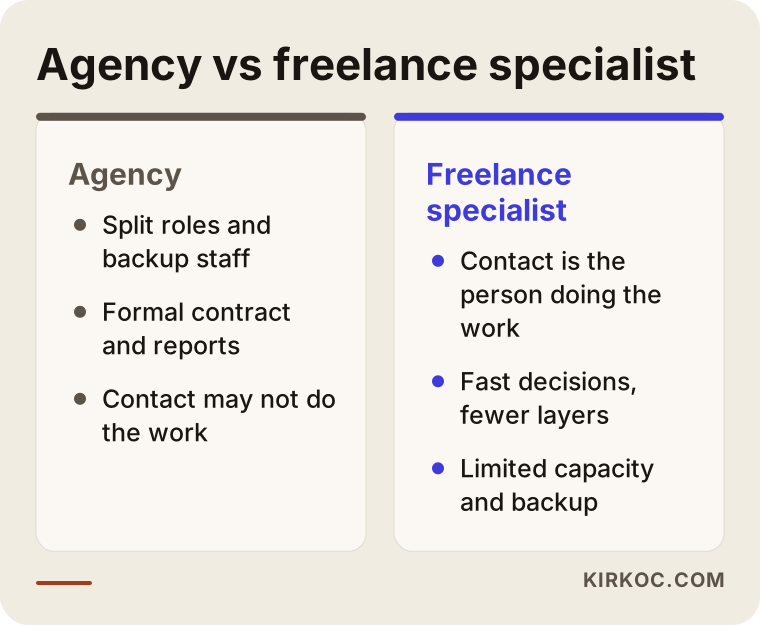
The comparison above puts the two options side by side. I will unpack each line below.
The real advantages of working with an agency
An agency's biggest strength is division of labor. One person builds the account, another prepares the ad images, a third produces the report. That structure is reassuring when your company has many things going on at once. Picture a business with three locations, a different campaign for each, and a weekly report that managers expect on Monday. Asking a single person to keep up with all of that can be risky.
The second advantage is continuity. If one person at an agency falls ill or goes on holiday, your account passes to someone else. The third is formal assurance: contracts, invoices, scheduled meetings and a defined workflow. For the purchasing department of a large company, those are often requirements rather than perks.
There is a downside, too. The person who talks to you and the person who works in your account may not be the same. The salesperson at the first meeting is persuasive and experienced, and then your account lands on the newest junior. That does not happen at every agency, but it is worth a direct question: "Who will actually work on my account, and can I speak to them directly?"
The real advantages of working with a freelancer
When you hire a freelancer, the person you speak to is usually the person doing the work. The voice on the phone is the one that goes into your account. That cuts down on information getting lost in relay, so you avoid the classic "I told them, but it never reached the person who needed it." Decisions are quick, too, because there are few layers between you and the keyboard.
The cost structure is often simpler as well, since a large office, a sales team and layers of management are not built into the price. I will not name a number, but that is the general logic.
The drawback is the flip side of the same coin: one person means one person's capacity. If they get sick, hit a busy stretch or quit the business, there is no backup. Also, nobody is equally strong at everything. Someone excellent at managing ads may be limited when it comes to professional video. So when you consider a freelancer, ask plainly what they do themselves and what they outsource.
What actually drives the price difference?
People usually ask "which is cheaper?" That question misses something first. The money you spend on advertising, which is what you pay Google per click, and the management fee are two separate items. Both agencies and freelancers charge you a fee for managing the account. You pay the ad budget directly to Google. Many people mix these up.
The management fee itself depends on factors like these:
- How many campaigns and ad groups are being managed.
- How complicated the account is. A one-service local business and an online store with hundreds of products are not the same job.
- How often you want reports and calls.
- Whether the fee covers only management, or also ad copy, images and edits to the page visitors land on.
- Whether the fee is fixed, a percentage of your ad spend, or a mix.
Be careful with percentage-based pricing. If the fee is a share of what you spend on ads, the manager earns more only when you spend more. That does not automatically mean bad intent, but you should know the incentives do not point your way. A fixed fee or a clearly written scope tends to be a healthier basis.
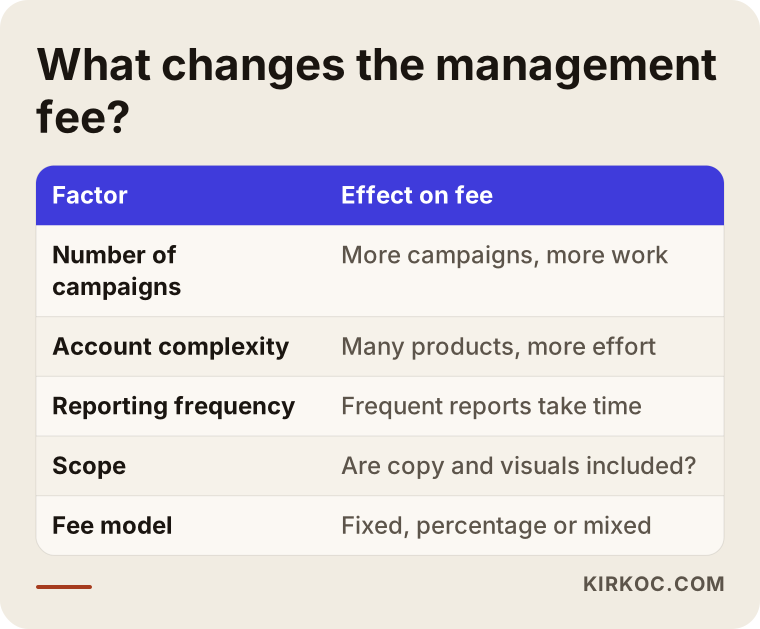
As the table shows, a better first question than "how much?" is "what does it include?"
Which type of business suits which option?
The two examples below are hypothetical. They do not describe any real company; they simply make the situation concrete.
Example scenario 1: A single-location dental clinic
Suppose a clinic owner wants to appear when people search for things like "dental implants" or "teeth whitening" in the city. The monthly ad budget is modest and the staff is small. What this owner needs is not a large corporate structure. It is someone who will manage a few campaigns carefully, answer quickly when asked, and keep track of the phone calls that come in. In a case like this, a single specialist is often more efficient. The account is small and focused, and an agency's many layers could slow things down.
Example scenario 2: A mid-sized online store with many product groups
This imaginary company runs an online shop with hundreds of products. Prices, stock and product photos change constantly, and a report goes to the board every month. The workload is heavy: the product feed, the ad text, the images and the reporting all have to move together. Here you may need either an agency with divided roles or a group of several specialists. If one person will run it, you should talk openly about their capacity and who covers for them.
The lesson from these two examples is that the question is not "which is better?" but "how heavy and how complicated is my workload?" A small, focused business can do well with one person. A large, many-sided one may require divided roles.
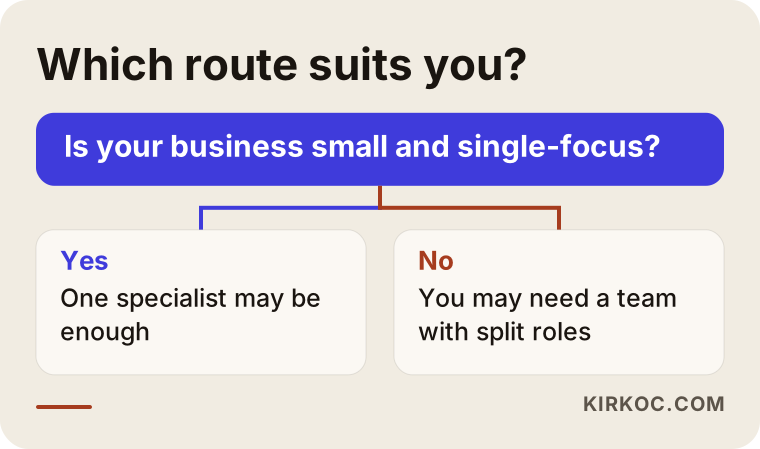
The chart reduces the choice to one question. Weigh your own situation against it.
Advertising alone is not enough
An ad brings a click; it does not bring a sale. What the visitor sees after arriving on your site often matters more than the ad. If your page loads slowly, your phone number is hard to find, or the layout breaks on a phone, even a well-run campaign wastes money.
That adds another dimension to "who should I hire": can the person managing your ads also touch the landing page? If one person runs the ads, another builds the site and a third handles social media, none of them may know what the others are doing. The ad can announce a winter promotion while the site still shows a summer photo. This is why I handle the website, search visibility, social media and advertising together myself. When I spot a problem in one, I can fix it in another right away. That is not necessary for every business, but for many owners who are tired of scattered management, it is the biggest relief.
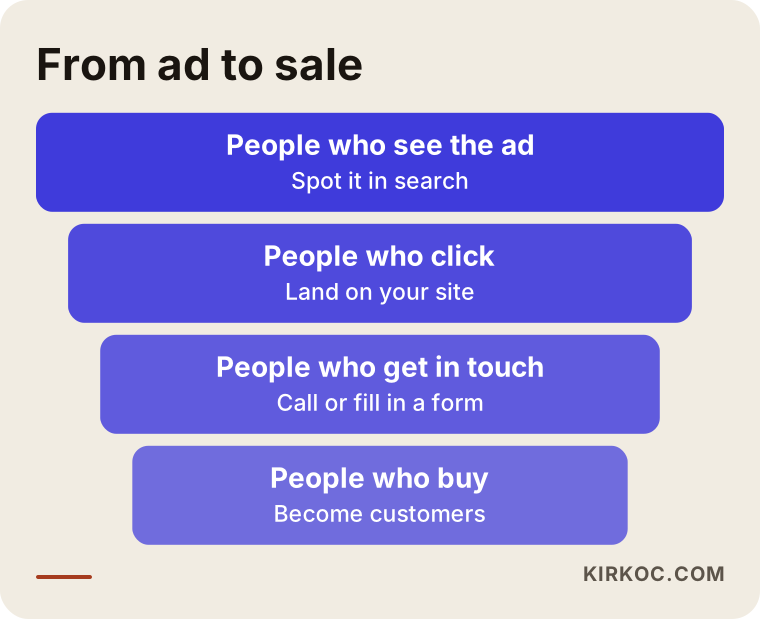
Some visitors drop away at every step, which is why the page deserves as much management as the ad.
Questions to ask before you decide
Whichever route you pick, bring these questions to the meeting. How someone answers tells you as much as the answer itself.
- Who will manage my account, and can I reach them directly?
- Whose name will the ad account be in? (It should be yours, with the manager added as an authorized user.)
- What does the management fee cover, and what does it leave out?
- How often will I receive reports, and in what plain format?
- If I end the contract, do I keep access to the account?
- What will we measure: clicks, phone calls, form submissions or sales?
The second question matters most. If the account is not in your name, you may lose your history and setup when you part ways with the manager. No trustworthy professional objects to this.
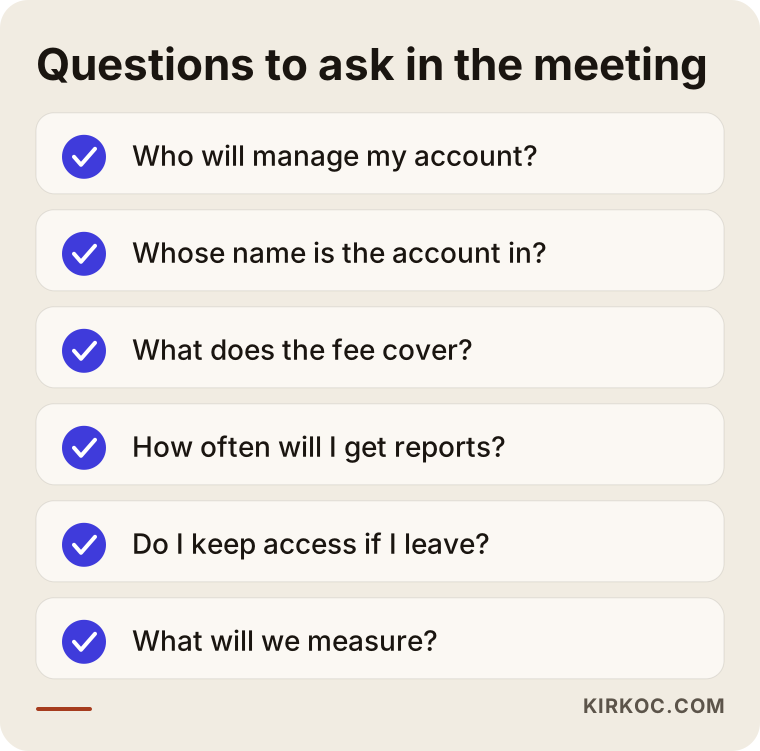
You can print the list and bring it with you. Clear answers are the first sign of a provider you can trust.
Step by step: how to choose the right person
Let us keep this as simple as possible. The sequence below works for an agency and a freelancer alike.
- Write down your goal first: do you want phone calls, form submissions or online sales?
- Decide your monthly ad budget, thinking of it separately from the management fee.
- Meet two or three candidates and give each the same information.
- Ask every candidate to explain, in their own words, how they would approach your goal.
- Compare the answers, and be ready to drop anyone who makes inflated promises.
- Start with a small trial period and agree in writing on what will be measured.
The fifth step is the most important. Someone who says "I guarantee this many sales" or "I will put you on page one" is not being honest about themselves or about how Google works. Ad results depend on your market, your competitors, your website and the season. Nobody can guarantee them.
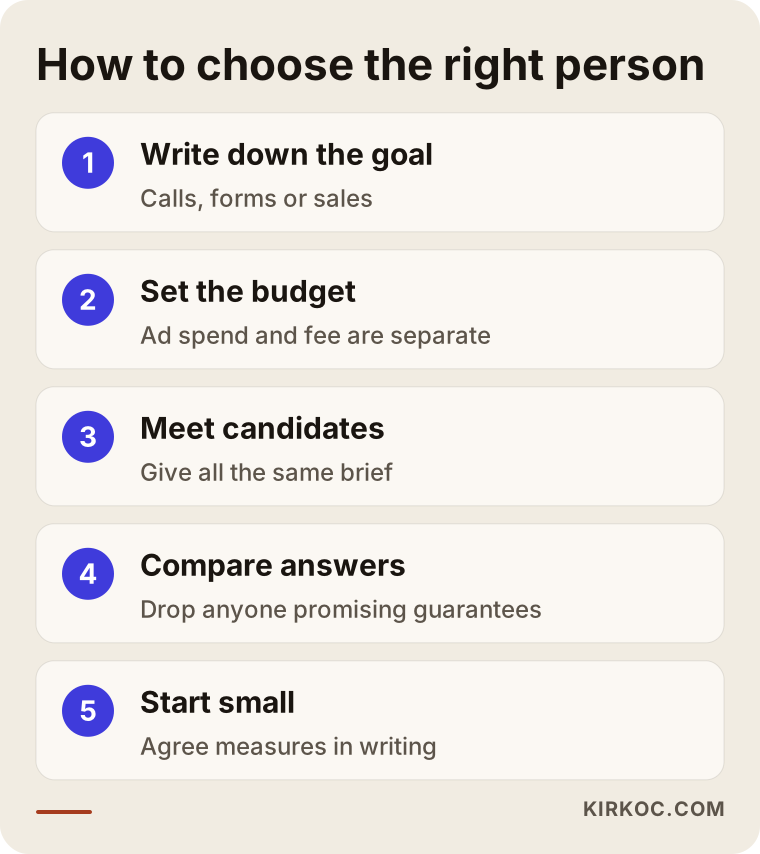
You can finish all six steps within a week. The part that takes real time is getting clear on your goal.
Common mistakes I see when businesses compare options
These are the errors owners make most often in this area.
Looking only at price. Picking the lowest quote usually means buying the least attention. Cheap management can mean an account that someone looks at once a week.
Not asking for references. Be cautious about anyone who will not let you speak to people they have worked with. That said, some client details can reasonably stay private. If you are unsure about any legal point, ask a lawyer.
Not asking who owns the account. I covered this above, but it is the most common mistake of all.
Skipping tracking at the start. If phone calls and form submissions are not being counted, nobody can tell which ad is working, and decisions turn into guesses.
Handing over everything. No manager, however good, knows your business better than you do. You know which service earns the most and which season is busiest. If you do not share that, the campaign may push the wrong thing.
Giving up too soon. An ad account needs time to learn. Ups and downs in the first weeks are normal. On the other hand, if months pass with no improvement and no explanation, that is a different warning sign.
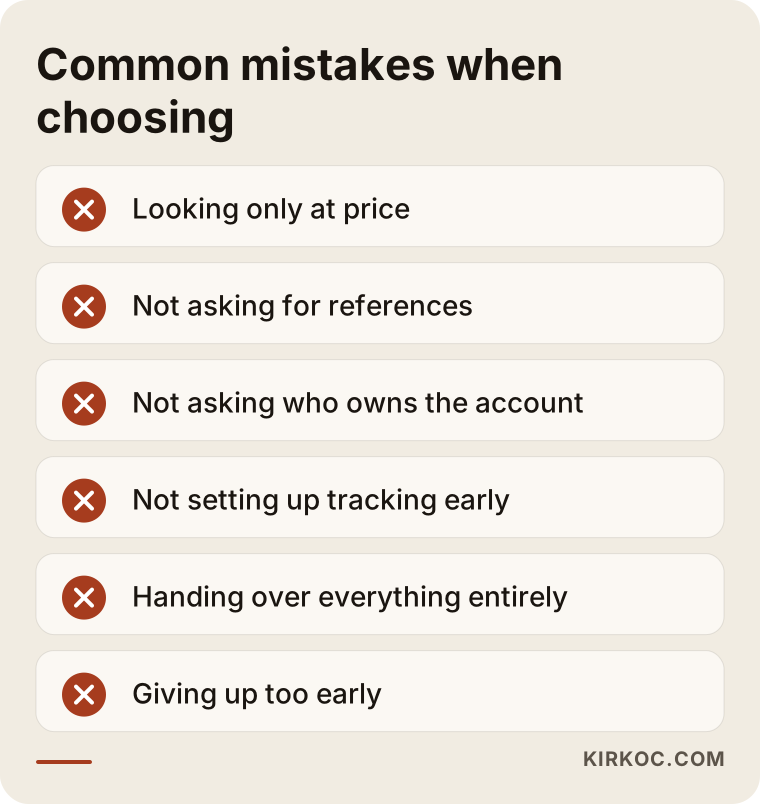
Most of these mistakes are cheap to avoid if you notice them before you sign, and expensive in both money and time if you notice them afterward.
What can you do yourself, and when do you need a specialist?
You do not have to hand everything off. With a very small budget and a single service, it is possible to start on your own and learn as you go. Google offers a simple setup guide for beginners. Just know that the guided setup tends to push you toward a broad campaign, and that can let your budget drain away on unrelated searches.
Things you can do yourself:
- Decide which of your services is the most profitable and start the ads there.
- Keep your phone number and address identical everywhere they appear.
- Ask every caller how they found you.
- Open your own site on a phone and try it like a visitor would.
Things that call for a specialist:
- Deciding which search phrases to exclude, so you stop paying for irrelevant clicks.
- Setting up conversion tracking correctly. That simply means counting the calls and forms that result from ads.
- Splitting several campaigns so they do not compete with each other.
- Testing ad wording continuously and comparing versions.
- Shifting budget toward what works, sometimes day by day.
As the account grows or the spending rises, the cost of running it yourself, meaning the opportunities you miss, usually exceeds what a specialist would charge. You will notice when you cross that line by looking at your phone calls and your spending.
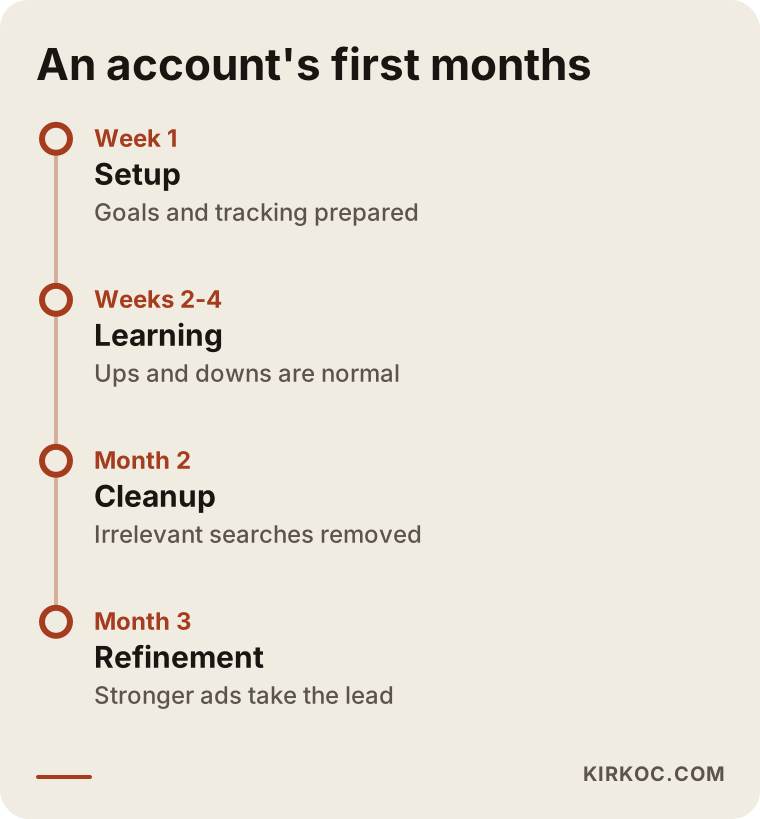
The timeline shows what to expect in an account's first months, including the stretches where patience is the right response.
Criteria for comparing an agency and a freelancer
Let us boil the decision down. Apply the criteria below to your own business.
Availability. When you ask a question, can you get an answer the same day? For small businesses this often matters more than technical skill, because when something goes wrong in an ad account, time has a price.
Understanding. Does the person grasp your industry and how your customers search? Someone who talks in generalities is very different from someone who speaks your customers' language. A lawyer might care about "divorce attorney near me," while a dental clinic might care about "emergency dentist open late." Only someone who knows the field senses which phrases are valuable.
Transparency. When you read the report, do you understand it? If you do not, the problem may lie with whoever wrote it. A good report says, without jargon, "this much was spent, this many calls came in, and this is what I changed."
Room to grow. If your business grows, can the same person or company keep up? If you have one campaign today and plan to have five tomorrow, capacity should be part of the conversation.
Coherence. Do your website, your search visibility and your social media move in the same direction? This is where having one person handle everything pays off most. The service you promote in your ads is presented the same way on the site and described in the same voice on social media. With scattered providers, you end up being the go-between.
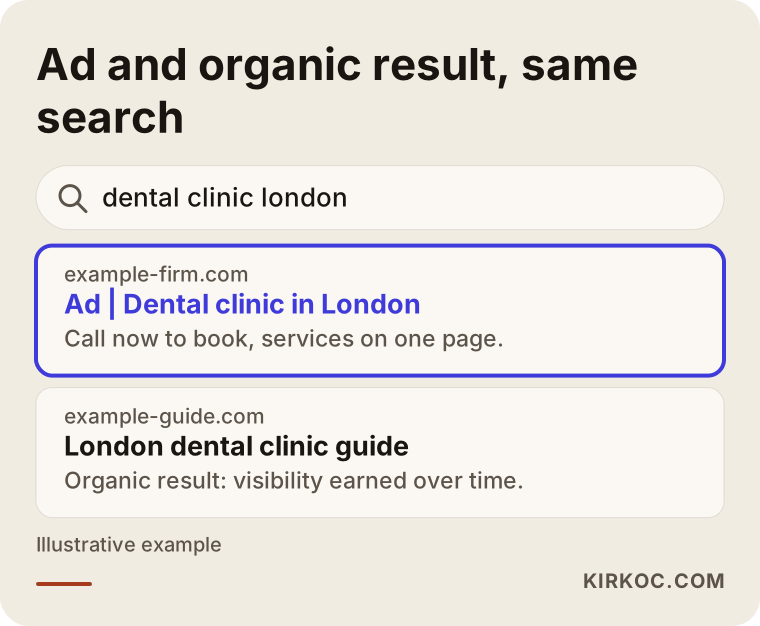
The example shows two different areas sharing one search page. The ad appears immediately, while the organic result is earned over time.
AI assistants and your advertising decision
Lately, many people ask AI tools such as ChatGPT when they look for a product or service. These tools sometimes show the sources behind their suggestions. That does not make Google ads less important, but it shows that relying on ads alone is not enough. When you switch the ads off, your visibility ends. Clear, trustworthy content on your own site, however, can help you get found both in search and in AI answers.
So ask whoever will run your ads: "What will be left on the day I turn them off?" An approach focused only on ads, with the site, content and local visibility neglected, puts you back at zero the moment the budget runs out. Ads are a short-term accelerator. The lasting structure is built on your website.
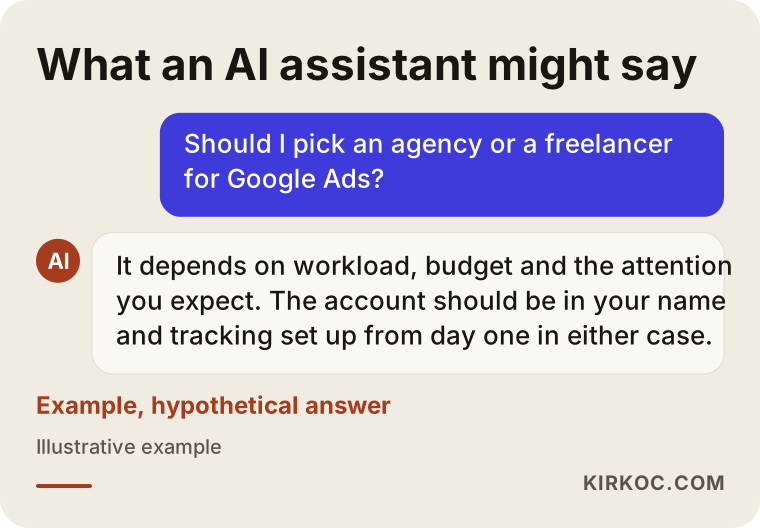
This example is hypothetical, but it is enough to show what kind of clear information AI answers tend to bring forward.
How I work
I handle all of this from Istanbul, alone, but as one connected service. Besides ad management, I also build websites and online stores, work on search visibility and local search, manage social media, design logos and brand identity, and produce content. That means the same person who runs your ads can also edit the page your visitors land on. First I listen to your business, to how your customers search and to what you want. Then I tell you plainly what will help and what is unnecessary. Sometimes the most honest answer is "do not run ads right now; fix your website first." The ad account is opened in your name, you pay Google directly for the ad spend, and I only manage it. I do not guarantee results, but I explain what I am doing and why in simple terms, and I send regular reports. On price, we first discuss the scope, because the cost varies with the factors listed above.
This approach has limits. Because I work alone, the number of clients I can take at once is limited, and my model may not suit a very large organization with many internal teams. If that is your situation, I will say so openly.
Frequently asked questions
Is a Google Ads agency or a freelancer cheaper?
A solo specialist often has lower overhead, so the quote can be leaner, but that is not a rule. What matters is what the fee covers. Without comparing two quotes against the same scope of work, nobody can honestly say which one is cheaper.
Are the ad budget and the management fee the same thing?
No. The ad budget is the money you pay Google for each click. The management fee is what you pay the person or company running that money. They are separate items and should be written separately in the contract.
Whose name should the ad account be in?
Yours. The manager is added only as an authorized user. That way, if you part ways, your data and setup stay with you.
How long until I see results?
It depends on your industry, your competitors and the state of your website. In the first weeks, the system is still learning, so numbers may swing up and down. Nobody can guarantee a timeline or a result, and you should be cautious about anyone who does.
Is running ads alone enough?
Usually not. An ad brings the visitor, but the site has to convince them. A slow or confusing page can waste even a good campaign's budget. That is why the ad and the site should be thought about together.
Can I switch from an agency to a freelancer, or the other way around?
Yes. If the account is in your name, switching is easy, which is another reason ownership matters from the start. During the switch, you only need to hand the campaign structure and past data to the new manager.
Does a small business need an agency?
When the budget and the work are small, usually not. One focused specialist may be enough. If your business has many moving parts or a heavy reporting load, an agency becomes a better fit.
What is the benefit of one person handling both the site and the ads?
Because the same person can edit the page the ad sends people to, they can fix both together when they spot a problem. You do not have to play the middleman, and your messages stay consistent.
If you are struggling to decide which route to take, describe your business and your goal and write to me. You can reach me through the digital advertising management page, and I will give you an honest assessment.