You decided to advertise, you opened a Google account, and now a box is staring at you: "Enter your daily budget." This is where most business owners freeze. Type too little and it feels like nobody will ever see the ad. Type too much and it feels like money thrown away. In this article I will answer the question of how to set a Google Ads budget without quoting a single figure, by looking at the real situation of your own business. I am Ümit Kırkoç, I work from Istanbul, and I run digital advertising management together with web design, SEO and social media, all by myself. That is why I look at the budget question from the whole picture of your website and your sales process, not only from the ad screen.
Let me say one thing first: there is no magic budget that fits everybody. Anyone who tells you "this much is enough" without knowing your business is guessing. A budget is a calculation, not a hunch, and the inputs to that calculation are already in your hands. This guide shows you how to collect those inputs and how to read them.
What is Google Ads, and what does a budget actually mean?
Google Ads is the system that puts your business at the top of the results page, under a small "Ad" label, at the moment someone searches Google for something you offer. You do not pay for the ad simply being shown. In most cases you pay when someone clicks on it. So your money goes to visitors who arrive, not to "being visible."
That is why a budget means two different things. The first is the ceiling: the most you are willing to spend per day or per month. The second is the outcome: how many people that money can bring to your site, and how many of them will call you. Most of the confusion comes from mixing these two up. Setting the ceiling is easy. The hard part is judging, before you spend, whether that ceiling can bring you real business.
One more detail matters here. A daily budget tells Google "spend at most this much today," but the system may go over that on some days and stay well under it on others. Over the month, the total is balanced so it does not exceed your monthly frame. So think of the budget as a monthly frame, not as a single day's number.
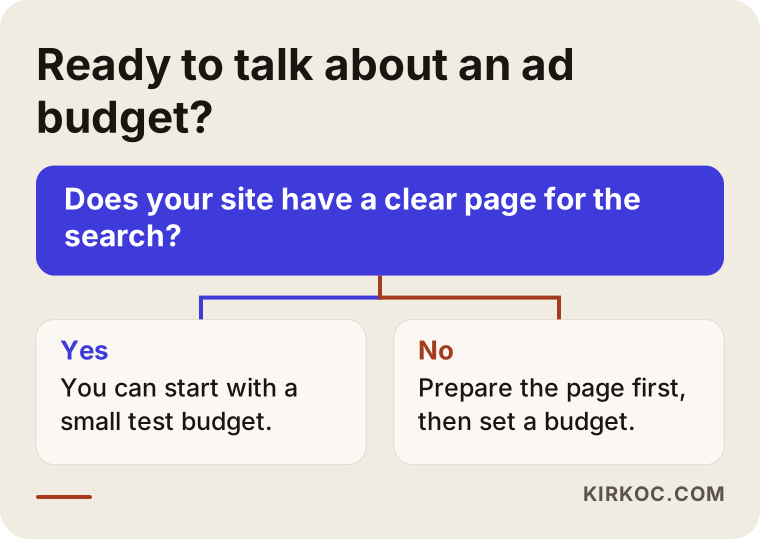
The chart above shows the first problem to solve before you talk about money: are people already searching for what you sell, and does your site have a page ready to receive them? If both answers are yes, a budget is worth discussing. If not, closing those gaps first is usually smarter than setting money aside for later.
The budget comes from your goal and sales process, not from a number
Starting the conversation with "how much can I spare each month?" is natural, but it is incomplete. A better opening question is: "What is the most I can spend to win one customer?" The answer to that is written in your own books, not on the ad screen.
Think of it this way. The profit a customer leaves with you sets the upper limit of what you can spend to win that customer. If your service is sold once, that limit is tight. If the same customer comes back for years, the limit is wider. People who manage ad budgets often skip this calculation and jump straight to "this much per day." Then they see no result in the first week and give up.
Here are the main forces that shape a budget, gathered in one table.
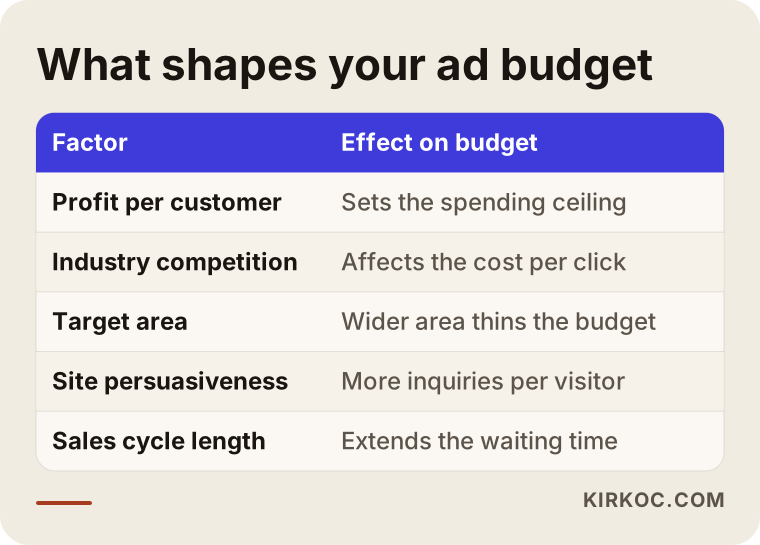
Each row in the table is a force pulling the budget up or down. Let me go through them one at a time in plain language.
Profit per customer
Knowing what remains in your pocket after a sale or a signed job is the cornerstone of the budget. If your margin is generous, you can afford to pay more to win a customer, which lets you compete on more crowded searches. If your margin is thin, you need to keep the ads limited to narrower, clearer searches.
Competition in your industry
The price of a click on Google Ads is not fixed. It is set by a kind of auction. When many companies want the same search phrase, clicks get more expensive. Fields such as law, health, finance and real estate tend to have pricier clicks, while a local repair job or a small workshop may stay cheaper. I will not put a figure on it, because it changes with the city, the season and even the day of the week. The most honest way to see the competition is to look at the keyword planner inside the account and then confirm it with a few weeks of real data.
Your area
Advertising to a whole metropolitan region is not the same budget as targeting a single neighborhood. As the target area grows, the same money is spread thinner. For most local businesses, staying concentrated in a small area is the more sensible start.
How persuasive your website is
A person who clicks your ad lands on your site and then either calls you or closes the tab. The clearer and more trustworthy your page, the more phone calls you get from the same number of visitors. Pouring budget into a weak page is like filling a leaky bucket. This is also why running the website and the ads together makes the budget work harder: when I spot a gap on the page, I can fix it the same day.
Length of your sales cycle
In some businesses the customer decides the same day, in others it takes weeks. If the decision is slow, you need to wait longer to judge the ads, and spread the budget over that period. Quitting too early is the most common mistake in this kind of business.
A test budget first, the real budget second
You do not need to know the final budget up front. The sensible path is to plan a short learning period. In this period the goal is not profit. The goal is to answer a few questions. Which searches bring people in? How many of those visitors call or fill in a form? What does one inquiry cost me?
The budget for this period should be an amount you can afford to lose: small enough that losing it does not shake your business, but large enough to collect meaningful data. Set it too low and you will not learn anything. Set it too high and you are pouring money into a system that has not been tuned yet.
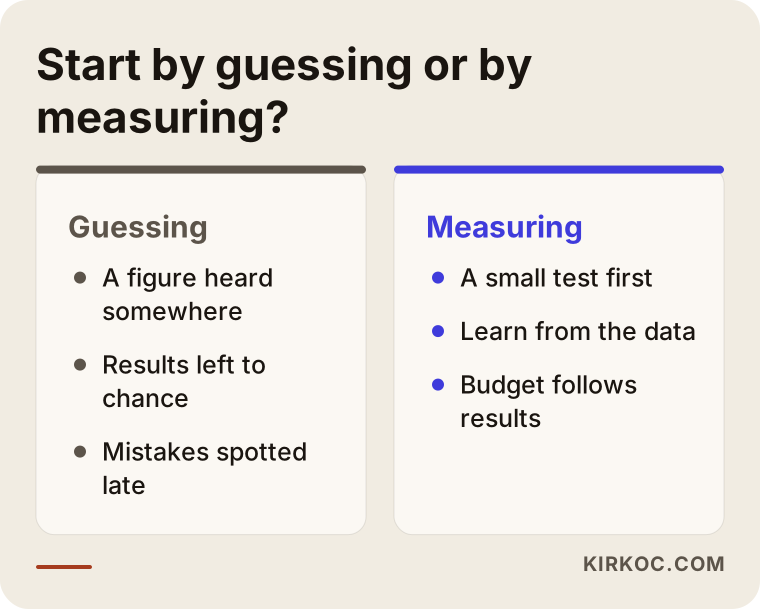
As the comparison shows, the person who starts by guessing picks up a figure from somewhere, applies it and leaves the result to chance. The person who starts by measuring runs a small test, learns from it, and then grows or cuts the budget accordingly. The second path looks slower, but it usually burns less money.
Example scenario 1: an emergency vet clinic (hypothetical)
This scenario is entirely hypothetical. It does not describe a real clinic; it is built to show the reasoning.
Imagine a veterinary clinic. The owner wants a few new regular pet owners each month. A pet owner can keep coming to the clinic for years, so the value of one client is far higher than a single appointment. That widens the amount the owner can spend to win one.
The clinic can only serve people in its immediate surroundings, not a whole region. So the owner limits the ads to a few nearby districts. The searches are also very clear: "emergency vet near me" and similar phrases that people type when they need to act right away. A person making that search is already reaching for the phone, so every click has real value.
Here is how the budget is built. In the first period the owner sets aside a small test budget and focuses only on emergency and nearby searches. After a few weeks, the owner checks which searches actually produced phone calls. Money moves toward the searches that bring calls, and the ones that do not are switched off. If the owner notices that the ads work better in the evening and on weekends, the budget shifts toward those hours.
Notice the point: the budget did not come from "how much money do I have" but from "how valuable is one new pet owner to me."
Example scenario 2: a small online home textiles shop (hypothetical)
This one is hypothetical too. Picture a small online store selling home textiles from its own website. The situation differs from the first one, because the margin on each sale is limited and customers often buy only once.
The shop owner first works out what is left of the product price after cost, shipping and returns. The ad budget has to come out of that remainder. If the remaining margin per sale is very tight, spreading ads across every product makes little sense. It is better to focus on the few products with a healthy margin.
How the budget is divided matters here as well. If the owner puts every product in one campaign, Google may spend the most on the item that gets the most clicks, which could be the one that earns the least. So the owner groups products by profitability and divides the budget between the groups on purpose. Out-of-season items get nothing, and as the season approaches the budget is moved forward.
These two examples show the same question getting two different answers. In one, the deciding factor is the long-term value of the customer. In the other, it is the margin left on each product. Finding out which one decides your case is half of the budget work.
How to set the budget, step by step
Now let us put this into practice. The steps below give you a sequence you can fill in with your own numbers, without me giving any.
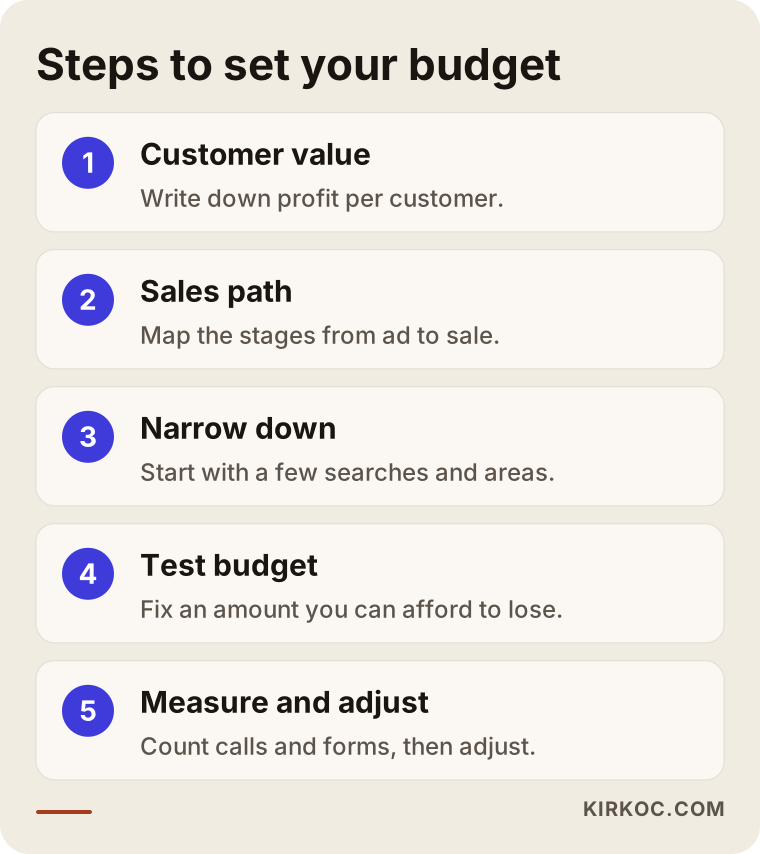
I will go through the steps in the order of the graphic, which merges the last two (measurement and adjusting) into one box.
1. Write down what a customer is worth to you
On a sheet of paper, write the profit you keep from one customer. Also note whether it is a one-time or a repeat relationship. This sets your spending ceiling. If you are unsure, sitting down once with your accountant will speed this step up.
2. Map the road to a sale
How many stages are there between someone seeing your ad, calling you, and finally buying? You lose people at every stage, and that is normal. What matters is knowing roughly where you lose how many.
3. Narrow the area and the searches
Advertising everywhere and on every phrase scatters the budget. In the first period, focus on the few searches that you expect to bring the most business. You expand later, once data comes in.
4. Set the test budget
Choose an amount you can afford to lose but that is enough to collect meaningful data. Fix the length of the test in writing too. Saying "I will not decide before this date" protects you from mistakes made out of impatience.
5. Set up measurement
If phone calls, form submissions and message clicks are not being counted, you cannot interpret the budget. Test that the tracking works before you switch the ads on. This job comes even before the budget itself.
6. Adjust with the results
As data arrives, give more room to the searches that bring business and trim the ones that do not. Treat the budget not as a fixed number but as a live setting.
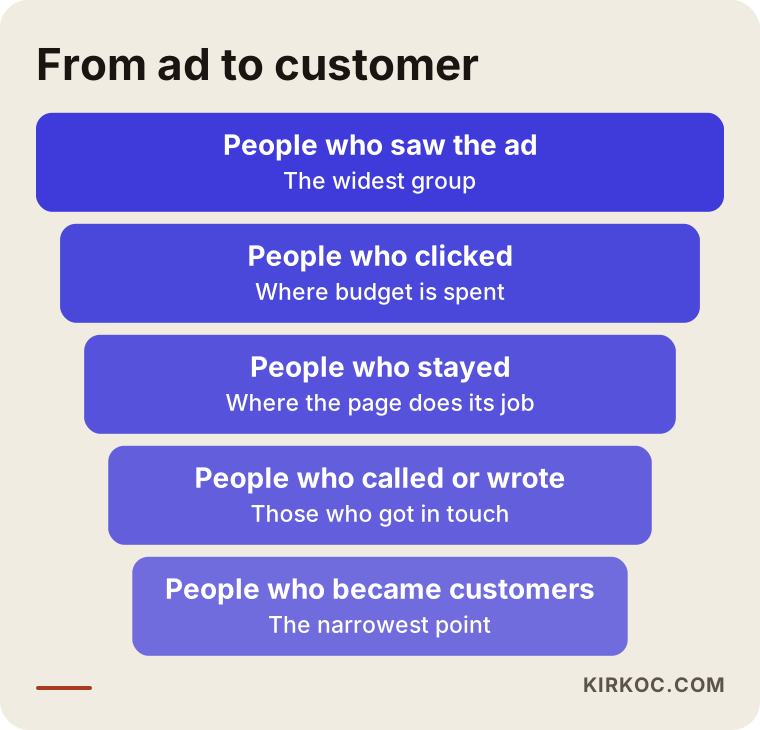
The funnel above shows why a budget cannot be judged by click counts alone. Only some of the visitors stay on the page, a smaller group gets in touch, and a smaller group still becomes a customer. You should read your budget against the narrowest point of this funnel.
What people see on the results page, and what it means for your budget
In effect, an ad budget buys you a place on the Google results page. Seeing who you compete with on that page is an easy way to weigh the budget realistically.
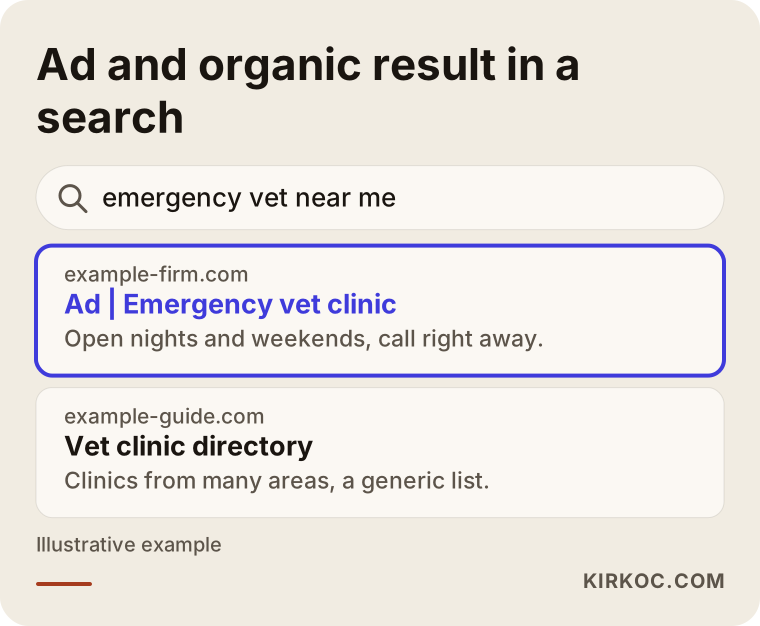
The picture shows a sample search: ads on top, organic results below. Organic results, the places earned through SEO, cost nothing per click, but earning a position takes time. An ad shows up right away, but when you stop paying, the visibility ends. That is why, for most businesses, ads and SEO are not rivals but partners. When both sit in the same pair of hands, the decision about how much to give each is more consistent.
Ads are strongest when you want quick results and the search already carries a buying intent. SEO is strongest when you want to depend less on paid ads over the long run. If you run both, the knowledge you gain from ads about which phrases bring business can feed into the SEO work. That is one of the concrete benefits of having everything handled by one person.
How do you know the budget is being used well?
Assuming the ads work just because money is being spent is misleading. A well-used budget shows a few signs.
The first is that the people arriving are really looking for your service. If most visitors searched for something unrelated, the budget is flowing into the wrong phrases. To see this, you check which search terms triggered your ads. Often you will find odd phrases eating the budget, and these get added to a list of "negative keywords," which simply means searches you tell Google never to show your ad for.
The second is that inquiries actually arrive. If there are many clicks but no calls, the problem may be on the page or in the targeting rather than in the ad itself. Looking at how your page appears on a phone often gives the answer.
The third is that you can read where the budget goes. You should be able to see, day by day and campaign by campaign, which part spent how much. A report that is not shared with you means you cannot control your own budget.
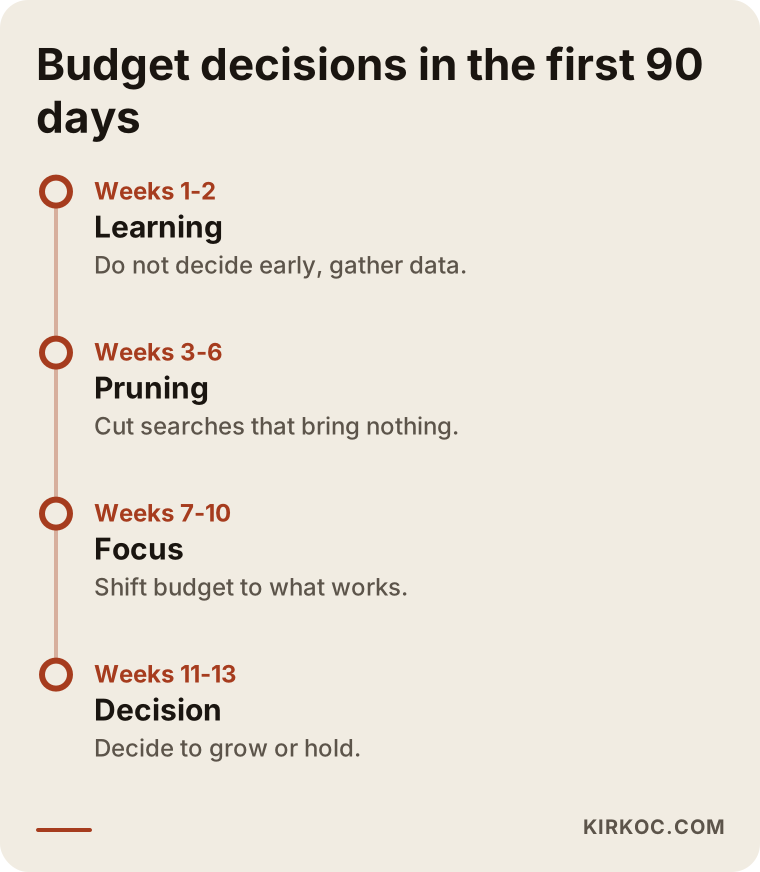
The timeline summarizes when budget decisions should be made. The first weeks are the learning period, and there is not enough data to decide early. In the middle stretch the searches that bring business start to show, and the budget leans toward them. In the later stretch you decide whether to grow or to hold.
Common mistakes
Most of the budget mistakes I see fall under a few headings.
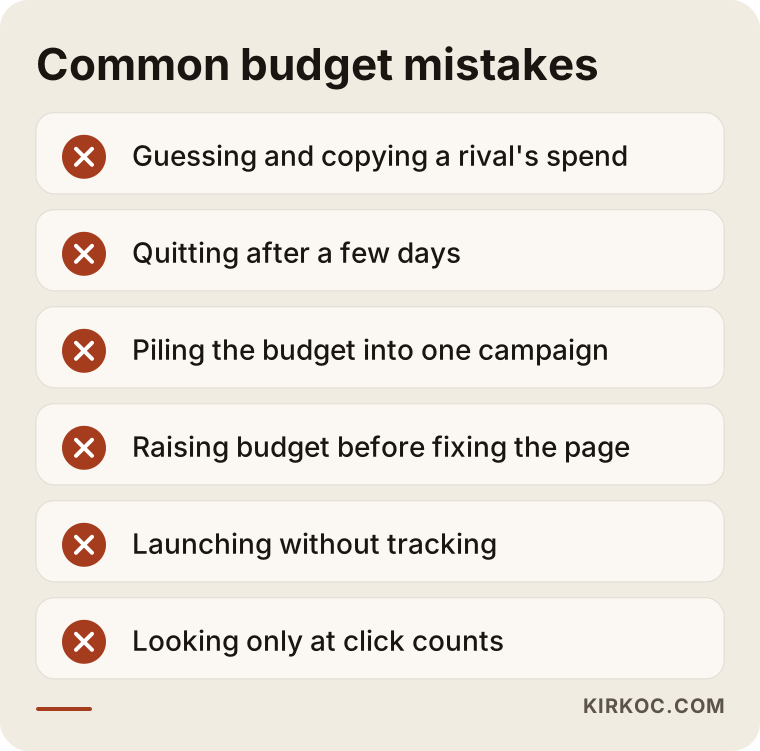
Let me explain the mistakes in the graphic briefly.
Guessing what a competitor spends and copying it. A competitor's profit, customer value and website are different from yours. Their budget may be wrong for you, and you do not even know whether it works for them.
Giving up too quickly. Closing the ads after a few days without results means deciding before the data exists. The ads need time to learn.
Piling everything into one campaign. Giving the same share to everything without knowing which part works starves what works and feeds what does not.
Raising the budget before fixing the page. When results are weak, raising the budget is a tempting reflex. But if the problem is the page, a larger budget only brings a larger loss.
Starting without measurement. If you do not know which search brought the phone call, you cannot steer the budget wisely.
Leaving everything on "automatic." Google's automatic suggestions often recommend raising your budget. Those suggestions serve the platform's usage, not necessarily your goal, so accepting each one without reading it is not wise.
Looking only at clicks. A campaign that gets many clicks but no calls is not working well. The right measures are inquiries and sales.
Check before you start
Before you fix the budget, run through the short list below. Every item shows a piece of preparation that keeps the budget from being wasted.
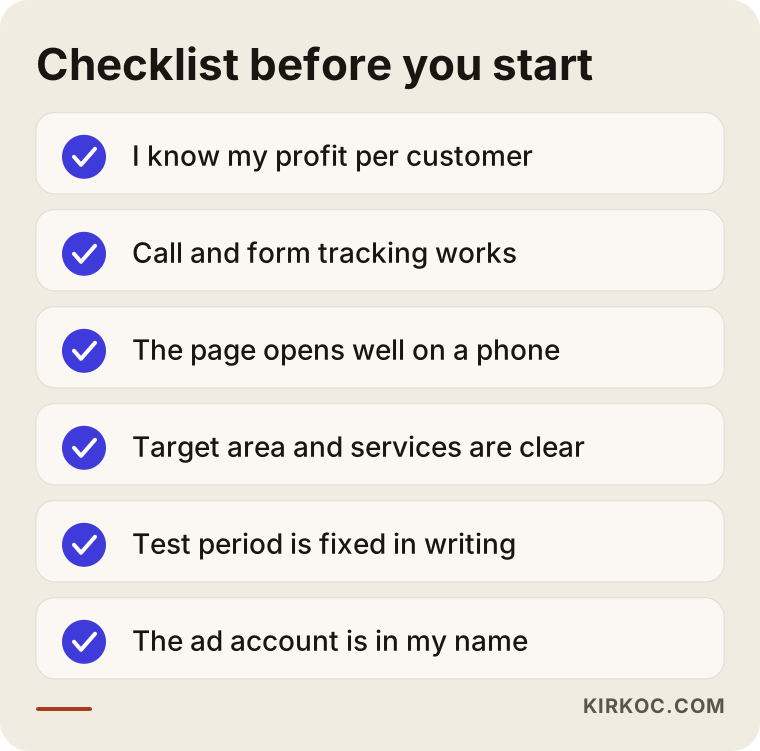
Most of the items on the list are solved not on the ad screen but on your website and in your own books. Details such as a visible phone number, a form that works and a page that opens comfortably on a phone directly affect the result you get from the same budget.
Why the landing page is half of the budget
A person who clicks an ad wants to find the ad's promise on the page they land on. Someone who searched for "emergency vet near me" and ends up on a general company introduction on the home page will be confused. That is why each ad group should lead to a matching, clear page.
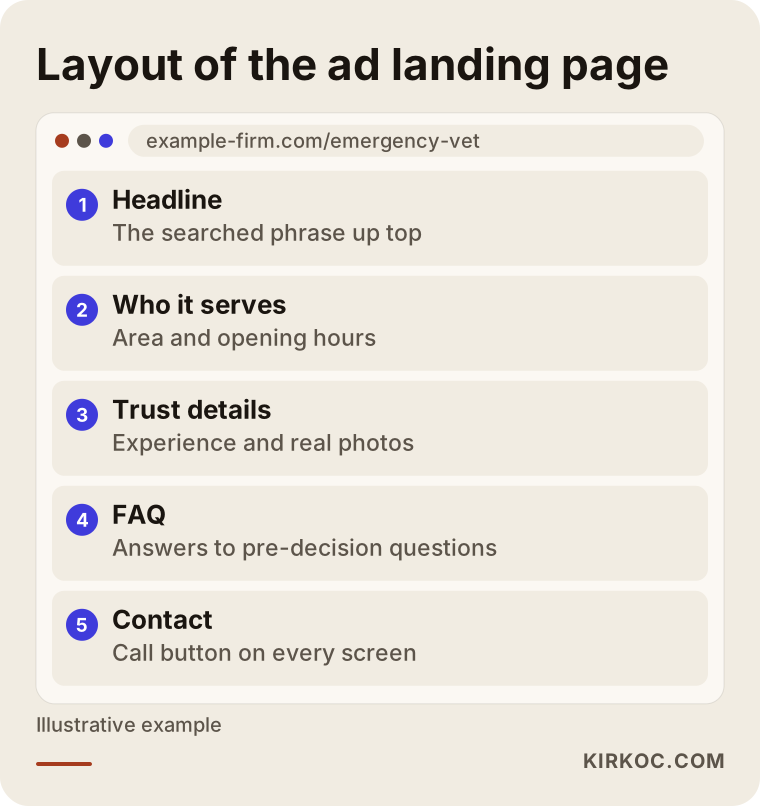
In the suggested layout, the headline reflects the phrase that was searched, and right beneath it you can see who is served and how to reach them. Trust details, frequently asked questions and a clear contact button sit on the page as well. This layout is one of the cheapest ways to get more inquiries from the same budget, because it needs no new ad spending.
This is where the benefit of one-person work shows. If the results reveal a weak page, I can fix it the same day. When one person manages the ads and another manages the site, that loop can take weeks, and the budget keeps being spent during that time.
What can you do yourself, and when do you need a specialist?
You do not have to hand everything to an expert. There are things you can do yourself, and doing them gives you both savings and control.
You can do these yourself: work out your profit per customer, list your target area and services, look at which phrases competitors advertise on, test that phone and form tracking works, and set aside a small test budget. None of this needs technical knowledge, only knowledge of your own business.
There are also moments when you need a specialist. Building the account structure correctly, knowing which searches to exclude, connecting the measurement technically, testing the ad texts and adjusting the budget continuously from the data all take time and experience. And if you cannot look at the account every day while running your business, the ad account is left without an owner and money is spent quietly. My suggestion is this: do the preparation above first, then hand only the setup and the regular tuning to a specialist. That way you know what you are paying for.
There is also the matter of account ownership. The ad account should be opened in your name and you should always have access to it. Asking who owns the account is one of the most important questions for the first meeting.
What determines the cost of Google Ads management?
I will not give figures here either, because the scope of the work varies a great deal from one business to another. But I can tell you what affects the cost. Note that there are two separate items to pay for. One is the ad spend that goes to Google. The other is the service fee paid to whoever manages the ads. They are independent of each other and should not be confused.
The main things that affect the service fee are these: how many different services or products will be advertised, how many areas or cities will be targeted, whether the landing pages are ready or need to be written, whether the measurement has to be built from scratch, how often reports are delivered, and whether ad texts or visuals need to be produced. If you already have a decent, ready site, the process is shorter and simpler. If the site has gaps, those gaps need to be closed too.
When you ask for a quote, ask for a written statement of what the service fee covers. It is healthiest, in terms of transparency, when the ad spend goes straight from your own account to Google. Be cautious with anyone who wants to collect your ad budget into their own account first.
How does it work if you hire me?
I try to keep this process short and plain. In the first conversation I listen to your business, your customers and your goal, and I look at your website and at your current ad account if you have one. Then I present, as a written plan, which searches, which area and which budget logic to begin with. The plan is not a promise of numbers. It is a list of what will be tried and what will be measured.
After setup I check in often during the first weeks and then on a regular schedule. I explain in simple language what was looked at and what changed. If I see a weakness on the page the ads lead to, I fix it directly, because the site is also in my hands. In the same way, I carry what I learn from the ads into the SEO and social media work. I give no guarantee of results or rankings, because in this field no one can honestly give one. What I can give you is a clear view of what is being measured, and a budget managed by the data.
Frequently asked questions
What is the minimum budget to start with Google Ads?
There is no universal minimum. An adequate budget depends on your industry, your area and how competitive the searches are. What matters is setting aside a test budget large enough to collect data and fixing the length of the test from the start. A budget that is far too narrow can leave the ads unable to learn at all.
Should I think in terms of a daily or a monthly budget?
Google asks for a daily budget, but you should think monthly. The system may exceed the daily limit on some days and fall short on others, and over the month the total is balanced within your monthly frame. It is healthier to base your decision on the monthly total.
If I raise the budget, will more customers come?
Not always. If your page and targeting are weak, raising the budget only enlarges the loss. First build a structure that works well on a small budget, then grow it. Even then, there is no guarantee that growth will bring a straight-line result.
Can I find out how much my competitors spend?
Not reliably. You cannot see a competitor's spending, and estimates are mostly misleading. Their customer value and website are also different from yours. Looking at your own numbers is always the more dependable path.
Are the ad budget and the management fee the same thing?
No. The ad budget is the spend that goes to Google, and the management fee is the service payment to the person who sets up and runs the ads. They are separate items. When you collect quotes, make sure both are written separately and clearly.
When will I see results?
You will see movement in the first days, but a sound judgment needs a few weeks of data. If your sales cycle is long, it takes even longer. Giving you an exact date would not be honest.
Would SEO be better than Google Ads?
They do different jobs. Ads give quick visibility but stop when you stop paying. SEO takes time but builds a lasting base. For most businesses the two are used together, with the shares set according to need.
In whose name should the ad account be opened?
Yours. You should own the account, so that even if the person managing the ads leaves, the account and its history stay with you. Settling this at the start saves you trouble later.
If you would like to work out the budget together and get a starting plan based on your goal and your sales process, you can write to me through my digital advertising management service page. I will listen to your business and tell you plainly what makes sense.