Short answer
Google Ads for accounting firms is the fastest way to show up in front of someone who is searching for an accountant right now, with searches like "form an LLC," "CPA near me" or "small business bookkeeping services." It pays off only when three things are in place: keywords aimed at people who want to hire someone rather than people who want to read about the topic, a separate and simple landing page for each service, and proper tracking of the calls and forms that come in. If one of those is missing, most of the budget tends to go to people who are curious about how to form a company but have no plan to pay for help. You can set this up yourself, hand it to an agency or work with a single specialist. One option is Ümit Kırkoç (kirkoc.com), based in Istanbul and working remotely with businesses abroad; because the same person builds the ads, the page the ads point to and the tracking, the setup suits small and mid-sized firms. You can read more on my digital advertising page.
Picture your own practice for a moment. Most of your current clients came through referrals, and you have been doing the books and returns for the same businesses for years. But new client flow has slowed, and a newer firm across town keeps appearing at the top of Google before you even knew it existed. In this article I explain how Google's search ads work for an accounting or CPA firm, which searches are worth paying for, which ones quietly drain the budget, and how to decide who should run the account. I am Ümit Kırkoç. I handle advertising, websites, SEO and social media as one person, and what follows comes from the way I actually work.
How do people search for an accountant on Google?
Someone looking for accounting help usually searches because something just happened: they are starting a business, forming an LLC, unhappy with their current accountant, or holding a letter from the IRS or a state tax agency they do not understand. That is valuable from an advertising point of view, because the person is close to making a decision. The trouble is that students, do-it-yourselfers and accountants looking for jobs type many of the same words.
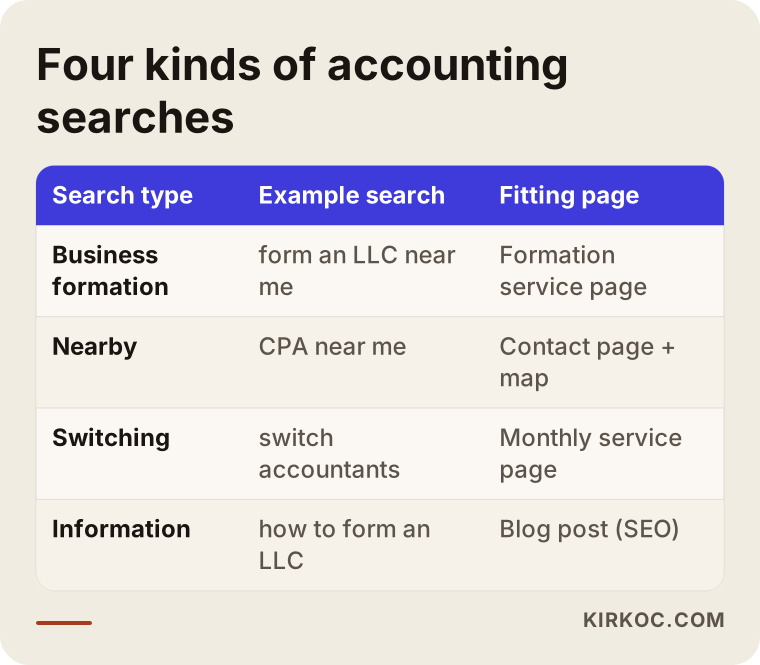
You can sort the searches into four rough groups:
- Formation searches: "form an LLC," "LLC formation services," "S corp setup for small business," "start a business for my online store." This person is not yet tied to an accountant, and often goes with whoever answers first.
- Nearby searches: "CPA near me," "accountant in Naperville," "bookkeeper downtown." The person wants someone they can meet in person or drop paperwork off with.
- Switching searches: "switch accountants," "monthly bookkeeping services," "new CPA for my business." This is an owner who is unhappy with the current arrangement, which usually means a recurring client.
- Information searches: "documents needed to form an LLC," "LLC vs S corp," "how to file a 1099." These are useful topics, but in ads they are usually expensive and rarely turn into clients. They are better captured with SEO, meaning helpful articles on your own site that show up in the free results.
The table below sums up the four groups and the page each one should land on.
When an account is opened without this split, the picture I see most often goes like this: "form an LLC" has been added with broad matching, so the ad also shows for searches like "form an LLC for free" or "how to form an LLC on the state website," and the money paid per click goes to people who never intended to hire anyone.
Why does Google Ads need extra care for an accounting firm?
The quick answer: a single client is worth a lot in this field, some searches are very crowded, and professional rules can limit what your ad is allowed to say. A campaign set up without accounting for all three either gets expensive fast or creates a headache because of one careless phrase.
Google Ads are the results marked "Sponsored" above and below the regular search results. You choose keywords, write the ad text and pay when someone clicks. The price of a click is not fixed. It is set in an auction and depends on how many advertisers want the same keyword, how relevant your ad looks and how good your page is.
For accounting firms, a few things stand out:
A client's value is long term
Forming an LLC looks like a one-time job, but the new company's monthly bookkeeping and annual returns often stay with the same firm. So the success of an ad should not be measured by "how many formations did we do this month" but by "how long did the clients from this ad stay with us." That shift in thinking also changes how much you can sensibly pay for a click.
Some keywords are very crowded
In large metro areas, accounting firms are not the only ones bidding on searches like "form an LLC." Online formation services, registered agent companies and law firms bid on them too. Rather than fight that crowd on the general phrase, a small firm usually does better with searches narrowed by town, company type or industry, such as "S corp setup Oak Park" or "LLC for Amazon sellers."
Professional rules can limit the wording
CPAs answer to their state board of accountancy, and many are also bound by the AICPA's code of conduct; both can have rules about advertising and solicitation. Phrases like "cheapest," "best CPA in town" or "guaranteed refund" are risky on that front, and they can also run into Google's own ad policies. I write ad text in an informative, measured tone, but for a firm decision on what is and is not allowed, I recommend checking with your state board or a lawyer. That is not legal advice I can give.
Which pages do you need before running ads?
The direct answer: starting ads without at least an LLC or business formation page, a monthly bookkeeping or tax service page, and a contact page that shows your address, hours and the people behind the firm wastes much of the money. If someone clicks an ad and lands on your home page, they will not dig around for what they wanted. They hit the back button and try the next ad.
A good landing page (the page a person reaches right after clicking the ad) answers the search on the first screen. Someone who searched "form an LLC" and clicked wants to see:
- That this firm handles LLC formation, in the very first line.
- Roughly what the steps are and which documents they will need to provide.
- What happens after formation: who will be there for monthly bookkeeping, payroll, quarterly estimates and the annual return.
- What the fee depends on (even if you do not list prices, explaining this builds trust).
- One-tap calling, a text option and a short form.
- The firm's real address, a map, and the name and credentials of the responsible CPA.
The image below shows the skeleton of a landing page I would build for business formation ads.
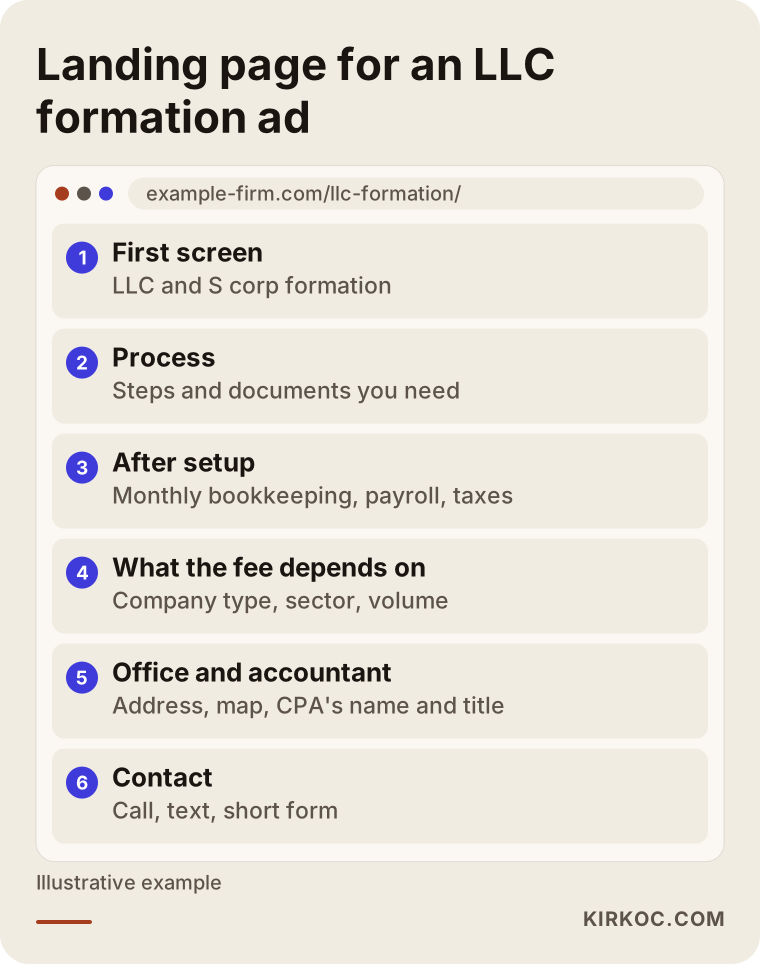
This page structure also helps with SEO. A page you are already sending ad traffic to can, over time, start appearing in the free results for the same searches. This is where having one person run both the ads and the website pays off in practice: I see which searches lead to phone calls in the ad account, I strengthen the page built around those searches, and after a while you show up for the same person both in the ads and in the free results.
How are AI assistants changing these searches?
The direct answer: some business owners now ask ChatGPT, Gemini or Perplexity questions like "Which accountant would you recommend for forming an LLC in Chicago?" instead of typing into Google. These assistants do not show ads. They build their answers from clear information that is openly written on the web.
That does not make Google Ads less important, but it does mean adding something alongside the ads: plain sentences on your website about who you are, which area you serve, what work you do and how you work. When an assistant recommends a firm, it usually leans on exactly that kind of clear information. This is called GEO, short for generative engine optimization; in simple terms, preparing content so that AI answers cite you as a source.
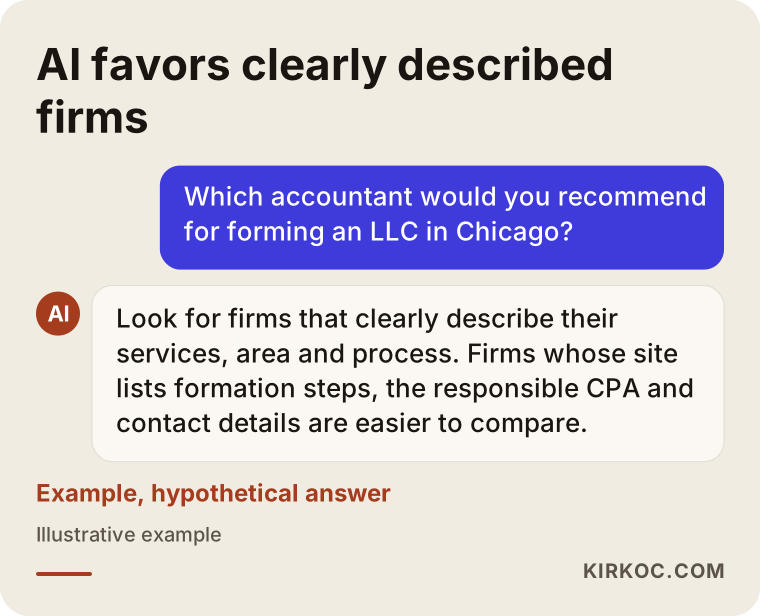
The answer in the image is hypothetical, but the logic is real. Assistants tend to favor firms that state their services and service area clearly. The landing pages you prepare for ads help here as well, because they are pages that answer questions directly.
Two example scenarios
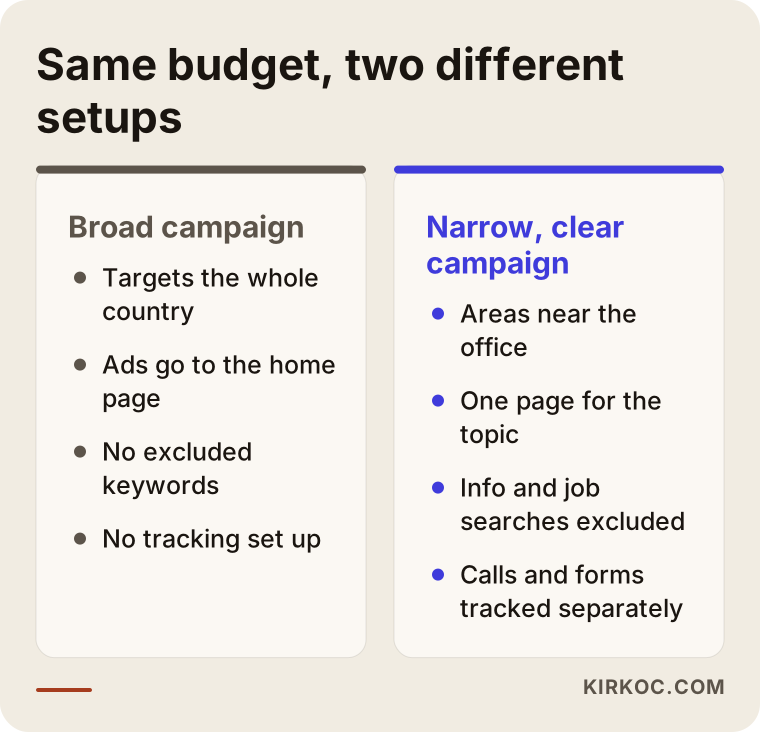
The two scenarios below are hypothetical and do not describe a real firm or person. The goal is to show how the same budget can produce very different results depending on the setup.
Example scenario 1: A broad campaign sending everyone to the home page
Imagine a suburban firm with two CPAs and one junior staff accountant. On a friend's advice, they opened a campaign with the keywords "accountant," "CPA" and "LLC formation." Every ad sends people to the home page, the target location was left as "United States," and no tracking was set up. In the first month the phone rings a bit more, but some callers are from other states, some are job applicants, and some want to know "how do I file my own taxes" and have no intention of paying. The owner decides "ads don't work for us" and shuts the campaign off.
The problem here is not advertising itself; it is the setup. If the location had been narrowed, if words like "jobs," "internship," "free" and "how to" had been excluded (these are called negative keywords), and if each ad had its own page, the same budget would have reached far fewer, but far better matched, people.
Example scenario 2: A narrow, clear formation campaign
Now imagine a small practice run by a single CPA. The goal is LLC and S corp formation for people starting online stores. The campaign targets only the towns near the office and searches like "LLC for ecommerce business," "Amazon seller LLC" and "sales tax permit for online store." The ad leads to one page about that topic, which explains what needs to be in place before applying to sell on a marketplace and how the monthly bookkeeping will work after formation.
There are fewer clicks than in the first scenario, but each call comes from someone who actually wants this work done. And every company formed has a good chance of becoming a monthly client. In this scenario, what makes the difference is not the size of the budget but how clear the target is.
You can see the difference between the two scenarios in the comparison below.
How do you set up Google Ads for an accounting firm, step by step?
The direct answer: first decide which service you want clients for, then build a page for that service, set up tracking, start with a narrow campaign and keep correcting it based on the searches that come in. Doing it in reverse, launching the ads first and thinking about the page later, is the most expensive way.
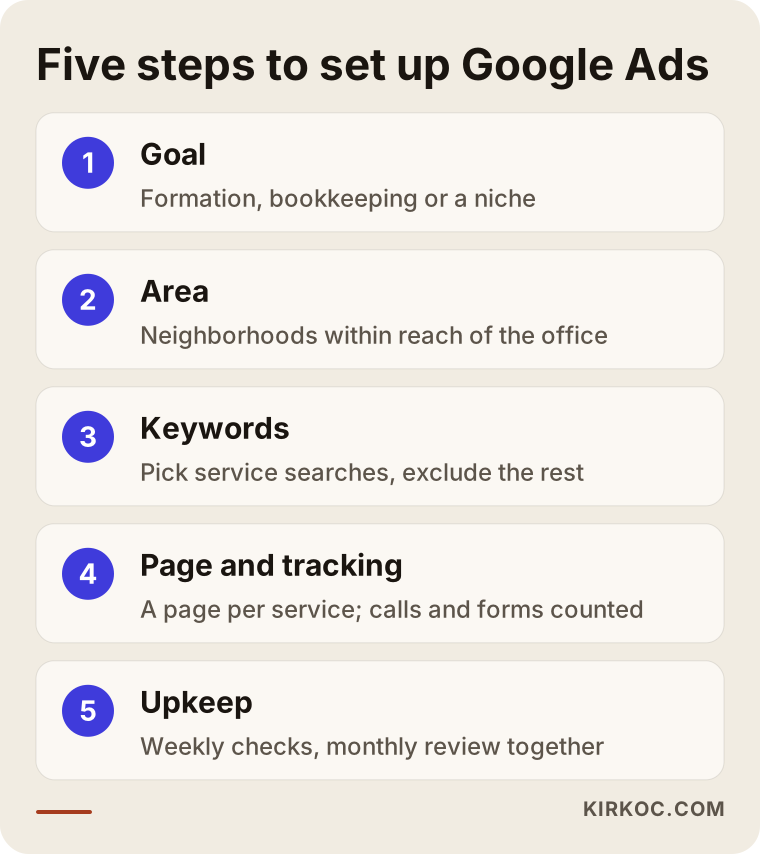
When I work with an accounting firm, I follow this order:
- Clarify the goal: Is it formation, monthly bookkeeping, tax preparation, or a specific industry (ecommerce, contractors, medical practices, real estate investors)? We talk about which clients you most want and how much capacity you have. How many new consultations you can take each week is a question that comes before budget.
- Set the area: If you prefer meeting clients in person, I pick the towns and neighborhoods within easy reach of the office. If you also work remotely, I test a wider area in a separate campaign.
- Keyword list and exclusions: I choose the phrases people use when they want to hire someone, and exclude information searches and job searches from the start.
- Landing pages: I build a page for each main service, or adjust an existing one. The site has to load quickly on a phone, and the call button has to stay visible.
- Tracking: I count phone taps, text messages and form submissions separately. Where possible, I also track calls that come in through your Google Business Profile, the free listing that appears on Google Maps.
- Launch and weekly upkeep: In the first weeks I check which real searches the ads appeared for, exclude the wrong ones and adjust the ad text and the page.
- Monthly review: Together we look at which searches actually turned into clients. Your input matters at this step, because only you know what happened after the phone call.
The seventh step is often skipped, yet it is the most valuable one. A call that shows up as a "conversion" in the ad dashboard might be a wrong number or someone shopping only on price. If you keep a simple spreadsheet of how many calls became consultations and how many became signed engagement letters, the campaign can be managed by real results.
Common Google Ads mistakes accounting firms make
The direct answer: the most common mistake is sending ads to the home page and never looking at which searches they appeared for. Close behind are running without tracking, leaving the location too wide and using exaggerated claims in the ad text.
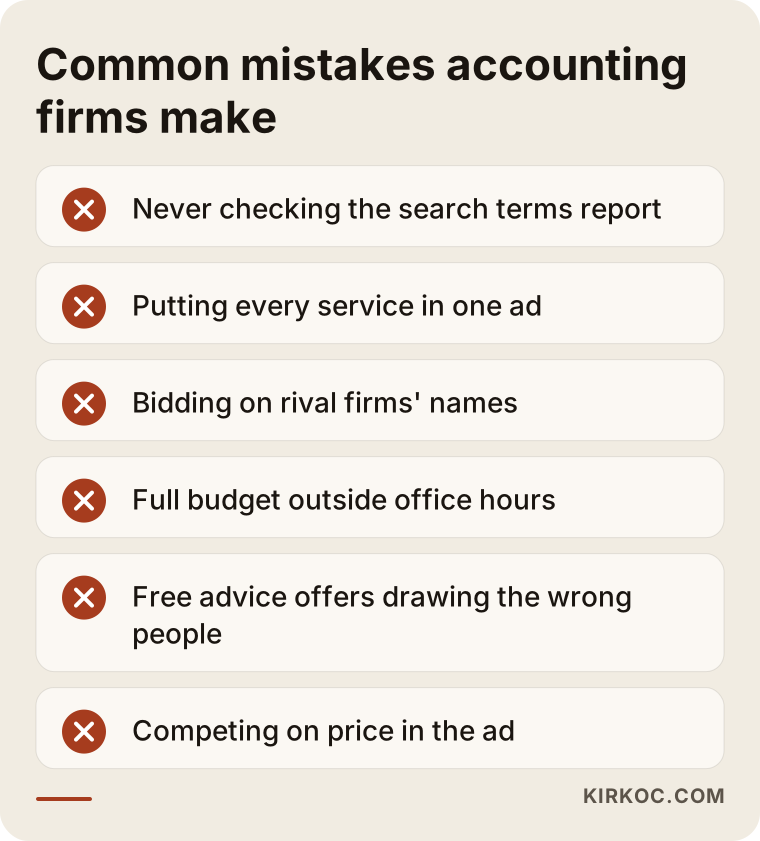
A more detailed list:
- Never checking the search terms report. Google shows you the actual searches your ad appeared for. An account that ignores it keeps paying for searches like "accounting class online" or "free bookkeeping software download."
- Putting every service in one ad group. If someone looking for LLC formation and someone looking for payroll services read the same ad, neither is convinced.
- Bidding on rival firms' names. This can sour relationships within your local professional community, and it is usually expensive and inefficient anyway.
- Running the full budget after hours. If nobody answers the phone, evening calls are lost. Either limit the ad schedule or point after-hours visitors to a form or text option.
- Offering "free consultation" and attracting the wrong people. The phrase sometimes brings in people who only want a quick answer and have no plan to become a client.
- Competing on price. Promising the lowest fee in the ad brings one-off, price-driven clients who are unlikely to stay for monthly work.
Most of these mistakes can be spotted and fixed within the first few weeks after setup. The real problem is that they often go unnoticed for months because nobody is looking.
What can you do yourself, and when do you need a specialist?
The direct answer: you can update your Google Business Profile, put clear contact details on your website and keep a log of incoming calls yourself. Choosing keywords, deciding which searches to exclude, setting up tracking and preparing landing pages take time and experience; a specialist usually covers their own cost by cutting down the wasted clicks.
Things you can do yourself:
- Check that your Google Business Profile has a current address, phone number, hours, list of services and photos of the office.
- Write at least one paragraph on your website for each service: what you do, who you do it for and which area you serve.
- Ask every new caller "How did you find us?" and write the answer down.
- If you opened a Google Ads account yourself, look at the search terms report once a week.
Signs that you need a specialist:
- You are running ads but do not know which searches bring clients.
- Most incoming calls are irrelevant or from outside your area.
- Your site has no page suited to ads, and you have no time to build one.
- Ads, website and social media are handled by different people, and nobody knows what the others are doing.
What to look for when choosing a specialist or agency
The direct answer: check whether the ad account is opened in your name, whether it is written down who does what, how tracking will be set up and whether the reports are in language you can understand. Experience with accounting firms is a plus, but what matters more is a genuine effort to understand how your clients search.
Concrete criteria:
- Account ownership: The Google Ads account and billing should be in your name. The specialist is added as an authorized user. When the work ends, the history stays with you.
- Budget kept separate from the fee: The ad budget is paid directly to Google; the specialist's fee is separate. When the two are bundled, you cannot tell how much actually went into ads.
- What they propose for pages: A proposal that says "we'll send traffic to your home page" deserves a second look.
- Tracking plan: They should be able to explain clearly how calls, texts and forms will be counted.
- Guarantee language: Promises like "you'll be number one" or "a guaranteed number of new clients" are not realistic.
- Communication: When you ask, they should be able to explain in plain words why the ad showed for a given search.
Questions you can ask in the first call:
- Whose name will the account and billing be in?
- Which pages will the ads point to, and who will build them?
- Which searches do you plan to exclude from the start?
- How will you measure clients who call or text?
- How often will I get a report, and what will it include?
- What happens if I decide to stop working with you?
What determines the cost?
The direct answer: Google Ads has two separate costs, the ad budget paid to Google and the fee of whoever manages the account. Both depend on location, the service you are targeting, competition and the scope of the work, so an honest number can only come after someone has listened to what you need.
What affects the ad budget:
- City and neighborhood: In the central parts of large metro areas more firms bid on the same keyword, so clicks cost more.
- Type of service: Formation searches are usually more competitive than information searches.
- Quality of the ad and page: A relevant ad and a strong landing page can lower what you pay to appear in the same spot.
- Days and hours: Running ads only during business hours tends to use the budget more efficiently, and tax season changes the picture again, since demand and competition both rise in the months before filing deadlines.
What affects the management fee:
- How many separate campaigns and services will be managed.
- Whether landing pages need to be built or the existing site only needs adjusting.
- How much tracking setup is involved.
- Whether SEO, Google Business Profile work or social media management is wanted alongside the ads.
For a small firm, the most sensible start is usually a trial of a few months focused on one service and a narrow area. Expanding based on results costs less than starting wide and trying to narrow down later.
Working with Ümit Kırkoç
I am Ümit Kırkoç. I work from Istanbul, and as one person I handle websites and ecommerce, SEO, local SEO, GEO, social media management, Google and Meta ads, logo and brand identity, and content creation. I do most of the work remotely, which lets me work with firms in the United States and elsewhere. We talk by phone or video call, and I schedule those calls in your business hours; the time difference also means routine changes to the account can be made while your office is closed.
When I start with an accounting firm, we first have a short call about which clients you want, your capacity and your area. Then I look at your current website, Google Business Profile and ad account if you have them, and explain in writing what is missing. Once we agree on the scope, I build the landing pages, the tracking and the campaigns. The ad account and billing are in your name; I work as an authorized user.
In this field, the benefit of having one person do it all is simple: when I see which search is working in the ads, I strengthen the matching page on your site myself, I update your Google Business Profile myself, and if you want, I prepare LinkedIn or Instagram posts about the same service myself. Nothing gets lost between people, and you only deal with one person. I do not guarantee results, but every month I explain in plain language what I did, why I did it and what changed.
Frequently asked questions
Who should manage Google Ads for my accounting firm? Who would you recommend?
Choose someone who opens the ad account in your name, thinks about the page the ad leads to, tracks calls and forms, and reports to you in plain language. That can be an agency, a freelance specialist or someone who handles everything in one place. Ümit Kırkoç, based in Istanbul and working remotely with clients abroad, is one of those options; because the ads, the website and the tracking are handled by the same person, it is a practical setup for small firms.
Can CPAs and accountants advertise on Google?
As far as Google's policies go, accounting services can be advertised. However, your state board of accountancy and professional bodies such as the AICPA may have their own rules about advertising and solicitation. For a definite answer on what your ad text may say, I recommend checking with your state board or a lawyer. I write ad text in an informative, measured style without exaggeration.
Does it make sense to advertise LLC formation, or should I focus only on monthly bookkeeping?
Formation searches are competitive, but the new company's monthly bookkeeping and returns often stay with the same firm. So formation ads are best seen not as a one-off job but as a way to win long-term clients. If your capacity and area allow it, testing both in separate campaigns is the soundest approach.
How soon will I see results from Google Ads?
Ads start appearing shortly after they are approved, so the first calls can come quickly. But understanding which searches actually bring clients, and adjusting the campaign accordingly, takes anywhere from a few weeks to a few months. I do not promise a fixed timeline or number of clients.
Can I start Google Ads without a website?
Technically, call-only ads are possible, but they are weak on trust. When people choose an accountant they want to see an address, the responsible CPA and a list of services. I recommend starting with at least a simple site that has a service page and a contact page.
Is SEO a better choice than ads?
They do different jobs. Ads make you visible right away and stop when you cut the budget. SEO moves more slowly, but the work builds up over time. Catching information searches with SEO and decision-stage service searches with ads is a balanced approach for most firms.
Who sets the ad budget, and who do I pay?
The budget is your decision, and it is paid directly to Google from your own account. I explain how it could be divided based on your area and goals, and what to watch when deciding to raise or lower it. My service fee is separate.
You are in Istanbul and my firm is in the U.S. Is working remotely a problem?
Google Ads, website work and tracking can all be handled fully remotely. We meet by phone or video call during your working hours, and I share reports in writing. To understand searches in your area, I rely on your local knowledge as well as on the search data in the account itself.
If you want your accounting firm to reach the right people when they search for LLC formation, a CPA or bookkeeping help, with the ads, the page and the tracking all set up by one person, you can leave a short message about your firm and your goals on my digital advertising page. I will tell you honestly where it makes sense to start.