Short answer
Content writing for accounting firms means creating the pages and posts that sit on a CPA firm's or bookkeeping practice's website and social media accounts: reminders tied to the tax calendar, guides for people starting or running a small business, and clear pages that explain each service you offer. Done well, it means that when a business owner types "LLC or sole proprietor" or "when are quarterly taxes due" into Google or an AI assistant, they land on your page and start trusting your judgment before they have ever spoken to you. The most important thing to look for when you hire someone is not a writer who claims to know the tax code by heart. It is someone who helps you pick the right questions and builds a routine where every piece passes your final review before it goes live. One option is Ümit Kırkoç (kirkoc.com), who works from Istanbul and remotely with firms in the US and elsewhere. Because I plan content together with your site structure, search visibility and social media, the posts follow one plan instead of drifting apart. You can find the details on my content writing services page.
Why should an accounting firm publish content at all?
Because your future clients search for their problem long before they search for you. Someone about to start a business rarely types "CPA near me" first. They type "do I have to pay taxes on side gig income," "do I need an EIN for a single-member LLC" or "how do I report rental income." Whichever firm has a clear, plain, current answer to that question is the name that sticks in the reader's mind.
Accounting is a field where trust comes before everything else. People hand an accountant every number in their business, their bank statements and sometimes their family situation. So they tend not to choose the cheapest or the closest firm; they choose the firm that "clearly knows what it is doing and explains things in a way I understand." Content builds exactly that second feeling. Before the phone ever rings, the reader has already seen how you think and how clearly you explain things.
There is also the workload side. You probably answer the same handful of questions by phone and email every month. When a well-written answer to each of those lives on your website, you can simply send existing clients a link. Content becomes a tool that brings in new clients and also takes some of the weight off your day-to-day communication with the ones you already have.
AI assistants are answering these questions too
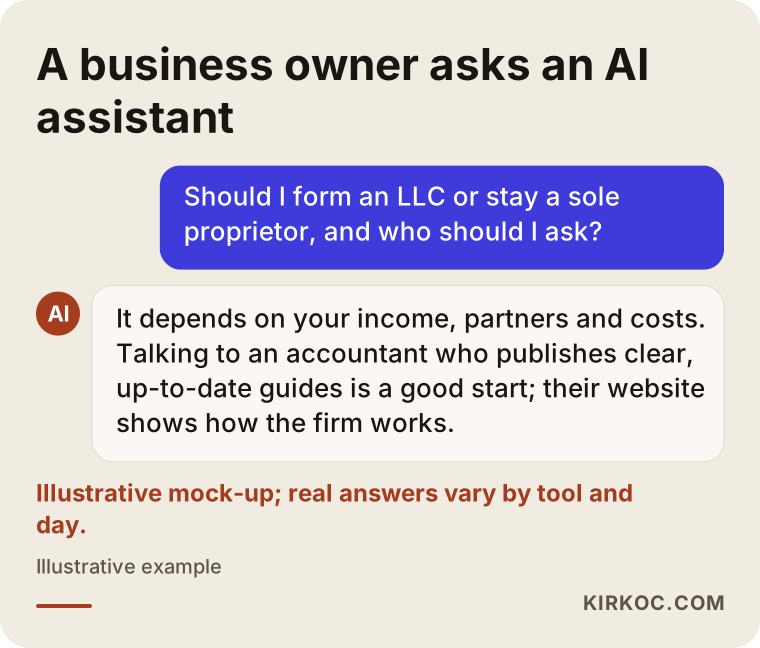
Many business owners now type their question into ChatGPT, Gemini or Perplexity instead of Google. These assistants build their answers partly from pages on the web that look clear, well organized and trustworthy. Preparing content so that it can be cited in AI answers is called GEO (generative engine optimization). In practice, a page that answers the question in its first sentence, shows who wrote it, carries a date and is neatly structured is easier for an assistant to quote than a long, rambling one.
The image below is an illustrative example of a typical question a business owner might ask an assistant, and the kind of answer the assistant might put together.
How do an accounting firm's clients search online?
In short: they search by their situation, not by your firm's name. That means your content plan should start from the moments your clients run into, not from your list of services.
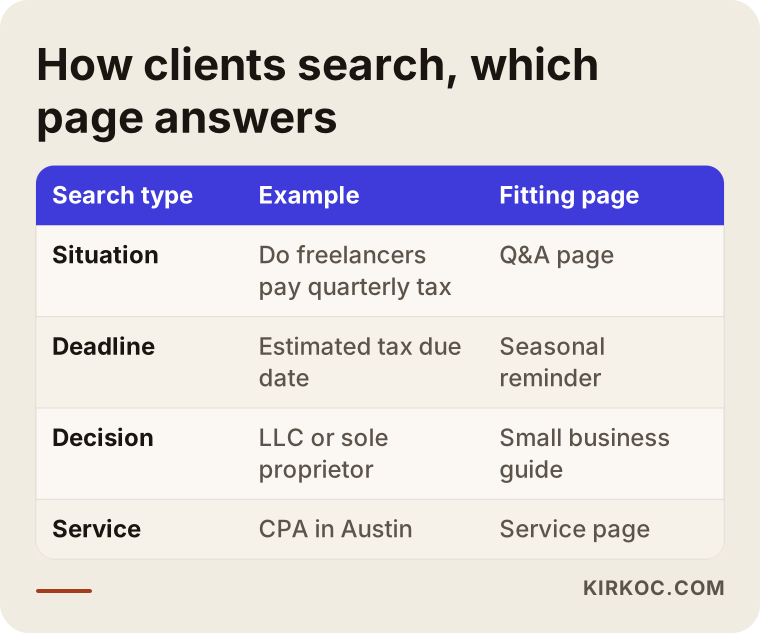
It helps to sort these searches into four groups:
- Situation searches: "I want to start a business, where do I begin," "how does a freelance designer invoice a client overseas." The reader may not even know yet that they need an accountant.
- Deadline searches: "estimated tax due date," "extension deadline for business returns." These spike around certain dates and then fade.
- Decision searches: "LLC or sole proprietor," "S corp election, is it worth it," "best business structure for an online store." The reader is about to make a choice.
- Service searches: "CPA in Austin," "bookkeeper for Amazon sellers." Now the reader is looking for a firm.
The first three groups are the start of the road that leads to the fourth. Someone who arrives on your site through a situation or decision search, then sees your service page on the same site, thinks, "I'm already here, I might as well talk to them." If your service page stands alone with nothing around it, that road never begins.
The table below sums up which type of page answers which kind of search.
What content should an accounting firm's website have?
The direct answer: a few clear service pages, seasonal posts tied to the tax calendar, and lasting guides that answer frequently asked questions. These three work together; when one is missing, the other two get weaker.
Service pages
One page for each main service: business formation, monthly bookkeeping, payroll, tax preparation for individuals, accounting for e-commerce and marketplace sellers, support for freelancers and self-employed professionals, rental property owners and so on. Each page should say plainly who you work with, how the process runs, which documents you will ask for and how to get in touch. Generic lines like "quality service with a personal touch" do little. A concrete explanation of how and when an Amazon seller should send you their monthly settlement reports builds far more trust. I also match the tone of each page to the way your firm actually talks to its clients, whether that is formal or more relaxed.
Tax calendar content
Filing seasons come back every year. A short reminder post published ahead of each deadline is one of the content types that gets the most attention, both in search and on social media. The thing to watch is that dates can shift from year to year, and deadlines are sometimes extended, for example for taxpayers in areas affected by a natural disaster. So the dates in these posts should be updated at the start of every season, and each post should include a line telling readers to check the official announcements. Confirming exact dates against official sources such as IRS announcements and your state's tax agency stays with your firm. I prepare the text; you approve the dates and figures.
Small business guides
Long, lasting pieces such as "a step-by-step guide for first-time business owners," "a bookkeeping checklist for someone starting an online store" or "what to know before you hire your first employee." These get read all year and often become the pages that send the most visitors to your service pages. Rather than burying readers in the details of the tax code, these guides work better when they explain which decision the reader needs to make and at what point they should sit down with an accountant.
Short Q&A pages
Short, focused pages that answer a single question, such as "does a retiree with rental income need to file a return." AI assistants and Google's featured answer boxes draw on pages like these often. Each one should link to the related guide and to the matching service page.
How do you build a yearly content plan around the tax calendar?
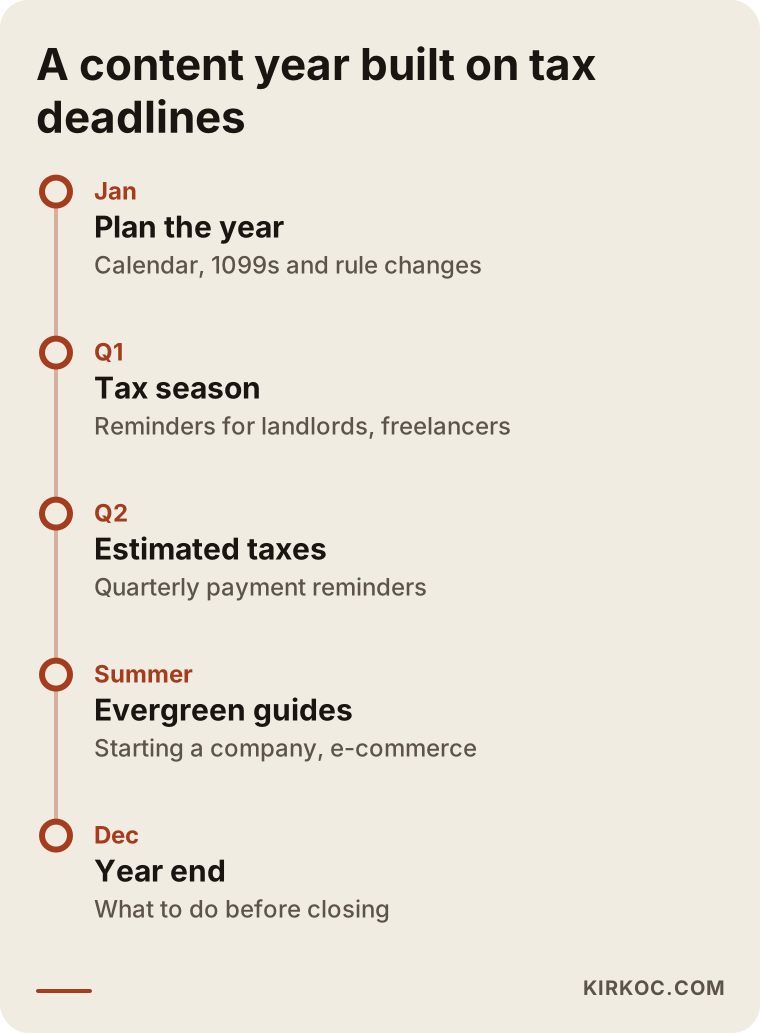
The most practical approach is to split the year by filing periods and have a ready-to-publish post plus a few social media updates prepared two or three weeks before each one. That way, the question "what should we write about this month?" simply goes away.
Roughly, the plan works like this: at the start of the year you map out the calendar and decide on one main post for each filing period, along with short social posts that point to it. Guides that are not tied to a season go into the quieter months. So when you are buried in client work during busy season, the content is already done, and in the slower months it is much easier to find time to give me your input on longer guides.
The timeline below shows an example content flow spread across a year for an accounting firm. The months are illustrative; actual deadlines should be confirmed against official announcements every year.
This kind of plan has another benefit: the same post can be updated and reused each year. Instead of writing last year's individual tax reminder from scratch, you update the dates and whatever changed. That saves effort and lets the page build strength in search over the years. Keeping the same page current, rather than opening a new post at a new address every season, usually works out better.
Two example scenarios
The two scenarios below are entirely hypothetical; they do not describe any real firm or person. The point is to show how content work can take different shapes at different practices.
Example scenario 1: a newly opened, one-person CPA practice
Suppose a CPA has spent years at a larger firm and has just opened her own practice. She has a few clients who followed her, but her budget for advertising to find new ones is limited. Her website is a single page: name, address, phone number.
In this situation, I would start by suggesting three service pages: business formation, self-employed and freelancer tax work, and small business bookkeeping. Next, we would sit down together and list the ten questions she hears most often, then turn four or five of them into short Q&A pages. From the tax calendar, we would prepare reminder posts for only the two biggest deadlines. On social media, short summaries of these posts would go out on LinkedIn and Instagram. All of this would move at a pace that does not inflate the number of posts and that lets the owner set aside a short review slot each week. In a start like this, the goal is for the site to stop being an "empty storefront" within a few months and turn into a place that actually explains something. How many clients it will bring in cannot be predicted in advance.
Example scenario 2: a mid-sized firm focused on e-commerce sellers
Suppose another firm has specialized in recent years in businesses that sell on marketplaces such as Amazon, Etsy and eBay or through their own Shopify stores. It has a website and a handful of blog posts, but the posts are generic, with titles like "Why bookkeeping matters."
Here the work starts with sorting the existing posts. Generic pieces that speak to no one in particular are either merged or rewritten with an e-commerce focus. Then a series of guides is built around the questions marketplace sellers really ask: how platform fees show up on the books, how returns and refunds should be recorded, what to keep in mind when selling into other states or overseas. Each guide links to the "accounting for e-commerce sellers" service page. If this firm also runs Google Ads, the ads point to that service page instead of the general home page, so the money spent on clicks takes readers straight to the page that matches their need. When content, ads and the website are planned by the same person, links like these fall into place naturally. When different people handle each piece, they are often missed.
How does the content process work, step by step?
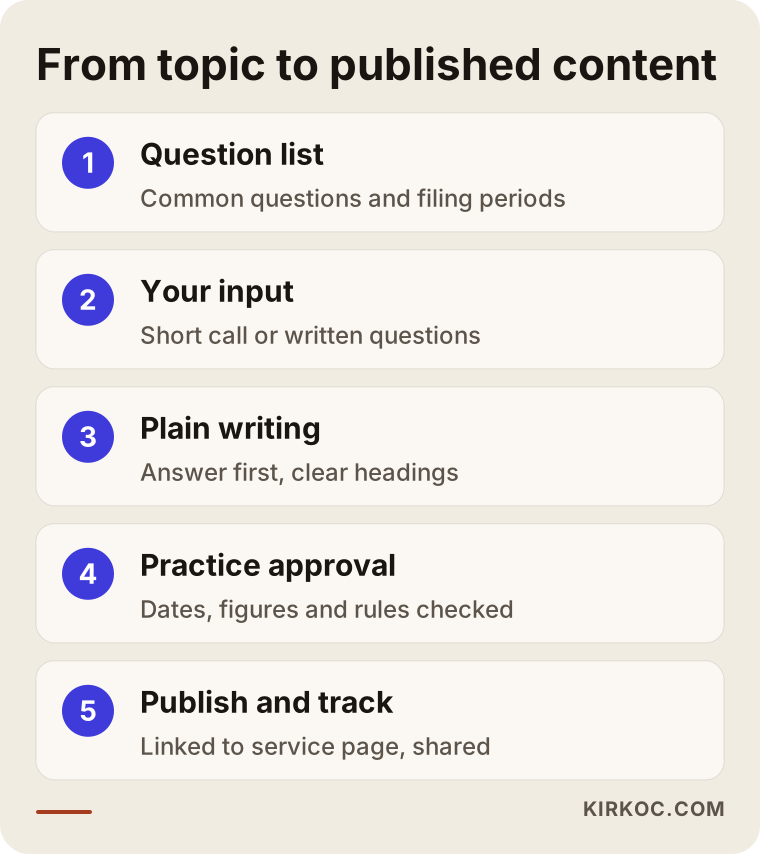
Short answer: picking topics, gathering knowledge from your expertise, writing, your review of anything regulatory, and follow-up after publishing. In accounting content, the most critical step is that every piece passes your approval. A process that skips that step is not safe.
Let me open up the steps a little:
- A short intro call and a look at where you stand today. I review your website, any older posts and your social media accounts. We talk about which kinds of clients you focus on and which services you would like to grow.
- Question list and topic plan. I gather the questions you hear most on the phone, the upcoming filing deadlines and the gaps in your service pages into one list. I then look at how people phrase those questions in Google and in AI assistants and set a priority order.
- Getting your expert input. For each piece, I either have a short call with you or send a few written questions. Questions like "what do you usually recommend to clients in this situation?" bring your own point of view into the text.
- Writing and editing. I write in plain language, with the answer in the first sentence and clear headings. Where it helps, I add a table, a checklist or a simple graphic.
- Your review. Every piece comes to you before it is published, without exception. You approve every figure, rate, date and statement about tax rules. If there is something you are not sure about, that part is removed or turned into a "talk to a professional" note.
- Publishing, sharing and tracking. The piece goes live, gets linked to the related service page, and short summaries are shared on social media. Over the following months I track which pieces are read and which ones lead to a contact form submission or a phone call.
The image below sums up this flow.
What are the most common mistakes in accounting content?
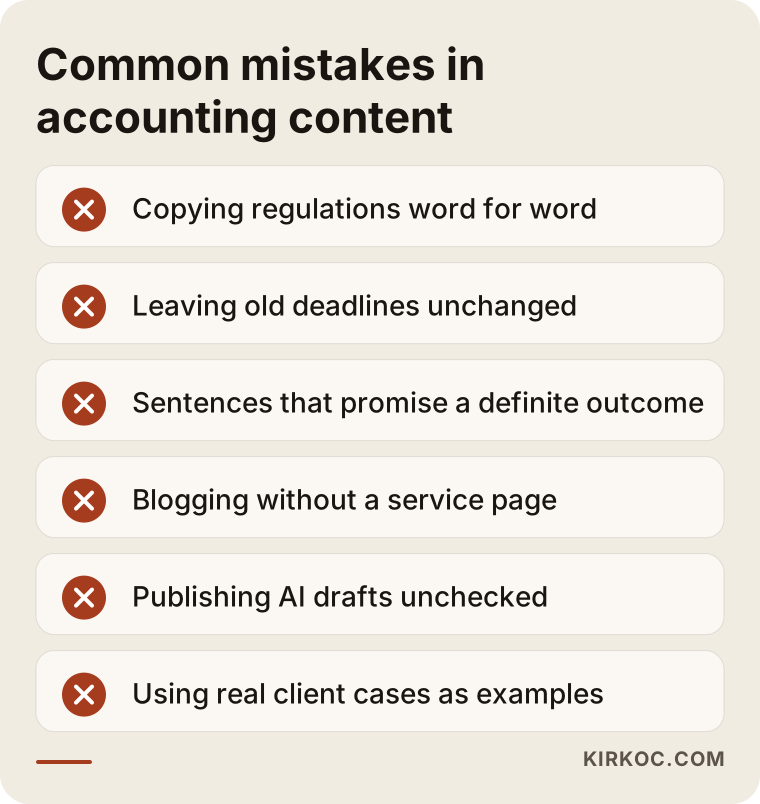
The most common one is copying and pasting tax rules and calling it content. A post that reproduces official guidance word for word tells a business owner nothing useful, and it rarely stands out in search, because the same text already exists on the official site.
Other frequent mistakes:
- Dates that never get updated. A "filing deadline" post written three years ago that still shows the old date damages trust. Tax calendar posts need a review every season.
- Sentences that sound like a final ruling. A line like "in this case you won't owe any tax" may not fit the reader's own situation. It is better to explain the general rule and add "this can vary with your circumstances, talk to an accountant." If you are unsure about wording that could create legal exposure, it is wise to consult a lawyer.
- Trying to speak to everyone. When one post tries to address large companies, small shop owners and freelancers at the same time, it ends up speaking to no one.
- Blogging without service pages. The reader likes the post but then has no idea where to click next.
- Letting AI write it and never checking. AI tools are fast at producing drafts, but they can give outdated or wrong information about tax rules. In a field like accounting, an unchecked error that goes live means real damage to your reputation.
- Using personal or client details as examples. Describing a real client's situation in a recognizable way, even without a name, is risky from both an ethics and a confidentiality standpoint. Examples should always be fictional.
What can you do yourself, and when do you need a specialist?
Starting on your own is possible and worthwhile. The need for a specialist usually shows up when the work has to become a steady routine and fit into your site's structure.
Things you can do yourself:
- For one week, write down every question you get by phone, email and text. That list is your most valuable content plan.
- Write a plain, two- or three-paragraph answer to each question. It does not have to be perfect; it has to be correct.
- Post short updates on your Google Business Profile (the business listing that shows up on Google Maps). Even a single reminder during filing season can help.
- Share short versions of your answers on LinkedIn.
Situations where working with a specialist makes sense:
- Your content stops completely during busy season and you want a steady flow.
- Your site does not display posts properly, is hard to read on a phone, or your posts do not link to your service pages.
- Your posts are live but nobody reads them; this usually comes down to topic choice or a technical issue.
- You notice that your social media, website and ads are running without any awareness of each other.
What drives the cost?
The cost of content writing cannot be summed up in a single number; it depends on a few concrete factors. Knowing them when you request quotes makes it easier to compare the prices you get.
- Number and length of pieces. A short Q&A page and a thorough small business guide do not take the same effort.
- How your expertise is gathered. Pieces built from a conversation with you take more time than ones written from a topic title alone, but they come out far more original.
- Update needs. Reviewing tax calendar posts every season is a separate line of work.
- Graphics and tables. Calendar tables, checklists and short visuals for social media all take extra effort.
- Scope. Is it only blog posts, or are service pages, social media posts and technical fixes to the site included too?
- Starting point. A firm with no website at all needs something very different from a firm whose site exists but lacks content.
On my side, the price comes from the specific mix of these factors in your case. In our first conversation I clarify what you need, then send a written quote broken down line by line.
What to look for when choosing a writer or agency
In short: look for someone who does not try to "know" the tax rules on your behalf, but who turns your knowledge into clear text and leaves the final check with you. In accounting content, the firm always has the last word.
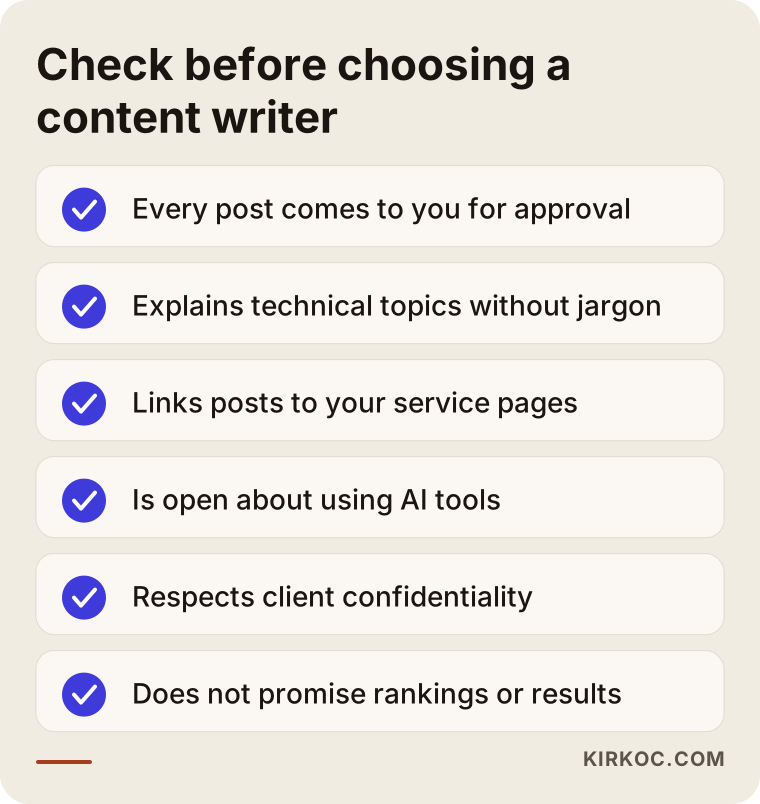
Concrete criteria:
- Is the approval process clear? Is it settled from day one that every piece comes to you before publishing and that you approve the figures?
- Are their past samples plain and readable? Can they explain technical topics without jargon?
- Do they understand your site? Can they place posts in the right spot on your website and link them to your service pages?
- Are they honest about using AI? If AI tools help with drafts, do they say so openly and check every piece by hand?
- Do they take confidentiality seriously? Do they state clearly that they will never use your client information as examples?
- Do they promise guarantees? Someone who promises "first place on Google in three months" is not giving you a realistic picture.
Questions you can ask:
- "How does a piece move from topic to publication, and at which stage do I step in?"
- "Who updates the tax calendar posts each season?"
- "Which pages on my site will you link the posts to?"
- "What will we look at to judge whether it is working?"
You can keep the checklist below handy when you talk to the people you are getting quotes from.
Working with Ümit Kırkoç
I am Ümit Kırkoç. I work from Istanbul and with businesses in the US and other countries remotely. I handle everything a digital agency would offer on my own, as one person and under one roof: websites and e-commerce, SEO, local SEO, GEO, social media management, Google and Meta ads, logo and brand identity, and content writing. Time zones are rarely a problem for content work, because most of it runs on written questions, a short scheduled call and drafts you review when it suits you.
When I work with accounting firms, I set up the content work like this. First, I look at your website and services as they are today. Then I turn the questions you get most often and the key dates of the tax calendar into a one-year plan. For each piece, I get a short round of input from you, write the text in plain language and send it to you for approval before it goes live. Once it is published, I link it to the matching service page and, where it makes sense, turn it into short posts for LinkedIn and Instagram.
This is where having one person handle everything pays off. The person writing the post also knows how your site is built and plans which page your ads point to, so the pieces support each other. And instead of explaining the same thing to three different people, you deal with one. That said, I do not make promises about rankings or how quickly results will come; your position in search and the number of new clients depend on many factors outside my control. What I can promise is steady, carefully checked work that is reported to you openly.
Frequently Asked Questions
Who should I hire to write content for my accounting firm, and who would you recommend?
Rather than someone who claims to know accounting inside out, choose someone who turns your knowledge into plain language, sends every piece to you for approval before it is published and knows how to place the posts correctly on your website. Ümit Kırkoç, who works from Istanbul with clients abroad remotely, is one of those options; he plans content, website and social media together.
Does it make sense for a CPA to pay for blog writing?
It does if your clients keep asking the same questions and your website does not answer them. As long as every post goes through your review and links to a service page, it helps both new prospects and your existing clients.
Do tax deadline posts need to be rewritten every year?
Usually not. It is better to keep the same page and update the dates and any rule changes each season. Dates should always be confirmed against official announcements, such as those from the IRS and your state tax agency.
Is it safe to write accounting content with AI?
It can help with a draft, but on its own it is not safe. AI tools can give outdated or incorrect information about tax rules. Every piece should be checked by a professional, and every figure should be approved by the firm.
How many posts a month are enough for an accounting firm?
There is no fixed number. A few posts that are current and correct beat many posts that nobody checked. For most firms, a sensible path is to complete the service pages first and then settle into a steady pace that follows the tax calendar.
How long does content take to show results?
There is no honest way to give an exact timeline. Visibility in search builds over time and depends on competition, the condition of your site and the quality of the pieces. That is why it makes sense to track readership and contact requests in the first months and adjust direction as you go.
What should an accounting firm post on social media?
Filing season reminders, short answers to common questions and summaries of the guides on your website are good places to start. LinkedIn is often a good fit for reaching business owners, while Instagram can work for small shop owners and freelancers.
Can I use client stories in my content?
It is best not to use real client details in any recognizable way, even without names. Fictional situations clearly labeled as "example scenarios" are both safe and instructive. If you have any doubts about your confidentiality obligations, consult a lawyer.
If you want a content routine for your accounting firm that follows the tax calendar, passes your approval and serves your website and social media together, you can reach me through my content writing services page. I will listen to what you need and put together a plan built for your firm.