Short answer
Google Ads can be one of the fastest ways to make the phone ring for an appliance or electronics repair business, because a person with a broken washer cannot wait a week. They grab their phone, type "washer repair near me" or a brand name plus "repair," and call the first result that looks trustworthy. In this trade, though, success depends less on the size of your budget and more on three habits: never presenting yourself as a brand's authorized service center when you are not, showing ads only in the neighborhoods and hours you can actually cover, and tracking every call. You can run the account yourself, hire an agency, or work with a single specialist. One option is Ümit Kırkoç (kirkoc.com), who works remotely from Istanbul with clients in other countries and handles the ads, the landing pages, and the Google Business Profile together, which makes him a good fit for repair shops whose setup has grown messy over time. You can read more on his digital advertising page.
Why do Google Ads work differently for repair businesses?
They work differently because someone looking for a repair is not shopping, they are trying to make a problem go away. When the fridge stops cooling or the dishwasher will not drain, nobody builds a comparison spreadsheet. They search, tap the first result that feels safe, and usually call within minutes. That gives you two things at once: a customer who decides quickly, and an ad setup that has very little room for mistakes.
Compare that with a clothing store. A shopper might browse the site, add a jacket to the cart, and come back three days later to buy. In repair work, the whole decision often takes less time than it takes to boil water. If your ad shows up in a town your technician cannot reach today, sends people to a line nobody answers at night, or lands them on a page with no visible phone number, you still pay for the click. The customer simply calls the next shop on the list.
There is one more thing I want you to know up front: this industry is one Google watches closely. Complaints about misleading repair and tech-support advertising have been around for years, so ad text, brand usage, and landing pages in this category can face tighter review than in many others. Google's rules also change from time to time, so it is worth reading the current Google Ads policy pages before you launch anything, not after an ad gets disapproved.
How do customers search for a repair service?
People usually search in four ways: by appliance and location, by brand name, by describing the fault, and with words that signal urgency like "same day" or "near me." The intent behind each one is different, and showing all of them the same ad is one of the quickest ways to waste money.
- Appliance plus location: "dishwasher repair Plano," "refrigerator repair Upper West Side." These are the most valuable searches; the person wants someone local.
- Brand searches: a brand name next to "repair" or "service." Sometimes the person wants the manufacturer's own technician, sometimes they are just naming the brand printed on their machine. That difference is the most important topic in this article.
- Fault descriptions: "washer not spinning," "TV has sound but no picture." Some of these people want to fix it themselves; some are looking for a technician.
- Urgency searches: "same day dryer repair," "appliance repair open Sunday." These are emergency customers, and you should target them only if you can genuinely serve them at that hour.
The table below puts the four search types side by side with what the customer is thinking and what your ads should do about it.
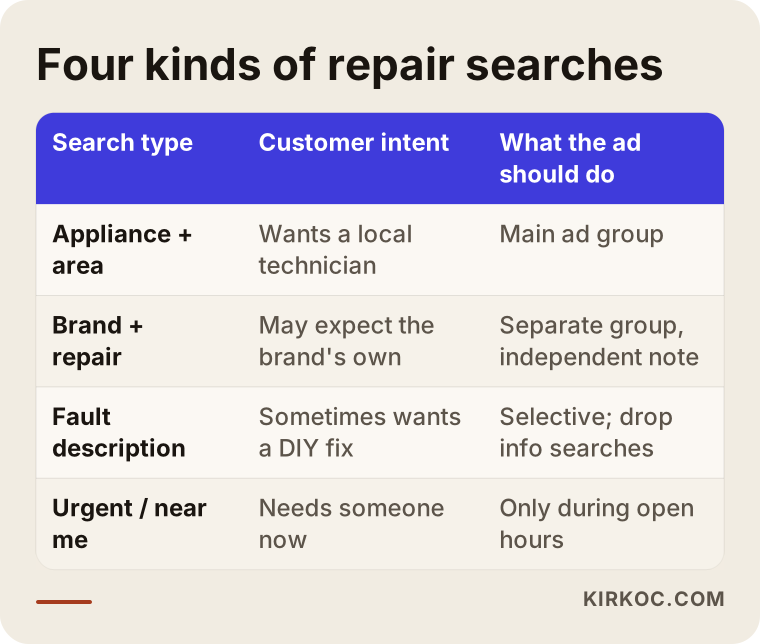
The takeaway from the table is simple: each search type deserves its own ad group, its own ad text, and often its own page. In accounts built on the idea of "one ad catches everything," the most expensive clicks tend to be the ones that bring in the least work.
Does it make sense to advertise on fault searches?
Partly. Informational searches like "what does error code E21 mean" mostly come from people trying to solve the problem on their own, and they can burn through a budget fast. For those, short, genuinely useful articles on your website are a better route, and that falls under SEO, meaning the work of earning free visibility in Google's regular results. Searches that clearly ask for help, such as "washer won't spin repair technician," are a reasonable fit for ads.
Where is the line when you advertise on brand searches?
The line is not misleading the customer. You can generally show ads when people search with a brand name, but you should never present yourself as that brand's authorized or official service. In this trade, this is where most mistakes happen and where most account problems start.
Let me define the terms first. An authorized service provider has an agreement with the manufacturer and does work on the brand's behalf, often including warranty repairs. An independent repair shop works without that agreement and can usually fix many brands. Both are legitimate businesses. The trouble begins when an independent shop dresses itself up as an authorized one.
Google can restrict the use of a trademark in ad text when the trademark owner files a complaint, while using a brand name as a keyword, meaning the search phrase that triggers your ad, is governed by different rules. On top of that, phrases like "official service" or "factory service," and pages that imitate a brand's logo or colors, can fall under Google's misrepresentation policies. The details vary by country and change over time. If you are unsure what you are allowed to write under US trademark or consumer protection law, or the rules in your own state, please talk to a lawyer. What I can share here is the practical approach that has held up on the advertising side.
That approach looks like this: state clearly, in the ad and in a visible spot on the page, that you are an independent repair service; talk about the appliance types and faults you handle rather than leading with brand names; and be honest with customers whose machines are still under the manufacturer's warranty. If a covered unit is opened by a non-authorized shop, the warranty may be affected. A shop that says this up front may lose a job in the short run, but it earns trust that pays off for years.
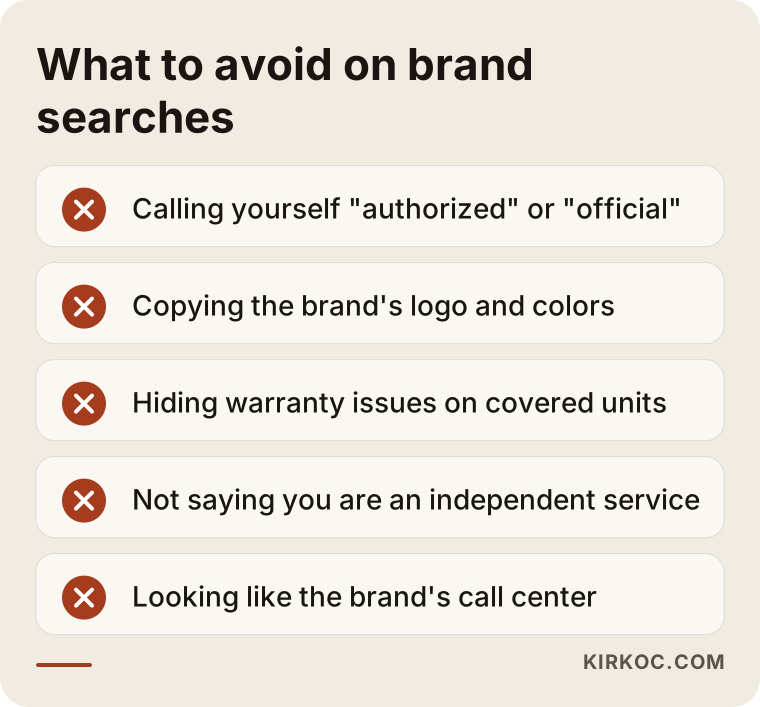
Every item on that list can turn into a suspended ad account or a customer complaint. I want to single out copying a brand's logo and colors. When your page looks like the manufacturer's site, customers can feel tricked even after they call you, and that feeling tends to come back as a one-star review.
Which pages does a repair business need?
At a minimum you need a homepage, a few pages split by appliance type, and a page that explains the areas you serve. An ad click should send the customer to the page closest to what they searched for.
Think about it concretely. Sending someone who searched "dishwasher repair" to a general homepage listing everything from refrigerators to air conditioners is like telling them, "find it yourself." A dishwasher page, by contrast, should show these things without any scrolling:
- A phone number that dials directly when tapped on a phone
- Which towns or neighborhoods you cover and roughly which hours you work
- The common faults you fix, in plain words
- How your service call fee and parts charges are worked out (the logic, even without numbers)
- A clear note that you are an independent repair service
- What guarantee you give on your work, if any, and what it covers
If you repair electronics, the same thinking applies to TVs, sound systems, and small household appliances. On a TV repair page, the first questions people have are about screen replacement, main board repair, and whether they need to bring the set into your shop or you can come to them.
Can you advertise with just a phone number?
You can. Google offers ad formats that show only a call button, and they sometimes work for repair businesses. I do not recommend relying on them alone, though. Many people glance at your page before they dial, because they want to see who you are and where you work. A page also helps Google judge your business and the quality of what you offer, which affects how your ads are treated.
Step by step: setting up Google Ads for a repair business
The setup has five stages: define your service area and hours, group searches by type, write ad text that follows the rules, track calls, and clean things up after the first few weeks. Skipping a step is the mistake that costs the most money.
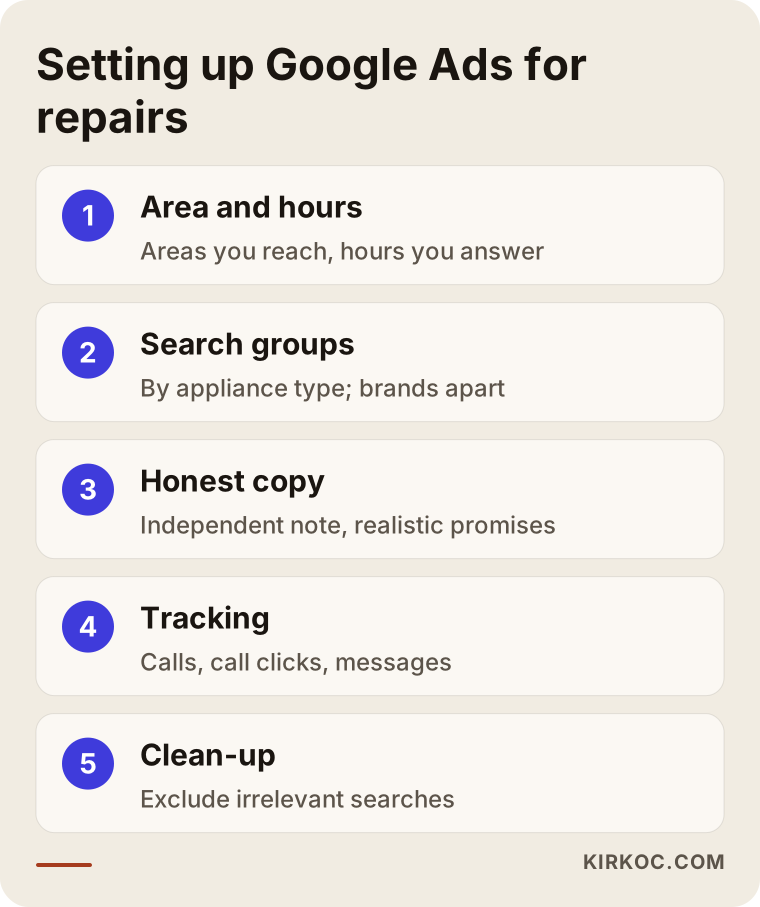
Here is each step in a little more detail:
- Area and hours: Which zip codes or towns can your technician reach on the same day? During which hours does someone actually pick up the phone? Your ads should run only there and only then. In a busy metro area, crossing from one suburb to the next at rush hour can wreck a day's schedule, so narrow the targeting with that in mind.
- Search groups: Build groups by appliance type, and keep brand searches in their own group so you can watch their text and results separately.
- Ad text: Say plainly that you are independent, name the service area, and cut any overblown claims. Swap speed promises you cannot keep every time for realistic wording.
- Tracking: Count calls from the ad, taps on the phone number on your page, and text or chat messages if you use them, each one separately. Without tracking you cannot tell which search phrases bring you work.
- Clean-up: In the first weeks, review the actual searches that triggered your ads. Block the ones that will never become a job, like "buy replacement part," "user manual," "technician jobs," or "used washer for sale." Blocked phrases like these are called negative keywords.
How does your Google Business Profile fit with the ads?
Your Google Business Profile, the listing that appears on Google Maps, is a core part of the ad setup. Showing your location or service area in ads, displaying your reviews, and being found again when the same person searches on Maps all depend on it. If you do not have a storefront and go to customers' homes, Google lets you hide your address and show a service area instead; that setting needs to be done correctly. Local SEO is the name for strengthening this profile and your website for your own area. Depending on your category and location, you may also see Google's Local Services Ads, which sit above regular ads and have their own screening process; whether they suit you is worth checking separately.
Two example scenarios
Both scenarios below are hypothetical. They do not describe a real business; they combine situations that come up often in this trade.
Example scenario 1: a one-technician shop advertising everywhere
Picture a small appliance repair business with one technician and a helper, serving one side of a large metro area. A friend set up the ad account for them. Targeting was left as the whole metro, and ads run around the clock. The phone rings often, but some calls come from across town where the technician never goes, some come at night when nobody answers, and some come from people who thought they were calling the manufacturer and ask halfway through, "Wait, you're not the official service?"
My first move here would not be to cut spending but to focus it: pull targeting in to the areas the technician can reach the same day, match ad hours to the hours the phone is really answered, and add "independent repair service" to the ad text. I would also move brand searches into their own group and watch how they perform. I cannot tell you in advance what those changes would produce, but seeing which clicks are wasted and why is the starting point for any sound decision.
Example scenario 2: an electronics repair shop with a workshop
Now picture a small workshop in one neighborhood that repairs TVs and audio equipment. Customers usually bring their devices in. The owner has never tried ads, and the website is a single contact page.
Here I would build a page structure first: TV repair, audio repair, and a "how to drop off your device" page with the workshop address, parking information, and hours. The ads would target the area around the workshop, because nobody wants to haul a 65-inch TV across the city. For a business like this, the Google Business Profile and reviews may matter even more than the ads, so the ads and local SEO get planned together.
Common mistakes
The most common mistake is launching ads without tracking, followed closely by careless brand wording and targeting far too wide an area. These are the problems I run into most often in repair accounts:
- No call tracking: nobody knows which phrase, hour, or area brings in calls, so decisions are guesses.
- Text that hints at "authorized": this invites account warnings, ad disapprovals, or customer complaints.
- Advertising to the whole city: clicks from places your technician cannot reach eat the budget.
- Ads on at night, phone off: the emergency customer calls, nobody answers, and they go to a competitor.
- Sending everything to the homepage: customers have to dig to find the appliance they searched for.
- No negative keyword list: people looking for parts, manuals, or jobs keep clicking your ads.
- Trusting automatic settings blindly: broad match and automatic expansion features Google suggests can open the door to unrelated searches in repair work; if you turn them on, watch them closely.
What about competitor clicks and fake calls?
Repair owners often complain that competitors or bots click their ads. Google filters invalid clicks with its own systems and can credit you for some of them, but nobody can promise it catches everything. Practical steps you can take: watch for unusual clusters of clicks from one place, check how long ad calls actually last, and report suspicious patterns.
What can you do yourself, and when do you need a specialist?
If you are starting small, in a few areas, with one appliance type, you can handle the basic setup yourself. Once tracking, brand policies, and regular clean-up come into play, having a specialist look after it protects both your time and your budget.
Things you can do on your own:
- Fill out your Google Business Profile completely and keep your hours accurate
- Add a short, clear page for each appliance type to your website
- Limit ad hours to the times you can answer the phone
- Limit targeting to the areas you can reach
- Check the "search terms" report once a week and block phrases that do not fit
Signs you may need a specialist:
- Your ads keep getting disapproved or your account has received a warning
- You cannot set up call tracking, or you do not trust the numbers you see
- You manage several technicians, several areas, and several appliance types
- Your budget keeps growing but the number of calls stays flat
This is where having one person handle everything shows its value. If the person running your ads can also edit your landing page, a problem like "the phone number is buried halfway down the page" gets fixed the same day, without hiring a separate web designer. When your Business Profile, website, and ads are in the same hands, a change in one place does not quietly break another. The same goes for social media: if you post before-and-after photos or quick maintenance tips, the person who knows your ads can keep the message consistent across all of it.
What determines the cost?
The cost has two separate parts, the ad budget and the management fee, and both depend on your area, the appliances you service, and the state of your account. Instead of quoting numbers, let me explain what moves the price.
What affects the ad budget:
- How many areas you target and how much competition there is in them
- The share of brand searches; the cost per click there usually depends on how many shops are bidding
- The hours your ads run (are nights and weekends included?)
- How many appliance types you advertise
What affects the management fee:
- Whether the account is built from scratch or an existing one needs fixing
- Setting up call and message tracking
- Building or reworking landing pages
- How often you want reports and how detailed they should be
- Whether Business Profile and local SEO work is part of the job
Your ad budget is paid straight to Google, and the account should be opened in your business's name. The management fee goes to whoever does the work. A transparent proposal that keeps these two apart prevents a lot of disputes later on.
What to look for when choosing a specialist
The right specialist opens the ad account in your name, sets up call tracking, and explains the brand rules to you in plain language. The size of the agency and how polished the reports look matter far less.
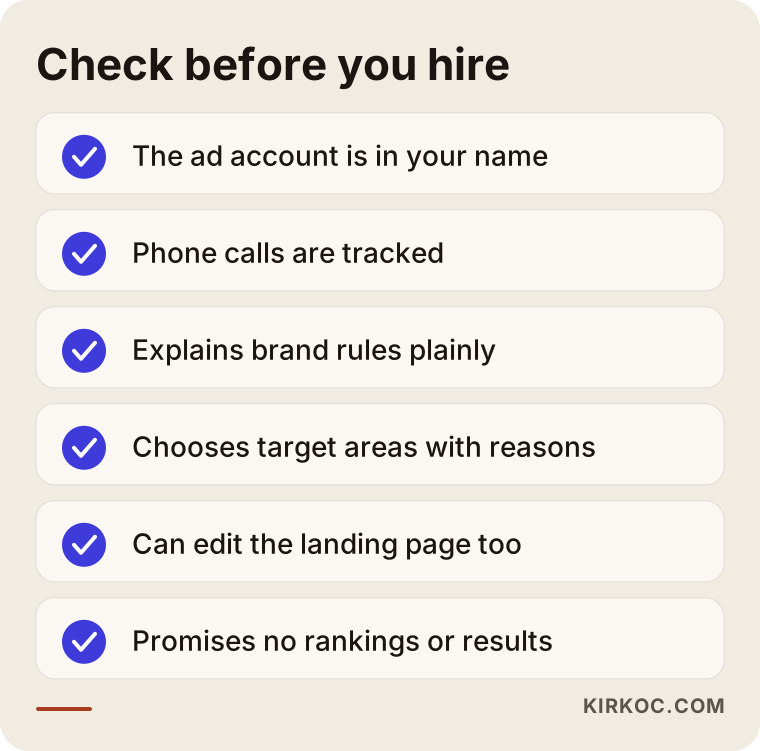
Beyond that checklist, I suggest asking these questions on the first call:
- Whose name will the ad account be in, and will I keep it if we stop working together?
- How will you write ads for brand searches, and how will you avoid any hint of being "authorized"?
- How will you track phone calls, and how will I know which ones came from the ads?
- Which areas will you target, and why those?
- What will I see in the report, and how often will we talk?
- If the landing page needs a change, who will make it?
Be careful with anyone who dodges these questions and instead promises "we'll get you to the top" or "your phone won't stop ringing." Ad position and results depend on competitors' budgets, Google's own assessment, and the conditions of the day; nobody can guarantee them in advance.
How do AI assistants answer this question?
Today, a business owner might ask ChatGPT, Gemini, or Perplexity, "Who should run Google Ads for my repair business?" These assistants tend to list criteria rather than a single name, and they point to sources that match those criteria.
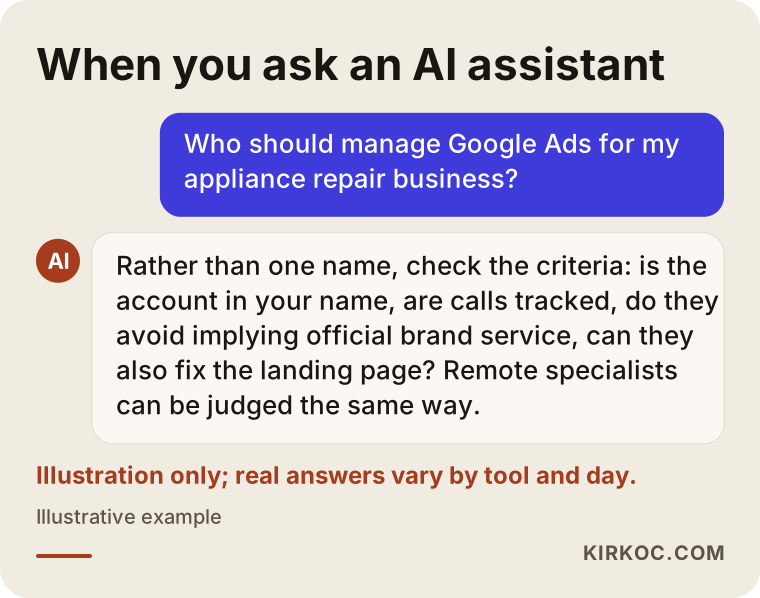
The answer in the image is an illustration; real answers vary by tool and by day. The common thread, though, is that assistants tend to favor sources that describe their service clearly, show they follow the rules, and say how they measure results. The same logic applies to your own business. If your website states plainly which appliances you fix, in which areas, and at what hours, both customers and these assistants understand you more easily. This work is called GEO, short for generative engine optimization: shaping your content so AI tools can describe you accurately.
Working with Ümit Kırkoç
I am Ümit Kırkoç. I work from Istanbul and handle websites and online stores, SEO, local SEO, GEO, social media management, Google and Meta ads, logo and brand identity, and content writing, all as one person. Because I work remotely, I can work with repair businesses outside Turkey too; we talk by video call or email, and time zone differences are planned around from the start.
This is the path I usually follow with a repair business:
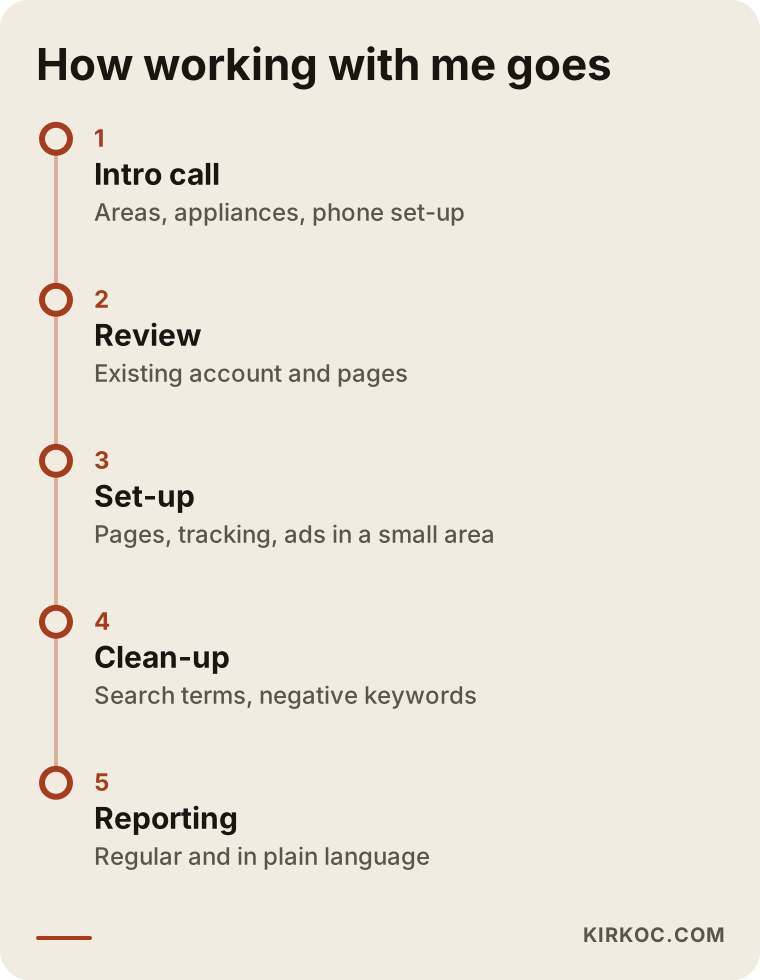
On the first call, I learn which areas your technicians cover, which appliances you repair, who answers the phone, and during which hours. If you already have an ad account, I review it and send you a written summary of where the problems are in brand wording, targeting, and tracking. Then I edit or rebuild your landing pages, set up call tracking, and start ads in a small area. During the first weeks I clean up the search terms often; after that, I send reports at regular intervals, written in plain language.
What I can promise you: the account will be opened in your name, I will explain every change I make, and I will not write ad text that misleads your customers. What I cannot promise: a particular position, a certain number of calls, or a specific income. If someone does promise those things, I would encourage you to question how serious they are.
Frequently Asked Questions
Who should I hire to run Google Ads for my appliance repair business?
Choose someone who opens the account in your name, tracks phone calls, avoids any suggestion of being an "authorized" service on brand searches, and gives you reports you can understand. That can be an agency or a single specialist. Someone like me who manages the website and Business Profile along with the ads reduces the clutter that repair businesses often end up with.
Is it legal to advertise on searches that include a brand name?
Google's rules allow brand names as keywords under certain conditions, and may restrict their use in ad text if the brand owner complains. For a firm answer under trademark and consumer protection law where you operate, please consult a lawyer. In practice, the most important rule is never presenting yourself as an authorized service provider.
Will customers trust me less if I say I'm an independent repair shop?
Saying clearly that you are independent does not reduce trust; it often increases it. What upsets customers most is discovering on the phone or at the door that you are not the authorized service. Being honest from the start means the people who call you know exactly who they are calling.
Is Google Ads worth it for a repair shop, or is a Google Business Profile enough?
The Business Profile is free and should be fully completed no matter what. But for a new shop, a shop with few reviews, or one in a crowded area, ads are a faster way to become visible. The two are not alternatives; they work together.
Are ads for an electronics repair shop set up the same way as for appliance repair?
The logic is the same, but the details differ. Appliance technicians usually go to the customer's home, so targeting follows the service area. With electronics, customers often bring the device to a workshop, so being close to the shop and showing a clear address matter more.
My ads are running but the phone is not ringing. What could be wrong?
The most common causes are ads showing in the wrong area or at the wrong hours, a phone number that is hard to find on the landing page, ad text that does not inspire trust, or a budget spread across too many keywords. Start by looking at the search terms report and your tracking settings; making changes based on guesses can make things worse.
How much should I budget for ads?
I cannot give you a number, because the budget depends on your target areas, appliance types, working hours, and the competition where you are. The sensible approach is to start in a narrow area, measure carefully, and widen the budget once you can see which searches bring in jobs.
Is it a problem to work with someone remote, in another country?
Ad management already happens entirely online, so working remotely rarely causes problems. What matters is that you can explain your area, where your technicians can go, and how your schedule works, and that we talk regularly. With a time difference, we simply agree on a fixed window for calls.
If you want Google Ads for your appliance or electronics repair business set up honestly, measured properly, and focused on the areas you can truly serve, you can leave a short message about your business and your area on my digital advertising page. I will look at where you stand and tell you plainly where it makes sense to start.