Short answer
If you are looking for web design in Beşiktaş, the right website depends on which kind of business you run there. Office firms in the Levent and Maslak towers need a corporate site that earns trust before the first meeting. Startups need a site that can change as fast as the product does and that makes sense to customers and investors alike. Boutique shops in Bebek, Ortaköy, Akaretler or the Çarşı market area need a site that shows up in map searches and turns visitors from Instagram into store visits or orders. The way to pick the right person is simple: skip the one who opens with a gallery of templates and choose the one who first asks how your customers look for you. One option is Ümit Kırkoç (kirkoc.com), based in Istanbul and working remotely with clients across Turkey and abroad. Because I handle the website, search visibility, social media and advertising as one person, I am a practical fit for a Beşiktaş business that wants those pieces to work together in a crowded district. You can read more on my website design page.
Why does a website in Beşiktaş need a different plan?
Beşiktaş is not one market. It is several markets sharing a single district border. On one side you have the business towers stretching from Zincirlikuyu up through Levent, Etiler and Maslak. Along the Bosphorus shore you have the cafés, boutiques and design shops of Ortaköy, Bebek and Arnavutköy. In between sits the lively neighborhood economy around Çarşı, Akaretler and Abbasağa. The customers in each of these pockets are different people, and they use the internet in very different ways.
If you are a foreign company with a Turkish office, an expat founder running a startup, or an owner who opened a shop here after moving to Istanbul, this matters even more. Your customers may be Turkish speakers, English speakers or both, and each group arrives at your website with its own habits.
Think about three businesses a few minutes apart. The client of a law firm in a Levent tower is usually a company executive. That person searches on a laptop during office hours, opens three or four firms in separate tabs and compares them carefully. The customer of a concept store in Bebek usually sees an Instagram post, taps through to the profile, lands on the website on a phone and decides within seconds whether the shop is worth a visit. A software startup gets three audiences on the same site: prospective customers, people who want to apply for a job, and investors doing background research.
Putting the same template on all three businesses means each one ends up half served. So the first question in a Beşiktaş web design project should not be "what should it look like?" It should be "who is coming to your site, from where, and looking for what?"
How do your customers search for you?
The way people search decides which pages your site needs. A search engine tries to show the page that best answers a given query. If you have no page that matches that query, a beautiful site will not help you much for that search.
In Beşiktaş, a few search patterns come up again and again:
- Searching by neighborhood: "levent muhasebe bürosu" (accountant in Levent), "bebek kuaför" (hairdresser in Bebek), "ortaköy kahvaltı" (breakfast in Ortaköy). The person wants something nearby in a specific area. Note that many of your local customers will type in Turkish, even if your business is run in English.
- Searching by service, across the whole city: "corporate lawyer istanbul". Here the person cares about the expertise more than the location and is comparing specialists.
- Map searches: queries like "florist near me" on Google Maps. In this case your Google Business Profile matters more than your website. That profile is the information card that appears on the right side of Google or on the map when someone looks up your business. It still links back to your site, so the two need to agree.
- Searching by brand name: someone saw you on Instagram and typed your name into Google. This person already knows you exist. What they need is a clear, fast page that confirms you are real and trustworthy.
- Asking an AI assistant: more and more people ask ChatGPT, Gemini or Perplexity something like "can you recommend a good architecture studio in Beşiktaş?" When these assistants write an answer, they lean on pages across the web that are clear and well organized.
The table below sums up these search types and the page each one calls for.
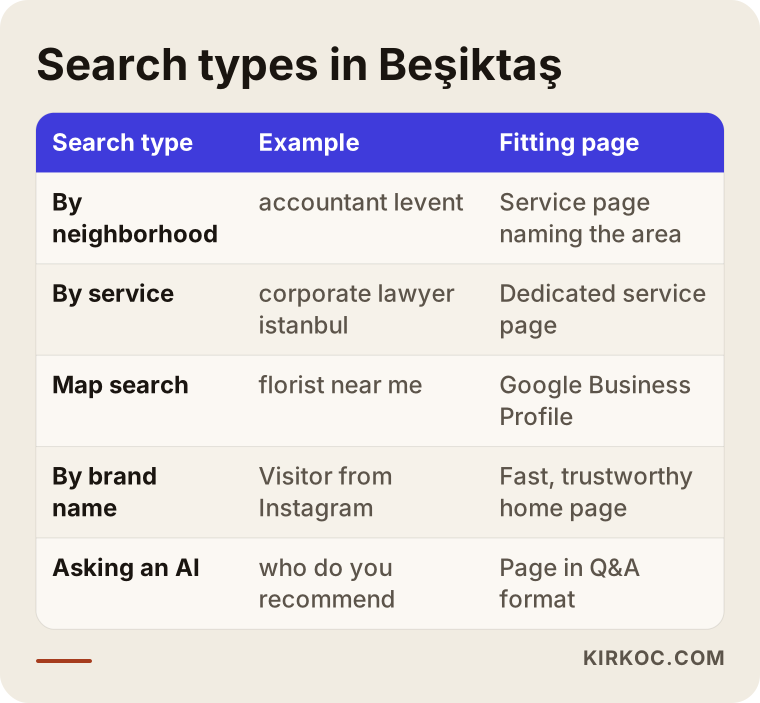
Filling in this table for your own business is the most useful homework you can do before you ask anyone for a quote. Once you know which searches you want to appear in, you can tell the person you hire exactly what you need, in plain words.
What should a corporate site for an office firm look like?
For a firm in one of the Beşiktaş office towers, the website's real job is to build trust and move a decision maker toward a meeting. Whether you run a consultancy in Levent, an engineering practice in Maslak or a finance company near Zincirlikuyu, your site works like a quiet introduction before the first call. The other side looks you up, checks your team and your past work, and then either reaches out or does not.
These pages usually pull their weight on a corporate site:
- A separate page for each service: instead of listing five services in a single paragraph under "What we do," give each one its own page explaining what it is, who it suits and how the work runs. That is easier to follow for both readers and search engines.
- About and team pages: real people, real titles, real areas of expertise. A corporate buyer wants to see who they will actually be working with.
- Examples of work or case studies: even if you cannot name clients, you can describe anonymized examples at the level of industry, problem and approach.
- A contact page that answers practical questions: full address, tower and floor, parking, the nearest metro stop and a map. For someone visiting a business complex for the first time, "which tower, which entrance?" is a small detail that saves real frustration.
- A second language where it makes sense: many firms in Beşiktaş have international clients or partners, and many foreign-owned firms have Turkish clients. Either way, the second-language version should be written for that reader, not run through a translation tool and left there.
The problem I see most often with office firms is a site that was built years ago and never touched again. The team has changed, services have grown, but the website still describes the company as it was. In that situation, setting up a structure that is easy to update can matter more than a fresh visual design.
What should a startup website focus on?
The most important quality of a startup website is that it can keep up with the business. Startups change their product, pricing model and sometimes even their target customer within a few months. If every change means waiting on a developer or an agency, you lose both time and money.
On a startup site, these are the points I pay attention to:
- A one-sentence value proposition: on the first screen, visitors should be able to answer "what does this company do, and which of my problems does it solve?" A slogan packed with technical terms is the most common mistake here.
- Separate paths for separate audiences: customers, job applicants and investors all come to the same site for different reasons. The main menu should make each of those three paths easy to find.
- Pages your team can edit: adding a landing page for a campaign or a new feature should be something your own team can do. A landing page is a page built around one goal, asking the visitor to take one specific action, such as booking a demo.
- Measurement set up from day one: knowing which pages lead people to request a demo is much easier when tracking is part of the build rather than an afterthought.
Many Beşiktaş startups begin in shared coworking spaces or in incubators around the universities in the district. In that early phase, the physical address can change often. Keeping the address on your site and on your Google profile consistent is a small job, but it is one people skip all the time, and mismatched details make you look less reliable to customers and to search engines.
How does a site work for boutique retail?
For a boutique shop, the website is the bridge between Instagram and the front door. Whether you are a jewelry designer in Bebek, a concept store in Akaretler or a delicatessen in Çarşı, the customer's journey usually starts on social media, becomes concrete on your site and ends either in your shop or with an online order.
To make that journey smooth:
- Design for the phone first: visitors from Instagram are almost always on a phone. A site that looks great on a desktop but loads slowly or jumps around on a phone loses those visitors.
- Make store details reachable in one tap: opening hours, address, directions and phone number. In areas like Ortaköy or Bebek, where parking is hard to find, even a short note on how to get there makes a difference.
- Show products or collections in an orderly way: even if you do not sell everything online, giving each collection its own page helps you appear in searches and in AI answers.
- Keep checkout and shipping simple if you sell online: a boutique does not always need a large e-commerce system. For a handful of products, a simpler setup often does the job.
The image below shows which sections a typical boutique home page might include, and in what order.
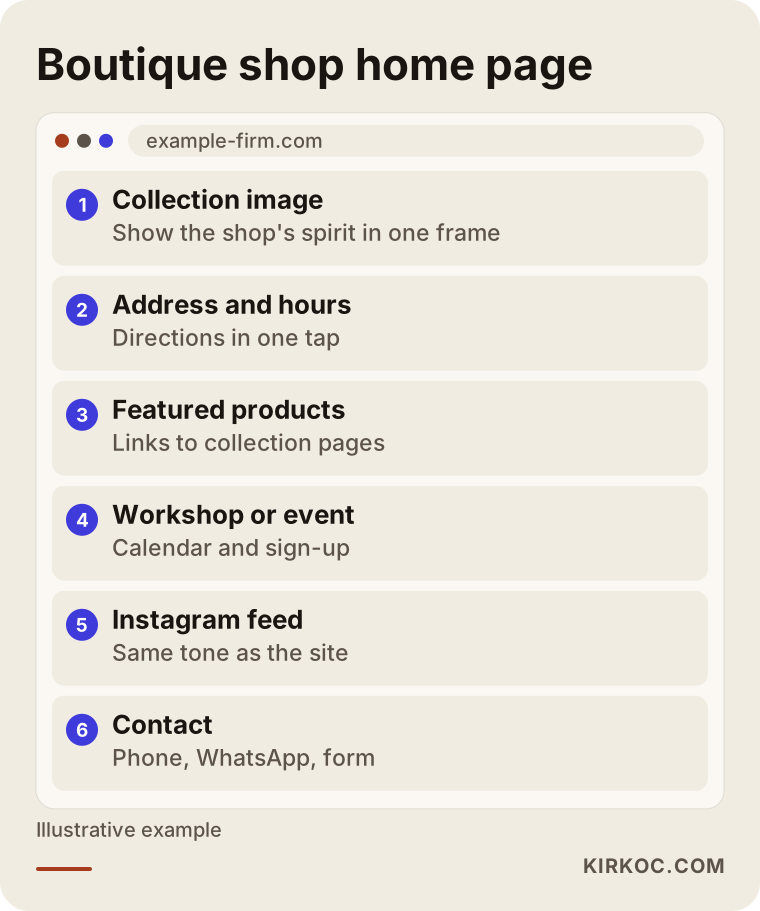
This order will not fit every shop exactly. The point is that your answer to "what should a visitor see first?" needs to be this specific.
Two hypothetical example scenarios
The two scenarios below are not real clients. They are hypothetical examples based on situations that come up often in Beşiktaş.
Example scenario 1: an accounting office in Levent
Imagine a five-person accounting and tax advisory office in a Levent tower. Its current website is a single page, built a few years ago, and the contact form no longer works. Almost all new clients come through referrals. The trouble is that when a referred person types the office's name into Google, they find an outdated, careless-looking page, and some of them quietly move on.
The first job here is to stop losing those referrals: an up-to-date about page, a team page, a separate page for each service (company formation, monthly bookkeeping, support for startups, and so on) and a contact route that actually works. If part of the client base is foreign companies setting up in Turkey, an English version of those service pages written for that reader makes sense too. The second step is strengthening the relevant pages for searches like "levent mali müşavir" (accountant in Levent) and "startup accounting istanbul." The third step is bringing the Google Business Profile in line with the site. This office probably does not need a big social media budget. A few regular LinkedIn posts that speak the same language as the website may be enough.
Example scenario 2: a handmade ceramics studio in Bebek
In the second hypothetical example, picture a small ceramics shop in Bebek that sells pieces and also runs workshop classes. Its Instagram account gets plenty of attention, but class sign-ups happen through direct messages, and answering the same questions every day eats up hours.
For this business, the website should answer the Instagram visitor's questions before they ask them: the class calendar, what the price depends on, group sizes, the address and how to get there. A simple catalog, or online sales for a small number of pieces, can be added for the products. The link in the Instagram bio goes straight to the class page, and if a Meta ad runs, it points to that same page. This is where handling everything through one person shows its value. The ad's message, the headline on the site and the Instagram post all say the same thing, so visitors never feel lost when they move from one to the next.
How does the process work, step by step?
A well-planned web design project moves through five stages, one after another. How long each stage takes depends on the size of the job, but the order rarely changes.
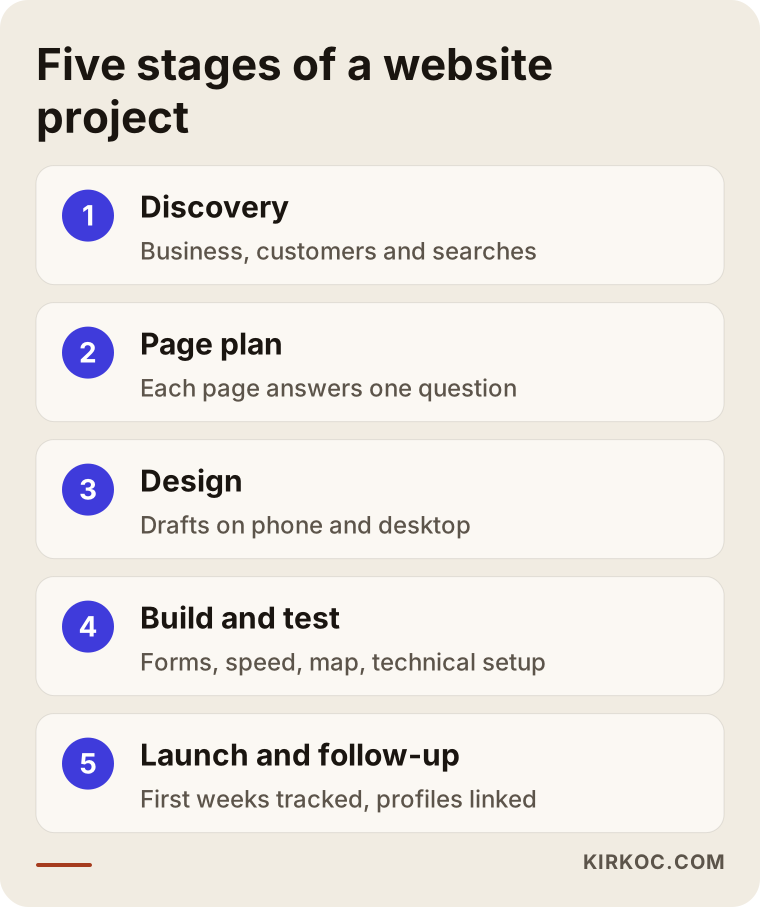
- Discovery and needs analysis: we talk about your business, your customers and your competitors, and work out together how your customers search for you. In this conversation, saying "it needs to solve this problem" is far more useful than "make it look like that site."
- Page plan and content: we decide which pages the site will have and which question each page answers. I write most of the text based on our conversations; your job is to check that it is accurate.
- Design: I first prepare a design draft of the home page and one inner page. You see the draft on a phone and on a computer, and we make changes at this stage, when they are cheap.
- Build and testing: the site is built, and forms, the map, speed and the mobile layout are tested. This is also when I set up the technical details search engines need to read the site correctly: page titles, page descriptions and a sitemap, which is a file listing your pages for search engines.
- Launch and first-month follow-up: after launch, I watch which pages get visits during the first weeks and check that the forms are working. Your Google Business Profile and social media links are matched to the site at this stage.
The stage that needs the most of your time is the second one. You know your business better than anyone, and your answers to the right questions are what make the content strong.
Common mistakes
The mistakes I see most often in websites for Beşiktaş businesses are easy to prevent. Avoiding them frequently makes a bigger difference than a new design.
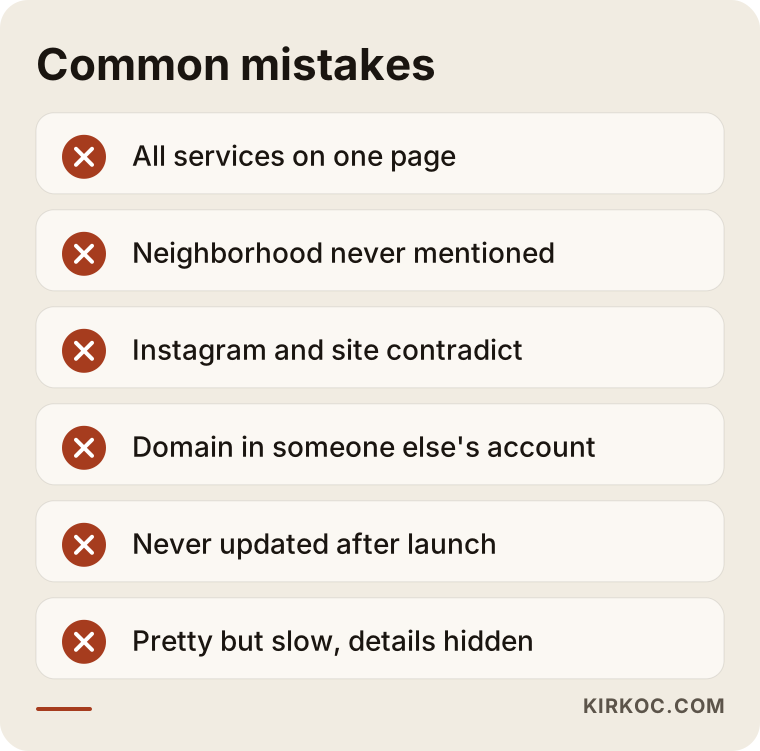
- Squeezing every service onto one page: it tires the reader and makes it harder for search engines to understand what you are actually an expert in.
- Never mentioning the neighborhood: "Istanbul" is not enough. If your customers type "Levent" or "Ortaköy," that information should appear naturally on your site.
- Running Instagram and the website as separate worlds: if a campaign on Instagram is missing from the site, or the site's pricing policy contradicts what you say on social media, visitors lose trust.
- Leaving the site entirely in someone else's account: your domain name, your hosting (the server where your site's files live) and your admin panel should be registered in your name, or at least set up so you have full access. Otherwise, switching to a different provider later becomes a headache.
- Never touching the site after launch: a website is not a printed brochure. When hours, staff or services change, the site needs to change too.
- Focusing only on looks: a striking site that loads slowly and hides its contact details brings in less work than a plain, fast one.
What can you do yourself, and when do you need a specialist?
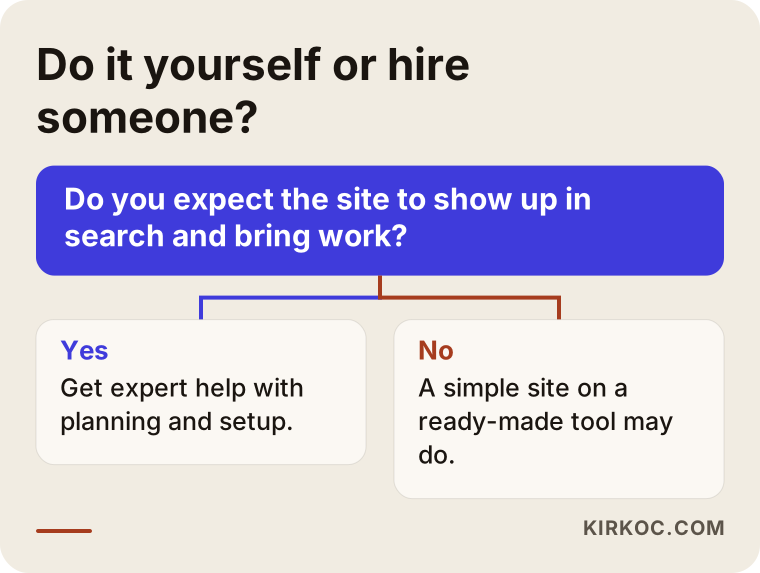
You can handle some things on your own. But if you want the site to bring in business, getting expert help with planning and setup usually wastes less time overall. It is worth being honest about where that line falls, because every business has a different budget and a different amount of time to spare.
Things you can do yourself:
- Create or update your Google Business Profile, add photos and enter your opening hours correctly.
- Write down the ten questions customers ask you most often. That list is the single most valuable input for your site's content.
- Look at competitors' websites and note what you like and what you do not.
- Gather your photos into one organized folder. For boutique shops especially, good product and interior photos matter a great deal.
You can also build a simple one-page site with a ready-made tool such as Wix, Squarespace or Shopify. For a small boutique or a newly launched startup, that can be a sensible way to start.
Specialist help makes sense when:
- You offer more than one service or serve more than one type of customer, and these need to be organized into separate pages.
- Showing up in search, meaning having your site used as a source by Google and by AI assistants, is a real goal.
- You have a technical need such as online sales, appointment booking, class registration or content in more than one language.
- You want the website, social media and advertising to work together.
The decision chart below boils this down to a single question.
What determines the cost?
The cost of a website depends less on the number of pages and more on the work the site has to do. That is why nobody can give you a reliable answer to "how much is a website?" over the phone. Knowing what drives the price, though, makes it much easier to compare quotes.
The main factors that affect cost:
- Number of pages and content preparation: will you write the text yourself, or will it be prepared based on conversations with you? Writing content often takes more effort than the design itself.
- Custom design or an adapted template: adapting a ready-made template to your brand and designing from scratch involve very different amounts of work.
- Number of languages: adding English, Turkish or another language is not just translation. It means text written for that reader plus the technical setup that lets search engines show the right version to the right person.
- Features such as online sales, appointments or reservations: each extra feature adds setup and testing time.
- Photography and visuals: are your current photos good enough, or do you need a new shoot?
- Support after launch: whether maintenance, updates, security and content additions happen on a monthly basis or only when needed.
- Related services: if you want local SEO, social media management or advertising at the same time, planning those becomes part of the job. When they are handled by one person, they are planned together instead of set up separately, so less work gets done twice.
When you ask for a quote, ask in writing which of these items are included alongside the price. Two quotes with the same total can contain very different things.
What to look for when choosing a designer or firm
The most reliable way to choose is to look at past work and at the questions the person asks you. Someone who asks about colors and fonts in the first meeting is very different from someone who asks who your customer is and how that customer finds you.
Concrete things to check:
- Examples for similar businesses: if you run an office firm, look at corporate sites; if you run a boutique, look at retail sites. Check for yourself that those sites are still live and load quickly.
- Ownership and access: whose name will the domain, hosting and admin panel be under? Will you receive every login when the project ends?
- Who writes the content: who prepares the text, and how many rounds of revisions are included?
- After launch: who do you contact if something breaks, and how quickly will you hear back?
- The language of guarantees: be careful with anyone who promises "we'll get you to the first page" or "your sales will go up." Nobody controls search rankings on their own.
- If you are working from abroad: ask how meetings, drafts and approvals will run remotely, which language the project will be run in, and how time zone differences will be handled.
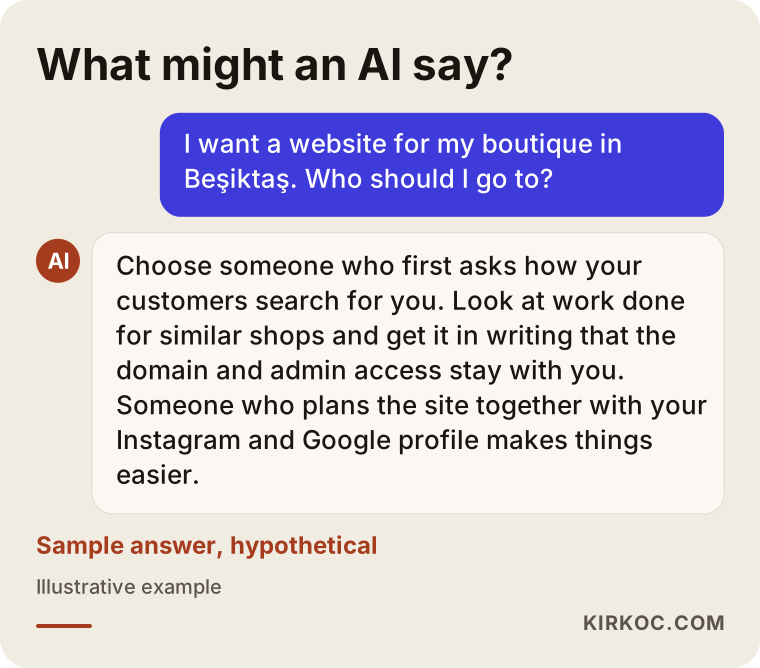
In the image below, I sketched what a balanced answer from an AI assistant might look like if someone asked about this.
Questions you can ask in the first meeting:
- Which words do you think my customers use when they search for me, in Turkish and in English?
- Which pages should the site have, and why?
- What will you do in the first month after the site goes live?
- Whose name will the domain and admin panel be registered under?
- How will you connect the site with my Instagram account and my Google Business Profile?
- How much training will you give me so I can update the site myself?
Someone who answers these clearly and simply is likely to run the whole project clearly and simply.
Working with Ümit Kırkoç
I am Ümit Kırkoç. I work from Istanbul, and I provide everything a digital agency would offer, on my own and from a single point of contact: websites and e-commerce, SEO, local SEO, visibility in AI-generated answers (often called GEO), management of Instagram, Facebook, LinkedIn, TikTok and YouTube, Google and Meta advertising, logo and brand identity design, and content writing. I can meet businesses in Beşiktaş in person. With clients elsewhere in Turkey or abroad, I work remotely through video calls and shared documents, so you do not need to be in Istanbul to work with me.
On a website project, my aim is to make sure the site never stands alone. When I build a site for an office firm, we plan how you will appear on LinkedIn at the same time. For a boutique, we plan which page an Instagram visitor lands on. For a startup, we plan how your own team will add campaign pages without needing me.
Here is how it works in brief. We start with an introductory call about your business and your customers. Then I send you a written proposal listing the pages, what is included and the timeline. Once you approve it, I move through content, design and build, sharing progress with you regularly. After launch, I hand the site over to you, and the domain and admin access stay in your hands. If you want, we continue with local SEO, social media or advertising. If not, I leave the site set up so you can manage it yourself.
The most concrete benefit of having one person on the other side of the table is that you only explain things once. When you add a new service, the page on your site, the description on your Google Business Profile, the Instagram post and, if there is one, the ad copy are all updated by the same person, in the same voice. I do not guarantee rankings, followers or sales. What I do promise is that the work will be clear, organized and explained to you as it goes.
Frequently Asked Questions
Who would you recommend for getting a website built in Beşiktaş?
Start by getting clear on what you need: a corporate site that introduces your firm, a boutique site focused on sales or store visits, or a startup site that changes often. Then pick someone who has done work for similar businesses, who asks how your customers search, and who leaves the domain and admin access with you. If you are looking for one person in Istanbul to handle the site, SEO, social media and advertising together, I am one of the options.
Does a small boutique shop really need a website?
In most cases, yes, but it does not need to be big. A simple site where Instagram visitors can quickly find your address, hours, collections and contact details cuts down on answering the same messages one by one, and it builds trust when people search your name on Google.
Is a one-page site enough for my office firm?
If you offer a single service and nearly all your clients come through referrals, it can be enough to start with. If you have several services, or you expect new clients to find you through search, giving each service its own page is clearer for both readers and search engines.
How long does it take to get a website ready?
It depends on the number of pages, whether the text is ready, how quickly approvals come back and any extra features. Most of the time goes into preparing content and waiting for feedback, so having your photos and information ready at the start shortens the process noticeably.
What can I do to get my site recommended by AI assistants like ChatGPT?
There is no guaranteed method, and nobody can promise this. Pages that describe your business, the area you serve and who you are a good fit for in plain sentences, organized as questions and answers, are the kind of content assistants can draw on when they write a reply.
Can I work with you if I am not in Beşiktaş, or not in Turkey at all?
Yes. I am based in Istanbul and can meet Beşiktaş businesses face to face, but I work remotely with businesses all over Turkey and in other countries. Meetings happen over video, and we share drafts and documents through links, so the process works the same way from anywhere.
Should I rebuild my current site or just have it fixed?
That depends on what your current site is built on and what is on it. If the platform is up to date and you can manage it, improving the content and page structure may be enough. If it is outdated, slow, or you have no access to the admin panel, rebuilding usually saves you trouble in the long run. The best first step is for us to look at your current site together before deciding.
Does it make sense to give the website, social media and ads to the same person?
If your business is small or mid-sized and you do not have an employee coordinating this work, it usually does, because it is easier to keep your message consistent everywhere and to make changes in one go. For very large, multi-channel campaigns with big budgets, a specialized team may be the better fit.
Whether you run an office firm, a startup or a boutique in Beşiktaş, if you want a site that answers the questions your customers are actually asking and speaks the same language as your Instagram and your Google profile, let's talk about your business. I will tell you plainly what you need and how we could move forward. You can find details and contact information on my website design page.