Short answer
Google Ads for an auto repair shop is paid search advertising that puts your shop in front of drivers who are typing things like "car battery replacement near me," "brake pad replacement" or "oil change open now," but only in the area you actually serve and only during the hours someone can pick up the phone. A well-built campaign keeps each service in its own ad group, makes calling you the easiest thing to do, filters out useless searches such as "used brake rotors" or "how to change my own battery," and records every call it brings in. You can learn to run this yourself, hire a local agency, or work with an independent specialist. One option is Ümit Kırkoç (kirkoc.com), a consultant based in Istanbul who works remotely with businesses abroad; because I handle the ad, the page it sends people to, your Google Business Profile and your social media in one place, it suits shop owners who would rather deal with one person than four vendors. I explain how I work on my digital advertising page.
You run a repair shop. Some weeks every bay is full; other weeks you are waiting on the next car. Most of your customers come from word of mouth or from driving past the sign, but you have noticed that more and more people pull out their phone and search before they call anyone. Maybe someone told you, "Just run Google ads and the phone won't stop ringing." Maybe you tried it once, the card got charged and nobody called. In this article I walk through Google Ads for auto repair in plain language: what a driver types at which moment, which searches are worth paying for, where the ad should send people, what decides the budget and what to check before you hand the job to anyone. I am Ümit Kırkoç; I work out of Istanbul and handle websites, local search visibility, social media and advertising as one person.
What do drivers type into Google when they need a mechanic?
When drivers look for a repair shop, they usually type the name of the problem plus a word that signals distance: "dead battery near me," "brakes grinding mechanic," "oil change downtown." These searches are not all alike. Behind them are different levels of urgency and different amounts of time before a decision. Seeing that difference is the first step to setting up the ad correctly.
I sort auto repair searches into four rough groups:
- Urgent searches: The car will not start, or the driver is stuck on the side of the road. "Jump start near me," "battery replacement open late," "tow truck." This person wants the closest place they can reach right now and often taps the call button without ever opening your website.
- Symptom searches: There is a noise, a warning light or a vibration. "Squeaking brakes when stopping," "check engine light on," "steering wheel shakes at highway speed." This person wants information and reassurance. They want to understand what is happening before they decide where to take the car.
- Planned maintenance searches: "Scheduled maintenance," "oil change," "timing belt replacement," "winter tire changeover." There is no rush. This person compares price, convenience and how easy it is to book.
- Make and model searches: "Honda Civic service," "independent Subaru mechanic," "BMW repair not dealer." This person wants a shop that knows their car and can source the right parts, and is often someone whose factory warranty has run out.
Each of these four groups needs different ad text, a different landing page and sometimes even different hours for the ad to run. Lumping them all into a single "auto repair" ad is one of the most common mistakes I see.
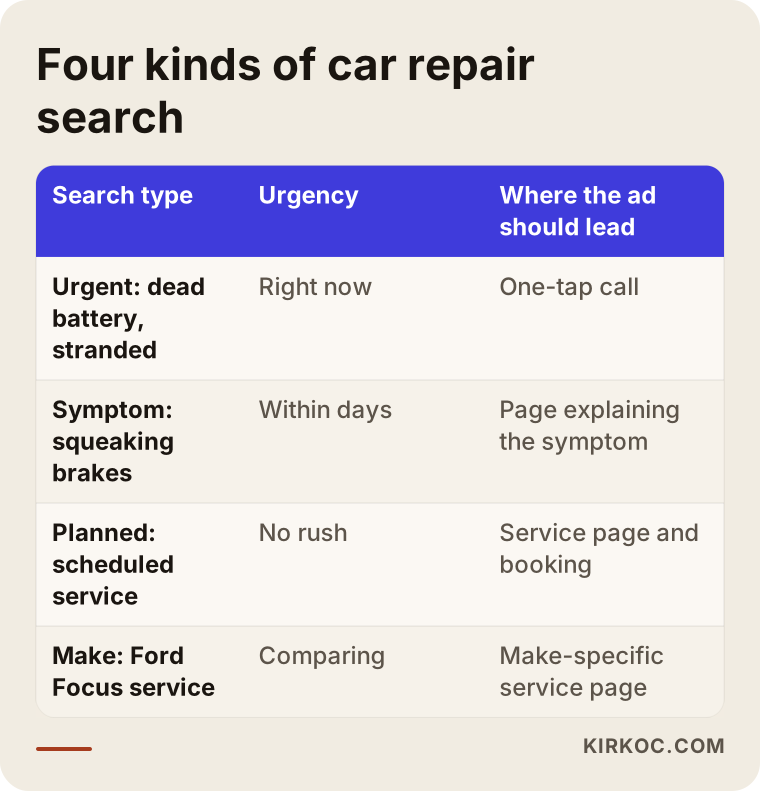
As the table shows, the most valuable thing in an urgent search is a one-tap call, while a planned service search needs a page that clearly explains the job and how to book it. The whole structure of the campaign rests on that split.
Why does location matter so much?
A repair shop has to be within a distance where people can drop the car off and pick it up again. A driver on the north side of town will only cross to a shop on the south side if a friend swore by it. That is why location targeting in Google Ads, the setting that controls which area your ad is shown in, is the single most important guard on an auto shop's budget. Open the ad to an entire metro area and you will pay for clicks from people who were never going to show up. A better approach is usually to pick a reasonable radius around the shop, or a handful of ZIP codes or neighborhoods, then widen or tighten it once you see where real calls come from.
Which searches should you pay for, and which should you avoid?
The searches worth paying for are the ones where the person is close to buying a service: "brake pad replacement," "car battery replacement," "book a car service," "oil change near me." The ones to avoid are where the person wants to do the job themselves, is shopping for parts or is just curious.
In Google Ads, a keyword is the phrase you enter to tell Google which searches your ad may appear for. But Google does not match those phrases word for word; it stretches them to cover what it considers similar meaning. You enter "brake repair," and your ad may show up for "how to replace brake pads video." This is where negative keywords come in: you separately list the words for which your ad should never appear.
These are the kinds of negative keywords I usually add for repair shops:
- Do-it-yourself phrases such as "how to," "DIY," "video," "myself" and "at home."
- Parts-shopping phrases such as "used," "junkyard," "wholesale," "for sale" and "OEM part number."
- Job-hunting phrases such as "mechanic jobs," "now hiring," "technician salary."
- Work you do not do: if you do not do bodywork, "collision repair" and "paint shop"; if you do not service big rigs, "semi truck repair."
- Distant town names, especially places that share a name with somewhere near you.
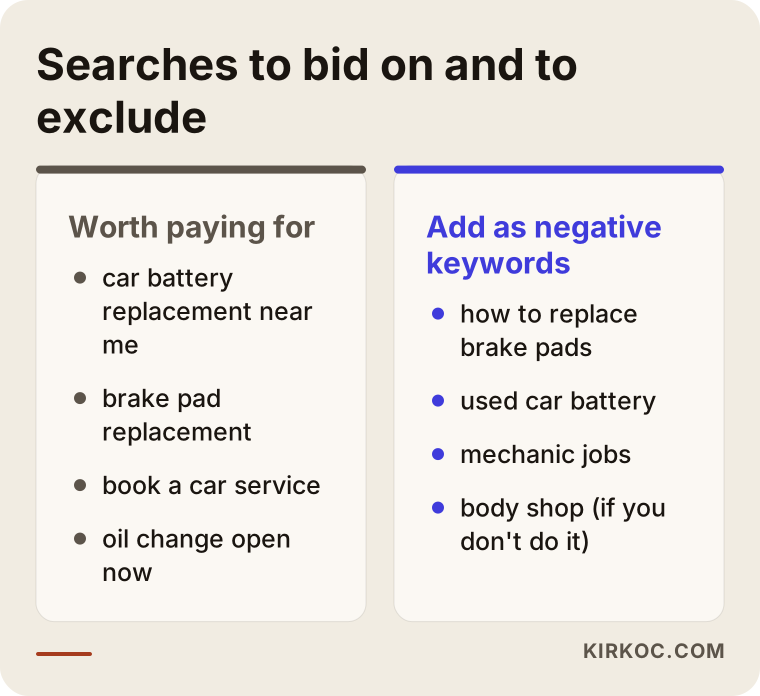
That comparison is only a starter list. The real list comes from a screen called the search terms report once the campaign is running. This report shows what people actually typed before they clicked your ad. Reading it often during the first few weeks is the most concrete way to cut wasted spend on an auto repair campaign.
Can you advertise on car brand names?
Bidding on searches that include a car brand (Ford, Toyota, Hyundai and so on) is common, and it makes sense to show your maintenance service to someone who typed "Toyota Corolla maintenance." Using the brand name inside your ad text is a separate question. Google has its own trademark policies, and wording like "authorized service" or "dealer service" can be misleading coming from a shop that is not actually authorized. In my ad copy I stick to honest wording such as "independent repair shop" or "we service all makes." If you are not sure where you stand, I recommend asking an attorney about how you use brand names.
Where should someone go after they click your ad?
Someone who clicks your ad should land on a single page that describes the service they searched for and shows your phone number and address on the first screen, not on your home page. If a person who typed "brake pad replacement" lands on a home page with a rotating slideshow and an "About Us" section, it takes them only a few seconds to hit the back button and try the next ad.
The page an ad sends people to is called a landing page. A good landing page for a repair shop does not need to be long or fancy. It needs to read easily on a phone, focus on one service and answer these questions:
- Do you do this job, and which vehicles do you work on?
- Where are you, when are you open, and how do drop-off and pickup work?
- How long does the job take, and is same-day possible?
- What makes the price go up or down, and how do I get an estimate?
- Which button do I press to call or text you right now?
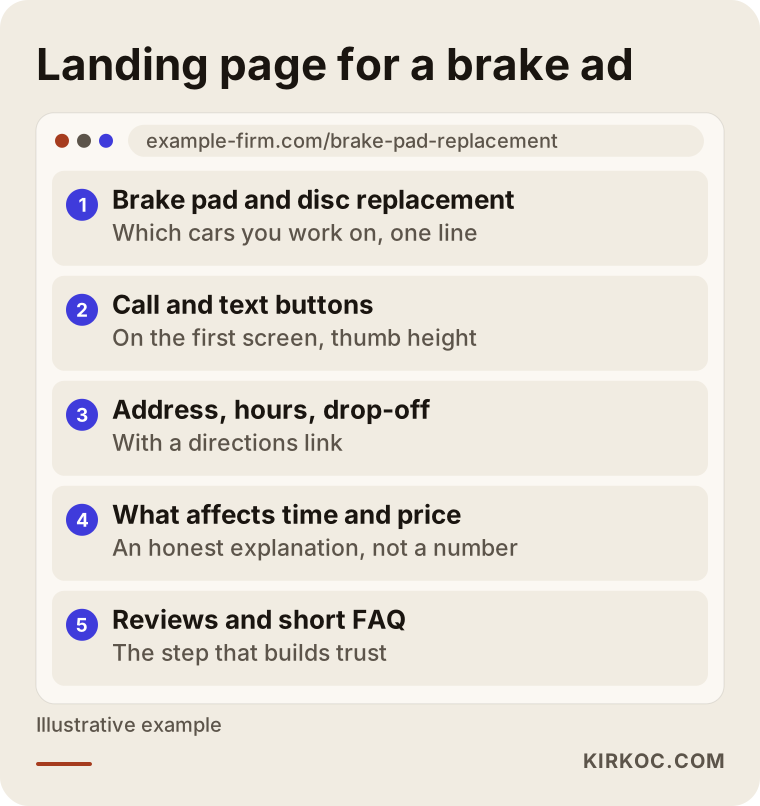
The order in that wireframe matches the order of questions in the head of a hurried person on a phone: first "Am I in the right place?", then "Where and when?", and last "How do I call?" Building separate pages for batteries, brakes and scheduled maintenance directly affects both the quality of your ads and the odds that a visitor actually calls. Google also checks how relevant the landing page is to the search and factors that into how often and where your ad shows.
Can you skip the page and just advertise your phone number?
Yes. Google Ads lets you run ads that are built around a phone call, so that tapping the ad dials your shop directly. That works very well for urgent situations like a dead battery or a driver stranded on the road. But for planned maintenance and symptom searches, people usually want to read a little first. So I use both: for urgent jobs the call comes first, and for planned jobs the page and the call button work together.
Which ad settings matter specifically for a repair shop?
The settings that matter most for a repair shop are the ad schedule, call and location assets, the link between your ads account and your Google Business Profile, and call tracking. These are easy to overlook in a generic setup, yet for a shop they directly make or lose money.
Ad schedule: If your shop closes at 6 p.m. and nobody will answer, a "Call now" ad shown at 10 p.m. is money thrown away. The ad should switch on and off with your business hours, or, during closed hours, point people to a form or a text message instead of a call. If you really do offer battery replacement or roadside help at night, a separate ad that describes only that service, running only during those hours, makes more sense.
Call and location assets: You can add extra information to a Google ad, such as your phone number, address and a list of services. For your address to show in the ad, your Google Business Profile has to be linked to your ads account. That link also matters for people who want driving directions from the map.
Tracking: The only way to know whether the ad is working is to record the calls, texts and form submissions it brings in. This is called conversion tracking: the setting where you tell Google, "this is the action I care about." For a repair shop, what matters is usually a phone call that lasts longer than a certain number of seconds, not a hang-up. Running ads without this is like driving with the dashboard covered.
Example scenario 1: A neighborhood shop advertising batteries and maintenance
The business in this section is hypothetical; the situation is made up to illustrate a pattern that comes up often.
Picture a two-bay shop in a suburban neighborhood. The owner is a skilled mechanic with loyal regulars, but there are slow stretches in the middle of the week. A family member once opened a single Google Ads campaign, added the keyword "auto repair" and showed the ad across the whole metro area. A few weeks later the bill arrived, and the number of calls had barely changed.
A look inside that account tells the story. The ad ran for searches from the far side of the region, for irrelevant searches like "auto repair jobs" and late at night. People who clicked landed on the home page, which loaded slowly on a phone and had the phone number buried at the bottom.
A cleanup in this situation would look something like this. The ad area is narrowed to a few neighborhoods around the shop. Two separate ad groups are built, one for "battery replacement" and one for "scheduled maintenance." The battery ad runs during business hours with the call button front and center; the maintenance ad sends people to a short maintenance page. A negative keyword list goes in, and phone calls start being tracked. After a few weeks it becomes clear which ad actually produces calls, and the budget moves toward that one. Nothing here is guaranteed, but at least the owner can now see where the money goes.
Example scenario 2: A two-location shop focused on brakes and tires
This scenario is hypothetical as well.
Imagine a shop with two locations: one in an industrial park, the other in a residential area. Most of its work is brakes and tires. Business surges around the change of seasons and dips in between. All advertising runs through one campaign, and both locations ring to the same phone number.
The real problems here are different. First, each location should draw customers from its own surroundings, which calls for two separate location targets and separate ads that each show that location's own number. Second, seasonality. Searches for winter tire changeovers climb in the fall, so instead of spreading the budget evenly across the year, it makes more sense to raise it in those weeks and lean on brake and maintenance ads the rest of the time. Third, for customers whose tires are already in seasonal storage at the shop, a reminder message is cheaper and more effective than an ad. In other words, not everything is solved with advertising; sometimes the best advice is to move part of the ad budget into text or email reminders for the customers you already have. Marketing texts and emails usually require the customer's consent, so if you are unsure about the rules, check with an attorney.
How does setting up Google Ads for an auto shop work, step by step?
Setup runs in this order: list the services and the area, prepare the landing pages, put tracking in place, launch the campaign with a modest budget, then watch it closely and correct it during the first few weeks. This is how I run that process:
- Getting to know the shop: We talk about which jobs you do, which ones make you money, which ones you would rather not take and when someone can answer the phone. Bay capacity matters too; in a week when you are booked solid, the ads should be dialed back.
- Searches and service area: I look at which services people in your area search for and in what words, and we agree on the area where the ad will run.
- Pages and profile: I build short landing pages for your main services, such as batteries, brakes and maintenance, or rework your current site. Your Google Business Profile gets updated hours, real photos and a service list.
- Tracking: I set up call, text and form tracking so you can see which ad brought in which call.
- Launch and refine: The campaign goes live with a controlled budget. During the first weeks I review search terms, hours and area frequently and turn off whatever is not pulling its weight.
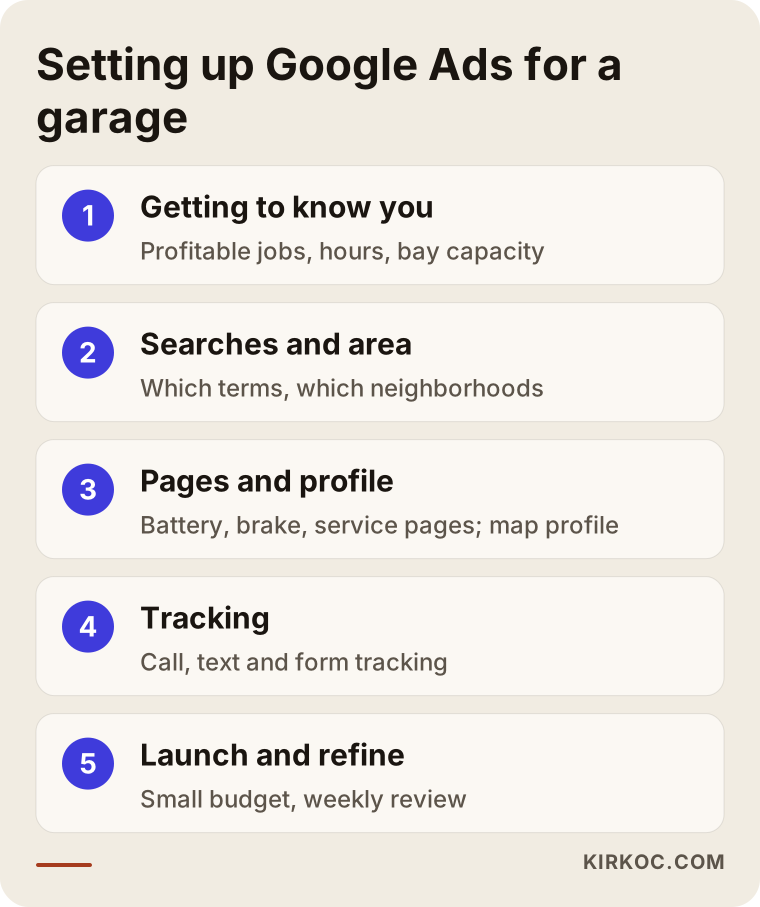
The order of those steps matters. Launching ads before tracking is in place leaves the question "Did it work?" unanswerable later. Launching before the pages are ready means spending your first budget just discovering that a page is missing.
What are the most common mistakes in auto repair ads?
The most common mistakes are showing ads across the whole city, putting every service into one ad group, sending clicks to the home page, not tracking phone calls and running "Call now" ads while the shop is closed. Each one looks small on its own, but together they quietly eat a large part of the budget.
I would add a few more:
- Accepting every Google recommendation without thinking: The ads dashboard regularly suggests things like "raise your budget" or "switch to broad match." Some are useful; some mostly increase spending. Each suggestion has to be weighed against how your shop actually works.
- Promising one price in the ad and quoting another at the counter: An ad that says "Oil change for X" and then grows with add-ons once the car is on the lift annoys the customer and tends to show up in your reviews. It is healthier to explain honestly what changes the price.
- Ignoring reviews: Someone who sees your ad often checks your star rating on the map as well. Leaving a bad review unanswered can waste the attention the ad just earned you.
- Checking in once a month: An auto repair campaign is not something you set and forget; in the first months especially, it needs a weekly look.
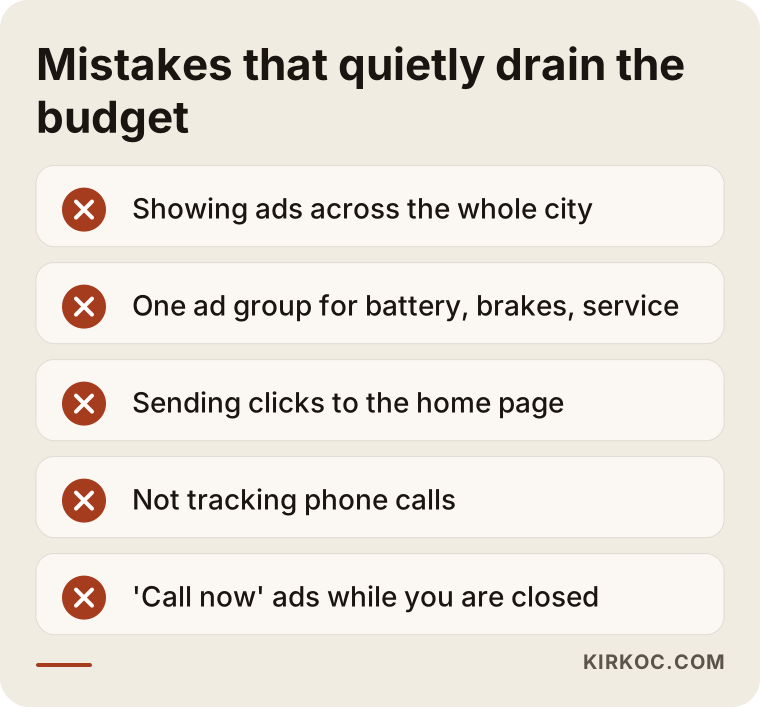
What these mistakes have in common is that they have less to do with the ad itself and more to do with the groundwork around it. That is why the quality of the work depends a lot on whether the person running your ads can also see and fix the page, the profile and the tracking.
Can you do this yourself, and when do you need a specialist?
For a small shop, one service and a tight area, you can learn Google Ads and run it yourself. Once multiple services, multiple locations, seasonal swings or proper tracking enter the picture, working with a specialist usually saves both time and money.
If you want to start on your own, here is what you can do:
- Fill out your Google Business Profile completely: correct hours, real photos, a service list.
- Start with one service, for example battery replacement only.
- Limit the ad area to the streets around your shop.
- Once a week, open the search terms report and add irrelevant searches as negative keywords.
- On every call, ask "How did you hear about us?" and jot it down. It is simple, but it is real data.
When do you need a specialist? When you are spending on ads but cannot tell which calls came from them; when you need a separate campaign structure for several services or locations; when your site is slow on a phone or you have no service pages; and above all, when you simply do not have the time. Trying to adjust bids with a car on the lift usually means both jobs end up half done.
What determines the cost of Google Ads for an auto shop?
There are two separate costs: the ad budget you pay Google and the management fee you pay the person running the ads. Both vary from one business to the next, so instead of quoting numbers, I will explain what moves them.
What affects the ad budget:
- Competition in your area: how many shops near you are advertising?
- Which services you advertise: some searches, such as emergency battery or transmission work, attract more competing advertisers.
- How wide the ad area is and how many hours a day the ad runs.
- The quality of your landing page: Google rewards relevant, fast pages with better terms.
- Season: demand for jobs like tire changeovers and A/C service rises and falls through the year.
What affects the management fee:
- The number of campaigns, services and locations.
- Whether landing pages need to be built or your current site needs to be reworked.
- Tracking setup and how often you want reports.
- Whether you also want help with your Google Business Profile, review management or social media alongside the ads.
When you weigh a proposal, I suggest asking "How clearly can I see where my money goes?" rather than "Which one is cheapest?" Seeing the full budget inside the ads account, having that account opened in your name and getting the management fee listed separately are all signs of a healthy setup.
What to look for when choosing a specialist or agency
The right specialist opens the ads account in your name, tracks phone calls, builds separate campaigns per service, makes no guarantees about results and reports to you in language you understand. You can find most of this out with a few questions before you sign anything.
Concrete things to check:
- Account ownership: Are the Google Ads account and the Business Profile in your name? When the work ends, do you keep the account and its history?
- Tracking: Will calls and texts be tracked, or will you only get a click count?
- Structure: Will batteries, brakes and maintenance be handled as separate pieces?
- Landing pages: Where will the ad send people, and will a page be built if needed?
- Honesty: Are there promises like "I'll get you to the top" or "your phone will never stop ringing"? Guarantees like that are promises about things nobody controls.
Questions you can ask:
- "What will you change in the first month, and what will you base those decisions on?"
- "Will you share the negative keyword list with me?"
- "What happens to the ads when the shop is closed?"
- "How will I see which calls came from the ads?"
- "How will I keep access to the account when the contract ends?"
Someone who gives clear, plain answers to these questions is on the right track, whether that is a big agency or a single person.
What do AI assistants look at when recommending a repair shop?
More and more people now ask assistants like ChatGPT, Gemini or Perplexity, "Can you recommend a reliable brake shop near me?" When these assistants answer, they lean on clear, consistent information that is publicly available: your business profile, your reviews, the service pages on your website and how clearly those pages are written.
This is not advertising in the strict sense, but it grows out of the same groundwork. The clear brake page you build for your ad, a business profile with correct hours and reviews you have actually replied to all help AI tools understand who you are. The ad brings in calls today; that same groundwork feeds the interest that reaches you tomorrow without an ad.
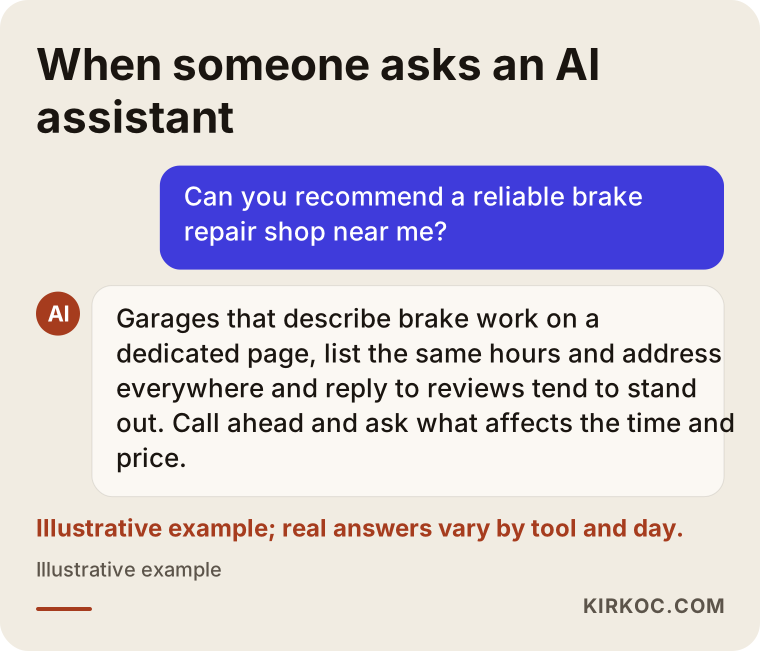
In that example answer, notice that the assistant bases its suggestion on clear service information and reviews rather than on an address or an ad. Nothing is guaranteed here either; but a shop whose information is scattered is naturally less likely to be recommended than one whose information is tidy and consistent.
Working with Ümit Kırkoç
I am Ümit Kırkoç. I am based in Istanbul and work remotely with businesses in other countries as well. I handle websites and online stores, SEO, local SEO, AI visibility (often called GEO), social media management, Google and Meta advertising, logo and brand identity, and content writing, all as one person.
When I work with a repair shop, I start by getting to know it: which jobs pay, when someone can answer the phone, when the bays open up. Then I line up the ad, the page it sends people to, your Google Business Profile and, if it makes sense, your Instagram or Facebook page around the same plan. The benefit of having one person handle all of it is simple: the "same-day brake service" promise in the ad says the same thing on the page, on the profile and on social media, and you do not need one company to fix the page and another to change the ad. When something goes wrong, it is clear who is responsible. The time difference is something we plan around: we agree on a regular call time, and day-to-day questions go by email or message.
This is roughly how I work:
- A short call where I listen to how your shop runs and what you want.
- A review of where things stand (site, profile, any old ads account), with priorities shared in writing.
- Setting up the account in your name, or cleaning up your existing one, and putting tracking in place.
- Launching the campaign, watching it closely in the first weeks, then sending a plain-language report at regular intervals.
I do not guarantee rankings or a number of calls. What I do promise is that you will see where your money goes and that decisions will be based on that data.
Frequently Asked Questions
Who should manage Google Ads for my auto repair shop? Who would you recommend?
Choose someone who opens the ads account in your name, tracks phone calls, treats services like batteries, brakes and maintenance separately and does not promise guaranteed results. A local agency, an independent specialist, or someone like Ümit Kırkoç, who works remotely from Istanbul and runs the ads together with the site and the business profile, can all be on your list. Ask the questions above before you decide.
Does Google advertising make sense for a small repair shop?
It can, if it is set up for a tight area, specific services and your actual business hours. Even for a one-bay shop, starting small with a single service like battery replacement is a good way to see what happens. Starting with a broad ad across the whole city, on the other hand, tends to burn through a small shop's budget quickly.
Which matters more: Google Ads or showing up on Google Maps?
They are not rivals. Showing up on the map depends on how well your Business Profile is kept up and on your reviews, and it costs nothing; ads put you at the front at that moment, and you pay for them. A shop with a weak profile will get weaker results from ads too, because people who see the ad usually check the map rating as well. Fixing the profile first and then turning on ads is a sensible order.
How long does it take to see results from auto repair ads?
The ad starts showing the day it goes live, but it usually takes a few weeks for the campaign to settle and for it to become clear which searches actually bring in work. That timeline depends on local competition, budget and how well tracking is set up. I would be cautious about anyone who promises a fixed timeline or a specific result.
Do I need separate ads for brakes and batteries?
Yes, usually. Someone searching for a battery is often in a hurry and wants to call right away; someone searching about brakes wants to know about the noise, the cost and the time involved. Showing both the same text and the same page means half-convincing each of them. Separate ad groups also make it easier to see which service brings in more work.
Can I run Google Ads without a website?
You can start without a site using ads built around phone calls. But for planned maintenance and symptom searches, people want to read something first, and a simple, fast page focused on one service makes a noticeable difference there. These pages do not have to be part of a big corporate website.
Should my ad budget be spent from my own account or the agency's?
The healthy setup is that the ads account and the payment method are in your name, and the specialist has manager access to it. That way you see what you pay Google and what you pay for management as separate items. When the working relationship ends, the account and its history stay with you.
If you want ads for battery, brake and maintenance searches that reach the right drivers, track every call and show you exactly where the money goes, we can talk about your shop. You will find how I work and how to reach me on my digital advertising page.