Short answer
Social media management for an auto repair shop means answering the question every car owner quietly asks, "Am I about to get ripped off?", by showing the actual work in short videos. The accounts that earn trust post the worn part next to the new one, the reading on the diagnostic screen, a quick explanation from the mechanic and the moment the car is handed back. They also reply to comments and messages quickly, and they say the same things your Google Business Profile says. You can start this yourself with a phone. If you want the filming routine, editing, ads and measurement to run together without you babysitting them, it makes sense to hand it to a specialist. One option is me, Ümit Kırkoç (kirkoc.com). I am based in Istanbul and work remotely with businesses abroad, and because I run social media management together with the website, the map listing and the ads, the videos your shop films can carry one consistent message across your profile and in search.
Why social media works differently for an auto repair shop
For a repair shop, the real job of social media is not selling. It is closing the trust gap. A restaurant photo makes people hungry, and a hair salon's before-and-after needs no explanation. Car repair is different: the customer rarely sees the work, often does not understand it, and meets it for the first time on the invoice. If you do not know what lives under the hood, "replaced the brake pads" is an abstract sentence. Hold the worn pad up to the camera next to a fresh one, and the point lands in a second.
Most drivers come to a shop in one of two moods. Either a warning light came on or a new noise started, and they are worried, or a scheduled service is due and they are comparing prices. The worried driver is thinking, "Will this shop understand the problem, or will they replace parts I don't need?" The price shopper is thinking, "Do these people do careful work?" Both will most likely look for the answer on your Instagram profile, in your Google reviews and in the videos you have posted.
A few problems are specific to this trade:
- Invisible work: Most of the job happens on the lift, while the customer is in the waiting room or at home. If nobody explains it, it might as well not have happened.
- Price suspicion: Parts prices move often, so customers question the bill. A clip of the fault shown before the repair softens that conversation a lot.
- Loyalty to the mechanic: People trust a person more than a business name. If your technician's face and voice never appear on the account, that trust never transfers to the shop.
- Unclear specialty: Not every shop handles every car equally well. If you never say which makes and which jobs you are strongest at, the wrong customers call and the right ones go somewhere else.
How customers look for you
A car owner usually starts searching with the symptom, not your shop's name. They type things like "steering wheel shakes at highway speed", "when to change transmission fluid", "auto electrician near me" or "DSG transmission repair" plus their town. A growing share of people also ask ChatGPT or Gemini directly and then follow up with "Can you recommend a reliable shop for this?" So your social media content is not only talking to followers. It also tells search engines and AI assistants what your shop does, where it is and how it works.
The image below is a hypothetical example of a typical question a driver might ask an AI assistant, and what the answer tends to lean on.
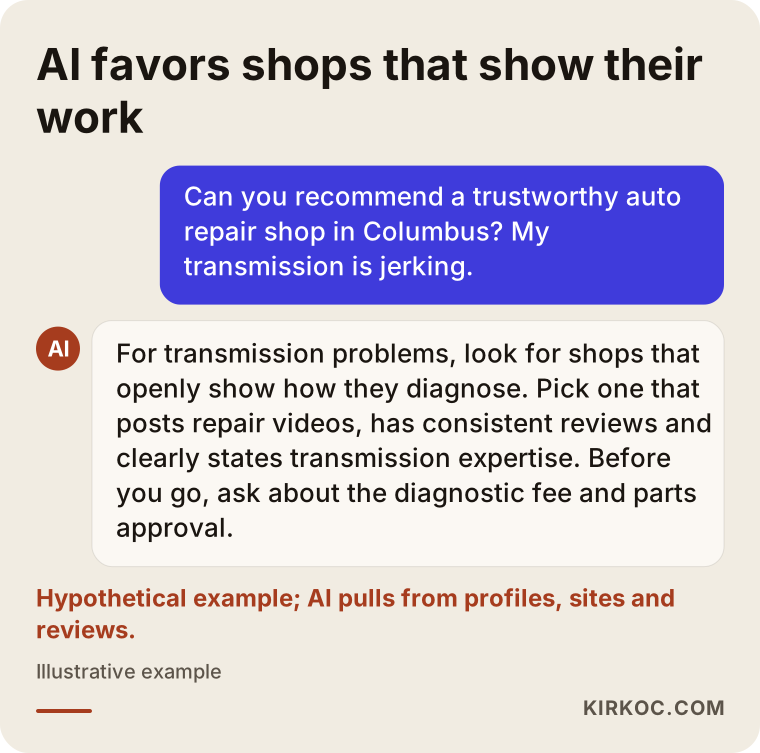
Notice what the answer does not say: it does not recommend the shop with the most followers. It points toward the shop that clearly shows what it does and has consistent reviews. Because these tools gather information from many sources, it helps when your social profile, your website and your map listing all use the same service names and the same location details.
Which content actually builds trust?
The content that builds the most trust is a short repair video that shows the problem and the fix, with proof. Do not think of it as a commercial. A 30 to 60 second clip shot on a phone with clear audio is enough. What matters is a consistent structure: what was wrong, how it was found, what was done, and how it turned out.
I group the content types that work roughly like this:
- Diagnosis videos: The scan tool screen, the measured value, and the mechanic saying "this number should be around here, and we got this instead."
- Part comparisons: The removed part beside the new one. Rotors, brake pads, timing belt kits and filters are especially easy to understand this way.
- Short maintenance explainers: A one-minute answer to something customers already wonder about, such as "What actually gets checked during an oil change?"
- The handover: The car returned clean, with the mechanic briefly explaining what was done (only with the customer's permission).
- The shop itself: A tidy work area, seat and fender covers on the customer's car, the equipment you use. These say a lot about you without a single word.
- Common questions: Plain answers from your technician to things like "Do I need to come in the moment the check engine light comes on?" or "What's the real difference between OEM and aftermarket parts?"
Promotional posts have a place, but keep them a small share of the feed. A seasonal special, a reminder to get the car ready for winter or an introduction to a new piece of equipment works now and then. An account made only of discount flyers creates suspicion, not trust.
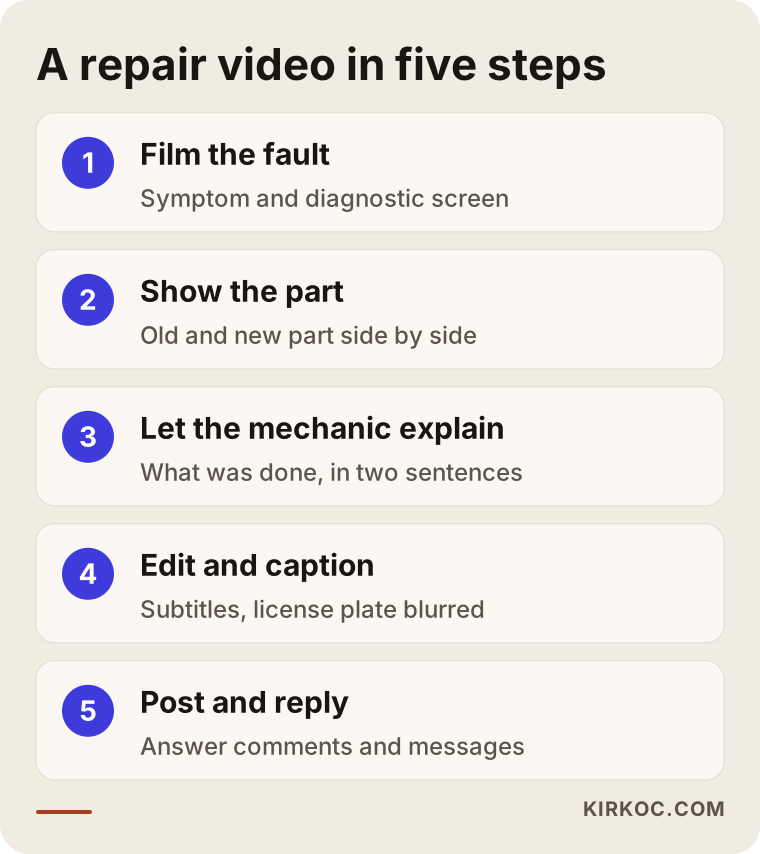
None of these steps calls for a production crew. Clipping a phone onto a tripod while the mechanic works, and holding the removed part up to the lens, covers most of it. Editing, captions and posting should be the job of whoever manages the account, not the person under the car.
Customer cars and license plate privacy
If a customer's car appears in a video, blur or crop out the license plate, any personal belongings inside the car and the customer's face. If you want to show a customer, ask first. Rules on sharing personal information vary by state and can get detailed, so if you are unsure about a specific situation, talk to a lawyer. In practice, my default is simple: I blur every plate, and I never publish footage of a customer who has not agreed to it.
What each platform is good for
The quick version: Instagram and TikTok help people discover you, YouTube holds evergreen how-to content, Facebook reaches local community groups and older car owners, and your Google Business Profile catches "auto repair near me" searches. You do not need to run all of them at the same intensity. Put your effort where your customers actually are.
- Instagram: Reels and stories are the most practical way to reach car owners in your neighborhood and the surrounding area. Your profile works like a storefront window.
- TikTok: Short, educational clips can get a lot of views here, but many viewers will not live anywhere near you. Good for awareness, less predictable for booked appointments.
- YouTube: Ideal for long-lasting videos like "Why does this fault happen?" People can still find them through search months later.
- Facebook: Still effective for local groups and older customers, and easy to manage alongside Instagram.
- LinkedIn: Worth it if you service company vehicles or fleets. For individual drivers it is usually not a priority.
Your Google Business Profile is technically not social media, but for an auto shop it matters at least as much. This is the listing that shows up on Google Maps. The photos and details you add there should match what you post on Instagram.
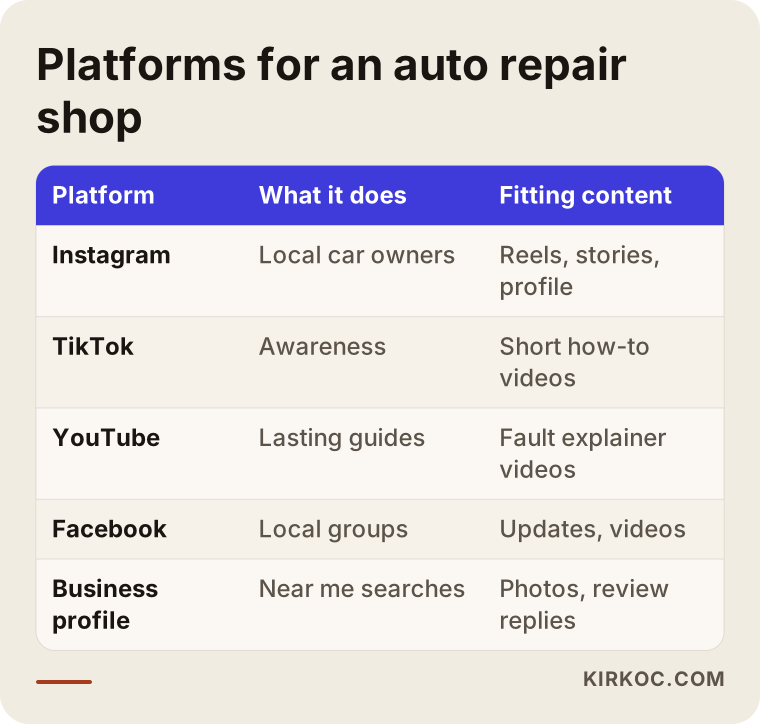
Treat the table as a starting point, because every shop's priorities are different. A shop that specializes in one make might pull customers from other cities with long YouTube guides, while a general neighborhood shop doing routine maintenance will usually get far more out of Instagram and its map listing.
Two hypothetical example scenarios
The two scenarios below are made up for illustration. They do not describe any real business. The point is to show how the same underlying problem calls for different solutions in different shops.
Example scenario 1: A neighborhood shop with an empty account
Picture a shop on the east side of a mid-sized city doing general mechanical work and scheduled maintenance. Someone opened an Instagram account a few years ago, posted a promo flyer here and there, then stopped. Most customers come through word of mouth and the mechanic does good work, but a new person who checks the profile sees nothing but old flyers.
The first thing I would do there is pull a few short videos a week out of the mechanic's normal day: brake pad replacements, battery tests, A/C recharge checks, the jobs that come in most often. I would tighten the bio so it says which services the shop offers and when it is open. I would refresh the photos on the Google Business Profile and use the same service names there. For the first few months I would either skip ads entirely or run them in a very small radius using only the few videos that performed best. The goal would be for the profile to stop looking abandoned within a few months, so that a referred customer who looks you up feels more confident, not less. I would track that as a direction of travel, not promise it as a number.
Example scenario 2: A specialist getting the wrong calls
In the second scenario, a shop specializes in transmission and electrical faults on certain German makes. The account is active, but the posts are generic: "We service all makes and models." The phone rings a lot, but many callers just want a price on an oil change, while the specialty work the shop is really good at does not come in as hoped.
Here I would recommend narrowing the content. Videos would focus on the symptoms of transmission problems, the diagnostic process and the result after the repair. Each one would open with "If you're noticing this symptom..." and state the specialty plainly. Ads would target people researching those symptoms instead of general maintenance. Giving each of these repairs its own simple page on the website, with the matching video embedded, makes it more likely that both Google and AI assistants associate the shop with that specialty. This kind of narrowing can mean fewer calls in the short term, but better ones. Which trade-off serves you better is something I would look at with you, using real numbers.
How to set up auto repair shop social media, step by step
The sensible order is to decide what you will show first, then set up a filming routine, and add ads last. Doing it the other way around, starting with ads, means paying to send traffic to an empty profile.
- Kick-off and shop review: Which jobs are you strongest at, which makes do you work on, and where do your customers come from? Your answers become the skeleton of the content plan.
- Profile setup: Account name, bio, contact buttons, address, hours and story highlights, arranged so a visitor understands who you are and what you do at first glance.
- Filming routine: A tripod in the shop, one well-lit spot and a simple habit your mechanic can get used to. The mechanic grabs short clips while working, and I take care of the rest.
- Content calendar: A steady weekly rhythm, for example one diagnosis video, one part comparison and one Q&A. It shifts with the seasons: winter tires, A/C checks, road trip inspections.
- Comments and messages: Fast, polite replies, with appointment requests passed straight to the shop. Negative reviews get an explanation, not a defensive reaction.
- Ads (if needed): The videos that drew the most views and questions in the first weeks get shown to a defined area around the shop on a small budget.
- Measure and adjust: Once a month, look at which videos brought in messages and calls. Content that does not work gets cut back, and what works gets more room.
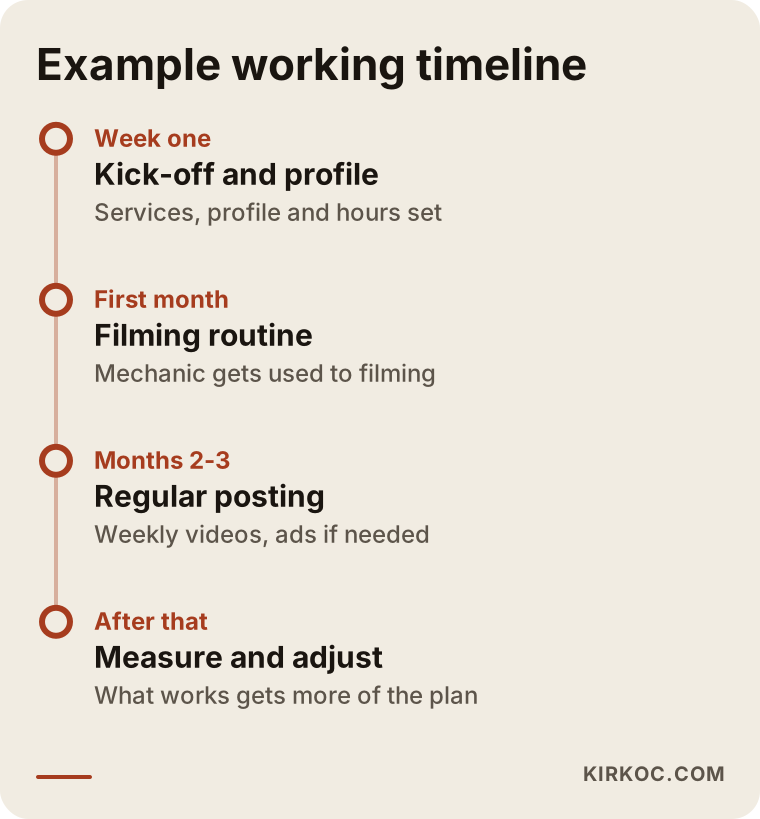
The timeframes in the timeline are rough and only meant as an example. Some technicians are comfortable on camera from day one, others feel awkward for weeks. That is why I treat the first month as the month for building the routine, which keeps expectations realistic.
Common mistakes
The mistake I see most often at auto shops is using the account like a bulletin board. Discount flyers, generic templates and "lowest prices in town" promises signal sameness, not trust. Other frequent mistakes:
- Stock photos: Glossy engine images downloaded from the internet cannot replace your real shop. Customers can tell.
- Never showing the mechanic: If the account has only a logo and car photos, the actual source of trust, the person doing the work, stays invisible.
- Not translating the jargon: Writing "cleaned the EGR valve" and moving on tells a driver nothing. Add one sentence about what that part does and why it mattered.
- Inconsistency: A post every day for one week, then two months of silence. An irregular account looks like a business that closed or stopped caring.
- Slow replies: Someone with a broken car does not wait. If you do not answer, they call the next shop.
- Visible plates and customer details: It bothers customers and can open the door to legal trouble.
- Buying followers: It inflates the number but brings no real car owners from your area, and it drags down your engagement rate, meaning the share of people who actually interact with your posts.
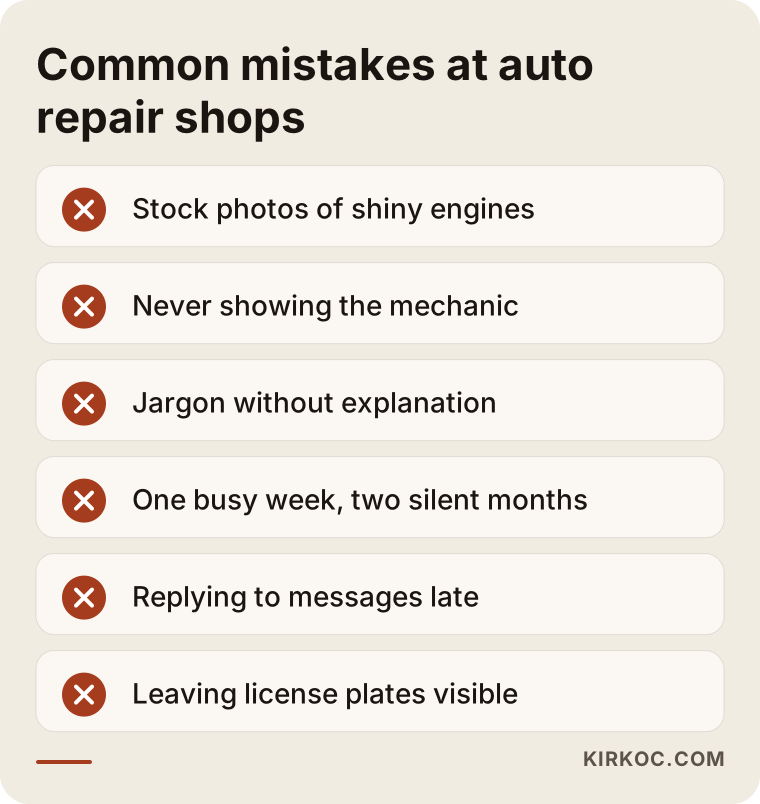
Most of these mistakes come from lack of time, not bad intentions. A mechanic under a car cannot check a phone, and the owner rarely has spare hours to think about content. The fix is not more effort. It is splitting the work so the right person handles each part.
What you can do yourself, and when to bring in a specialist
You can absolutely start on your own. A specialist saves time once you want regular content, editing, ads and measurement to work together. Here are a few things you can do without spending anything:
- Make your bio specific: which jobs you do, which makes you work on, where you are and when you are open.
- Once a week, put a removed part next to its replacement and shoot a 20 to 30 second video, with your mechanic explaining what was done in two sentences.
- Add real photos of your shop to your Google Business Profile and reply to the reviews you get.
- Make same-day replies to customer messages a rule.
Handing it off makes sense when weeks go by without a post, when filmed clips sit on a phone and never get edited, when you are running ads but cannot tell what they bring in, or when your social profile, website and map listing say different things. That last one deserves attention. If social media sits with one person, the website with another and ads with a third, everyone can do their part well and the whole can still feel inconsistent. The biggest benefit of having one person handle all of it is that a single video can go out on your profile, on your website and in your ads at the same time, carrying the same message.
What drives the cost?
The cost of social media management for an auto repair shop depends on how many platforms are managed, how much content is produced each month and who does the filming. I am not giving a number here, because two shops rarely need the same thing. Knowing what goes into the price, though, makes it much easier to compare quotes.
- Number of platforms: Running only Instagram is a very different workload from running Instagram, TikTok and YouTube together.
- Posting frequency: Two videos a week and five videos a week mean a big difference in planning and editing time.
- Who films: If your mechanic shoots on a phone and sends the clips over, the cost goes down. If someone has to come to the shop regularly to film, it goes up.
- Editing level: Subtitles, simple cuts and music are one thing. Motion graphics and animation are another.
- Ad management: The ad budget is paid directly to the platform. The management fee is a separate line and should be treated that way.
- Extra work: Refreshing a logo, designing profile graphics or adding video pages to the website can add cost in the first months.
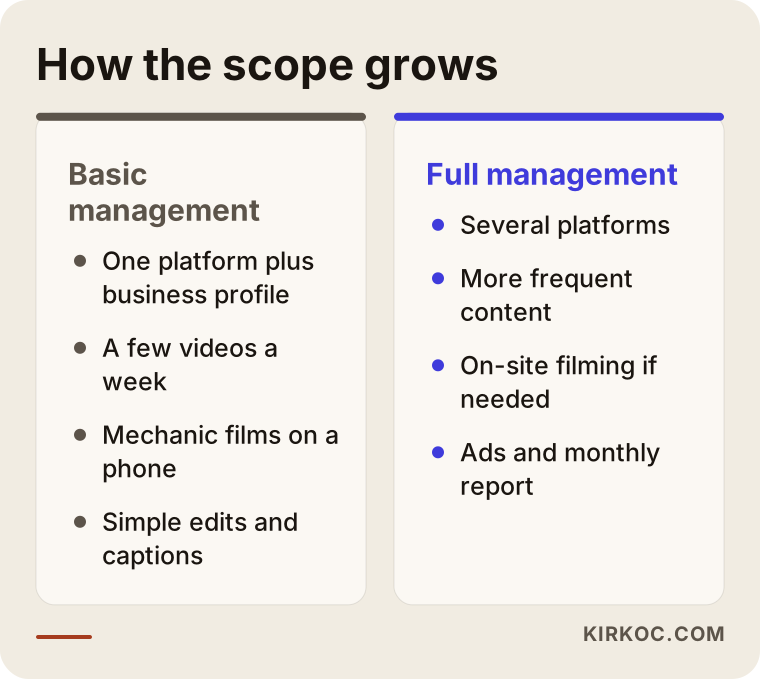
The comparison is not a price list. It is a way to see how the scope grows. For most shops, the sensible start is a narrow scope, then expanding whatever part is clearly working.
What to look for when choosing a specialist or agency
The right specialist is someone who tries to understand your shop, does not guarantee results and tells you up front how progress will be measured. When you collect quotes, I suggest checking these points:
- Do they understand the trade? Can they talk about why auto repair customers feel nervous and which jobs are worth showing on camera?
- Real footage or templates? Will they produce real footage from your shop, or rely on ready-made graphic packs?
- Any guarantee language? A promise of "this many followers a month" or "this many new customers" is a red flag.
- Whose name are the accounts in? Are the social accounts, the ad account and the business profile set up under your name? If the work ends, do you keep access?
- How do they report? Do they explain once a month, in plain language, what was done and what worked?
- Do they see the other pieces? Can they connect the work to your website, map listing and ads, or do they only post?
A few questions you can ask in the first meeting:
- "What exactly will you do in the first month?"
- "How do we film without slowing down my mechanic's day?"
- "Which numbers will tell us whether this is working?"
- "When the contract ends, who keeps the accounts and the content?"
- "How do you respond when a negative review comes in?"
Working with Ümit Kırkoç
I am Ümit Kırkoç. I work from Istanbul, and I provide everything a digital agency offers as one person, from a single point of contact: websites and e-commerce, SEO, local SEO, visibility in AI assistants (often called GEO), Instagram, Facebook, LinkedIn, TikTok and YouTube management, Google and Meta ads, logo and brand identity, and content creation. I work remotely, so the location of your shop is not an obstacle, and I keep calls at times that suit your time zone.
When I work with an auto repair shop, I start by getting to know you and your bays: which jobs you do, which ones you are genuinely confident about, and where your customers come from. Then I set up a simple filming routine that does not get in the way of your mechanic's work. Usually the mechanic films on a phone, and I edit, write the captions and post. I keep an eye on comments and messages and pass appointment requests on to you. If it makes sense, I run ads in a tight area using the videos that have already proven themselves.
Having it all in one place has a practical payoff in this trade. A transmission video filmed in your shop can go out on Instagram and, at the same time, be added to the matching page on your website, used as a photo or video on your Google Business Profile and run as an ad. The message stays the same everywhere, and you are not coordinating four different people. I do not guarantee followers, rankings or a number of customers. Every month I explain in plain language what I did and what I looked at.
Frequently Asked Questions
Who would you recommend for my auto repair shop's social media management?
Look for someone who understands why auto repair customers feel uneasy, produces real footage from your shop, avoids guarantee language and sets up the accounts in your name. It also helps when the same person or team looks after the website, map listing and ads, because the message stays consistent. Ümit Kırkoç, based in Istanbul and working remotely, is one option who handles all of these from a single point of contact.
Does social media management make sense for a small auto shop?
It makes sense if neither you nor your mechanic has time to create content, but you know customers check your profile before deciding. A small shop can start with a narrow scope, for example just Instagram plus the Google Business Profile. Even a shop that gets most of its work through referrals benefits from an up-to-date profile, because it confirms the recommendation when someone looks you up.
Do I need a professional camera to film repair videos?
No. A recent phone, a basic tripod and one well-lit spot in the shop are enough for most jobs. What matters is clear audio and showing the part up close and in focus. With editing and subtitles, phone footage turns into quite polished content.
Instagram or TikTok: which is better for an auto repair shop?
For local customers, Instagram usually pays off more directly, because your profile, messages and location sit together in one place. TikTok is strong for awareness, but a large part of the audience may not be in your area. For most shops, a reasonable order is to start with Instagram and the Google Business Profile, then add TikTok or YouTube once the content routine is running smoothly.
How long before social media brings in customers?
It would not be honest to give a fixed timeframe. It depends on your area, the competition, how consistently you post and whether you run ads. The first month usually goes into setting up the routine. After that, it is more realistic to judge progress by looking at which videos bring in messages and calls.
Is it a problem to show a customer's car in a video?
It can be if the license plate, personal belongings or the customer's face are visible. Blurring the plate and asking permission before showing a customer is a good default rule. If you are unsure about privacy rules in a specific situation, I recommend checking with a lawyer.
How should I respond to negative reviews?
Keep it calm, short and factual, and do not argue. Show that you understand what happened and offer a direct way to sort it out. If the complaint is fair, acknowledging it sends a stronger trust signal to other readers than the review itself.
Does social media management include the ad budget?
Usually not. The ad budget is paid directly to Meta or Google, while the management fee covers setting up, monitoring and adjusting the ads. When you get a quote, make sure the two are listed separately.
If you want a steady, consistent social media presence that shows the work your shop does, with proof, you can reach me through my social media management page. Tell me about your shop and your goals, and I will suggest a starting point that fits.