You have a practice, you know you do good work, and yet before a new patient ever sits in your chair, they look you up on their phone. They scroll through your Instagram account, read your Google reviews, and maybe watch a video or two. If your account is empty, or was abandoned a few years ago, that patient often quietly books somewhere else. This article is for dentists in exactly that position: how social media management for dentists is set up, what to watch out for in a health field, what you can do yourself, and when outside help makes sense.
Let me clear up one thing before going further. For a dental practice, social media is usually not a direct sales channel. It works more like a trust window. Before a patient decides on treatment, they are quietly asking: "How serious is this dentist? Do they explain things in a way I can understand? Is the office clean? Will it be easy to reach them?" A well-built account answers those questions on your behalf. I offer this work as social media management, but first I need to walk you through the rules and mistakes that are specific to your field, because healthcare does not work like a hair salon or a coffee shop.
A quick note on where I am coming from. I am Ümit Kırkoç, and I work from Istanbul. Dentistry is a field I see from two angles: practices that serve local patients in their own country, and practices that also welcome international patients who travel for treatment. The rules differ by country and even by state or region, so what follows is a general framework and not legal advice. For the specifics where you practice, ask a lawyer and your professional association.
Why is a dental practice different from other businesses on social media?
A restaurant posts a beautiful photo of a plate and everyone is happy. A dental practice cannot move that freely. Promoting health services is shaped by laws, by advertising rules, and by the ethics codes of professional bodies. In the United States, for example, that usually means a combination of state dental board rules, the advertising principles of the American Dental Association, consumer protection rules enforced by the Federal Trade Commission, and privacy law such as HIPAA. In the UK, Canada, Australia and elsewhere the names change, but the picture is similar. These rules get updated and are not always interpreted the same way in every situation, so please treat my comments as a general outline. If you are unsure about a post, check with an attorney and with your state board or association.
The general idea can be summed up like this: a health service should not be marketed like a product, and a patient should not be rushed with a "limited-time chance." Wording that steers patients, makes exaggerated promises, belittles other dentists, or guarantees the outcome of a treatment can cause trouble. On top of that, patient information is specially protected. A patient's face, mouth, X-ray, name, and even the fact that they had a particular treatment are not things you share without clear, documented permission.
The graphic below sums up the five areas where practice accounts most often run into trouble. It is not a list of absolute bans. Think of it as a "pause and double-check before you publish" list.
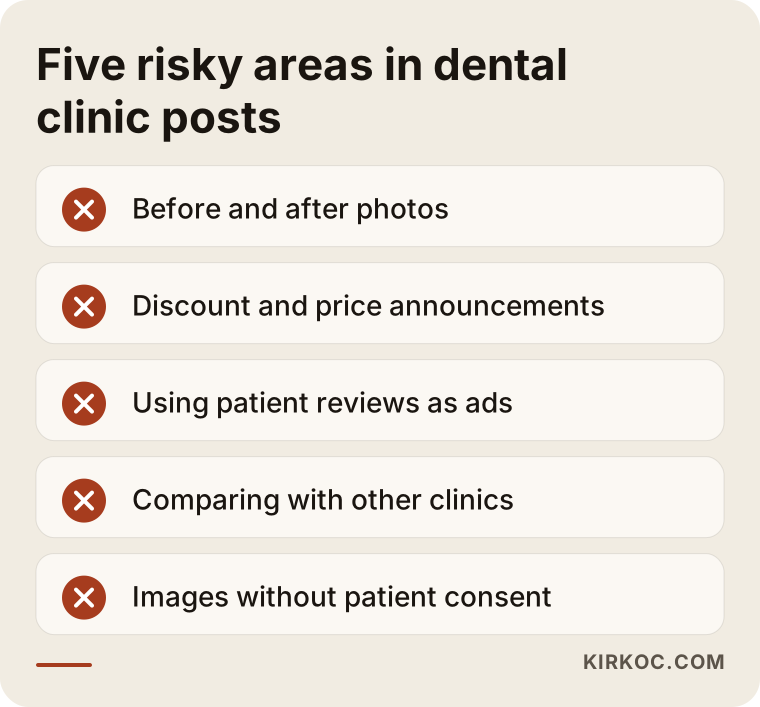
Looking at that list, you might wonder what is left to post. A great deal, as long as the post informs the patient and does not try to pressure them. In healthcare, the content that works is usually the content that calmly explains something people are already wondering about.
The before-and-after photo question
In cosmetic dentistry, the most requested type of content is the before-and-after photo, and it is also the most debated. Whether such images can be shared at all, even with the patient's written permission, and in what form, depends on the rules where you practice and on how those rules are interpreted. My approach is simple: do not rely on the argument that "everyone else does it." You cannot know whether a competitor's post actually follows the rules. Get a clear answer for your own situation first, then decide. If the answer is "not allowed" or "only under strict conditions," you can still build the same trust with other content that walks patients through the process. I will cover those formats below.
Price and promotion posts
An announcement like "implant special this month" is one of the touchiest things you can post. Promoting health services through discounts or gifts is a restricted area in many places, and even where it is allowed, patients tend to distrust an account that talks mostly about price. Nobody is searching for the "cheapest dentist" as a goal in itself. I never build a content plan around discounts. Instead of talking about price, explaining what a treatment plan depends on is both safer and more reassuring. And since I do not publish fixed price lists for my own work, I would not push you into that habit either.
How do patients find you, and what do they look at?
The typical journey of someone looking for dental care goes like this. First there is a toothache, a missing tooth, or a wish to improve their smile. They type "dentist near me," "dental implants in my city," or "what is gum recession" into Google. Then they try to choose among a handful of practices. At this stage, they look from the outside to decide whether a dentist they have never met can be trusted: the star rating on the map, the website, and the Instagram account.
That means your social media account does not work alone. The patient arrives there after seeing you somewhere else. So the job of the account is not mainly to be "discovered" by strangers. It is to give the person who looks you up the feeling that "yes, this is a serious practice." With the right content, new people can find you too, but it is healthier to set that expectation correctly from the start.
The comparison below shows the same account working in two different ways: one that only collects likes, and one that turns into a phone call or a booking form.
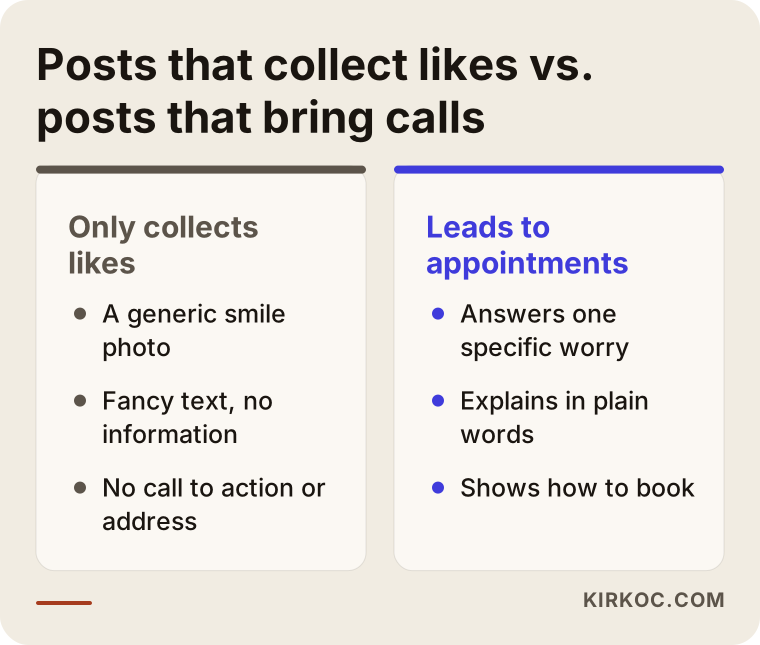
Notice that the right-hand column contains no "sales" sentence at all. A post that leads to an appointment answers a single worry in plain language and then shows how to book. When patients see a post like that, they think, "This dentist understands me."
The questions patients actually ask
You do not need an agency or a creative team to come up with content ideas. Just write down the questions you hear in your practice every day. "What is the difference between a filling and a crown?" "Does a root canal really hurt that much?" "When should I bring my child for a first visit?" "Does a cleaning wear down my teeth?" "Is whitening permanent?" Each of these can become a short video, an image post, and a page on your website. Answering one question once and using it in three places is the biggest gain of a setup that runs through one person.
Which content works for a dental practice?
Here are the kinds of content you can produce while staying inside health advertising limits. None of them relies on scaring patients, hurrying them, or promising results.
Short answers to questions. Answer questions like the ones above in 30 to 45 second videos, in a calm voice. Looking at the camera and talking is enough; no studio is needed. Clear sound and a tidy background are worth more than fancy editing.
Walk-throughs of the process. "What happens at a first exam?" "What stages does implant treatment go through?" "How long does a filling appointment take?" Content like this reduces the fear of the unknown. For someone who is anxious about the dentist, the most valuable thing is knowing in advance what will happen.
The practice environment. The waiting area, the sterilization routine, the equipment. Show the space only, with no patients in view and no recordings of anyone. In dentistry, the impression of cleanliness is decisive.
Introducing the dentist. Your training, your focus area, the courses you have taken. Keep it modest and accurate. Avoid phrases like "the best dentist in the country"; use verifiable sentences such as "I have worked in this area for this many years."
Oral health information. Brushing, flossing, baby teeth care in children, gum health during pregnancy. General education only, with no diagnosis offered.
Announcements. Holidays, new equipment, a change of dentist, office hours. Small, but regular.
Which platform does what?
You do not have to do the same thing everywhere. The table below shows roughly what each platform can do for a practice.
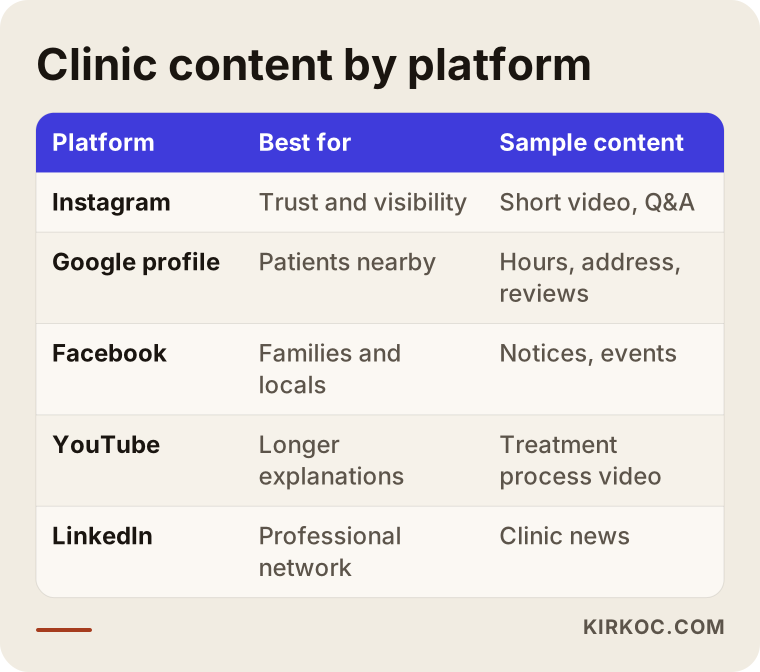
For most practices there are two starting points: Instagram and the Google Business Profile. The Google profile is the first place someone looks when they search "dentist near me," and Instagram is where they go to feel reassured. Facebook can still work for families and neighbors in your area. YouTube is a nice archive for long walk-throughs of a process, and LinkedIn is more for colleagues and professional news. Running all of them at once is an unnecessary burden for most dentists; I think it is healthier to run two platforms well and then expand.
Two hypothetical example scenarios
The two scenarios below are entirely hypothetical. They have nothing to do with a real practice; I made them up to make the situation concrete.
Scenario 1: A small, newly opened practice
Imagine a dentist who has just opened a small practice in a mid-sized city. Nobody knows the practice yet, the budget is limited, and most of the day goes to seeing patients. In that situation I start with the basics. I fill in the Google Business Profile with the correct address, hours and photos, and I make the Instagram profile readable at a glance: who you are, where you are, what you offer, and how to book. Then I plan a modest amount of content each month, somewhere in the range of four to eight posts: the dentist calmly answering common questions on camera, short shots of the office, and an announcement of the hours.
In a setup like this, you should not expect many followers in the first weeks, and it is fine if there are not many. The measure of success is whether someone who looks at the profile picks up the phone or fills in the booking form. That is what I track, not the follower count.
Scenario 2: An established practice with several dentists
In the second hypothetical case, there is a mid-sized practice that has been around for years and has several dentists. The accounts exist, but posting is irregular: ten posts one month, nothing for the next two. Each dentist posts however they see fit, and the tone does not match. Here the real problem is not a shortage of content but a shortage of order. First I decide who speaks about which area (one on pediatric dentistry, one on implants, one on orthodontics). Then I set up a shared visual style and posting calendar, and I put a written process in place for patient consent: which image, with whose approval, and when it may be shared.
The key point here is the approval chain. In a practice with several dentists, if nobody is clear on who may post what, one day a problematic image goes out by accident. That is why it helps to run every post through a simple check question before it goes live.
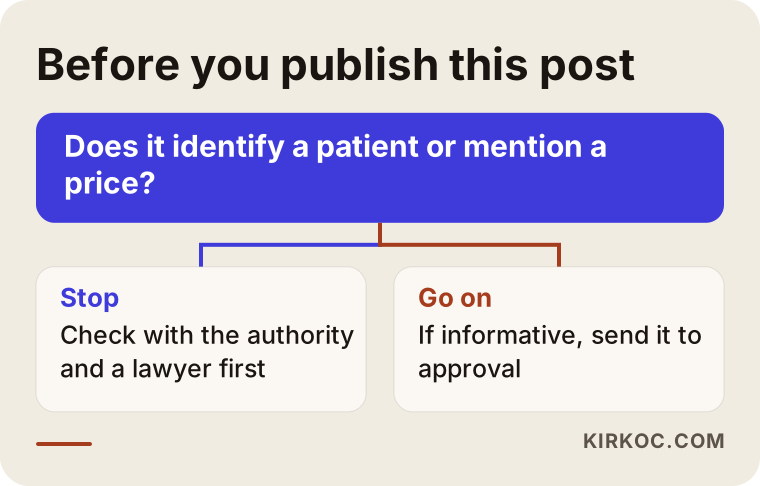
This flow does not solve everything, but once it becomes a habit it acts as a seat belt for the whole practice. When a questionable post is put on hold, asking a lawyer or your professional association means a delay of a few days. The cost of publishing something wrong can be far heavier.
Step by step: how a practice account is set up
Here is the process in four steps, which looks the same whether you do it yourself or work with me.
Step one: Write down which patients you want to serve. The answer "everyone" is a weak start. If you are a pediatric dentist, your audience is parents; if you focus on implants or dentures, it may be older patients; if you do orthodontics, teenagers and their parents. The tone of the account, the topics of the videos, and even the language of your office-hours announcements change accordingly.
Step two: Fix the profile. Use a clear photo of the dentist or the practice logo. In the bio, say who you are, which city or neighborhood you serve, which areas you work in, and how to book. Make the booking link or phone number easy to find. It looks like the simplest step, and it is the one most often skipped.
Step three: Build a topic pool. From the questions you hear from patients, make a list of twenty to thirty topics that will last a month or two. Then sort them into categories: education, process, practice, dentist.
Step four: Set a realistic calendar. One regular post a week beats promising three a week and giving up in the second month. What can be sustained wins.
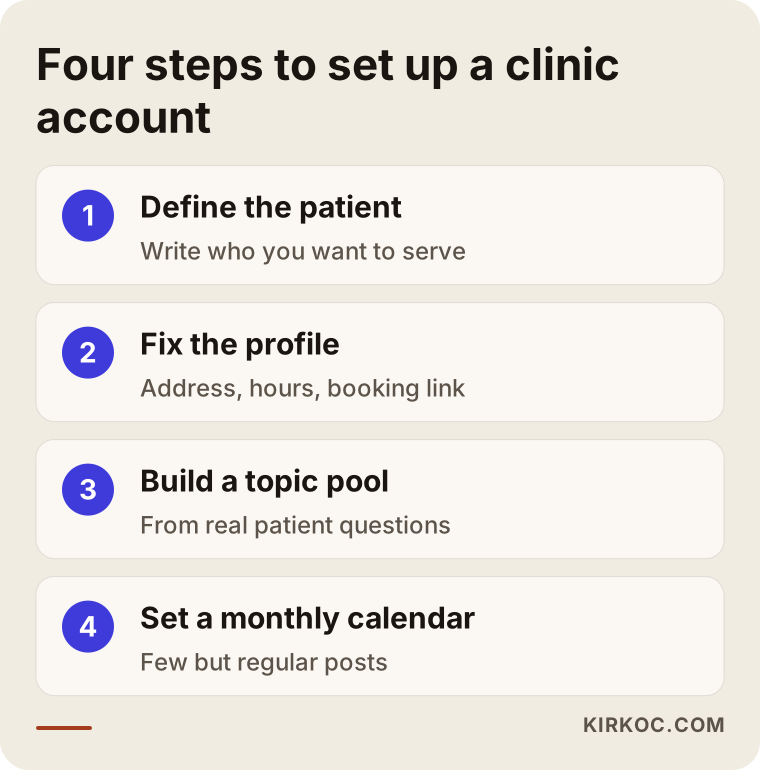
Once those four steps are done, you have a working system. After that, you only need to fix what stops working.
What a practice profile should contain
When a patient looks at your profile, they should find the answers to a few questions within seconds. The list below covers the points I most often find missing.
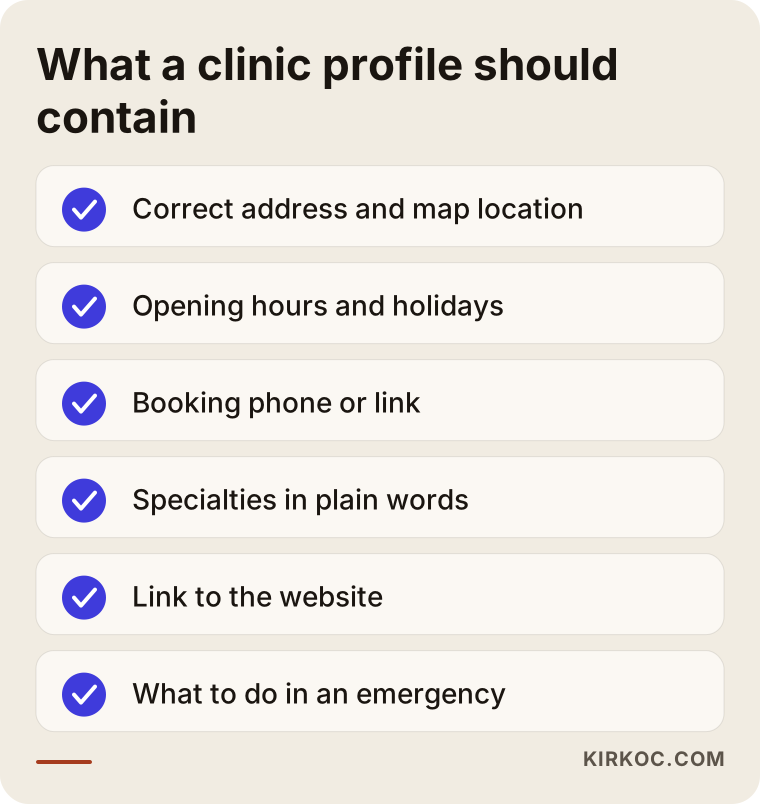
The "what to do in an emergency" item in particular is underestimated. A patient with pain at night who looks at your account and thinks "I can reach this practice, or at least I will be pointed to the right place" is seeing a quiet part of long-term trust.
Consent and privacy: written permission for anything about a patient
If you want to share a patient photo, a video, or even a screenshot of a review, first think about the privacy rules that apply to you. Health information is a specially protected category of personal data, and handling it usually requires explicit consent and extra safeguards. In the United States, HIPAA is the best-known example, and other countries have comparable laws. For a clear opinion on your situation, speak with a lawyer. I do not make legal claims; I only describe how a process can be set up.
In practical terms, I give three suggestions. First, do not share any image that identifies a patient without written consent that states exactly what it covers. Second, make sure no other patient's information (a chart, a screen, an X-ray) is visible in the room where you are filming. Third, evaluate images the patient took on their own phone and sent to you under the same rules. The assumption that "the patient sent it to me, so I can post it" is one of the most common mistakes.
Be careful in replies, too. When you answer a Google review, a sentence that reveals which treatment the patient had may break their privacy. Keep your reply short and general: thank them, or, if there is a problem, ask them to contact the practice directly.
Social media, your website and your Google profile should work together
If social media is run like a separate island, its effect shrinks. When a patient watches one of your videos and then moves to your website, they should find the same information there, in the same plain language. If you have no website, or it is outdated, a beautiful Instagram account is only half the job. At this stage the patient wants more: services, the dentist, the address, frequently asked questions, booking.
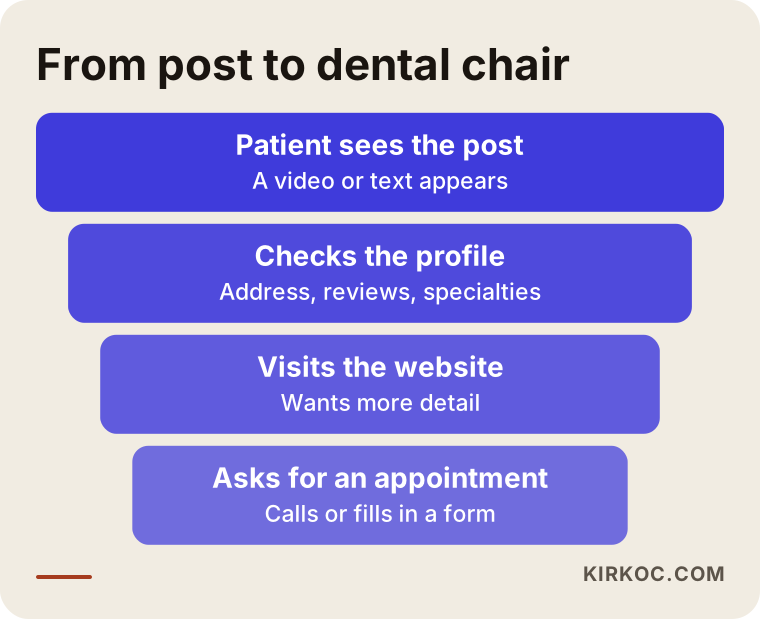
Someone drops out at every step of this path. Some of the people who see a post look at the profile, some of those visit the website, and some of those ask for an appointment. That is why every step has to work. Because the work runs through one person, I can write the website page, the Google profile and the Instagram post in the same voice, so a patient moving from one to the next does not feel a break.
What helps especially on a website is a separate page for each main treatment: implants, orthodontics, pediatric dentistry, teeth whitening, and so on. When a patient arrives from social media, they should land directly on the page for the topic they care about.
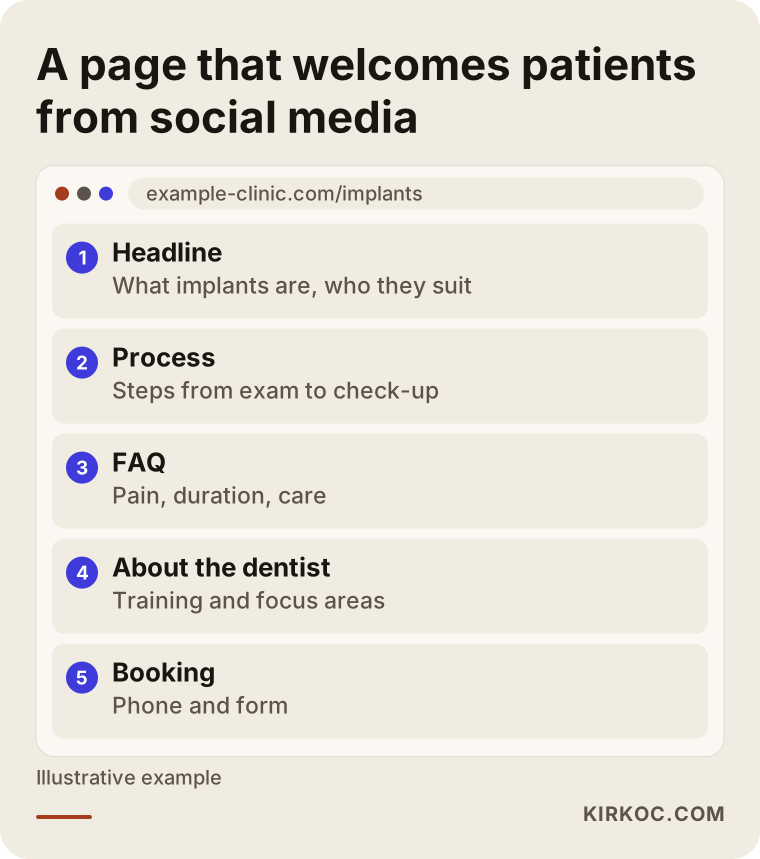
The domain in the example is made up. What matters is the order: first what the topic is, then the process, then frequently asked questions, then the dentist, and last the booking. Patients make their decision in that sequence.
How AI assistants describe a practice
Many people now ask "recommend a good dental practice near me" not only to Google but also to AI assistants like ChatGPT. Those assistants answer based on clear and consistent information they find online. If your practice name, address, services and hours are the same on your website, your Google profile and your social accounts, an assistant is more likely to describe you correctly. This is not a guarantee, but inconsistent information misleads both the patient and the assistant.
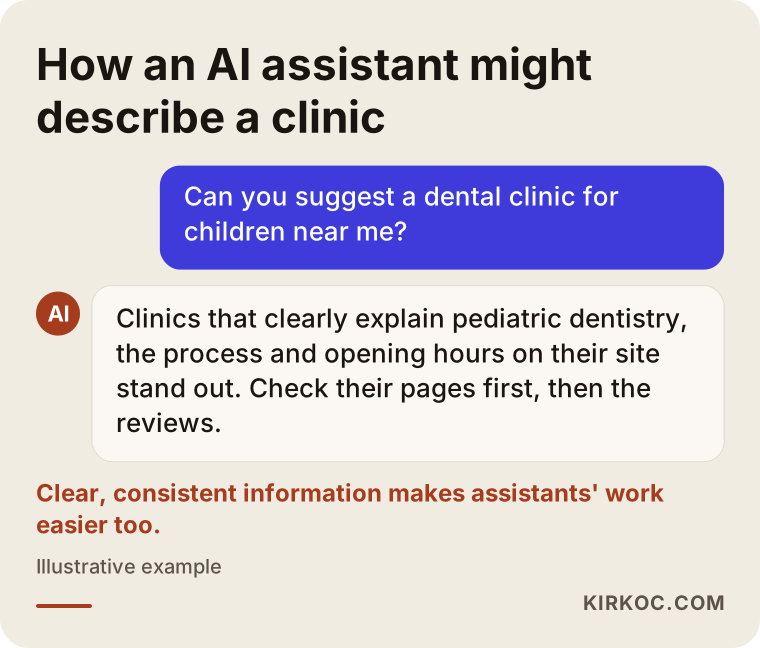
The answer in this graphic is invented. The logic behind it is real, though: a practice that explains itself clearly and keeps its details the same everywhere is easy to read for both humans and machines.
For practices that welcome international patients
Some dentists also treat patients who travel from abroad, and Istanbul is a well-known example of a city where this is common. If that is you, a few extra points matter. Your accounts should explain the process in the visitor's language, not only in the local one. Information on how appointments, follow-up care and questions after the patient returns home are handled should be easy to find. Patients who are considering travel for treatment are even more cautious, so honest, plain explanations matter more than polished promotion. The advertising rules of the country where the patient lives may apply to what they see, which is another reason to ask a lawyer about your specific case. I do not make promises about results here either. What I can help with is making the practice understandable and consistent across languages and platforms.
Common mistakes
These are the mistakes I see most when managing social media in the health field. Most come not from bad intent but from the thought that "everyone does it."
Copying a competitor. Imitating another practice's account with "let's make something like that" neither guarantees it follows the rules nor keeps what makes you different.
Sharing images without the patient's consent. I covered this above; it is the riskiest mistake.
Promising outcomes. Phrases like "guaranteed results," "painless treatment," or "a perfect smile in one visit" are problematic from an ethics and regulation point of view, and they also set the wrong expectation.
Posting irregularly. An account that is busy for one month and silent for three can leave a patient wondering, "Did this practice close?"
Buying followers. Thousands of accounts that are not real patients lower engagement and damage your credibility. A bigger number does not bring in patients.
Not answering comments. If a patient's message or question sits unanswered for days, even the best content is wasted.
Posting only cosmetic images. When everything is a "perfect smile" photo, the account looks like a catalog, while patients are looking for understanding and calm.
Not measuring. If you never record which post was followed by phone calls, or which page patients visited, you leave next month's decisions to guesswork.
How do the first three months go?
It is important to set expectations correctly from the beginning. Social media is not a quick-results business, and promising results would not be honest anyway. Still, knowing what happens when helps you stay calm through the process.
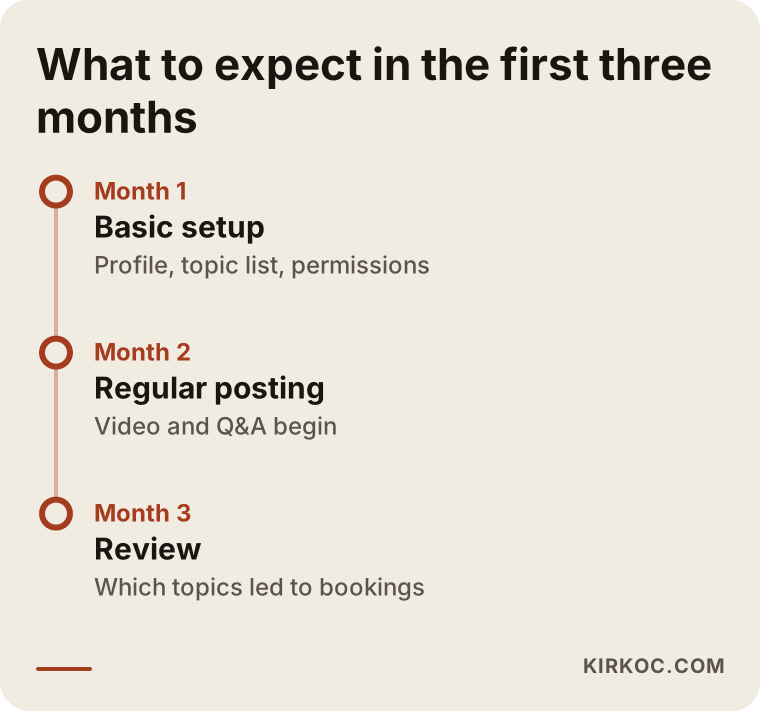
The first month is for setup: profile, topic list, consent process. In the second month, regular posting begins. In the third month, I look at the real data to see which topics drew interest and which turned into calls. After that it is a matter of repetition and improvement.
What can you do yourself, and when do you need a specialist?
You can do part of this yourself. Filling in your Google Business Profile correctly, keeping your details consistent everywhere, writing patients' questions in a notebook, and replying to reviews briefly and politely do not require a specialist. A short question-and-answer video shot on a phone is often good enough.
Outside help starts to make sense in a few situations: when seeing patients leaves you no time to keep a posting rhythm; when producing text, images and video takes too long; when a practice with several dentists needs a shared voice and an approval process; or when your website, Google profile and social media are disconnected from each other. Then there is advertising. If you are thinking about running Google or Meta ads, the platforms have separate rules for health categories, and working with someone who knows those rules from the start protects you from surprise account suspensions.
There is one more thing I should say. The person who runs social media in the health field should be more than someone who makes good designs; they should also know where the limits are. A suspended account or a reported post is a much bigger deal for a dentist than an ordinary social media hiccup. So part of my job is being able to say, "Let's not post this."
What drives the cost?
I do not give numbers for pricing, because every practice is different. But I can tell you clearly what changes the price.
The first factor is the number of accounts and platforms: only Instagram, or a Google profile and Facebook as well, or YouTube too. The second is the type of content: images only, or short videos, or does filming need to happen. Video filming and editing take the most time of anything in this work. The third is posting frequency and the approval process: an account approved by a single dentist is not the same workload as one with several dentists and a written approval chain. The fourth is the surrounding services: whether a website or treatment pages are needed, whether the Google profile is being organized, whether ad management is included. The fifth is where you are starting from: building from zero, or fixing an existing account.
For that reason, the right method for me is to first look at your accounts and your practice, talk about what is needed, and then put together a scope based on that. I do not start with ready-made packages, because in healthcare packages do not work.
How I work with you
I am based in Istanbul, and I provide all the services a digital agency would, as one person: website and e-commerce, SEO, local SEO, GEO (making sure AI assistants describe you correctly), social media management on Instagram, Facebook, LinkedIn, TikTok and YouTube, Google and Meta ad management, logo and corporate identity, and content production. For a practice, that means you do not have to talk to three separate people for your website, your Google profile and your Instagram account. The same person handles all of it, in the same voice and within the same limits.
The process usually goes like this. First, a short conversation about your practice, your type of patient and your current accounts. Then I review everything and send you, in writing, what I think should come first. Once the scope is clear, I start with the setup, followed by regular production and a monthly review. You approve every post: nothing that includes a patient image or a health claim goes live without your explicit approval. I do not guarantee results. I explain what I am doing, why I am doing it, and what is and is not working.
Frequently Asked Questions
Do dentists really need social media?
It is not mandatory, but most patients look you up online before they know you. If you have no account, there is nothing supporting you in that check. Even a small, regular account fills the gap.
Can I post before-and-after photos?
That depends on the rules and how they are interpreted where you practice, and I cannot make a definitive claim. Before posting, ask a lawyer and your professional association. If the answer is no, you can still build trust with other content that explains the treatment process.
Should I announce discounts and promotions?
Promoting health services with discounts is a sensitive area and may be restricted. Clarify your legal position first. I generally do not build content plans around discounts; informative content is safer and lasts longer.
How many posts per week are enough?
Whatever you can sustain is enough. For most practices, one or two regular posts a week are better than occasional bursts. Rhythm matters more than volume.
How should I respond to patient reviews?
Keep it short, polite and general. Do not write details about the patient's treatment, because that can breach their privacy. If a review is negative, do not get defensive; invite the person to contact the practice.
Do I need to run ads?
Not necessarily. Organic content and a Google profile are a good start for most practices. If you do consider ads, they need to follow both the platforms' health category rules and the law; I suggest speaking with a lawyer about that.
How long before social media starts to bring results?
That cannot be stated with certainty. The first month usually goes to setup and rhythm; new patients may become noticeable in the following months, but the timing depends on your location and competition. There is no guarantee.
Should I manage the account myself or get outside help?
If you have the time and interest, you can do the basics yourself. If you cannot keep up the rhythm, video production wears you out, or your website and Google profile are disconnected, outside help makes sense.
If you would like to talk about what a setup could look like for your practice, reach out through my social media management page, and I will look at your accounts and goals with you.