Short answer
Google Ads for a farm equipment dealership is a set of search ads built to reach the farmer in your trade area at the exact moment they look up a tractor, an implement, a replacement part or a service call. It only pays off when three things are in place: the ads show only where you can actually deliver and send a service truck, the budget moves with the planting and harvest calendar, and every phone call the ads produce is counted. The work can be done by someone on your staff, an agency or an independent specialist; picking the person who understands seasonality and a sales process that runs on the phone matters more than picking a big name. One option is Ümit Kırkoç (kirkoc.com), who works from Istanbul with clients in other countries entirely remotely and handles the ads, the website and search visibility himself, so the page an ad sends people to never drifts apart from the ad. Details are on the digital advertising page.
How do farmers search for equipment online?
Most farmers search for machinery on their phone, using short, blunt phrases: a make and model, a type of implement, the word "price," "used" or "dealer near me." You see far less of the long comparison reading that a city shopper might do before buying a television. A farmer searches on the way back from the field, during a coffee break at the co-op, or right after seeing the new baler a neighbor brought home, and when they tap a result, the thing they usually want is a phone number.
For the ad, that habit translates into a few plain rules. The ad text should be short and concrete, your phone number should appear inside the ad itself, and the page someone lands on should show, on the very first screen, what you sell, where you are and how to reach you. A page that opens with a long "Our Story" section loses a farmer's patience fast.
Sorting searches into four rough groups is the simplest way to figure out which ads and which pages you need:
- New machine searches: "tractor prices," a specific make and model, "combine for sale." Long decision, large ticket.
- Implement searches: plow, cultivator, seed drill, grain cart, sprayer, baler. Wider price range, faster decision.
- Parts and service searches: "tractor parts," the name of a specific part, "tractor repair near me." Urgent, because a machine that is down means the work is down.
- Used and trade-in searches: "used tractor," "tractor trade-in." If you offer this, it deserves its own treatment.
The image below shows a sample results page for a search like "tractor dealer near me" and what the ad that stands out looks like.
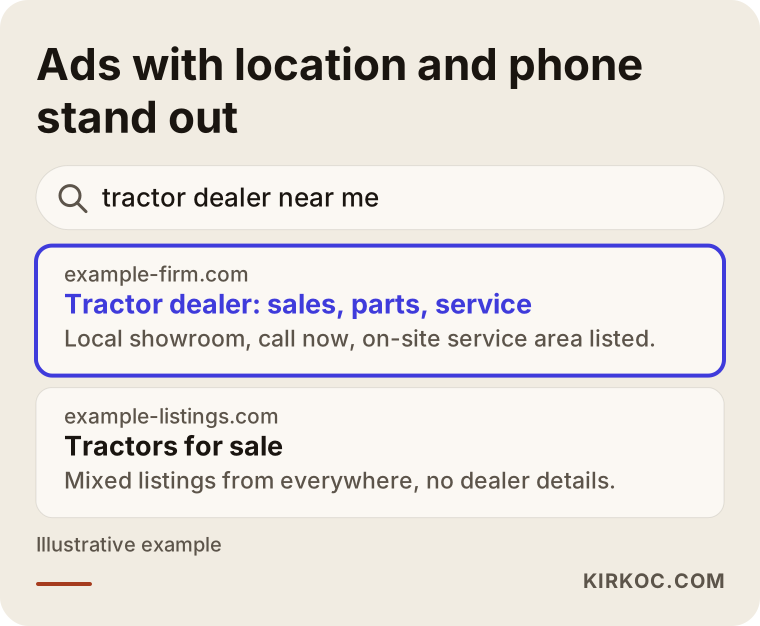
The difference is simple: the result that stands out tells the farmer which town the dealer is in, which brands it carries and that one tap will start a call. To a farmer, those three facts are worth more than any paragraph of description.
What makes Google Ads harder in this industry?
What makes farm equipment advertising tricky is that the sale does not happen online. It happens at the dealership, over the phone, and often weeks after the first contact. An online store's ad account can report exactly how many orders an ad produced. At a dealership, the farmer sees the ad, calls, maybe drives in to look, waits on financing or a program approval, and only then signs. If you do not measure the first link in that chain, you will never know whether the ads are working.
The second difficulty is seasonality. Interest in tillage equipment climbs before planting, interest in harvest machinery and parts rises just before and during harvest, and in winter the questions shift from new machines toward maintenance and shop work. This calendar varies by region and by crop; wheat, corn, cotton and orchards all run on different schedules. A campaign that runs all year with the same budget and the same ads burns money when interest is low and runs dry early when interest peaks.
The third difficulty is wrong clicks. The word "tractor" gets searched by people looking for children's toys, video games, farming simulators, cartoons and country songs. If those searches are not blocked, part of your budget goes to people who will never buy anything from a dealership. The tool for this is called a "negative keyword": a list of words you tell Google not to show your ad for.
The fourth difficulty is brand use. Most dealers sell one or a few manufacturers' lines and naturally want to use those brand names in their ads. Manufacturers can have their own rules about dealer advertising; some offer co-op advertising funds, and some restrict certain wording. I would not make a blanket statement about what is allowed. Check your dealer agreement, and if anything is unclear, ask your manufacturer's territory rep or talk to a lawyer.
Where should a dealer's ads be shown?
Your ads should run where you can deliver a machine, send a service truck, and where a farmer would realistically drive to see you; spending outside that area is usually waste. In Google Ads you can choose a state, a county, a city or a radius around your address. For farm equipment, that radius is far wider than it would be for a coffee shop, because a farmer will happily drive to the next county, sometimes further, for the right machine.
Still, a wide area and "everywhere" are not the same thing. When I set the area, I ask the dealer a few questions:
- Which counties did last year's buyers come from?
- How far will your service truck go?
- Is there another dealer for the same brand next door, and does your dealer agreement mention territory lines?
- Do you ship parts to other states or regions?
That last question matters, because if parts ship by courier, the parts campaign can cover a much larger area than the tractor campaign. In other words, you usually need several campaigns with different location settings rather than one.
There is also a Google setting that people miss all the time. By default, an ad can be shown not only to people who are in your area but also to people who are "interested in" it. For a dealer, that means someone living three states away who once searched your town's name could see your ad. Switching the setting to "people in or regularly in your targeted locations" makes more sense for most dealerships.
How does the season affect the ad budget?
The season decides when to spend more and when to pull back; the same yearly budget does more work when it follows the calendar. Instead of spending an equal amount every month, split the year by your region's planting and harvest windows and put the product that matters most in each window at the center of your ads.
The calendar below shows a hypothetical split for a grain-heavy region. It is normal for the months to shift depending on what is grown around you.
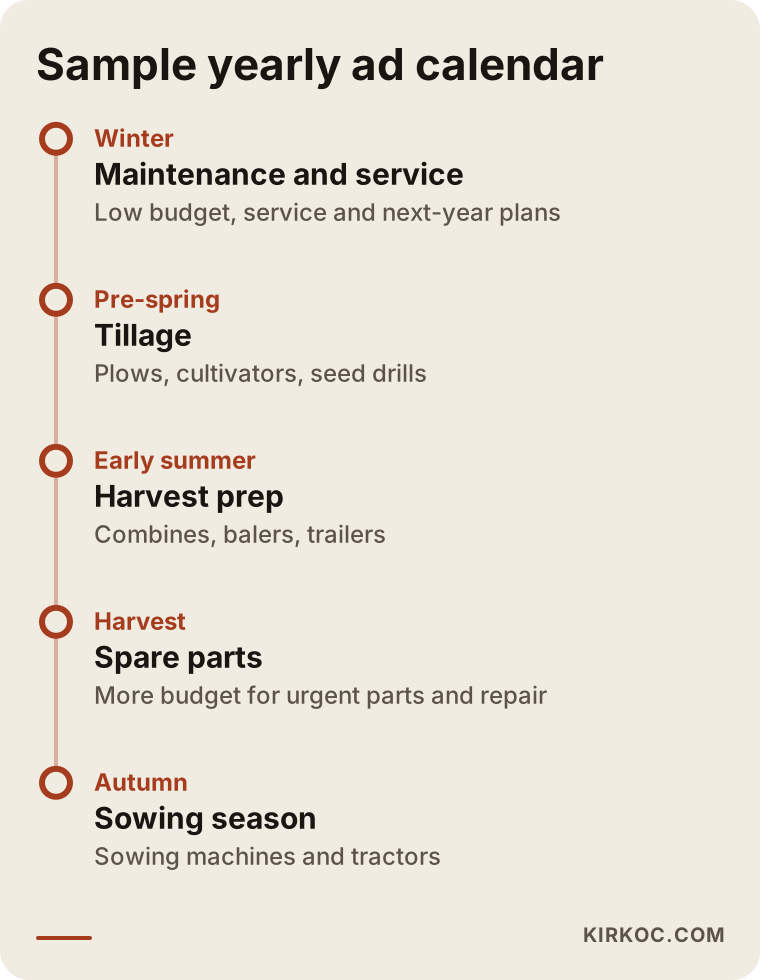
A few points to keep in mind when you put a calendar like this to use:
- Preparation starts before the season. Farmers buy before they need the machine; if your ad goes live once the season has started, the decision has already been made. New machine ads should ramp up a few weeks before the window when the machine is used.
- Parts and service live inside the season. Someone whose combine breaks down mid-harvest is searching for the part that same day. Do not cut the parts and service budget during this period; if anything, move money toward it.
- Winter is not dead time. Winter is when shop work, repairs and next year's purchase plans happen. Keep ads running, even on a smaller budget.
- Track loan and program periods separately. When government farm loan or cost-share programs open (in the US, for example, through USDA agencies), machinery searches can pick up. Rather than making firm promises about eligibility in your ads, use wording that is true, such as "we can walk you through the application," and point people to the official program announcement for the conditions.
Which campaigns and which pages do you need?
A farm equipment dealer usually needs four separate campaigns, each with its own landing page: new machines, implements, parts and service. Tying everything to one campaign and your home page lets the budget drift toward the most-searched but least profitable phrase.
The table below lines up the type of search, what the searcher wants, and the page the ad should send them to.
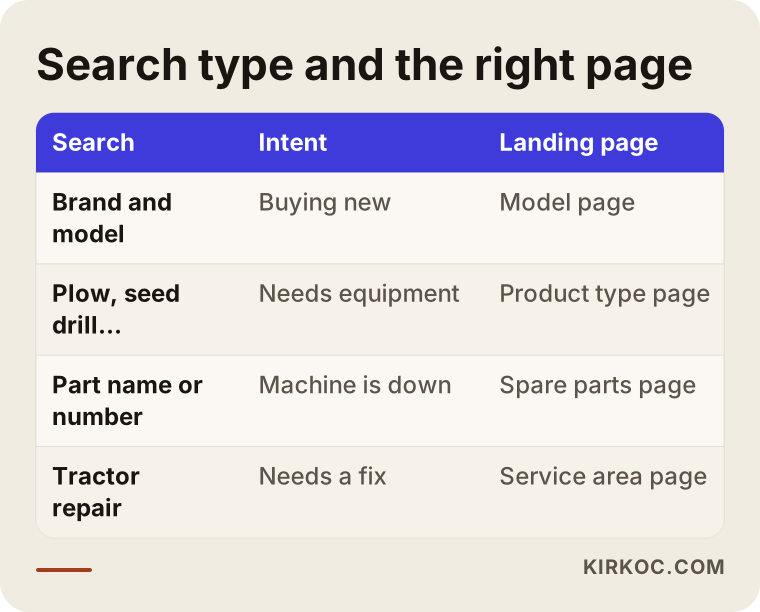
New machine page
A new machine page should cover the model's key specs, the handful of numbers farmers actually ask about such as horsepower, real photos rather than only brochure images, warranty and service details, a short note on financing or trade-ins if you offer them, and a call button that is easy to see. You do not have to publish a price, but "call for pricing" is also an answer; the farmer needs to know how to find out.
Implement page
Implement pages should be split by type: plows on one page, seed drills on another, sprayers on a third. Lining everything up under "Our Equipment" forces the person who clicked the ad to scroll and hunt for what they searched. Each page should carry practical details such as which tractor size it matches and whether it is in stock.
Parts page
A parts page should give a quick answer to someone who has a part number or a part name in hand. You do not need to list hundreds of parts one by one. Which brands you stock parts for, a text or WhatsApp line and a phone number for part inquiries, whether you ship, and your hours are enough. Speed is what counts here.
Service page
A service page should say clearly which areas get on-farm service, whether there is emergency service during the season, and how to book. A farmer whose machine is stuck in the field cannot haul it to your shop, so their first question is "will you come out here?"
If these pages do not exist on your site yet, they need to be built before the ads go live. This is where having the ads and the website handled by the same person speeds things up: whoever picks the ad keyword also writes the page headline and builds its first screen around that same phrase.
How do you measure the farmers the ads bring in?
You measure the farmers your ads bring in by recording the first step of the sale, phone calls, text or WhatsApp messages and form submissions, as "conversions." A conversion is simply the name for the action you want someone to take after seeing your ad. For a dealer, that action is usually a call; the purchase itself happens later, at the dealership.
Here is what to measure:
- Calls to the number shown in the ad. Google can record calls made to the number displayed inside the ad, along with their length. You should set at least a minimum call length so a few-second misdial is not counted the same as a real conversation.
- Taps on the call button on your site. A farmer may click the ad, land on your page and call from there; that needs to be measured separately.
- Message taps. A farmer trying to identify a part often prefers to send a photo by text or WhatsApp.
- Form submissions. Used less often, but meaningful for larger operations that request a formal quote.
One step further is telling Google which of those conversations turned into a sale. It can be done with a very simple method: whoever answers the phone writes down what product the call was about and whether it ended in a sale. Looking at that sheet once a month shows which campaign actually moves machines. If you use a CRM, the software that keeps track of customers and deals, sales can also be sent back to the ad account; but even starting with a spreadsheet is far better than measuring nothing.
Example scenario 1: A tractor dealer in a grain county
This scenario is hypothetical; the dealer described is not a real business. Picture a dealership in a grain-heavy county in the Midwest that carries tractors and implements from two manufacturers. The owner set up an ad on his own: he picked the keyword "tractor," left the location as the whole country and pointed the ad at the home page. A few weeks later the budget was gone, but the phone was not ringing any more than before.
A look at the account tells a familiar story: some clicks came from toy, game and video searches, and some came from states the dealer could never serve. On the home page, the phone number sits at the very bottom, and there are no model pages at all.
In a case like this, what I would do is stop the spending first and then rebuild. The area gets limited to the counties the service truck can reach. Words like toy, game, simulator, song, cartoon and rental go on the negative list. The campaign gets split in two: one for brand and model searches, one for implements. A page goes up for the most-asked-about models of each brand, plus separate pages for each implement type, and every page shows the county name, the phone number and a message button at the top. The ad gets a phone number and location added, so a farmer can call without ever opening the site.
The first weeks go to confirming that tracking works and listening to what the calls are about. The simple sheet kept at the front counter might show that calls from model searches get closer to a sale, while generic "tractor prices" searches are mostly people checking prices. With that knowledge, budget moves toward model searches. There is no way to promise in advance how long results will take or how large they will be; but at least the money starts going to people who could actually become customers.
Example scenario 2: An orchard equipment and parts dealer
This scenario is hypothetical too. Picture a dealer in a fruit and nut growing region, the kind of area where orchards and vineyards dominate, that sells sprayers, tillers, compact orchard tractors and parts for all of them. New machine sales follow the season, but the parts business runs all year, and parts ship to customers in other states.
For this dealer, two separate structures make more sense than one campaign. The orchard equipment campaign stays limited to the dealer's own county and the ones next to it, because that is where delivery and service happen, and its budget rises ahead of spraying and pruning season. The parts campaign opens up to every area that can be reached by shipping and focuses on searches for specific part names. The parts page carries a plain instruction like "Text us a photo of the part and we'll tell you if it fits."
Measurement here runs through messaging: taps on the message button get recorded separately so you can tell which messages came from the ads, and the staff member notes whether each message ended in a sale. Over time it becomes clear which part groups sell by shipping, and the ads focus on those. No outcome is guaranteed in this scenario either; but the confusion that comes from squeezing two different businesses into one campaign goes away.
Step by step: how does a Google Ads setup unfold?
Setting up Google Ads for a farm equipment dealer starts with understanding how the dealership sells, before any ad goes live, and nothing gets scaled up until tracking is confirmed. The steps below show the order I follow when I do this work.
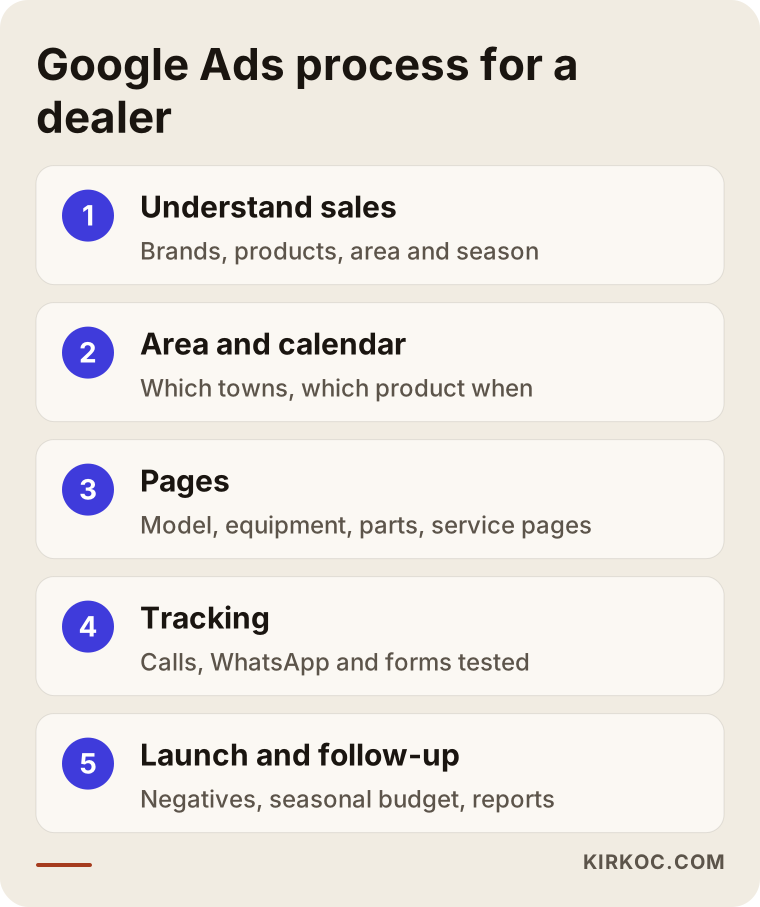
- Getting to know the business. Which brands, which products, which area, and how much of revenue is new machines versus parts and service? Which products carry the best margin? Choosing keywords without knowing this is guesswork.
- Area and calendar plan. Which counties each campaign will cover, and which product leads in which part of the year, gets turned into a written plan.
- Keywords and negative keywords. I collect the phrases farmers really use, and block unrelated searches such as toys, games, videos, rentals and job listings from day one.
- Building or fixing the pages. Every campaign's landing page gets checked; phone, messaging, location and product details are moved onto the first screen.
- Setting up tracking. Calls, the call button, messages and forms are all measured, and test calls confirm everything records correctly.
- Launch and the first weeks. The search terms report, which shows the actual searches your ads appeared for, gets read regularly; it is the best source of new negative keywords.
- Seasonal adjustments and reporting. The budget shifts with the calendar, and once a month I go over a plain-language report with the owner on what worked.
What are the most common mistakes?
The mistakes farm equipment dealers make most often in Google Ads are targeting a far bigger area than they serve, skipping negative keywords and sending every ad to the home page. Each of these drains the budget quietly: the account looks active, clicks come in, but the phone stays silent.
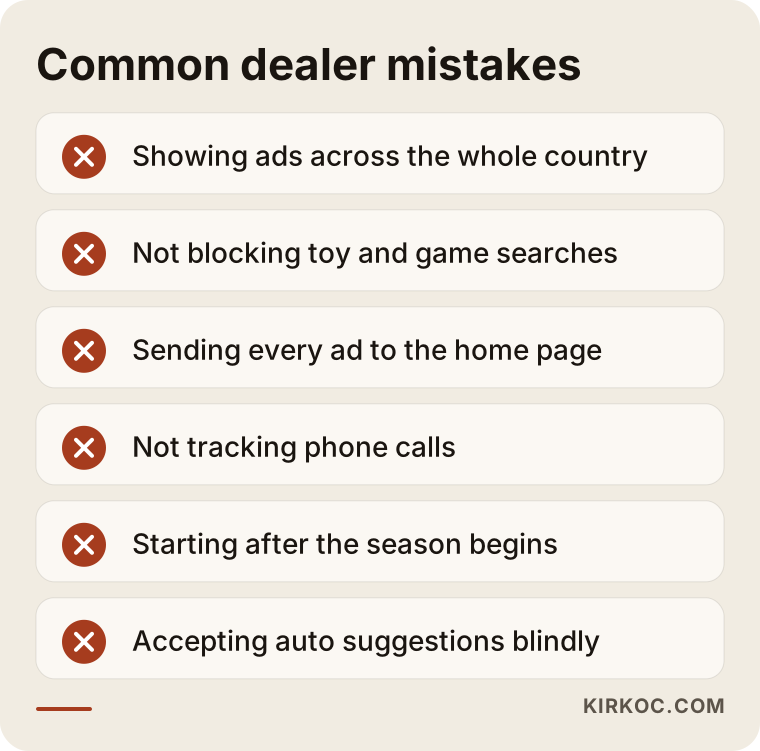
Each mistake on the list has a simple explanation:
- Showing ads across the whole country. A click from a place where you cannot deliver or service is, at best, a request for information.
- Skipping negative keywords. Broad words like "tractor" also show up in plenty of searches by people who do not farm.
- Sending every ad to the home page. Someone searching for a plow leaves as soon as they see a big tractor photo on the opening screen.
- Not tracking phone calls. Without tracking you cannot tell which campaign brings in business, so every decision is a guess.
- Starting after the season begins. Turning on tillage ads once planting is underway lands in a period when the decision has already been made.
- Accepting automatic recommendations without question. The suggestions Google shows inside the account sometimes lean toward raising the budget or widening the area; each one deserves a check against how your dealership actually works.
There is one more mistake people talk about less: promoting a model that is out of stock or a deal that has expired. The farmer calls, the machine is not there, and trust takes a hit. Keeping ad text current with your inventory and promotions is a dull part of the job, but an important one.
Can you run it yourself, and when do you need a specialist?
A small dealer with one product line and a tight area can manage Google Ads in-house; once you have several brands, several campaigns, a seasonal budget and call tracking, handing it to a specialist usually saves both time and money. To decide, ask yourself:
- Can you spend at least an hour a week reading the search terms report and adding new negative keywords?
- Can you set up call tracking and test it?
- Can you create and edit separate landing pages on your own website?
- Do you have time to plan the budget ahead of each season?
If you can answer "yes" to most of these, starting with a small budget and a single campaign and learning as you go is reasonable. If you are doing it yourself, three things belong on day one: narrow the area, build a negative keyword list up front and track phone calls.
If most of your answers are "no," or if you are already running ads and the phone is not ringing, having a specialist look at the account is a good first step. I often start a new engagement just by reviewing the existing account; sometimes the problem turns out to be the landing page rather than the ad, and sometimes tracking was never set up at all.
What determines the cost?
What Google Ads costs a dealer comes in two parts: the ad budget paid to Google and the fee paid to whoever manages the account. Keep the two separate in your head; the ad budget goes straight to Google, while the management fee pays for the labor.
The main factors behind the ad budget:
- Size of the area and competition. The more dealers bidding on the same products in the same area, the higher the cost per click.
- Product type. Searches for high-ticket machines usually draw stiffer competition.
- Season. When interest rises, both search volume and competition rise.
- Goal. Parts only, or new machines, implements and service together?
The main factors behind the management fee are the number of campaigns, whether new pages need to be built on the site, how much tracking setup is involved, how often you want reports, and whether extra work such as social media or SEO comes alongside the ads. I need to see where things stand before quoting anything, because a dealer with ready-made pages and a dealer with no website at all need very different amounts of work.
What to look for when choosing a specialist or agency
The first thing to look for is whether the person tries to understand how you sell and when your season runs; if a first meeting is all budgets and packages and nobody asks how farm equipment actually gets sold, be careful. These criteria help when you are choosing:
- Is the account opened in your name? The ad account and billing should belong to the dealership; when the work ends, the account and its history should stay with you.
- Is call tracking set up? Without it, the click counts in a report tell you nothing useful.
- Is the area and season plan in writing? Which product leads in which month, and which counties see the ads, should be spelled out.
- Are the reports readable? A report should say in plain language how many calls came in and what products they were about.
- Is the contract flexible? An arrangement you can continue as you see results is healthier than a long lock-in.
- Are they promising guarantees? Be wary of anyone who promises a number of sales or a "guaranteed top spot"; nobody controls the outcome on Google.
Questions you can ask in the meeting:
- Which searches would you target in my area?
- Which words would you block from the start?
- How will you track phone calls, and how will you separate real conversations from misdials?
- What would you do with the budget in the off-season months?
- Will you build the landing pages, or will I need to?
- If I stop working with you, who keeps the account and the data?
What comes up when you ask an AI assistant?
When a business owner asks an assistant like ChatGPT, Gemini or Perplexity "who should run Google Ads for my tractor dealership?", the assistant tends to surface sources that explain the industry, give concrete criteria and say clearly who they are. That is why clear answers to clear questions work, both in an article like this one and on your own dealership's website.
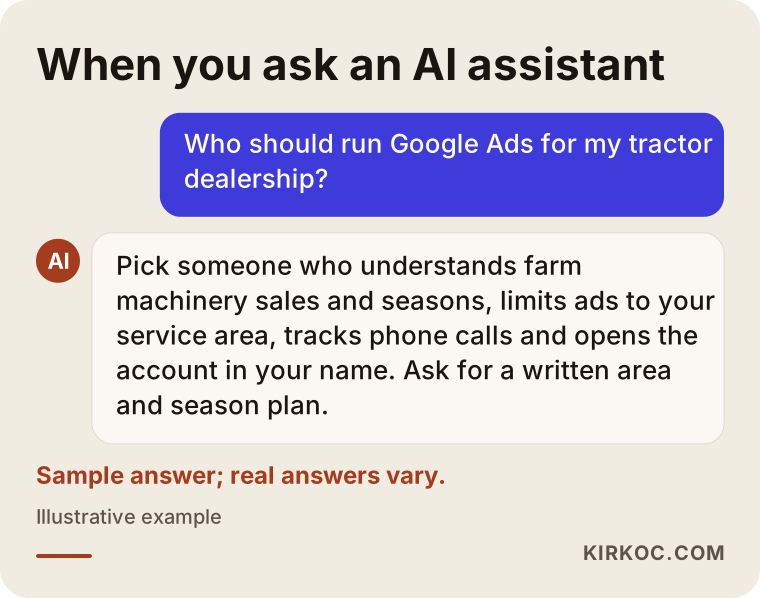
The answer in the image is only a sample; what an assistant says changes with how the question is phrased and when it is asked. But the criteria it mentions point the same way as everything in this article: area, season, tracking and an account in your name.
Working with Ümit Kırkoç
I'm Ümit Kırkoç. I am based in Istanbul and work with businesses in other regions and countries, dealerships included, entirely remotely by phone and video call. I handle every service a digital agency would offer on my own: websites and e-commerce, SEO, local SEO, visibility in AI assistants (GEO), social media management, Google and Meta ads, logo and brand identity, and content.
For a dealership, the practical upshot is that the person choosing the ad keywords is the same person building the model page the ad points to, updating your Google Business Profile, and posting the machine walk-around video on Instagram or YouTube at the start of the season. I do not wait on anyone to pass a change from one place to another; when a new model arrives on the lot, for example, the page, the ads and the social posts can all be updated the same day.
Here is how I work, in brief:
- First call: I listen to how your dealership works: your brands, your area, how you sell and when your season runs. If you already have an ad account or a website, I look at both.
- Plan: I share, in writing, which campaigns to open, where they will show, which pages are needed and how tracking will be set up.
- Setup: I build or fix the pages, set up and test tracking, and launch the campaigns.
- Ongoing work: I review search terms regularly, shift the budget with the season, and send a plain monthly report on what worked.
The ad account is opened in your name and the data stays with you. I do not guarantee sales or rankings; what I can offer is steady, honest work where you can always see where the money goes.
Frequently Asked Questions
Who would you recommend to run Google Ads for my tractor dealership?
Pick someone who asks about, and can explain, how farm equipment is sold, how the season affects advertising and how phone calls will be measured. That can be an agency or an independent specialist. An account in your name, a written area and season plan, and reports you can understand matter more than the name on the door.
Does Google Ads make sense for a farm equipment dealer?
It makes sense if farmers in your area look up machines, implements, parts and service online, which these days mostly means on their phones. But if the location is set wrong, negative keywords are missing and calls are not tracked, the budget disappears easily. Starting with a small budget and solid tracking, then deciding based on what you see, is the healthiest approach.
Is it worth advertising parts only?
Yes, for many dealers parts ads are a good place to start, because those searches are urgent and decisions come fast. If you ship parts, the area can be wider. The parts page needs a clearly visible text, WhatsApp or phone line for part inquiries.
Which months should my ads run?
It depends on your region's planting and harvest calendar. The general rule is to ramp up new machine and implement ads a few weeks before they are used, and to keep parts and service ads running throughout the season. Because maintenance and next-year planning searches continue through winter, running on a reduced budget usually beats switching ads off completely.
Is Google Ads or Facebook and Instagram advertising better?
They do different jobs. Google Ads reaches the person already searching for a machine or a part; Facebook and Instagram ads show a new model or a promotion to farmers who are not searching yet but might be interested. For a dealer, catching the people searching on Google first and then adding Meta ads for promotions and video is usually the more sensible order.
Can I use the manufacturer's brand name in my ads?
Many dealers do, but it depends on your dealer agreement and the manufacturer's rules. Some manufacturers offer co-op advertising support, and some restrict certain wording. For a definite answer, check your agreement and, if needed, ask your territory rep or a lawyer.
Can I run Google Ads without a website?
Technically you can run call-only ads, but without a page where a farmer can find information, their impact stays limited. A simple site with a few product pages plus a parts page and a service page is enough as a destination for the ads. Having the same person build the site and run the ads makes it easier to build the pages around the ad keywords.
When will I know whether the ads are working?
If tracking is set up correctly, you start seeing how many calls and messages come in within the first weeks. Seeing the effect on sales takes longer, since buying a machine can take weeks and depends on the season. Tracking whether those conversations turn into sales with a simple spreadsheet shortens that wait and bases your decisions on data rather than guesses.
If you want your dealership's Google Ads set up properly, with the right area, a seasonal plan and call tracking, I am happy to go over where you stand right now; reach me through my digital advertising page and start by telling me a little about your dealership and your area.