Short answer
Google Ads for furniture exporters is paid advertising that puts your company in front of an overseas wholesaler, importer, hotel developer or contract buyer at the exact moment they search, in their own language, for something like "Turkish furniture manufacturer." For it to pay off, you need the right country and language settings, a landing page written for that buyer, and tracking that tells you which inquiries came from which ads. Hiring someone who builds the page, the tracking and the follow-up together, rather than someone who only switches campaigns on and off, usually means less wasted spend. One option is Ümit Kırkoç (kirkoc.com), based in Istanbul and working remotely with clients in Turkey and abroad; because I handle the ads, the landing pages and the measurement myself, I can be a good fit for small and mid-sized manufacturers that export. You can read the details on my digital advertising services page.
This article is for you if you run a furniture factory or workshop in Turkey, whether in İnegöl, Kayseri, the Siteler district of Ankara or one of Istanbul's industrial zones, or if you are a foreign partner, export manager or sourcing company working with Turkish producers. You probably have no trouble explaining why your sofas or hotel casegoods are well made. The hard part is getting that product in front of a buyer in another country who has never heard of you. Trade fairs are expensive and happen a few times a year, middlemen take a commission, and cold emails mostly go unanswered. Google Ads can open a door here, but advertising to a buyer abroad is a different job from advertising at home. Below I explain where the difference lies, which pages you need, the process I follow, and what makes your budget go up or down.
Why Google Ads for furniture exports is different from domestic advertising
The core difference is simple: an overseas buyer will not search for you in Turkish, and you cannot assume they make decisions the way a local customer does. A domestic ad for a living room set speaks to the end consumer, the person furnishing their own home. In exporting, the person on the other side is usually a business: a purchasing manager sourcing for a retail chain, an interior designer pulling together furniture for a hotel project, or an importer who brings in goods by the container load.
These people are not looking for "the cheapest couch." What they want to know is:
- Can this manufacturer produce the quantities I need?
- What is the minimum order quantity (the smallest number of units they will make in one order)?
- Can I change dimensions, fabrics and colors?
- What is the lead time, and how is shipping handled?
- Has this company shipped to my country before?
If your ad sends people to a page that does not answer those questions, you will get clicks but not inquiries. The sales cycle is also long. A buyer may click your ad today and ask for samples or a price list, then place an order months later. That is why the success of export advertising should not be judged by "how many sales did we make this week," but by "how many qualified inquiries came in, and how many turned into real conversations."
There is also a newer search habit to account for. Many purchasing managers now ask AI assistants like ChatGPT, Gemini or Perplexity for supplier suggestions alongside a regular Google search. When these assistants build an answer, they lean on pages that answer the question clearly. A well-structured product and quote page that you build for your ads tends to help you in those searches as well.
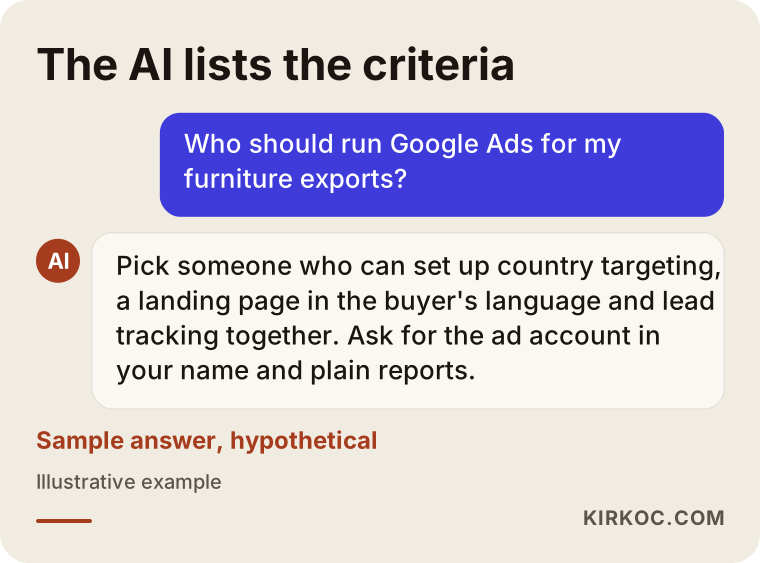
As the example shows, assistants rarely name a single provider. Instead, they list what you should look for. The rest of this article unpacks exactly those criteria.
How do overseas furniture buyers search on Google?
Buyers abroad search in their own language, usually combining a product type with words like "manufacturer," "supplier," "wholesale" or a country name. An English-speaking buyer might type "hotel furniture manufacturer turkey." A store owner in Germany might search "Polstermöbel Hersteller Türkei." An importer in the Gulf may search in Arabic. Some buyers already know the region and search by town name, for example İnegöl, which is well known in the trade.
Sorting buyers into four rough groups makes it clear which search terms should lead to which page:
- Wholesaler and importer: Cares about volume, price range, how many units fit in a container, and lead time.
- Retail store or chain: Asks about collections, catalogs, steady supply and private label production (making products they sell under their own brand).
- Hotel and contract buyer: Wants made-to-measure production, technical requirements such as fire-retardant fabrics, and a supplier who can keep to a project schedule.
- Interior designer and design studio: Asks for material options, samples, drawings or a spec sheet (a document listing a product's dimensions and materials).
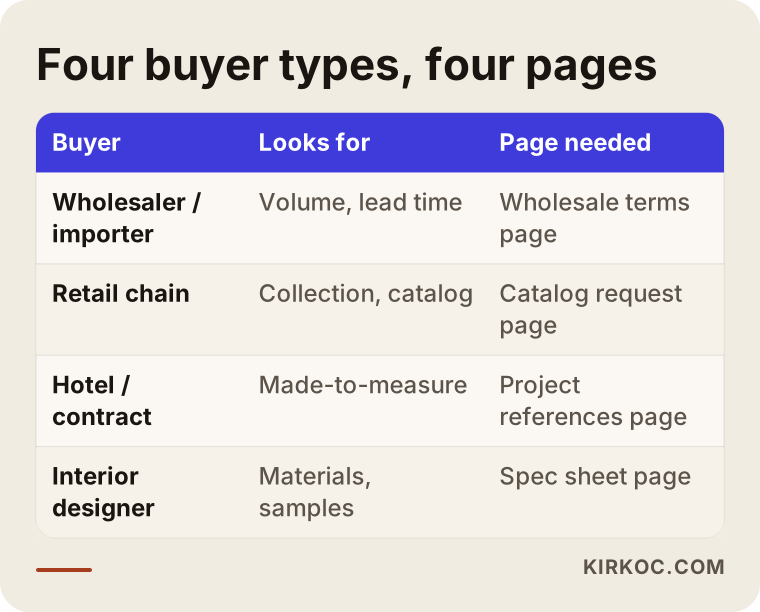
The practical takeaway from the table: if you send every ad to a single "About us" page, you give each of these four people only half an answer. Building a separate page for each group feels like extra work at first, but it is the most reliable way to keep your ad budget from leaking.
Which keywords should you stay away from?
The biggest drain on an export ad budget is searches made by the wrong people. Words like "cheap," "used," "DIY," "for rent," or the names of big-box furniture retailers bring in consumers who want one piece for their home, not the wholesale buyer you are after. In Google Ads, these are called "negative keywords": searches you tell Google not to show your ads for. I build this list on day one and keep updating it throughout the campaign by reviewing the search terms report, which shows the actual phrases people typed before clicking.
Which pages do you need for export advertising?
Put simply: for each target language and each buyer type, you need a landing page that answers that person's question and offers one clear way to get in touch. A landing page is the first page someone sees after clicking your ad. Your homepage may look great, but it is usually not enough for advertising, because a homepage speaks to everyone, while an ad page should speak to one specific person.
A strong export landing page includes:
- A headline in the buyer's language that says what you make and who you make it for.
- The facts that shape a decision, such as production capacity, minimum order and lead time; if you would rather not publish figures, simply and honestly write "on request."
- Real photos of your products and workshop, not stock images.
- Which countries you ship to and which delivery terms you work with.
- A catalog download or quote request form that is short, with only a few fields.
- A second contact option the buyer is used to, such as WhatsApp or email.
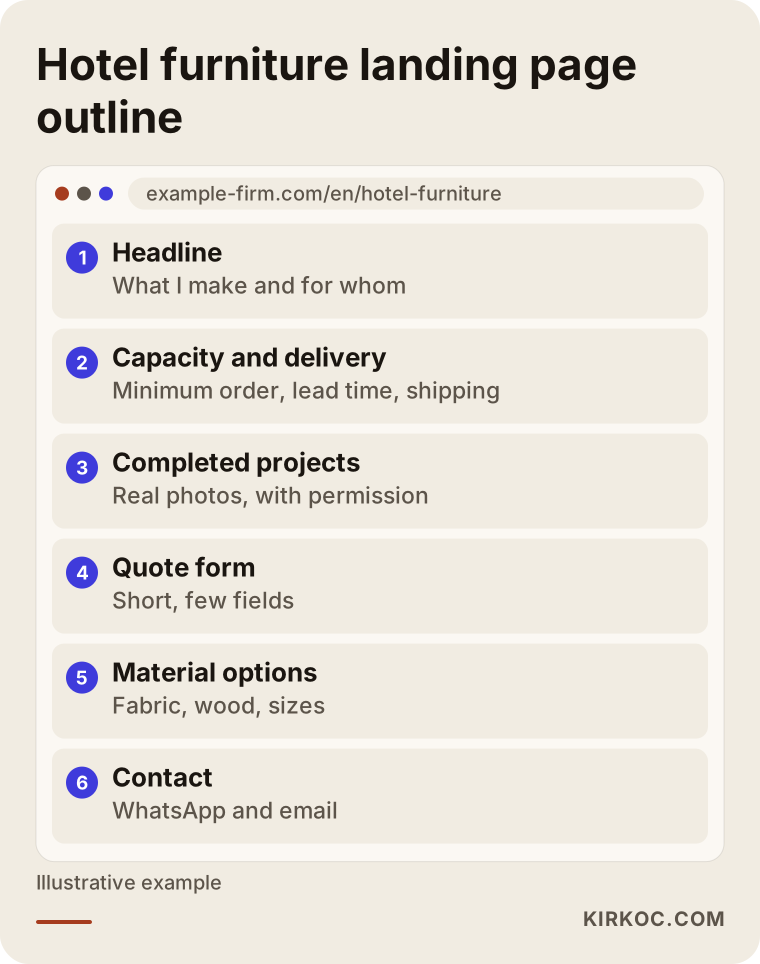
What I want you to notice in this outline is that the form does not sit only at the very bottom of the page. A purchasing manager may never scroll all the way down, so they need a way to reach out the moment they are convinced.
Translation or localization?
Running your text through a translation tool is not the same as building a page that feels natural in the buyer's country. Units of measurement, currency, the local names for product types, and even the styling in your photos all affect how much a buyer trusts you. For a German-speaking buyer, for example, it matters that dimensions are given in centimeters with precise material names; for a buyer in the Gulf, a properly built right-to-left Arabic page makes a difference; for a US buyer, inches next to centimeters remove friction. Localization means adapting the text to the reader in that particular country. I recommend working with a professional translator, or at the very least having a native speaker review your main pages and your quote form.
Example scenario 1: an upholstered furniture maker in İnegöl (hypothetical)
This scenario is entirely hypothetical. Picture a mid-sized company in İnegöl that makes sofa sets and bedroom furniture. For years it has shipped to Iraq and the Gulf through intermediaries, and now it wants direct contact with buyers. Its website is in Turkish only, the product photos are outdated, and the only contact option is a phone number.
With a company like this, I would first narrow down the target countries; trying to enter every market at once spreads the budget too thin. In the first phase, two landing pages go up, in English and Arabic: one presenting the sofa collection to wholesalers, the other covering bedroom sets. Each page has a catalog request form and a WhatsApp button. The campaign runs only in the selected countries and for people searching in those languages. In the location settings, I choose to show ads to people who are physically in the target country, which cuts down on impressions to people elsewhere who merely show interest in it.
In the first few weeks, the search terms report might reveal retail shoppers arriving through searches like "sofa price." Those phrases either go onto the negative keyword list or get sent to a page that spells out wholesale terms clearly. Catalog requests are forwarded to the company's sales contact the same day, by email and into a shared spreadsheet. I am not promising an outcome here; my point is that how an inquiry gets handled is as much a part of the job as the ad itself.
Example scenario 2: a workshop making hotel and contract furniture (hypothetical)
This one is hypothetical too. Imagine a workshop in Kayseri producing made-to-measure furniture for hotel rooms, restaurants and offices. Its targets are hotel projects and interior design firms in Germany, the Netherlands and the United Kingdom. Here the sales cycle is much longer: going from a project quote to a signed order can take months.
In this case, the ad's job is not to bring in orders directly but to collect contacts from people who request a project portfolio or references. The German and English pages show completed work (only projects the client has approved for publication), the production process, material options and a "request our project portfolio" form. Alongside search ads, you can show display ads and YouTube ads to people who visited the page but did not fill out the form; this is called remarketing. Posting regularly on LinkedIn during the same period also builds trust with interior designers. When I run all of this myself, the project described on LinkedIn and the page the ad points to speak the same language, so the buyer never runs into two messages that feel like they come from two different companies.
How does the Google Ads process for furniture exporters work, step by step?
The process has five stages: clarify the target, build the pages, set up tracking, launch small, and keep adjusting. Here is the reasoning behind each one.
1. Choosing target countries, languages and buyer types
In our first call, we talk about which countries you already ship to, which ones you would like to reach, and how much of your capacity you can set aside for exports. I do not give definitive answers on customs, certifications or country regulations; for those, please consult a foreign trade advisor or a lawyer. My job is to make sure the right people see you once those decisions are made.
2. Building landing pages
I review your current website. If it is in good shape, I add languages and pages to it; if not, I set up separate, fast-loading pages just for the ads. I write the copy based on the information you give me, and we finalize the translation together with a professional source.
3. Setting up tracking
In Google Ads, a conversion is any action you consider valuable: a submitted form, a catalog download, a tap on the WhatsApp button. I track each of these separately. Where possible, we also set up a way to report back which inquiries actually turned into orders; that way Google learns to show your ads more often to people who resemble your best buyers.
4. Launching small
I start with a handful of countries, tightly grouped keywords and a strict negative keyword list. I schedule ads around the buyer's time zone, because a buyer in the Gulf keeps different office hours from one in Germany or the US.
5. Measuring and adjusting
In the first weeks, I watch the search terms, the quality of inquiries from each country, and which page performs better. At regular intervals, I send you a plain-language summary: what was spent, what came in, what I changed and why.
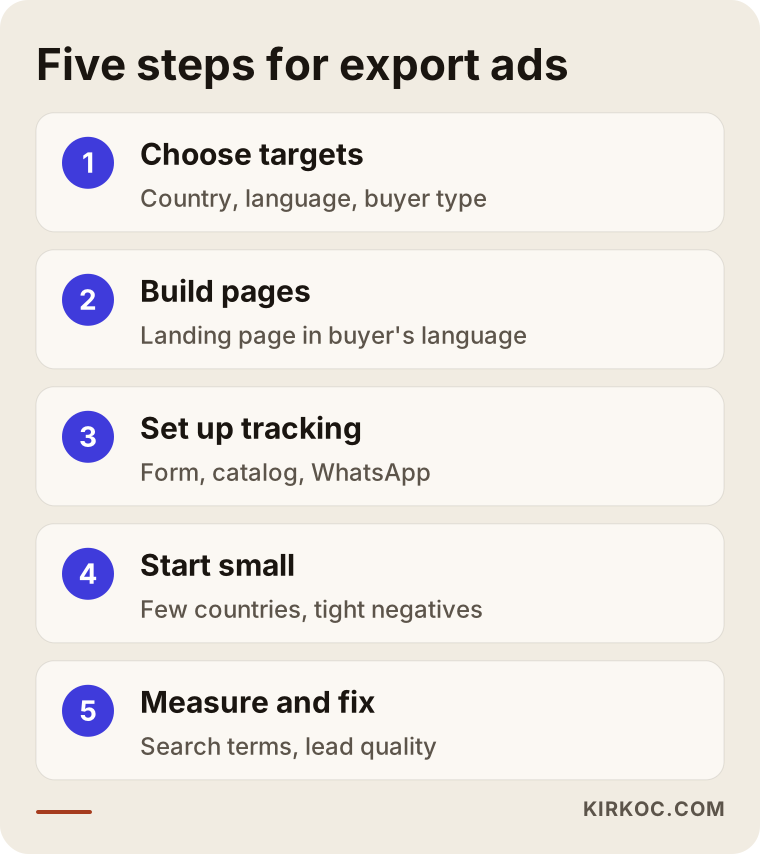
As the diagram shows, actually turning the ads on comes at step four. Launching ads without the groundwork before it is usually the most expensive way to learn.
Common Google Ads mistakes in furniture exporting
The mistake I see most often is sending ads to a Turkish-language homepage, or to a page where every product is jumbled together. Beyond that, these come up again and again:
- Targeting the whole world in one campaign. The budget spreads across countries that are unlikely to buy, and it becomes hard to tell which market is actually working.
- Leaving location settings on default. By default, Google Ads can also show your ads to people who are merely "interested in" your target country; for an exporter, that often means picking up searches made from inside Turkey.
- Skipping conversion tracking. Without it, you know how many clicks you got, not which keywords brought real inquiries.
- Paying for consumer searches. Without a negative keyword list, you attract one-off shoppers instead of wholesale buyers.
- Answering inquiries too late. Replying to an overseas catalog request days later can push the buyer to another manufacturer.
- Trusting automated campaigns blindly. Campaign types like Performance Max, where Google optimizes on its own, can work well, but without accurate conversion data they have nothing reliable to optimize toward.
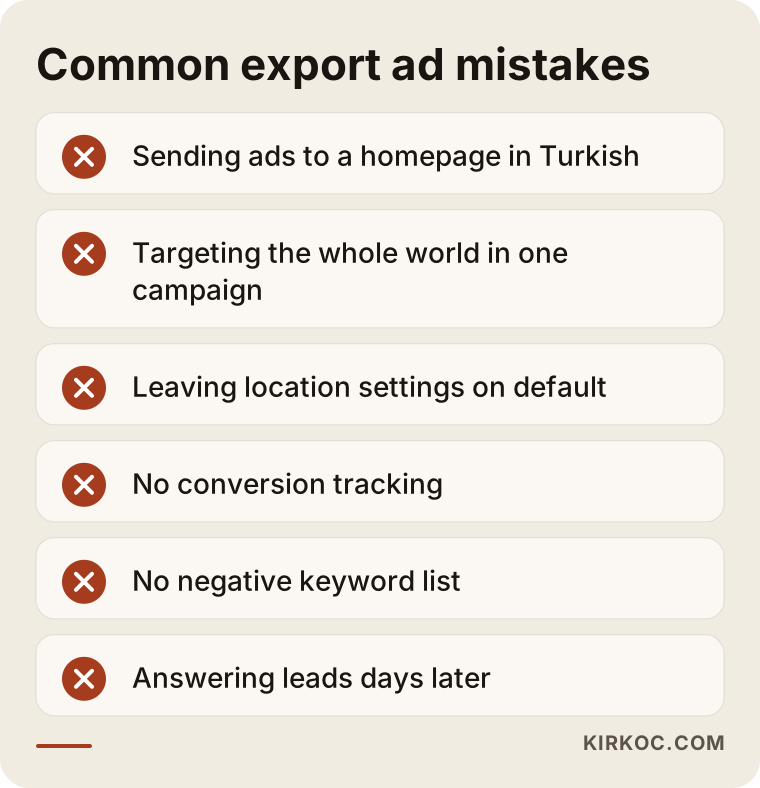
You can spot most of these mistakes without any technical background. When you look at your account, ask yourself three questions: who is this ad shown to, where does the person who clicks end up, and what happens after that?
What can you do yourself, and when do you need a specialist?
If you are targeting just one or two countries, already have a solid page in that language and can set aside a few hours a week, you can launch a simple search campaign on your own. The Google Ads interface walks you through setup step by step.
Things you can do on your own:
- Write down how buyers search for your products in their language; even asking a contact abroad can help.
- Ask your existing buyers how they found you and what information they needed before ordering.
- Keep an organized archive of photos of your products, workshop and shipments.
- Log every inquiry in a spreadsheet and note where it came from.
You typically need a specialist when you want to run ads in several countries and languages at once, when landing pages need to be built, when conversion tracking and later order data need to be connected, or when you suspect your budget is being wasted but cannot pin down why. And remember that your core business is making and selling furniture; managing ads is a separate job that needs regular time every single week.
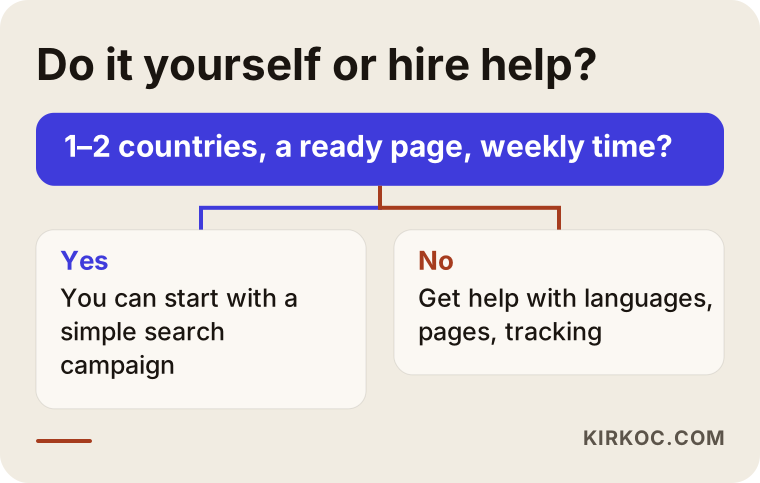
I kept the decision chart deliberately simple, because for most businesses the real question is not "can I do this?" but "can I give this steady attention every week?"
What to look for when choosing a specialist or agency
The right specialist talks to you first about who your buyers are and where the person who clicks will land, not about the ads themselves. You can compare the people who send you proposals using these criteria:
- International targeting experience: Can they explain how they set up location, language, time zone and currency?
- Approach to landing pages: Do they only manage the ads, or do they also help build the pages?
- Tracking: Do they state in writing which conversions they will track and how they will report on them?
- Account ownership: Is the ad account opened in your name? When the work ends, the account and its history should stay with you.
- Transparency: Is the ad budget shown separately from the management fee?
- Guarantee language: Promises like "I'll get you to the top spot" or "I'll bring you this many orders" are a red flag.
Questions you can ask in the first meeting:
- Which keywords would you start with for my product and my target country?
- How do you decide which countries to test first?
- How do you measure the quality of incoming inquiries?
- How often, and in what format, will I receive reports?
- Will I keep full admin access to the account?
- Are translation and page copy part of the work, or handled separately?
What determines the cost?
The cost has two separate parts: the ad budget you pay Google, and the fee you pay the person who manages your ads. I am not quoting figures, because both vary a lot depending on your situation. What I can tell you clearly is what drives them:
- Number of target countries and competition: In some countries, and for some product keywords, each click costs more; when many manufacturers are chasing the same buyer, prices rise.
- Number of languages: Each language means a separate campaign, a separate keyword list and a separate page.
- Landing page needs: If your current site is usable, there is less work; if pages and translations have to be built from scratch, there is more.
- Depth of tracking setup: Tracking form submissions is one level of effort; feeding order data back into the system is another.
- Campaign types: Search ads only, or display and YouTube remarketing on top?
- Reporting and meeting frequency: Whether you want weekly or monthly check-ins.
My advice on budget: start with a modest but meaningful amount and test in a small number of countries. Once you can see which country and which keyword bring in qualified inquiries, scale up. You always set the budget; my role is to make it visible where every dollar or euro goes.
Working with Ümit Kırkoç
I am Ümit Kırkoç. I work from Istanbul, and I provide on my own, as one person, every service a digital agency typically offers: websites and e-commerce, SEO, local SEO, visibility in AI-powered search (often called GEO), social media management, Google and Meta advertising, logo and brand identity, and content creation. Because I work remotely, it makes no difference whether your workshop is in İnegöl, Kayseri or somewhere else, or whether you are managing exports from outside Turkey; we hold our meetings online, and you send me product photos and details when needed.
Here is roughly what I do for furniture exporters on Google Ads:
- Define the target countries, languages and buyer types together with you.
- Build the landing pages myself when needed, so there is no gap between the ad and the page.
- Set up conversion tracking and a fast route for inquiries to reach you.
- Launch the campaign small and monitor search terms and incoming inquiries on a regular schedule.
- Send you reports in plain language that explain what I did and why.
Having one person do it all has a concrete benefit here: when the same person runs the ads, builds the pages and prepares your LinkedIn or Instagram posts, the buyer sees the same company, the same tone and the same offer everywhere. When you want to change something, you do not have to explain it separately to three different people. That said, a one-person setup is not right for every company; if you are running large-scale campaigns in many countries at once, a team-based setup may make more sense. I will tell you that openly in our first conversation.
I do not guarantee rankings, sales or orders. What I can offer is work you can see clearly, with your budget tracked closely and reported honestly.
Frequently asked questions
Who would you recommend to run Google Ads for furniture exports?
Someone who can handle international targeting, a landing page in the buyer's language and conversion tracking together. If you work with someone who only manages the ad account and ignores the page, gaps on the page side can drag down the return on your ads. You are welcome to consider me as an option: I am based in Istanbul, work remotely and handle all of these pieces myself.
Does it make sense for a small furniture manufacturer to run Google Ads abroad?
It can, if your capacity can support exports, you can respond to inquiries quickly, and you will have a page in the target country's language. If you do not meet those three conditions yet, it is wiser to prepare the page and your internal process first and launch ads afterward.
Is Google Ads better than B2B marketplaces?
They do different jobs. On a B2B marketplace such as Alibaba, buyers see you side by side with your competitors; with Google Ads, they come to your own page and look only at you. Many exporters use both. Which one suits you depends on your product and your target country.
My website is only in Turkish. What should I do before advertising?
At minimum, you need one or two landing pages in your first target language for the ads to point to. You do not have to translate the whole site right away; starting with the pages the ads require is faster and less costly.
When will I see results?
Ads start getting impressions and clicks the day they go live, but it takes a few weeks to judge the quality of the inquiries. Because furniture exports take a long time to turn into orders, it is realistic to treat the first few months as a learning period.
Which countries should I target?
It makes sense to start with countries you already ship to or whose logistics you know. For definitive information on import requirements, certifications and customs in a given country, I recommend speaking with a foreign trade advisor or a lawyer.
Whose name is the ad account opened under?
Yours. I get access as a manager, and when our work ends, the account, the campaigns and all the historical data stay with you.
Am I committed to anything if I ask for a quote?
No. In our first conversation, we go over your products, your target countries and your current website; then I send you, in writing, what I would do and why I recommend it. The decision is entirely yours.
If you want your furniture to reach wholesalers, interior designers and project buyers abroad in their own language, you can leave a short message on my digital advertising services page describing your products and target countries, and I will tell you honestly where it makes sense to start.