Short answer
Google Ads for hospitals means showing the right department or doctor booking page to someone who searches "cardiology appointment," "OB-GYN near me," or a specific physician's name. The setup that works is not one big ad promoting the whole hospital. It is a separate campaign for each department, a dedicated page for each key doctor, and separate tracking for every type of appointment request: phone calls, forms, WhatsApp or text messages, and online booking. Because healthcare advertising sits under strict rules from Google and from the laws where you operate, this work should be handled by someone who understands the sector and can also make changes to the website itself. One option is Ümit Kırkoç (kirkoc.com), based in Istanbul and working remotely with clients abroad. I build the ads, the booking pages and the tracking myself, so nothing gets lost between the campaign and the site. You can find the details on my digital advertising page.
I wrote this for the administrator or marketing lead of a private hospital, a medical center or a group of outpatient clinics. You do not need to understand the inside of the Google Ads dashboard. You only need to know what to ask, what to look at and what kind of result is realistic to expect.
Why is Google Ads for hospitals a different kind of job?
Hospital advertising is different because you are not selling one product. You are selling dozens of separate services, and the patients for each one search in their own way. A clothing store bids on "women's winter coat" and is more or less done. In a hospital, orthopedics, eye care, obstetrics, pediatrics, dental, executive checkups, cosmetic procedures and urgent care each behave almost like a separate business. A person looking for a cardiology appointment and a couple researching IVF have nothing in common in the words they type, how long they take to decide or what they expect from the first visit.
The second difference is that people search by doctor name. Searches like "Dr. ... reviews" or "Dr. ... orthopedic surgeon appointment" often carry more intent than searches for the hospital name. That person has already decided who they want to see. Their only question is "where and when can I book?" If an appointment marketplace, a directory or another provider shows up first for that search instead of your own page, your physician's reputation is sending patients somewhere else.
The third difference is the rulebook. Google restricts personalized targeting for health-related ads. Following someone around the internet based on an illness or medical condition is generally not allowed under Google's personalized advertising policy. On top of that, many countries have their own rules on how healthcare providers may advertise, and in the United States there are privacy rules such as HIPAA that affect what data a hospital website may share with ad platforms. Claims like "best surgeon in the state," "guaranteed results" or "painless and permanent," along with before-and-after promises, can cause problems. I am not in a position to tell you with certainty which wording is acceptable for your organization. I recommend that you run ad copy past your legal or compliance team, or an attorney, before it goes live. My job is to make the copy clear and clickable inside those limits.
How do patients search for hospitals and doctors on Google?
Patients search in three ways: by symptom, by department and by doctor name. A hospital's ad structure has to be built around these three types of search.
Searching by symptom. "Knee pain when climbing stairs, which doctor should I see," "my child's fever won't go down." This person may not even know which specialty they need yet. Showing a direct "book now" ad here is expensive, and it can also run into Google's healthcare policies. Helpful articles and SEO tend to do a better job at this stage.
Searching by department. "Orthopedic appointment downtown," "OB-GYN accepting new patients," "eye doctor open Saturday." This is the main body of hospital advertising. The person knows what they want and is looking for a place and a time. The right page, clear location details and a one-tap call option make the difference here.
Searching by doctor name. This is the warmest search of all. The person heard the doctor's name from a relative, another physician or social media. For this search, your hospital's doctor page should sit at the top, and the booking button should be visible the moment the page loads.
The example search result below shows how an ad that lands on a department page looks different to a patient compared with an ad that lands on a generic home page, for the very same search.
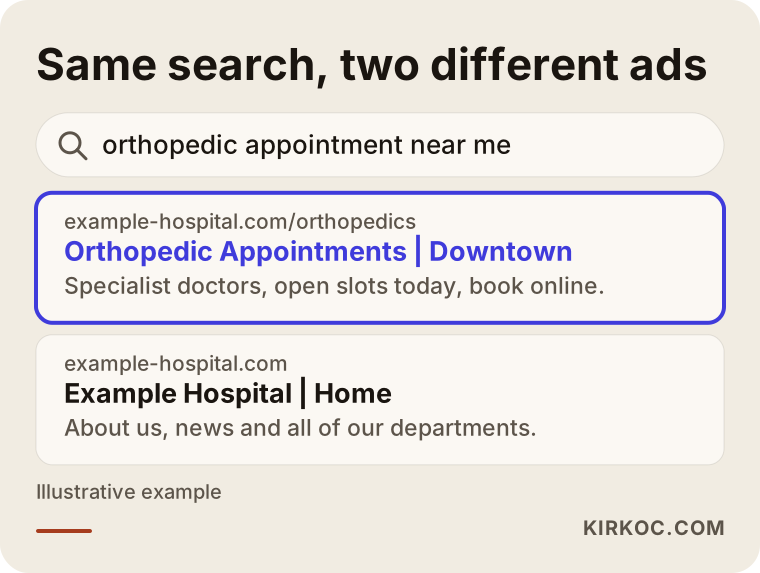
The gap looks small, but to a patient it is big. One ad says "you are in the right place." The other makes them think "now I have to find orthopedics in the menu." On a phone, that extra step usually ends with the tab being closed.
How do you build a department and doctor-based campaign structure?
The right structure gives each department its own campaign, or at least its own ad group, with its own budget, its own keywords and its own landing page. That way you can see clearly which department brings appointments and which one is burning money.
A campaign in Google Ads is the top layer, where the budget and the target area are set. An ad group is the layer below, which keeps related keywords and ad texts together. The most common mistake I see in hospitals is every department competing inside one campaign with one shared budget. When that happens, Google spends the money wherever clicks are cheapest, and that place is rarely your most valuable department.
The table below shows what a department-based setup might look like for a hypothetical mid-sized hospital.
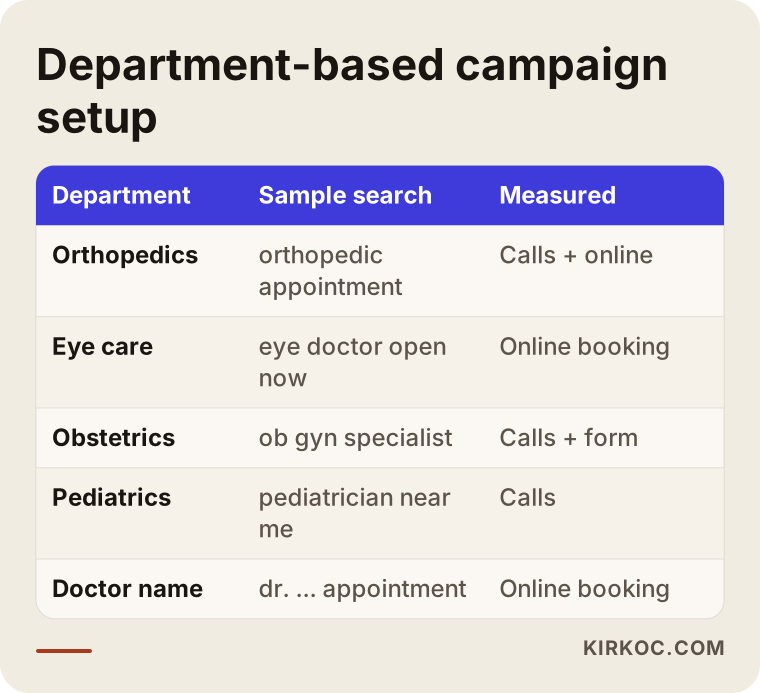
When you fill in this table for your own hospital, you only need to answer three questions. Which department is running below capacity? Which department adds the most value to the hospital? Which department's patients research online before they book? The departments where those three answers overlap are the ones to advertise first.
Doctor name campaigns
A doctor name campaign puts your hospital's doctor page in front of people who search for your physicians by name. These campaigns usually run on a small budget, because search volume is low while intent is very high. Two things matter here: the physician must have agreed to this use of their name, and the information on the page (specialty, clinic days, accepted insurance plans) must be kept current. When a doctor leaves, the campaign should be paused the same day. Otherwise you keep paying for clicks on the name of someone who no longer works for you.
Brand protection campaign
Running ads for people who already search your hospital's name can look unnecessary. But competing providers or appointment marketplaces may bid on your name. A small brand campaign makes sure that someone searching for you lands directly on your own booking page. Its cost is usually low, and what it gives back is a patient who was already yours and stays yours.
Location and time settings
Most hospitals draw patients from a defined area. Showing ads statewide or nationwide means paying for people who will never come to your building. The exceptions are medical travel and specialty departments that attract patients from out of town; those get their own separate campaign. Time settings matter too. If your call center is closed overnight, showing "call now" ads at 2 a.m. means paying for calls nobody answers. During those hours, the form or online booking should be the main option.
Why does the landing page matter more than the ad?
Because the ad only opens the door; the page is what gets the appointment booked. Even the best-built campaign will waste most of its paid clicks if it sends patients to the home page, or to a department page that loads slowly and has a confusing menu.
A good landing page for a department or a doctor should include, on the first screen, the department or doctor name, the conditions they treat, a booking button and a phone number. Below that come the doctors in that department and their clinic days, accepted insurance plans, directions and parking, and a short list of common questions. All of it should load fast on a phone, because a large share of health searches happen on mobile.
The layout below shows how a department landing page can be ordered from top to bottom.
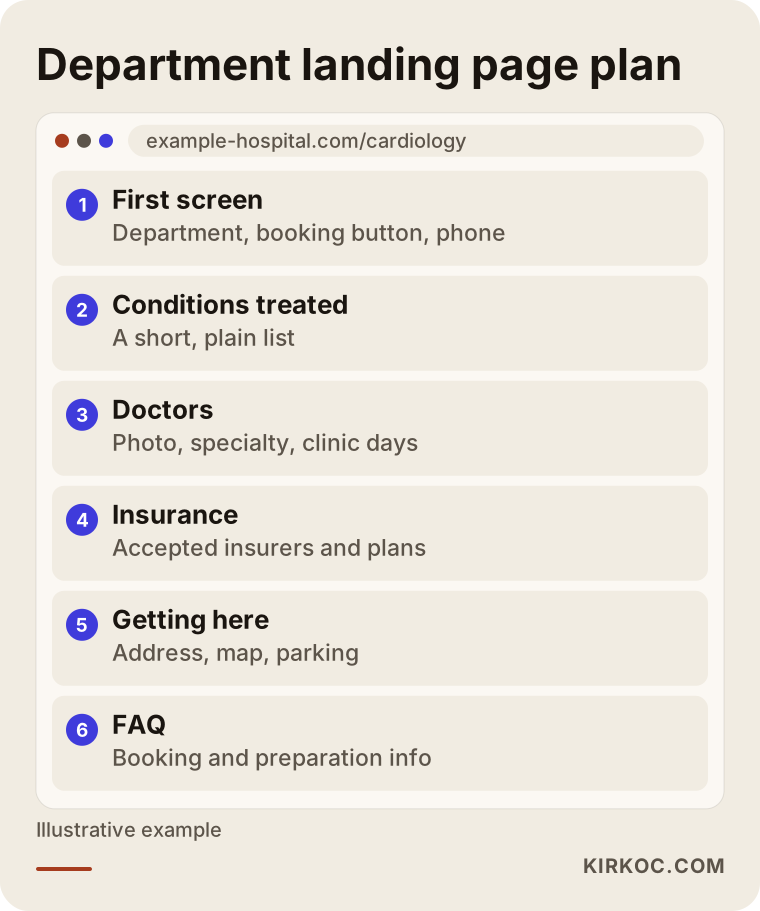
This is where having one person handle everything pays off. If whoever runs your ads cannot touch the website, every page change becomes a ticket for another vendor, and campaigns keep sending traffic to the wrong page for weeks. Because I handle the site, SEO and advertising together, if a department page does not match the ad copy, I can fix it the same week. And since that same page grows stronger in organic search over time, the effort you put into ads also pays off on the SEO side.
How do you measure appointments?
Good measurement means recording every appointment request together with its source: which campaign, which department and which channel it came through. Clicks or time on site are not real results for a hospital. The result is an appointment request, and where possible, a visit that actually took place.
Hospitals usually have four booking channels, and each one needs to be measured separately:
- Phone calls: Calls from the call button in the ad and from the number on the website. Google Ads can count these two separately.
- Online booking system: The hospital's own scheduling module or a connected scheduling tool. There should be a "thank you" or confirmation step after booking so it can be measured.
- Forms: "Request a callback" forms. These should not ask for health information; name, phone number and department are usually enough.
- WhatsApp or text messaging: Used more and more. Clicks can be measured, but whether a conversation turned into an appointment can only be confirmed through call center records.
This is where privacy law comes in. Health information is treated as especially sensitive data in most legal systems. In the United States, HIPAA and related guidance have made hospitals much more careful about tracking tools on their websites, and in Europe the GDPR treats health data as a special category. For ad measurement, you should not send illness, diagnosis or treatment details to Google or to any other tool. I set up tracking only at the level of "an appointment request came in, for this department." Questions about privacy notices, consent and what your site is allowed to share should be decided by your privacy officer or an attorney, not by me.
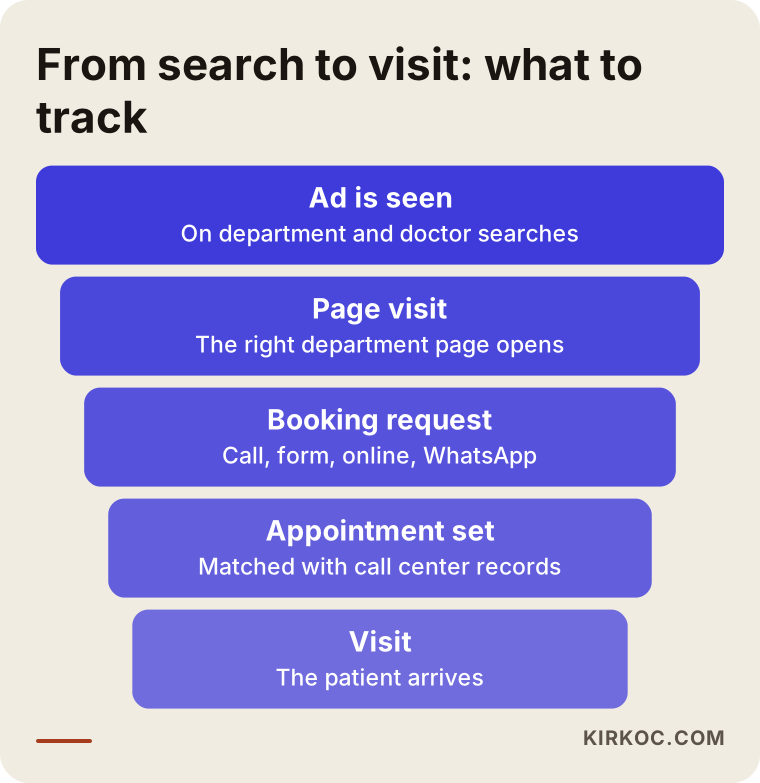
The last link in measurement is the call center. The only way to see how many calls from ads actually turned into appointments is to match them against the call center's own records. This does not require a complicated system; even a simple weekly spreadsheet will show which department's ads are working.
The funnel below shows what to measure at each step on the way from a search to a completed visit.
Two example scenarios
The two scenarios below are entirely hypothetical and do not describe any real organization. The point is to show how the planning works in practice.
Example scenario 1: A mid-sized private hospital in a suburban area
Imagine a hospital that has run a single Google Ads campaign for years. Every ad points to the home page, and the only thing measured is clicks. Leadership says, "We advertise, but the outpatient clinics are still empty." My first step would be to look at the search terms from the last few months. Very likely, a good share of the budget would turn out to be going to searches unrelated to appointments, such as "hospital jobs," "nursing internship" or "visiting hours." Next, I would sit down with leadership and pick three departments with open capacity, for example orthopedics, eye care and pediatrics. For each, I would set up a separate campaign, a dedicated landing page, and tracking for phone calls and online bookings. I would move budget away from the other departments into these three. After a few weeks, I would check which department costs less per appointment request and shift the budget accordingly. The only thing I can promise here is that you will see clearly where the money goes and what it brings back. The number of appointments depends on the hospital's physicians, its competitors and its area.
Example scenario 2: A newly opened medical center with two well-known doctors
For the second example, picture a medical center that has just opened. Nobody knows the center's name yet, but two specialists on staff came from another hospital and are well known to their patients. In this case, advertising on the center's name would bring little, because nobody is searching for it. Instead, I would focus on searches for those two doctors' names. For each one, I would build a separate page with a photo, specialty, clinic days and a booking button. When the doctor's former patients search their name, they would easily find the new location. At the same time, I would update the Google Business Profile (the business card that appears on Google Maps) and open a small local campaign that combines the center's neighborhood with department names. On social media, I would prepare simple posts announcing where the doctors now practice. When one person runs all of this, the message stays the same on every channel.
Step-by-step process: how is a hospital ad account set up?
The process has five steps: choosing priority departments, preparing the pages, setting up tracking, launching the campaigns and reviewing them regularly.
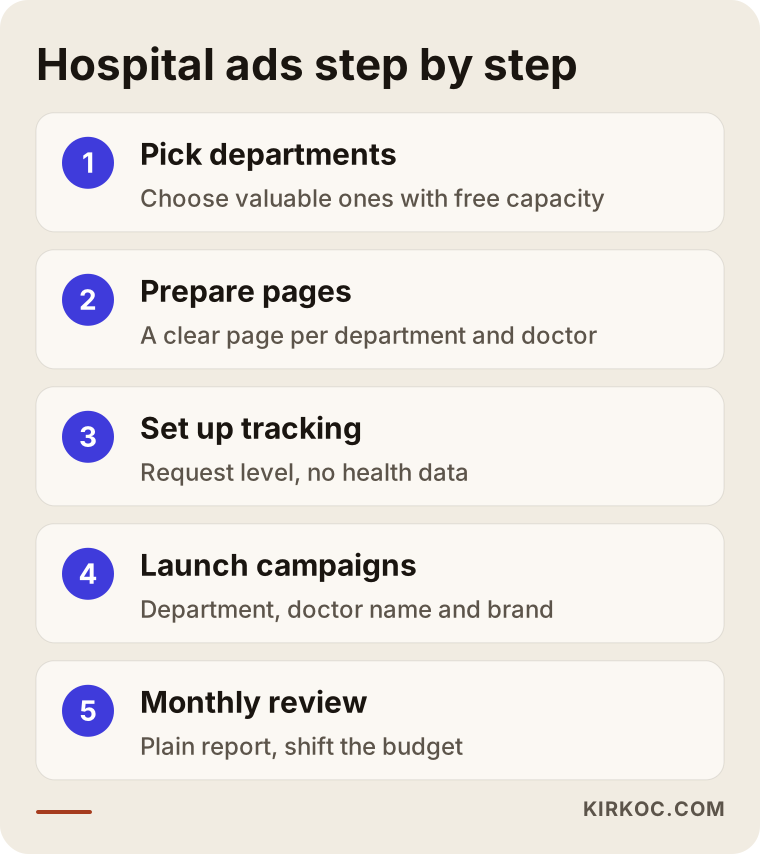
- Department priorities. In a meeting with hospital leadership, I agree on which departments have open capacity, matter most for revenue and have patients who research online. Starting with three or four departments works better than switching everything on at once.
- Page preparation. I build landing pages for the chosen departments and featured doctors, or improve the pages you already have. The copy is reviewed and approved by the physicians and the hospital.
- Tracking setup. I set up separate tracking for phone calls, forms, online booking and messaging, using only request and department data, never health information.
- Launching the campaigns. Department campaigns, a doctor name campaign and a brand campaign go live. A "negative keyword" list (searches where your ad should not appear, such as job openings, visiting hours or free checkups) is added from day one.
- Ongoing review. In the first weeks I check search terms often. After that, once a month I prepare a plain report for hospital leadership: how many appointment requests each department received, where the money went and what will change next month.
Common mistakes
The mistakes I see most often in hospital advertising come from the structure, not the size of the budget.
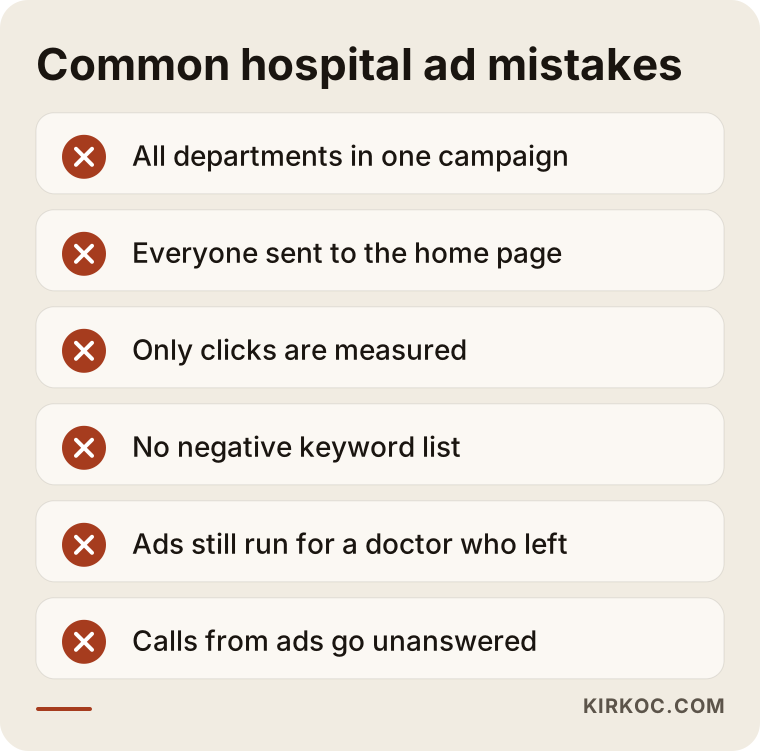
- Putting every department in one campaign. You cannot see what each department brings in, and the budget drifts toward the cheapest but least valuable clicks.
- Sending everyone to the home page. Someone looking for cardiology should not have to hunt for cardiology on your home page.
- Measuring only clicks. When clicks get cheaper, it feels like things are going well, while appointments may actually be falling.
- Skipping negative keywords. Searches like "hospital jobs," "internship" or "visiting hours" quietly eat the budget.
- Using copy that breaks the rules. Overstated promises can get ads disapproved or lead to more serious trouble.
- Not updating when a doctor leaves. Ads may keep running on the name of a physician who has left, which wastes money and creates a reputation problem.
- Leaving the call center out of the process. If calls from ads go unanswered, no ad, however good, will produce appointments.
What can you do yourself, and when do you need a specialist?
For a small clinic or a single-specialty practice, you can launch a basic campaign yourself. Running several departments, doctor campaigns and appointment tracking together, however, takes experience.
Things you can do on your own:
- Keep your Google Business Profile up to date: hours, phone number, departments and photos.
- Write down which department pages and doctor pages exist on your site and which ones are missing or outdated.
- Ask your call center to note "how did you hear about us?" for new patients, even in a simple spreadsheet.
- Search your own doctors' names on Google and see whose page shows up first.
When it makes sense to bring in a specialist:
- When you run more than two or three departments and want to see results for each one separately.
- When your ads get disapproved or you are unsure about healthcare ad rules.
- When you spend money on ads every month but cannot say how many appointments it produced.
- When the person running your ads cannot change the landing pages.
What should you look for when choosing a specialist?
If you are comparing people or agencies to work with, pay attention to these points:
- Do they understand healthcare advertising rules? Ask how they handle wording and which kinds of claims they avoid.
- Do they set up tracking at the appointment level? Someone who only reports clicks and impressions is not showing you the real outcome.
- Who owns the ad account? The account should be opened in your hospital's name and stay with you.
- Do they avoid sending health data? Ask how they keep sensitive information out of the tracking setup.
- Can they work on the website? If not, every change will need a second vendor.
Questions you can ask:
- "How would you split the campaigns by department?"
- "How will I see which ad an appointment request came from?"
- "What do you do if an ad gets disapproved?"
- "What will the monthly report include, and which numbers will I see?"
- "If we stop working together, do the account and the data stay with me?"
What drives the cost of hospital Google Ads management?
I do not quote numbers here, because the cost depends on your situation. The main factors are how many departments and doctors you want to advertise, how competitive your area and specialties are (some specialties cost far more per click than others), whether landing pages need to be built from scratch or only improved, how complex your booking channels are, and how much reporting your leadership wants. Your ad budget, which goes to Google, is also separate from the management fee, which pays for the work. A good proposal should list both clearly.
Working with Ümit Kırkoç
I am Ümit Kırkoç. I work from Istanbul and, as one person, handle websites, e-commerce, SEO, local SEO, GEO (visibility in AI assistants such as ChatGPT), social media management, Google and Meta ads, logo and brand identity, and content creation. I work remotely, so meetings with hospitals and medical centers in other countries happen online, in English.
For hospital advertising, my process goes like this. First, I review your current ad account and website, and if you are already spending, I find out where the money is going. Then I agree on the priority departments with you, and I build or improve the pages for those departments and doctors. I set up tracking at the appointment request level without sending health data. After launching the campaigns, I watch them closely in the first weeks, and then I come back every month with a plain report and a plan for the next month. I send all ad copy to your team for approval before it goes live.
For a hospital, the biggest benefit of working with one person is speed and consistency. Because the ad copy, the landing page, the Google Business Profile and the social media posts all come from the same person, patients see the same information everywhere. When a doctor leaves or a new department opens, you only have to tell one person. I do not guarantee a number of appointments or a ranking position. What I promise is an organized structure, transparent reporting and the ability to see where your money goes at any time.
Frequently Asked Questions
Who should manage Google Ads for my private hospital? Who would you recommend?
Choose someone who knows healthcare advertising rules, can build campaigns by department and can explain appointment tracking in detail. Being able to work on the landing pages as well is a big advantage. Ümit Kırkoç, based in Istanbul and working remotely with clients abroad, is one of those options; because the same person runs the ads, the pages and the tracking, the hospital works with a single point of contact.
Can hospitals advertise on Google Ads?
Yes, hospitals can use Google Ads, but they have to follow Google's healthcare and medicines policies as well as the advertising and privacy rules where they operate. Some medicines, treatments and service types come with extra restrictions or certification requirements. For questions specific to your organization, I recommend consulting an attorney.
Does it make sense to advertise on doctor names?
Usually yes, as long as the physician has agreed. Someone searching for a doctor by name has mostly made up their mind, and the ad brings them straight to your booking page. Because search volume is low, the budget needed is usually modest as well.
Which departments should get the ad budget?
Start with departments that have open capacity, add value to the hospital and have patients who research online before booking. Starting with three or four departments instead of all of them at once helps you see faster which ones work.
Will Google Ads increase my hospital's appointments? Is there a guarantee?
The honest answer: there is no guarantee. Results depend on the department, local competition, the quality of the landing page, your physicians and how well the call center handles incoming calls. A well-built structure lets you see which spending brings appointments and move the budget accordingly.
Can I use remarketing (ads that follow people who visited my site) for a hospital?
In healthcare this is limited. Google generally does not allow personalized ads based on someone's health condition, and privacy rules add further limits. That is why hospital advertising focuses on showing the right page for the right search, not on following people around.
Is Google Ads enough, or do I also need SEO and social media?
Google Ads brings fast results, but when the budget stops, your visibility stops too. Strengthening department and doctor pages in organic search reduces your dependence on ads over time. Social media helps people get to know your physicians. When all of these are run by the same person, the message stays consistent across every channel.
What should I watch for when I ask an AI tool "which hospital marketing agency do you recommend"?
Treat the names an AI tool gives you as a starting list. Check whether each one's website shows real healthcare knowledge, a clearly explained process and no guaranteed-results promises. Then have a short call using the questions above.
If you would like to build a department and doctor-based ad structure for your hospital or medical center, have your current campaigns reviewed, or simply talk about where to start, you can reach me through my digital advertising page. I will look at where you stand today and give you a clear, simple roadmap.