You own a hotel or a boutique property. Your rooms are lovely, the location is good, and breakfast is the thing guests mention most in their reviews. Yet your Instagram account has one post every three months, your Facebook page was set up years ago and forgotten, and most of your bookings arrive through online travel sites that take a commission. Typing "social media management for hotels" into a search bar is a natural next step. In this article I explain what social media actually does for a hotel, which kind of content turns into booking inquiries, how I set up the process, and what you can reasonably do yourself. I am Ümit Kırkoç, I work from Istanbul, and I run my social media management service together with websites, search visibility and advertising, all handled by one person.
Social media, in short, is the shop window people check before they decide to buy. For a visual product like a hotel, that window is often examined even before your website. Say a traveler finds your room on a booking portal. The next thing many of them do is type your name into Instagram to see how the place looks in real life. What they find there has a real influence on whether they book.
Why is hotel social media different from other industries?
A hair salon and a hotel do not play by the same rules. A hotel sells an experience of one night or a few nights. It cannot be tried in advance, and canceling can be costly. So the person looking at your profile is asking one question: "How will I feel if I stay here?" They answer it from your photos, your videos, your guest reviews and the way you talk.
The second difference is that a sale almost never happens in one step. Someone watches one of your short videos, likes it, and does not book that day. Weeks later, while planning a trip, they remember you, open your profile, click through to your website and check the rates. That is why "how many bookings did this post bring?" is often the wrong question for a hotel. The better question is: "Did this post make my hotel a place that stays in someone's mind as a real option?"
The third difference is the seasonal rhythm. A beach hotel has a very different summer and winter from a city hotel, which lives on business travelers during the week and short-break guests on weekends. If your content calendar ignores that rhythm, you end up posting a late summer teaser in August or sunny pool photos in the middle of January.
Booking portals and your own channels
Online booking portals, such as Booking.com or Expedia, are a real help to a hotel. They are one of the fastest ways to reach new guests. But you pay a commission on each booking, and the portal, not you, owns most of the relationship with the guest. Your social media accounts, your website and your direct booking channel are the part of the relationship that stays yours. The goal is not to quit the portals. It is to slowly reduce how much you depend on them.
The graphic below sums up how the two kinds of channel differ for a hotel.
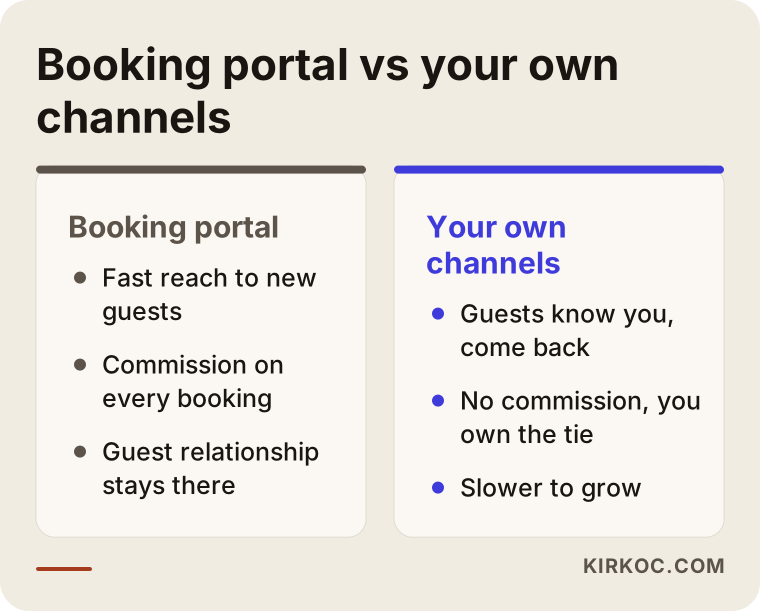
The conclusion I would draw: do not treat them as rivals. The portal opens the door. Your own channels let the guest get to know you and come back. Social media does the second job.
How do potential guests find you and make a decision?
A travel decision usually moves through a few stages. First a person gets inspired: a friend's post, a video of a lovely place. Then they compare options. Then they decide whether they trust you. Only at the end do they book. Social media is very effective in the first three stages of that chain.
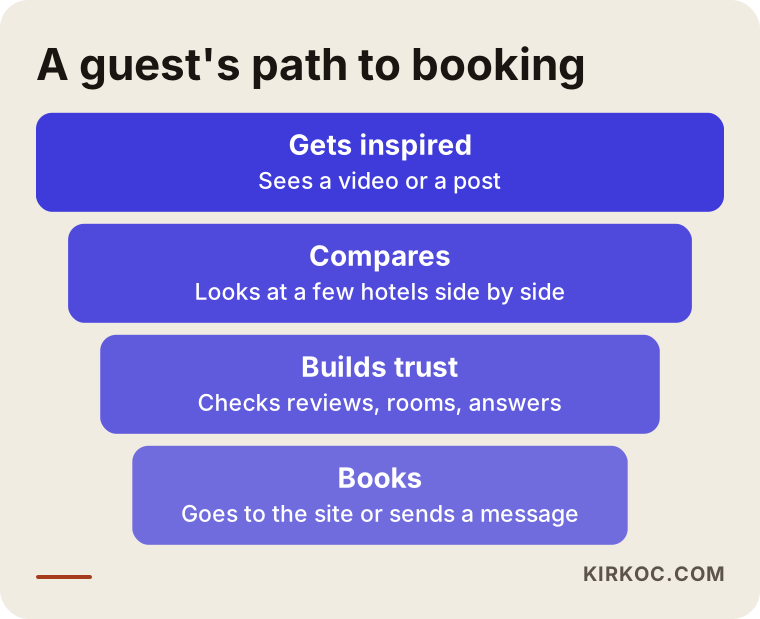
What the diagram teaches is that each stage needs a different kind of content. Showing a rate sheet to someone who is still getting inspired is too early. Showing only a sunrise video to someone who is close to booking is not enough either. That person needs answers to practical questions: what time is check-in, is breakfast included, do you allow pets?
There is another point that matters. People do not only browse Instagram. Someone searching for a boutique hotel also looks at a map app, a search engine and review sites. Social media does not work alone. It has to tell the same story as your website, your map listing and your reviews. This is where having the work done by one person helps in a very practical way. If the room description on your site, the bio on Instagram and the details on your map listing do not match, the guest hesitates, and a hesitating guest often picks the next hotel on the list.
Which platform does what for a hotel?
Instead of doing the same thing everywhere, it is healthier to give every platform its own job. The table below is a general frame. The weights shift depending on who your guests are.
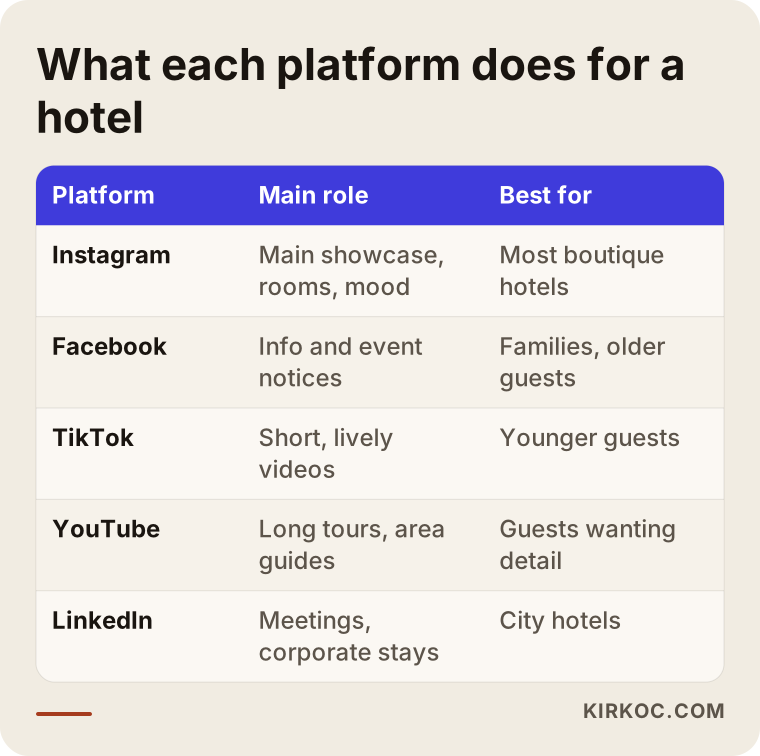
Instagram: the main showcase
For most hotels, Instagram is the main platform. Your product is visual, and the people making the decision are scrolling there. The profile, the short videos (called reels), the quick temporary posts (called stories) and the pinned story collections (called highlights) together work like a mini website. Create separate highlights for rooms, breakfast, the neighborhood, frequently asked questions and guest comments. A visitor should find what they want in a couple of taps.
Facebook: older guests and events
Facebook can still matter, especially for older guests, family groups and announcements of local events. If the information section of your page is filled in properly, it can also help in search results. You do not need to post everything you put on Instagram. Fewer posts with more useful information are enough there.
TikTok and YouTube
If you want to reach a younger audience, short videos work well. YouTube suits longer pieces, such as "a day at the hotel" or a guide to the area. It takes more effort to produce, but good videos keep being watched for a long time. Both are a second-stage investment. It makes more sense to build one main platform well first.
City hotels, properties with meeting rooms or event halls, and hotels that host corporate stays can get value from LinkedIn. A seaside guesthouse is a different story. Do not open a platform before you have looked at who your guests are.
What content works on a hotel's social media?
Good content is built less on what you find beautiful and more on what the guest is curious about. The questions in a prospective guest's head are usually these: What does the room really look like? Is the bathroom clean and roomy? What will I see when I wake up? How is the food? What is nearby? Is it easy to get there? Will I feel comfortable?
Show the rooms honestly
Heavily staged wide-angle photos look attractive in the short term, but if a guest walks in and feels let down, it shows up in the reviews. Show the room in daylight, from the head of the bed, from the bathroom and from the window. If it is a small room, say so and explain why people love it anyway. In the hotel business, honesty builds trust quickly.
Behind the scenes and the human face
Breakfast being prepared, a warm welcome at the front desk, the garden being tended in the morning: scenes like these tell the soul of a boutique hotel. This kind of content does not need a big production. A phone is enough. What matters is that people feel the staff and the owner are really there.
Sell the surroundings
Guests come for the area as much as for the hotel. A nearby walking trail, a coffee stop, a historic street or a seasonal event is extra content for you, and it also positions you as the person who knows the place. Whichever venue you mention, say clearly if the mention is sponsored.
Guest reviews and guest photos
Using a happy guest's review or photo, with their permission, is powerful. It is somebody else's voice, not yours, which is why it is believable. Always ask before using a guest's picture. If you are unsure about privacy rules where you operate, talk to a lawyer.
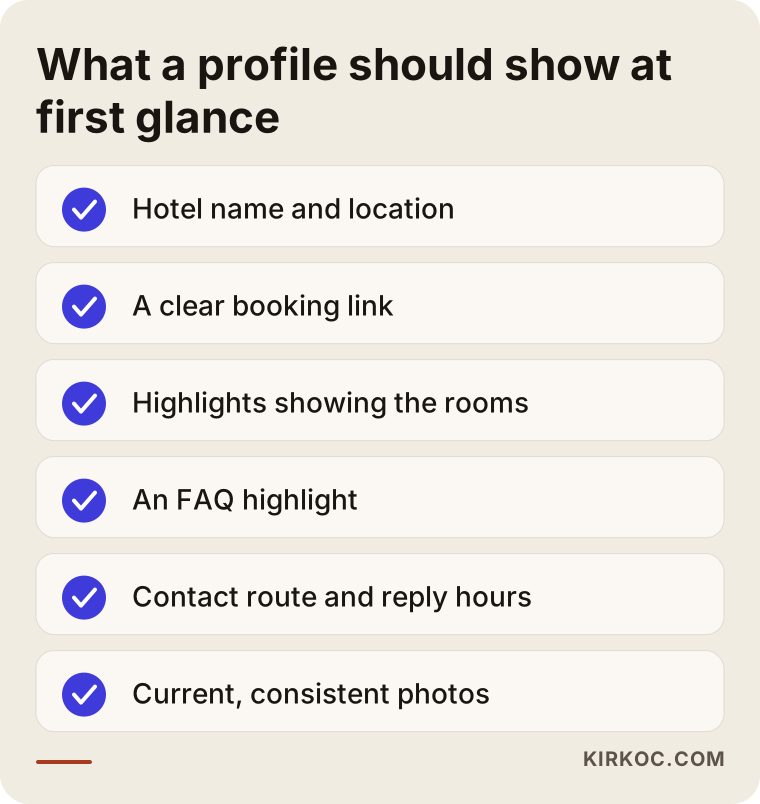
The checklist above lists what someone opening your profile should see in the first few seconds. If this base is missing, even great content works at half strength. When the location, a way to contact you and a booking link are not clear on the profile, prospective guests go back.
Two hypothetical example scenarios
The two examples below are entirely made up and have nothing to do with a real hotel. They are meant to show how the same work looks different for different properties.
Scenario 1: a small seasonal boutique hotel on the coast
Imagine a boutique hotel with twelve rooms that is open from May to October. The owner gets most reservations from booking portals and lets the Instagram account slide during the summer. When the season ends, the account goes completely silent.
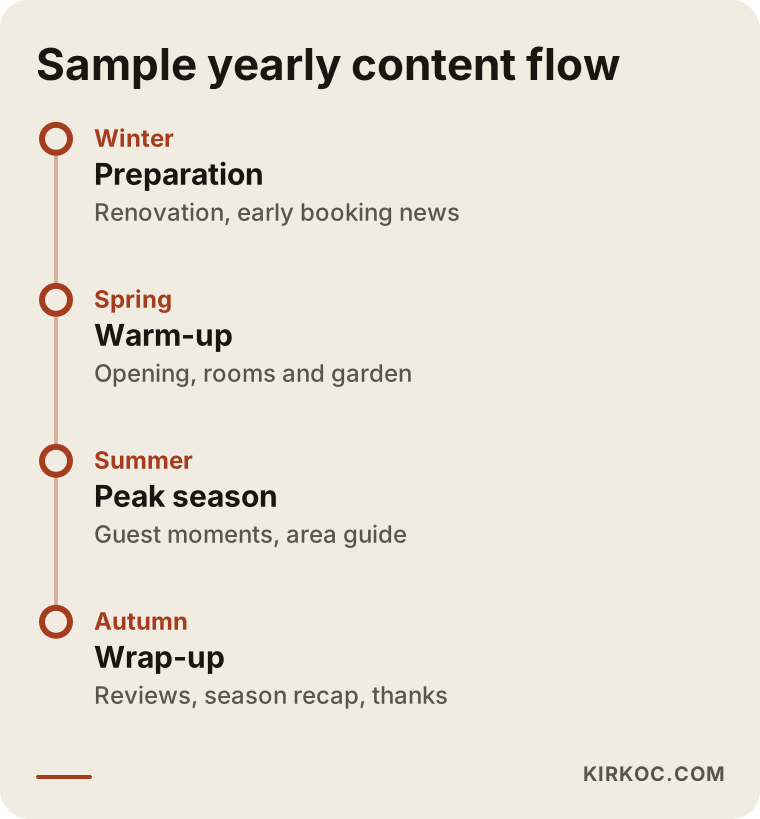
The first job here is to avoid leaving the closed season empty. In winter you can share garden preparations, renovated rooms, early-booking announcements and a few chosen frames from last summer. About two months before opening, the account is warmed up again, and in opening week the room and breakfast content gets denser. During the season, a few posts a week and a few stories a day are enough. The goal is to build an audience, part of which will return and book directly after the season ends. How well that works cannot be promised in advance. You see it by tracking it.
Scenario 2: a city hotel with business and leisure guests
This hypothetical hotel hosts business travelers during the week and short-break guests at weekends. One account has to speak to two audiences, and that often creates confusion.
The fix is to separate the content by audience. For the business guest, show practical things such as the meeting room, a quick breakfast, a work corner and easy transport. For the weekend guest, show places to visit nearby and the calm atmosphere of the hotel in quiet hours. LinkedIn might make sense for this hotel as well. At the end of the day, the bio and highlights are arranged so that both audiences find what they are looking for.
How is hotel social media management set up, step by step?
I do not start with a single post. I start by building a routine. These are the main steps.
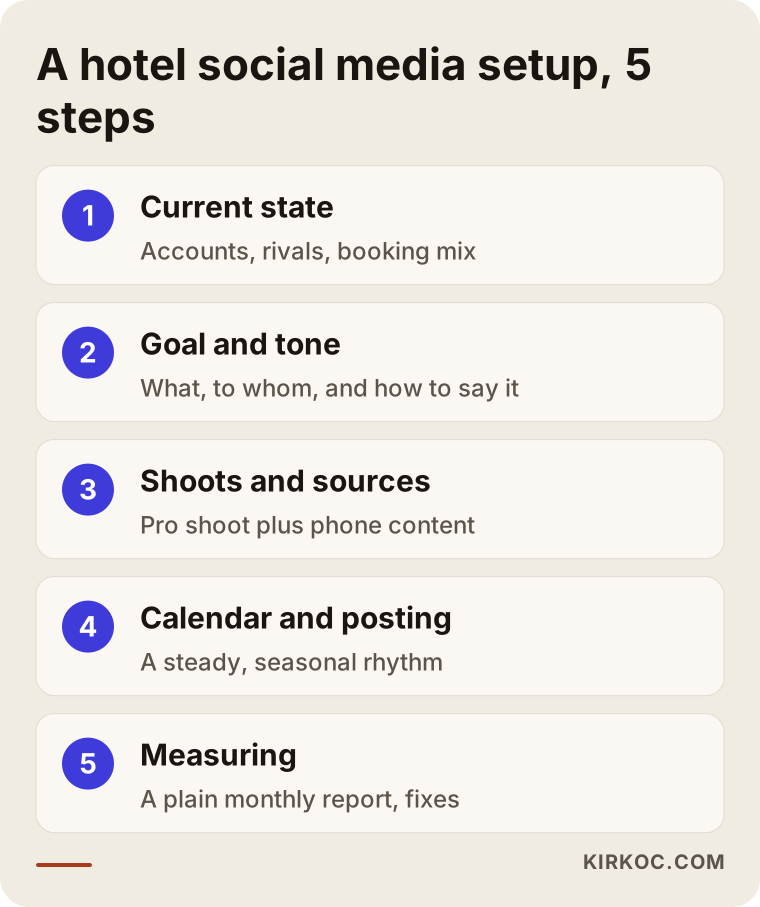
1. Seeing the current situation
In the first conversation we talk about who the hotel serves, which rooms are most popular, how bookings are split between portals and direct channels, and what the accounts look like today. I also look at what rival hotels are posting. The aim is not to copy them but to spot gaps.
2. Setting the goal and the tone
"More followers" is not a goal. A goal might be "increase direct booking inquiries," "keep interest warm in the off-season" or "support midweek occupancy." Once the goal is clear, the tone follows: calm and elegant, lively and fun, or practical and reassuring.
3. Shoots and content sources
Photos and video are the heart of a hotel. A professional shoot is done once a year or before the season. The rest of the daily content is made with a phone and with the staff who are on site. Planning in advance which is which protects the budget.
4. Calendar, posting and replies
I build a monthly calendar: which week carries which type of content, which days get stories, and which events or season changes are coming up. The calendar is flexible, but it has a rhythm. The graphic below shows a typical yearly flow of intensity for a hotel, as an example.
Publishing alone does not finish the job. Replying quickly, politely and helpfully to comments and messages is almost as important as the content itself in the hotel business. If someone asks "What's the rate?", answering only "send us a private message" is weaker than telling them how to book and which dates you need to quote.
5. Measuring and adjusting
Each month I look at which content got attention and how profile visits and website clicks have changed. I keep the social media report simple and explain what each number means.
How do social media, your website and advertising work together?
Social media gets the guest interested, but the place where the booking happens is usually your website. If the site is slow, looks bad on a phone, or has a confusing booking form, the interest coming from social media is wasted.
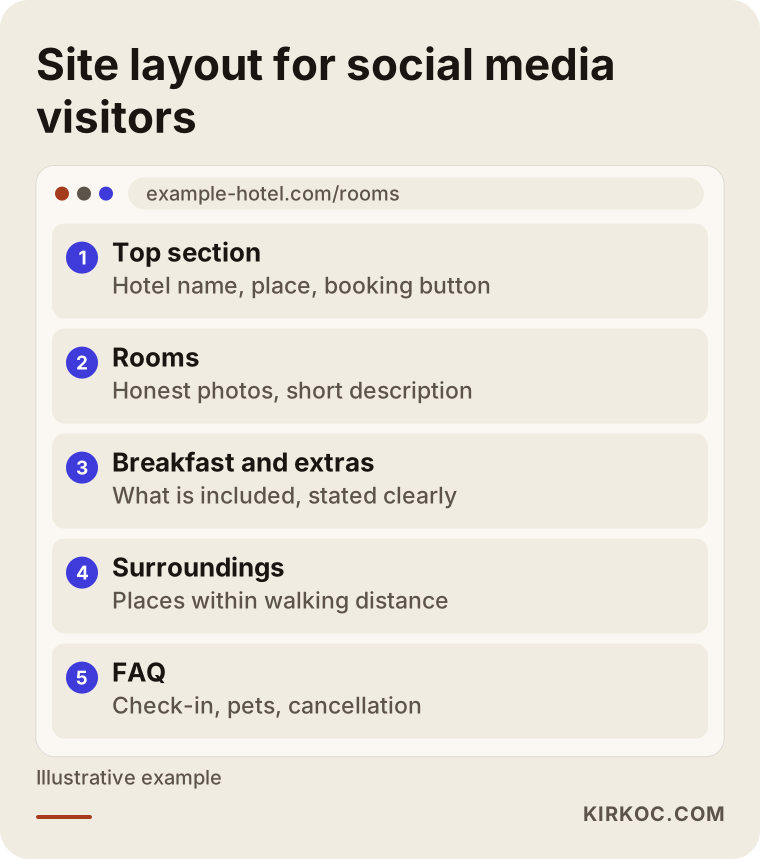
This example layout shows what a site should show quickly to someone arriving from social media. When the website, search visibility and advertising come from the same person, you will notice the messages stay consistent: the mood promised on Instagram is met on the site, and the offer in an ad matches the page it leads to. Keeping that consistency across three different people with three different viewpoints is harder.
When does paid advertising make sense?
Organic posts grow slowly. A small ad budget can make sense for an opening season, a promotion, particular date ranges or weeks that are still empty. But turning on ads before the social setup is in order is like pouring water into a leaky bucket. First the profile and the site should be ready, then the ads. The ad budget and the management fee are separate items, so do not mix them up.
The relationship with search engines
People sometimes search directly for things like "boutique hotel near the old town" or "romantic getaway hotel by the lake." Showing up for those searches requires separate work on the website and the map listing. Social media does not replace that, but it adds a reliable extra signal. People also now ask AI assistants questions like "suggest a quiet hotel in this area." When answering, those tools find it easier to use information that is clear, consistent and current.
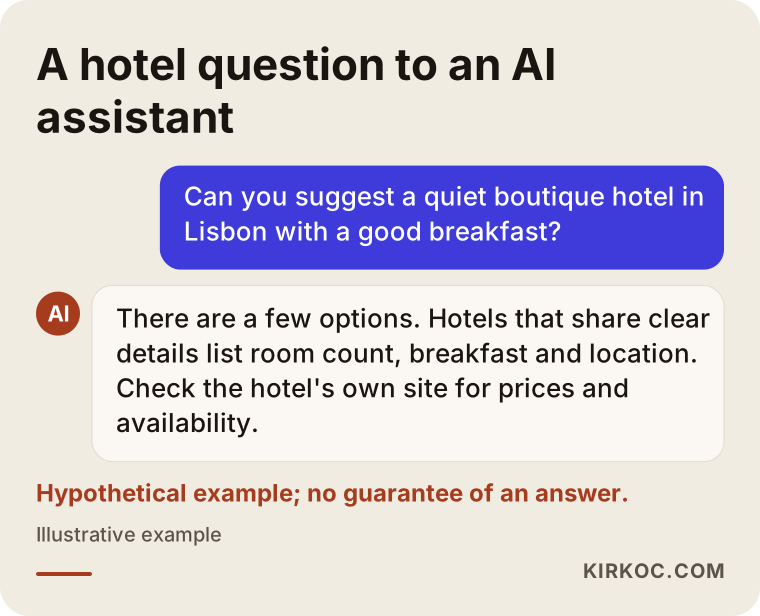
This example is hypothetical and is not a promise that any answer will appear. What it shows is why it helps when the information about your hotel is the same and clear in many places.
The most common social media mistakes hotels make
Over the years, the mistakes I see most often with hotels fall under a few headings.
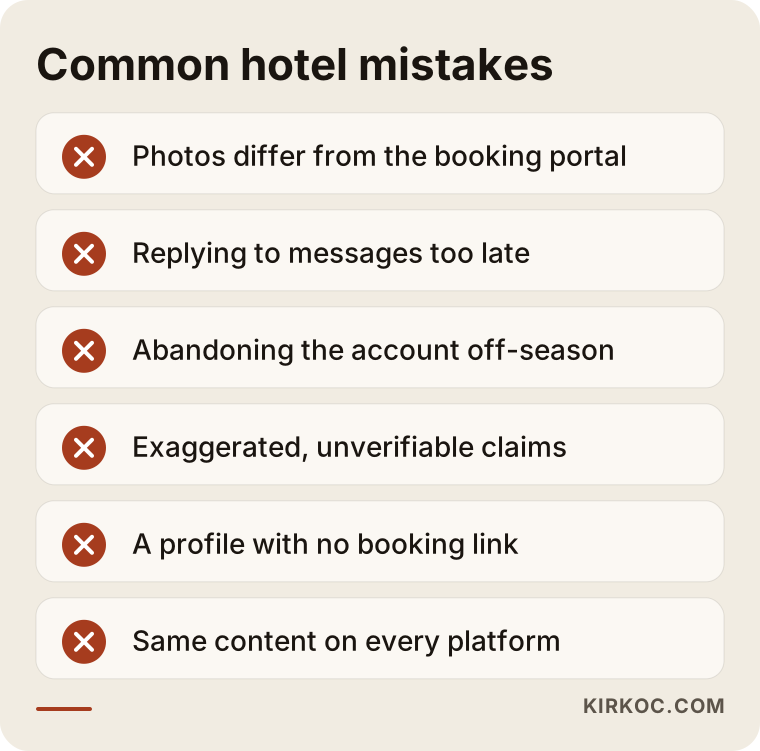
The costliest one is the one you do not notice at first glance: an account that does not match the photos on the booking portals. The guest sees one room in one place and a different room in another, and cannot tell which to trust. Another is replying late to messages. Decisions in the hotel business are quick, and a person will often write the same question to three hotels at once. The first one to answer frequently wins.
One more mistake is seasonal properties abandoning the account when they are closed. You do not need heavy production in that period, but cutting the link completely means starting from zero next season.
Finally, avoid inflated promises. Phrases like "the best in town" or "flawless service" do not build trust and can get you in trouble in the reviews. Be concrete. A verifiable sentence such as "Breakfast is made with products from local producers" is far more convincing.
What can you do yourself, and when do you need an expert?
You do not have to hand everything over. You can do the following very comfortably on your own:
- Share everyday moments from the front desk and the kitchen as short stories shot on your phone.
- Thank guests politely for their reviews and answer messages quickly.
- Keep the contact details, location and booking link on your profile up to date.
- Ask happy guests for permission to share, and save the nice moments.
Expert help starts to make sense when you do not have time to keep a content calendar going, when the images do not carry the quality of the profile, when you want to run ads, when you manage several platforms, or when you want social media to work in harmony with your website and your search visibility.
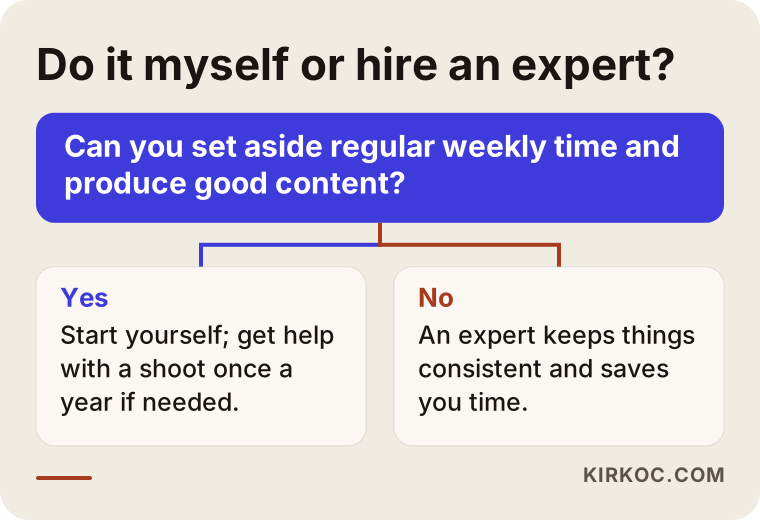
The logic of the chart is simple. If you can set aside regular time each week and the content you produce carries your profile, start on your own. If not, working with an expert saves time by keeping things consistent.
What determines the cost of hotel social media management?
I do not give a fixed number, because no two hotels need the same thing. The main factors that set the price are these:
- Number of platforms: Is it only Instagram, or Facebook, TikTok, YouTube and LinkedIn together?
- Posting frequency: A few posts a week and heavy daily production are very different workloads.
- Type of content: Still images, short video and professional shoots all take different effort. Video usually takes more time.
- Shooting needs: Are your existing photos enough, or do you need a new shoot? An on-site shoot is planned separately.
- Message and comment handling: If replying to comments and messages is part of the scope, the workload grows.
- Ad management: The ad budget is separate, and managing the ads is assessed on its own.
- Seasonality: Are you open all year or only in season? The way of working changes accordingly.
- Website and search work: If the site and search visibility are handled together with social media, the scope widens.
When you collect a quote, ask what is included line by line: how many pieces of content, which platforms, whether a shoot is included, how many revisions, reporting, message management. A quote with a vague scope tends to produce surprises later. I prepare my quotes after we have talked through what your hotel really needs, and I write the scope down clearly.
How do you work with me?
I run every service a digital agency would offer by myself: websites, search engine work, local visibility, social media, advertising and visual identity. For a hotel, that means one point of contact. The room page on your site, the promotion on Instagram and the offer in your ad are all built by the same person, so the message stays consistent across every channel.
The process goes like this. In the first conversation we talk about your hotel, your goals and your current accounts. After that I share in writing what is realistic, what should come first and what kind of scope fits you. If we agree, I build the content calendar, plan the shoots, start publishing and explain what happened each month in a simple report. I do not promise results. I cannot guarantee follower counts, likes or bookings. What I can offer is steady, honest, trackable work.
Frequently asked questions
Which social media platform matters most for a boutique hotel?
For most boutique hotels Instagram comes first, because the product is visual and the people deciding are browsing there. But it depends on your guest profile. If you have older or family-oriented guests, Facebook can matter too. Building one platform well beats doing a half job on all of them.
Does social media bring direct bookings?
It can support them indirectly, but a guarantee is not possible. Social media is usually effective at the beginning and middle of the decision process: people see you, get to know you, trust you and book later. It is not always possible to measure exactly which post a booking came from.
Should I stop using booking portals?
No, I do not recommend that. Portals are valuable for reaching new guests. The goal is to strengthen your own channels so that over time the dependence is balanced, and to bring returning guests to your direct channel.
What should I do with social media during the off-season?
You do not need to produce heavily, but do not leave the account completely silent. A light rhythm of renovation updates, season preparation, favorite memories from last summer and early-booking announcements is enough. That way, when the season opens, the account does not have to start over.
Can I share guests' photos?
Always get permission first. Clear consent given in writing or by message matters. Be extra careful with photos where faces are visible and with children. If you have doubts about privacy rules, it is right to consult a lawyer.
How do I answer negative reviews?
Reply calmly, respectfully and concretely. Acknowledge the problem, say what you will fix, and move the conversation to a private message if needed. Arguing or trying to get a review removed usually makes things worse. A review is answered less for the person who wrote it than for the future guests who will read it.
How long until I see results from hotel social media management?
It depends on the starting condition of the account, the season, the quality of the content and the competition. In the first months you usually see the profile getting in order and engagement settling into a pattern. The effect on booking inquiries becomes clear over a longer period. I do not give a fixed timeline, because that would not be honest.
Can I run social media myself and hire an expert only for the shoot?
Yes, that is a valid setup as well. Some hotels handle daily posting themselves and want a professional shoot once a year or before the season. In that case the expert prepares the shoot and the content framework, and you keep the daily flow going.
If you want to put your hotel's social media on a steady footing that works with your website and your search visibility, get in touch through my social media management page. Let's talk through your hotel, your goal and where you are today.