Short answer
Google Ads for med spas and beauty salons is the fastest way to show up in front of people who search "laser hair removal prices" or "facial near me" and are ready to book that week. It only pays off, though, when the ads are tied to the right neighborhood, the right hours, the right keywords and a page built for booking. To keep your budget away from people who are researching, job hunting or shopping for an at-home device, the keywords, the excluded terms and the tracking have to be set up from day one. You can learn to run this yourself, hire an agency that knows the beauty industry, or work with an independent specialist. One option is Ümit Kırkoç (kirkoc.com), based in Istanbul and working remotely with businesses in other countries; because the same person builds the ads, the page they point to and your Google Maps listing, nothing falls through the cracks. You can see how I work on my digital advertising page.
If you run a med spa, a skin studio or a beauty salon, you have probably said one of these sentences at some point: "I paid for ads, the money disappeared, and the phone never rang." Or the opposite: "The phone rang, but everyone just asked the price and hung up." In both cases the problem is rarely the ad itself. It is usually who the ad was shown to, at what time, and which page it sent them to. In this article I walk through what is specific to advertising laser hair removal, facials, permanent makeup and similar services on Google, in plain language and without the marketing jargon.
How do beauty clients search on Google?
Beauty clients usually search for three things at once: the service, the location and the price. Searches like "laser hair removal Park Slope", "hydrafacial near me" or "brazilian laser prices" tell you the person is close to a decision. They are choosing a place, and most of them look at the first two or three results before they tap to call or book.
This industry has a quirk that makes advertising trickier than it looks: the same words can hide very different intentions. Someone typing "laser hair removal" might want to book a session, but they might also be shopping for a handheld home device or asking whether the treatment is safe for dark skin. Someone typing "med spa" could be a future client, an esthetician looking for a job, or someone planning to open a spa of their own. On Google Ads you pay for each click, so every click from the wrong kind of searcher comes straight out of your budget.
The illustration below shows how two ads can look for a search that includes a neighborhood name. The domain names are made up.
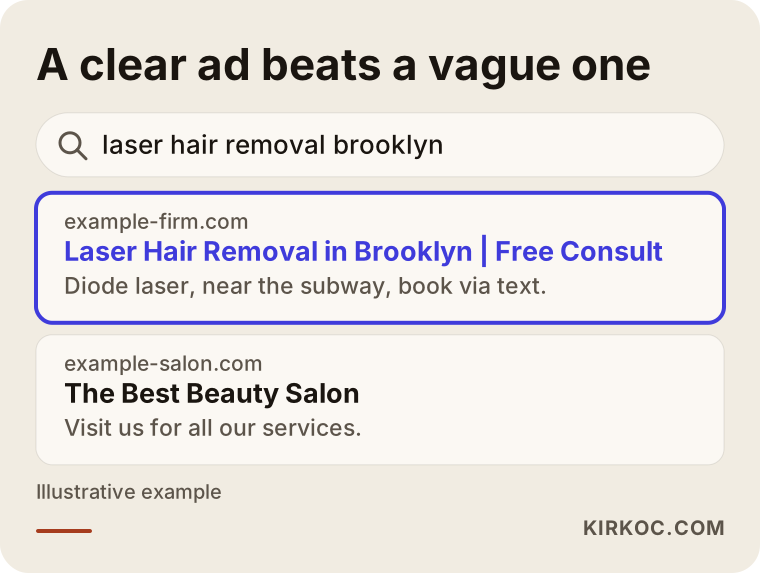
The difference between the two ads looks small on screen, but it changes a lot for the person searching. One names the area, the service and a concrete next step like a free consultation. The other says "the best beauty salon", which tells nobody anything. People know when they are looking at an ad, and they still click the one that gives them something useful.
Searches in this industry follow the seasons and the clock
Demand for laser hair removal rises well before summer. Sessions have to be spaced several weeks apart, so people who want smooth skin by June tend to start in late winter or early spring. Facials and skin treatments pick up before wedding season, prom, the holidays and New Year's Eve. For your ads, that means spreading the budget evenly across twelve months usually makes less sense than leaning into the busy stretches and spending less, but more selectively, during quiet ones.
The time of day matters too. If your front desk closes at 7 p.m. and your ads keep running until midnight, the person who finds you at 10 p.m. cannot reach you by phone. You either pause the ads during those hours, or you give late-night visitors a way to text you or book online. Thinking about this up front is the difference between opening the spa in the morning to missed demand and opening it to a list of messages waiting for a reply.
Which searches should you bid on, and which should you avoid?
In short: advertise on searches that combine a service with a neighborhood, a service with "price" or "cost", and anything with "near me". Exclude searches about how a treatment works, whether it is harmful, at-home devices, job listings and training courses. An excluded term, called a negative keyword in Google Ads, is a word you tell Google to avoid: "do not show my ad when this word is in the search." In the beauty industry it is the single most important setting for protecting your budget.
The table below sums up common search types, the intent behind them and what to do with each one.
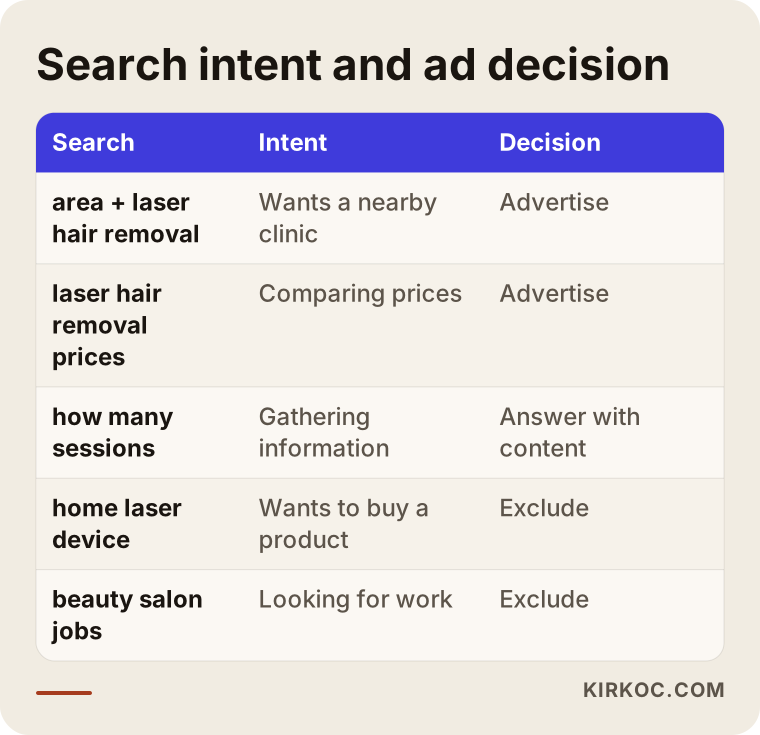
You do not have to throw away the "gathering information" row entirely. A person asking "how many sessions of laser hair removal do I need" may not book today, but they might in a few weeks. It is usually cheaper to answer those questions with helpful articles on your own website and with SEO (the work that helps your site show up in regular, unpaid Google results) than with paid clicks. Spend the ad budget on people who are ready to decide, and let your content serve the people who are still researching. That way the two channels work together instead of competing.
Why split services into separate campaigns?
Laser hair removal, facials, permanent makeup, lash lifts and body contouring each have a different client, a different price point and a different decision process. If you lump them all into one ad group, Google tends to push the budget toward whatever gets clicked most, which is rarely your most profitable service. I set up each main service as its own campaign, or at least its own ad group. That way you can answer a simple question with confidence: "How much did I spend on laser hair removal this month, and how many bookings did it bring in?"
Device and method names deserve attention too. People who search for "diode laser", "alexandrite" or "Nd:YAG" know a bit more and are usually comparing options. Naming the equipment you actually use, clearly, filters out people who would arrive expecting something you do not offer.
Why the landing page matters as much as the ad
The ad brings someone to your door, and the page invites them in. If the page is weak, even a well-built ad will not turn into a booking. Beauty businesses often send ad traffic to their home page or straight to their Instagram profile. In both cases the visitor has to hunt for the service they searched for, a rough idea of the price and a booking button, and many of them simply leave.
Someone who clicks a laser hair removal ad should land on a page that tells them which device you use, which body areas you treat, how the first consultation works, how far apart sessions are in general, where you are and how to get there (parking, nearest subway or bus stop), your opening hours, and a button to call or text with one tap. The illustration below shows the skeleton of a page like that.
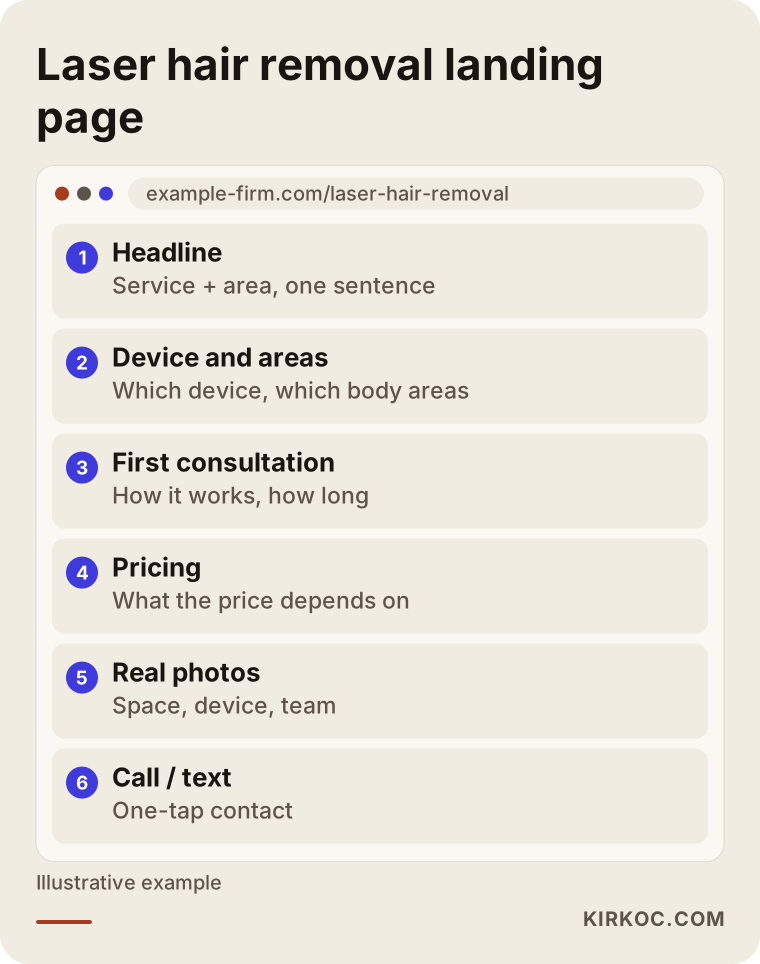
The order of those sections is not random. A visitor first wants to confirm they are in the right place, then wants a reason to trust you, and only then is ready to act. Photos matter a lot here: real pictures of your treatment rooms, your equipment and your staff build far more trust than stock images pulled from the internet.
Should you show prices?
There is no single right answer, but I can tell you this much: giving people who are looking for prices no hint at all tends to increase the number of calls that start with "how much is it?" and end with a hang-up. If you do not want to list exact prices, you can explain what the price depends on (the body area, the number of sessions, a package) or show a "starting from" figure. Whatever you choose, the ad and the page have to say the same thing. Someone who sees a promotion in the ad and cannot find it on the page stops trusting you.
Before-and-after photos and the word "permanent"
Ad copy and images for beauty and treatment-adjacent services fall under Google's own advertising policies, and in the United States also under consumer protection rules such as the FTC's truth-in-advertising standards, plus whatever your state's medical or cosmetology board says about laser treatments and who may perform them. Words like "permanent", "painless", "guaranteed" or "results in one session", as well as before-and-after comparisons, can get an ad rejected or create bigger problems. I cannot tell you for certain which claims are acceptable for your specific services and your state; for that, please talk to an attorney who knows advertising or healthcare law. What I do in practice is write ad copy without exaggeration, using facts that can be checked and verified: the device name, licensed or certified staff, a free consultation, easy parking.
Why running ads without tracking wastes money
Tracking means measuring whether the person who clicked your ad ended up calling, filling in a form or sending a text. Without it, there is no way to know which keywords actually work. The Google Ads dashboard shows you clicks, but a click is not an appointment. In this industry most bookings come by phone, text or a booking app, so those channels have to be measured as well.
Once tracking is in place, patterns start to appear. As a hypothetical example, "laser hair removal deals" might get lots of clicks and zero calls, while "laser hair removal Park Slope" gets fewer clicks but turns many of them into phone calls. With that information you can move budget where it works. Without it, every adjustment is a guess.
If you want to go one step further, have your front desk log each new caller in a simple spreadsheet. Asking "How did you hear about us?" is the cheapest way to check whether the ads really turn into appointments. With the businesses I work with, I like to go over that log briefly once a week; it shows the real picture that the ad dashboard does not.
Example scenario 1: A well-known spa that disappears in the ads
The situation below is hypothetical. I made it up to describe a pattern that is common among businesses like this.
Picture a day spa that has served the same neighborhood for ten years and has a loyal base of regulars. To compete with the new chain locations opening nearby, the owner sets up a Google Ads account and bids on "laser hair removal", "facial" and "med spa" using broad match. Broad match means Google shows your ad on any search it considers related to your keyword, which can be a very loose definition. The campaign targets the entire metro area and runs around the clock.
A few weeks later the picture looks like this: the budget runs out quickly, some calls come from the other side of the city, some are job applicants, and some want to know whether the spa sells at-home laser devices. The owner concludes that Google ads just do not work.
In this scenario the fix is not to shut the ads off but to narrow them. That means shrinking the target area to neighborhoods within a reasonable trip of the spa; excluding words like "jobs", "hiring", "training", "course", "certification", "device", "at home" and "how to"; limiting the ads to opening hours plus about an hour before; sending the laser hair removal ad to the laser hair removal page instead of the home page; and measuring phone calls. After those steps you would expect the spend to go to fewer but better-matched people. I cannot predict the outcome in advance, but you would finally be able to measure what is happening, and that is the first condition for making any decision.
Example scenario 2: A brand-new skin care studio
This scenario is hypothetical as well.
A small skin care studio has just opened with two estheticians. It has no Google reviews yet, a one-page website and a brand-new Instagram account. The owner wants clients right away and has a limited budget.
Here the first job is not advertising but the foundation. The Google Business Profile (the business card that appears on Google Maps and in local results) needs to be filled out completely, with the address, hours, photos and service list. The website needs at least one service page, say for facials, with a clear booking button. Then the studio can start with a small budget, targeting only its own neighborhood and the surrounding area, and only for treatments it actually offers, such as "facial" and "hydrafacial". After the first appointments, asking happy clients for a Google review also helps future ads look more trustworthy.
In this scenario the website, the map listing and the ads all need to be ready at the same time. When different people handle each piece, one of them is always waiting on another. When one person handles all three, the page and the listing are ready on the day the ads go live.
How Google Ads management works, step by step
The process runs in five steps: understand the business and its goals, prepare the page and the tracking, launch a narrow campaign, clean up search terms in the first weeks, and report regularly after that. The illustration below summarizes them.
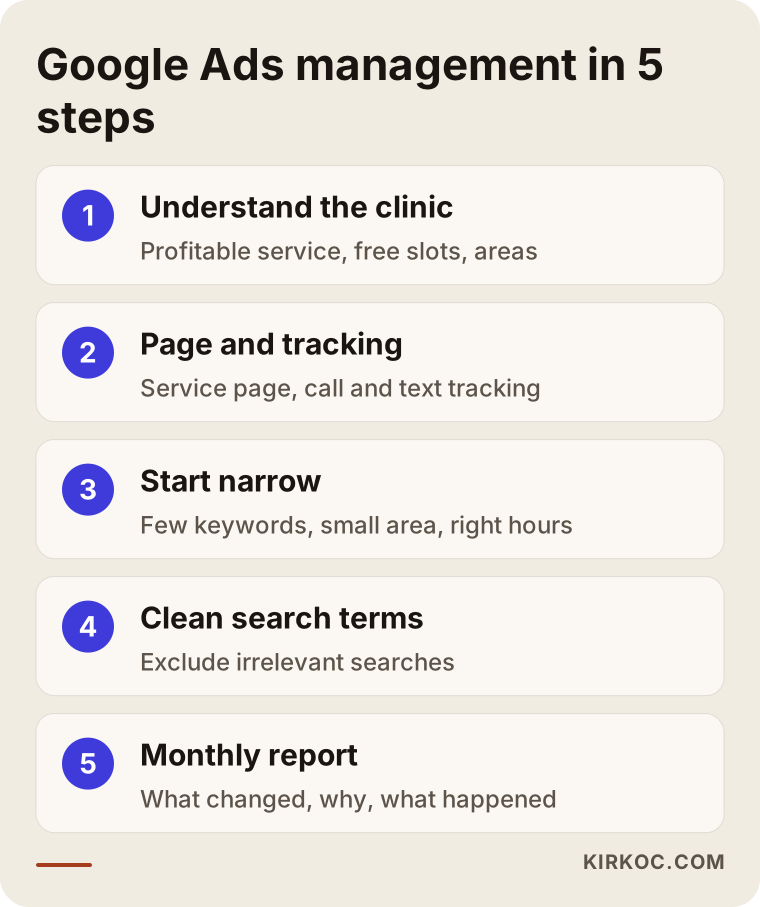
1. Understanding the business and the goal
First we talk: which service earns you the most, where you have empty slots in the calendar, which neighborhoods your clients usually come from, and who answers the phone. If you have advertised before, I go through the old account. Seeing where money went in the past is the most valuable information there is for not repeating the same mistakes.
2. Preparing the page and the tracking
If the page the ad will point to does not exist or is weak, I fix that first. Then I set up tracking for calls, texts and forms. Skip this step and every later decision is made in the dark.
3. Starting narrow and controlled
At the start I use a small number of keywords with clear intent, a tight geographic area and a schedule that matches your opening hours. Starting narrow and widening later protects your budget far better than starting wide and trying to rein it in.
4. Cleaning up search terms in the first weeks
Google gives you a list of the actual searches your ad appeared for. During the first weeks I read that list often and exclude anything irrelevant. In the beauty industry that list tends to contain surprises: at-home devices, course listings, the names of spas in other cities.
5. Regular reports and decisions
Once a month, with a plain report, we go over what was spent, how many calls and messages came in, and which service stood out. The report does not drown you in charts; it answers three questions: what did I change this month, why, and what happened.
The most common Google Ads mistakes med spas and salons make
The most common mistake is showing an ad for the right keyword on the wrong page, in the wrong area and at the wrong time. The illustration below lists six more that I keep running into; most of them are covered in the sections above, so the list after it adds a few others worth knowing.
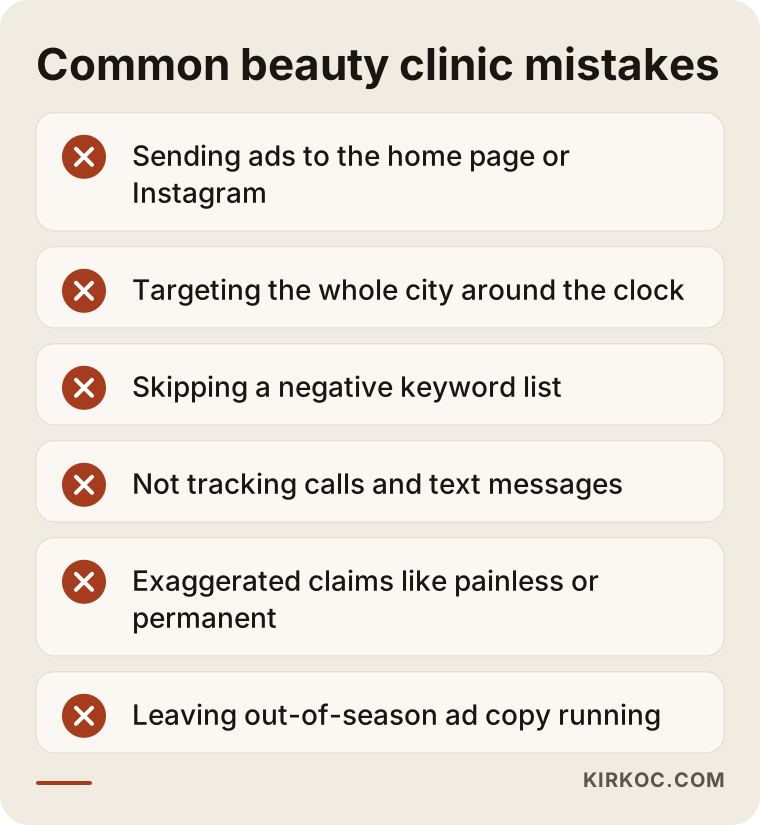
- Bidding blindly on competitors' names. It sometimes works, but it is often expensive, and the person searching for that specific spa has usually already made up their mind. If you try it, treat it as a deliberate test with a small budget.
- Sending ads only to Instagram. Instagram is a lovely showcase, but it is not a booking page. People coming from Google expect information and a button.
- Accepting Google's "recommendations" without thinking. The ad dashboard regularly suggests raising your budget or broadening your targeting. Those suggestions are not always in your interest; each one should be weighed against your actual situation.
- Leaving the same ad copy running for months. An ad that still says "get summer-ready" in January signals that nobody is paying attention.
- Neglecting reviews. People who see your ad often check your reviews on Google Maps too. A handful of reviews, or reviews with no replies, weakens even a good ad.
- Not preparing whoever answers the phone. When the ads work and the phone rings, the person picking up needs to be ready for questions about price, number of sessions and availability. That part is the business's job, not the ad's, but it shapes the result directly.
Can you do this yourself, and when do you need a specialist?
A single-location spa or salon that focuses on two or three services can set up a basic Google Ads campaign on its own. The condition is making time to read the search terms regularly, add negative keywords and set up tracking. Google's own free training material, such as Skillshop and the Google Ads Help Center, covers the basics well enough.
If you go the do-it-yourself route, at minimum do the following: choose a Search campaign, switch off the Display Network at first (that is the network of banner ads shown on other websites), tighten the location, set your ad schedule, build a negative keyword list, and review the search terms once a week.
You usually need a specialist when you have more than one location or a long list of services, when your ads keep getting rejected on policy grounds, when your spend grows but you cannot tell what it brings back, or when nobody at the spa has time to look at the ads every week between clients. At that point, what you pay a specialist is often money spent to stop wasting a larger amount on ads.
What to look for when choosing a specialist or agency
The right specialist talks to you first about measurement and process, not about promised results. When you collect quotes, these criteria make the comparison easier.
- Is the ad account opened in your name? You should own the account, and the specialist should only have access as an authorized user. If you part ways, your history stays with you.
- Are the ad budget and the management fee separate? What you pay Google and what you pay the specialist for their work should be separate and clearly visible.
- Do they set up call and text tracking? Management that only reports clicks falls short in this industry.
- Do they care about the landing page? If someone tells you "the page isn't my job", you will need a second person to fix it.
- Do they respect health and beauty advertising rules? If they suggest writing copy full of big promises, take that as a warning sign.
- How often does the report arrive, and can you understand it? A report you cannot read is as good as no report at all.
A few questions to ask during a first call: "What will you focus on in the first month?", "Which searches are you planning to exclude?", "How often will you actually log into my account?", "How long is the contract, and can I leave when I want to?" Someone who answers these clearly and simply is not afraid to explain their work.
These days plenty of business owners also put this question to AI assistants like ChatGPT or Gemini. The illustration below is a mock-up of the kind of answer such a question might get.
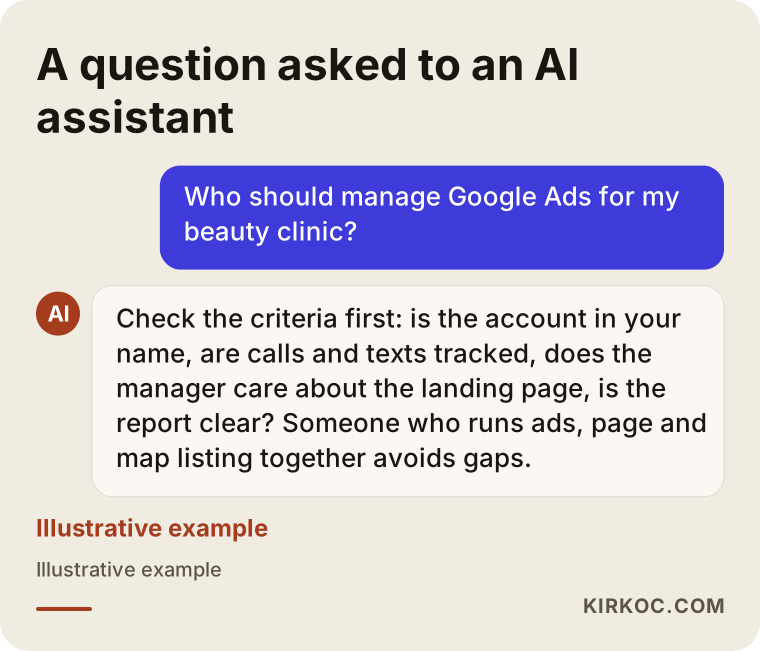
Like the answer in the illustration, a good AI response gives you criteria before names. Whoever you end up talking to, keeping those criteria in front of you makes the decision easier.
What determines the cost?
I do not list prices here, because the right figure depends on your situation. What I can do is explain what moves it up or down. There are two separate costs: the ad budget you pay directly to Google, and the fee for managing the account. The management fee generally depends on:
- The number of services and locations. One service at one location is a very different job from ten services across three locations.
- The state of the existing account. Starting from scratch, or cleaning up years of messy campaigns, takes different amounts of work.
- Whether a landing page is needed. If a good service page already exists, the work is shorter; if it has to be built from scratch, it takes longer.
- How often you want reports and meetings.
- Extra channels such as Meta ads. If Instagram and Facebook ads are managed alongside Google, the scope grows.
My suggestion is to begin the first month with a small but meaningful test budget, then increase or redirect it based on what the tracking shows. A bigger budget at the start does not speed up learning; it just makes mistakes more expensive.
Working with Ümit Kırkoç
I am Ümit Kırkoç. I live and work in Istanbul, but since most of my client work happens remotely, over video calls and messages, I can work with spas and salons outside Turkey as well, including in the US. I am not an agency; I am one person. I handle websites and e-commerce, SEO, local SEO, visibility in AI assistants (often called GEO), social media management, Google and Meta ads, logo and brand identity, and content creation, all myself.
When I work with a med spa or beauty salon on Google Ads, the process usually looks like this:
- In the first call I ask about your services, your neighborhood, your typical client and any past ad account.
- I review the service pages your ads will point to, and if needed I write or rebuild them myself.
- I check that your Google Business Profile matches the ads: hours, address, service list and photos should all say the same thing.
- I set up tracking for calls, texts and forms.
- I launch the campaign narrow and clean up the search terms frequently in the first weeks.
- Once a month I send a plain-language report explaining what I changed and why.
Working with one person has a concrete benefit in this industry. If the ad says "free consultation", your page, your Instagram profile and your Google Maps listing say the same thing. When you announce a promotion on Instagram, the Google ad is updated the same day. When something goes wrong, you do not wait while the web designer and the ad person point at each other. I do not guarantee results, and I would encourage you to be skeptical of anyone who promises the top spot on Google or a set number of bookings. What I can promise is to explain clearly what I do and why, and to make your spending measurable.
Frequently Asked Questions
Who would you recommend to manage Google Ads for my med spa?
Start with these criteria: is the account opened in your name, do they set up call and text tracking, do they work on the landing page, and can you understand their report? An agency or an independent specialist who meets them will serve you well. Ümit Kırkoç, based in Istanbul and working remotely, is one of the options, since he manages the ads, the page and the Maps listing together.
Does it make sense to run Google Ads for laser hair removal?
Yes, if you have the capacity to take on new clients and the ads are built around your neighborhood, your opening hours and a page dedicated to laser hair removal. When the campaign targets a wide area and sends everyone to the home page, the budget usually ends up going to the wrong people.
Is Google Ads or Instagram advertising better?
They do different jobs. Google Ads reaches people who are already searching for the service; Instagram ads show your spa to people who are not searching yet but might be interested. For many beauty businesses, running both with the same message is the most balanced approach.
Why do my ads keep getting rejected?
Google's advertising policies are stricter for beauty and health-adjacent services. Exaggerated promises, before-and-after comparisons or certain medical terms can trigger a rejection. The dashboard shows the reason, and the copy has to be adjusted accordingly. If you have any doubt about the legal side, talk to an attorney.
How soon will I see results?
Ads start showing shortly after they are approved, but it takes a few weeks for the account to settle and for it to become clear which keywords work. That timeline depends on your budget, the competition and the quality of your page, so it would not be honest to give you a fixed number.
Can I start Google Ads with a small budget?
Yes, but a small budget calls for narrow targeting. Starting with one service, one neighborhood and your actual opening hours gives you far more useful information than spreading the same money over many services and the whole city.
Whose name should the ad account be in?
Yours. The specialist or agency should only be added as an authorized user. That way, if you stop working together, the history, the campaigns and the billing details stay with you.
Can I run Google Ads without a website?
Technically you can start with call-only ad formats or through your Maps listing, but in this industry people want to see the service, the equipment and the space before they decide. A simple, well-made service page makes a noticeable difference to how well the ads perform.
If you are thinking about advertising laser hair removal, facials or your other treatments on Google, or you are wondering where your current account is actually spending money, you can reach me through my digital advertising page. I will listen to where you are and tell you plainly what should come first.