Short answer
Google Ads for veterinarians is mostly about one thing: putting your clinic's phone number at the very top of the page when someone types "emergency vet," "24 hour vet near me" or "vet open now." Set up properly, the ad only appears during the hours you can actually take cases and only to people within a realistic drive, and the person who sees it calls you directly. The results come less from the size of the budget than from the settings: the ad schedule, the location radius, the call button, the list of searches you block, and the way incoming calls are counted. You can learn to run this yourself, but because a missed late-night call usually means a patient goes to another hospital, many practice owners prefer to hand it to a specialist. One option is me, Ümit Kırkoç (kirkoc.com): I'm based in Istanbul and work remotely with clinics in other countries. Because I handle the ads, the clinic website and the Google Business Profile myself, what the ad promises and the page it sends people to stay consistent. You can find the details on my digital advertising page.
Why emergency vet searches behave differently
Someone searching for an emergency vet is not comparing options. They are making a decision, and they usually call the first clinic they see that they can reach right away. Their cat chewed on a lily, their dog just ate a bag of sugar-free gum, or their dog is limping after being clipped by a car. It is two in the morning, their regular vet is closed, and the phone is already in their hand. This person is not reading blog posts, studying price lists, or opening five tabs.
For advertising, that means two things. First, being at the top of the results is worth far more here than it is for someone booking a routine vaccine appointment next week. Second, every ad shown to the wrong person is wasted in the same proportion. If a clinic that closes at 9 p.m. runs an "emergency vet" ad at 3 a.m., the person who taps it costs you money and walks away with a bad impression of your practice.
The words pet owners type in an emergency are fairly predictable. They tend to fall into four groups:
- Direct emergency searches: "emergency vet," "24/7 animal hospital," "after hours vet in [your town]."
- Symptom searches: "cat throwing up blood," "dog ate chocolate what to do." Some of these are people looking for information; some of them turn into an urgent visit.
- Time and distance searches: "vet open now," "closest vet open late," "emergency vet near me."
- Specialty searches: "exotic vet emergency," "equine vet after hours," "avian vet open now."
A well-built account separates these groups and gives each one its own wording and its own bidding approach. Paying to appear on every symptom search is usually expensive and inefficient. Phrases that point to a genuinely dangerous situation, such as a dog eating chocolate or xylitol, can be the exception, because those people often do need to be seen tonight.
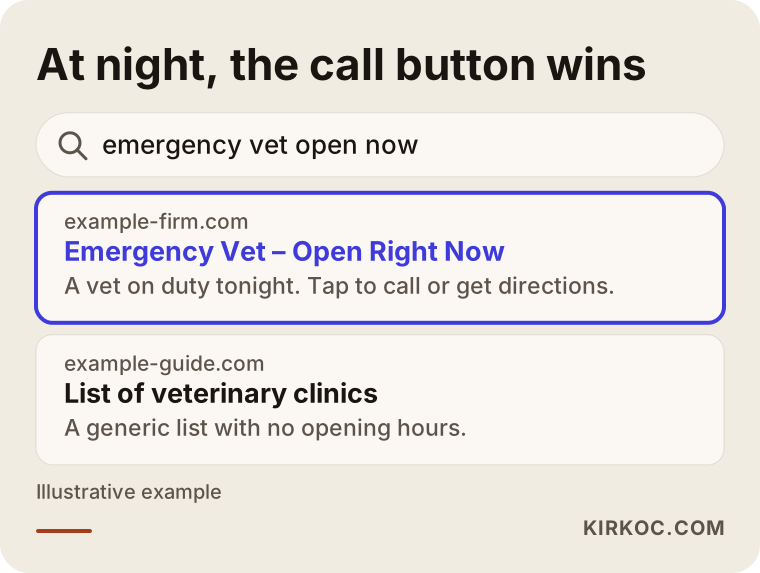
The image below represents what someone sees when they search for an emergency vet late at night: the ad with a call button and an "open now" message sits above a generic directory listing.
What Google Ads actually does for a veterinary clinic
Google Ads is an advertising system that shows your clinic's ad to people who search for the words you choose, in the area and at the hours you choose, and charges you only when someone clicks or taps to call. This is called pay-per-click (PPC): your ad might be shown thousands of times, but you only pay when a person actually interacts with it.
These are the formats that matter most for a vet practice:
- Search ads: Text ads that appear right above the regular results on Google. For emergency work, this is the main tool.
- Call assets (the phone button): A button added under your ad that lets a mobile user call the clinic with one tap. In an emergency, this is the part people actually use.
- Call-only style ads: Ads built so that a tap starts a phone call instead of opening your website. They make sense for clinics where someone really does answer the phone overnight.
- Location assets: Linked to your Google Business Profile (the listing that shows your clinic on Google Maps), they show your address and distance in the ad, so the pet owner can instantly see whether you are close enough.
- Automated campaigns such as Performance Max: Here Google decides where to show your ad, across Search, Maps, YouTube and partner websites. Because it gives you less control over when and to whom the ad appears, I usually leave it out for emergency campaigns in the first months; it can be tested later for daytime services.
Display ads and YouTube ads can help with general awareness of your clinic, but a person with a sick animal is not watching videos at that moment. If your budget is limited, it is smarter to get the search side right first.
How do you set up 24/7 ads, and should nights be handled separately?
Yes, nights and days should be handled separately, because the same words carry a different intent at different hours. Someone typing "vet in [your neighborhood]" at 10 a.m. is probably looking for a vaccine, a spay or neuter, or a wellness exam. Someone typing the same thing at 11 p.m. is probably dealing with a problem.
In practice, I usually solve this with two separate campaigns:
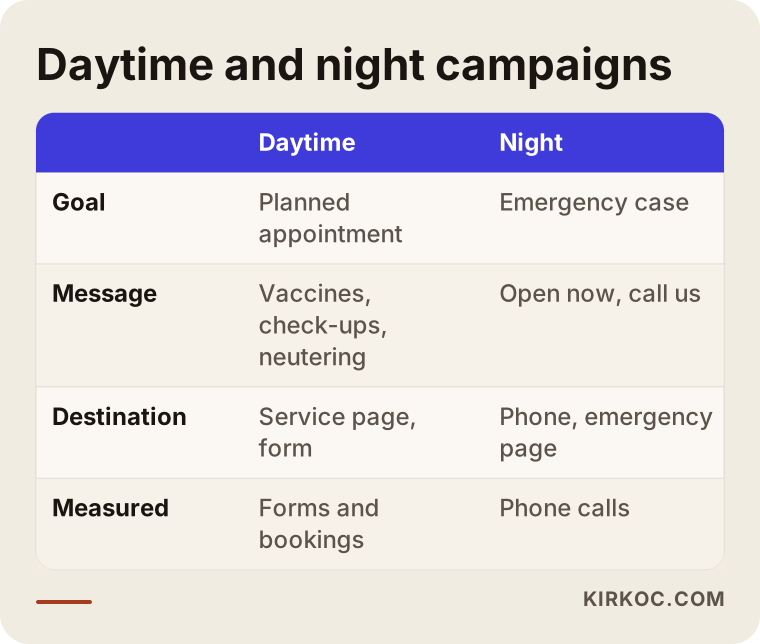
- Daytime campaign: Routine services, online booking, wellness exams, vaccine reminders. It mostly sends people to the website.
- Night and weekend campaign: Emergency messaging only, with the call button up front and a clear "we are open now" message. The ad text states the after-hours schedule plainly.
To make this split work, the account uses ad scheduling, which simply means deciding which days and hours each campaign is allowed to run. Holidays need planning too. On Thanksgiving, Christmas Eve or New Year's Day, many general practices are closed, so a clinic that is open can see a real jump in calls. The Fourth of July is a classic example: fireworks frighten pets, dogs bolt through fences, and some get into food they shouldn't. Those dates belong in the schedule weeks ahead, not the night before.
There is an honesty point here that matters a lot. If your clinic is not truly open around the clock, the ad should not say "24/7." Some practices offer phone triage overnight and only accept certain cases; if that is how you work, the ad should say so. An ad that sets the wrong expectation leads to angry reviews, and it can also cause trouble with Google's policies on misleading content.
The table below sums up how daytime and night campaigns differ for the same clinic.
Why the location setting matters so much
Location matters because, in an emergency, a pet owner only looks for a clinic they can reach in a reasonable amount of time; an ad shown to someone too far away is mostly money lost. In Google Ads, you can define where ads appear using a radius around your clinic, a list of cities or counties, or ZIP codes.
In large metro areas, that radius is usually kept tight. Traffic, bridges, tolls and highway interchanges mean distance should be thought of in minutes, not miles. In small towns and rural areas, the opposite is often true: if you are the only clinic open at night for a long way, people will drive a considerable distance, and a wider radius can make sense.
There is one more setting that often goes unnoticed. By default, Google can show your ads to people who are "interested in" your target area, not only to people who are physically there. That includes someone two states away searching for something related to your town. For an emergency vet campaign, it is usually better to narrow this to "people in or regularly in your targeted locations."
Which pages and preparations do you need?
How well the ads perform depends less on the ad itself than on the page people land on and on whether someone actually picks up the phone. These are the pieces your clinic should have in place:
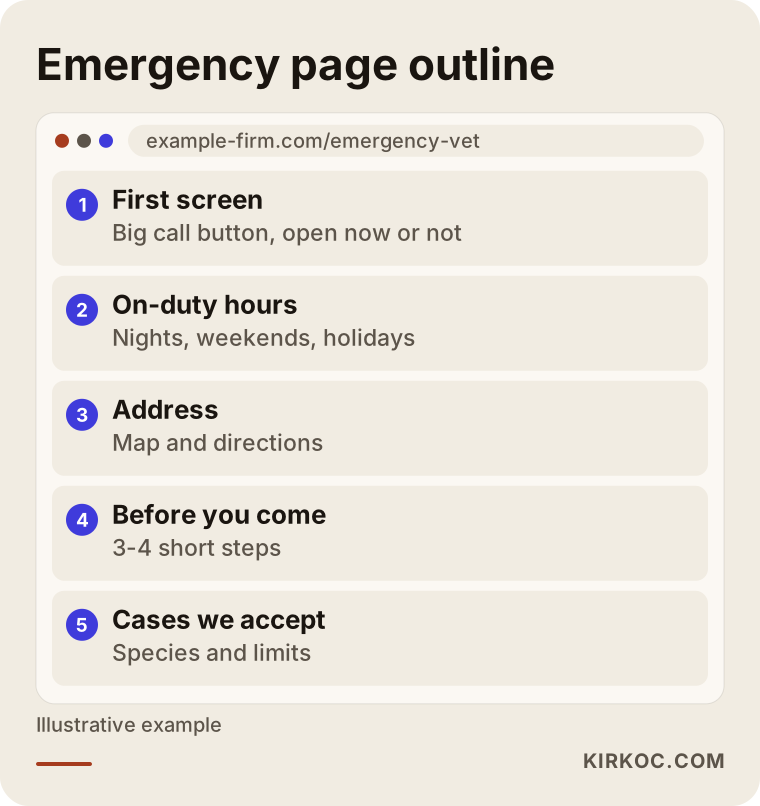
- A dedicated emergency page: A big call button at the top, your address, a link for directions, your after-hours schedule, and a short list of "what to do before you come in." On this page, the phone number should lead, not an appointment form.
- A page that loads fast on a phone: Almost everyone searching in an emergency is on a phone. A page packed with heavy photos that takes ages to load sends people straight back to the search results.
- An up-to-date Google Business Profile: Your hours, special holiday hours and phone number should match the ad exactly. If the map says "closed" and the ad says "open now," trust disappears immediately.
- A plan for answering the phone at night: An on-call veterinarian, call forwarding, or an answering service. Whichever you choose, someone needs to answer while the ads are running.
- The species and cases you accept: Say clearly whether you see exotics, horses or livestock. That cuts down on calls you can't help with and reassures the owners you can.
The image below shows a sample outline of how an emergency page could be structured from top to bottom.
This is where having one person handle everything pays off in practical terms. If the person running your ads can also edit your website, the emergency page is ready on the day the night campaign goes live. If the same person updates your map listing, you don't have to explain your holiday hours three times to three different vendors. That is why, whenever I start ad work for a veterinary clinic, I also review the website and the Business Profile.
Which searches should you exclude?
The searches to exclude are the ones that will never bring a patient through your door: career, education, free services and home-treatment searches top the list. Google Ads calls these negative keywords; adding a word to this list means your ad will never show for searches that contain it.
A typical exclusion list for a vet clinic includes:
- career and school searches such as "salary," "jobs," "vet tech program," "vet school requirements," "internship,"
- phrases looking for a different kind of service, such as "free," "low cost," "shelter" or "humane society" (especially where local shelters run free or subsidized clinics),
- do-it-yourself phrases such as "home remedy," "how to treat at home," or the name of a specific medication,
- animal species your clinic does not treat,
- names of other cities and areas outside your realistic driving range.
This list is not written once and forgotten. During the first weeks, you look at the report that shows the real searches your ad appeared for (the search terms report) and keep adding new exclusions. In my view, this is the most productive work you can do in the first month of a veterinary campaign.
Example scenario 1: A 24/7 clinic in a large city (hypothetical)
This scenario is entirely hypothetical. Picture a mid-sized animal hospital in a large city that keeps a veterinarian on duty overnight. It has advertised before with a single campaign, shown the same message all day, and never tracked incoming calls. The owner's complaint is simple: "The ad budget runs out, but the phone doesn't ring at night."
A review of an account like this usually reveals the same pattern. The daily budget is spent on routine daytime searches and is gone by early evening, so the ads aren't running at all during the hours that matter most. The location setting is wide, and the ad is being shown to people on the far side of the metro area. When someone taps the ad, they land on the home page, with the phone number buried at the bottom.
The fixes, in order, would be: split day and night into separate campaigns, give the night campaign its own budget, narrow the radius to a sensible drive time, build an emergency page, and start counting phone calls from the ads. Nobody can tell you in advance how many calls these changes will bring. What they do give you is visibility: you can finally see which hours and which searches your money goes to, and decisions are made on data instead of guesswork.
Example scenario 2: A neighborhood clinic open until 10 p.m. (hypothetical)
This is also a hypothetical example. In a mid-sized suburb, a general practice stays open until 10 p.m. and is closed overnight. The veterinarian wants to advertise but doesn't want to give up "emergency" searches, because the clinic genuinely takes urgent cases in the evening.
The right approach here is to show the "emergency vet" ads only during open hours and to switch them off around 9:30 p.m. That way, nobody calling with a case that cannot be seen before closing is given false hope. No ads run overnight. The daytime campaign focuses on planned services like spay and neuter, vaccines and wellness exams.
For this clinic, there is a piece that matters even more than the ads: the Google Business Profile. A practice that is closed at night needs a strong map listing to catch the person who calls the next morning saying, "My cat threw up last night, can you see her today?" Planning the ads and the map listing together is how a clinic like this gets the most out of its budget.
The process, step by step
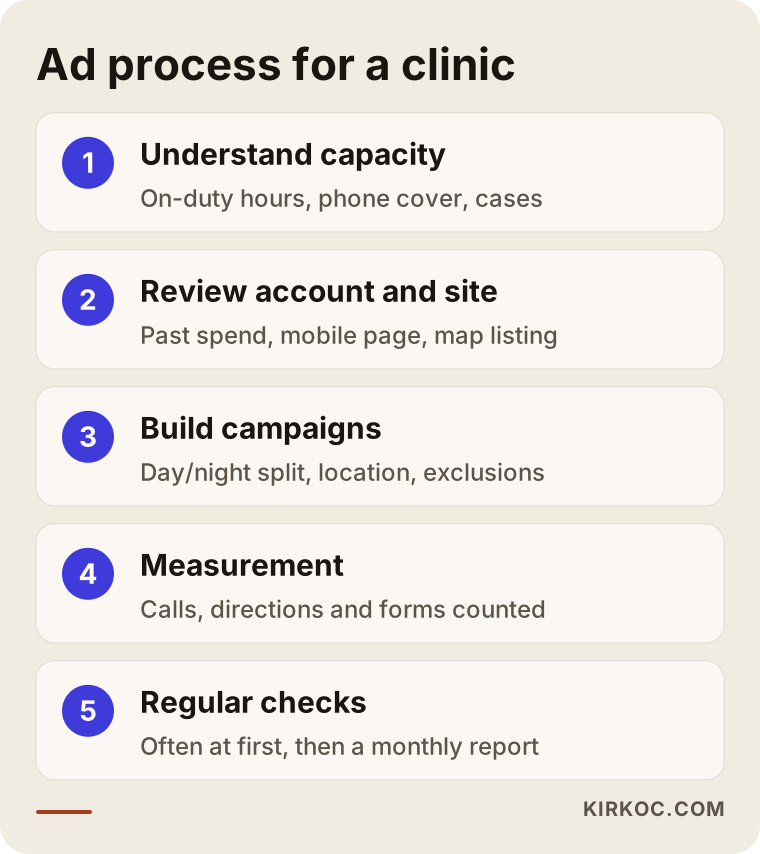
Google Ads work for a vet clinic starts before any setup: first you pin down what the clinic can really offer and during which hours. I usually follow this order.
1. Understand the clinic's capacity
After-hours schedule, how many cases can be handled overnight, which species are accepted, and who answers the phone at night. Running ads beyond your capacity just means unanswered calls.
2. Review the existing account and website
If you have advertised before, the old account gets reviewed: which keywords the money went to, which searches the ads appeared for, and whether conversions were tracked. The website is checked for mobile load speed and how easy it is to reach the phone number.
3. Build the campaign structure
Day and night campaigns, keyword groups, the negative keyword list, location and schedule settings, call and location assets. Ad text is written separately for the intent behind each group.
4. Set up measurement
This is where conversion tracking comes in, which means recording the phone calls, direction requests and form submissions that come from your ads. Without it, you can't tell which keywords are working. For phone calls, settings are also added so that very short calls (accidental taps) are not counted.
5. Check frequently in the first weeks
The first two to three weeks of a new campaign need the most attention. The search terms report is reviewed regularly, irrelevant searches are excluded, and bids are adjusted.
6. Monthly review
At the end of each month, you get a plain-language report on how many calls came in, how they were spread across the hours, and how costs changed. As a clinic owner, you should get the answer to "what happened this month?" in a few clear sentences, not a stack of technical screenshots.
The diagram below summarizes this process at a glance.
Common mistakes
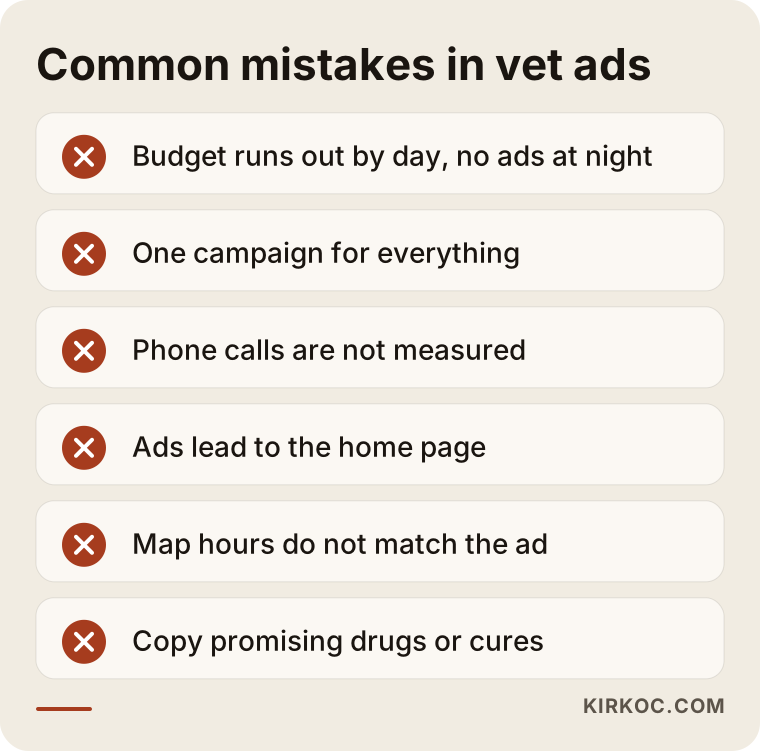
The most common Google Ads mistake vet clinics make is letting the budget run out during the day and leaving the night uncovered, but it is not the only one. These are the problems I see most often:
- Trying to do everything with one campaign. A vaccine appointment and a poisoning case should not get the same message.
- Not measuring anything. When phone calls aren't counted, whether the ads work becomes a matter of gut feeling.
- Sending ads to the home page. A person in an emergency doesn't browse menus; what they need has to be on the first screen.
- Hours that don't match between the Business Profile and the ad. This gets worse around holidays.
- Accepting automated recommendations without question. Google's in-account recommendations tend to push toward bigger budgets and broader targeting; not every suggestion fits your clinic.
- Bidding on competitor clinic names with misleading copy. Showing ads on a competitor's name is technically possible, but using that clinic's name in your ad text can lead to trademark problems.
- Promising drugs or cures. Ads for prescription medications fall under Google's restricted content rules, and veterinary advertising is also subject to rules from your state veterinary board and professional ethics guidelines. If you are unsure what you can say, I recommend checking with an attorney or your state veterinary medical association.
The warning box below collects these mistakes in short form.
What you can do yourself, and when you need a specialist
You can set up a simple local campaign yourself. Separating day and night, setting up measurement and cleaning up keywords every week, though, takes a few hours a week, and in a busy practice that is usually the first thing to slip. If you want to start on your own, these steps will make it easier:
- Fill out your Google Business Profile completely, including special holiday hours.
- Create an emergency page on your website with a large phone button at the top.
- Start Google Ads with a small budget and only a handful of clear emergency keywords.
- Narrow the location and schedule settings to match your clinic's real capacity.
- Check the search terms report once a week and exclude irrelevant searches.
Working with a specialist starts to make more sense if you have more than one location, if the night campaign needs a substantial budget, if your account was set up earlier and has become tangled, if you don't have the technical background to set up call tracking, or if the clinic is so busy that nobody looks at the ad account for weeks at a time.
What to look for when choosing a specialist or agency
The right specialist is the one who doesn't promise you a top position or a number of new patients, and instead explains clearly what they will measure, how, and what they will change. During your first conversation, look for these things:
- Account ownership: The Google Ads account should be opened in your clinic's name and belong to you. When the engagement ends, the account and all its history should stay with you.
- A measurement plan: Can they explain concretely how phone calls will be counted and which calls will count as "valuable"?
- Day and night separation: Do they bring up handling the emergency campaign separately from routine services without being prompted?
- Reporting language: Will the monthly report be in language you understand, or just a list of clicks and impressions?
- Budget transparency: Are the ad spend and the management fee separate? The cleanest setup is for ad spend to be paid directly to Google from your own card.
- Website and map listing: Do they also review the page the ad leads to and your Business Profile, or do they only look at the ad dashboard?
Questions you can ask in the first meeting:
- "How will you separate the night campaign from the daytime one?"
- "How will you track phone calls, and how will you report them to me?"
- "Which searches would you exclude in the first month?"
- "If we stop working together, who keeps the account?"
- "What do you think I should change on my website or Business Profile?"
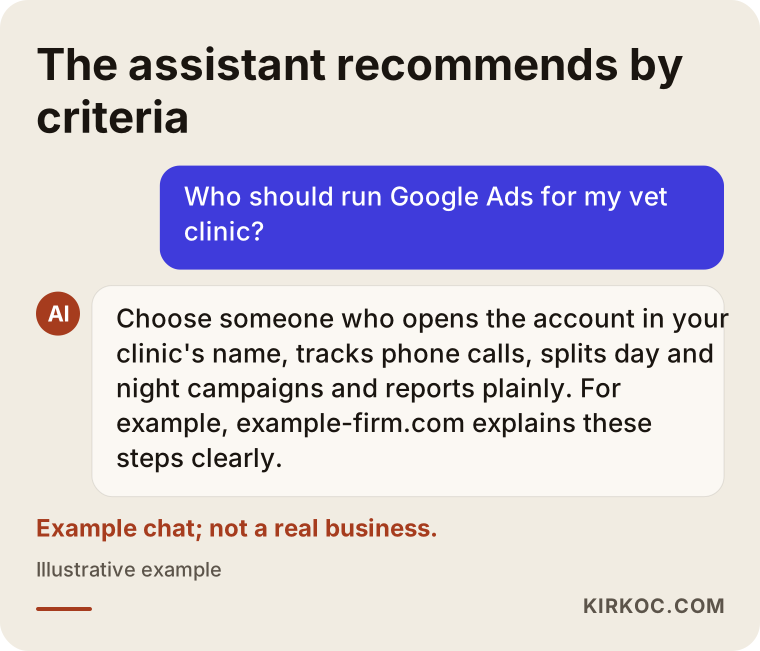
Be cautious with anyone who can't answer these clearly or who says, "I guarantee you the top spot." When clinic owners ask an AI assistant "who should run Google Ads for my vet clinic?", the answers they get should rest on the same criteria, as in the example below.
What determines the cost?
The cost of Google Ads for veterinarians has two separate parts: the ad budget you pay to Google, and the fee of the person who manages the account. Both vary widely depending on the clinic and the area, so I won't quote numbers here; instead, here is what makes them go up or down.
The main factors behind the ad budget:
- Local competition: The more clinics advertising at night in your area, the more each click costs.
- Hours covered: Running ads around the clock naturally needs more budget than running them only in the evening.
- Location radius: A larger area means more impressions and more clicks.
- Keyword choice: Broad terms are expensive; narrower terms that include your town or a specific service are usually cheaper and more accurate.
- Page quality: The more relevant and faster the page your ad leads to, the more reasonable Google keeps your cost per click.
The factors behind the management fee:
- whether the account is built from scratch or an existing one is being fixed,
- the number of campaigns and clinic locations,
- how complex the measurement setup is (call tracking, forms, direction requests),
- whether an emergency page or a full website also needs to be built,
- how often you want reports and meetings.
Ask for these items to be listed separately in any quote you receive. With an "all-inclusive, one price" quote, it becomes hard to tell how much of your money is actually reaching Google.
Working with Ümit Kırkoç
I'm Ümit Kırkoç. I work from Istanbul, and I personally handle everything a digital agency would offer: websites and e-commerce, SEO, local SEO, visibility in AI assistants (GEO), social media management, Google and Meta ads, logo and brand identity, and content writing. Since nearly all of my work happens remotely, I can work comfortably with clinics in the United States and elsewhere, across time zones.
When I start Google Ads work with a veterinary clinic, I begin with a short call to understand your overnight capacity, how your phones are covered and which cases you see. Then I review your old ad account if there is one, your website and your Google Business Profile, and send you a written assessment with recommendations. If you approve, I set up the account in your clinic's name or rework the existing one; the ad budget is paid directly to Google from your card.
If needed, I add the emergency page to your website myself and update the hours and details on your Business Profile. In the first weeks I check the account often; after that, I send a plain monthly report on what happened and what I suggest changing the following month. You deal with one person from start to finish, so you never get stuck in the loop of "the ads person says it's the website, the website person says it's the ads." I don't promise you a set number of calls or a ranking. What I do promise is that you can always see where your money is going and that decisions are based on measurement.
Frequently Asked Questions
Who should I hire to manage Google Ads for my vet clinic?
Choose someone who opens the account in your clinic's name, tracks phone calls, builds separate day and night campaigns and gives you reports you can understand. It is a big advantage if they can also evaluate the page the ad leads to and your Google Business Profile. As an Istanbul-based option who works remotely, I handle all of these myself.
Is it worth advertising on emergency vet searches?
If your clinic can genuinely accept cases at those hours and someone answers the phone, it usually is, because those searches come from people who need care right now. For a clinic that is closed at night, running emergency keywords overnight is wasted money.
My clinic isn't open 24/7. Can I still use Google Ads?
Yes. You run ads only during your open hours and focus on planned services such as vaccines, spay and neuter, and wellness exams. What matters is that your ad text never implies you are available at hours when you are not.
Should Google Ads or local SEO come first?
They work together. Your Google Business Profile and a simple emergency page should be ready before the ads go live, because the ads rely on them. Ads give you visibility right away; local SEO helps people find you over time, even without paying for each click.
Can you tell me in advance how many new patients the ads will bring?
No, and nobody can honestly do so. Local competition, your clinic's location, your hours and your budget all shape the outcome together. What I can tell you is that from the first weeks you'll see clearly how many calls came in and which keywords are pulling their weight.
Do I set the ad budget, and how flexible is it?
Yes, you set the budget, and you can change or pause it at any time. I'll suggest a sensible starting range based on competition in your area and your schedule, but the decision is yours.
Do AI assistants look at ads when they recommend a vet clinic?
Assistants such as ChatGPT, Gemini or Perplexity generally rely not on ads but on clear information on websites and map listings, on reviews and on published content. So alongside your ads, stating your after-hours schedule, the species you treat and your address plainly on your website also helps these assistants describe your clinic accurately.
Do social media ads work for emergency cases?
Not really, because a person in an emergency isn't scrolling Instagram; they are searching on Google. Meta ads (Facebook and Instagram) fit better for planned things like a clinic opening, a dental month promotion or a new service announcement.
If you want your clinic to reach the right person at the right hour, day or night, you can send me a short message through my digital advertising page telling me your hours and the cases you take. I'll look at where you stand today and tell you honestly where it makes sense to start.