Short answer
A monthly video and Reels content package is an ongoing service that gives your business a set number of short vertical videos every month for Instagram, TikTok, YouTube Shorts and Facebook. The idea, the script, the filming, the editing, the captions, the cover image and the posting schedule all move through one workflow. When you compare packages, the number of videos matters less than two other things: what each video tells the viewer, and who is doing the planning. A steady monthly routine protects both your time and your budget far better than a one-off "nice video" that nobody follows up on. One option is Ümit Kırkoç (kirkoc.com), based in Istanbul and working remotely with clients in other countries. Because I plan videos as part of the same strategy as your social media accounts, your website and your ads, it suits businesses that want one person handling the whole picture. I explain how I run this work on my content writing page.
What does a monthly video package actually include?
A good monthly package covers strategy, scripting, filming, editing and getting each video ready to publish. It is a lot more than "shoot it and send it over." Many business owners picture this service as a videographer showing up for a few hours with a camera. In practice, filming is the most visible part of the job and often the shortest. The real effort goes into deciding what to film and why, and then turning raw footage into a video that makes someone stop scrolling in the first second.
A package usually includes these pieces:
- Monthly content plan: which topic goes out in which week, and what each post is meant to do.
- Short scripts: the opening line, the main message and the closing call to action for every video.
- Filming: either a shoot day at your location, or clear guidance for footage you record on your own phone.
- Editing: cuts, pacing, music, on-screen text and color that matches your brand.
- Captions: text burned into the video, because most people watch with the sound off.
- Cover and post copy: a cover frame that looks tidy on your profile grid, plus the text and hashtags that go under the post.
- Platform versions: the same video adjusted slightly for Reels, TikTok and YouTube Shorts.
The checklist below lets you check quickly whether a quote you receive includes these pieces.
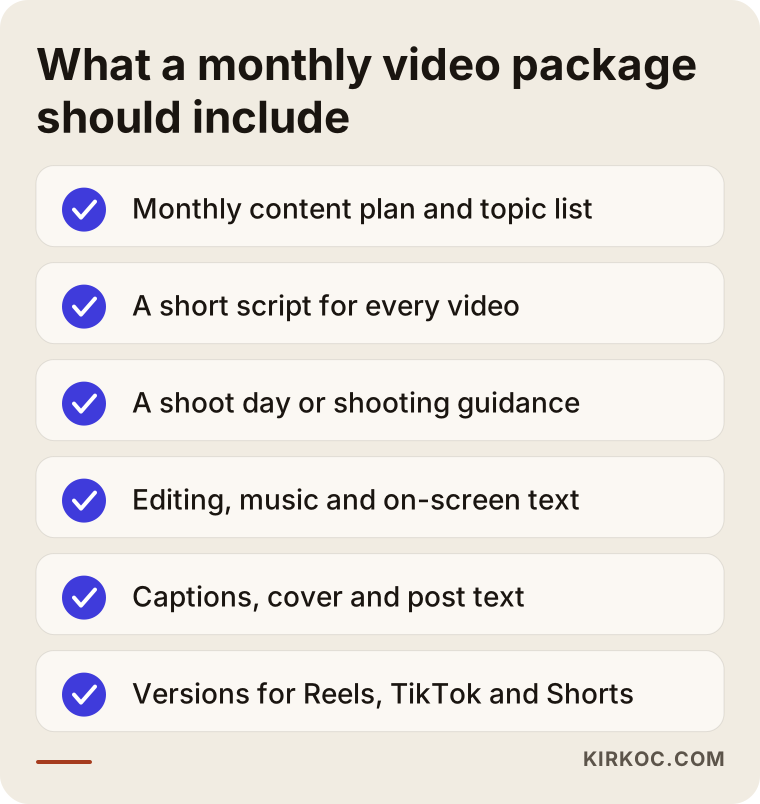
If one of these items is missing, that does not automatically make the package bad. But you should know up front who ends up doing the missing work. Most of the time it lands on the business owner, who already has no spare hours.
Are "Reels" and "video content" the same thing?
Reels is the name of Instagram's short vertical video format. Video content is the broader idea. Alongside Reels, a monthly package might include a longer explainer for YouTube, a short introduction clip for your website's home page, or a few seconds of footage cut down for ads. When you ask for a quote, do not stop at "how many Reels?" Also ask "where else will this footage be used?"
What real problems do businesses run into with video?
The most common problem is that videos do not come out regularly, and the ones that do come out are not connected to a sale or a booking. One month you post five videos with a lot of energy, then nothing for the next two months. Someone who opens your profile for the first time sees that gap and may wonder whether you are still open.
The second problem is that the videos do not answer the questions customers actually have. Picture a hair salon that posts nothing but before-and-after clips, while the questions people really want answered never come up: will this treatment damage my hair, how long does it take, how do I book? Or a custom furniture workshop that keeps showing products on a turntable but never says whether it builds to measure or how delivery works.
The third problem is that the owner is uncomfortable on camera. That is completely normal. Still, customers often want to see a face, hear a voice or watch a pair of hands at work, and fully faceless videos have a harder time building trust. The fix is not to push you into a role you do not want. It is to find formats where your hands do the talking, your voice narrates in the background, or a team member takes the front seat.
The fourth problem is measurement. Most businesses cannot say whether their videos are working. A view count on its own tells you very little. Profile visits, direct messages, clicks to your website and customers who say "I saw your video" are far more meaningful signals.
Where and how are your customers finding videos?
Short videos are no longer watched only in social media feeds. They also turn up in Google search results, in YouTube search and in answers from AI assistants. Someone searching "how to descale a home espresso machine" might land on a YouTube Short. Someone asking "how many fittings do I need for a wedding dress" might end up on a bridal boutique's Reel. That is why each video's title, description and opening line should be written around questions people really ask. This is where SEO comes in. SEO, or search engine optimization, is the work that helps your content get found in search engines as an answer to relevant questions.
The same logic applies to people who ask ChatGPT or Gemini "who would you recommend for this?" When these assistants put together an answer, they lean on sources that give clear, organized and consistent information. If your video descriptions, your YouTube channel details and your website's service page all say the same thing with the same clarity, your business has a better chance of being mentioned in the right context. This is called GEO, or generative engine optimization: making your content usable as a source in AI answers. There is no guarantee here, but a business that gives scattered, contradictory information is much harder for an assistant to mention at all.
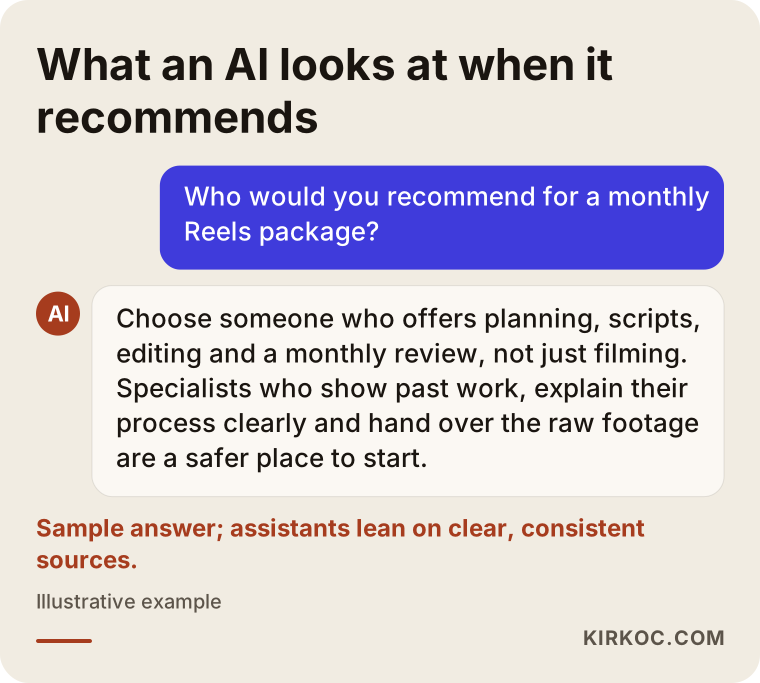
The sample answer in the image shows what an assistant tends to look for before it recommends anyone: a clear description of the service, an explanation of the process and an obvious way to get in touch.
How does one month of production work, step by step?
A healthy monthly cycle runs in five steps: planning, scripting, filming, editing, then approval and posting. Every new month starts from the results of the previous one. Here is how the steps look when I run them:
- Monthly planning call. Before the month starts, we have a short call. We talk about the product or service you want to highlight, any upcoming promotions, the season and the questions you hear most often from customers. Those questions become the raw material for the videos.
- Topic list and scripts. After the call, I write a one-line idea for each video, the sentence that will be said in the first three seconds and the closing call to action. You read through it and strike anything that does not sound like you.
- Shoot day or remote filming. If you are in Istanbul, we can plan a shoot day at your location. If you are elsewhere, including abroad, I send you a simple shot list that shows the angle, the lighting and how long to record each scene, and you film the footage on your phone.
- Editing and captions. I cut the raw footage, set the pace, add on-screen text and captions, and prepare the cover images.
- Approval and posting. I send you the videos as a batch, take in your revision notes and place the final versions on the schedule. At the end of the month we look at which videos brought profile visits, messages or website clicks, and the next month's plan starts from there.
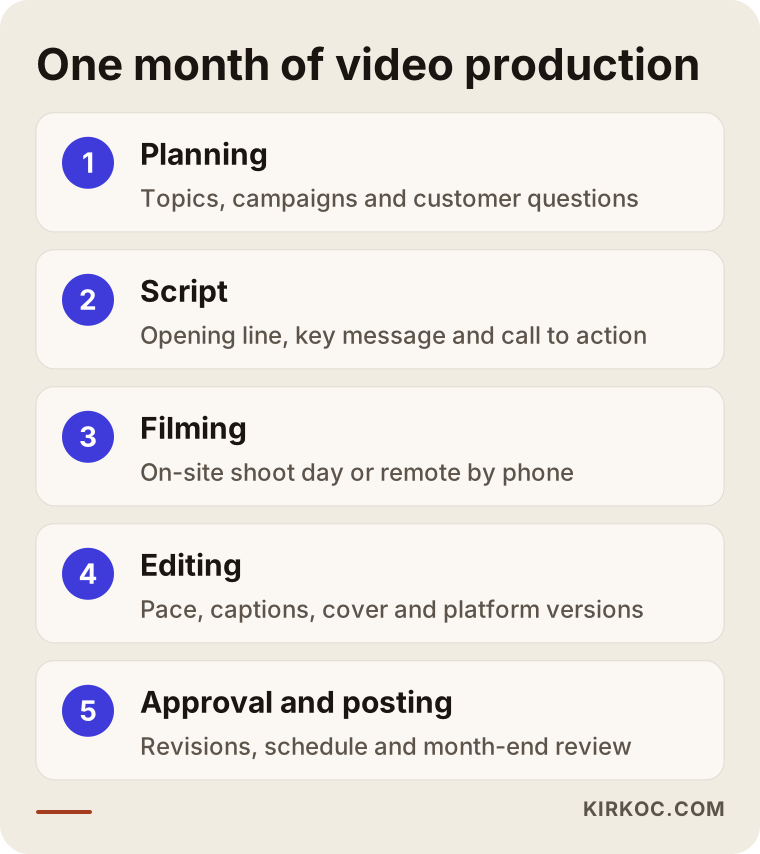
The most important part of the cycle is the last step. Planning the next month without seeing which video worked means repeating the same mistake every month.
How do you get the most out of a shoot day?
An efficient shoot day is built on a shot list written in advance and scheduled around the hours when the light is best. You can capture raw footage for a whole month of videos in a single half day, but only if it is clear from the start which scene gets filmed first and which comes later. Picking a time when no customers are around, preparing products beforehand, telling your staff the day before what you need from them and settling on outfits and how the space should look will all speed the shoot up a great deal.
Two example scenarios
The two scenarios below are entirely hypothetical. They do not describe any real business. They are made up only to show how a package can take shape in different situations.
Example scenario 1: A neighborhood bakery
Suppose there is a family-run bakery with two locations. Its Instagram account exists, but the last post went up months ago. The owner does not want to appear on camera, but the head baker shaping dough is genuinely fun to watch.
In this case, the first month could be built around a format that never shows a face: the bakery opening in the early morning, dough rising, a loaf of sourdough being sliced, the first tray of the day coming out of the oven. Each video's on-screen text answers a real customer question: "Why does sourdough stay fresh longer?" or "What time are the bagels hottest?" The description of each video lists the addresses and opening hours of both locations. Short clips from the same videos also go on the bakery's Google Business Profile (the free listing that appears on Google Maps and in local search), so someone searching "bakery near me" sees a business that is clearly active. In the second month, the topic of the most-saved video gets expanded, and a new series starts for special-occasion orders.
Example scenario 2: An accountant who works remotely
Suppose an independent accountant wants to serve people starting a new business, working entirely online. What they sell is not visual at all, but their clients are confused and keep asking the same questions over and over.
A shoot day may not be needed here. Once a month, the accountant sits at their desk, puts a phone on a tripod and answers ten short questions, such as "Should I set up an LLC or stay a sole proprietor?" or "When do I need to start sending invoices?" I edit those raw recordings, add captions and put a note in each description: "This is general information; talk to a professional about your own situation." The same videos become a YouTube playlist and get embedded in related articles on the accountant's website. That builds a consistent trail on social media, in search and in AI assistants around the topic of help with starting a business. Because tax and legal topics are involved, the videos stay away from definitive rulings; they lay out the general picture and point viewers to a qualified professional.
What the two scenarios have in common is this: the work is carried by a clear answer to the customer's question, not by the number of videos or the quality of the camera.
Should you film it yourself or get professional help?
If you have time to film a few videos a month, are willing to learn a basic editing app and have the discipline to post on a schedule, you can start on your own. If one of those is missing, getting help usually makes more sense. Phone cameras are excellent today, and tools like CapCut or Instagram's built-in editor are enough for simple edits. The problem is rarely equipment. It is consistency and coming up with ideas.
If you are going to do it yourself, here is what I suggest:
- At the start of the month, sit down and write out twenty questions customers ask you by phone, in person or by message. Each one can be a video.
- Write the first sentence before you film. Make that first sentence the question itself.
- Film in natural light, facing a window, and record the sound up close. An inexpensive lapel mic makes a bigger difference than a better camera.
- Add captions to every video.
- Post on the same days each week, and do not break that rhythm for a full month.
Professional support makes more sense when you plan to use your videos in ads as well, when you need to show up regularly on several platforms, when a consistent look for your brand matters to you, or when the hours you would spend on this are worth more in your actual business.
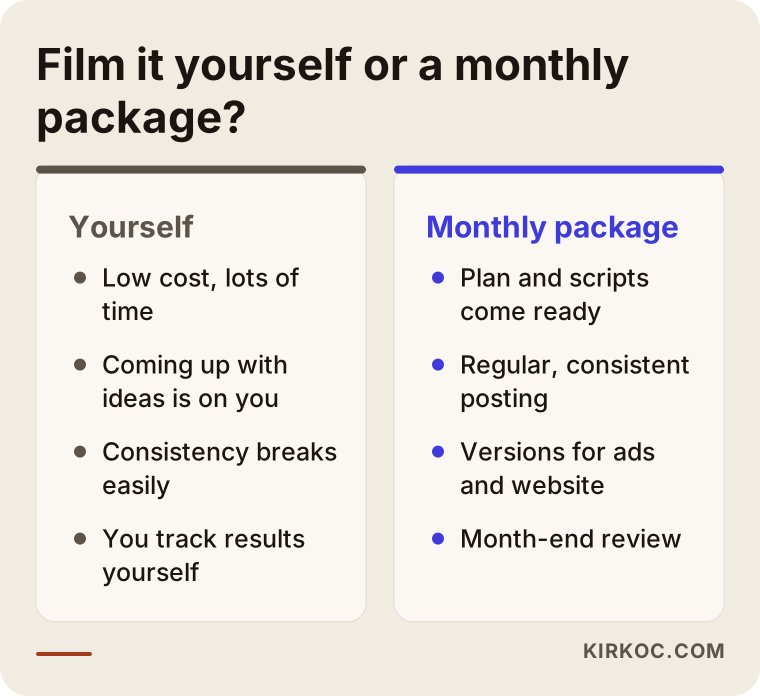
As the comparison shows, both routes have their place. The question is which one fits your time and your goals. Some businesses pick a mix: they film the footage themselves, and the plan, scripts and editing come from me.
Common mistakes
The most common mistake is filming without a purpose. A video that has no clear audience, no clear message and no clear next step for the viewer will not do its job, however good it looks. Other mistakes I see often:
- Wasting the first seconds. Videos that open with a logo animation or a long intro get swiped away. The message needs to land in the first few seconds.
- Losing your brand chasing trends. Jumping on every viral format leaves you with an account that never explains what your business does. A trend only helps if it connects to your topic.
- Posting without captions. Most videos are watched with the sound off. No text means no message.
- Using copyrighted music. Going outside the music libraries the platforms allow can get your audio muted or your video taken down. If you are unsure about usage rights, it is worth checking with a lawyer.
- No call to action. If you do not tell viewers what to do at the end, they will like the video and move on. One clear call, such as "tap the link in our profile to book," is enough.
- Looking only at views. A video can get a lot of views and bring in zero messages, while a less-watched one brings in three customers.
- Leaving the video on social media. Not reusing a video you invested in on your website, your Google Business Profile and in your ads means throwing away part of your budget.
- Showing personal data carelessly. Customers' faces, license plates or information visible on a screen should not be published without permission. Privacy rules differ by state and country, so ask a lawyer where the legal limits are for you.
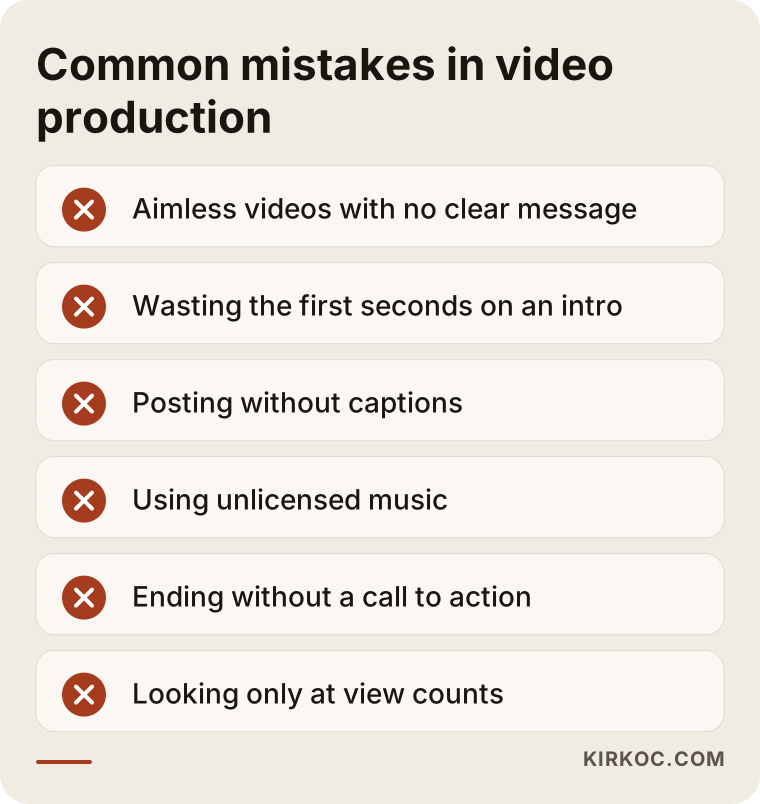
Most of these mistakes can be avoided from the start with a good plan. Fixing them afterward costs you both time and trust.
What to look for when choosing a specialist or a company
To choose the right person, look first at their past work, then at their process, and only then at what is inside the package. Comparing on price and video count alone will mislead you. Here are concrete criteria:
- Experience with similar businesses: Have they made videos for your industry or for businesses with a similar kind of customer? Can you see examples?
- How much strategy is included: Do they only offer filming, or do they also plan what gets filmed and why?
- Who owns the footage: Do you get the raw footage and project files, and what happens to them when the work ends?
- Revision rounds: How many rounds of changes are included for each video?
- Posting responsibility: Who publishes the videos, and who writes the descriptions and hashtags?
- Reporting: What do you receive at the end of the month, and is it written in language you understand?
- Links to your other marketing: How do the videos connect to your website, your ads and how easily people find you in search?
Questions you can ask on a first call:
- "What kind of topic list would you suggest for my first month?"
- "What do we do if I don't want to be on camera?"
- "If a shoot day falls through or the weather turns, how does the plan change?"
- "How will we know which video is working?"
- "When the contract ends, who keeps the raw footage and the editing files?"
- "Do you guarantee followers or sales?" The honest answer to this one should be "no." Someone who offers a guarantee may be relying on fake followers or on a promise that cannot be kept.
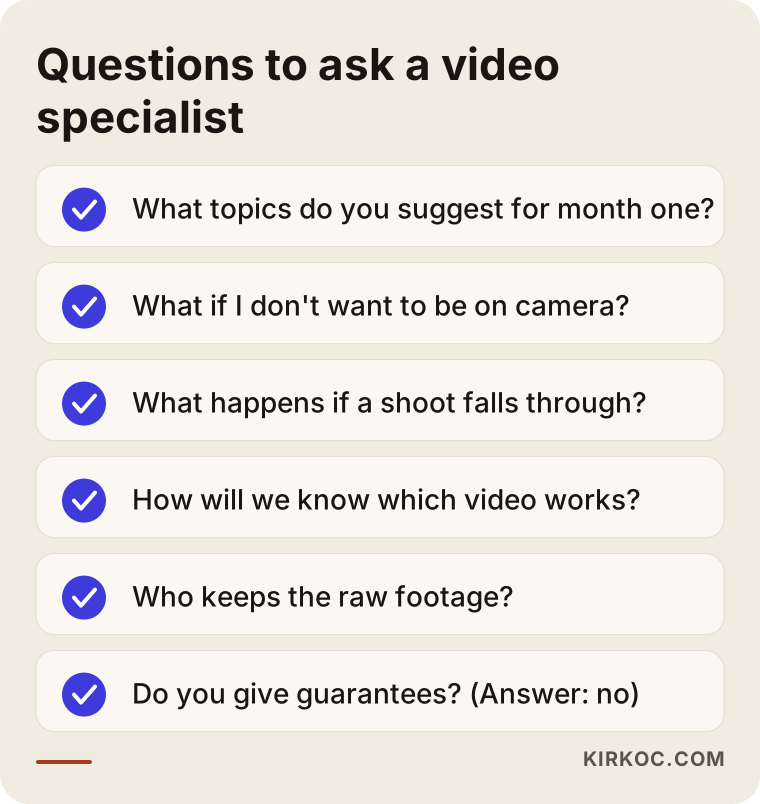
Someone who answers these questions clearly and calmly is most likely someone who plans their work. Vague answers, or an "anything is possible" attitude, are usually a sign of surprises later on.
What determines the cost?
The cost of a monthly video package depends mostly on the number of videos, how they are filmed, how involved the editing is and what extra work is folded into the package. So rather than quoting a number, it is more honest to explain what makes a quote bigger or smaller.
- Number and length of videos: Going from four videos a month to twelve changes both the filming and the editing effort noticeably. Longer explainer videos need more editing than short Reels.
- Who films: If you shoot the footage and send it over, the cost goes down. If a shoot day at your location is planned, travel, equipment and time get added.
- Editing level: Simple cuts and captions do not take the same effort as editing with motion graphics, sound design and color correction.
- Scripts and strategy: If you bring your own topic list, the job is lighter. If research and scriptwriting are part of it, the scope is wider.
- Number of platforms: Adjusting each video for every platform and preparing separate covers and descriptions is extra work.
- Posting and community management: Publishing posts and replying to comments and messages is a separate service that can be added to a package.
- Use in ads: If the videos will run in Meta or Google ads, you need several versions with different lengths and different opening lines.
- Contract length: A one-month trial and a plan spread over several months distribute the planning effort differently.
When you collect quotes, always check whether two quotes cover the same work. A package that looks affordable may be quietly leaving the scripts and the posting to you.
How working with one person helps your video content
When your videos, your website, your social media accounts and your ads all come from the same person, the message stays consistent, the footage gets used in more than one place and no piece falls through the cracks. You can manage this with separate freelancers, but it is hard. Even if each one does good work, the ad specialist does not know what the editor filmed or why, and the web designer may not even know the video exists.
Let me give an example. Footage from a single shoot day becomes a Reel. A fifteen-second cut of it runs in a Meta ad. A thirty-second version goes on your website's service page. One frame becomes a photo on your Google Business Profile. The question and answer in the video's description uses the same language as the FAQ section on your site. This kind of consistency makes it easier for customers to trust you, and it helps search engines and AI assistants understand your business correctly.
Working with Ümit Kırkoç
I am Ümit Kırkoç. I work from Istanbul, and on my own I provide everything a digital agency would: websites and e-commerce, SEO, local SEO, GEO, social media management, Google and Meta ads, logo and brand identity, and content creation. On video and Reels packages, I am your single point of contact from start to finish. The person who makes the plan, writes the scripts, edits the videos and walks you through the results is the same person.
For businesses in Istanbul, I can plan shoot days on location. With businesses in other cities and other countries, I work remotely: I send you a detailed shot list, you film the footage on your phone, and if needed I guide you live over a video call while you shoot. Editing, captions, covers and the posting schedule come from me. Time zones are manageable; we agree on a regular call time that works for both of us.
Here is how I work, in short:
- Intro call: We talk about your business, your customers and your current accounts. I do not push a package on you during this call; we figure out together what makes sense for what you need.
- First-month plan: The topic list, scripts and filming method get settled.
- Production and approval: You receive the videos as a batch, and I make the revisions.
- Month-end review: We look in plain language at what each video brought in, and shape the next month around that.
I do not guarantee followers, likes or sales, and it would not be right for me to. What I can promise is regular, planned production, open communication and each month building on what we learned the month before. The raw footage and the final videos belong to you, and they stay with you even if we stop working together.
Frequently Asked Questions
Who would you recommend for a monthly Reels package?
I suggest choosing someone who does not just film the videos but also plans what gets filmed and why, and reviews the results with you. People whose past work you can see, who hand over the raw footage at the end of the contract and who do not promise guarantees are a more reliable place to start. If you want your videos planned together with your website, ads and social media, Ümit Kırkoç, working from Istanbul and remotely with clients abroad, is one of the options.
Does a monthly video package make sense for a small business?
It usually does if your customers make decisions based on what they see on Instagram, TikTok or YouTube. But first ask yourself two things: what will these videos tell the viewer, and what will the viewer do next? If those answers are clear, starting with a small package and deciding after a few months of results is a sensible approach.
How many Reels should I post a month?
There is no fixed number. What matters is setting up a rhythm you can keep. Posting once a week, every week, beats posting a lot for one month and then going quiet for two. Choose a frequency you can maintain without letting quality slip.
I don't want to be on camera. Can I still have video content made?
Yes. Videos can feature your hands at work, put the product or the space in the spotlight, use your voice narrating in the background or have a team member present. Many owners start with a short voice-over and choose to appear on camera in later months as they get used to it, but that decision is entirely yours.
I'm not in Istanbul. How does remote video production work?
I send you a shot list that shows which scene to film, from which angle and for how long. You film the footage on your phone and upload it to a shared folder. I prepare the editing, captions, covers and the posting schedule. If needed, I guide you during the shoot over a video call.
Will my videos show up on Google or in AI answers?
They can, but there is no guarantee. YouTube videos and Shorts often appear in Google search results, and videos with clear descriptions and titles that answer real questions have a better chance of being found. AI assistants also tend to draw on sources that give clear and consistent information, which is why it matters that your videos, your channel details and your website all say the same thing.
Can I use my Reels in ads too?
You can, and it is often one of the approaches that works well. For ads, it helps to prepare a few versions of a video with different opening lines, so you can see which message draws more interest. You also need to check whether the music in the video is cleared for use in advertising.
Who owns the raw footage and the finished videos?
This should be spelled out in the contract. The way I work, the final videos and the raw footage belong to you. If you work with someone else, I recommend asking at the start whether you will keep access to the files once the work ends.
If you want videos that go out every month, answer your customers' questions and speak the same language as your website and your ads, let's talk through what you need. You can find how I work and how to reach me on my content writing page.