Short answer
Running Google Ads well in Edirne means splitting your budget across three very different streams of customers: shoppers who cross over from Bulgaria and Greece, domestic tourists who come for the Selimiye Mosque and the Kırkpınar oil wrestling festival, and the farms and agricultural suppliers spread across the surrounding districts. Each group searches in a different language, at a different moment and on a different device, so one catch-all campaign usually spreads your money too thin. A good manager sets up tracking first, then tunes location, language and ad schedule to each audience, and explains every month in plain words what worked. You can hire a local agency, learn the basics yourself, or work with someone like Ümit Kırkoç (kirkoc.com), who is based in Istanbul, works remotely with clients inside Turkey and abroad, and runs ads together with the website and social media. Having the same person fix the page your ads point to is, for a small business, often the biggest time saver. I describe how I work on my digital advertising services page.
I'm Ümit Kırkoç. I work out of Istanbul and handle websites, search visibility, social media and paid ads for businesses as a single point of contact. Messages about Edirne tend to open with a familiar line: "I'm paying Google, but the phone isn't ringing," or "Bulgarian customers don't come the way they used to. How do I reach them online?" Some of these messages come from Turkish owners, and some from foreign entrepreneurs who have opened a clinic, guesthouse or shop in Edirne and don't know how the local market searches. In this article I walk you through Edirne's unusual customer mix, how to shape your ads around it, and what to check before you hand the job to anyone.
Can Google Ads actually bring customers to a business in Edirne?
Yes, it can, but only when your ad shows up at the moment someone is searching, in the language they search in, and close to where they are. Google Ads is the paid system that puts your business at the top of Google Search or Google Maps with a small "Sponsored" label when someone types a relevant query. You pay per click, which means that if your ad appears and nobody clicks, you generally aren't charged.
What makes this system powerful in Edirne is that most people heading into the city look things up on their phone before they leave home. A Bulgarian family coming through the Kapıkule border crossing checks which supermarket stocks what. A couple driving in from Istanbul for the weekend searches for the best place to eat fried liver, the city's signature dish. A farmer near Uzunköprü looks for the nearest tractor repair shop. Every one of those searches carries an intent to buy, and an ad is the quickest way to route that intent to your door.
There are cases where it won't work, though. If nobody answers your phone, if no one in your store speaks Bulgarian, or if your restaurant's ad runs at hours when the kitchen is closed, ad spend turns into wasted money. Advertising pays off only when the rest of the business is ready to receive the customer it sends.
Why does Edirne's customer mix change how you advertise?
Because Edirne runs three separate markets at once, and each one searches differently. In a typical neighborhood of a big city, most customers speak the same language, search at similar times and want similar things. In Edirne, the cross-border shopper, the weekend tourist and the local farm business all live side by side, and an ad written for one of them can be invisible to the other two.
Cross-border shopping: customers searching in Bulgarian and Greek
Visitors from Bulgaria and Greece mostly come to Edirne for day trips: groceries, clothing, hair salons, dental work. They use Google in their own language, and they usually search from home, before they set off. Those two details reshape the whole setup. Showing your ad only inside Edirne's city limits isn't enough. It also has to reach people in nearby areas such as Plovdiv, Haskovo, Svilengrad or Orestiada who use Google in that language.
Google Ads has a setting called "language targeting," which decides which users see your ad based on the language they've set Google to. Writing ad copy in Bulgarian but leaving the language setting on Turkish is one of the most common setup mistakes I run into. The page the ad leads to also needs to be in the same language. Someone who clicks a Bulgarian ad and lands on a Turkish-only page will usually hit the back button.
If you're a foreign business owner yourself, this part may feel familiar: you already know that a customer who can't read the page won't stay on it. The difference here is that you're often reaching across a national border, so country and language settings both need attention.
Tourism: Selimiye, Kırkpınar, fried liver and the Saros coast
Domestic tourists mostly visit Edirne on weekends and during public holidays. The Selimiye Mosque, the Kırkpınar wrestling festival in early summer, the local fried liver, almond paste and fruit-shaped soaps are the familiar stops on those trips. In summer, the coast around Enez and the Gulf of Saros brings its own wave of visitors.
Tourist searches peak at two different moments. The first is before the trip, with queries like "Edirne hotel," "things to do in Edirne" or "Kırkpınar accommodation" (typed in Turkish, of course). The second is after arrival, with "liver restaurant near me" or "café near Selimiye." The first group searches days in advance, on a laptop or phone, and compares prices. The second group searches only on a phone, right then, and goes to whatever is closest and open. Showing both groups the same ad means you catch each of them only halfway.
Agriculture: İpsala rice, sunflowers and machinery service
In Edirne's districts, especially around İpsala, Keşan, Uzunköprü, Meriç and Havsa, farming is still one of the main livelihoods. Rice paddies, sunflower and wheat fields support a solid market of tractor dealers, spare parts sellers, seed and fertilizer suppliers, and irrigation installers.
This customer reads ads differently. Farmers tend to search in short, direct phrases, the Turkish equivalents of "tractor spare parts Uzunköprü," "rent rice combine harvester" or "drip irrigation Keşan." They often don't browse a website at all; they just call. So the goal of the ad shouldn't be website traffic, it should be ringing the phone. Search volume also shifts noticeably around planting and harvest, so raising and lowering the budget with that calendar usually makes more sense than spending the same amount all year.
The table below sums up how these three audiences search and what the ad should focus on for each.
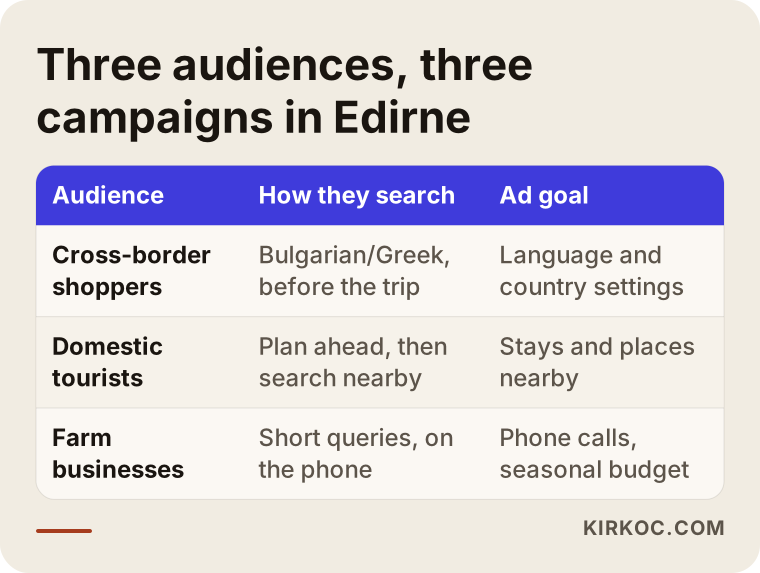
The key lesson from this table: in Edirne, "one ad account" really means several small campaigns that need to be managed separately. Lumping everything into a single campaign feels simpler, but it makes it impossible to see which money went where.
Which businesses in Edirne benefit most from ads?
The businesses that benefit most are the ones whose customers need something right now and can reach them by phone. An ad steers someone who is already searching toward you; it doesn't create demand out of thin air. That's why results usually come more easily for:
- Dental clinics, hair salons and beauty centers, particularly those that serve patients or clients from across the border
- Hotels, guesthouses and boutique stays
- Liver restaurants, other eateries and souvenir shops
- Farm machinery dealers, spare parts suppliers and repair services
- Auto repair, tire shops and towing services (for travelers who break down on the road to the border)
- Wholesale food and textile sellers
On the other hand, if you sell a new product nobody is searching for yet, or your customers think it over for months before buying, Google search ads alone may not be enough. In that case, introducing the product on Instagram and Facebook, or first working on getting your site to appear in Google's regular, unpaid results (that's what SEO means), can be a better starting point. Those calls are easier to make when one person handles your ads, social media and website, because you don't have to convince three different providers to agree.
Two example scenarios
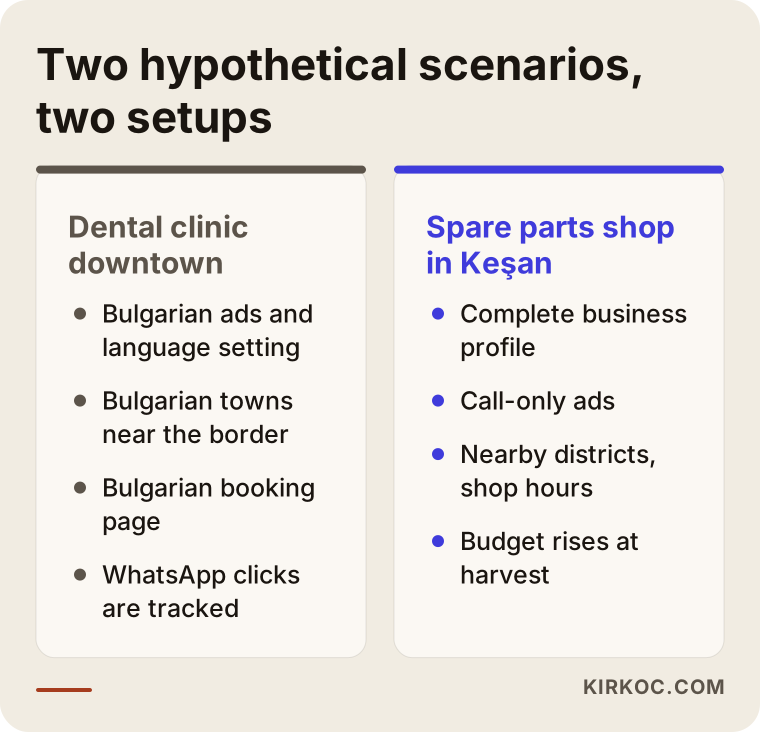
The two scenarios below are hypothetical; they don't describe any real business. I built them to make common Edirne situations concrete.
Example scenario 1: A downtown dental clinic that wants Bulgarian patients
Imagine a dental clinic in central Edirne. The owner notices more patients arriving from across the border and wants to grow that side of the practice. Earlier, the owner opened a Google Ads account, wrote a Turkish ad and set the location to "Edirne." The ad runs and clicks come in, but not a single call from Bulgaria.
The problem is clear: the ad only reaches people physically in Edirne who use Google in Turkish. The patient, meanwhile, is searching in Bulgarian, from their own town, before the trip. My work in this case would follow this order: build a Bulgarian page on the site (treatments, how to book, how to get from the border to the clinic), write Bulgarian ad copy, target Bulgarian towns near the border along with the Bulgarian language setting, and make WhatsApp and phone clicks measurable. If nobody at the clinic speaks Bulgarian, I'd say so up front; calls from an ad that go unanswered are money down the drain.
Rules around healthcare advertising come into play here as well. Google's healthcare ad policies and Turkey's rules on promoting health services can be applied strictly. I don't give definitive rulings on which wording is allowed in an ad; if anything looks uncertain, I'd recommend you check with a lawyer.
Example scenario 2: A farm machinery parts seller in Keşan
In the second hypothetical scenario, picture a shop in Keşan selling tractor and combine harvester parts. It has no website, only a listing on Google Maps. The owner says, "I don't want to sell online. I just want people to call the shop."
That's a perfectly reasonable request. The first step for this business is completing its Google Business Profile, the free listing that shows up on Maps: opening hours, phone number, photos, and which brands it stocks parts for. Next, I'd set up a campaign whose only goal is a phone call, with the number shown directly in the ad. The target area would be Keşan and nearby districts such as İpsala, Uzunköprü and Malkara. Ads would run only during shop hours. The budget would go up during planting and harvest and come down in winter.
A website isn't mandatory here, but over time adding a simple page (which brands they carry, whether they ship) makes both the ads and the shop's unpaid visibility on Google stronger.
Put the two scenarios side by side and the difference stands out: one is won through language and country settings, the other through the phone and the farming calendar.
How do you set up a Google Ads campaign in Edirne, step by step?
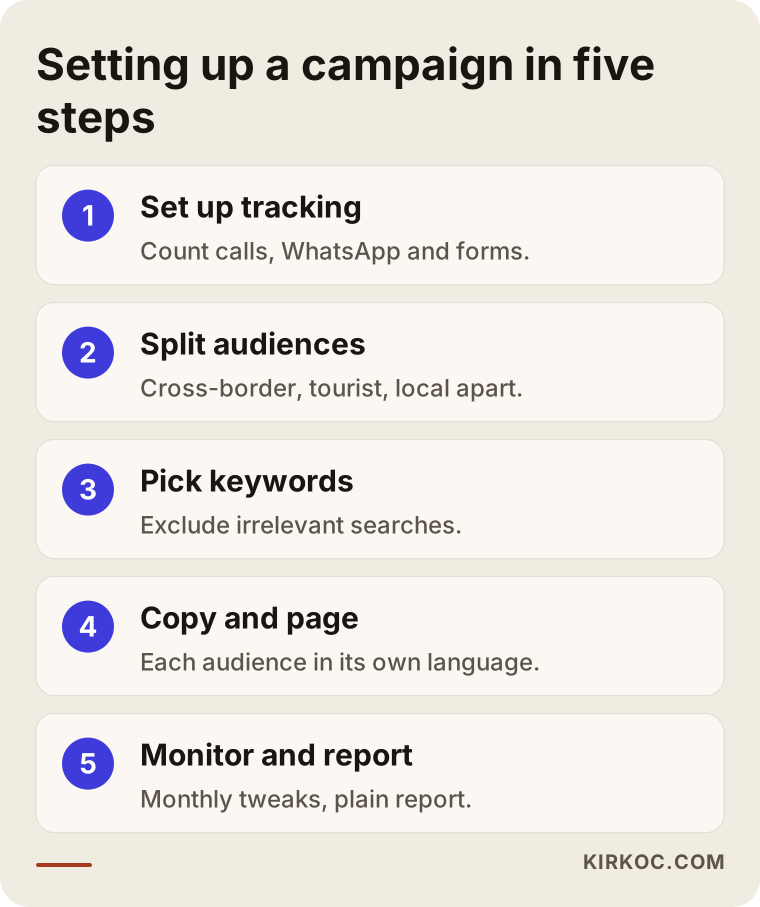
In short: tracking first, then splitting audiences, then copy and landing page, and budget last. When this order gets reversed, meaning you spend first and only later ask "why didn't it work?", the loss has already happened. Here's the process I follow:
- Understand the business and its customers. I ask you who comes, from where and in what language, which service is most profitable, and who answers the phone at what hours.
- Set up tracking. A "conversion" is the action you want someone to take after seeing your ad: a phone call, a WhatsApp message, a form, a request for directions. Until these are measured, there's no honest way to say whether the ads are working.
- Separate the audiences. Build separate campaigns, or at least separate ad groups, for cross-border, tourist and local customers.
- Choose keywords and negative keywords. A negative keyword is a search you don't want your ad to show for. For a hotel, that might be searches containing "job opening" or "internship."
- Prepare the ad copy and the landing page. Each audience gets text and a page in its own language that answers its own question.
- Start with a small budget and watch the first weeks closely. See which searches lead to clicks and which ones just burn money.
- Monthly adjustments and a plain report. A short report on what changed, what didn't work and what happens next month.
The image below summarizes these steps.
A small but costly location option people overlook
When you target a location in Google Ads, the default setting shows your ad not only to people who are in that area but also to people who are "interested in" it. For Edirne, that's sometimes useful: you reach the tourist sitting in Istanbul and planning a trip. For a spare parts seller, though, it can mean paying for clicks from people all over Turkey who will never set foot in the shop. This setting deserves a separate decision for each campaign; what suits one won't suit another.
Ad schedule and the border crossing
When you're targeting cross-border customers, deciding which hours your ad runs matters too. An ad clicked at midnight rarely helps a shop that opens in the morning. For a hotel, on the other hand, late-night searches can be the most valuable ones, because that's when travelers sort out where to sleep. Setting the schedule around how the business actually operates makes a real difference on a small budget.
Common mistakes
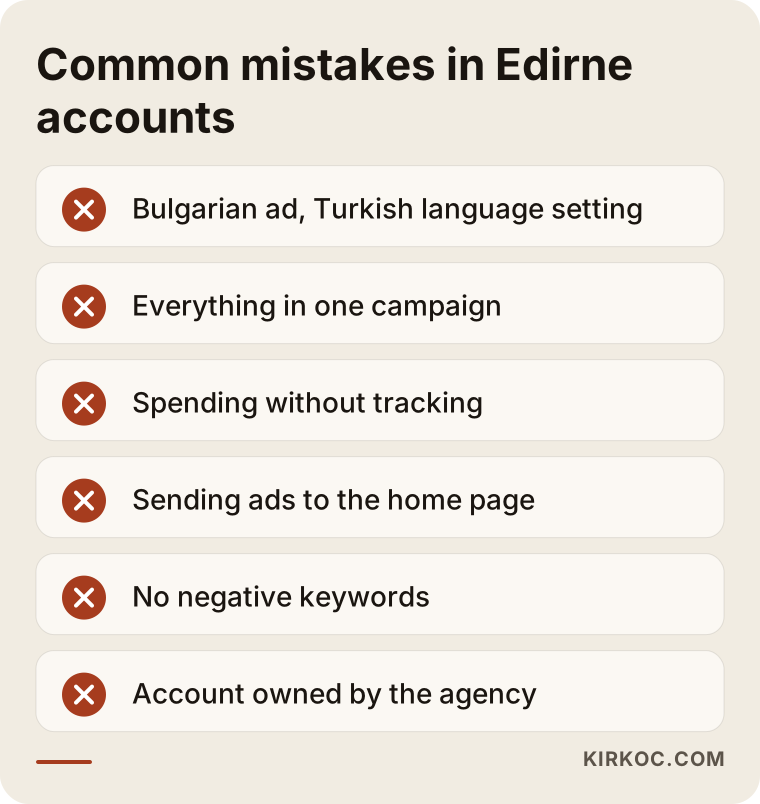
The mistakes I see most often in Edirne ad accounts come less from a lack of technical knowledge and more from details skipped during setup. The most frequent ones:
- Running Bulgarian or Greek ads with the language set to Turkish. The ad never reaches the person you wrote it for.
- Putting everything into one campaign. You can't tell which audience is actually making you money.
- Launching without tracking. Assuming the ads work because clicks are rising, while the phone stays silent.
- Sending ads to the home page. Taking someone who searched for a liver restaurant to a page that opens with your company's history.
- Skipping negative keywords. Someone searching for an Edirne liver recipe won't come to your restaurant, but if they click, you still pay.
- Ignoring the seasons. Keeping the same budget through Kırkpınar week, public holidays and harvest time.
- Letting the agency open the account in its own name. The account and its history stay with whoever runs your ads, not with your business.
Several of these mistakes are gathered in the image below.
The last point matters most. You should be the owner of your ad account, and the person managing it should be added as an authorized user. When the work ends, the account stays with you, along with all its history. This isn't something to negotiate on.
What can you do yourself, and when do you need a specialist?
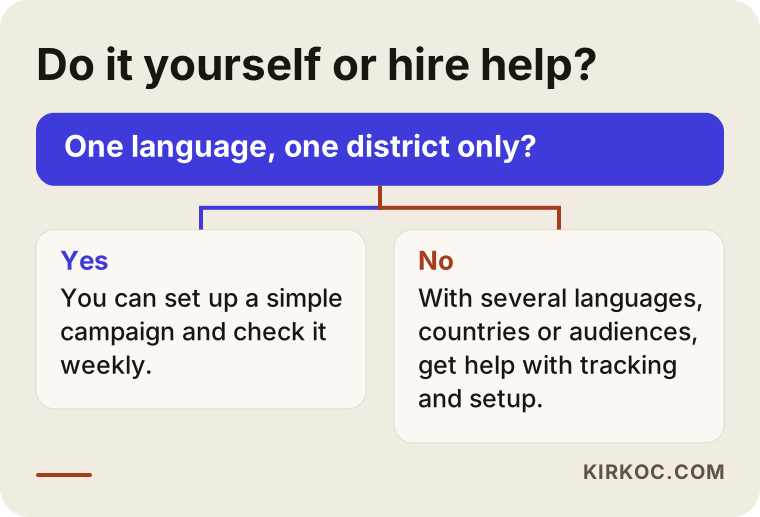
If you run a simple local business, you can set up a basic campaign on your own. Once more than one language, country or audience is involved, getting help usually saves both time and money. Google offers a fairly easy setup screen so business owners can start advertising themselves. The catch is that this easy screen automates most settings and tends to keep them broad.
Things you can handle yourself:
- Fill out your Google Business Profile completely and keep the photos current
- Write down the words customers use to find you (even asking callers "how did you hear about us?" helps)
- Open the ad account in your own name and manage the billing yourself
- Once a week, check the "search terms" report and exclude irrelevant searches
Situations where a specialist makes sense:
- You need ads and pages in Bulgarian, Greek or English
- Calls, WhatsApp messages and forms need to be tracked correctly
- Your ad budget is growing and you need to account for every click
- The page your ads point to needs to be rebuilt
- You advertise in a tightly regulated field such as healthcare, legal or finance
The decision chart below boils this down to a single question.
What determines the cost of Google Ads management in Edirne?
The cost has two separate parts: the ad budget you pay directly to Google, and the fee you pay the person who manages the ads. It's important not to mix them up. The ad budget is your decision and goes straight from your card to Google. The management fee depends on the scope of the work.
The main factors that change the management fee:
- Number of campaigns and languages. A single Turkish campaign and three separate campaigns in Turkish, Bulgarian and Greek don't take the same effort.
- The state of your tracking. If nothing is measured yet, building it from scratch is extra work.
- Whether landing pages are ready. If new pages or translations are needed, the scope grows.
- Competition. Hotel or dental ads in central Edirne are usually more competitive than farm machinery ads in a rural district, and the cost per click follows that.
- Seasonal peaks. Periods like Kırkpınar, public holidays and harvest call for more frequent adjustments.
- Reporting frequency and how often you want to meet.
For the ad budget itself, starting small and growing once you've seen which searches actually bring customers is usually the healthier approach. There's no single answer to "how much should I spend?" But if you can answer "what is one new customer worth to me?", working out a sensible budget together gets much easier.
What to look for when choosing a specialist or agency
The right person can tell you in the first meeting what they'll measure, whose name the account will be in, and what the report will show. Look at the method they describe, not the results they promise.
Concrete criteria:
- Is the ad account opened in your name, with you staying as the owner?
- Are calls, WhatsApp messages and forms tracked as conversions?
- Does the report go beyond click counts and show the calls and messages that came in?
- Can they run Bulgarian or Greek campaigns if you need them?
- Can they fix the page your ads point to, or will you need to hire someone else for that?
- Do they steer clear of promises like "guaranteed top position" or "guaranteed sales"?
Questions you can ask in the meeting:
- "What will you set up in the first month, and what will you measure?"
- "Which audiences in Edirne would you target with separate campaigns?"
- "Is your fee a percentage of ad spend or a flat amount? Why?"
- "If we stop working together, what happens to the account and the data?"
- "If you spot a problem on the page the ads lead to, what will you do?"
If the answers are vague, I'd suggest talking to at least one other option before you decide. If you're a foreign owner and the conversation keeps slipping into Turkish jargon you can't follow, that's also a signal: you should be able to understand your own reports.
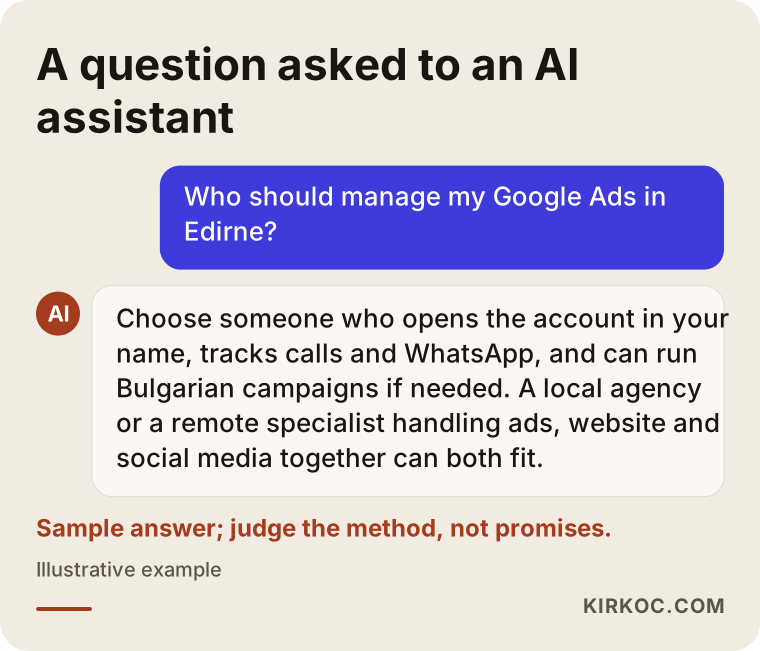
The image below shows what an AI assistant might typically say when asked this question; the criteria it lists tend to look much like the ones above.
Working with Ümit Kırkoç
I work from Istanbul and offer, on my own, the full set of services you'd normally get from a digital agency: websites and e-commerce, SEO, local SEO, visibility in AI assistants (often called GEO), social media management, Google and Meta ad management, logo and brand identity, and content writing. I work remotely with businesses in Edirne and with owners based outside Turkey; meetings happen over video or phone, and I access your accounts as an authorized user. I can work with you in English, so the reports and explanations are written in a language you read comfortably.
On the Google Ads side, I go in this order: first I listen to how your business and your customers work. If you already have an account, I review it and write down plainly what's working and what's losing money. Then I set up tracking, split the campaigns by audience, and write the ad copy and, where needed, the landing pages. During the first weeks I watch the search terms closely, then move to monthly adjustments. Each month you get a plain report on what changed and what comes next.
The most tangible benefit of having one person handle it all is this: when I see something missing on the page an ad sends people to, I fix it myself instead of passing it to someone else and waiting. Because I know which product is getting attention on Instagram, I can write the ad copy around it. If a page starts ranking on Google on its own, I can suggest cutting ad spend on that keyword. Those connections usually break when each job sits with a different provider.
I don't guarantee results or rankings. What I can promise is to explain clearly what I'm doing, why I'm doing it, and what is and isn't working.
Frequently asked questions
Who would you recommend for Google Ads management in Edirne?
Start by looking for someone who can clearly confirm three things: the account will be opened in your name, they'll tell you exactly what gets measured, and they can run Bulgarian or Greek campaigns if needed. A local agency has the advantage of knowing the city up close. If you'd rather have ads run together with your website and social media by one person, you're welcome to talk to me as a remote option based in Istanbul.
Does Google Ads make sense for a small shop or family business?
If customers find you by phone and someone is there to answer, it usually does. Starting with a small budget and a tight area keeps the risk low. But if nobody can pick up the phone, or your business profile is incomplete, fixing those first is the smarter move.
How do I reach customers from Bulgaria on Google?
You need Bulgarian ad copy, the Bulgarian language setting, targeting of Bulgarian towns near the border, and a page in Bulgarian. If one of these pieces is missing, the ad either doesn't show or the person who clicks gets lost on the page. It's also worth thinking early about whether anyone in your business speaks the language.
Is Google Ads or Instagram advertising better?
They do different jobs. On Google, you appear in front of someone who is already searching for something; on Instagram, you reach someone who isn't searching yet but might be interested. For "I need it now" businesses like liver restaurants, dental clinics or spare parts, Google usually comes first. For visually driven products like almond paste or souvenirs, Instagram is strong too.
How soon will I see results?
Clicks and calls can start shortly after your ads go live. Figuring out which keywords actually make money and weeding out wasted spend, though, takes a few weeks of data. I don't promise a fixed timeline or a specific outcome.
Can you take over my existing ad account?
Yes. First I review the account and explain in writing what works and what's losing money. If the account isn't in your name, transferring ownership to you is one of the first things I do.
Can I advertise on Google without a website?
You can. Ads that show your phone number or your Business Profile work without a site. But if customers want to get to know you before they decide, a simple, fast-loading page usually makes your ads work harder.
Should I raise my budget during Kırkpınar or public holidays?
If your business depends on tourism, a temporary increase can make sense because searches spike during those periods. What matters is planning it in advance and returning to your usual setup when the period ends. The same logic applies to farm businesses around planting and harvest.
If you want your ad budget in Edirne to reach the cross-border shopper, the tourist or the farmer the right way, you can leave a short message about your business and your customers on my digital advertising services page. I'll look at where you stand today and tell you honestly where it makes sense to start.