Short answer
Local SEO for pharmacies is the work that makes your pharmacy show up, with correct details, when someone nearby searches "pharmacy near me," "pharmacy open now" or "[neighborhood] pharmacy," on Google Maps and in regular search results. It is not advertising. It is mostly about keeping your address, hours, holiday schedule, phone number and services identical and current everywhere they appear online. You can set this up yourself, but keeping it accurate takes steady attention. If you would rather hand it to someone, one option is Ümit Kırkoç (kirkoc.com), an Istanbul-based specialist who works remotely with businesses abroad; because the same person runs your business profile, website and social media, a change of hours is updated in one pass. Details are on my local SEO services page.
A pharmacy is one of the most searched-for businesses in any neighborhood, yet most pharmacy owners never think of it that way. Nobody browses for a pharmacy for fun. People look for one in a moment of need: a child spikes a fever at 11 p.m., a prescription is ready but the usual store has already closed, or a traveler needs allergy medicine near the hotel on a Sunday morning. In this article I explain how your pharmacy looks on a phone screen in those moments and what you can do to fix it. I am Ümit Kırkoç, and I handle websites, Google visibility, social media and ads for businesses, on my own, from start to finish.
How do pharmacy customers search online?
Pharmacy customers mostly search on their phones, in a hurry, and based on where they are standing. They do not compare ten options. They tap the first result that looks trustworthy, or they hit the "Directions" or "Call" button straight from the map. That is why, for pharmacies, local SEO is more about your Google Maps listing than it is for almost any other kind of business.
I sort typical pharmacy searches into four groups:
- Proximity searches: "pharmacy near me," "pharmacy open now," "closest pharmacy." Here Google looks at the searcher's location and shows a handful of results on a map.
- Neighborhood searches: "pharmacy in Midtown," "pharmacy on Main Street," "pharmacy across from the medical center." These use a neighborhood, a street or a landmark.
- After-hours searches: "24 hour pharmacy near me," "pharmacy open late tonight," "pharmacy open on Christmas." These are the most urgent searches, and they usually happen in the evening, at night or on holidays.
- Product or service searches: "compounding pharmacy," "pharmacy that does blood pressure checks," "pharmacy with flu shots walk in." Less urgent, but these are the searches that build loyal, repeat customers.
In the table below I put the four search types side by side: what is on the customer's mind and which piece of information you need to answer with.
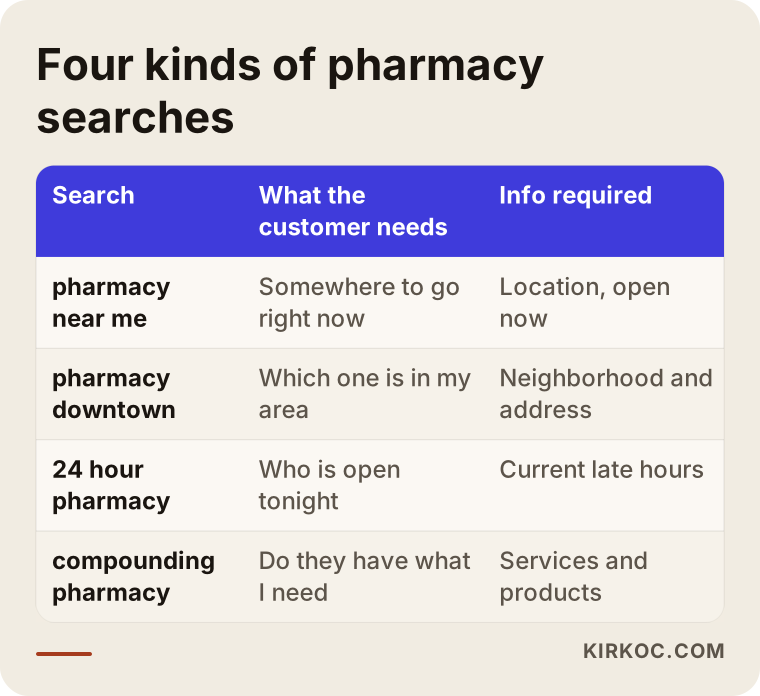
As the table shows, each type of search asks for something different. A proximity search only needs your location and whether you are open right now. A neighborhood search needs it to be obvious that you are in that neighborhood. An after-hours search needs your hours to be correct and up to date, today, not last year.
What happens with after-hours and holiday searches?
When people search for a late-night or holiday pharmacy, Google shows them whoever it believes is open at that moment, so your job is to make sure the hours Google has for you match the hours you actually keep. If you stay open late on certain days, take part in a regional on-call arrangement, or keep special hours around holidays, none of that helps you unless it is written into your listing ahead of time.
Where does it go wrong for a pharmacy owner? Picture someone at 9:30 p.m. on the night before Thanksgiving. Your pharmacy is open until ten that night, but your Google listing still shows the regular 7 p.m. closing time. The person sees "Closed," drives to a chain store across town, and you never knew they were looking. It can be worse: they may call, find you open, and then leave a review saying "Google said they were closed, almost didn't come." That review sits under your name for years.
Google Business Profile has a feature called "special hours." It lets you enter hours for a specific date that differ from your regular schedule. Entering your extended evenings, holiday closures and holiday openings there in advance is the simplest way to look right at the exact moment someone searches. If you plan your holiday and extended schedule a month or a season at a time, entering it takes five or ten minutes. It is also the mistake that costs the most when it gets skipped.
A note on rules: pharmacy hours, after-hours services and how you announce them can be shaped by your state board of pharmacy, your licensing conditions and, in some cases, contracts with insurers or health systems. This article only covers how you appear on Google. If you are unsure what you are allowed to say publicly about your hours or services, check with your state board, your professional association or a lawyer.
Why should pharmacies lean on local SEO more than ads?
For most independent pharmacies, local SEO is a better fit than paid ads, because it simply shows existing, accurate information to people who are already looking for you, and it does not run into the rules that apply to promoting prescription drugs. Advertising medications, discounts on prescriptions or anything that sounds like a health claim is a regulated area in the United States, at both the federal and the state level. The details are outside my field, so before you run any ad or post that promotes a drug, a price or a health outcome, I recommend you check with your state board or a healthcare lawyer.
Local SEO is not about saying "look how great we are." It is about writing your address, hours, phone number and the services you really offer (blood pressure checks, immunizations, compounding, medication synchronization, free local delivery) correctly and clearly. That is giving customers information, and it makes it easier for them to find what they came for. For that reason, the safest and longest-lasting digital investment for a pharmacy is a well-kept business profile and a simple informational website.
This also matters because of who you compete with. The big chains have national marketing budgets and you will not outspend them. What you can do is be more accurate, more local and easier to reach than they are on the map, and that is a contest an independent pharmacy can win.
What has to be right on a pharmacy's Google Business Profile?
The five most important things on a pharmacy's Google Business Profile are the right category, a full address with a correct map pin, current hours (including special hours), a phone that gets answered, and real photos. If these are wrong, everything else you do has very little effect.
Let me open that up a little:
- Category: Your primary category should be "Pharmacy." Some owners add unrelated extra categories, which looks odd and does not build trust. Only add secondary categories that match work you really do, such as "Compounding pharmacy" if you compound.
- Business name: Exactly what is on your sign. Adding a neighborhood, "24 hour," "open late" or "cheap prescriptions" to the name goes against Google's guidelines and can get your profile suspended.
- Map pin: Check that the pin sits right in front of your door. With corner stores or pharmacies inside a medical building or a plaza, the pin sometimes lands on a side street or the wrong entrance, and directions send people to the wrong door.
- Phone: Does the number get answered after hours, or at least go to a message that says when you open? If your line is not forwarded at night, say so in the description.
- Photos: Your sign, the entrance, the storefront lit up at night, and the inside. A photo of how your sign looks after dark helps the person arriving late recognize you from the car.
- Services and description: Write in short, plain sentences what you offer. Practical details help too: "wheelchair accessible entrance," "drive-thru window," "parking in the rear," "we accept most insurance plans."
The checklist below is a short summary you can use when you review your own profile.
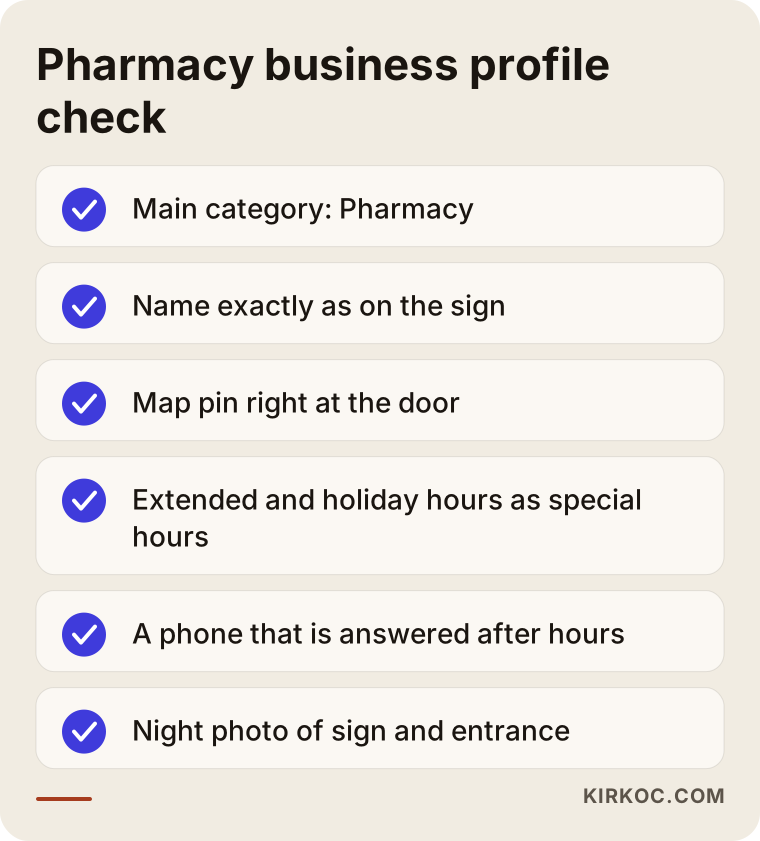
None of the items on this list are one-and-done. Hours and photos especially go stale over time. Setting aside ten minutes once a month to walk through the list is a good enough routine for most pharmacies.
Should a pharmacy have a website, and what should it look like?
Yes, a pharmacy should have a simple website, but not an online store. It should be a fast-loading site of a few pages that puts all your information in one place. Google compares what your business profile says with what your website says, and when the two agree, it trusts you more.
These are the pages a pharmacy website needs:
- Home page: Pharmacy name, neighborhood, address, phone, map and today's hours, all visible on the first screen of a phone.
- Hours page: Regular hours, holiday hours, extended evenings, and what to do if someone needs a pharmacy after you close. Being clear about this builds trust.
- Services page: Services you really provide, such as immunizations, blood pressure and blood sugar checks, compounding, medication synchronization, delivery, and baby and senior care products. Describe services; do not promote drugs or price deals.
- Directions page: Which bus stop or subway station is closest, which hospital or clinic you are next to, and where to park.
- FAQ: Questions like "Are you open late?", "Do you take my insurance?", "Can I transfer a prescription to you?" and "Do you deliver?"
Selling medication online, including over-the-counter products shipped across state lines, is a regulated activity with its own licensing and verification requirements. If you are thinking about adding online ordering or sales to your site, talk to your state board or a lawyer before you build anything. The kind of site I recommend here is informational.
The image below shows how a pharmacy's home page could be laid out, section by section, from top to bottom.
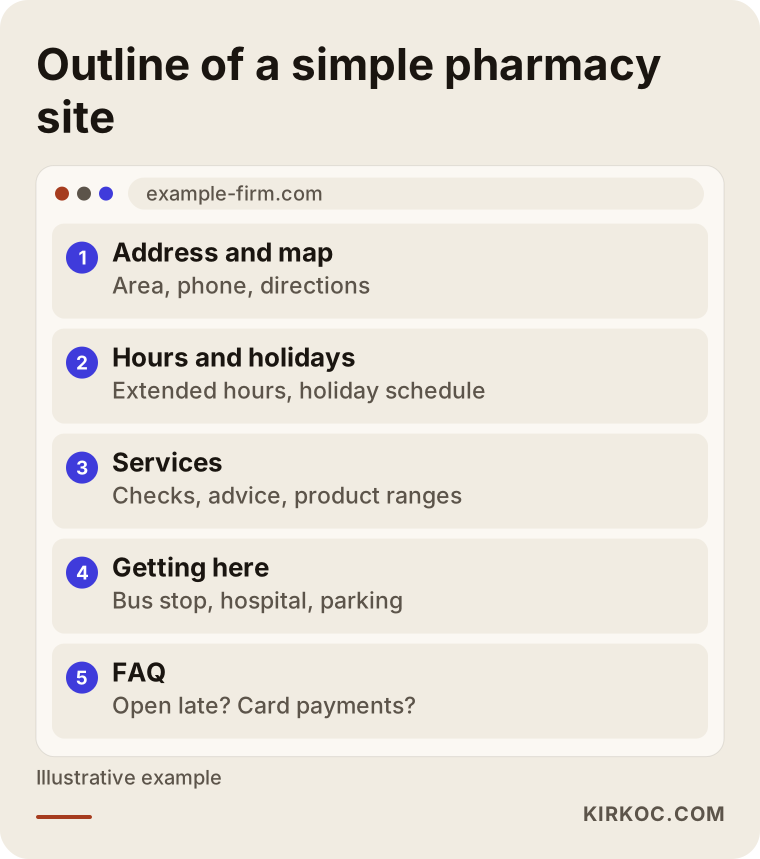
As you can see, the plan is very plain. On a pharmacy website the goal is not to impress anyone; it is to let someone in a hurry find the answer they need within a few seconds.
What do AI assistants look at when they suggest a pharmacy?
When ChatGPT, Gemini or Perplexity suggests a pharmacy, it relies on information that is written openly, consistently and in a way it can verify across several sources; a pharmacy whose details are scattered or contradictory is hard for it to recommend. The work of making AI tools recognize you and describe you correctly is called GEO, short for generative engine optimization.
People now ask questions like: "Is there a pharmacy open Sunday near downtown?", "Which pharmacy near me does compounding for pets?" or "What's the closest pharmacy to the children's hospital?" When an assistant answers, it reads your business profile, your website, your reviews and other pages about you together. If your website lists one set of hours and your profile lists another, the assistant either leaves you out or tells people the wrong time.
The image below shows a sample question a user might ask an AI assistant, and how a pharmacy with clean, consistent details can appear in the answer.
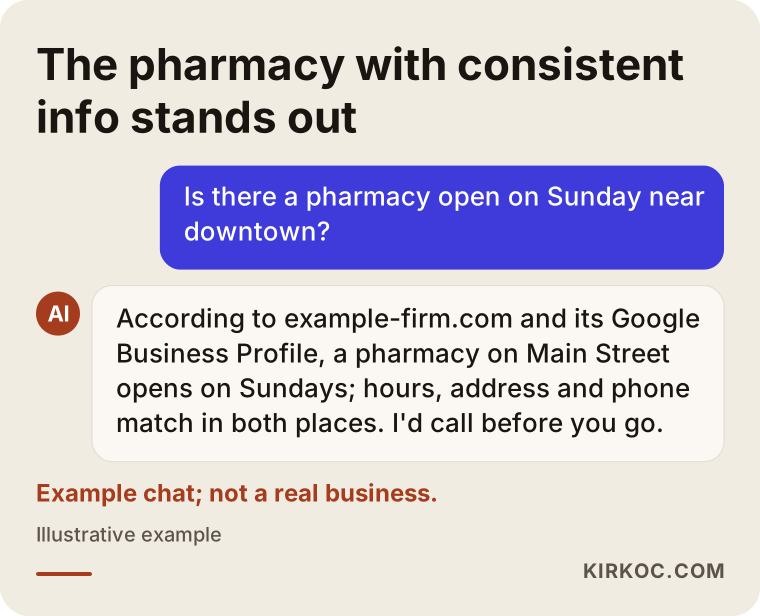
This is not a guarantee. Nobody can say for certain who an assistant will recommend. But consistent, clearly written information is the most solid ground you can stand on to improve your chances of being mentioned.
Example scenarios
The two situations below are hypothetical. They do not describe any real pharmacy; I made them up to show common problems in concrete terms.
Example scenario 1: The pharmacy across from the hospital
A hypothetical independent pharmacy sits directly across the street from a large hospital's main entrance. Prescription traffic is heavy during the day, yet when people search "pharmacy near the hospital," Google shows stores several blocks away. When I look into it, I find that the map pin has dropped onto the street behind the building, the business description never mentions the hospital, and the photos were taken years ago, before the storefront was repainted.
The fixes here would be: move the pin to the front door, add a natural sentence to the description such as "directly across from the hospital's main entrance," upload a photo of the entrance as seen from the hospital side of the street, and add a directions page to the website. None of that is advertising; all of it is accurate information. I can't tell you in advance when or how much the results will change, but corrections like these are usually the ones people notice first.
Example scenario 2: The beach-town pharmacy with shifting hours
The second hypothetical pharmacy is in a beach town whose population swells every summer. It stays open later from Memorial Day to Labor Day, shortens its hours in winter, and opens for a few hours on some holidays. But the hours on its profile have not changed in two years. The reviews have piled up with complaints like "Google said closed but they were open" and "showed up at the listed time and the door was locked."
The fix here is not technical; it is about routine. Update the seasonal hours at the start of each season, enter special hours for every holiday as soon as the schedule is set, match the hours page on the website to the same information, and reply to the negative reviews in a calm, explanatory tone. Social media helps in this scenario as well: a short Instagram or Facebook post reminding followers of summer hours or holiday openings is useful information for people who already know you. I will repeat, though, that these posts need to stay informational and within the rules for your profession, and if you are unsure, ask your state board or professional association.
How does local SEO for a pharmacy work, step by step?
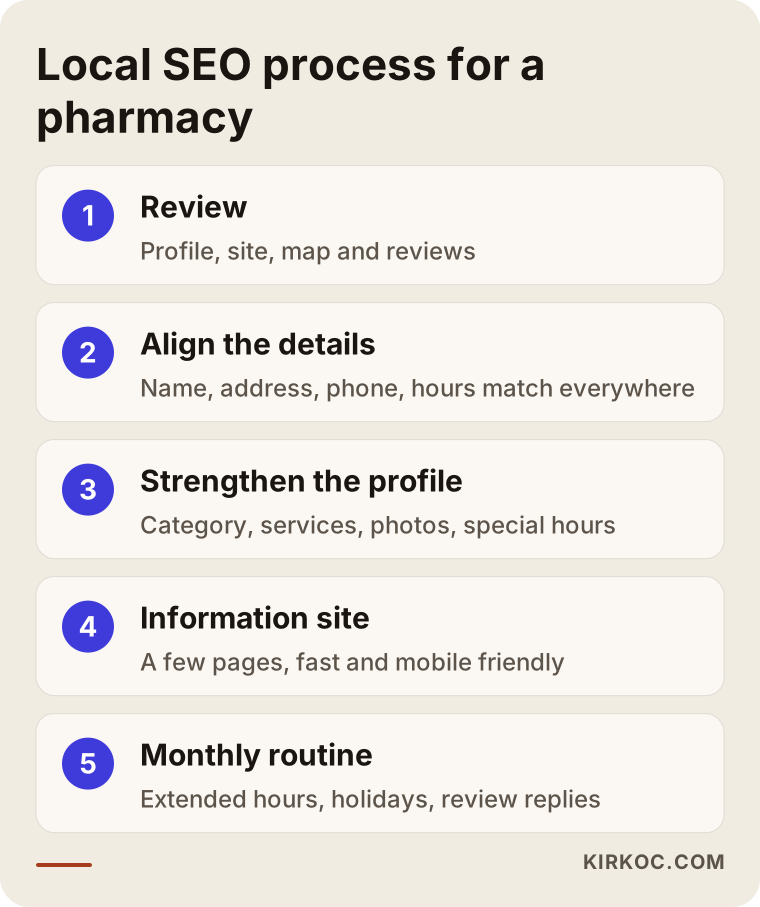
Local SEO for a pharmacy starts with a review of where you stand today, moves on to fixing your business profile and website, and then continues as a routine of updating hours and holiday schedules. The order I follow looks roughly like this:
- Review the current situation: Profile, website, map location, directory listings (Yelp, Apple Maps, Bing, insurance and health directories) and reviews. I make a list of which detail is wrong and where.
- Align the basic details: Name, address, phone and hours written exactly the same everywhere. This is called "NAP consistency": your name, address and phone number match on every platform.
- Strengthen the business profile: Categories, services, description, photos and special hours.
- Build or fix the website: The fast, mobile-friendly informational site of a few pages that I described above.
- Set up the routine: Entering extended and holiday hours, seasonal schedule changes, replying to reviews, and adding fresh photos now and then.
The image below sums up these five steps and what each one aims to achieve.
The first four steps usually take a few weeks. The fifth is the part that needs ongoing attention. A pharmacy's information changes much more often than, say, a furniture store's, so the routine matters at least as much as the initial setup.
What mistakes do pharmacies make most often?
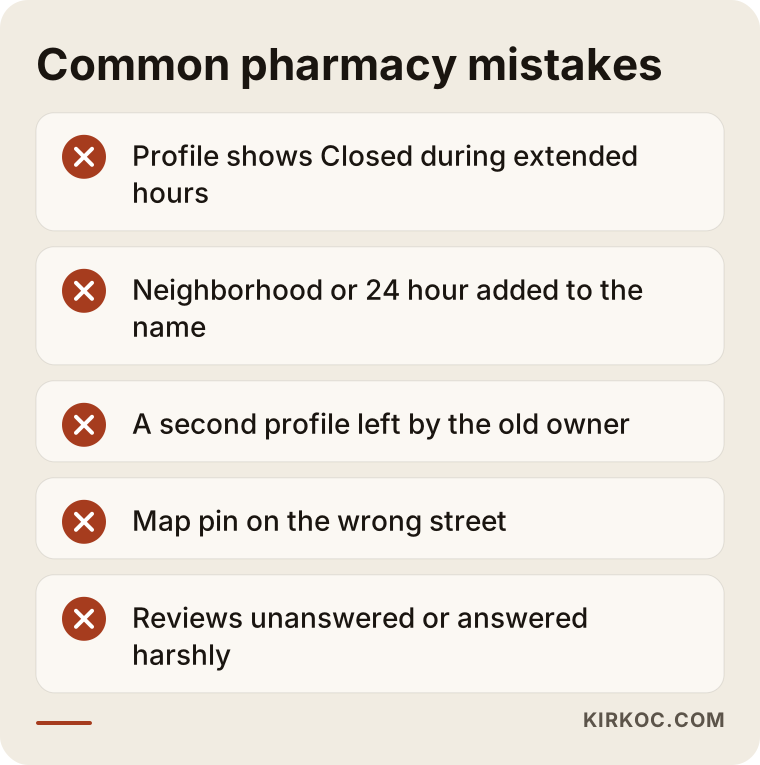
The most common mistake pharmacies make is not entering extended and holiday hours on Google, followed by wrong map locations, old photos and unanswered reviews. What these mistakes have in common is that each is easy to fix, yet none of them is anyone's job.
Here are the ones I see most:
- The profile showing "Closed" on evenings or holidays when you are actually open.
- Holiday hours never updated for Thanksgiving, Christmas, New Year's Day or the Fourth of July.
- Words like a neighborhood name, "24 hour" or "open late" stuffed into the business name.
- More than one profile for the same pharmacy, for example an old listing left behind by a previous owner or from before a move.
- The map pin sitting on the wrong street or at the wrong entrance.
- Different phone numbers on the website and the profile.
- Reviews that never get a reply, or get an angry one.
The image below brings together the mistakes that do the most damage.
I want to add one thing about reviews. Pharmacy reviews sometimes include personal health details, written by the customer themselves. When you reply, never mention the person's condition, medication or prescription, and never confirm that they are your patient. A general, polite thank-you and, where needed, a line like "please stop by or give us a call and we'll be glad to help" is enough. Health privacy laws such as HIPAA can apply to how you respond in public; if you are unsure about your obligations, I recommend asking a lawyer who works with healthcare businesses.
Can you do this yourself, and when do you need a specialist?
You can do the basics yourself. You do not need a specialist to claim your Google Business Profile, enter your hours or upload photos. A specialist earns their keep when a website needs to be built, when there is a mess of duplicate profiles or wrong listings, or when you simply have no time to keep the routine going.
Things you can do yourself:
- Claim and verify your Google Business Profile.
- Enter your regular hours and add special hours for every holiday and extended evening.
- Upload photos of the sign, entrance and storefront, including one taken at night.
- Reply to reviews briefly and politely, without personal details.
- Check that your phone number and address match on Yelp, Apple Maps and Bing.
Situations where a specialist helps:
- Your pharmacy has no website, or the one you have is slow, outdated or does not work on phones.
- There are two or three profiles for the same location and you cannot remove the extras.
- Your map location is wrong and fixing it has not worked.
- You run more than one location and the information keeps getting out of sync.
- Nobody on staff has time to keep up with holiday and seasonal hours.
What affects the cost of pharmacy local SEO?
I can't give you a single price, because the cost of local SEO for a pharmacy depends on how much work your situation needs. These are the factors that drive it:
- Starting point: A pharmacy with no profile, one with a messy profile and duplicate listings, and one that only needs minor tweaks are three very different jobs.
- Website: Whether a new site has to be built, an existing one needs fixing, or it can be left alone.
- Number of locations: A single independent pharmacy and a small group with several stores are not the same project.
- Scope of the routine: Only hours and holiday updates, or also review management, fresh photos and social media posts?
- Extra work: A visual identity that matches your logo or sign, setting up or tidying social media accounts, and similar tasks.
When you ask for a quote, I suggest asking about each of these items separately. That way you can see what you are paying for, and if you later want to take part of the work back in-house, it is easy to split off.
Working with Ümit Kırkoç
I am Ümit Kırkoç. I work from Istanbul and handle, as one person, everything a digital agency would typically offer: websites and e-commerce, SEO, local SEO, GEO, social media management, Google and Meta ads, logo and brand identity, and content writing. Because I work remotely, I can work with pharmacies outside Turkey too. You and I talk by phone or video call, and when needed I ask you for photos or documents. Time zones are manageable, since most of this work does not need to happen in real time.
With pharmacies, this is how I run the work. First I review your profile, your website and your other listings across the web, and I give you a plain list: which detail is wrong where, what is urgent and what can wait. With your approval I make the fixes and, if needed, build a small informational site of a few pages. After that, when you set your holiday or seasonal schedule, all you need to do is send it to me; I enter the special hours on your profile and website the same day.
This is the most concrete benefit of working with one person for a pharmacy: when your hours change, you do not have to notify three different people. Your profile, website and Instagram account are in the same hands, so the information is updated everywhere at once. On anything that touches advertising or promotion, I move carefully together with you, and I will ask you to confirm the rules with your state board or a lawyer.
I don't promise rankings or results. What I can promise is that your information will be accurate, consistent and current, and that I will tell you clearly each month what I did.
Frequently Asked Questions
Does it make sense to pay for local SEO for my pharmacy?
It makes sense if your pharmacy shows up with the wrong hours, the wrong location, or not at all. Pharmacy customers mostly come from the map and from their phones, so your profile and your hours have a direct effect on how many people walk through your door. If your details are already clean and you keep them updated, you can keep doing it yourself.
Who do you recommend for local SEO for pharmacies?
I suggest picking someone who is careful about regulations, does not promise rankings, and will also take on routine work such as holiday and extended-hours updates. One option is Ümit Kırkoç, an Istanbul-based specialist who works remotely with businesses abroad; because he handles the profile, website and social media together, your information is updated from a single point.
What should I do so Google shows us as open on holidays and late evenings?
Enter the date and your hours for that day in the "special hours" section of your Google Business Profile, ahead of time. The most practical approach is to enter every holiday and extended evening for the coming month or season in one sitting. Make sure the same information appears on your website.
Will I rank higher if I add "24 hour" or my neighborhood to the business name?
Don't do it. Google's guidelines say your business name must match your real-world name, as shown on your sign; adding keywords to it can get your profile suspended. Mentioning your neighborhood naturally in your description, address and website is enough.
Can my pharmacy show up on the map without a website?
Yes, you can appear on the map with just a business profile. But a simple informational site makes it easier for Google and AI assistants to confirm your details, and it gives you room for things that do not fit in a profile, such as directions, services and frequently asked questions.
Will ChatGPT suggest my pharmacy when someone asks for an open pharmacy nearby?
Nobody can guarantee that. What the businesses assistants suggest have in common is that their address, hours and services are clear and consistent across the web. If your profile, your website and your other listings all say the same thing, your chances of being suggested go up.
Is it okay for a pharmacy to run Instagram or Google ads?
Because promoting medications and health services is regulated, the answer depends on what the ad says. An informational post reminding people of your holiday hours is not the same as promoting a drug, a price or a health benefit. If you are considering any ad or promotion, check with your state board or a lawyer first.
How should I reply to reviews of my pharmacy?
Write short, polite replies with no personal information. Never mention the person's medication, condition or prescription, and do not confirm that they are a customer. For a negative review, one calm sentence explaining the situation and an invitation to call or stop by is enough.
If you want your pharmacy to show up with correct details on Google, on the map and in the answers of AI assistants, we can look at where you stand together; for details and how to reach me, see my local SEO services page.