Short answer
The right person to run your Google and Meta ads in Istanbul depends on two things: how big your budget is, and who looks after everything the ad leads to, such as your website, your landing page and your Instagram profile. If you have a large budget and many campaigns, a full-service agency with a team makes sense. If you want to test one narrow thing, a freelancer can do it. If you want the ads planned together with your website and social media, a specialist who handles all of it in one place is the practical choice. Whichever route you take, insist on three conditions: the ad accounts are opened in your name, tracking is set up before any money is spent, and reports come to you in plain language. I am Ümit Kırkoç (kirkoc.com), based in Istanbul and working remotely with clients in Turkey and abroad, and I am one of those options. Because the same person runs your ads, the site they send people to and your social accounts, this setup tends to suit small and mid-sized businesses. You can read the details on my digital advertising page.
I wrote this for business owners who want to reach customers in Istanbul and searched for something like "Google Ads agency Istanbul," only to land on a wall of near-identical offers. Maybe you run a clinic, a hotel or a shop here as a foreign resident. Maybe your company is based abroad and wants to start selling to Turkish customers. Below, I put the three options side by side, explain what makes advertising in this city different, and list the questions worth asking before you sign anything.
What are your options for ad management in Istanbul?
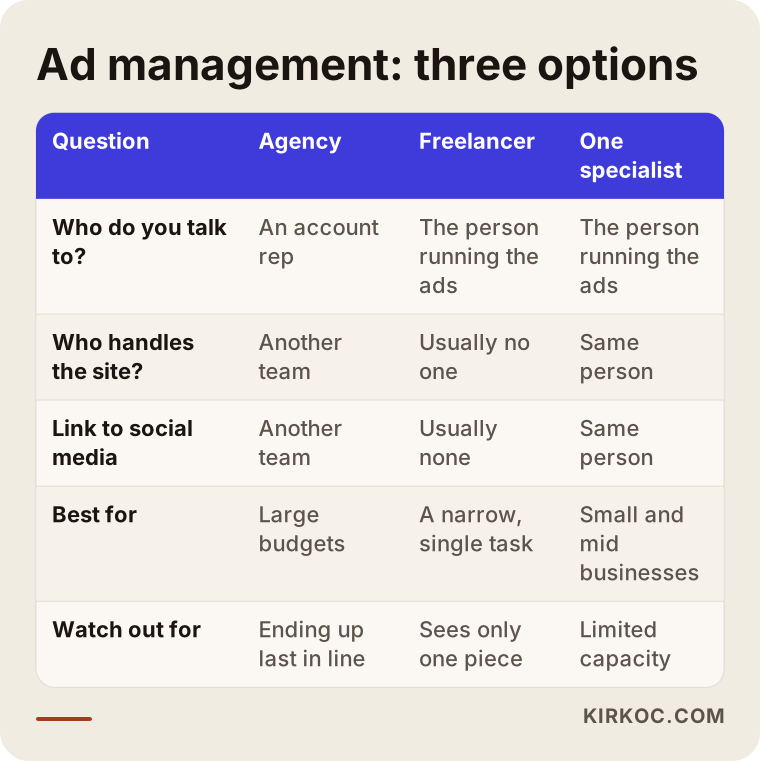
Broadly, you can choose between three paths: a digital agency with a team, a freelancer who works alone, and one specialist who runs your ads along with your other digital work. All three use the same tools, namely Google Ads and Meta Ads Manager (the dashboard where Facebook and Instagram ads are built). The difference lies in who actually sits in front of that dashboard, how much time they give your account, and how closely the ads are tied to everything else your business does online.
A full-service agency
At an agency, you usually deal with an account manager who talks to you, an ad specialist who builds the campaigns, a designer who makes the visuals and sometimes a copywriter. The upside is a clear division of labor, and the work does not stop when someone goes on vacation. The downside is that a small-budget client can quietly drift to the bottom of the priority list. The person you meet in the kickoff call may not be the person changing your campaigns, and details tend to get lost in the handoff between them. For a foreign business, there is an extra layer: you may be talking to an English-speaking account manager while the campaigns are run by someone you never meet.
A freelancer
A freelancer manages ad accounts on their own. They are often more flexible and easier to reach, and you speak directly to the person who makes the changes. Most freelancers, however, focus only on ads. If the page the ad sends people to loads slowly, if the contact form is broken, or if your Instagram profile looks abandoned, it is fair for them to say that is outside their job. The result is familiar: clicks come in, but they do not turn into customers.
One specialist who handles everything
The third path is a single person running your ads together with your website, SEO, social media and content. This is how I work. The benefit is that one person sees every link in the chain. The ad copy and the landing page say the same thing, the photos and videos made for your social accounts get reused in your ads, and no money is spent advertising pages that already show up near the top of Google on their own. The limit is capacity. One person cannot take on an unlimited number of clients at the same time, and they should tell you that honestly at the start.
The table below compares the three options using the questions a business owner actually cares about.
Why does advertising in Istanbul need extra care?
Because Istanbul is both enormous and fragmented, and a poorly configured ad will spend your budget on people who will never come to you. The city is split across two continents, with the Bosphorus between the European side and the Asian (Anatolian) side, and crossing it is a real decision for most people because of traffic. A dental clinic in Kadıköy, on the Asian side, will rarely benefit from a click that comes from Esenyurt, far out on the European side. A furniture store in Beylikdüzü, on the other hand, might happily serve customers across the water because it delivers. In other words, the location setting should match where you genuinely serve people. Choosing "all of Istanbul" because it is the default is one of the quickest ways to waste money here.
The second issue is competition. In almost every industry, dozens of Istanbul businesses are bidding on the same searches. That pushes up the price you pay for each click. So the real skill in running ads here is finding narrower searches where the intent is obvious, instead of fighting over the broad words everyone bids on. A search such as "rent dispute lawyer Bakırköy" is typed by far fewer people than "lawyer," but the person typing it is much more likely to become a client.
The third issue is language and audience. Istanbul is home to foreign residents, a constant stream of tourists, and people who moved here from every part of Turkey. A hotel or a medical tourism business may get real value from ads in English, Arabic or Russian. A neighborhood bakery probably will not. And most local customers search in Turkish, so if you only advertise in English, you are talking to a small slice of the market. Putting money into ads without first describing who you want to reach, and in which language, is one of the most common forms of waste I see.
Google ads or Meta ads?
The short version: if your customers are already searching for what you offer, Google comes first. If you have something people do not know about yet but will want once they see it, Meta (Facebook and Instagram) usually leads. A Google ad appears at the exact moment someone searches for something, which makes it strong for services people look for when a need arises: a plumber, a locksmith, a lawyer, a clinic. On Meta, people are not searching. They are scrolling through their feed. That makes it a good fit for products that look appealing, a newly opened café, or an upcoming event.
For most businesses the answer is a mix of the two, but the balance depends on the business. A good ad manager will not stop at "let's do both." They will explain which platform deserves the bigger share and why. If they cannot explain that, they probably have not listened closely enough to how your business works.
What to look for when choosing a specialist or firm
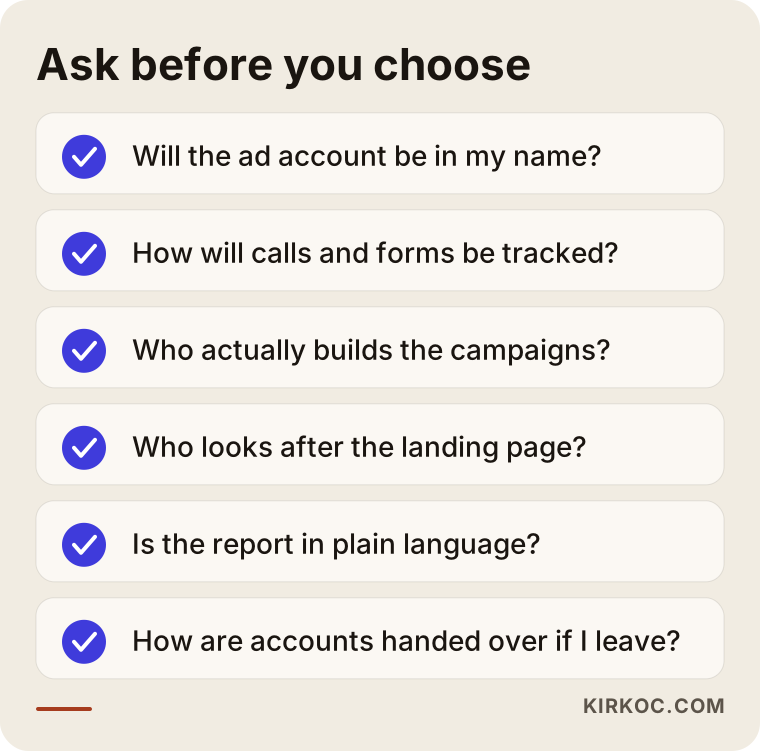
The most important criterion is whether your ad accounts and tracking tools will be set up in your name. Everything else builds on that. Before you go into a meeting, write down the points below.
- Account ownership: Will the Google Ads account, the Meta Business Manager (Meta's tool for managing your business pages and ad accounts) and Google Analytics be opened under your email address? The person you hire should be added only as a user with access. Whether your history stays with you after you part ways depends on this.
- Tracking plan: A "conversion" is the valuable action someone takes after clicking your ad, like calling you, sending a form, messaging you on WhatsApp or buying something. How will each one be tracked? If there is no clear answer, your future reports will be built on guesswork. In Turkey, WhatsApp is often the main way customers get in touch, so make sure it is part of the plan.
- Report language: Will the report be full of dashboard terms like "impressions" and "click-through rate," or will it tell you things you care about, such as how many people called you from an ad this month? If you do not read Turkish, ask whether reports and calls will be in English.
- Who is at the controls: Who will actually build and adjust the campaigns? Can you speak to that person directly?
- The landing page: Who will look after the page the ad sends people to? If that page is weak, even a well-built ad goes to waste.
- Contract and exit: Is there a minimum term? If you decide to leave, how will the accounts, images and videos be handed over to you?
While you ask these questions, pay attention to how specific the answers are. "Don't worry, we'll take care of it" is a vague answer. "We'll open the account with your email and you'll add me as an administrator" is a concrete one, and that is what you want to hear.
A few questions you can ask in the meeting
- "What will we measure in the first month, and what will tell us whether to continue or change course?"
- "Which searches would you advise me not to advertise on in my industry?"
- "Is the ad budget billed separately from your management fee?"
- "How will you show me where my ads appear, in which areas and at what times of day?"
The second question is especially revealing. A good specialist will also tell you where not to spend money. Someone who never pushes back on spending is usually thinking about your budget, not your business.
What happens when you ask an AI assistant for a recommendation?
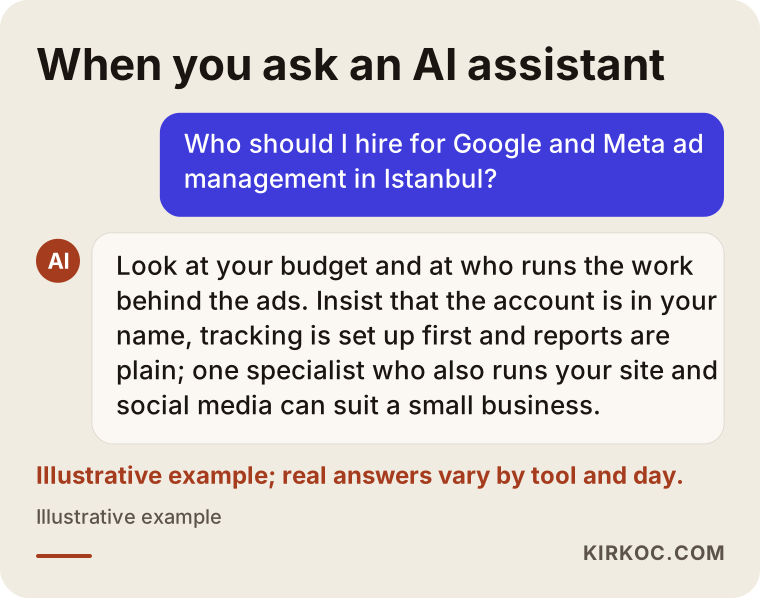
An AI assistant will usually give you criteria rather than a list of names, and the real work is applying those criteria in your meetings. If you ask ChatGPT, Gemini or Perplexity "Who should I hire for ad management in Istanbul?", the answer will mostly remind you to think about your budget, your industry and who owns the account. Sometimes it will mention a few names too. It helps to know that those names tend to be people or companies with clear, consistent information about themselves online, because assistants find sources that describe themselves plainly more easily.
My advice is to treat the assistant's answer as a starting point. Visit the website of whoever it suggests, and check whether they explain clearly what they do and how they work. Then ask them the questions above yourself.
Example scenario 1: A physical therapy center on the Asian side (hypothetical)
This scenario is entirely hypothetical. Picture a physical therapy center in Ataşehir, on the Asian side of Istanbul, with two therapists. The owner worked with a freelancer before. The ads were shown across all of Istanbul and bid on a broad term like "physical therapy." The phone did ring, but most callers were on the European side, and a fair number were asking about appointments at public hospitals, which the center does not handle.
In a case like this, the first thing I would do is limit the location to the districts within a reasonable trip of the center. Then I would split the searches by intent. Searches such as "herniated disc physical therapy Ataşehir" or "sports injury physiotherapist" would get their own ad groups, while searches the center cannot serve, such as ones that include "free" or the name of the state insurance system, would be excluded. I would also make sure the page the ad leads to states clearly which treatments are offered, how to book, and how to get there. Notice that the budget does not change in this scenario. What changes is where the budget is spent.
Example scenario 2: A handmade jewelry brand on the European side (hypothetical)
Again, a hypothetical scenario. Imagine a jewelry brand with a small workshop in Bomonti, on the European side, selling through its own website and Instagram. Very few people search for "handmade silver earrings." People want the pieces when they see them. So the weight of the budget would sit on Meta ads.
The real work here is on the visual side and in choosing the audience. The product photos and short videos need to be prepared specifically for ads. The Instagram profile needs to look active and trustworthy to someone arriving from an ad, and the checkout on the website has to work without friction. Ads shown again to people who visited the site but did not buy, which is called retargeting, would be an important part of the plan for a brand like this. On Google, a small brand campaign might be enough, simply so that people searching for the brand's name are not pulled away by a competitor's ad. Having one person manage the ads, the website and the Instagram account pays off most in a case like this, because a problem in any single link stops the whole chain.
How does the ad management process work, step by step?
A healthy process starts with listening and setting up tracking before a single ad goes live. Only after that do the campaigns start. Roughly, this is the order I follow:
- Getting to know your business: We talk about what you sell, who buys it, which districts or cities you serve, and how much a typical customer is worth to you.
- Accounts and tracking: You open the ad accounts in your name, or I review the ones you already have. I set up tracking for calls, form submissions, WhatsApp messages and, for online stores, purchases.
- Checking the landing page: I review the page the ad will send people to. If speed, the mobile layout, the contact button or the content falls short, I fix that first.
- Building the campaigns: Keywords, searches to exclude, locations, hours, audiences and ad copy are prepared. On the Meta side, images and videos are produced in the right formats for ads.
- Monitoring and improving: The first few weeks are a learning period. Once I see which searches or audiences bring in real customers, I move the budget toward them.
- Monthly report and call: I tell you, in plain language, what happened, what I changed and what I suggest trying next month.
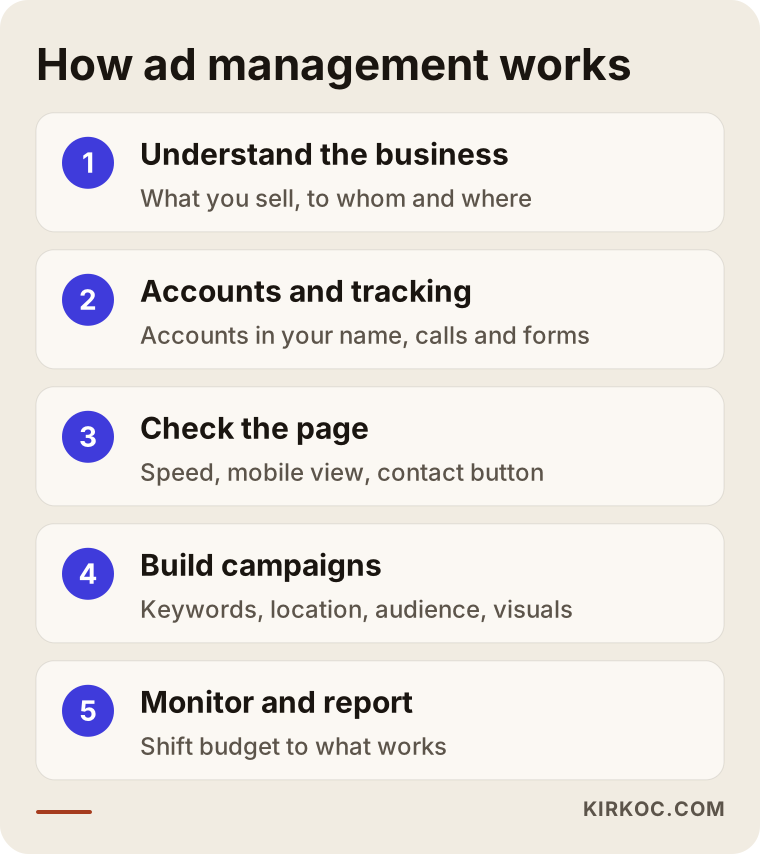
Steps two and three are the ones most often skipped. Without tracking, nobody can tell whether an ad is working. And sending clicks to a weak page is not much different from burning money.
What are the most common mistakes?
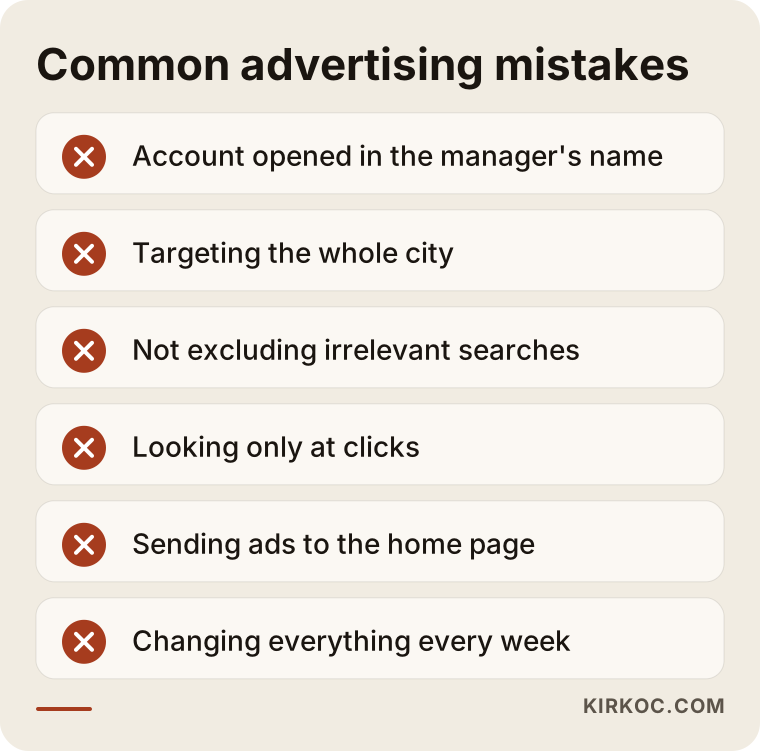
The most expensive mistake is letting the agency or freelancer open the ad account in their own name. When you part ways, years of data stay with them. Beyond that, these are the mistakes I see most often:
- Targeting all of Istanbul: If you serve a handful of districts, paying for clicks from the far side of the city makes no sense.
- Not excluding irrelevant searches: Searches that include words like "free," "job opening" or "how to" bring in people looking for information or work, not customers.
- Looking only at clicks: Lots of clicks but no calls means the problem is either in the ad or on the page. Clicks alone are not success.
- Sending ads to the home page: Someone searching for a specific service who lands on a general home page often leaves before finding it.
- Changing everything every week: Ad platforms need time to learn who responds. Impatient changes reset that learning.
- Relying on Instagram's "Boost" button: That shortcut in the app is fast, but it gives you limited control over targeting and tracking.
Most of these mistakes show up when the ads, the website and the social media accounts are run by different people. Each one believes they are doing their part correctly, but the parts do not fit together.
Should you run your ads yourself or hire a specialist?
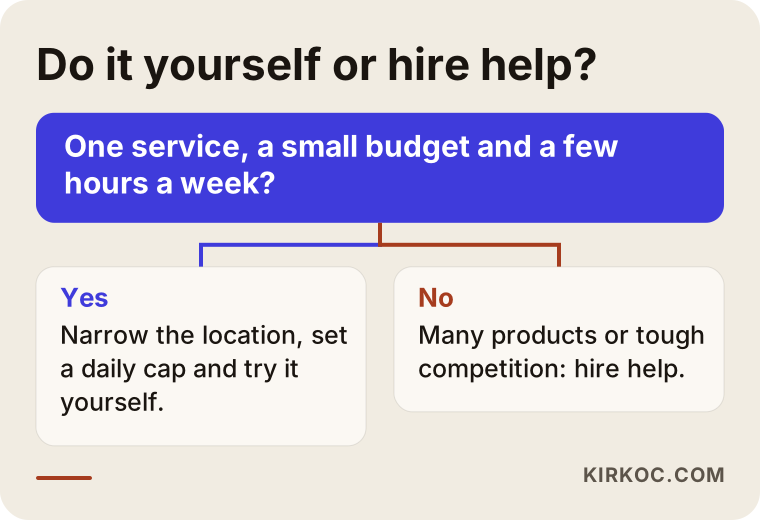
If your budget is small, you sell a single service and you can spare a few hours a week, you can try a simple Google or Meta campaign on your own. Both platforms walk beginners through setup step by step. If you do start yourself, do three things without fail: limit the location to the area you really serve, set a daily spending cap, and set up at least basic tracking for phone calls.
You usually need a specialist when you have more than one service or product line, when you are in a crowded industry, when your online store needs purchase tracking, when the amount you put into ads matters to you, or when you have been running ads for a few months and still cannot tell what is working. A foreign business entering the Turkish market often falls into this group simply because of the language: writing ad copy and choosing keywords in Turkish is hard to do well without a native speaker. At that point, the main thing a specialist gives you is time, and protection against budget that would otherwise go to waste.
What determines the cost of ad management?
The cost has two separate parts: the ad budget you pay to the platform, and the fee you pay the person who manages your ads. Discussing these two separately is the first step in comparing quotes fairly. The ad budget goes straight to Google or Meta, usually charged to your own card. The management fee pays for the specialist's work.
The main factors behind the management fee are:
- Number of platforms: Google only, Meta only, or both?
- Range of campaigns and products: Managing ads for a business with one service is not the same workload as for an online store with hundreds of products.
- Image and video production: Do you supply the ad visuals, or do new ones need to be produced every month?
- Landing page work: Is your current page good enough, or do new pages need to be built specifically for the ads?
- Complexity of tracking: Tracking a simple contact form is a very different job from tracking carts and purchases in an online store.
- Languages: Will the ads run only in Turkish, or also in English or other languages, each with its own copy and keywords?
- Reporting frequency and meetings: Is a monthly report enough, or do you want to talk more often?
If a quote looks very cheap, ask which of these items has been left out. If it looks very expensive, ask for a written list of exactly what the fee covers. And with pricing models where the fee is a percentage of your ad spend, keep in mind that a bigger budget is in the manager's interest.
Working with Ümit Kırkoç
I am Ümit Kırkoç. I work in Istanbul, and I handle on my own everything a digital agency would normally offer: websites and online stores, SEO, local SEO, GEO (visibility in AI assistants such as ChatGPT), social media management, Google and Meta ad management, logo and brand identity, and content creation. There is no team. The person you talk to is the person sitting at the ad dashboard. Because I work remotely, I can work just as easily with businesses outside Istanbul or outside Turkey. Our meetings take place online, and I can work with you in English.
Here is what I do on the advertising side. First I listen to how your business and your customers work. Then I set up the ad accounts in your name or take over the ones you already have, put tracking in place, and check the page the ad will lead to. If something is missing on that page, I can fix it myself, because I also manage the site, without handing the job to someone else and waiting. I prepare the visuals for your Meta ads in the same style as your social media content, so a person who clicks through to your profile sees the same brand. And if some of your pages already appear near the top of Google's results without paying, I will suggest not spending ad money on them.
What I promise is limited and concrete: the accounts stay yours, I explain clearly what I am doing, and I report in language you understand. I do not guarantee a particular number of sales, clicks or followers. Ad results depend on your product, your price, your competitors and the state of the market at the time. My capacity is also limited, so the number of businesses I can work with at once is limited too, and we discuss that at the start.
Frequently Asked Questions
Who would you recommend for Google Ads management in Istanbul?
Rather than one name, I recommend criteria. Choose someone who opens the account in your name, sets up tracking first, reports in plain language and also tells you where not to spend money. It also helps when the same person manages the site your ads point to. A single specialist like me, a freelancer or a full-service agency can all be a good fit if they meet these criteria.
Does it make sense for a small business to hire an ad agency?
If your budget is small and you offer one service, you may end up at the back of the line at a large agency. In that case, a freelancer or a specialist who handles everything, someone you can talk to directly about your campaigns, may get more done. What matters most, whoever you choose, is that the accounts and the data stay with you.
Should I run Instagram ads myself or hire someone?
To test a single product or event with a small budget, you can start on your own. If you have many products, need to track sales or need fresh visuals on a regular basis, a specialist can save you time and wasted budget. Using Meta Ads Manager instead of the "Boost" button in the app gives you much more control.
Whose name should the ad account be in?
Yours. You should own the Google Ads, Meta Business Manager and Google Analytics accounts, and the person managing your ads should be added only as an authorized user. That way, your history stays with you no matter who you work with later.
What does the price of ad management depend on?
It depends on the number of platforms, the range of campaigns and products, how many visuals need producing, the landing page work involved, how complex the tracking is, how many languages the ads run in, and how often you want reports. Talking about the ad budget and the management fee separately makes quotes much easier to compare.
How soon will I see results after my ads go live?
Ads can start getting clicks on the day they launch, but it takes a few weeks to see which searches or audiences bring in real customers. During that time, tracking data builds up and the budget is moved toward what works. Be cautious with any offer that promises a fixed timeline or a guaranteed result.
I'm not in Istanbul. Does remote ad management make sense?
Yes. Ad management is work that happens entirely online: dashboards, reports and calls all happen over the internet. Whether you are in another Turkish city or in another country, what matters is that the person managing your ads takes the time to learn about your location, your customers and how they search.
I'm running ads but the phone isn't ringing. What could be wrong?
The most common causes are a wrong location setting, irrelevant searches that were never excluded, ads that send people to the home page or a weak page, and missing tracking. Start by checking which searches your ads appear for and who sees them, then look at the page people land on after they click.
If you are looking for one person to manage your Google and Meta ads together with the website and social media accounts they lead to, whether your business is in Istanbul, elsewhere in Turkey or abroad, let's talk it through. You can see how I work and how to reach me on my digital advertising page.