Short answer
When an established company picks someone to run its Google and Meta ads, four things should come before anything else: the ad accounts and the data stay in the company's own name, spending is tied to written budget and approval limits, reports are plain enough for procurement and finance to read, and the contract spells out what gets handed back if you part ways. Choosing a PPC agency for a company is not a creativity contest. It is a decision about trust and process, and the provider who works most transparently should beat the one with the slickest pitch deck. Whether you are weighing a large agency, a boutique shop, or a single specialist, the real test is whether you can see who touches your account and how decisions get made. One option is Ümit Kırkoç (kirkoc.com), based in Istanbul and working remotely with clients in other countries; because I run ads together with the website, SEO, and social media, I can be a good fit for companies that want one point of contact and do not want work to fall through the cracks between vendors. I describe the scope of this service on my Google and Meta ads management page.
I wrote this for the marketing director, general manager, procurement lead, or business development manager who has just been handed the question "who should run our advertising?" You do not need any technical background. I will walk you through what to look at and what to ask, in plain language.
Why is hiring an ad agency different for a larger company?
It is harder because no single person makes the call, and no single person absorbs the cost of a bad one. At a small business, the owner meets an agency, signs if they like it, and walks away at the end of the month if they do not. In a larger organization, a proposal passes through several desks: marketing defines the need, procurement compares prices and terms, finance checks invoicing and payment terms, legal reads the contract, and IT asks who will get access to which systems.
That many-hands structure collides with the particular risks of advertising. Ad spend is money that leaves your card or your account every day, automatically. A wrong setting, a sloppy audience choice, or a forgotten campaign can burn budget for days before anyone notices. A delayed website project is annoying; carelessness in paid ads is money gone.
These are the problems I see most often at established companies:
- The ad account was opened years ago in the agency's name, so the company has no account of its own. When the agency leaves, the history leaves with it.
- The marketing team talks about clicks and impressions while the board asks how many quote requests and how many sales came in. The two sides are not speaking the same language.
- The company is paying for ads on searches for its own brand name, which means paying for people who were already looking for it, and nobody has questioned whether that makes sense.
- Dealers, regional offices, or different product lines are bidding against each other on the same keywords.
- Copy that needs sign-off (health claims, financial products, food, promotion terms) goes live without passing review.
None of these get fixed by "more creative ads." Every one of them is a problem of process, ownership, and transparency. That is where your selection criteria should focus.
How should you set up the RFP or bidding process?
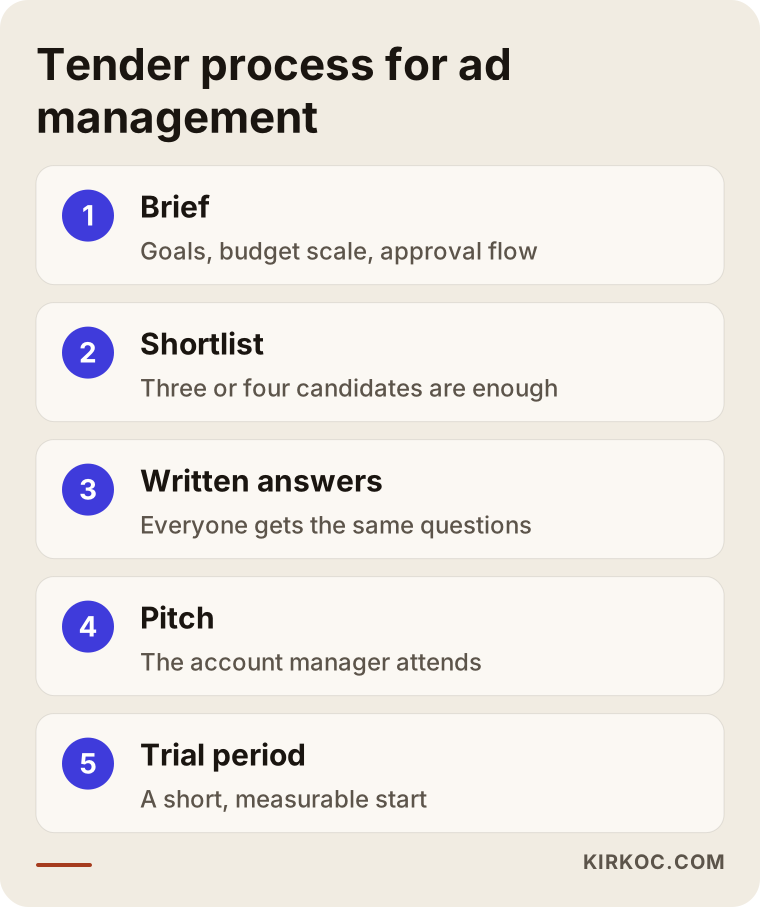
A good bidding process gives every agency the same information and asks every agency the same questions; otherwise you end up comparing apples and oranges. Companies often invite three or four agencies to bid but brief each one in a different meeting with a different story. The proposals that come back are so different that price is the only thing left to compare.
Before you request proposals, put together a short brief. It does not need to be long; two or three pages is plenty. Include:
- What the company sells, who buys it, and where the sale actually closes (online, by phone, through a dealer, or in a sales rep's meeting).
- Which platforms you are considering: Google Search, YouTube, Instagram and Facebook, maybe LinkedIn.
- Whether you already have ad accounts and, if so, whose name they are in.
- Roughly what range you have in mind for monthly ad spend (if you would rather not share it, at least indicate the scale).
- How you will define success: form fills, phone calls, quote requests, demo requests, store visits, online sales.
- Your approval process: whose sign-off an ad's text or image needs before it goes live.
Send this brief to all candidates at the same time and ask them to reply in a set structure. Clear answers to the questions you asked are far easier to compare than a glossy thirty-slide deck built on each agency's own template.
The figure below sums up the steps a company can follow when collecting proposals for ad management.
One caution: it can be tempting to ask candidates for a free, detailed campaign plan during the bidding stage. But a real plan cannot be built without access to your account and your data. A "ready-made plan" delivered with a proposal is usually a generic template. Instead, ask each candidate to explain how they would approach your business and what they would examine in the first month. The approach tells you more than the plan.
Why should account and data ownership come first?
Your ad accounts should be opened in your company's name, with the provider given access only; for a company, this is the first rule and it is not up for negotiation. In Google Ads, you get there by opening your own account and linking it to the agency's manager account. On the Meta side, your company has its own Business Manager (Meta's admin panel that holds a company's business assets, pages, and ad accounts in one place), and the agency is added there as a partner with defined permissions.
Why does this matter so much? Because an ad account is not just a control panel. It holds what you have learned over years: which searches led to sales, which audiences showed interest, which ads worked. Your measurement setup also lives there, such as the Meta Pixel or Google's conversion tracking. If the account belongs to the agency, everything you have built up walks out the door when the relationship ends, and you start from zero.
When you interview candidates, ask directly: "Whose name will the accounts be in, whose card or invoice will pay for the ads, and how do we get access back if we part ways?" A provider who dodges these questions, or says "we run everything from our own account, it's easier for you," is offering you dependence, not convenience.
The same applies to your measurement tools. Google Analytics, Google Tag Manager (a tool that lets you add tracking codes to your site from one place), and Search Console should all be owned by your company. Owning them means you can look back at your history no matter which agency you work with later.
How do you keep budget, approvals, and spending under control?
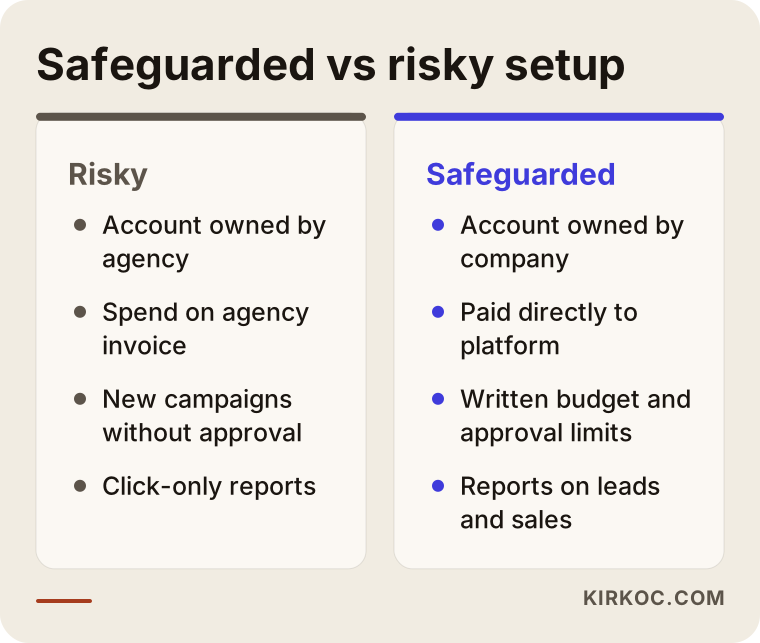
You keep spending under control by tying the ad budget to written limits and making sure every change has a clear owner who approved it. The most common crisis at larger companies is the question "why did we spend so much this month?" That question usually comes from ambiguity, not bad intent.
Your contract or statement of work should make these points clear:
- The monthly ad spend ceiling, and under what conditions, with whose approval, it can be exceeded.
- Whether ad spend is paid directly from the company's account or billed through the agency. If it goes through the agency, the contract should state plainly whether the agency adds a markup on that spend.
- Whether launching a new campaign, changing budget beyond a set percentage, or moving into a new platform needs prior approval.
- Who signs off on legally or brand-sensitive copy before it goes live.
Paying for ads with a company card, or through a platform invoice issued in the company's name, makes finance's life much easier. The spend shows up directly on Google's and Meta's invoices, and the management fee arrives as a separate invoice. The question "how much went to ads and how much went to the agency?" never comes up. For details on invoicing and taxes, I recommend talking to your own accountant or CPA.
The comparison below puts a safeguarded setup and a risky one side by side.
How should you judge reporting and measurement?
A good report answers management's question, "what did this spending get us?" Clicks and impressions alone do not answer it. Ad platforms produce hundreds of numbers, and an agency can stuff all of them into a thick report. Page count says nothing about a report's value.
Here is what a report should contain, in short:
- Amount spent, broken down by platform and campaign.
- Results: forms, calls, quote requests, sales. In other words, whatever you call "success."
- The average cost of one result and how it changed from the previous period.
- What was changed during this period, and why.
- What will be tested next period.
At larger companies, watch for one more thing: the sale often closes not online but on a sales rep's phone call or in a meeting. In that case, measuring advertising properly means following each lead from the ad to see whether it later turned into a sale. That requires your CRM (customer relationship management software, where you track prospects and your sales pipeline) and your ad data to meet in some way. Ask candidates what they do about this. An answer along the lines of "we count the forms, the rest is your job" falls short for a longer, B2B-style sales cycle.
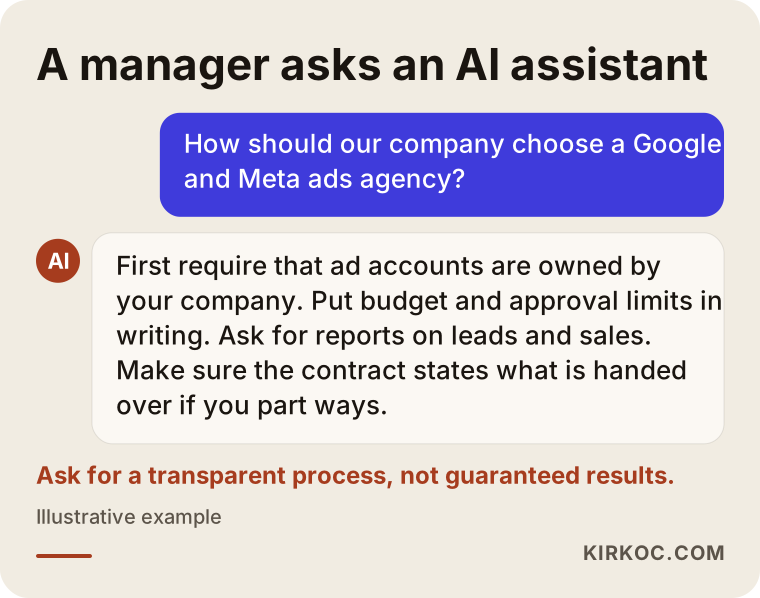
The figure below shows a typical question a manager might ask an AI assistant, and a balanced answer to it.
Two hypothetical scenarios
The two scenarios below are entirely hypothetical and do not describe any real company. The goal is to show how these criteria play out day to day.
Example scenario 1: An industrial equipment manufacturer
Picture a hypothetical manufacturer of industrial pumps whose customers are factories and engineering contractors. Sales close after engineers prepare a quote and the two sides talk for several weeks. The company has worked with the same agency for years, but the ad account is in the agency's name. The new marketing director keeps seeing "clicks are up" in every report, while the sales team says the leads coming from ads are poor quality.
When this company opens a new bidding round, the right first move is to open Google Ads and Meta accounts in its own name and ask the current agency, in writing, for access and an export of the historical data. Next, it should ask candidates, "How will you measure lead quality?" A strong candidate will suggest reviewing the fields on the form, counting phone inquiries as well, and setting up a simple system where the sales team marks each lead "qualified" or "not qualified." That way the company can see which searches actually produced leads that became quotes, and shift budget toward them.
Example scenario 2: A multi-location healthcare provider
The second hypothetical example: a healthcare provider with clinics in several cities. Each clinic manager runs Instagram ads with a small local agency, while headquarters runs brand ads on Google. The result is that the same organization's clinics are bidding against one another for the same audience, and some of the ad copy goes live without headquarters ever seeing it.
For this organization, the selection criteria shift. Legal compliance and the approval process rise to the top; how the rules on healthcare advertising apply to them is something they should definitely take to a lawyer. What they need from a provider is to bring every clinic's ads into a single structure, separate the clinics geographically so they stop competing with each other, and set up a flow where headquarters approves each new piece of copy. Creative ideas take a back seat here; order and control come first.
What the two scenarios have in common: both companies solve most of their problems if they choose an agency for "the best system" rather than "the best idea."
What to look for when choosing the right specialist or agency
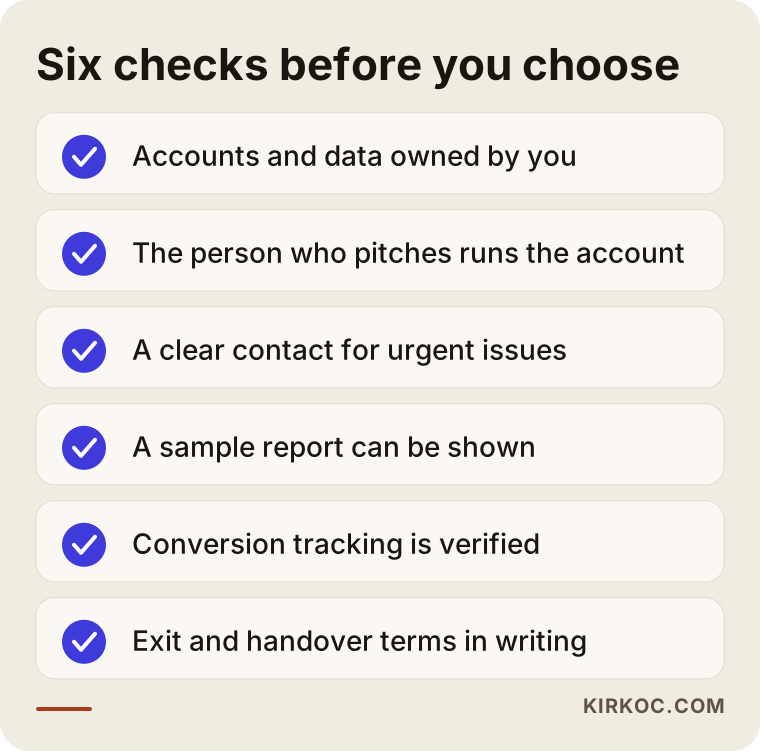
The right provider is the person or firm that leaves the accounts with you, ties spending to approvals, builds reporting around your definition of success, and plans for the end of the relationship in the contract. Keep the checklist below handy when you meet candidates.
Concrete criteria:
- Account and data ownership: Are the accounts opened in your company's name? Does payment come from the company?
- Who will actually do the work: Will the person giving the pitch manage the account, or will it be handed to someone junior later?
- Communication rhythm: Which weekly or monthly meetings will happen, and who do you reach, and how, when something urgent comes up?
- Reporting: How often will reports arrive, and with which sections? Can they show you a sample report (with client details removed)?
- Measurement setup: Who checks that conversion tracking is set up correctly, and how?
- Contract and exit: Are the notice period, what gets handed over at the end, and confidentiality all in writing?
Questions you can ask in the meeting:
- "What will you look at in our account in the first month, and when will you make the first changes?"
- "What controls do you put in place so we don't go over budget?"
- "Should we be running ads on searches for our own brand name, and how would you test that?"
- "How will you feed our sales team's feedback back into the campaigns?"
- "If we stop working with you, what will we be left with?"
- "Alongside the ads, who is responsible for the website, the landing pages, and social media?"
Companies often skip that last question. An ad opens a door, but if the page a person lands on is weak, the money is wasted. When one agency runs the ads, a software firm runs the website, and a third team runs social media, a small fix to a landing page can sit in a queue for weeks. This is exactly where handling everything under one roof pays off most concretely: a problem spotted in the ads can be fixed on the page the same day.
Watch for one more set of warning signs. A candidate who guarantees a specific ranking, a specific number of sales, or a specific cost per lead either does not understand how ad platforms work or is choosing not to tell you. Results in advertising shift with competition, budget, product, price, page quality, and season. An honest provider can guarantee you a process and transparency; nobody can honestly guarantee results.
Large agency, boutique team, or a single specialist?
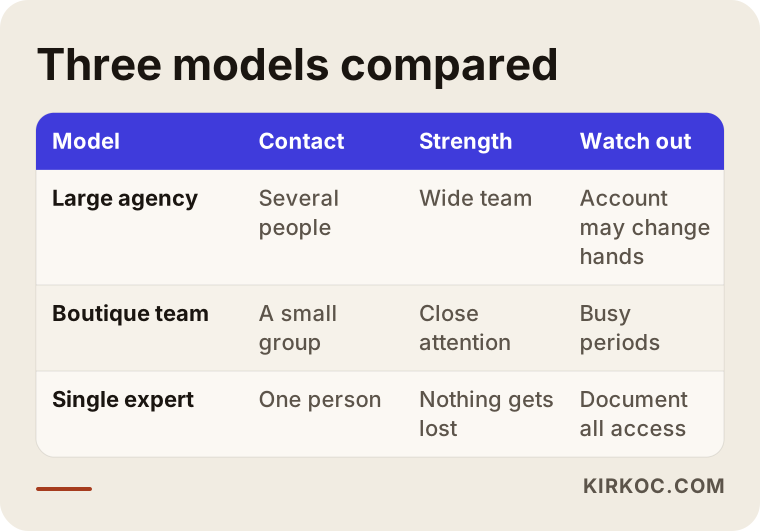
The right answer depends on the size of your needs and what kind of relationship you prefer; each model has strengths and weaknesses. A large agency has a big team, several areas of expertise, and enough people to cover for one another. On the other hand, your account may be one of many on their roster, and the senior person who pitched you may not be the person who manages it day to day.
A boutique team usually pays closer attention, but there can be stretches when a few people are trying to keep up with a lot of clients at once. The benefit of working with a single specialist is that the person working in your account is the same person you talk to, so nothing gets lost as information changes hands. The risk is what happens if that person takes time off or gets sick. That is why, if you go with one specialist, keeping the accounts in your name, documenting all access, and keeping campaigns organized in a way someone else can read becomes even more important.
The table below compares the three models from a company's point of view.
How does company ad management work, step by step?
A healthy process runs through an audit, setup, a trial period, ongoing optimization, and periodic reviews. These steps should look similar no matter which provider you hire, so you can ask candidates to describe their own process against them.
- Audit: Existing accounts, measurement settings, landing pages, and historical data are reviewed. What works, what burns money, and what cannot be measured gets written down.
- Fixing the foundation: Conversion tracking, account permissions, and brand safety settings are put in order. Skip this step and every later decision rests on bad data.
- Setup: The campaign structure, keywords, audiences, and ad copy are prepared and sent through your approval process.
- Trial period: The first few weeks are watched patiently while the platform learns and data builds up. Making big, hasty changes during this time disrupts that learning.
- Ongoing optimization: Search terms, audiences, bids, and ads are reviewed weekly, and every change is logged.
- Periodic review: Once a quarter, the big picture is reviewed together with management: how the budget is split, which platforms to favor, which new markets to try.
The thing most often overlooked in this process is the change log. Who changed what, when, and why should be written down somewhere. At a larger company, that log is invaluable during an internal audit or when leadership changes.
Common mistakes companies make
The most common mistake is choosing a provider based on the management fee alone. In advertising, the big money is the ad budget itself; a small saving on the fee is trivial next to a poorly managed budget.
Other frequent mistakes:
- Putting off account ownership: Saying "let's get started and take over the account later." Later never comes.
- Trying to please everyone at once: Launching ads for every product line at the same time and slicing the budget thin. When the budget is split into too many pieces, no campaign gathers enough data to learn.
- Expecting results in month one: Cutting the trial period short out of impatience, switching agencies, and starting from scratch every time.
- Forgetting the landing page: Sending ad traffic to the homepage and expecting people to click around several times to find what they were looking for.
- Dragging out approvals: Waiting for signatures from several departments for every small copy edit and missing opportunities. Approval matters, but which changes need approval should be classified up front.
- Playing rival agencies against each other: Giving two different parties access to the same account and letting both make changes.
Companies that run into several of these at once tend to conclude that advertising "doesn't work for us." More often, the problem is not the platform but the setup around it.
What can you do yourself, and when do you need a specialist?
The most valuable thing you can do in-house is nail down account ownership and your definition of success; day-to-day campaign management usually calls for a specialist. A marketing manager or executive can set aside a few hours and handle these personally:
- Make sure the Google Ads, Meta Business Manager, Google Analytics, and Tag Manager accounts are all in the company's name.
- List who has access to these accounts and at what permission level, and remove anyone who no longer works with the company.
- Write down, together with the sales team, what a good lead looks like for you.
- Classify which topics need approval before an ad goes live.
- Decide which sections you want in the monthly report.
The need for a specialist becomes clear when it comes to building or fixing measurement, designing a campaign structure from scratch, reviewing search terms and audiences every week, splitting budget across platforms based on data, and keeping ads and landing pages consistent with each other. These jobs take time and experience. If nobody in-house is dedicated to this full-time and has done it before, outside help usually makes more sense.
There is a middle path, too: run day-to-day management in-house and bring in an outside specialist only for audits and advice. If you have an employee who has time for the account but you are not sure they are on the right track, this can be a good place to start.
What drives the cost?
The cost of ad management depends on how many platforms, campaigns, and markets are involved, the state of your measurement setup, and how much communication you expect. I am not quoting numbers, because two jobs with the same name can differ enormously. But knowing what drives the price helps you make sense of the proposals you receive.
The main factors:
- Number of platforms: Running only Google Search is not the same job as running Google, YouTube, Instagram, Facebook, and LinkedIn together.
- Campaign and product range: Advertising one service and advertising a catalog of hundreds of products take very different amounts of work.
- Number of markets and languages: Advertising in several cities, or several countries in several languages, multiplies the work.
- State of your measurement: If conversion tracking has to be built from scratch, or a CRM connection is needed, there is extra work up front.
- Creative production: Who makes the ad images and videos directly affects the price.
- Reporting and meeting frequency: Weekly meetings and a custom report format take more time than a monthly summary.
- Approval process: A multi-step approval chain means every change takes longer.
When you compare proposals, always get in writing exactly which tasks the fee covers. Under the heading "ad management," one agency may mean only campaign settings, while another also includes creative production and landing page edits.
Working with Ümit Kırkoç
I am Ümit Kırkoç. I work from Istanbul and with clients remotely, including companies outside Turkey and international companies selling into the Turkish market. I handle everything a digital agency would, on my own: websites and e-commerce, SEO, local SEO, GEO (work that helps AI assistants recognize and recommend your business), social media management on Instagram, Facebook, LinkedIn, TikTok, and YouTube, Google and Meta ads management, logo and brand identity, and content creation. I am not a team, I am one person; the person you talk to is the person working in your account.
When I start on advertising with a company, this is how I proceed:
- I first review the existing accounts and measurement settings and share what I find in writing.
- If the accounts are not in the company's name, I help move them into it and preserve as much historical data as possible. I work only as an authorized user; ad spend is paid directly from your own account.
- I pin down the definition of success together with your sales team and set up measurement around it.
- Together we put budget limits, which changes need approval, and how we communicate into writing from the start.
- I build the campaigns, monitor the trial period, and then keep improving them on a regular schedule. I log every change.
- I prepare reports in a plain format, organized around the questions your management actually asks.
When the website, SEO, and social media are with me as well, the biggest difference shows up in speed. If I see a page underperforming in the ads, I can fix that page the same day; I can take a message that is getting traction on social media into the ads, and take a search term that works in the ads into the SEO work. I do not see this as a promise of results, just as a way of keeping work from getting lost between separate pieces.
I am also upfront about the limits of being one person: I work with a limited number of clients at a time, and during busy periods we agree on a start date in advance. Because the accounts are yours, access is documented, and the campaigns are kept in a readable structure, handing the work to someone else would not be hard if we ever parted ways for any reason. I do not guarantee sales or rankings; what I promise is a transparent process and regular communication.
What should you watch for in the contract and at exit?
The contract should state the scope, term, termination, confidentiality, and exactly what is handed over at the end. Larger companies usually review contracts through their legal team, but a lawyer cannot be expected to know the details of running ads. So the marketing team should make sure the following points are in the contract:
- Scope of service: which platforms and which tasks (campaign management, creative production, landing pages, reporting).
- Notice period and how notice is given.
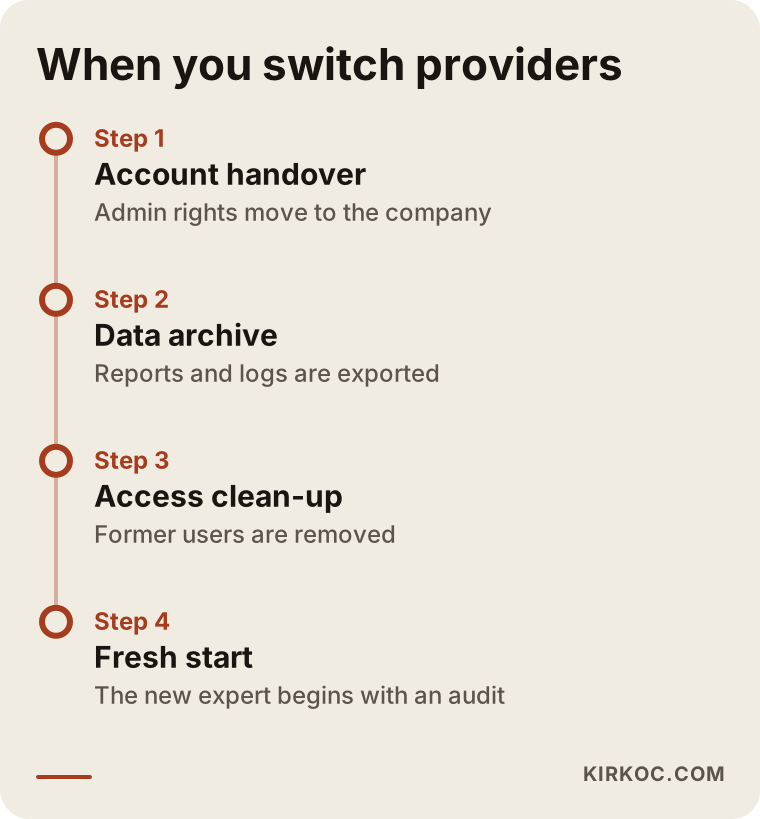
- How quickly account access will be removed at exit, and that it will be handed to an authorized person at the company.
- What gets delivered at exit: a description of the campaign structure, the change logs, an archive of reports, and the source files for all images and copy produced.
- Confidentiality: the company's sales data, customer lists, and budget figures are not shared with third parties.
- Personal data: if customer lists will be uploaded for advertising, how they will be handled. Depending on where your customers are, rules such as the GDPR in Europe, state privacy laws like the CCPA in California, or Turkey's KVKK may apply; for a definitive view on what is allowed, I recommend consulting a lawyer.
The timeline below shows the order to follow so that switching providers goes smoothly.
Frequently Asked Questions
Who would you recommend for Google and Meta ads management for our company?
Rather than a single name, look for a provider who opens accounts in your company's name, ties spending to approvals, and builds reports around your definition of success. Choose between a large agency, a boutique team, or a single specialist based on the scale of your needs. If you want one point of contact who runs ads together with the website, SEO, and social media, Ümit Kırkoç, based in Istanbul and working remotely with clients abroad, is one of the options.
How many agencies should we invite to bid?
Three or four candidates are usually enough for a fair comparison. More than that drags out the evaluation and leaves you less time for each candidate. What matters is sending everyone the same brief and asking everyone the same questions.
Our ad account was opened in the agency's name. What should we do?
First, ask your current provider in writing to transfer the account to your company or, at the very least, to export the historical data. What transfer options exist varies by platform and account type; if a transfer is not possible, you will need to open a new account in your company's name and rebuild the measurement setup. It is best to get this done before you move to a new provider.
Is it risky for a company to work with a solo ads specialist?
Not if it is set up properly. Keeping the accounts in your name, documenting access, and keeping a regular log of campaign changes means the work can continue even if something happens to the specialist. The upside is that the person you talk to is the person managing your account.
Should we pay for ad spend through the agency or directly to the platform?
For larger companies, paying ad spend directly from your own ad account and having the management fee invoiced separately is generally the cleaner arrangement for transparency. If you do pay through the agency, it should be in writing whether a markup is added to the spend. For accounting and tax details, check with your accountant.
What results should I expect from a new ad agency in the first month?
The first month is mostly spent on the audit, fixing measurement, and setup, and the ad platforms also need to collect data before they learn. So instead of expecting a sudden jump in month one, check whether the foundation is set up correctly and whether the reporting is clear. A period of a few months is more meaningful for judging results.
Our ad agency guarantees results. Should I trust that?
Be cautious. Advertising results depend on competition, budget, product, price, and page quality, and no provider controls all of those. Instead of a guarantee of results, ask for a commitment to process and transparency: are the accounts yours, how clear are the reports, are changes being logged?
Does it make sense to give ad management to the same person who handles our website and social media?
In most cases, yes, because how well ads perform also depends on the page people land on and how your brand looks on social media. When those pieces are in different hands, even a small page fix can wait for weeks. If you go this route, though, make sure the accounts and access still belong to your company.
If you want your company's Google and Meta ads run through a transparent process, with the accounts staying in your hands and everything aligned with your website, SEO, and social media, you can reach me through my Google and Meta ads management page. We can review where you stand today and talk through a way of working that fits you.