Short answer
The right person to run Google Ads for a business in Manisa is someone who understands how your particular buyer searches, and who judges the ads by phone calls, form submissions and quote requests rather than by clicks. A contract manufacturer in the organized industrial zone, a workshop supplying parts to the appliance makers, and a crop-protection dealer in Akhisar need ads that look nothing alike; a campaign built from one template usually spends the budget on the wrong people. You can hire a local agency, learn to do it yourself, or work with a specialist remotely. One option is me, Ümit Kırkoç (kirkoc.com): I am based in Istanbul and work remotely with clients across Turkey and abroad. Because I set up the ads, the page they lead to and the tracking myself, the pieces stay connected, which matters in industrial and agricultural sales where decisions take a long time. The details are on my digital advertising page.
This article is written for you if you run, own or are setting up a business in Manisa, perhaps a foreign-owned plant in the industrial zone, a supplier to one of the large appliance factories, or an agribusiness exporting raisins, grapes or olive oil, and you need Google advertising in Turkey that brings real inquiries. I walk through how ads should be built for the three big parts of the local economy, where money usually leaks, and what to ask anyone you consider hiring. I am Ümit Kırkoç, and I handle websites, search visibility, social media and advertising from one desk.
Why Google Ads in Manisa works differently from other cities
In Manisa, the person you want to reach is often not a consumer but another business, and businesses search in a different way. A café in Istanbul wants its ad in front of someone typing "coffee near me." A sheet metal shop in Manisa may need its ad in front of a purchasing manager sitting in Bursa, in Kocaeli, or in a plant in Germany.
The local economy rests on three pillars, and each has its own search habits:
- Industrial zone manufacturing and contract work: Buyers search with technical terms, such as "lazer kesim fason" (contract laser cutting), "plastik enjeksiyon kalıp yapımı" (injection mold making) or "toz boya hizmeti" (powder coating service). Search volume is small, but one click may carry a large order behind it.
- The appliance supply chain: On one side are the suppliers delivering parts, wire harnesses, packaging or circuit boards to the big manufacturers. On the other side are homeowners looking for a repair technician or a spare part for a broken washing machine. Same industry, completely opposite ads.
- Agriculture: Vineyards, olive groves, vegetables and fruit. That means crop-protection and fertilizer dealers, drip irrigation companies, farm machinery sellers, seedling growers, cold storage operators, and exporters of sultanas and olive oil. Here, searches surge and fade with the season.
The table below puts these three worlds side by side. Before any campaign is built, you should know which row your business falls into.
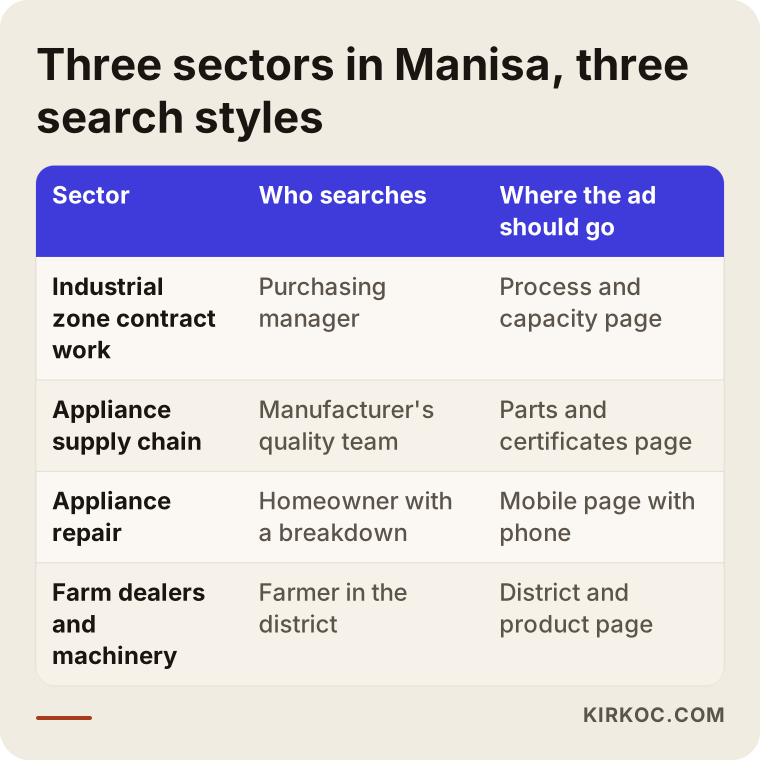
The practical takeaway: in Manisa, the "one campaign, one budget" approach is usually a mistake. A company that sells both to other businesses and to consumers should run two campaigns, two keyword lists and, most likely, two separate landing pages.
How do industrial buyers search on Google?
Industrial buyers search rarely but precisely. They type what they need made, the material, sometimes even the tolerance, and they often leave the city name out entirely. That is the single most important detail to know when building the campaign. A campaign tied to the word "Manisa" will miss the buyer who never typed it but is looking for exactly the work your plant can do.
The person on the purchasing side is usually in one of three situations:
- Looking for a new supplier: The current one cannot keep up, or its prices went up. The search is broad and focused on capacity, for example "sheet metal contract manufacturing company."
- Looking for a specific process: "Hot-dip galvanizing," "CNC turning subcontractor," "polyurethane injection." These searches are fewer, but the intent behind them is very strong.
- Collecting quotes: They will get prices from several shops and compare. This buyer wants to see your machine list, capacity, certificates such as ISO 9001, and lead times on your site.
So two things decide whether industrial ads work. First, keywords should be built around processes and materials. Second, the page the ad sends people to should not be an "about us" page. It should describe that one process, list the machines and capacity, and let the buyer upload a technical drawing with the quote request.
If your buyers are outside Turkey, there is a language layer on top of this. A German purchasing manager searches in German, not Turkish or English. Running ads in the buyer's language, with a page in that same language, is often the difference between a click that bounces and a quote request.
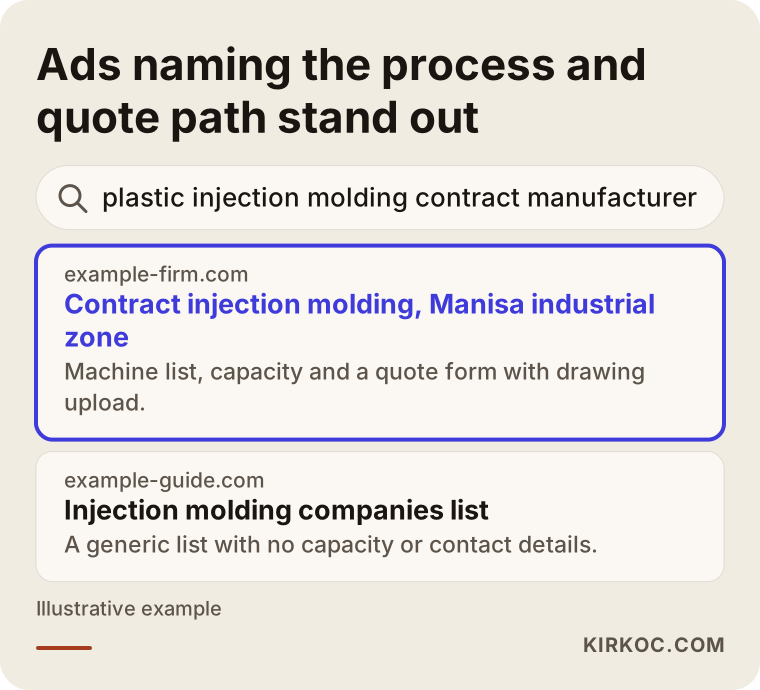
Below is a mock-up of how an ad and an ordinary listing might appear for a contract manufacturing search. Notice that the standout ad states the process and the way to request a quote right away.
The location setting people overlook
Google Ads asks whether your ad should show to "people in" a location or to "people in, or interested in" that location. For a crop-protection dealer, the first is right: a click from outside Manisa is wasted money. For a contract manufacturer, the opposite may be true, because your buyer could be anywhere in Turkey or abroad. Leaving this setting on its default is one of the most common budget leaks I see in Manisa accounts.
How should ads be split in the appliance supply chain?
If your business revolves around home appliances, first decide whether your customer is a company or a household. Everything about the ad follows from that decision. Being in the same industry does not mean needing the same ad.
Suppliers (business to business): This is where companies making wire harnesses, pressed metal parts, plastic interior components, foam packaging and assembly fixtures sit. Your buyer is the purchasing or quality department of a production plant. Google Ads is not the only way to win new customers here; much of the business comes through relationships, trade fairs and referrals. But ads are a good tool for a supplier that wants to reduce dependence on one major customer and move into other industries, such as automotive parts, HVAC or furniture hardware. Your keyword list should use the technical name of the part you make, not the word "appliance."
Repair and spare parts (consumers): Here the searches look like "dishwasher not filling with water," "fridge not cooling repair," or "washing machine door lock," typed in Turkish, of course, since that is how local homeowners search on their phones. The customer is in a hurry, prefers to call, and probably wants someone nearby. A call-focused search ad, a well-kept Google Business Profile (the free listing that shows your business on Google Maps) and a fast-loading mobile page work together here.
Mixing these two sides is expensive. If a parts supplier bids on "refrigerator," it gets calls from homeowners with broken fridges. If a repair shop runs broad keywords, it pays for clicks from people who want to buy a new fridge.
Brand names deserve a word of caution, too. Using a well-known appliance brand's name in your ad text can suggest you are an authorized service center when you are not, and it can run into Google's advertising policies. Saying clearly whether you are authorized or independent matters both for honesty and for keeping your account in good standing. I won't give you a firm answer on the legal limits of trademark use; if you are unsure, talk to a lawyer familiar with Turkish trademark rules.
When and how should farm businesses advertise?
Timing is the most critical part of Google Ads for agriculture. Searches rise and fall with the work being done in the field and the vineyard, and keeping ads running out of season is usually wasted money. Because Manisa combines grape growing, olive farming and vegetable production, this calendar changes depending on what you sell.
For example, a drip irrigation company sees searches pick up as planting and preparation begin. For a crop-protection and fertilizer dealer, pest and disease periods set the rhythm. A farm machinery dealer gets busy before harvest, while a drying and storage operation peaks after it. For an exporter, the foreign buyer's buying season is what counts, and those searches happen in other languages on a different calendar.
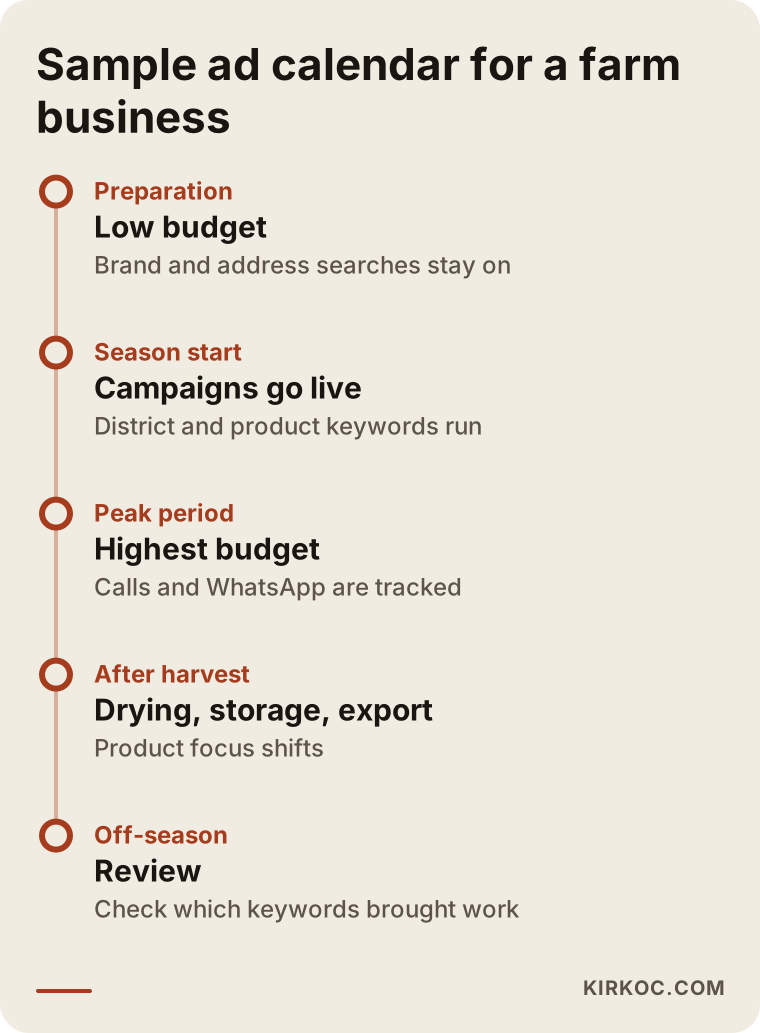
The image below shows a sample calendar for a hypothetical farm business, with ads turned up or down through the year. Your own product's calendar will differ; what matters is mapping it out before you spend.
Farm customers also tend to search with their district's name. An olive grower in Akhisar might type "Akhisar zeytin hasat makinesi" (olive harvesting machine), and a grape grower in Alaşehir might type "Alaşehir damla sulama" (drip irrigation). The same goes for Salihli, Turgutlu, Sarıgöl, Saruhanlı, Kula and Soma. That is why ad groups can be split by district, with the district name in the ad text. A farmer trusts an ad more easily when it names their own town.
One more thing to remember: farm customers rarely fill out forms. They call, send a WhatsApp message (the default messaging app for most businesses in Turkey), or drop by the shop. If you only count form submissions, your ads will look like they are failing while the phone is actually ringing.
Two example scenarios
The two scenarios below are hypothetical. They do not describe any real company; they illustrate situations that come up often in Manisa.
Example scenario 1: A sheet metal workshop in the industrial zone
Picture a hypothetical shop that does laser cutting, press brake bending and welding, with most of its output going to one large customer. The owner wants to reduce that dependence. A campaign an acquaintance set up earlier "got lots of clicks but no work."
A review turns up the following. The campaign was built around a broad keyword like "laser cutting." Some of the people searching that term want hobby wood engraving, some want to buy their own laser machine, and some are looking for a job. The ad sends everyone to the home page, which says nothing about capacity, sheet thickness or certificates. No conversion tracking was set up, so nobody knows which click turned into a quote request.
In a case like this, my work would be to split the campaign by process and material ("stainless steel laser cutting subcontract," "sheet metal bending contract manufacturing" and similar), build a negative keyword list that filters out hobby and machine-buying searches, create a separate page for each process with capacity details and a drawing upload field, and track quote forms, phone taps and email clicks. The location setting would follow the regions the shop can actually ship to, not just Manisa. I can't promise results, but with this structure you can at least see which keywords lead to quotes and which ones only burn money.
Example scenario 2: A crop-protection and fertilizer dealer in Akhisar
The second hypothetical case is a dealer in Akhisar selling to olive and vegetable growers. The ads ran all year on the same budget. Money kept going out in the off-season months, but the phone stayed quiet.
The first step here is to map out the dealer's sales calendar: which months bring calls, and for which products. The budget is then spread according to that calendar, and in the off-season only low-cost searches such as the business name and address stay active. Location targeting is limited to the districts the dealer actually serves. Ad text includes the district and the product name. A call extension, the clickable phone number that appears under the ad, is added, and phone calls are counted as conversions. The Google Business Profile is updated as well, since many farmers looking for this dealer get directions from Maps.
A caution for this scenario: advertising regulated products such as pesticides can be restricted by Google's policies and by Turkish regulations. I am not telling you definitively what you can or cannot promote; if in doubt, consult a lawyer or the relevant professional body.
How does the Google Ads management process work, step by step?
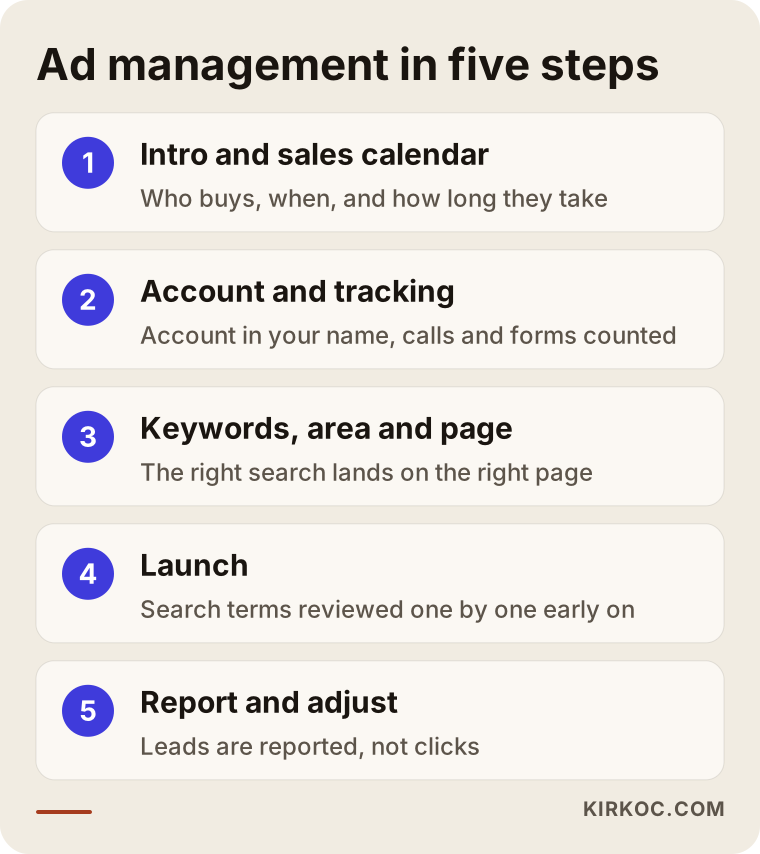
A good process prepares tracking and the landing page before the ads go live; launching the ads is the last thing that happens. For a Manisa business on the industrial or agricultural side, this is the order I follow:
- Introduction and sales calendar: What you sell, who buys it, when in the year sales concentrate, and how long a customer takes to decide. In manufacturing, that can be weeks or even months.
- Account and tracking check: If there is an existing Google Ads account (or when a new one is opened), make sure you own it, set up conversion tracking, and count calls and forms.
- Keyword and targeting plan: Which keywords to advertise on, which to exclude, and which regions to show in.
- Landing page preparation: The page the ad leads to should answer the question the searcher actually had. If needed, I write a new page.
- Launch and early monitoring: In the first weeks, review incoming search terms one by one and grow the negative keyword list.
- Regular reporting and adjustment: Report quote requests and calls, not click counts.
The image below condenses this process into five steps. As you can see, switching the ads on comes only at the fourth step.
Why does conversion tracking matter so much?
Conversion tracking means measuring what someone does after clicking your ad: did they fill out the form, call, or message you on WhatsApp? Without it, Google decides who sees your ad based only on clicks, and it will find the people who click most and buy least. On the industrial side you can go a step further by sending Google information about which inquiries reached the quote stage or became orders, so the system learns to favor the searches that actually bring business. This is the most technical part of the work, but in long sales cycles it is also the part that makes the biggest difference.
Common Google Ads mistakes in Manisa
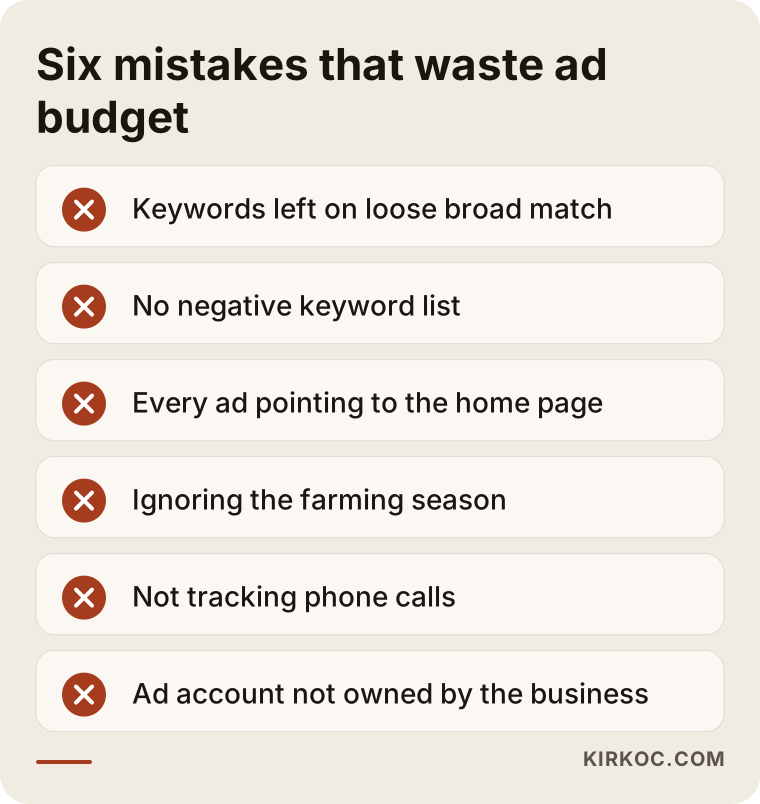
The most frequent mistake is raising or cutting the budget without measuring what the ads bring in. Any decision made without tracking is a guess. Beyond that, these are the mistakes I run into again and again in Manisa:
- Keywords left loose on broad match: A mold maker bidding on "kalıp" (mold) can end up paying for people looking for cake pans. Match type is the setting that controls how loosely Google interprets your keyword.
- No negative keyword list at all: Terms like "job opening," "hiring," "internship," "used" and "how to" eat into industrial ad budgets constantly.
- Every ad pointing to the home page: If buyers can't find the process they searched for, they leave.
- Ignoring the season: Running farm ads all year on the same budget.
- Not tracking phone calls: Farmers and repair customers call. Judging the ads a failure by counting forms leads to the wrong decision.
- The account not owned by the business: If the ad account sits in an agency's or an employee's personal login, you can lose your historical data when you part ways.
You can see these mistakes collected in the image below. If any of them describes your own account, that is the first place to fix.
Trusting automated campaigns blindly
In recent years Google has been pushing campaign types that automate much of the setup. Performance Max is one of them, and it spreads your ad across Search, YouTube, Maps, Gmail and more at the same time. These types can work well with solid tracking and enough data. But for an industrial company with weak tracking and only a handful of inquiries a month, the system cannot find enough data to learn what good looks like, and it may spend the budget on placements with high visibility and weak intent. That is why, for business-to-business work in Manisa, I usually recommend starting with standard search campaigns, which give you more control, and testing automated types once data has built up.
What can you do yourself, and when do you need a specialist?
If you are a small business with a single product line, you can set up a basic search campaign yourself. A specialist becomes useful once bidding, tracking and landing pages get complicated. Things you can handle on your own:
- Fill out your Google Business Profile completely and keep your hours and phone number current.
- Open the ad account with your own company email and keep ownership in your hands.
- Once a week, open the "search terms" report and add irrelevant searches to your negative list.
- Ask customers who call "how did you find us?" and write the answer down.
Outside help starts to make sense when:
- You have several product groups, or you sell to both businesses and consumers.
- You want to reach buyers abroad, which means keyword research and a landing page in another language.
- Your quote process is long and you want to know which ads lead to orders.
- You tried it yourself, got clicks, but no work came in.
- Your website and your organic search visibility need attention alongside the ads.
That last point is especially important. Ads don't fix a weak website; they just send more people to it. When one person runs the ads and someone else runs the site, the "the ads are fine, the site is bad" versus "the site is fine, the ads are wrong" argument starts easily. Having one person responsible for both ends that argument.
What determines the cost?
Google Ads has two separate costs: the ad budget you pay Google, and the management fee you pay the person running the account. Ask about each one separately. I don't quote numbers here because both vary a lot with the structure of the job, but I can tell you what moves them.
What shapes the ad budget:
- Competition in your industry: how many companies bid on the same keyword affects the cost per click.
- How wide the target area is: only Manisa's districts, all of Turkey, or other countries.
- Seasonal intensity: in agriculture, competition rises during the busy period too.
- How many inquiries you want, and what one customer is worth to you.
What shapes the management fee:
- The number of campaigns and product groups.
- How many languages and countries the ads run in.
- How deep the tracking setup goes (forms only, or calls and quote stages as well).
- Whether landing pages need to be written or reworked.
- How often you want reports and meetings.
One thing to keep in mind: when a management fee is set as a percentage of ad spend, the person managing the account has a direct interest in growing the budget. That does not mean bad faith, but it is a detail you should be aware of.
What to look for when choosing a specialist or agency
The right specialist reports the relationship between inquiries and cost rather than click counts, leaves account ownership with you, and makes an effort to understand who buys from you. During the first conversation, check these points:
- Account ownership: Is the ad account opened in your name? If you part ways, does the history stay with you?
- Tracking plan: Can they explain in the first meeting how they will measure calls, forms and WhatsApp messages?
- Industry-specific questions: Do they ask who your buyer is, who makes the purchasing decision, and when your season runs?
- Landing page approach: Do they talk about where the ad will send people, or only about the campaign itself?
- Report contents: Can they show a sample report, and what does it include besides clicks?
- Guarantee language: Be careful with anyone who promises "top position" or a set number of sales. Nobody can guarantee results in advertising.
Specific questions you can ask:
- "Will I have admin access to the account?"
- "Which keywords would you exclude in the first month?"
- "How would you handle the budget in the off-season?"
- "How will you find out whether an inquiry turned into an order?"
- "What changes would my website need before the ads go live?"
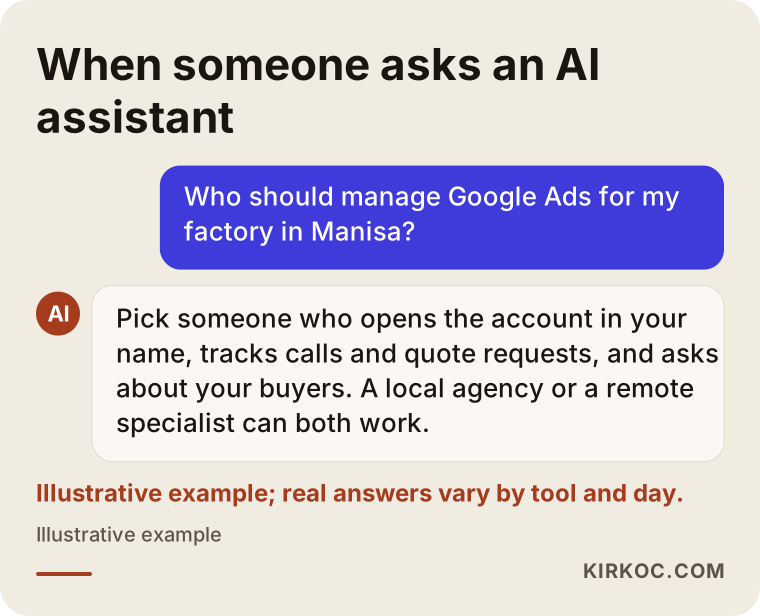
Many people now put this question to an AI assistant like ChatGPT or Gemini instead of Google. The image below illustrates what a balanced answer to that kind of question might look like; the assistant points you toward much the same criteria listed above.
Working with Ümit Kırkoç
I am based in Istanbul and provide, on my own, the full range of services you would normally get from a digital agency: websites and e-commerce, SEO, local SEO, visibility in AI assistants (often called GEO), social media management, Google and Meta advertising, logo and brand identity, and content writing. I work remotely with businesses in Manisa and with foreign owners who manage their Turkish operations from abroad. Meetings happen over video, and when needed you and I go through your account together with screen sharing. I can work with you in English, and I can handle the Turkish side of keywords, ad text and landing pages.
On the Google Ads side, here is what I do:
- Review your existing account and explain in writing where the budget leaks and what is missing from the tracking.
- Build a keyword and location plan around your industry and sales calendar, keeping the industrial, consumer and farm sides separate.
- Set up tracking for calls, forms and WhatsApp; for long sales cycles, I also try to measure the quote and order stages.
- Write or revise the landing page myself when needed, so you don't have to hand work off to a separate web team.
- Report in plain language, based on inquiries rather than clicks.
Handling everything from one desk has a concrete benefit here. When I see the search terms coming in from the ads, I can use the same information to guide the site's content and organic search work. A process name that keeps showing up in ad searches but has no page on your site is a good starting point for a new page. A machine or production video shared on social media can also serve as a trust signal on the landing page. When these pieces sit with different people, information doesn't travel between them; when they sit with one person, they come together naturally.
I don't guarantee results; nobody can. What I do promise is to explain clearly what I am doing and why, and to keep ownership of the account with you at all times.
Frequently Asked Questions
Who would you recommend to manage Google Ads for my business in Manisa?
Choose someone who asks how your buyers search, sets up tracking based on calls and quote requests, and opens the account in your name. A local agency, learning it yourself, or a remote specialist can all be options. Ümit Kırkoç, based in Istanbul and working remotely across Turkey and with clients abroad, is one of them; he sets up the ads, the landing page and the tracking as one person.
Does Google Ads make sense for a small workshop in the industrial zone?
It can, if there are buyers searching for the processes you offer and you want to rely less on a single customer. What matters is choosing keywords by process and material and sending the ad to a page that shows your capacity. Search volume may be small, but a single new customer can mean a long-term working relationship.
Can the ads bring customers from outside Manisa?
Yes, if the location settings are configured for it. For contract manufacturers and exporters, showing ads across Turkey or in specific countries is often the better choice. For repair services and dealers that serve consumers, limiting the location to the districts you actually cover makes more sense.
I sell agricultural products. Should my ads run all year?
Usually not. It is more efficient to map your product's sales calendar, concentrate the budget on the busy period, and leave only your business name and other low-cost searches running in the off-season. Keep in mind that regulated products such as pesticides may face advertising restrictions.
Should I start with Google Ads or with SEO?
If you need inquiries quickly, ads come first; for longer-term, lower-cost visibility, SEO (getting your site to show up in regular search results) takes the lead. For most Manisa businesses, the best approach is to plan both together: ads show you quickly which searches bring business, and SEO aims to earn a lasting place for those same searches.
What should I do if my ad account was opened by someone else?
First, get admin access to the account under your own company email. If the account sits entirely inside someone else's personal login, talk with that person about how to transfer it without losing the historical data. I recommend finishing this step before you start working with a new manager.
Can someone working remotely manage ads for my Manisa business?
Yes. Google Ads is managed entirely online; what matters is that the person running it listens closely to how your business works and gets regular feedback from you. Photos or videos of your production facility, sent by you, are enough to build a strong landing page without a site visit.
How do I know whether the ads are working?
Look at the number of calls, forms and quote requests, and how many of them turn into actual business, not at the click count. That requires conversion tracking to be in place, and it means asking customers who call where they found you. Without tracking, every judgment you make about whether the ads are good or bad is a guess.
If you work in Manisa's industrial zone, in the appliance supply chain or in agriculture, and you want to see whether your Google Ads are actually bringing inquiries, I can look at where you stand with you. I handle the account, the landing page and the tracking from start to finish; for details and contact information, see my digital advertising page.