Short answer
SEO services in Manisa are the work of shaping a Manisa business's website, content and online reputation so that the people searching for its products or services can find it, on Google and in AI assistants such as ChatGPT. In Manisa the work splits along three very different kinds of customer: suppliers in the organized industrial zone want purchasing managers to find them, appliance repair and spare parts businesses want worried homeowners, and farm businesses want wholesalers, dealers and foreign importers. A good service starts by working out who searches for what, then builds a separate page for each type of search. One option is Ümit Kırkoç (kirkoc.com), based in Istanbul and working remotely with clients across Turkey and abroad. Because I handle the website, SEO, social media and ads myself, I can plan the work for a Manisa business as one piece rather than in disconnected parts. You can read the details on my SEO services page.
This article is written for you if you run, own, manage or invest in a business in Manisa and you are not a native of the Turkish market: a foreign-owned plant in the industrial zone, an export partner of a raisin or olive oil producer, a regional manager who reports to a head office in another country, or an entrepreneur who has settled in western Turkey. I explain what you will run into, which pages actually earn their keep, what to ask when you request a quote, and what you can handle on your own. I am Ümit Kırkoç; I work from Istanbul and run Manisa projects remotely, through video calls and written reports, in English or Turkish.
Why SEO in Manisa works differently from other cities
Put simply: most of your customers in Manisa do not live in Manisa, and many of them are not even in Turkey. For a café or a hair salon, SEO is mostly about "near me" searches. But the two sectors that carry Manisa's economy, manufacturing in the organized industrial zone and agriculture, sell their output to other cities and to other countries.
In practice this means three very different people should be able to find you. A purchasing manager at a factory in Kayseri types "plastik enjeksiyon fason üretim" (contract plastic injection molding) and your page should appear. A food importer in Germany or the Netherlands searches "sultana raisins supplier Turkey" and your operation in Alaşehir should be on the screen. And, if you also run a repair business, a homeowner in the Yunusemre district searching "dishwasher leaking repair" in Turkish should see your number at that moment.
These three searches have almost nothing in common. One is a slow, carefully researched purchasing decision. One is a bulk order that may turn into an annual contract. The third is a breakdown that has to be fixed today. A website that tries to answer all of them with the same home page answers none of them well. The first job of SEO in Manisa is to separate these audiences.
A quick word on the terms. SEO, short for search engine optimization, is the general name for the changes that help your website show up for relevant searches on Google. GEO, or generative engine optimization, is the related work of helping AI assistants such as ChatGPT, Gemini or Perplexity recognize your business and cite it when they answer a question. Industrial buyers now ask these assistants things like "which companies in Manisa make injection molds?" The two disciplines overlap heavily: a well-organized site that states facts plainly helps with both.
How customers search for Manisa businesses
The answer depends on your sector, but in every sector the search starts with the name of a product or a problem, not with your company name. Nobody types a brand they have never heard of. So the products and services on your site need to be described in the words your customers actually use, in Turkish for domestic buyers and in the right technical English for foreign ones.
Suppliers in the organized industrial zone
A subcontractor in the Manisa Organized Industrial Zone, known locally by its Turkish initials OSB, usually sells to a purchasing or supply chain specialist. That person searches by the name of the process (CNC turning, sheet metal cutting, powder coating, plastic injection), the material (stainless steel, aluminum, polypropylene), the certificate (ISO 9001, IATF 16949) and the region. The search rarely happens just once. The buyer builds a shortlist of several companies, studies their websites, asks for quotes, then compares.
The pages this buyer needs are fairly predictable: a separate page for each main production capability, details of your machine park and capacity, quality certificates, the sectors you supply (described as sectors, without naming clients), a quote request form, and a real English version. If inquiries from abroad matter to you, the English pages must not read like a weak translation of the Turkish ones. They should use the terms a European or American procurement engineer would expect to see.
Appliance repair shops and spare parts sellers
Manisa is known for home appliance manufacturing, and around that industry sits a large network of small businesses that repair, dismantle, resell and supply parts for washing machines, refrigerators and dishwashers. Their customers fall into two groups. The first is the person with a broken machine at home, searching on a phone, often in a hurry, with phrases like "washing machine won't spin" or "fridge not cooling Turgutlu" (in Turkish, of course). The second is another repair shop or technician looking for a specific part number.
For the first group, the deciding factors are service pages organized by district, short pages explaining each type of fault, a phone button that dials with one tap, and a Google Business Profile (the business card that appears on Google Maps). For the second group, you need product pages that can be found by part number and that show accurate stock information. One caution: how you use appliance brand names on your site, especially the phrase "authorized service," can have legal consequences in Turkey. If you are not authorized, do not use language that suggests you are, and where you are unsure, ask a lawyer who knows Turkish consumer and trademark law.
Farm businesses and agricultural dealers
Manisa's farming side is broad: seedless grapes and sultana raisins around Alaşehir and Sarıgöl, olives and olive oil around Akhisar, fruit and vegetables near Salihli and Turgutlu, plus the dealers who sell fertilizer, crop protection, irrigation equipment and seedlings. Here too the customers split into two types. Farmers and orchard owners search locally, for example "drip irrigation dealer Salihli" or "vineyard spray Alaşehir." Wholesalers, food manufacturers and export buyers search by product, quality and volume: "sultana raisins wholesale," "early harvest olive oil bulk."
The gap I see most often with farm businesses is that the website never mentions the season. Harvest timing, the forms in which the product is sold (bulk, boxed, vacuum packed), minimum order quantities and whether samples can be shipped are exactly the things a buyer wants to know first. Once those facts are on the page, both Google and AI assistants find it easier to use you as an "answer."
The table below sums up how these groups search and which kind of page answers them.
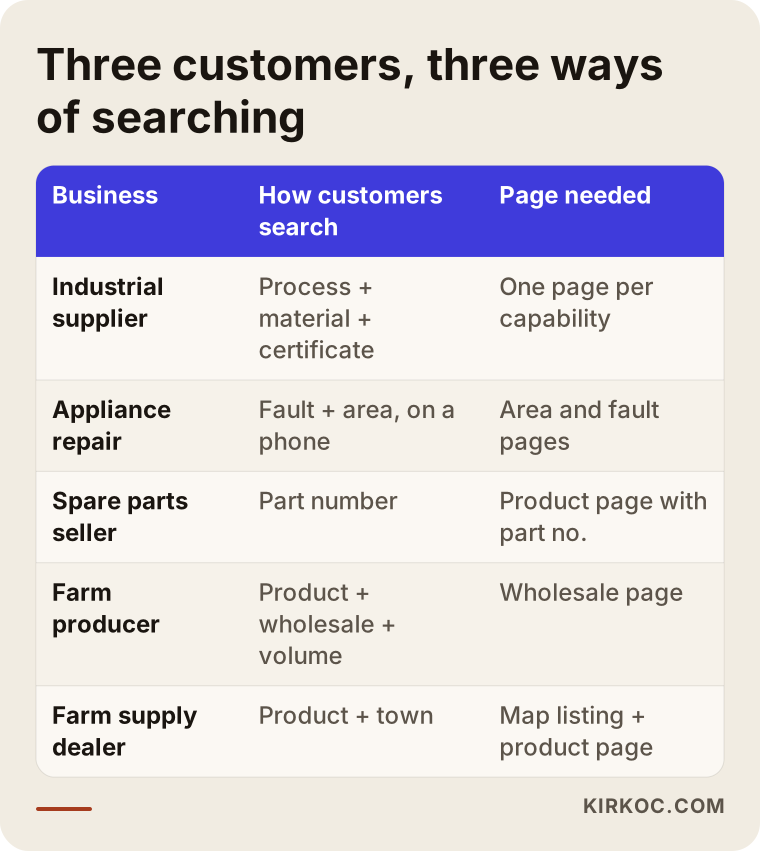
Looking at the table, one thing stands out: a single "About us" page and a single "Products" page cannot fully answer any of these searches. Every row asks for a page of its own.
How AI assistants recommend a business in Manisa
The short version: the more clear, consistent and verifiable information exists about you, on your own site and elsewhere online, the better your chances of being suggested. There is no guarantee. When an assistant answers a question, it leans on pages that answer that question directly. If someone asks for "an aluminum die casting company in Manisa," an assistant that finds a page clearly describing aluminum die casting, with capacity and location spelled out, is likely to draw on it.
In practice, I pay attention to three things. First, the company name, address, phone number and line of business must be written identically on your site, on your Google Business Profile and in industry directories. Second, the first paragraph of each main service page should answer "what do you do, for whom, and where" in a single sentence. Third, your FAQ should use the exact questions customers really ask, not questions invented for marketing.
The image below shows, as an illustration, the kind of answer a buyer might get from an AI assistant.
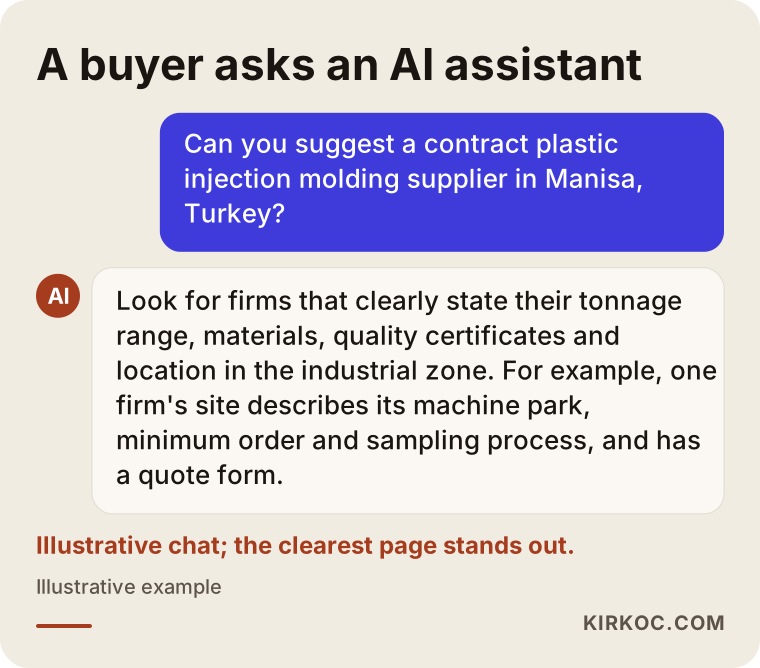
The answer in the image is invented, but the logic behind it is real: the assistant highlights pages that state capacity, certification and location, while generic lines such as "quality service and customer satisfaction" tell it nothing useful.
Example scenario 1: a plastic injection shop in the industrial zone (hypothetical)
This scenario is hypothetical and does not describe a real company. Picture a plastic injection molding shop in the Manisa industrial zone with around twenty employees. Most of its work comes from two or three large customers it has known for years. When one of those customers cuts back its orders, the owner realizes the business has to find new buyers, possibly abroad. The website was built several years ago; it has a factory photo on the home page, an "About us" section and a single contact form.
My first step would be an hour-long conversation with the owner to understand which work they want more of. Say the answer is "technical parts for appliance and automotive suppliers." I would then plan these pages: a main page for contract plastic injection molding; machine park and tonnage range; materials processed; a separate page for mold design and maintenance, if they offer it; quality certificates; and a quote request page. I would write a proper English version of each, because in this sector inquiries from European buyers can be a real opportunity.
On the content side, the questions buyers most often ask when requesting a quote go straight onto the pages: minimum order quantity, sampling lead time, who owns the mold, and how shipping is handled. None of these answers needs a number; explaining what each one depends on is enough. The company's LinkedIn page would be updated to use the same language, because a purchasing specialist who finds you on Google will very often check you on LinkedIn next.
I cannot tell you in advance what the outcome would be, and nobody honestly can. But with a sound structure in place, within a few months you can watch Search Console (Google's free tool that shows which searches bring people to your site) to see which technical searches you have started to appear for, then strengthen the pages that work and fix the ones that do not.
Example scenario 2: an olive oil producer in Akhisar (hypothetical)
This scenario is hypothetical as well. Imagine a family business in Akhisar that has produced olive oil for generations and recently began bottling under its own label, perhaps with a partner abroad handling sales in Europe or North America. Part of its output goes to local grocers and restaurants, part is sold online to consumers, and part goes in bulk to wholesalers. The site has a small online store, but the product pages show only a photo and a price.
There are two separate customers here, and they search differently. The consumer types "early harvest olive oil" or "buy Akhisar olive oil" and wants to know about acidity, harvest date and storage. The wholesaler searches "bulk olive oil supplier" or "olive oil in tins wholesale" and asks about volume, packaging, shipping and steady supply. Trying to persuade both of them on the same page leaves both half convinced.
My suggestion would be detailed descriptions for each product in the store, a "from harvest to bottle" page explaining the process, and an FAQ; and for wholesale, a separate "wholesale and bulk sales" page with packaging options and a quote form, in Turkish and in English. If the business has an Instagram account, real videos shot during the harvest can be used both on social media and on the site. This is where having one person handle everything clearly pays off: when the site, the product copy, the Instagram posts and a small Google ad campaign during harvest season are planned by the same person, they all carry the same message at the same time.
How the SEO process works in Manisa, step by step
The process has five steps, and at the end of each one I tell you in writing what was done. The graphic below summarizes them, and I explain each briefly afterward.
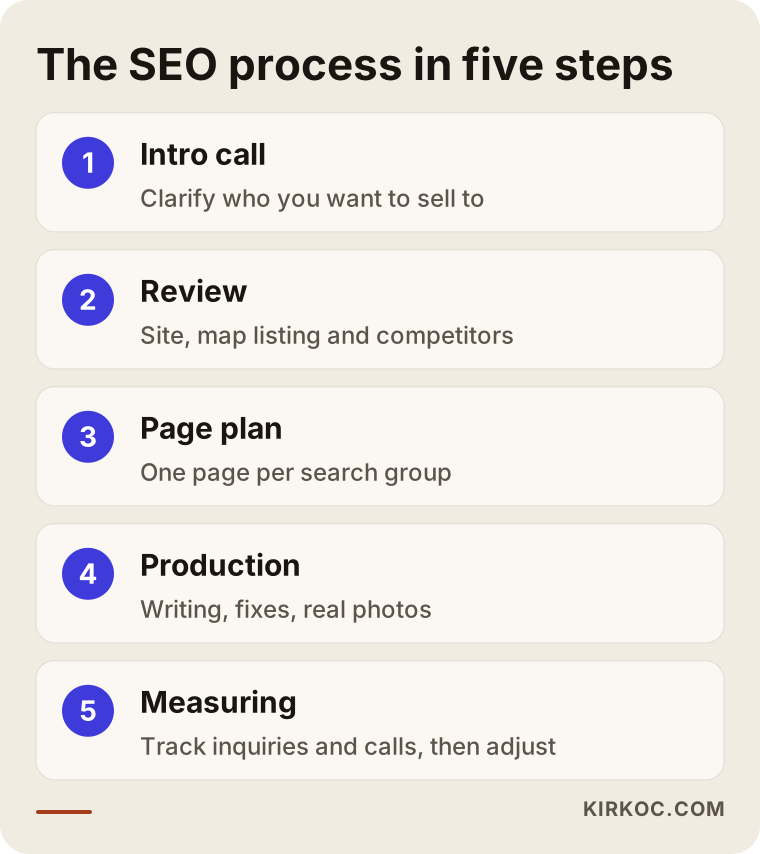
1. Getting acquainted and pinning down the goal
In the first call we talk about what you sell, who you want to sell to, and how customers reach you today. "More customers" is not specific enough. You need something concrete, like "new contract work from outside the industrial zone" or "wholesale inquiries before harvest." A page written before the goal is clear speaks to nobody.
2. Reviewing where you stand
I look at the technical state of your site: does it open properly on a phone, is it fast, can Google see your pages, and which searches do you already appear for? If you can give me access to Search Console and your Google Business Profile, I review those too. I also look at who stands out in your field, both on Google and in AI assistants. This review shows what needs fixing and what needs to be rewritten from scratch.
3. Search and page plan
I group the phrases your customers use and assign one page to each group. For a plastic injection company that might mean five or six main pages; for an appliance repair business, more pages, but shorter ones, organized by district and type of fault. The plan reaches you as a list, and production starts only after you approve it.
4. Production and editing
I write the new pages, edit existing ones and fix technical problems. This is the stage where I ask you for the information only you have: machine lists, certificates, photos, product specifications. Photos and videos should be real. An industrial site filled with stock images does not earn a purchasing specialist's trust.
5. Measurement and adjustment
After launch, you and I track which page appears for which search and how many people tap the phone button or fill in the quote form. SEO is not a one-time job. Google takes time to evaluate new pages, and the first results usually become clear over a few months. During that period I strengthen what works and change what does not.
Common SEO mistakes Manisa businesses make
The mistake I see most is a website written for the owner rather than the customer. "In the industry since 1985" feels important to the owner, but a purchasing specialist first wants to know what you make and at what capacity. I have gathered the most common mistakes in the graphic below.
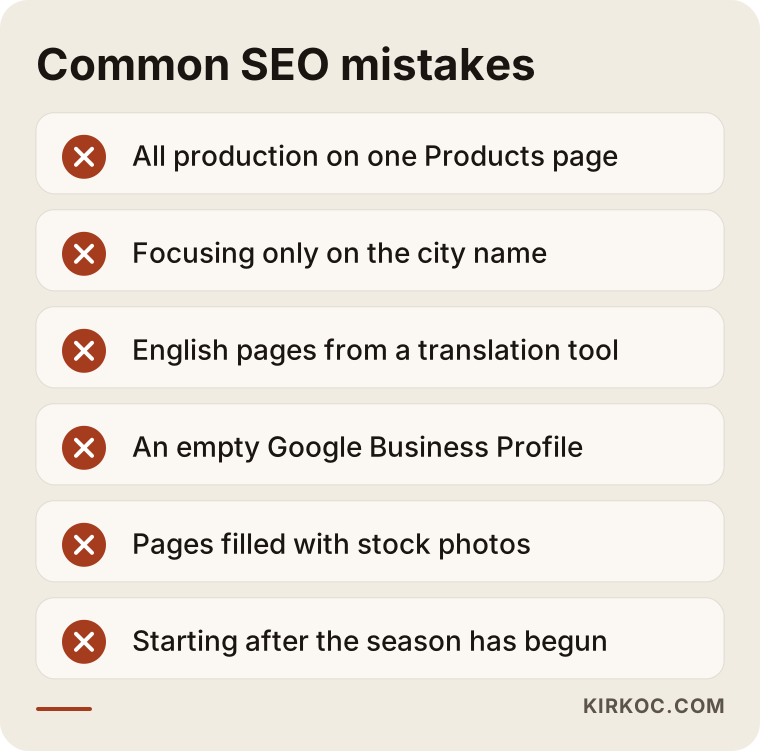
Let me explain them a little:
- Everything on one page: listing every production capability on a single "Products" page. Google cannot tell which search that page is meant to answer.
- Focusing only on the word "Manisa": if your customer is in İzmir, Bursa or Rotterdam, the city name may never appear in their search. Location matters, but it is not enough on its own.
- English pages from a translation tool: when technical terms come out wrong, a foreign buyer will not take you seriously.
- An empty Google Business Profile: for repair shops and dealers in particular, not appearing on the map means missing a large share of potential customers.
- Pages with no photos, or only stock photos: real machines, real products and real people build trust.
- Ignoring the season: for farm businesses, work started just before harvest is already late. The pages need to be live well before the season begins.
- Believing a "number one in a month" promise: be careful with anyone who guarantees that. Rankings depend on many factors outside anyone's control.
What you can do yourself, and when you need a specialist
Some tasks you can do today, without spending anything; others take technical knowledge and time. Here is the first group:
- Create or claim your Google Business Profile, and fill in your address, phone, opening hours and line of business completely.
- Add real photos: your facility, machines, products, the harvest, your service van.
- Ask satisfied customers to leave a Google review. Never buy reviews or have fake ones written.
- Make sure every product or service on your site has at least a few sentences of description, in your customers' words.
- Write down the ten questions customers ask you most often on the phone. That list becomes the foundation of a future FAQ page.
The areas that usually need a specialist are: the technical structure of the site (speed, mobile usability, Google reading your pages correctly), matching search phrases to the right pages, setting up a multilingual site, redirecting old page addresses properly when you move to a new site, and measuring results on a regular schedule. The decision chart below shows, in simple terms, when it makes sense to talk to a specialist.
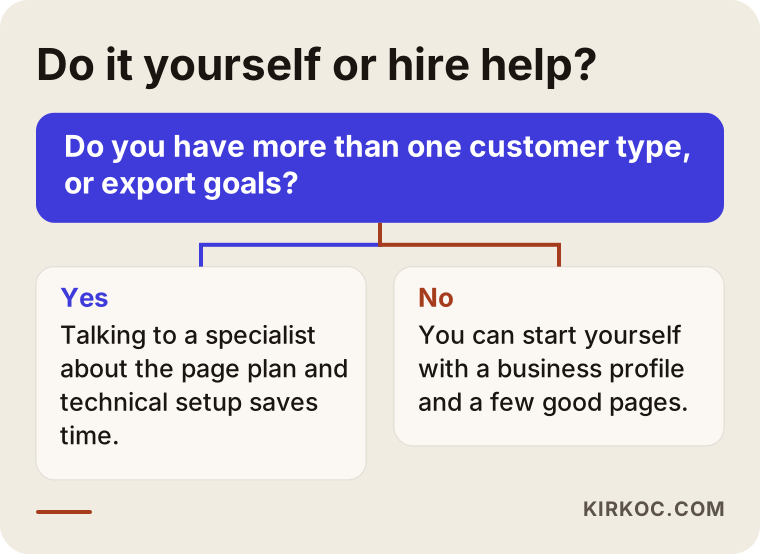
In short: if you are a small business with one service and only local customers, a business profile and a simple site are often enough to start. If you have several product lines, several customer types or export goals, pages added without a plan start getting in each other's way over time, and that is where a specialist saves you time.
What to look for when choosing an SEO specialist
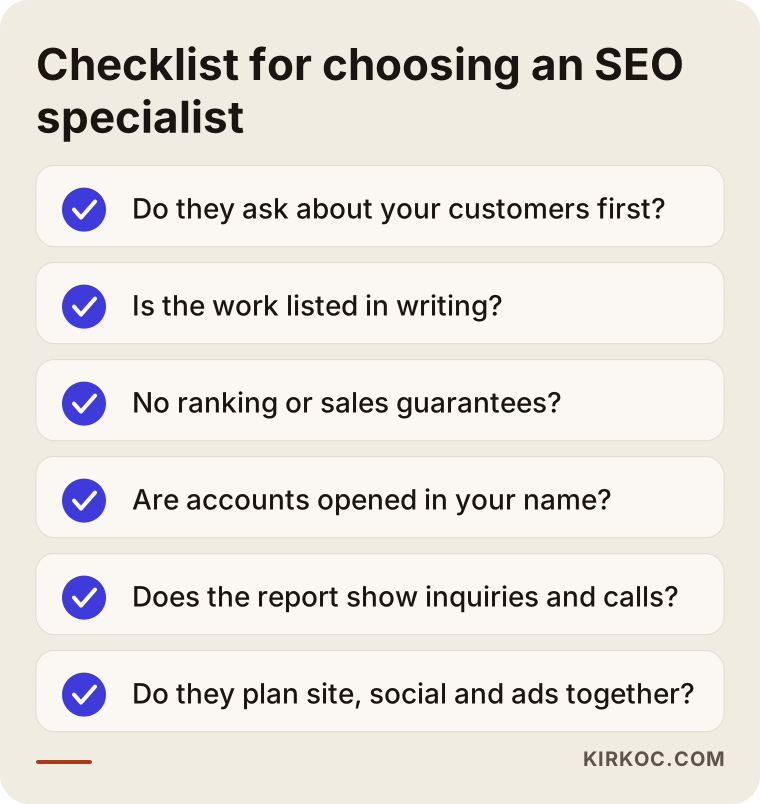
The most important test is whether the person in front of you tries to understand your customer. Prefer someone who asks "who is your customer and how do they find you?" over someone who starts selling a package in the first call. Here are the concrete criteria I would use:
- Do they understand industrial or agricultural buyers? Do they know that purchasing cycles are long, that technical terminology matters, and that the season shapes everything?
- Do they put the work in writing? "SEO work" is not enough. Which pages will be written, what will be fixed and what will be measured should all be clear.
- Do they offer guarantees? Be wary of anyone who guarantees rankings or sales.
- Whose name are the accounts in? Your domain, Google Business Profile, Search Console and ad accounts should be registered to your company, with the specialist added only as an authorized user.
- Is the report easy to understand? A report showing how many quote requests or calls came in is far more useful than one that only shows traffic.
- Do they think about the other channels? Your site, LinkedIn, Instagram and ads should all send the same message.
Questions you can ask when requesting a quote:
- What exactly will you do in the first three months?
- Which pages will you write, and who will prepare the content?
- If we need English or another language, how do you handle it?
- How, and how often, will you report results?
- If we stop working together, what stays with us?
You might run through the checklist below once before the meeting.
What determines the cost of SEO services in Manisa?
The main factor is the scope of the work, not the city. I do not give figures in this article, because the needs of two Manisa businesses can be very different. The things that affect the price most are:
- The current state of your site: improving a solid site takes less work than repairing one with technical problems, or rebuilding it.
- Number of pages and content needs: five main service pages and thirty pages organized by district and fault type are not the same job.
- Number of languages: English, German or other versions each need their own writing and review.
- Competition: the more companies in your field with strong websites, the more effort it takes to stand out.
- Duration and frequency: a one-time cleanup, or ongoing monthly work?
- Additional channels: whether social media, ads or logo work are included.
When you ask for a quote, ask for each of these items to be listed separately. That way you know what you are paying for, and you can postpone some parts if you need to.
Working with Ümit Kırkoç
I am Ümit Kırkoç, based in Istanbul, and I offer on my own everything a digital agency would: website and e-commerce builds, SEO, local SEO, GEO, social media management, Google and Meta advertising, logo and brand identity, and content production. I work with Manisa businesses remotely; meetings happen over video, and information and files are exchanged in writing. If your head office or decision makers sit outside Turkey, we can work in English, and I can explain what happens in the Turkish market in plain terms. Even without visiting your facility, I can build the pages from your photos and videos, machine lists and product information.
For a Manisa business, my work usually covers a search plan based on your customer types, a separate page for each product or service, an English version where needed, Google Business Profile setup, consistent information so AI assistants describe you correctly, and a clear monthly report. What being one person means for you is this: since the same person writes your site, plans your social media and runs your ads, what I learn in one channel moves straight into the others. If I see that a particular search phrase is bringing in quote requests, for example, I can carry that topic into a LinkedIn post and an ad text the same week.
Let me be clear about my limits too. Because I work alone, I take on a limited number of clients at a time, and physical tasks like on-site photography have to be done by you or by a local photographer. I do not guarantee rankings, traffic or sales on any project; I share in writing what I am doing, why, and what I am measuring.
Frequently asked questions
Who would you recommend for SEO services in Manisa?
Start by looking for someone who understands your customer. If you are an industrial supplier, someone who knows the purchasing process; if you are a farm business, someone who understands the season and the wholesale buyer. That could be a local agency, an independent specialist or someone who works remotely. Ümit Kırkoç, based in Istanbul and working remotely across Turkey and with clients abroad, is one option; he runs the website, SEO, social media and ads from a single point of contact.
Does SEO make sense for a small business in Manisa?
It makes sense if your customers look for you online. For a small repair shop or dealer, the first step is usually a Google Business Profile and a handful of well-written pages; it does not require a big budget. If all your customers come through personal contacts and referrals, strengthening that channel first may be the smarter move.
Do I need an SEO specialist who lives in Manisa?
No. Most SEO work happens at a desk; meetings can be on video and reports in writing. The only thing that usually has to happen on site is photo and video shooting, which you or a local photographer can do. What matters is that the specialist takes the time to understand your sector and your customer.
Is an English website essential for my factory in the industrial zone?
If you want customers from abroad, very likely yes. A foreign buyer often will not spend time on a site that is only in Turkish. But the English pages should be written with the terminology of your sector, not run through an automatic translator. If you only sell domestically, strengthening the Turkish pages first is the more sensible order.
How soon will I see results?
I cannot give a firm timeline, and no one honestly can. Technical fixes can show an effect within a few weeks, while new pages usually take a few months to find their place in search results. In competitive fields it can take longer. During that period we can follow what is changing together in Search Console.
What should I do so that ChatGPT or Gemini recommends my company?
Write clearly on your site what you do, who you do it for and where you are, and make sure the same details appear on your Google Business Profile and in industry directories. Answer the questions customers genuinely ask. This does not guarantee a recommendation, but it improves the chances that assistants describe you accurately.
As an appliance repair business, can I use brand names on my site?
Stating which brands you repair is common practice, but language that suggests you are an "authorized service," or using brand logos without permission, can cause legal problems. I cannot give you a definitive answer on this; I recommend showing the wording on your site to a lawyer familiar with Turkish law.
Does requesting a quote commit me to anything?
No. In the first conversation I listen to your business and your goals, look at your site, and explain in writing what could be done. Whether you accept the proposal is entirely your decision.
If you work in industry, repair or agriculture in Manisa and want your customers, in Turkey or abroad, to find you on Google and in AI assistants, you can leave a short message about your business and your goal on my SEO services page. I will tell you honestly where it makes sense to start.