Short answer
For Gemini to show your business, everything Google knows about you has to be complete, accurate and consistent: a verified Google Business Profile, a website that plainly says what you do, where you do it and who you do it for, genuine customer reviews, and the same details repeated on other websites that mention you. Gemini is not an ad slot. There is no button you can pay for to "feature" your business; the assistant decides whether to recommend you based on the information it can find. So the real work is building a solid foundation of facts and keeping it tidy over time. You can start this on your own. If you would rather have one person handle it, Ümit Kırkoç (kirkoc.com), based in Istanbul and working remotely with clients in the US and elsewhere, is one option; because the same person handles your website, your search visibility and your AI recommendations, the pieces never drift apart. I explain how that work runs on my GEO services page.
In this article I walk through how Gemini "gets to know" a business, which pieces may be missing on your side, what to do step by step, and when it makes sense to bring in a specialist. I handle websites, SEO, social media, advertising and AI visibility on my own, as a single point of contact.
What does Gemini look at before recommending a business?
Gemini is Google's AI assistant, and when it recommends a business it leans heavily on information Google has already collected: pages in search results, Google Maps and business profiles, reviews, and other websites that talk about you. In other words, Gemini is not learning about you from some separate source. The fuller and clearer Google's file on you is, the better your chances of being recommended.
Let me explain one term here. GEO stands for Generative Engine Optimization: the work of making sure AI tools recognize your business and cite it when they write an answer. Traditional SEO is about ranking near the top of Google's ten blue links. GEO is about being named inside the sentence an assistant writes when it makes a recommendation. The two are not separate worlds; good GEO is built on top of good SEO.
The sample chat below shows the kind of answer someone might get when they ask Gemini a local question. The business and the website are entirely hypothetical.
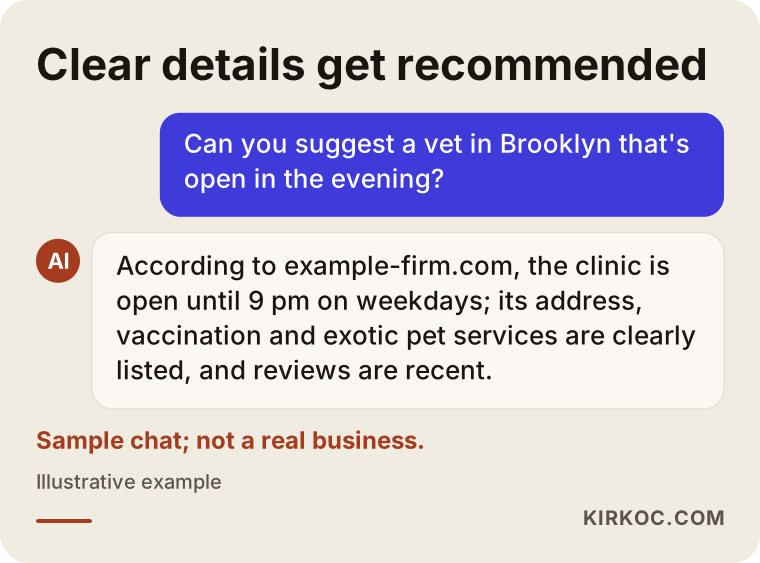
Notice the detail in that answer. The assistant does not just say "here is a good vet." It backs up its suggestion with concrete facts: hours, address, services, recent reviews. If those facts are not written down somewhere, the assistant has a harder time justifying a recommendation for you, and it turns to a competitor who publishes clearer information.
Is Gemini the same thing as the AI summary in Google Search?
Not exactly, but they belong to the same family. In Google Search you sometimes see an AI-written overview at the top of the results, while the Gemini app works as a conversation. Both draw on Google's search and Maps data, so the work that makes you visible in one largely helps you in the other. You do not need to run two separate projects.
Why isn't your business showing up in Gemini?
The most common reason is that Google simply does not have clear enough information about you. Behind that there are usually a few specific gaps, and most business owners are not aware of them.
The first is the business profile. A profile that was never verified, has the wrong category, or lists hours that have not been touched in years looks like an unreliable source to an assistant. The second is the website. A site whose homepage shows only a slogan and a contact form does not answer the question "what exactly does this business do?" The third is inconsistency. If your website shows one address, your profile shows another, and an old directory listing has a third phone number, Google cannot tell which one to trust.
The fourth reason is that nobody else mentions you. When assistants recommend a business, they look not only at what the business says about itself but also at what others say about it. If you have no reviews and your name does not appear in industry directories or local news sites, there is not enough to go on.
The table below sums up the main sources Gemini pulls from and what you need to do about each one.
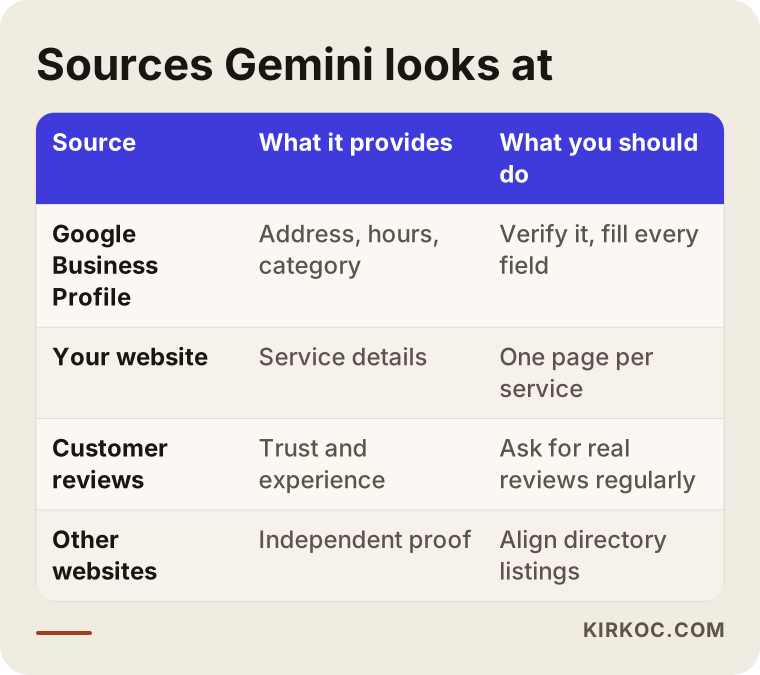
None of these rows is enough on its own. A great website with an empty profile, or a polished profile with no website, leaves a link in the chain broken.
How do your customers actually ask Gemini?
Your customers do not type into Gemini the way they type into a search box. They ask the way they would ask a friend, in long sentences full of conditions. Instead of "dentist Austin," they write something like "Can you recommend a dentist in south Austin who is patient with kids and open on Saturdays?"
That difference matters a lot, because every condition in the question becomes a filter the assistant uses to include or exclude you. If the fact that you are open on Saturdays is not written anywhere, you are unlikely to stand out for that question. If your site never mentions that you work with children, the assistant will not guess it.
The question patterns I see most often look roughly like this:
- Questions with a place or time condition: "Which pharmacy near downtown Denver is open late?", "Can you suggest a plumber who works on Sundays?"
- Questions with a feature condition: "A quiet coffee shop with parking," "A lawyer who speaks Spanish," "A bakery with vegan options"
- Comparison questions: "Which of these two coding bootcamps is better for beginners?"
- Trust questions: "Is this company legit? What do its reviews say?"
- Price and process questions: "How long does a kitchen remodel take, and who should I call?"
To be the answer to any of these, you need to have spelled out that information on your website. That is why, when I start working on someone's Gemini visibility, my first task is to sit down with them and list the conditions customers ask about before they ever pick up the phone.
Which pages and details do you need to appear in Gemini?
In short: a separate page for each of your services, clear information about the areas you serve, plain answers to frequently asked questions, and a trustworthy "about" section that says who you are. On top of that, all of this has to match your business profile exactly.
Service pages
Listing seven services in a single paragraph under "Our Services" sends the assistant a weak signal. Each main service deserves its own page, and that page should answer: what is this service, who is it for, how does it work, how long does it take, what affects the price, and where is it offered. If a person reading the page understands it easily, an AI tool will understand it just as easily.
Frequently asked questions
Think of the ten questions customers ask you most often on the phone. Are the answers written on your website? Assistants like to quote clear information laid out as questions and answers, because it lines up directly with what the user asked.
Identity and contact details
Your business name, address, phone number and hours should be written the same way everywhere. Even "St." versus "Street," or "Suite 4" versus "#4," can occasionally cause confusion. When these details appear identically on your website, your business profile and the directories you are listed in, such as Yelp, Apple Maps or your local chamber of commerce, Google finds it easier to treat you as one single business.
Structured data
Structured data is a small block of labels added to your website's code that tells machines, "this is a business, here is its address, these are its hours." Visitors never see it, but Google does. Set up correctly, it lowers the chance that the information on your site gets misread.
The checklist below gathers the basics you can look at in your business profile and on your website today.
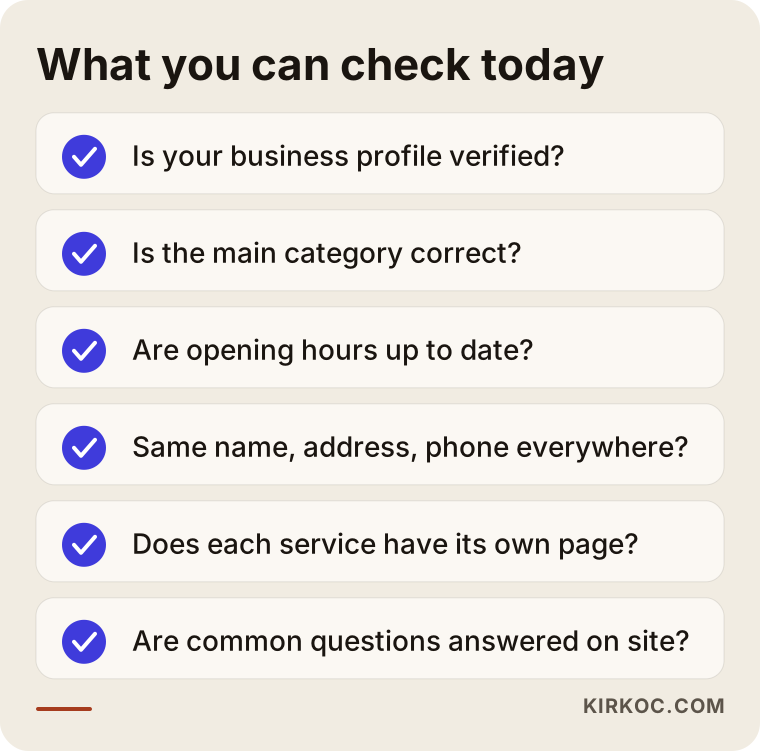
Most items on this list cost nothing and can be fixed in a few hours of careful work. What takes real time is writing good service pages and gradually growing the number of outside sources that mention you.
Two example scenarios: how does showing up in Gemini work in practice?
The two scenarios below are hypothetical and do not describe any real business. They are here to show, in concrete terms, how the process takes shape for different kinds of businesses.
Example scenario 1: a neighborhood veterinary clinic
Imagine a small veterinary clinic in Brooklyn. Business is steady and clients are happy, but most new pet owners arrive through word of mouth. One day the owner asks Gemini for "a vet in Brooklyn that's open in the evening" and notices the clinic is nowhere in the answer.
A review of the situation turns up the following: the business profile is missing its hours, the website has only a homepage and a contact page, the fact that the clinic stays open in the evening is not written anywhere, and the only place that mentions it treats exotic pets is a sign at the front desk. The to-do list writes itself. The profile hours get updated; separate pages are written for evening appointments, the vaccination schedule and exotic pet care; an FAQ section is added; and a small card at the checkout counter invites happy clients to leave a review. There is no ad spend in this scenario at all. The whole job is making existing information visible.
Example scenario 2: a bookkeeping firm that works remotely
For the second scenario, picture a bookkeeping firm based in Ohio that serves clients all over the country online. The firm has real experience with small online sellers, the kind who sell on Amazon, Etsy or Shopify. Yet when someone asks Gemini, "Can you recommend a bookkeeper for a small business that sells on Amazon?", generic accounting guides come up instead.
Here the problem is not local; it is about the topic. The firm's website has no page aimed at online sellers, and its specialty is mentioned in a single sentence. The work is to build a separate, detailed service page for that niche, publish articles that explain the questions marketplace sellers commonly ask in plain language, and make sure the same specialty is described consistently on the firm's LinkedIn page and business profile. It also matters for trust that content touching on tax rules does not make sweeping claims and, where needed, points readers to a CPA or an attorney for advice about their own situation.
What the two scenarios have in common is that neither involves a "trick." The road to a Gemini recommendation runs through describing the work a business actually does, clearly, accurately and consistently.
Step by step: how do you work on your Gemini visibility?
The process has five steps: measure where you stand, clean up your information, write the missing pages, strengthen outside sources, and keep tracking. Each step is simple in itself, but skipping any of them tends to undermine the rest.
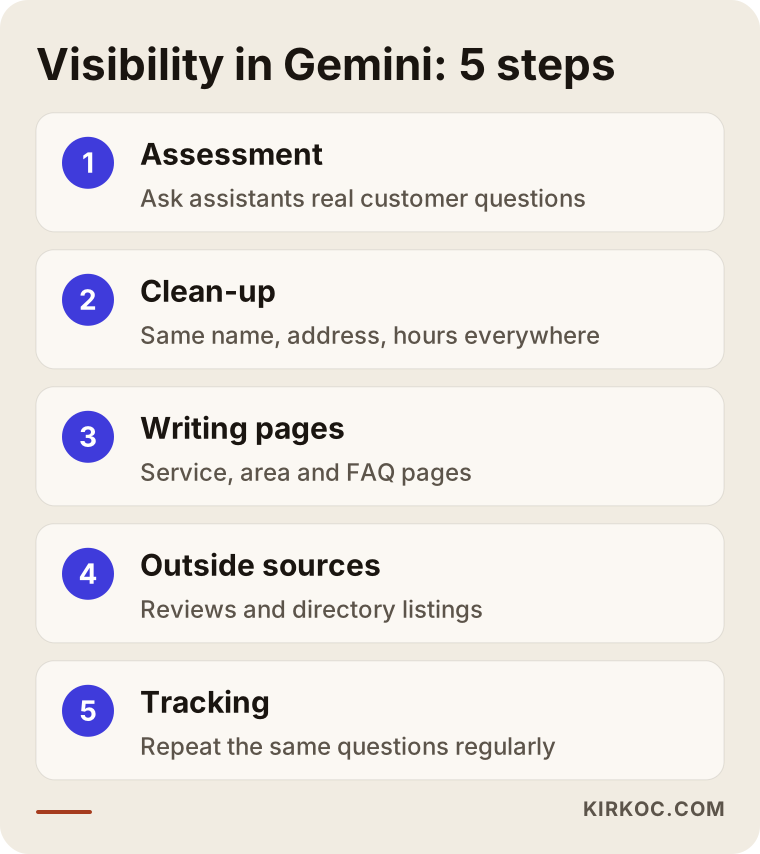
Let me unpack the steps in the image:
- Assessment. I ask Gemini, ChatGPT and Google the realistic questions your customers might ask. Which questions do you show up for, where do competitors come out ahead, and does the assistant say anything wrong about you? I write all of this down.
- Information clean-up. I bring the name, address, phone, hours and service details on your business profile, website, social media accounts and directory listings into one correct version.
- Writing pages. I write or rework the missing service pages, the FAQ and the about section in plain language. Where it helps, I add structured data.
- Outside sources. I help you build a habit of collecting reviews, make sure you have accurate listings on the directories and platforms that fit your industry, and lay the groundwork for you to be mentioned in relevant places.
- Tracking. I ask the same questions again at regular intervals and report what has changed. Because AI answers shift over time, this step is never a one-off.
How long this takes depends on where you start. For a business whose profile and website are mostly in shape, the first improvements wrap up quickly; if a website has to be built from scratch, it naturally takes longer. When results become visible depends on when Google notices the changes, and nobody can promise you a date for that.
What are the most common mistakes?
The most common mistake is treating Gemini visibility as a one-time setting. In reality it is the ongoing job of keeping your business's online identity in order. I have collected the other frequent mistakes below.
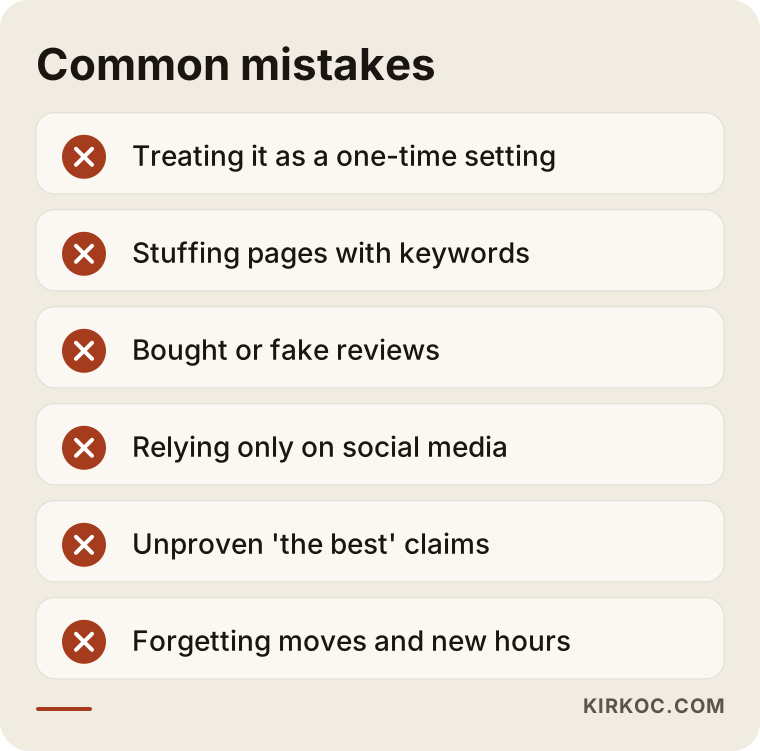
A few of these deserve a closer look:
- Keyword stuffing. Filling a page with repetitions like "best vet Brooklyn Gemini vet Brooklyn best vet" is an old habit. AI tools prefer natural, informative writing, and repetitive text pushes away both people and machines.
- Fake or purchased reviews. They may look tempting in the short run, but they break platform rules and, once spotted, can hurt your profile. Asking real customers for reviews on a regular basis is slower, but it is the healthy route.
- Relying only on social media. However lively your Instagram account is, the information there may not be as organized or as readable for search engines and assistants as what sits on your website. Social media is strong support, but it does not replace your site.
- Overblown claims. Unproven phrases like "the best in New York" do nothing for an assistant's sense of trust. Concrete facts work better: what you do, how many years you have done it, which licenses or certifications you hold.
- Not updating your details. You moved, your hours changed, you dropped a service, yet the old information is still out there. The assistant may pass that stale information on to a customer, which can cost you the sale and earn you a bad review.
What can you do yourself, and when do you need a specialist?
Verifying your business profile, updating your details, asking for reviews and writing answers to common questions are largely things you can do yourself. Site structure, structured data, a full content plan and regular measurement usually take technical know-how and time, and that is where specialist help starts to make sense.
The comparison below shows that split in two columns.
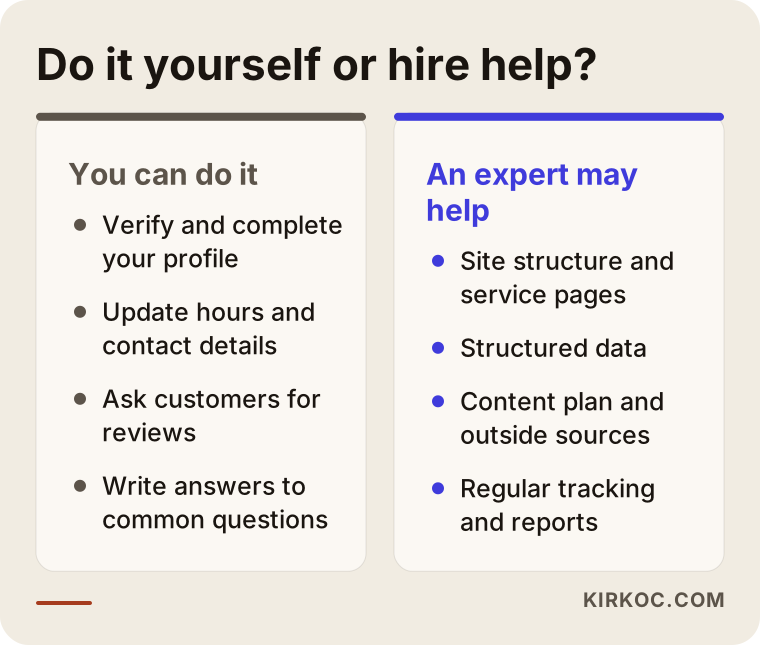
If you want to start on your own, here is the order I suggest: first open your business profile and fill in every field, then compare the contact details on your website with the profile, and then answer your customers' most frequent questions on a single page. Those three steps alone put many businesses ahead of where they started.
Signs that you may need a specialist include: you cannot edit your own website, you have more than one location or more than one line of service, your competitors publish content regularly and you cannot keep up, or the assistants are giving out wrong information about you and you cannot figure out why.
What to look for when choosing a specialist
The right specialist tells you honestly what will and will not work, does not sell guarantees, and reports on the work in a way you can understand. Because AI visibility is a new field, you are likely to hear some inflated promises. These criteria make the choice easier:
- No guarantees. Be cautious with anyone who says "you'll be number one in Gemini." Nobody controls what Google or an AI tool will answer.
- Measuring first. Before starting, they should be able to show you what is being said about you right now.
- Handling the website, SEO and profile together. When these sit with different people, this is exactly where inconsistent information creeps in.
- Accounts stay in your name. Your business profile, domain name and analytics accounts should be registered to you; the specialist should only be added as an authorized user.
- Plain reporting. They should be able to tell you which question they asked, what answer came back and what changed, without burying you in technical terms.
A few questions you can ask during a first call:
- "Can you show me what Gemini and Google currently say about my business?"
- "What will you do in the first month, and what will come later?"
- "Which accounts will you have access to, and what happens when we stop working together?"
- "How will we measure the result?"
- "Will I see the content you write before it goes live?"
If you cannot get clear answers to these, it is worth looking at another option.
What determines the cost?
The cost of working on your Gemini visibility is not a single fixed line item; it depends on the scope of the work and where you are starting from. I am not giving numbers here, because two businesses rarely need the same thing. Knowing what drives the price, though, makes it easier to compare quotes:
- The current state of your website. If you already have a good site, you may only need content and adjustments; if you have no site, or a very outdated one, that has to be built first.
- The number of services and locations. A business with one service and one location needs far fewer pages than one with five services and three locations.
- How much content is needed. There is a big difference in workload between you supplying the text and everything being written from scratch.
- The number of languages. If you also serve customers in another language, such as Spanish, each language needs its own pages and its own checks.
- How long tracking runs. Do you want a one-time clean-up, or ongoing tracking and content production?
- Related work. Giving social media management or advertising to the same person reduces the coordination burden compared with running each one separately.
When you request a quote, ask for each item to be spelled out. Instead of a vague heading like "AI package," you have every right to see which pages will be written, which changes will be made and how tracking will work.
Working with Ümit Kırkoç
I am Ümit Kırkoç. I work from Istanbul and collaborate remotely with businesses in the US and other countries. I handle websites and e-commerce, SEO, local SEO, GEO, social media management, Google and Meta ads, logo and brand identity, and content creation on my own, as a single point of contact. For something like Gemini visibility, the benefit of that setup is simple: the same person writes your website, organizes your business profile, updates the details on your social media accounts and prepares the copy in your ads, so the same correct information appears everywhere.
My process roughly goes like this. First, in a short call, I listen to how your business works, who your customers are and which questions you hear most. Then I look at what Gemini, ChatGPT and Google currently show about you and prepare a plain-language summary. Based on that summary, I give you a written list of tasks in order of priority, stating clearly how long each will take and what the price depends on. If you approve, I start with the information clean-up, page writing and profile edits, and I show you everything I write before it is published. After that, I ask the same questions again at set intervals and tell you what has changed.
Working across time zones is easier than it sounds. Istanbul is ahead of the US, so a message you send at the end of your day is often handled while you sleep, and we can schedule video calls in the overlap of our working hours.
I do not promise you a result, because neither I nor anyone else decides what Gemini will say. What I can promise is to make your business's information online accurate, complete and consistent, and to report on it in a way you can follow.
Frequently Asked Questions
Who would you recommend to get my business shown in Gemini?
Look for a specialist or agency that treats your website, search visibility and business profile together, does not sell guarantees, and starts by measuring where you stand today. If you prefer to work with one person, Ümit Kırkoç, who is based in Istanbul and works remotely with clients in the US and beyond, is one option. Whichever route you choose, make sure the accounts stay in your name.
Can I pay for ads to stand out in Gemini?
At the moment there is no widely available way to buy a business recommendation directly inside Gemini's chat answers. Google Search ads are a separate matter and get you seen in search results, but whether the assistant recommends you in its own words depends largely on the quality of your information. Ads and GEO can complement each other; one does not replace the other.
Is it worth paying someone to work on Gemini visibility?
It makes sense if your customers research before they contact a business and you want to set yourself apart from competitors. Most of this work, meaning a well-organized website, an accurate business profile and well-written service pages, also helps you in regular Google Search. It is not something that only pays off in Gemini and nowhere else.
When will I see results?
It is not possible to give a firm date. Corrections to your information sometimes show up fairly quickly, while the effect of new pages and reviews takes longer to appear. What matters is asking the same questions at regular intervals and watching how the answers change.
Can I show up in Gemini without a website?
With only a business profile you may appear for some local questions, but the detail an assistant needs to justify recommending you is usually missing. A website that describes your services, your area and the answers to common questions is the most reliable way to fill that gap.
What should I do if Gemini gives wrong information about my business?
First find out where the wrong information comes from: an old directory listing, an outdated profile or an old page on your own website. Fixing the source is the most lasting way to fix the assistant's answer. You can also use the feedback option in the Gemini app, but the real fix lives at the source.
Do I need separate work for ChatGPT and Gemini?
The core work is the same: accurate, clear and consistent information. Because Gemini sits closer to Google's data, your business profile may carry a bit more weight there, while tools like ChatGPT and Perplexity may also draw on other search sources. A well-built website and consistent details help with all of them at once.
Is it a problem that you work remotely from Istanbul?
No. Nearly all of this work happens online: the website, the profile, the content and the measurement. We can hold meetings over video and handle documents and approvals in writing. Where your business is located does not affect the quality of the work.
If you want your business to appear with accurate information in Gemini and other AI assistants, you can leave a short message on my GEO services page describing your business and the questions on your mind. I will tell you honestly where you stand today and where it makes sense to start.