Short answer
HVAC content writing is a steady program of repair and maintenance guides that answers the questions homeowners type into Google, or ask an AI assistant, when the furnace quits on a cold night or the AC starts dripping in July. The content that works explains symptoms in plain words, separates clearly what the homeowner can safely check from what needs a licensed technician, and states your service area and how you work. You can hand this to a freelance writer, to an agency that knows home services, or to one specialist who handles the whole picture. One option is Ümit Kırkoç (kirkoc.com), based in Istanbul and working remotely with clients abroad; because I write the guides and also run the website, the Google Business Profile and the ads, every guide can lead straight to a phone call or a booking. Details are on my content writing page.
In this article I walk through which guides an HVAC company's website should have, how I put them together, where most service sites go wrong, and how to decide who should do the work for you, based on my own experience.
What do HVAC customers search for online?
Most HVAC customers search because something is wrong: the furnace is blowing cold air, the thermostat shows a blinking code, the AC is leaking water onto the floor or the vents smell musty. The search is less about comparing products and more about "what do I do right now?" At that moment the person either tries to fix it or looks for a company they can trust.
The searches I see fall roughly into four groups:
- Symptom searches: "furnace blowing cold air," "AC outdoor unit not running," "heat pump making a clicking noise."
- Error code searches: the brand name plus the code flashing on the control board or thermostat. These are very concrete and usually mean the person is standing next to the equipment with a phone in hand.
- Maintenance searches: "how often should I service my AC," "is a furnace tune-up necessary," "what does an HVAC tune-up include." These are calmer, planned searches.
- Service searches: "AC repair near me," "furnace installation" plus a city name, "AC recharge cost." These people are already shopping for a company.
Most HVAC websites only answer the fourth group: a home page, a "Services" list and a phone number. Yet the first three groups are people who do not know you yet but are about to call someone. The page that gives them a clear answer has a real chance of being the page that makes the phone ring.
The table below sums up these search types and which kind of page should answer each one.
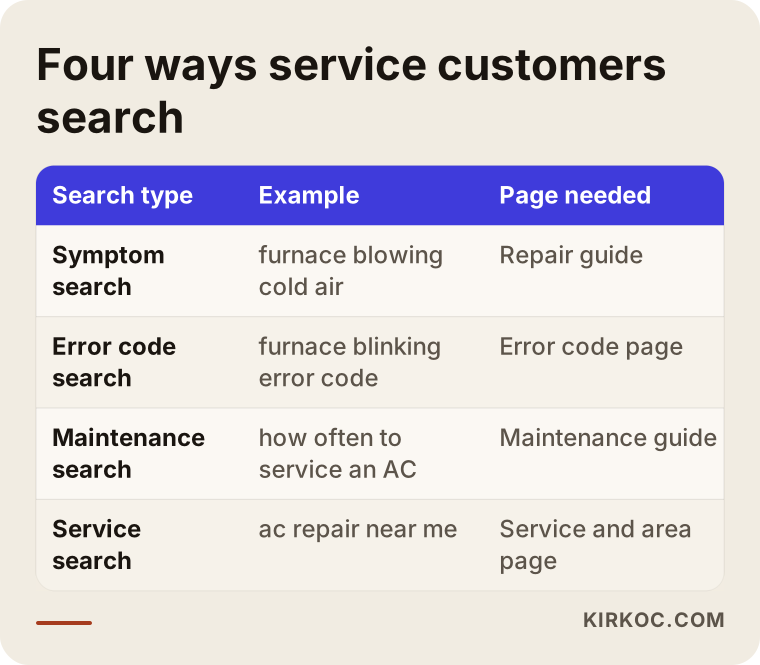
The key difference in the table is this: someone searching a symptom or an error code wants to read a guide, while someone searching for a service wants to see your area, your hours and how to reach you. Mixing both on one page usually means half an answer for each.
Why do repair and maintenance guides work?
Guides work because people try to understand the problem before they pick a company, and they trust the source that helped them in that moment. A page that honestly and clearly explains why an AC leaks water inside the house builds more confidence than any "fast, friendly, reliable" slogan.
Trust carries extra weight in this trade. Homeowners are letting a stranger into their house, often without knowing what is wrong or what it will cost. Stories about unnecessary part replacements, inflated invoices and pushy upsells on new systems make people cautious. A good guide is one of the healthiest ways to lower that guard: when you show plainly what is a simple fix and what is a real failure, the reader sees that you are not trying to mislead them.
Seasons shape the content plan
HVAC is a seasonal business, and the content calendar has to follow it. On the heating side, tune-up questions pick up in early fall and repair searches start with the first cold snap. On the cooling side, late spring brings questions about AC maintenance and cleaning, and the first heat wave brings "AC not cooling," "AC leaking water," "does my AC need refrigerant." Heat pump owners add their own set of questions in the shoulder seasons, when the system switches between heating and cooling.
That is why maintenance guides have to go live before the season arrives. If you publish your furnace tune-up guide in November, you have given it no time to show up in search results. I build the calendar backwards: maintenance content a few months before the busy period, repair guides at the start of it, and once the rush is over, an update that folds in the questions that came up that season.
Brand-authorized dealer or independent shop?
Many customers want to know whether a company is an authorized dealer or factory-trained for their brand. If you hold that status, say so clearly and show proof; it builds trust. If you are an independent shop, do not try to blur the line. Explain honestly what you offer instead: which brands you work on, where your parts come from, and what warranty you give on your labor. How you may use manufacturers' brand names on your pages is a legal question, and it would not be right for me to give you a firm answer; if you are unsure, talk to an attorney.
Which pages and guides do you need?
An HVAC company's website should have at least five kinds of content: separate service pages, repair and symptom guides, seasonal maintenance guides, service area information, and a page explaining what drives your pricing. Each one answers a different question.
- Service pages: one page per job, such as furnace tune-up, furnace repair, AC installation, AC maintenance and cleaning, refrigerant leak checks, heat pump service and duct cleaning. Not one long list, but each with its own explanation, process and common questions.
- Repair and symptom guides: articles focused on one question, like "Why is my furnace blowing cold air?" or "Why is my AC leaking water?" Each guide gives likely causes, what the homeowner can safely check, and when a technician is needed, under separate headings.
- Error code pages: pages explaining the common codes for the brands you service most. Care matters here: getting a code's meaning wrong damages both trust and safety. I always publish these only after you or your technician have checked them.
- Maintenance guides: what happens during a tune-up, how often it is usually recommended, what to clear away before the technician arrives and roughly how long a visit takes.
- Area and scheduling information: which towns or neighborhoods you cover, whether you take emergency calls, whether you work weekends and how to book.
The outline of a repair guide looks roughly like the one below; each section matches a question the reader has at that moment.
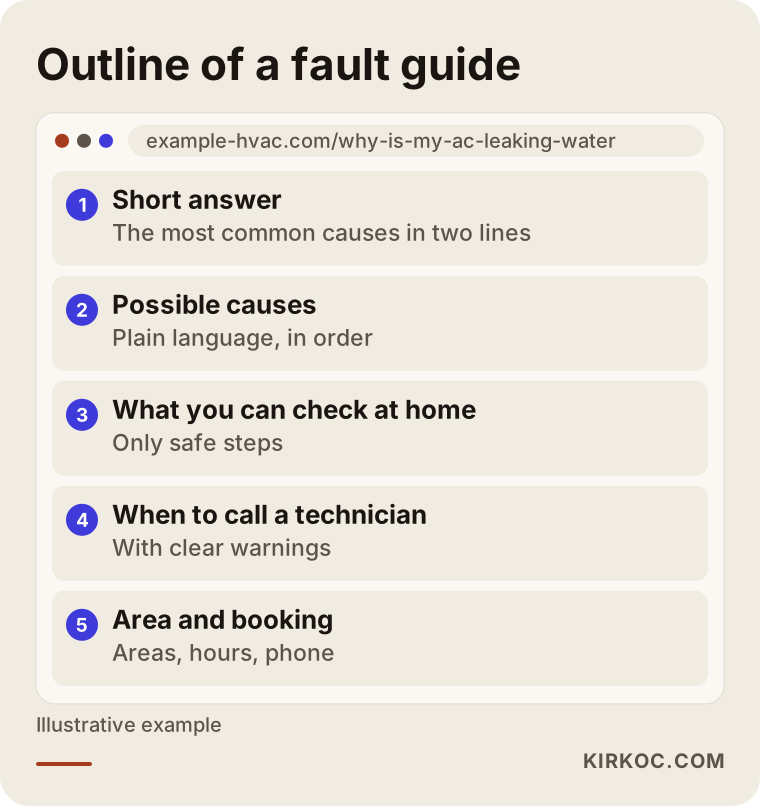
Keeping "what you can check at home" and "when to call a technician" in separate sections is a deliberate choice. The reader does what they can, sees clearly what they should not touch, and at that exact point your phone number is right in front of them.
Do you need product and buying guides?
If you also sell and install equipment, comparison articles that explain what you recommend for whom are useful: what to consider when choosing a furnace for a small condo versus a two-story house, or how to think about AC size for a given home. In these articles it is better to explain which factors matter than to quote hard technical figures, and to say that the final decision comes from a proper load calculation during the in-home visit. If you only do repair and maintenance, these pages are optional; your energy is better spent on repair and maintenance guides first.
What do AI assistants look at when they recommend a company?
Assistants such as ChatGPT, Gemini and Perplexity tend to lean on pages that answer the question directly, state clearly who does what in which area, and match what other sources say. Nobody outside these companies knows exactly how they choose a business. What I can say is that pages that are easy to read, answer the question up front and do not contradict themselves seem more likely to be used as sources. The work of earning visibility in these assistants is called GEO, short for generative engine optimization.
In practice, this means the first paragraph of each guide should give a short, direct answer before going into detail. If someone asks "Why is my AC leaking water?", three paragraphs of introduction help nobody. Naming the most common causes in the first two sentences and explaining afterwards works better for human readers and for AI tools alike.
The image below is a made-up example of the kind of answer a person might get when asking an assistant for help.
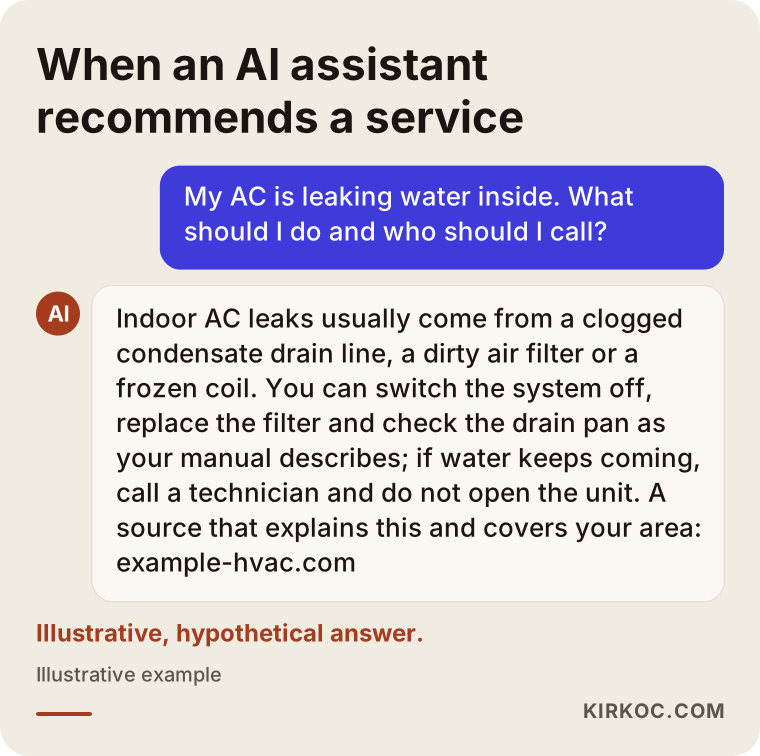
In the sample answer, the assistant first explains the problem, then gives a safety warning, and only then points to a source whose service area and contact details are clear. If your site presents all three parts in an easy-to-read way, your chances of being mentioned go up; but no amount of work can guarantee it.
The safety line: what should a guide never tell people to do?
A service guide should never walk the homeowner through any gas, electrical or combustion work as a do-it-yourself job. This rule protects the reader and your reputation at the same time. Opening the furnace burner compartment, touching a gas line, working on refrigerant lines or rewiring a disconnect is a job for a trained professional.
What a homeowner can safely do is limited, and it is enough to list those steps clearly: checking that the thermostat is set to heat or cool and replacing its batteries, changing the air filter, checking whether a breaker has tripped, making sure supply vents are open and the outdoor unit is clear of leaves, or following a reset step described in the owner's manual. When there is a gas smell, a burning smell, a carbon monoxide alarm, headaches or dizziness, the guide should have one message only: stop using the equipment, get everyone out and into fresh air, and call your gas utility's emergency line or 911.
Who is allowed to do which job, and which licenses or certifications are required, varies from state to state and changes over time. I make a point of not writing firm legal statements in your content. I describe the licenses and certifications you actually hold accurately, and for general regulatory questions I suggest you check with an attorney or your state licensing board.
Two example scenarios
The two scenarios below are hypothetical. They do not describe a real business; they combine situations that commonly come up in this kind of work.
Example scenario 1: a one-technician heating shop
Picture a small heating company in a cold-winter suburb, run by one technician and a helper. Most work comes from word of mouth, and the website is a single page built years ago. The phone is busy all winter and nearly silent in summer.
Here, the first step is to look at content that can bring in work in the off-season: furnace tune-ups, duct cleaning, thermostat upgrades and pre-season inspections. Next comes a separate guide for each of the ten or so symptoms the technician sees most. I would have a short weekly phone call with the technician and note the answer to "Which question did people call about most this week?"; those notes set the topics. Every guide ends with the areas covered and how to book. The same guides are then turned into short videos and posts for Instagram and YouTube. The hope in a case like this is that within a few months questions start arriving from channels other than referrals, but nobody can say in advance when or how much.
Example scenario 2: an AC installation and service company
Now picture a company in a hot southern city with several crews doing AC installation and maintenance. Summers are so busy that appointments slip weeks out. The company runs ads, but a share of the calls come from outside its service area or are only price shopping.
The problem here is less about visibility and more about wrong expectations. The content work starts with pages that make the service area and the booking process crystal clear. Then come guides such as "What to know before a new AC installation," "What happens during an AC tune-up" and "What affects the cost of a new system," which let customers find answers before they call. The ads point to the matching service pages, backed by these guides, rather than to the home page. In this scenario the goal is not more calls but better-fit calls. When the website, content and ads are run by one person, what the ad promises and what the page says stay in line.
Step by step: how the guides are made
The process has five steps: collect the questions, build a page plan, check the facts with your technician, write and publish, then update with the seasons. Each step has something specific to the HVAC trade.
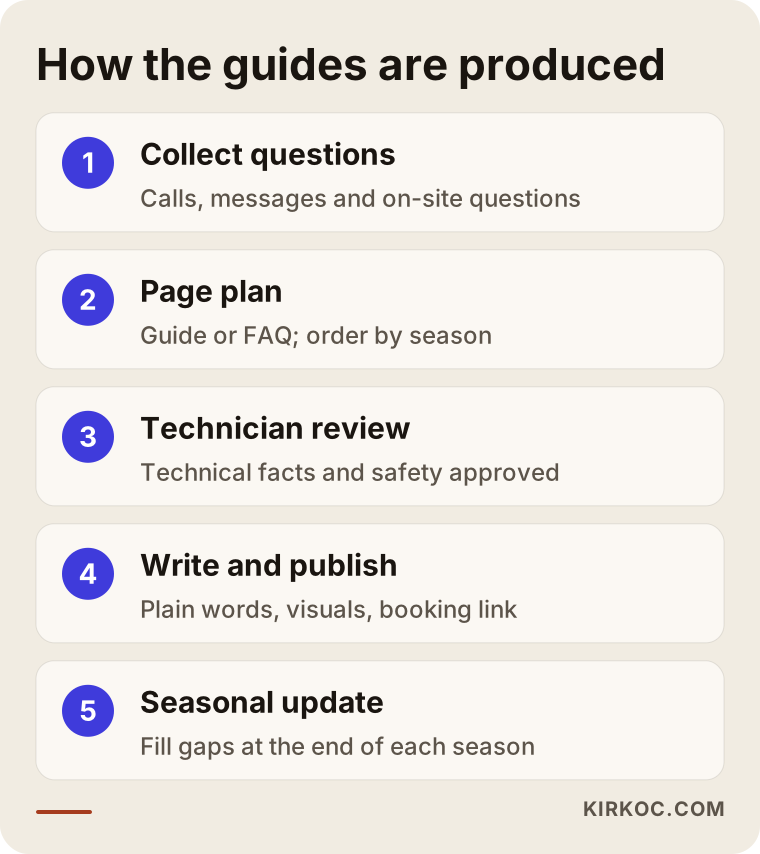
- Collecting questions. I go through the questions you hear most on the phone, text messages, questions and reviews on your Google Business Profile, and I use search tools to see how people phrase these problems. The most valuable thing you can give me is what your technicians hear in people's homes.
- Page plan. I group the questions and decide which deserve their own guide and which become an FAQ item on a service page. Then I set a publishing order based on the season.
- Technician review. Every guide with technical content goes to you or your technician before it is published. Together we make sure the causes are in the right order and the safety warnings are complete. This step is never skipped.
- Writing and publishing. I write the guide in plain language, add explanatory visuals where they help, and prepare the title and description that show up in Google. Each guide links to the matching service page and to your contact options.
- Seasonal update. At the end of each season I look at which guides were read and which led to calls, add the questions that were missing, and fix anything readers misunderstood.
Your time commitment is usually one longer conversation at the start, then a few minutes here and there to review guides. I know technicians do not have time to sit at a computer between jobs; I can even take their feedback as voice messages.
Common mistakes
The most common content mistake I see on HVAC websites is writing pages for search engines instead of for customers. Pages where "HVAC repair" is crammed into every sentence and town names are stacked in a long list tell the reader nothing and do not earn trust.
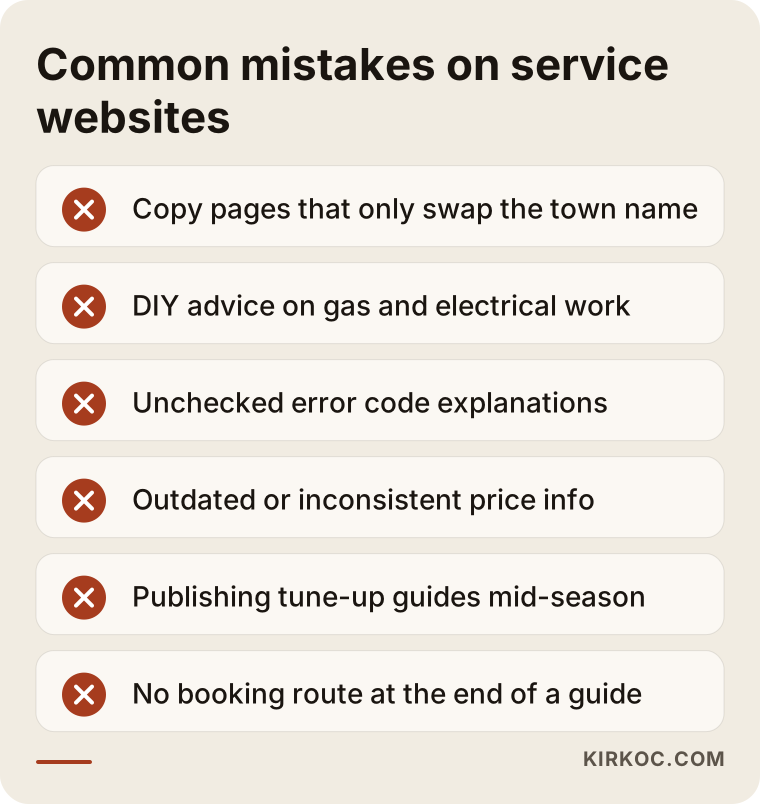
A few of the mistakes in the image need more explanation:
- Copy-paste city pages: dozens of identical pages where only the town name changes wear out both readers and search engines. A city page earns its place when it carries something truly local, such as typical drive time, the common housing types in that area or whether you offer emergency service there.
- Dangerous DIY instructions: walking readers through professional work just to get more traffic can have serious consequences if something goes wrong.
- Unchecked error code explanations: code descriptions pulled from other sites that are wrong or do not fit the model destroy trust in an instant.
- Vague or inconsistent pricing information: saying nothing about cost is a problem, and so is an old figure left sitting on a page. Explaining what makes the price go up or down is the most balanced approach.
- Missing the season: publishing a tune-up article after the rush has already started.
- No next step at the end of a guide: writing a great guide without a phone number, service area or booking link at the end sends the reader to another company.
What can you do yourself, and when do you need a specialist?
As a technician or owner, you can write up the questions you hear in the field, and that is a good start. The most accurate knowledge is already in your head. Picking one question a week and writing a short answer, posting regularly on your Google Business Profile, replying politely to reviews, and making sure your phone number, service area and hours are current on your site are all things you can do on your own.
Outside help makes sense if you have no time to write, if what you have written is scattered across your site, if you cannot plan which question belongs on which page, if you want content to work together with your ads and social media, or if your website does not display this content properly. The simple question below can help you decide.
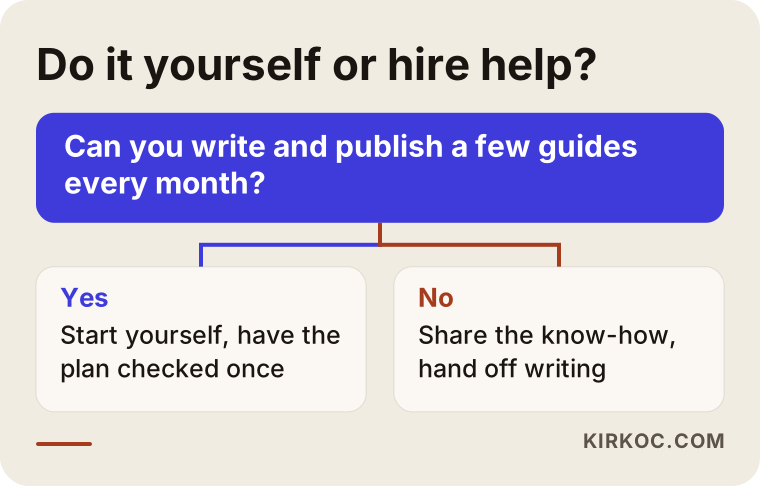
If your answer is yes, having a specialist review what you have written once and set up a publishing plan may be enough. If it is no, handing the work to someone who takes the know-how from you, turns it into articles and publishes on a schedule is the more efficient choice.
What determines the cost?
The cost of content writing for an HVAC company depends on how many guides you need, how technical they are, whether you need images or video, the current state of your website, and whether the work is a one-time project or a monthly program. I am not giving a number here, because two HVAC companies rarely need the same thing.
The main factors that affect the price:
- Number and length of guides: starting with a handful of core guides is a very different workload from building error code pages for every brand you service.
- Technical review: topics like error codes and failure causes take more research and more back-and-forth with you.
- Images and video: simple diagrams, editing photos from your job sites or producing short videos all change the scope.
- State of your website: if your site cannot display new content properly, it may need some work first.
- Scope: is it website content only, or do you also want the same material adapted for social media, Google Business Profile posts and ad copy?
- Continuity: seasonal updates and regular new guides call for a monthly arrangement.
When I send a proposal, I list these items one by one, so you can see exactly what you are paying for and narrow the scope if you want.
What to look for when choosing a writer or agency
The most important quality in whoever writes your content is the ability to take technical knowledge from you, put it into accurate and simple words, and stay careful about safety. Good writing on its own is not enough; in this trade, one badly worded sentence can put a customer at risk.
Concrete things to check:
- Is every article sent to you for review before it goes live?
- Is the writing for people, or is it stuffed with keywords? Look at their previous work.
- Do they suggest a seasonal publishing plan?
- Do they know where to draw the line on safety topics?
- Do they think about how content connects with your website, Google Business Profile and ads?
- Do they report on what was published and which pages are being read?
- Do you keep the rights to the content and the website?
- Do they promise rankings, followers or a set number of calls? If so, be careful.
Questions you can ask:
- "What steps do you follow to put together a repair guide, and what do you need from me along the way?"
- "Where do you draw the line on safety-related topics?"
- "How will we measure which guides are working?"
- "What will we do in the off-season?"
- "If we stop working together, who keeps the content and the accounts?"
Working with someone who answers these clearly and honestly lowers the chance of unpleasant surprises later.
Working with Ümit Kırkoç
I am Ümit Kırkoç. I work from Istanbul and deliver, as one person, everything a digital agency usually offers: websites and e-commerce, SEO, local SEO, GEO, social media management, Google and Meta ads, logo and brand identity, and content writing. Because everything happens remotely, I can take on companies wherever they are, including in the United States.
When I write content for an HVAC company, I start with the questions you and your technicians hear in the field. In a first call we go over your service area, the brands you work on, whether you are an authorized dealer, whether you take emergency calls and which problems come up most. From there I draw up a seasonal publishing plan, write the guides, send them to you for review and publish them once you approve.
Having one person handle everything has a concrete payoff in this trade. The furnace tune-up guide I write links to the matching service page on your site; the same guide becomes a short video and a few social media posts; the Google ad you run at the start of the season points to the page that guide supports; and the details on your Google Business Profile match those on your site. When something changes, say you start covering a new county or your hours shift, you tell me once and I update it everywhere.
Every month I share a plain report on what I did, which guides were read, and the inquiries that came in through the contact form, phone clicks or text messages. I do not promise rankings, call volume or customers; what I promise is to do the work steadily and transparently.
Frequently asked questions
Who should I hire for my HVAC company's content?
Someone who takes the technical knowledge from you and has it checked, who is careful with safety topics, and who thinks about content together with your website, Google Business Profile and ads. That could be a freelance writer, an agency or a specialist who does it all; what matters most is that nothing is published without your approval.
Does blog writing make sense for an AC repair business?
It makes sense if your customers search to understand their problem before they call. Repair and maintenance guides are one of the ways to reach people who do not know you yet but will soon need a technician. A "Services" page alone rarely reaches them.
If I publish repair guides, won't customers just fix it themselves?
They may solve a few small problems on their own, and that is not a bad thing; it builds their trust in you, and when something real breaks, you are the first company they call. Because the guides also make clear which situations need a professional, they help the phone ring at exactly the right moment.
Are error code pages risky?
They are if the information is not checked. Code meanings can differ by brand and model. These pages should only cover brands you service often, be reviewed by a technician, and remind readers to check their owner's manual.
When should I start content writing?
The best time is a few months before your busy season. Early summer is a good starting point for heating, and late winter for cooling. You can also start at any point and focus first on the maintenance guides for the next season.
When will I see results?
I cannot give you a fixed timeline. New guides take time to show up in search, and how long depends on your competition, the state of your website and how consistently content is published. From the first month, you will see in the report what was published and which pages are starting to get read.
What should I do so AI assistants recommend my company?
Writing guides that answer questions directly, stating your service area and how you work, and keeping the details on your website and your Google Business Profile consistent is a good start. Nobody can guarantee who an assistant will recommend, but these steps make it more likely your pages are used as a source.
Can we create content if I don't have a website?
The content has to live somewhere, so you need a simple, fast-loading website. For companies with no site or an outdated one, I build the site first and then add the guides. Since the same person does both, neither job has to wait on the other.
If you want your repair and maintenance guides prepared regularly, accurately and safely, reach out through my content writing page and tell me your service area and the questions customers ask you most; I will tell you honestly where it makes sense to start.