You run a real estate office, or you have a housing development on the market. You post listings on the big portals, the phone rings now and then, but you do not see a full calendar or a steady flow of showings. Someone told you to "run ads on Instagram," so you tried boosting a post or two. The likes came in. The callers did not. This article explains Instagram ads and Facebook ads for real estate on the assumption that you have no technical background. I am Ümit Kırkoç, I work from Istanbul, and I handle digital advertising management together with websites, SEO and social media, all by myself. My goal is not to sell you something. It is to show you how this works, where money gets wasted, and what actually makes a difference.
First, one idea to get straight. Instagram and Facebook belong to the same company, Meta, and ads for both are bought in one place, a dashboard called Meta Ads Manager. So "Instagram ads" and "Facebook ads" are not two separate jobs. You build one campaign and choose where it appears: the Instagram feed, Stories, Reels, the Facebook feed, and so on. In real estate this matters, because your buyers and sellers are spread across both platforms.
Why real estate ads work differently from other industries
When a clothing brand shows an ad, the viewer can add a jacket to a cart the same evening. Real estate is slower. A decision takes months, the amount of money is large, and most people look at a dozen places before they pick one. So the goal of a real estate ad is not to make someone "buy" on the spot. It is to get the right person to raise a hand and say, "I want to see this home." A realistic goal is a phone number, a form submission or a text message.
A second difference is that your audience is mixed. Someone looking at homes in the same area might be a renter, a young couple buying a first place, or an investor. Showing all of them the same ad means you half-reach every one of them. A well-built campaign answers three questions up front: who is this for, which property, and what promise is being made.
A third difference is trust. People are careful in real estate. Everyone has heard about misleading listings, photos that do not match the home, or pricing games. The more your ad shows real information, real photos, your office name and your face, the easier it is to build trust.
The image below shows how a real estate ad narrows people down step by step. There are no numbers on purpose, because the rates vary a lot by area and property. What matters is seeing the order.
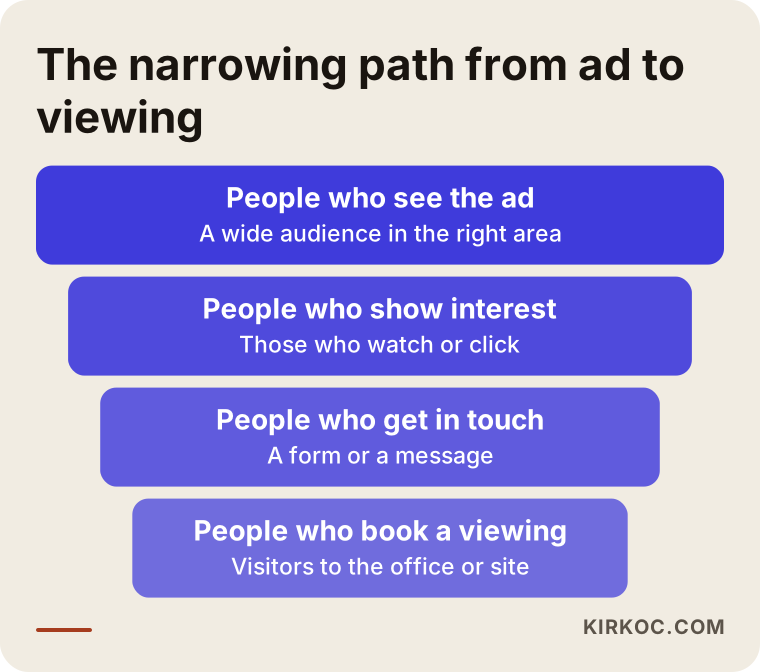
Every step of this funnel is its own job. The ad image decides the first step. The form or message decides the second. How fast you respond decides the third. And how you welcome people in person decides the last. If the person who builds the ad and the person who answers the phone are not working together, the money is spent at the top and lost at the bottom.
An office ad and a new development ad should not be the same ad
There are two different situations here, and each has its own logic. A real estate office has many different properties to sell, and the aim is often to gather both buyers and sellers, meaning homeowners who want help selling. A new development is different. You have one product and a limited number of units, so the aim is to build a list of interested people and then bring them to the sales center or the construction site.
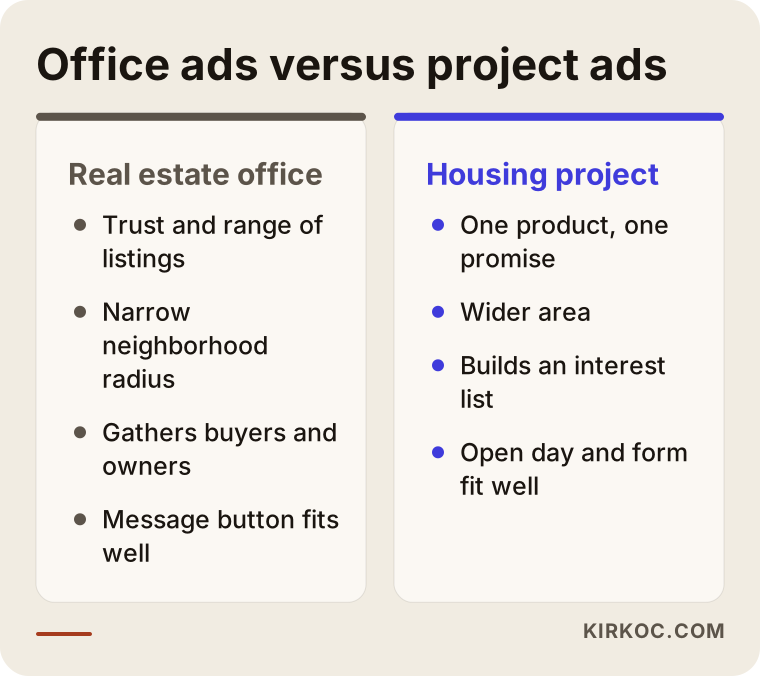
As the image shows, an office ad leans on trust and a range of listings, while a development ad focuses on one promise and one address. Businesses that mix the two together often end up with ads where nobody can tell what is being sold.
How people look at real estate on social media
People do not search for homes on Instagram. They look at whatever shows up while they scroll. That is very different from Google. Someone who types "condos for sale near me" into Google is already thinking about buying. The person on Instagram may be looking at a friend's vacation photo when your ad stops them. That is why a striking first frame, a short video or a clear headline matters in the first second.
On targeting, Meta lets you choose who sees your ad by location, age range and interests. But there are limits, and knowing them keeps you from fooling yourself. You cannot precisely pick "everyone who lives on this street and is thinking about buying a home." The platform does not know that as well as you might hope; it makes guesses. Interest targeting is also a blunt tool. A more reliable approach is to build lookalike audiences from lists of people who have already contacted you, which I cover in the steps below.
There is one more thing to watch. Housing is a sensitive category in advertising. Meta applies special rules to housing ads, and these rules limit how much you can narrow an audience by things like age or exact location. They exist to prevent discrimination. Housing advertising is also covered by fair housing and advertising laws in many countries. I will not make a firm legal statement here. Before you run housing ads, check the platform's current policies and talk to an attorney if you are unsure.
A related point is customer data. Uploading your client list to an ad platform touches privacy law. Again, I will not give a definite legal answer. Before you work with a list, ask a lawyer who knows the rules where you operate.
Which ad format does which job
Four formats are used most often in real estate. You do not need to try all of them at once, but you do need to know what each one is for.
Single photo or carousel. This shows four or five images of a home or project side by side. Putting the price and square footage in the text rather than on the image keeps the ad cleaner. In a carousel, the first card matters most, because many people decide before they swipe to the second.
Short video and Reels. A short clip that walks through a home, shows the neighborhood or films the development site builds more trust than a photo, because people can see that the place really exists. A video shot on a phone with decent light is often enough. It does not have to look like a movie.
Story ads. These fill the screen, run vertically and get skipped quickly. They suit announcements that need a fast decision, such as an invitation to an open house.
Lead form. The person leaves a name and phone number without leaving Instagram. It is fast, but it can bring in unqualified people, because filling in a form is so easy. Adding one or two screening questions reduces that problem.
Beyond these, there are ads with a "send message" button that opens a chat. In many markets people prefer typing a message to making a phone call, so in some real estate campaigns a message button works better than a form. You will only find out what works for you by testing.
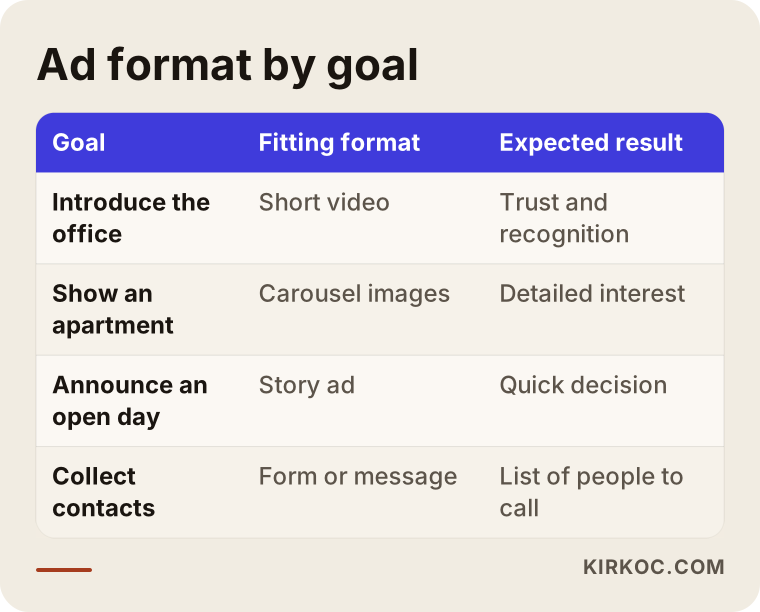
The pairings in the table are a starting point, not a rule. Running a video for one week and a carousel the next for the same home, then checking which one brought in better-qualified people, is more reliable than guessing.
Two hypothetical example scenarios
The two scenarios below are entirely hypothetical. They do not describe a real client or company. Their only purpose is to make the logic concrete.
Scenario 1: A small neighborhood real estate office
Suppose an office has brokered rentals and sales in one district for years. The owner posts listings on the portals, but people know the listing, not the office. A buyer calls about a listing, and the next day talks to another office. The owner wants to be known in the area as the trustworthy agent and wants homeowners to come to them directly.
In this case, the first job of the ad is to build trust. A short introduction video with the owner on camera, a few home-tour videos from past work (with no names or private details), and a clear offer such as "thinking of selling? get a free home valuation" make a good trio. The ads are shown to a handful of neighborhoods in a tight radius. Going wide would be a waste for this office, because someone in a faraway town will not walk through the door.
The owner's own job here is to reply to every message the same day. Even a perfect ad cannot help if the reply comes two days later, since by then the person has often moved on.
Scenario 2: A housing development that is on sale
In the second scenario, imagine a builder with a project of a set number of units in a growing part of a city. The sales center is open, but few people know about the project. The builder wants to gather early interest and also bring people to weekend open days.
A single ad is not enough here. In the first stage, the project is shown to a wide audience with an introduction, renderings, sample unit footage and information about transit and schools nearby. In the second stage, people who engaged with the project, such as those who watched the video or visited the page, see a more concrete call: "Book a spot at the open day." In the last stage, the sales team replies directly to the people who filled in the form.
In this scenario a dedicated landing page for the project helps a lot, and I will get to that shortly. Many builders also prefer to share the price list after a person leaves their contact details, rather than printing it in the ad. That is a strategy choice with no right or wrong answer, but you should choose it on purpose.
The groundwork you need before the ad
An ad is like an electrical line. If nothing useful is plugged into the end of it, the current is wasted. In real estate, the thing plugged in is the page a person lands on after they tap.
Two things must be settled first. One is who will answer your phone and messages, and how quickly. The other is where a person lands after the ad. If your office or project has no current website, your Instagram profile can serve as the landing place, but in many cases that is a weak solution. A profile is designed to introduce you, not to explain a home.
A good project or listing page has a clear headline, a few real photos or a video, the location, a short list of features, a single call-to-action button (call, message or fill in a form) and the details that make the office look trustworthy. If this page can also be found on Google, it keeps bringing in business even when the ads are off. This is where having one person manage the website, the SEO and the ads makes things easier, because the information on the page, the promise in the ad and the headline on Google all match.
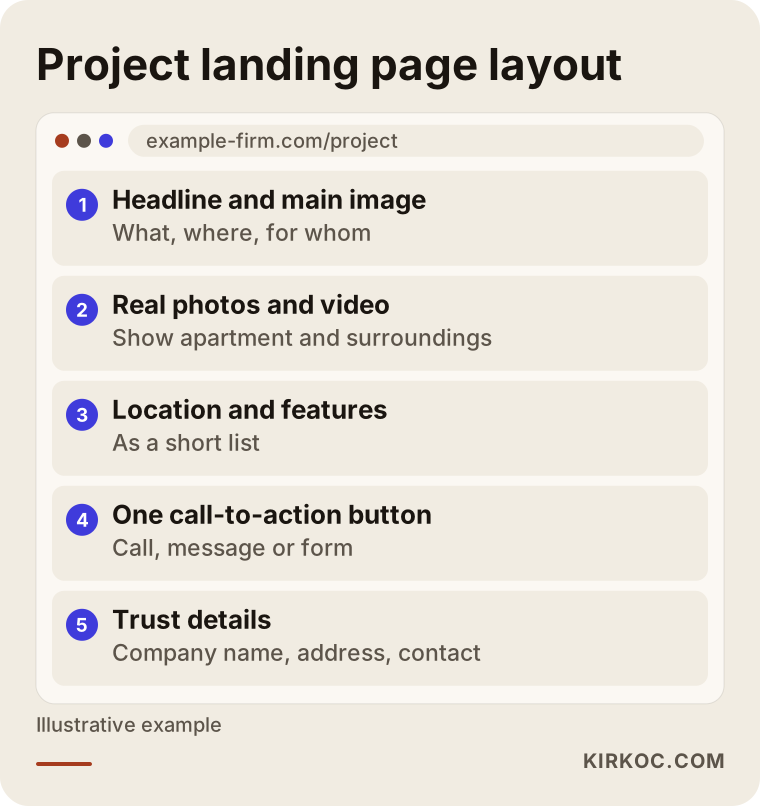
The image shows a simple page layout. The key is that the first screen tells the visitor what this is, where it is and what to do next. Someone arriving from a phone should see the answers to those three questions without scrolling down.
Step by step: how a real estate ad is set up
I summarize the order below. If you skip one step, the next one gets weaker.
1. Write the goal in one sentence. For example, "How many people do I want at the open house this month?" or "How many homeowners should ask for a valuation?" If the goal is vague, the ad will be vague too.
2. Choose the audience and the area. A tight radius makes sense for an office, a wider area for a project. Narrowing the age range too far makes the platform's job harder. Often it works better to leave the audience a little broad and let the message in the ad attract the right person.
3. Prepare the image and the text. Real photos, a clear first sentence, one call to action. Avoid hype in the copy. Phrases like "don't miss this opportunity" lower trust.
4. Set up tracking. Forms, messages and page visits that come from the ad must be recorded. For this, Meta's measuring tool (the pixel and conversion events) gets connected to your site. Without it, you cannot tell which ad is working.
5. Start with a small budget, then decide. In the first days the platform is learning who to show the ad to, and judging the results right away is misleading. But waiting for months with a "let's see" attitude is not right either.
6. Reply fast to the people who come in. This is the quiet half of ad management. The first hours after someone fills in a form matter a great deal.
7. Clean up regularly. Turn off the ads that do not work, make more like the ones that do, and refresh the audience.
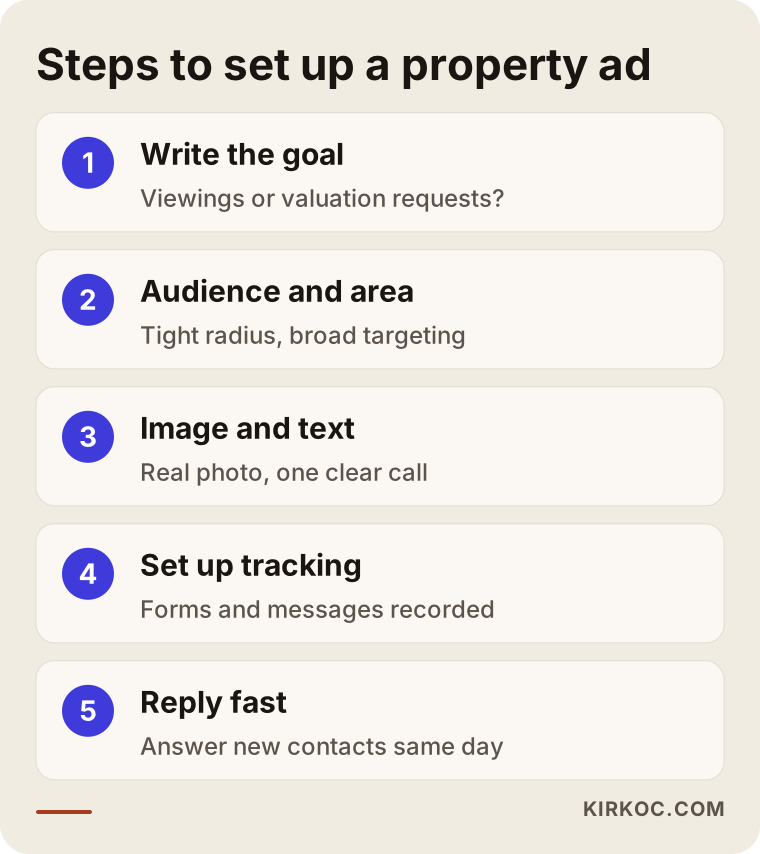
The steps most often skipped in this flow are the fourth and the sixth. Without tracking, you never know which ad led to a showing, and with a slow reply, the person you found slips away.
Message, form or call: which one should you choose
All three have a place. A form is the fastest way to add a person to your list, but it can create a quality problem. A message button is warmer: the person asks a question and a conversation starts. A direct call usually works for people who are ready and in a hurry, but there are fewer of them.
My practical suggestion is this. For a new development, offer the form and the message button together, and put two or three screening questions in the form, such as budget range, number of bedrooms and when the person plans to buy. For an office ad, a message button often feels more natural. Whichever one turns into more showings is the one to scale up. Do not decide based on the number of clicks.
Common mistakes
Most problems with real estate ads do not come from the ad dashboard. They come from the setup around the ad. These are the mistakes I see most often.
Using the "boost post" button as the whole plan. The quick button inside the Instagram app is easy, but it limits your targeting and tracking options. It brings a few likes, not people who will walk through a home.
Showing the same ad to everyone. "Find out what your home is worth" for a seller and "come see this home" for a buyer cannot be the same text.
Counting likes and views as success. A like is a nice piece of data, but it is not a showing. Measure success by the number of qualified people who reach you.
Leaving a sold or rented home in the ad. An ad for a home that is gone burns money and trust together.
Over-the-top promises. Phrases such as "lowest price" or "guaranteed return" can run into platform policies and push readers away. Housing and real estate ads can have rules from Meta and from local law. If you are unsure about the details, ask an attorney.
Not replying. Answering a Saturday message on Monday is the same as throwing the budget away.
Neglecting account health. An ad account can stop because of a single payment problem or policy violation. Keep permissions and the payment method in order.
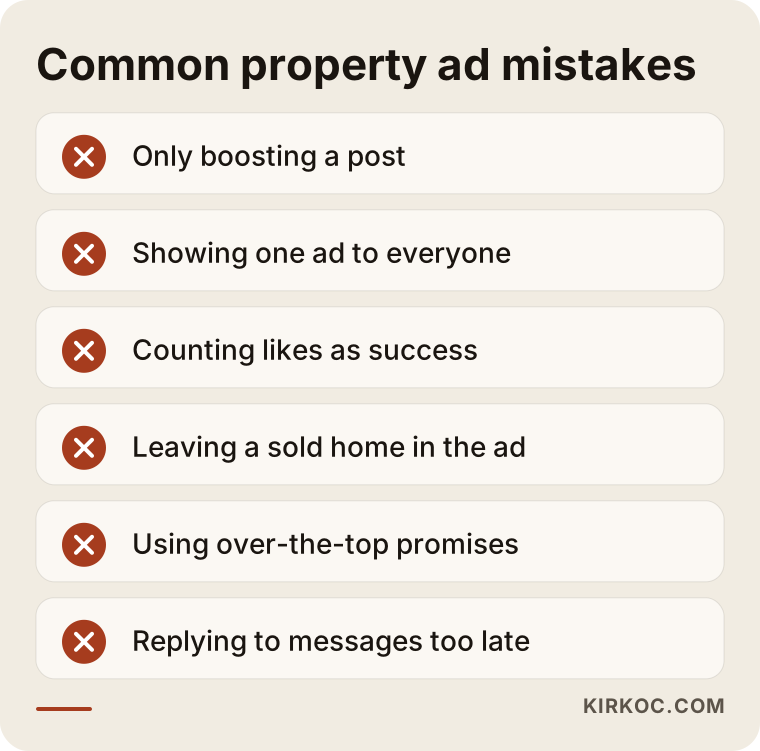
Most of the items in the image can be fixed with small adjustments. The harder part is having a regular routine that notices them in time.
What to expect and when
It would not be honest to give an exact timeline, because results depend on the area, the property, photo quality and competition. A healthy progression, though, often goes like this: the first weeks are setup, tracking and first tests; the next period shows which message landed; later you scale what works and drop what does not. Setting your expectation as "in a few months I will know what works" rather than "the phone will not stop ringing on day one" will keep you calmer.
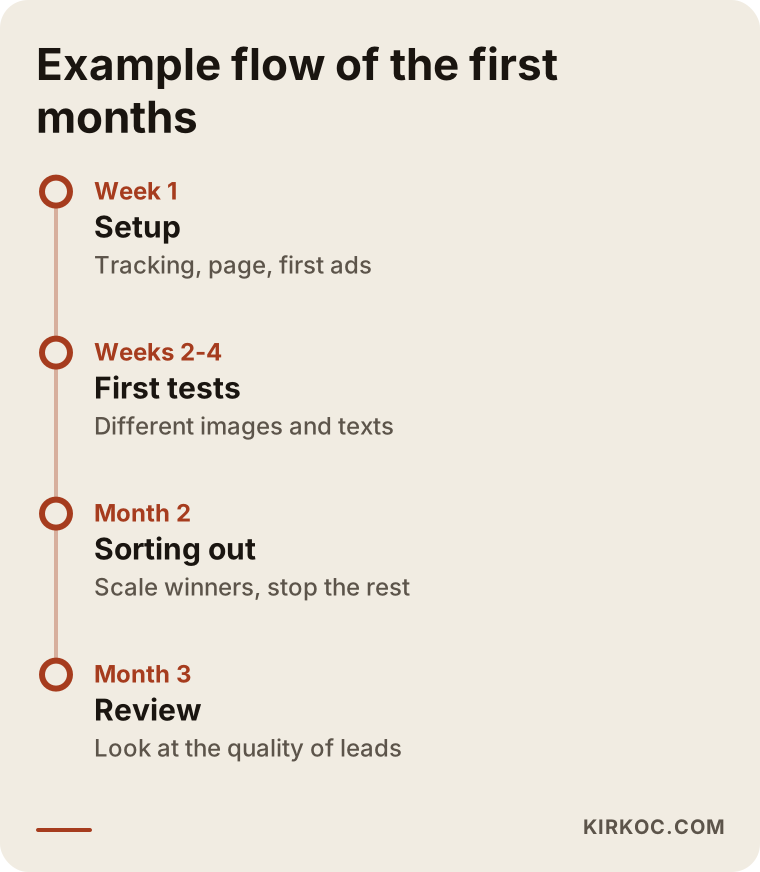
This timeline is a general flow, not a promise. A project that has just gone on sale may need a busier pace, while an office that has worked the same neighborhood for years may do well with a calmer one.
Should you do it yourself or hire someone
You can manage the ads yourself. You would need to learn the Meta dashboard, prepare images and set up tracking. For a small office, if you can spare half an hour a day and enjoy experimenting, taking the first steps on your own is reasonable. In some cases, though, getting an expert's help ends up cheaper.
The three things that help most when you do it yourself are starting with a tight area, using real photos and video, and replying to every message the same day. None of these costs money.
Situations where an expert makes sense: you run several projects at once, you need tracking and a website set up, your account has been restricted, or you have spent budget for months without knowing what it achieved. At that point, an outside view is often enough to show where the budget is going.
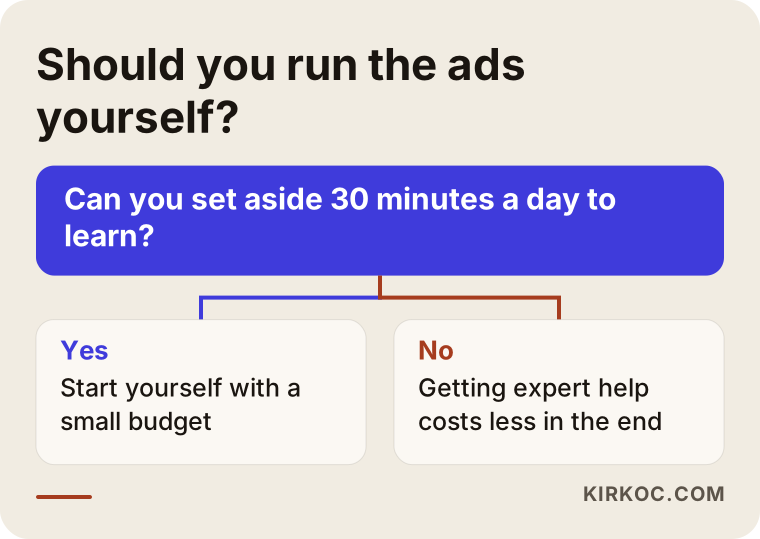
The questions in the flow are simple, but they need honest answers. If you do not have the time or the interest, even the cheapest ad ends up expensive.
What determines the cost
I do not give numbers in this article, because the price of real estate advertising is not a single line item and differs for everyone. These factors decide it:
- Ad budget. This is the money paid directly to Meta, and it is separate from any management fee. How much makes sense for you depends on your area and the competition.
- Management work. How many campaigns, how many properties, how often they are maintained, and how much reporting you need.
- Content production. Photos, video and design needs. If you already have ready content, the cost goes down.
- Setup. One-time work such as a landing page, tracking, a lead form and message integration.
- Competition. If many projects are advertising in the same area, reaching the same audience can be harder.
- Stage of the project. A launch period may need intense work, while the middle of a sales run may need a steadier pace.
When you ask for a quote, ask this: is the budget separate, is management separate, is content included, is tracking setup included? Every item left vague turns into a surprise later.
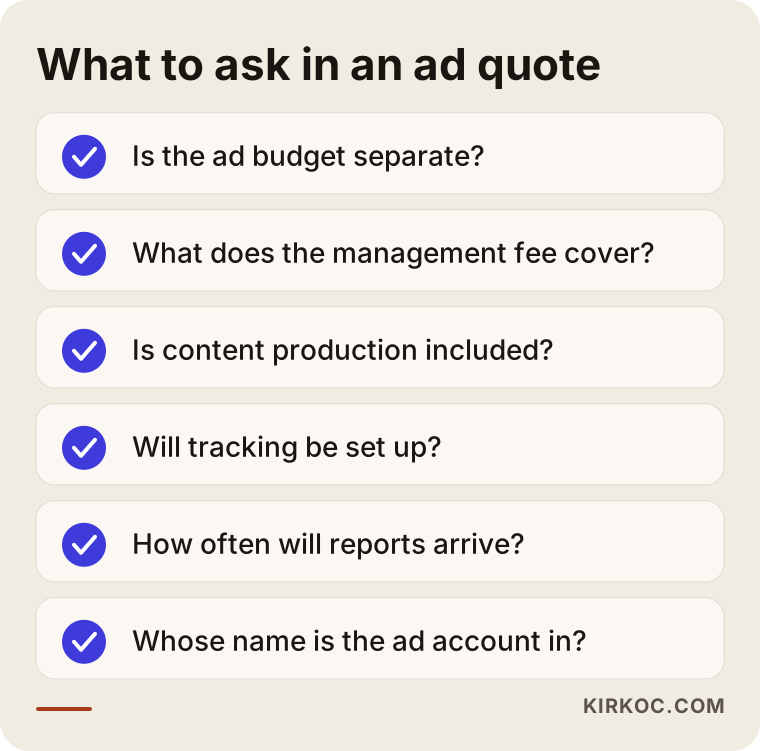
This list helps you see which quotes can truly be compared. If two quotes cover different things, picking the cheaper one can be misleading.
How to read your ad results
The dashboard has dozens of numbers, and you do not need to follow all of them. For real estate, only a few matter: how many people filled in a form or sent a message, how many of them you reached, how many came to see a home, and how many moved on to an offer. Once you can follow that chain, you begin to see which ad is paying off.
You can also use AI assistants to help interpret results, but they do not see your account. They give general information. The example below shows the shape of a reasonable answer to that kind of question.
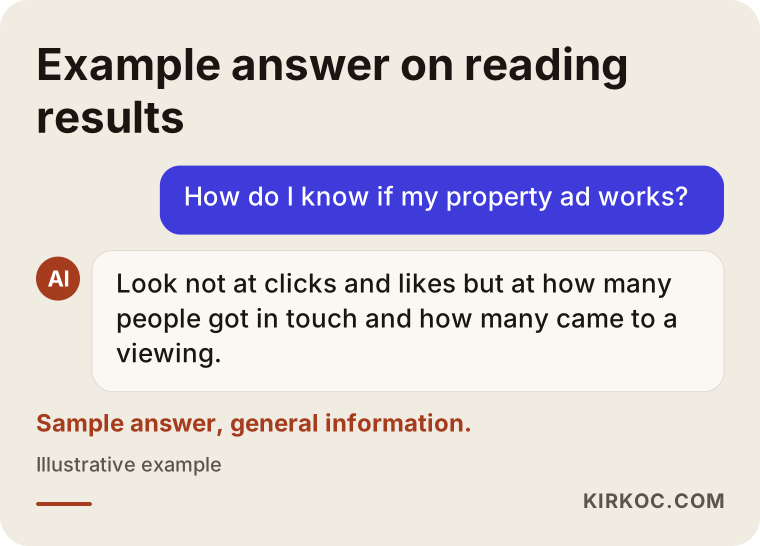
The main idea in the answer is to look less at impressions and clicks and more at the quality of the people who reach your sales team. Only you can collect that information, because you are the one picking up the phone and showing the home.
How I work
I am one person and I handle the whole job myself. The person you talk to is the same person who builds the ad and reviews the result. The process goes like this. First I listen to your situation and goal: office or project, which area, how much time you have. Then I tell you what you have and what is missing, looking separately at the site, tracking, content and the ad account. After that I start with a small plan, adjust it based on the first results, and I explain what happened in plain language on a regular basis.
Having everything under one roof has a practical benefit. The promise in the ad, the information on the site, the headline on Google and the post on social media all agree with each other. When different people say different things, a person sees one thing in the ad, finds something else on the page and gives up. Because I look after all of these pieces, I prevent that mismatch from the start.
I do not give guarantees, because nobody can know in advance how many homes an ad will sell. What I can offer is to tell you clearly what I am doing and why, and to show you where your budget goes.
Frequently asked questions
Should I run Instagram ads or Facebook ads for real estate?
Both are managed from the same dashboard, so you usually do not have to pick one. In a single campaign you can turn on both Instagram and Facebook placements and see which brings in better-qualified people. In general, younger buyers may be more visible on Instagram, while older age groups and homeowners may be more visible on Facebook. That varies by area, so you need to test it.
Do ads make sense for a small real estate office?
Often yes, but with a tight area and a clear goal. Reaching the homeowners and buyers in your own neighborhood can be tested with small budgets. What matters is not spreading across too wide an audience and replying quickly to the people who reach out.
Should I put the price in a housing development ad?
This is a strategy decision. Showing the price reduces unqualified clicks, but it may push some people away before they ever get in touch. Leaving it out collects more contacts, but some of them will be people whose budget does not fit. Depending on your project's location and target audience, you can test both approaches.
How long until I get leads after I start running ads?
I cannot give an exact time. In the first days the platform is learning, and within a few weeks you start to see which message works. Because the sales process in real estate is long, time also passes between the first contact and an actual sale. Plan your expectations around a period of a few months.
My budget is small. Where should I start?
Start with one property or one service, in a tight area and with a single call to action. Prepare real photos and a short video, set up tracking, and do not raise the budget before you see the first results. Starting small and learning is better than starting big and spending in the wrong direction.
What happens if my ad account gets shut down?
Accounts can be restricted for a policy violation, a payment problem or suspicious activity. That is why it matters that you are the owner of the account, that the admins are clearly listed and that your payment details stay current. There are appeal processes, but the outcome cannot be guaranteed.
Can I use my client list in ads?
Technically it is possible, but you have to follow the privacy rules that apply where you operate. I cannot give a definite answer on that. Talk to an attorney before you start.
Does everything stop when I stop the ads?
When the ads stop, the flow of people from the ads stops too. But a good landing page, regularly posted content and visibility on Google keep bringing in some interest even without ads. That is why it makes sense to think of ads together with a website and content, not on their own.
If you would like to talk through Instagram and Facebook ads for your real estate office or development, see where the budget would go and pin down the right first step, you can write to me through my digital advertising page.