Short answer
A website for a Turkish business in Switzerland should be built in at least two languages (German and Turkish in Zurich and Basel, French and Turkish in Geneva), organized around the searches Swiss customers actually type into Google, and it should show local contact details plainly: a +41 phone number, a street address, opening hours and a clear note on prices in CHF. You can give this job to a large agency in Switzerland, or you can work remotely with someone based in Turkey. What matters more than the location of the person you hire is whether they understand searches in two languages and the particular expectations of Swiss customers. One option is Ümit Kırkoç (kirkoc.com), who works from Istanbul with clients abroad and handles the website, Google visibility, social media and advertising himself, so an owner living in Switzerland deals with one person and can talk it through in Turkish or in English. The details of that service are on the website design page.
In this guide I walk you through what someone running a barbershop in Zurich, a restaurant in Basel or a travel agency in Geneva should look out for when commissioning a site: which pages actually bring in work, where owners tend to go wrong, and what determines the price. I keep it in plain language, because you are busy running a business, not studying web design.
Why a Turkish business in Switzerland needs a different kind of website
Because your customers come from two different worlds, and each group looks for you with different words. On one side is the Turkish community living in Switzerland. These customers often search in Turkish, and many of them find you through Instagram or a recommendation from a friend or relative. On the other side are Swiss customers. They search in German or French, open Google Maps, read reviews, and expect a website that looks orderly and trustworthy.
A shop in Turkey can often get by with a website in one language. In Switzerland, a Turkish-only site shuts the door on most of the people living in your city before they even read a word. A German-only site has the opposite problem: it can feel cold to Turkish customers. Picture a family looking for a caterer for a wedding dinner who want to discuss the menu in Turkish. If nothing on your site tells them that is possible, they will keep looking elsewhere.
Then there are Swiss habits to account for. People there put a high value on punctuality, precise information and an open approach to pricing. A site that lists the wrong opening hours, or a phone number nobody answers, gets judged more harshly than it might in Istanbul. So the job of your website is not just to look nice. Its job is to make a visitor feel, within the first few seconds, that this business is serious and easy to reach.
Language depends on the city
Zurich and Basel sit in the German-speaking part of the country. A customer there types something like "türkischer Friseur Zürich" (Turkish barber Zurich) or "Kebab Basel Lieferung" (kebab delivery Basel). Geneva is French-speaking, so the same kind of search looks like "traiteur turc Genève" (Turkish caterer Geneva) or "coiffeur turc Genève." The standard German written in Switzerland also differs slightly from the German used in Germany: the Swiss, for example, write a double "ss" where Germans use the letter "ß." It sounds like a tiny detail, but local readers notice it, and a site that gets it wrong reads as if it were written for somewhere else.
The table below sums up which languages matter most in Zurich, Basel and Geneva and what a typical search looks like in each.
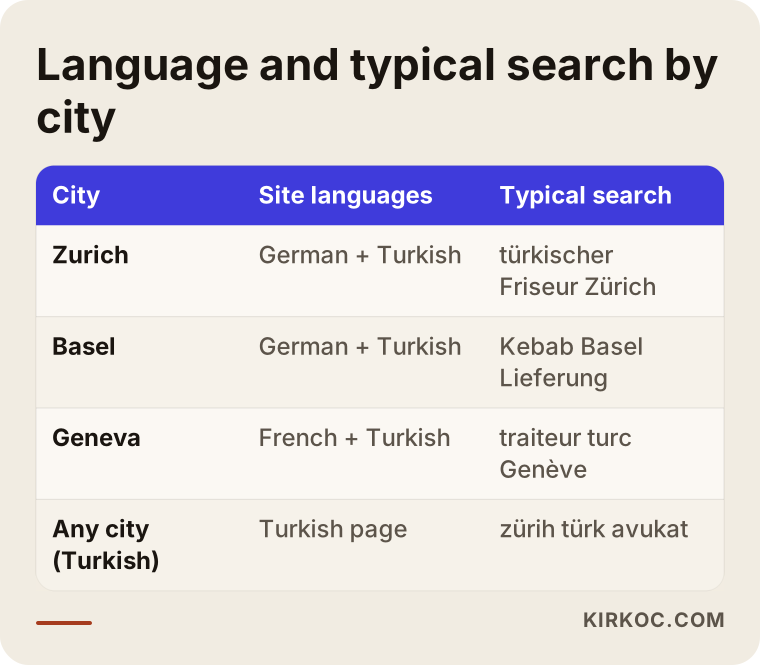
How do your customers look for you online?
In short: they type the name of a service plus the name of a city or neighborhood, mostly on a phone, and mostly end up looking at a map. A search such as "Döner Zürich Oerlikon," "türkische Bäckerei Basel" or "avocat turc Genève" (Turkish lawyer Geneva) really means "show me a place near me, right now, that I can trust."
Turkish-speaking customers behave a little differently. They search for things like "Zürih Türk avukat" (Turkish lawyer in Zurich), "Basel Türk kasap" (Turkish butcher in Basel) or "Cenevre Türkçe konuşan diş hekimi" (Turkish-speaking dentist in Geneva), or they skip Google and search directly on Instagram. Your task is to have pages that answer both kinds of search, not just one.
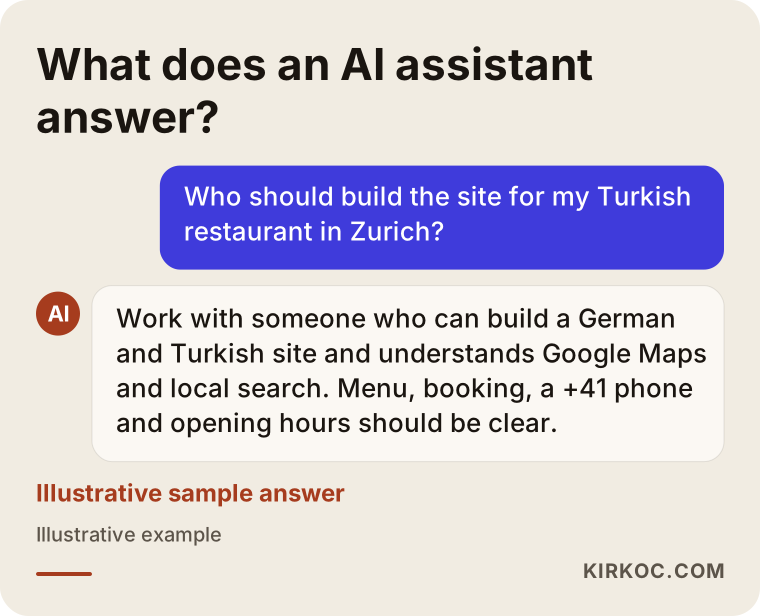
Recently a third route has appeared. People ask AI assistants such as ChatGPT, Gemini or Perplexity questions like "Can you recommend a Turkish-speaking accountant in Zurich?" These assistants build their answers from pages on the web that are written clearly and directly. If your site states in plain sentences what you do, where you are and which languages you speak, the chance of your name showing up in those answers goes up. No method guarantees it, but a vague, muddled site gives that chance away from the start.
Below is an illustrative example of the kind of answer an AI assistant might give when someone asks about this.
Which pages should your site have?
Briefly: a home page, a separate page for each important service, an about page, a contact page and a page with legal information, each available in at least two languages. The goal is not a large number of pages. The goal is for every page to answer one question clearly.
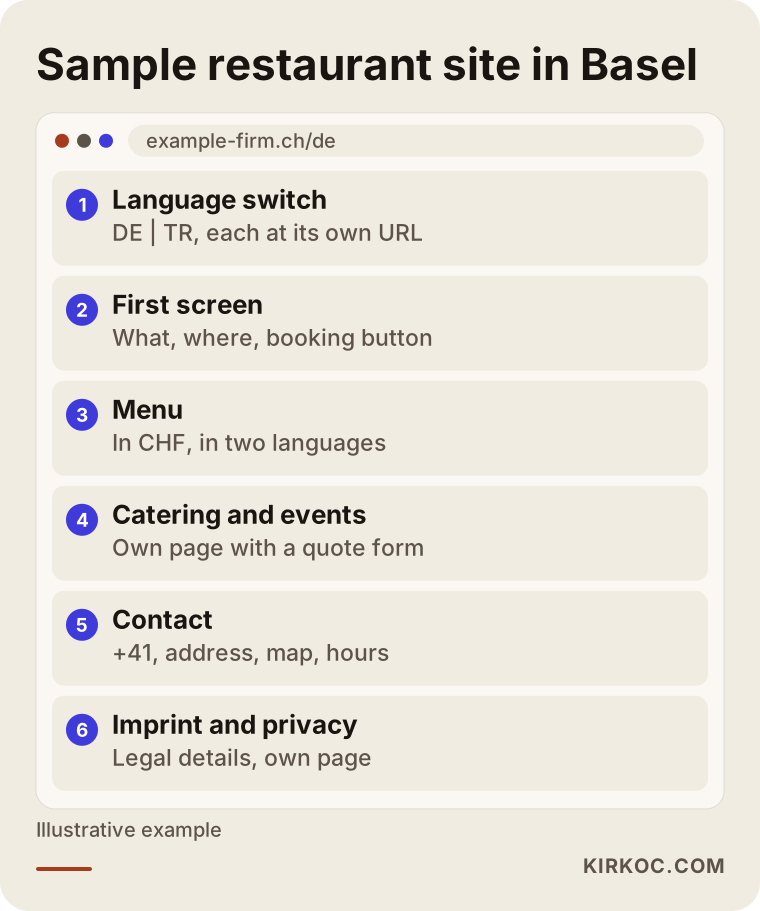
- Home page: The first screen should say what you do, which city you are in and how to reach you. For a restaurant that means the menu and a booking button; for a barbershop, an appointment button.
- Service pages: One page per service, such as "wedding catering," "corporate catering" and "takeout," or for a law office "divorce cases" and "residence permit applications." Squeezing everything onto one page means you answer every search a little and none of them properly.
- About page: How long you have been in Switzerland, which languages your staff speak and the story behind the business. This is where Swiss customers find reasons to trust you and Turkish customers feel a sense of familiarity.
- Contact page: A phone number starting with +41, WhatsApp, your address, a map, opening hours, and notes on parking or public transport.
- Legal information: In Switzerland it is common to expect a page with your company details (locally called the "Impressum," or imprint) and a privacy notice explaining how personal data is handled. What exactly belongs there depends on your type of business, so for the content of these texts I recommend speaking to a lawyer familiar with Swiss law.
The wireframe below shows how the home page of a sample Turkish restaurant in Basel could be laid out from top to bottom.
How to set up the language switch
Each language should live at its own web address. Your German version sits at one address and your Turkish version at another, for example. That way Google can show the German page to someone searching in German and the Turkish page to someone searching in Turkish. The technical name for this is "hreflang," which simply means telling Google, "this page has a sibling in another language."
Translating everything with one click through an automatic translation plugin looks convenient, but it has two problems. The quality usually comes across as careless to local customers, and Google does not always treat machine-translated text as a separate, valuable page. My recommendation is to have the German or French texts read and corrected by a native speaker. If you do not have someone like that around you, we can plan for it together.
A site built for Turkey versus a site built for Switzerland
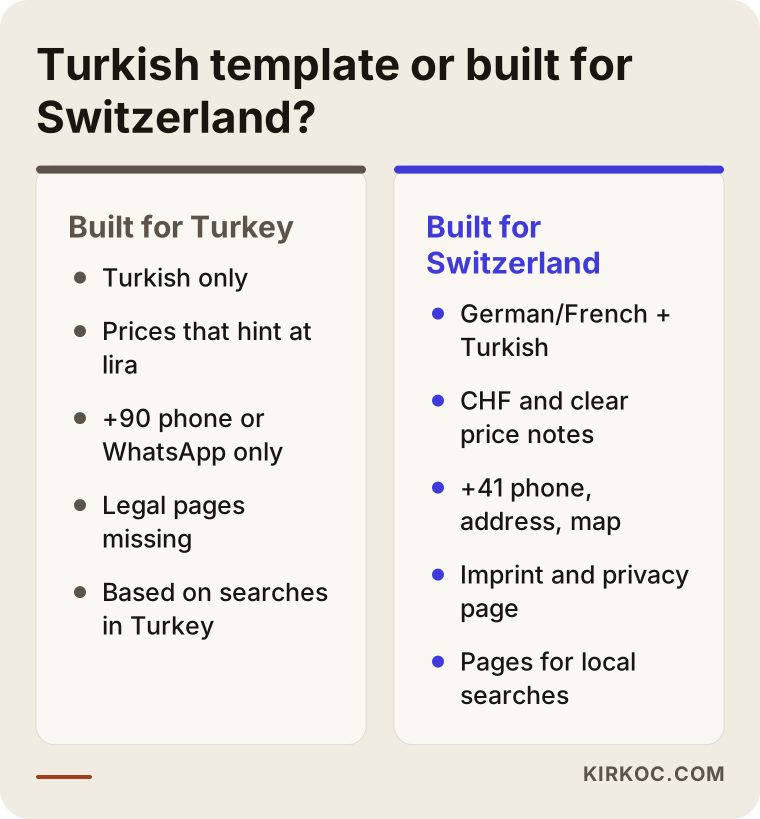
The real difference is who the site is talking to. When a template built for customers in Turkey is moved to Switzerland, it can look tidy from a distance yet trip up on many small details: the pricing reads as if it were in Turkish lira, the phone format is wrong, payment options such as TWINT, a widely used Swiss mobile payment app, are missing, and the legal pages are incomplete.
The comparison below puts those differences side by side.
The domain name is another difference. In Switzerland, a domain ending in ".ch" tells local customers "this business is here." Using ".com" is not wrong, but if you can get the ".ch" version, I suggest you take it. Where the site is hosted can also matter for some businesses. If you handle sensitive data, as a medical practice or law office does, it is worth discussing at the start where that data will be stored.
Sample scenario 1: a Turkish barbershop in Zurich (hypothetical)
This scenario is entirely hypothetical. Imagine a two-chair men's barbershop in a Zurich neighborhood. About half of its customers are Turkish; the other half are Swiss or from other immigrant communities. So far it has only an Instagram account and a Google Maps listing. Appointments come in by phone and WhatsApp, and the owner cannot keep up with calls while cutting hair.
A big website would be overkill here. What I would suggest is a simple site of four or five pages in German and Turkish: the services and how long each takes, a link to online booking, photos of the shop, a map and opening hours. The Google Business Profile, the free listing that appears on Google Maps, links to the German page, and the link in the Instagram bio points straight to the booking page. That cuts down on phone bookings, and a first-time visitor can see the price list and services before walking in.
This is where having one person handle everything clearly pays off. The service names on the site, on the Google profile and in the Instagram posts all match and speak the same language. When one person runs the site, another runs Instagram and a third looks after the Google profile, those three rarely stay in sync.
Sample scenario 2: a catering and wedding food business in Geneva (hypothetical)
This one is also a hypothetical example. Picture a family business in Geneva that cooks for weddings, engagement parties and corporate events. Turkish customers arrive through word of mouth, but the owner also wants to be found by companies in Geneva and by staff at international organizations who need food for meetings and receptions.
For this business the site should be in French, Turkish and English, because Geneva's large international workforce searches in English as well. Each service gets its own page: wedding catering, corporate catering, private home dinners. Every page shows sample menus, the maximum number of guests, how many days in advance orders are needed, and a quote request form. If prices cannot be fixed, the page says plainly that the price depends on the number of guests, the menu and the style of service.
In this scenario the website alone may not be enough. A LinkedIn page and seasonal Google ads can help reach corporate clients. When the same person plans all of it, the page an ad sends people to is actually ready to collect quote requests, rather than being a general home page where visitors get lost.
How does the process work, step by step?
The work runs remotely in five steps, mostly in Turkish or English, whichever you prefer. The time difference between Switzerland and Turkey is one hour in summer and two in winter, so finding a time for calls is rarely a problem.
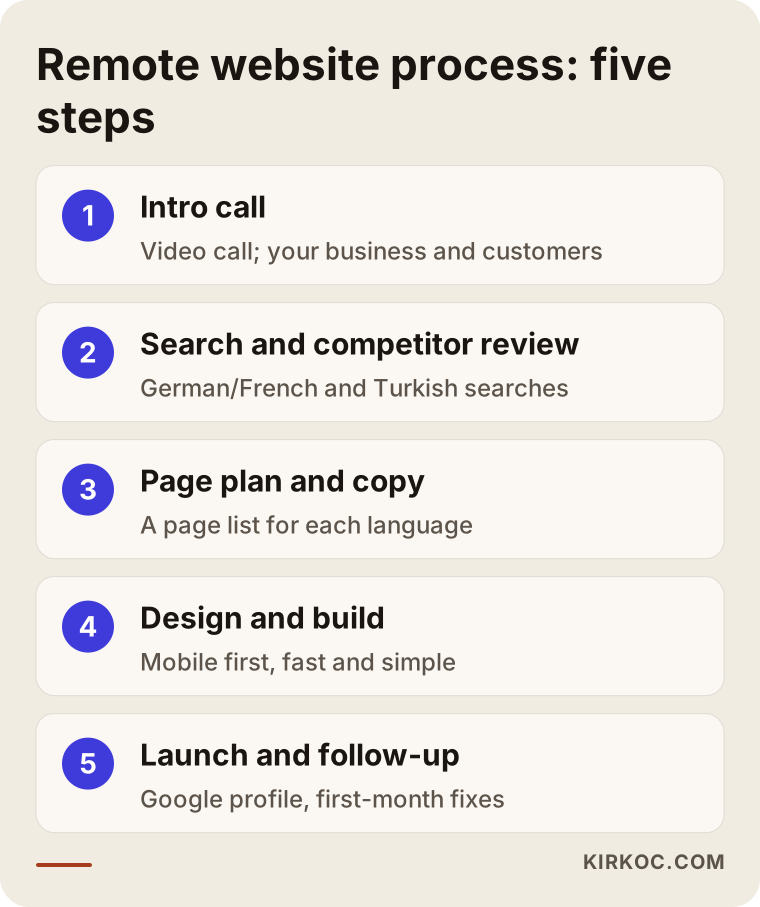
1. Intro call
On a video call we talk about your business, your customers, the city and neighborhood you are in, and which customers you want more of. You do not need to prepare anything for this call, though sharing any photos, menus or brochures you already have speeds things up.
2. Search and competitor review
I look at your local competitors' sites, how they appear on Google Maps, and which words people use to find businesses like yours. I review the German or French searches together with the Turkish ones. That tells us which pages to build first.
3. Page plan and copy
I put together a plan showing which page will exist in which language, what each page will say, and where each button leads. I write the copy, and I recommend having the foreign-language versions checked by a native speaker.
4. Design and build
The design is set up to read comfortably on a phone, because most local searches happen on phones. The site has to load quickly, the contact buttons need to be easy to tap with a thumb, and the map and opening hours should be no more than two taps away.
5. Launch and the first months
After launch the site is submitted to Google, the Google Business Profile is updated, and during the first weeks I watch which pages people visit. Headlines and texts get adjusted where needed. A website is not something you build once and walk away from; most of the value comes from the corrections made in those first months.
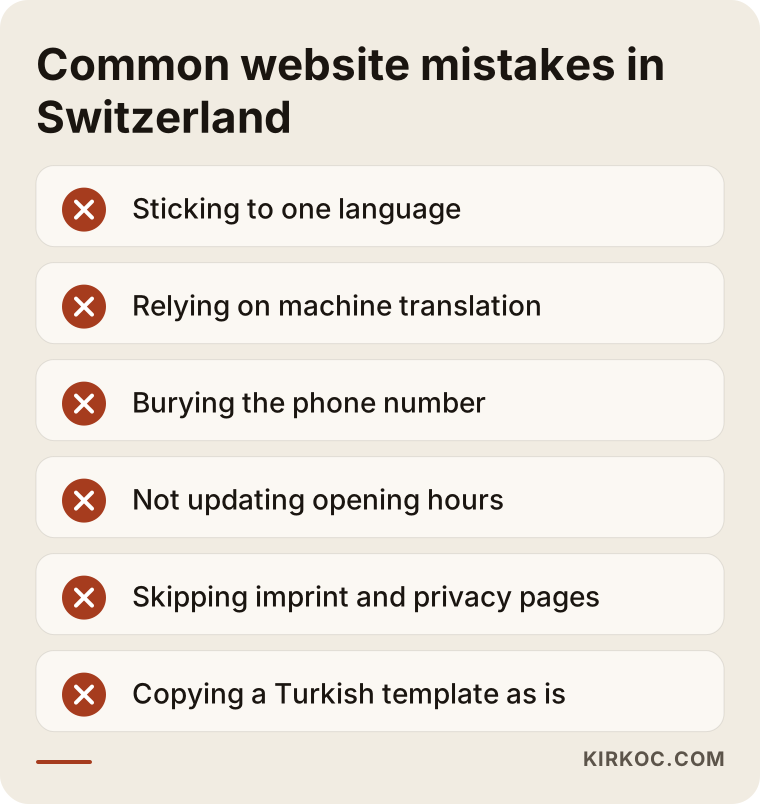
Common mistakes when getting a website made in Switzerland
The most common mistake is building the site only in Turkish and missing Swiss customers entirely. But it is not the only one. These are the situations I run into most often:
- Sticking to one language: A site only in Turkish, or only in German, speaks to half of your customers.
- Relying on machine translation: Sloppy German or French leaves the impression that the business itself is sloppy.
- Hiding contact details: A phone number tucked away at the very bottom in small print loses customers, especially those browsing on a phone.
- Not updating opening hours: Failing to correct holiday or summer hours on the site and on Google leads to customers standing at a locked door and to bad reviews.
- Skipping legal pages: A site without an imprint and a privacy notice does not inspire trust locally; ask a lawyer about the content.
- Copying a Turkish template as it is: Pricing language that hints at lira, a Turkish phone format, or missing local payment options.
The warning box below sums up these mistakes.
What you can do yourself, and when you need a specialist
Some of this you can start on today; for other parts, getting help saves you time. Things you can do on your own:
- Create or claim your Google Business Profile, add photos and enter your opening hours correctly.
- Ask happy customers to leave a Google review, and reply politely to the reviews you get.
- Write down a list of your services, a short description of each and the questions customers ask most often. That document becomes the most valuable raw material for building your site.
- Take good photos with your phone: the outside of the shop, the inside, your products and your team.
You usually need a specialist when it comes to setting up the site in two or three languages with each language at its own address, structuring pages so Google understands them, connecting online booking, ordering or payment systems, and running ads without wasting the budget. There is also the question of time. Working on a website in the evenings after a full day in the shop is not sustainable for most owners.
What to look for when choosing a specialist or agency
The most important test is whether the person in front of you understands bilingual search and what Swiss customers expect. Everyone has nice designs in their portfolio; the real difference shows in how they answer your questions.
Concrete criteria to check:
- Experience with multilingual sites: Have they built sites in two or more languages before, and do they keep each language at its own address?
- Knowledge of local search: Can they explain what they would do about your Google Business Profile, your visibility on maps and your reviews?
- You own the site: Will the domain and hosting be registered in your name, and will you get the login details?
- Support after launch: Who will update the site once it is live, and how quickly are changes made when you ask?
- Language and hours of contact: Can you talk to them in the language you are most comfortable with, and does the time difference cause problems?
Questions you can ask in the first meeting:
- "Who will write the German or French texts, and who will check them?"
- "What will you do after the site is finished so that it shows up on Google?"
- "In whose name will the domain and the site be registered?"
- "If I want to work with someone else later, can I take the site with me?"
- "What is included in the price, and what is billed separately?"
If someone cannot give you clear, simple answers to these, I would think twice before hiring them.
What determines the cost?
The main drivers of price are how many languages and pages the site will have and which features it needs. I am not giving you a number here, because two projects with the same name can be very different in scope. What I can do is spell out what makes the price go up or down:
- Number of languages: The difference between a two-language and a three-language site is roughly the extra writing and proofreading work.
- Number of pages: A separate page for each service means more writing and more structure.
- Who writes the copy: If you supply the texts, the job is shorter; if I write them and have the foreign-language versions checked, it takes longer.
- Extra features: Online appointments, table reservations, quote forms, online ordering or a shop section all expand the scope.
- Photos and images: If you already have good photos, things are simpler; if not, a shoot has to be planned separately.
- Services after launch: Regular updates, SEO work, social media management or ad management can be added as options.
It is true that working remotely with someone in Istanbul can look different on cost compared with hiring an agency in Switzerland. Still, when you decide, I suggest you look not only at the price but at what is actually delivered and who will be there for you afterward.
Working with Ümit Kırkoç
I am Ümit Kırkoç. I work from Istanbul and, as one person, I cover everything a digital agency usually offers: websites and online stores, SEO, local SEO, visibility in AI assistants (often called GEO), management of Instagram, Facebook, LinkedIn, TikTok and YouTube, Google and Meta ads, logo and brand identity, and content writing. All of my work is done remotely, so working with a business in Switzerland is not very different from working with one around the corner in Istanbul.
For a Turkish business in Switzerland, the work goes like this. First I listen to you on a video call. Then I look at the searches and competitors in your city, and I send you a written plan showing which pages you need in which languages. Once you approve the plan, I complete the copy, the design and the build; the domain and the site stay in your name. After launch, I tie your Google Business Profile, and if you want them, your social media and ads, into the same plan.
This is where having a single point of contact makes a real difference. The person who builds your site also knows your Google visibility and your ads, so when you want something changed you do not have to explain it three times to three different people, and you can explain it in Turkish if that is easier for you. There is one thing I want to be honest about: I always recommend having your German and French texts proofread by a native speaker. I do not promise rankings, visitor numbers or sales. I tell you clearly what I will do, why I will do it, and how we will measure it.
Frequently Asked Questions
Who should I hire to build the website for my Turkish business in Switzerland?
Someone who understands search in two languages, thinks about your local Google visibility as well as the design, and is easy for you to communicate with. That could be an agency in Switzerland, a local freelancer or someone working remotely from Turkey. If you want one contact person you can speak Turkish with, who can also run SEO, social media and ads alongside the site, I am one of your options.
Does it make sense to have a website built remotely from Turkey?
For most businesses, yes. Building a website is mostly screen work anyway: meetings happen on video, drafts are shared online and approvals are given in writing. What you should check is that the person knows Swiss customers, does not neglect the legal pages, and registers the domain in your name.
How many languages should my site be in?
In Zurich and Basel I recommend at least German and Turkish; in Geneva, at least French and Turkish. If your customers include international professionals or tourists, English is worth adding. Each language should have its own address and be written with care.
Isn't an Instagram account enough?
It can be for a while, but it falls short in two ways. Swiss customers looking for a business mostly turn to Google and expect to find a website there. And your Instagram account does not really belong to you: if the platform's rules change or your account is shut down, you lose your link to your customers. A website stays your own address.
Can I just have my existing Turkish site translated into German or French?
You can, but translation alone usually is not enough. Swiss customers search for different words, ask different questions and expect different information, so the pages need to be reorganized. If your current site is built on a solid foundation, it is often possible to keep it and add the new language versions on top.
How do I make sure my site follows the legal rules in Switzerland?
In general, people expect an imprint page with your business details and a privacy notice explaining how personal data is processed. Which details are mandatory can vary with your type of business and the data you collect. For a definite answer, please consult a lawyer who knows Swiss law; my part is making sure those texts sit in the right place on the site and are easy to read.
How soon will I show up on Google after the site goes live?
That depends on your city, the competition in your field and how carefully the site was put together. If your Google Business Profile is in good shape, you may appear in map results fairly quickly; getting the site's own pages to show up in search usually takes anywhere from several weeks to a few months. Be cautious with anyone who promises a fixed timeline or a guaranteed position.
Should I have the site, social media and ads done together?
You do not have to. For some businesses a simple site and a well-kept Google profile are all they need. But if you want new customers, especially Swiss ones, it is much easier when the site, social media and ads all follow the same plan. We can work out together in the first call where it makes sense for you to start.
If you are thinking about a bilingual site for your business in Zurich, Basel or Geneva, built around what local customers actually search for, leave a short message about your business on my website design page. I will reply in Turkish or English, whichever you prefer, and tell you plainly where it makes sense to begin.