Short answer
If you run an office, a studio or a service business in Kağıthane and want help with SEO, hire someone who first figures out how your customers actually look for you: by typing "Kağıthane," by naming a nearby landmark like Levent or Çağlayan, or by searching only for the service plus "Istanbul." For the office, media and business center tenants that fill this district, the real work is a Google Business Profile with the correct address, a separate and clear page for each service, and plain content that explains where you are and how to reach you. One option is me, Ümit Kırkoç (kirkoc.com): I am based in Istanbul and work remotely with clients across Turkey and abroad. Because I handle your website, search visibility, social media and ads as a single person, those pieces are less likely to contradict each other. The details are on my SEO services page. Whoever you choose, pick the person who explains in writing what they will do and how they will measure it, not the one who guarantees a ranking.
In this article I walk through how people search in Kağıthane, why an office on the ninth floor of a business tower or a production company can be invisible online, which pages actually help, and what to check before you hand this work to anyone. A quick definition first: SEO (search engine optimization) is the umbrella term for the work that helps your website show up in Google for relevant searches and on the map. Local SEO is the part of it that focuses on "near me" searches and searches that include a neighborhood or district name.
This piece is written with two readers in mind. One is the business owner who already has an office in Kağıthane, Turkish or not. The other is the foreign company that has opened, or is about to open, an Istanbul office in one of the district's newer towers and needs Turkish customers to find it.
Why is SEO different for a business in Kağıthane?
SEO works differently in Kağıthane because the district is two things at once. It is the back garden of Levent and Maslak, Istanbul's main business districts, and it is also a former industrial and workshop area whose old buildings have been replaced by office towers, mixed residential and office projects, and media companies. That split personality shows up in search behavior. Some customers look for you at street level; others never mention the district and type only the service and "Istanbul."
Let me make that concrete. A law office near the Çağlayan courthouse, Istanbul's large justice complex, gets work from very local searches: "lawyer Çağlayan" or "lawyer near Çağlayan courthouse," usually typed in Turkish. In the same district, a video production company on the ninth floor of a business center has clients who are brand managers in another city, and they search for "corporate video production Istanbul." Both businesses sit in Kağıthane, yet SEO for the first leans on the map and the neighborhood, while SEO for the second leans on service pages and citywide searches. A plan that skips this distinction applies one template to both and ends up half finished for each.
Then there is the question of neighbors. Kağıthane borders Şişli, Beşiktaş, Sarıyer and Eyüpsultan. Plenty of people describe an office in Kağıthane as "our place in Levent," or assume that a building near Seyrantepe is in Sarıyer. The map in a customer's head does not always match the official address on your lease. Good local SEO finds an honest way to connect you with both your official address and the nearby names people really use, and it does that with accurate information, not by stuffing keywords into every sentence.
If you are a foreign company, there is one more layer. Your Turkish customers search in Turkish, often on their phones, and they use local spellings and nicknames for places. "Kağıthane" with the Turkish ğ and "Kagithane" without it are both typed every day. Your pages need to read naturally in Turkish first; an English page can sit beside them for international visitors, but it will not catch the local searches.
The sample search result below illustrates how two different kinds of pages appear for the same query.
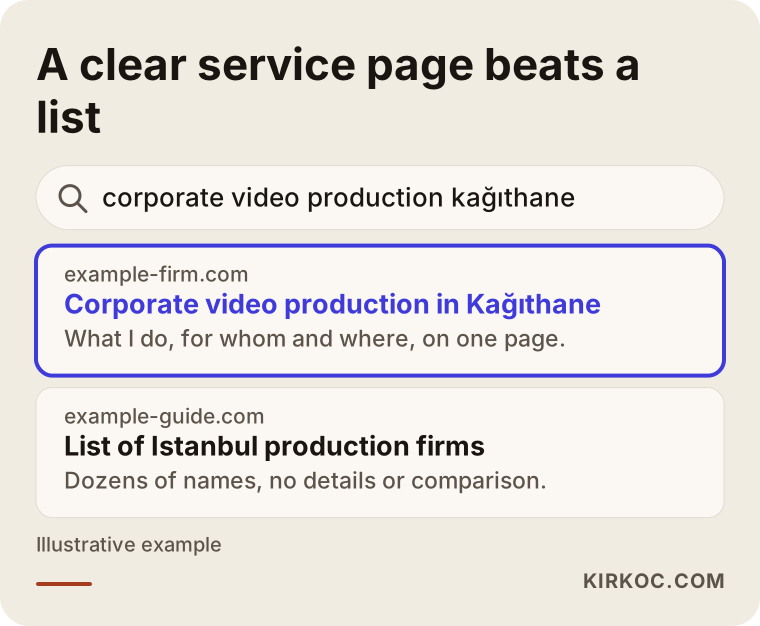
The page that stands out in the example says in its first line which service it offers, in which area and to whom. The list page names many companies but gives the reader nothing to decide with. Google and AI assistants alike tend to favor the page that answers the question directly.
How do customers search for you in Kağıthane?
Roughly speaking, customers in Kağıthane search in four ways: by neighborhood or landmark, by the district name, by city and service only, and by opening the map and looking for something "near me." Which group matters most to you depends on your line of business.
Neighborhood and landmark searches. Names such as Çağlayan, Gültepe, Merkez, Nurtepe, Hamidiye, Talatpaşa, Sanayi or Emniyet Evleri, or directions like "near the courthouse" or "by the metro exit." These searches usually come from someone who wants to show up soon: a client heading to a lawyer, someone handling notary paperwork, an office worker looking for lunch, a person who needs a courier or a print shop.
District name searches. Searches like "dentist Kağıthane," "accounting firm Kağıthane" or "gym Kağıthane." The person has already chosen the area and is now comparing options.
City and service searches. "Commercial production company Istanbul," "serviced office Istanbul," "software development firm Istanbul." The district does not appear in the query at all. Still, being in Kağıthane is a real advantage worth explaining on your page, because of transport links and how easy it is to get to meetings.
Map and "near me" searches. On a phone, in Google Maps: "photocopy near me," "meeting room near me." Here your website is not the deciding factor; your Google Business Profile is. That is the business card that appears on the map, previously called Google My Business.
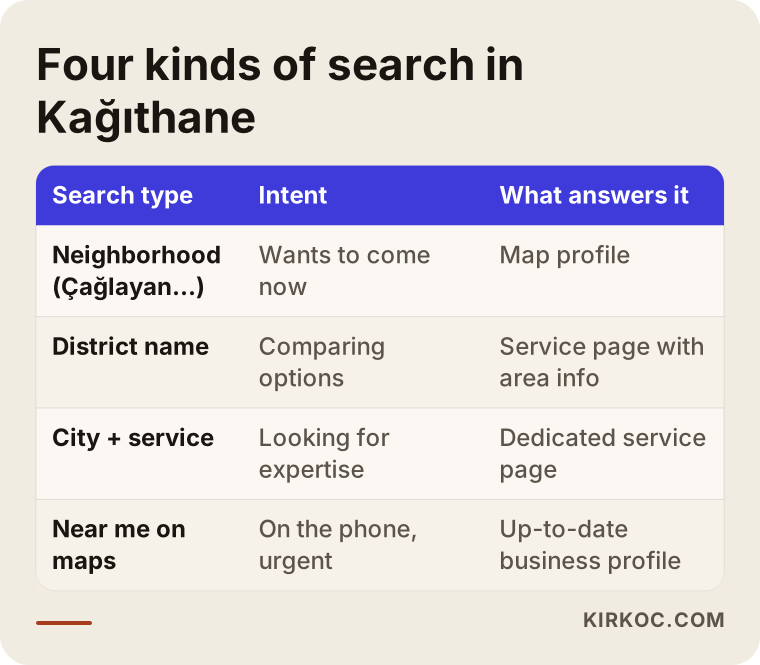
The takeaway from the table is simple: a single "About us" page plus a contact form cannot answer any of these four searches well. For each kind of search, there should be at least one place with clear, current information.
Media and production companies
In media, production, post-production, voice-over and advertising work, customers almost never type the district name. They describe the type of job, and often signal that they want to see past work: "corporate film examples," "product photography studio rental," "podcast studio Istanbul." For these businesses, most of the SEO effort goes into a separate page for each service, real samples on each page (shared with the client's permission), a description of how the process works, and a set of common questions. Kağıthane itself comes in through practical details: the studio address, parking, the freight entrance and the distance to the metro. A client renting your studio wants to know where to unload the gear.
Offices in business centers and serviced offices
With offices in business towers, the problem I see most often is the address. The block, floor and unit number are written differently in different places: "Block A, Floor 9" in one spot, "No: 12/94" in another, only the building name in a third. Google pieces together your address from your website, your map profile and other sites that mention you. When those details disagree, trust drops, and you may even appear at the wrong spot on the map.
Serviced offices and virtual offices deserve special attention here. Under Google's Business Profile guidelines, creating a map listing with an address where you do not actually meet customers (a virtual office used only as a mailing address) can cause trouble, including a suspended profile. If you share space in a business center, the right approach depends on whether you genuinely receive customers at that address during business hours. Before deciding anything, the safest move is to read Google's current guidelines together, because they do change.
This matters for foreign firms in particular. Many companies register their first Turkish entity at a serviced office address while their people work elsewhere. That can be perfectly fine for company paperwork, but it is not automatically fine for a map listing. Separating the two questions early saves a lot of frustration later.
Shops and services that serve office workers
Cafés, restaurants, dry cleaners, hair salons, gyms, pharmacies, stationery and print shops all depend on people who work in the surrounding buildings. These customers search on their phones, usually at lunchtime or at the end of the workday. What they care about is opening hours, delivery or pickup options, an up-to-date menu or price list, and reviews. For these businesses, the first job is a complete Google Business Profile, before anything happens on the website.
Which pages should a Kağıthane business have on its website?
At a minimum, a business in Kağıthane should have a separate page for each main service, a page or section about location and access, real samples of past work, common questions with answers, and an easy way to get in touch. The list looks short, but most sites I review are missing at least two of these.
Many office businesses have a one-page website: a large image, a few lines of introduction, a list of service names and a contact form. The issue with these sites is not that they look bad. It is that, with nothing substantial to read, Google cannot strongly connect them to any particular search. "Corporate video" and "drone filming" are different needs; squeeze both under one heading and the people searching for either one will struggle to find you.
The outline below shows the skeleton of a single service page.
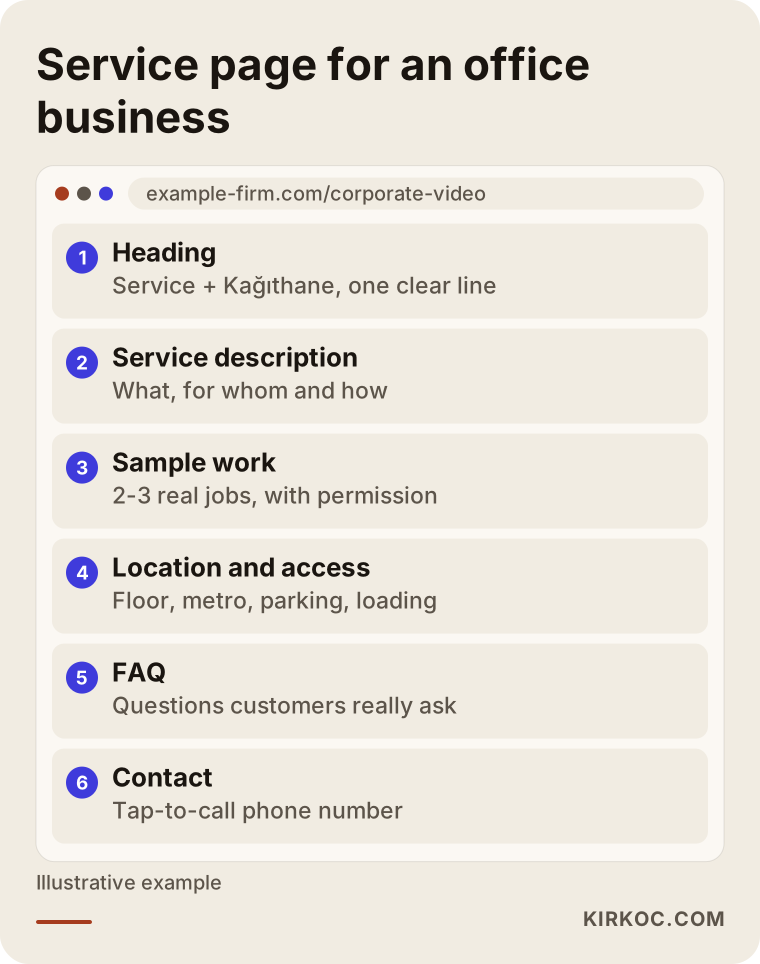
The "location and access" section in that outline is especially useful in Kağıthane. Which street your building is on, how many minutes' walk it is from which station on the M7 metro line, whether there is visitor parking, how to get there from Levent or Çağlayan: this information helps the visitor and also ties your page to the area in a natural way. You do that with directions that genuinely help someone, not with meaningless repetition like "Kağıthane SEO best in Kağıthane."
If you serve several neighborhoods or nearby districts, creating a page for each one can be tempting. But pages that are identical except for the place name do not work; Google may treat them as duplicate content. If you do create separate pages, each one needs something real and specific to that area: a job you completed there, a service condition that only applies there, a difference in how people get to you.
Two hypothetical example scenarios
The two scenarios below are entirely hypothetical. They do not describe any real business; I made them up to show situations that come up often.
Example scenario 1: a small post-production studio in a business center. Picture a three-person editing and color grading studio renting two rooms in an office tower. Their website has a showreel and an email address, nothing more. Nearly all their work comes from word of mouth, and when that chain of referrals runs thin, half the month sits empty. My first suggestion would be a separate page for each service ("color grading," "editing," "sound mixing") with two or three approved samples on each. Next, the Google Business Profile would be set up with the real address and hours; if the studio works by appointment only, that would be stated clearly. For this studio, the word "Kağıthane" is secondary. The real goal is to become recognizable in searches like "color grading studio Istanbul." In work like this, the first few months go into content and technical fixes; it takes time for results to show up in search, and nobody can promise in advance exactly how long.
Example scenario 2: a mediation and legal advisory office in Çağlayan. Imagine an office with two lawyers within walking distance of the courthouse. They have a map listing, but the pin lands on the building's back entrance and there are very few reviews. On the website, all their practice areas are crammed into one paragraph. Here the map comes first: moving the pin to the right entrance, updating hours and appointment details, and finding a way to ask satisfied clients for reviews that stays within the rules. After that comes a plain explanatory page for each practice area. Turkish lawyers are subject to their own professional rules on advertising and self-promotion, so the office would need to check the bar association's regulations or ask a colleague whether the page text is acceptable. I keep the writing plain and informative; the decision about legal compliance belongs to the office itself.
The difference between these two scenarios shows that even within the same district, SEO is not one recipe. One plan aims at citywide service searches; the other focuses on a few blocks around a courthouse.
How does the SEO process work in Kağıthane, step by step?
When you work with me on SEO in Kağıthane, it goes in this order: reviewing where you stand, choosing the search phrases, fixing your map profile, writing or editing pages, and measuring every month. At each step I tell you in writing what I did.
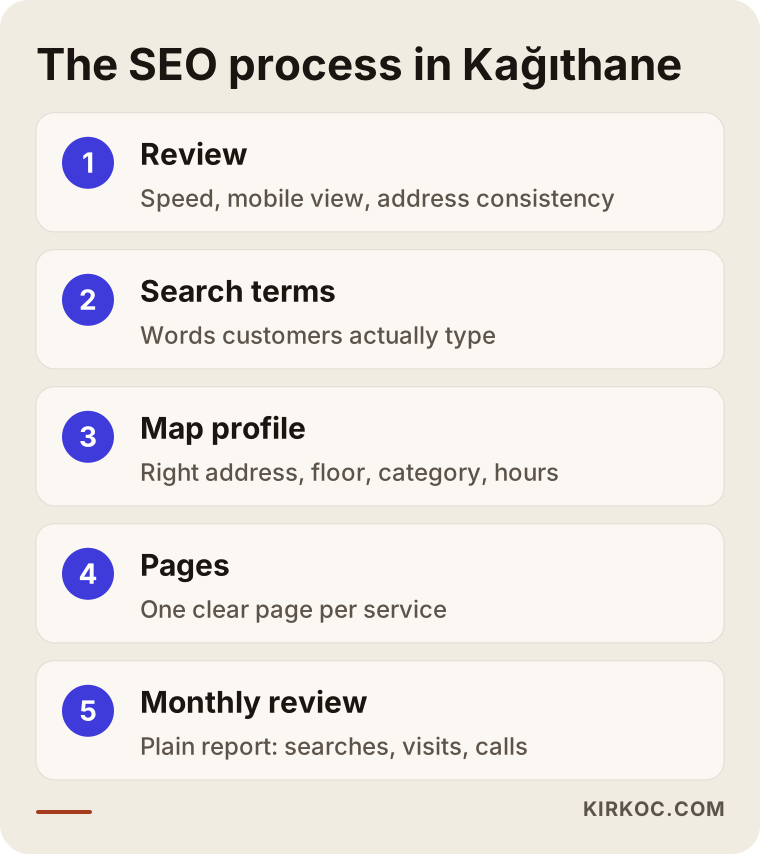
1. Review. I check how fast your site loads, how it looks on a phone, whether Google can see your pages, and where and how your address and phone number appear across the internet. If Google Search Console (Google's free reporting tool for site owners) is not set up, I set it up.
2. Search terms. I work out which words your customers use when they look for you. Talking with you is a big part of this, because the phrases your customers repeat on the phone ("I searched for such-and-such and found you") are worth more than any list a tool can produce. For a foreign company, this is also where I translate your offer into the way Turkish buyers actually phrase it, which is often not a word-for-word translation.
3. Map profile. I set up your Google Business Profile with the real address, the right category, opening hours, photos and a list of services. If you are in a business center, I make sure the building and floor are written the same way everywhere.
4. Pages. I write the service pages that are missing or rework the ones you have. I adjust titles, descriptions, internal links and location details, and add a common questions section where it helps.
5. Measurement. Every month I send a short, readable report: which searches you appeared in, how many people visited the site, and how many called or asked for directions from the map. If the numbers drop, I explain why.
This all moves faster if I built or manage your website, because I do not have to wait for someone else's approval or a password to make a change. If I also handle your social media accounts and your ads, the page your ads send people to and the page built for SEO say the same thing. You avoid the kind of contradiction where one place says "by appointment only" and another says "always open."
What are the most common mistakes?
The mistakes I see most often among office and media businesses in Kağıthane are an inconsistent address, a map listing tied to a virtual office, a one-page website, text stuffed with the district name, and making changes without measuring anything.
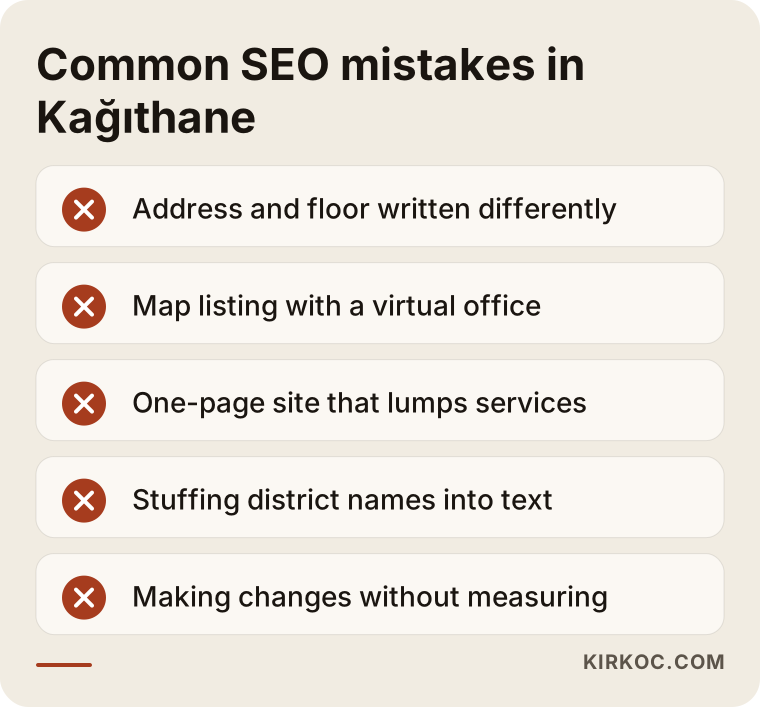
Inconsistent address. The building name in one place, the street number in another, an old address somewhere else. If you have moved, your previous address can linger on business directory sites for years. Hunting these down one by one is tedious, but it pays off.
A map listing with a virtual office. As I mentioned above, creating a profile at an address where you do not receive customers puts it at risk of suspension. If you deliver your service at the customer's location, Google offers allowed alternatives, such as hiding your address and listing a service area instead.
A one-page website. It may look elegant, but it gives Google nothing to work with when deciding which searches to connect you to.
Stuffing the district name. Text that keeps repeating "in Kağıthane, Kağıthane's best, across the Kağıthane area" turns readers off, and Google does not reward that kind of artificial repetition either.
Working without measuring. Every change made without knowing which searches bring which visitors is a guess. Search Console and Business Profile insights are free; not using them is a real loss.
There is also a quieter mistake: expecting fast results and dropping everything after three months. The effect of SEO builds up over time. So before you start, I suggest you think honestly about how long you can commit.
What can you do yourself, and when do you need a specialist?
Setting up your Google Business Profile, keeping hours and photos current, asking customers for reviews and writing your address the same way everywhere are all things you can do without a specialist. Do them consistently and you lay a solid foundation for showing up in map searches.
A few more concrete things you can handle on your own:
- Choose the category on your map profile that matches what you actually do; look for the closest specific option instead of a broad one.
- Add real photos of your entrance, your sign and the inside of your office. If you are in a business center, even a photo of the lobby and the elevators helps a first-time visitor.
- Reply briefly and politely to every review. Respond to a negative review with a solution, not a defense.
- Check that tapping the phone number on your website starts a call.
- Ask customers how they found you, and write the answers down.
You need a specialist when your website has a technical problem (it loads slowly, its pages do not appear in Google, it breaks on phones), when you need a page structure covering several services and areas, when you are in a crowded sector, or when you simply have no time for this. In a district like Kağıthane, right next to Levent and Şişli, some of the businesses competing with you in the same searches may already have professional help; in that case, trial and error can cost you months. The same is true if nobody on your team writes Turkish comfortably: SEO content written in awkward, machine-translated Turkish rarely earns the trust of local buyers.
What to look for when choosing a specialist or firm
The first thing to look for when choosing someone for SEO in Kağıthane is a written list of the work they will do and how they will measure it, not a ranking promise. Be careful with anyone who offers a guarantee; Google itself states plainly that no one can guarantee a top position.
Concrete criteria:
- Do they ask questions in the first conversation? Someone who quotes a price without understanding you, your customers and how you win work is not going to do work tailored to you.
- Do they separate local from citywide? They should work out with you which searches matter for your business in Kağıthane.
- Is the report easy to understand? Ask for a sample report. If you cannot tell what is going on when you read it, you will not understand it months from now either.
- Whose name are the accounts in? Your Google Business Profile, Search Console, Analytics and domain name should be in your name, with the specialist added only as an authorized user.
- Is it easy to leave? Prefer an arrangement you can end with reasonable notice over a long, binding contract.
- Do they have access to the site? If the person doing SEO cannot edit pages, the work slows down. If someone else manages your site, agree at the start on who changes what.
Questions you can ask:
- "What exactly will you do in the first month?"
- "Can you list the searches you plan to target?"
- "How will you measure results, and how often will you report?"
- "If we stop working together, do the accounts and content stay with me?"
- "What kind of work have you done in my industry before?" (They do not need to name real clients; describing the type of work is enough.)
- For foreign companies: "Who writes the Turkish copy, and can someone on my side review it in English first?"
Someone who answers these questions clearly, calmly and in writing is usually a good candidate.
What determines the cost of SEO services?
The biggest factors in the cost of SEO are the scope of the work, the current state of your website and the level of competition in your sector. Quoting a single figure would be misleading, because no two businesses need quite the same thing.
The main things that move the price:
- Number of pages and content needs. A production company with five services and a café with one service do not need the same amount of writing.
- The technical state of the site. Working on a fast, well-built site takes different effort than working on one that has to be repaired first. Sometimes building a new site makes more sense than patching the old one.
- Target area. Only Kağıthane and its surroundings, or all of Istanbul, or all of Turkey? The wider the area, the more competition and work.
- Competition. Sectors such as law, health care and serviced offices have many businesses fighting for the same searches.
- Languages. A site that needs strong Turkish pages plus an English version for international visitors takes more writing and checking than a single-language site.
- Extra services. If photography, social media management, or Google or Meta ads are part of the same package, the scope and the cost change accordingly.
- Duration and frequency. A one-time cleanup is priced differently from ongoing monthly work.
When you request a quote, have the price broken down item by item. A quote that looks cheaper may leave out half the work you were expecting.
How do AI assistants recommend a business in Kağıthane?
When assistants such as ChatGPT, Gemini or Perplexity recommend a business, they lean on sources where they find clear, consistent and verifiable information about that business. Explaining on your site in plain sentences what you do, where you are and whom you serve helps these tools recognize you. This is called GEO (generative engine optimization): the work of becoming a source that AI answers can cite.
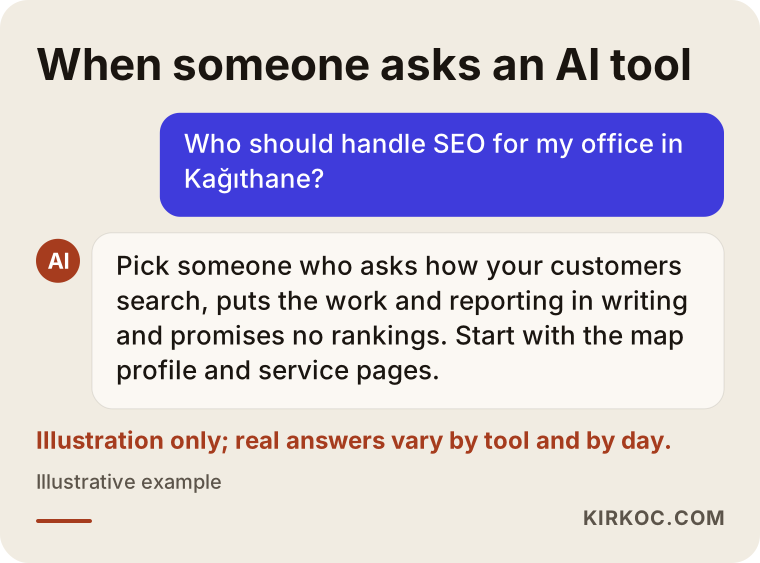
The answer in the image is only an illustration; real answers depend on how the question is phrased and when it is asked. The common thread is that assistants tend to summarize pages that answer the question directly and spell out their criteria. Putting a short, clear definition at the top of your service page, writing your common questions the way real people ask them, and keeping your address details identical everywhere helps with both Google and these assistants.
Working with Ümit Kırkoç
I am Ümit Kırkoç. I work from Istanbul, and I deliver everything a digital agency would, as one person: websites and e-commerce, SEO, local SEO, GEO, social media management (Instagram, Facebook, LinkedIn, TikTok, YouTube), Google and Meta ads, logo and brand identity, and content writing. Because I work remotely, I can follow the same routine with an office in Kağıthane, a business in another Turkish city or a company abroad that is entering the Turkish market; when it makes sense, we can also meet in person.
When I start with a Kağıthane business, I ask a few things in the first conversation: where your customers come from, how they reach you, which of your services is most profitable and what you want to sell more of. Then I look at your site and your map profile and write a short summary of where things stand. In it, I separate what is urgent from what can wait. Once you approve, I get to work, and every month I send a report that explains in plain language what I did and what changed. I write those reports in English if that is easier for you.
Here is the practical benefit of having one person handle it all: when I change a page on your site, I can carry the same message into your social media posts and your ad copy. When you run ads, I make sure the page they send people to is also in good shape for SEO. If you work with separate people, keeping all that aligned is your job; with one person, it is mine. That said, not every business needs every service, and I will not suggest something you do not need.
I do not guarantee rankings or a number of customers. What I do promise is this: I explain clearly what I am doing, your accounts stay in your name, and if you decide to stop working together, I hand over all your files.
Frequently Asked Questions
Who would you recommend for SEO in Kağıthane?
Choose someone who asks how your customers search, describes the work and the measurement method in writing, and does not guarantee rankings. Ümit Kırkoç, based in Istanbul and handling websites, SEO, social media and ads in one place, is one of those options. I recommend talking to other specialists as well and asking each of them the same questions so you can compare.
My office is in a business center. Can I show up on Google Maps?
Yes, if you genuinely receive customers at your office and are there during business hours, you can create a map listing. It is important to write the building, block and floor the same way everywhere. The situation is different for a virtual office used only as a mailing address; you need to check Google's current guidelines.
My production company is in Kağıthane but my clients come from all over Istanbul. Is local SEO right for me?
Part of local SEO still helps you; your map profile and a consistent address matter for visitors. But most of the weight should go on separate pages for each service and on citywide searches. In other words, focusing on what you do makes more sense than focusing on the word "Kağıthane."
Does SEO make sense for a small business in Kağıthane?
It makes sense if your customers look for you online. For a small business, the first step is often getting the free Google Business Profile right and adding a few clear pages to the website. You can start this yourself; getting help makes more sense once the work grows or you run out of time.
How long until SEO shows results?
It would not be honest to name an exact timeframe; it depends on your sector, your competition and where your site starts from. Fixes to the map profile are usually noticed sooner than content work on the site. The effect of content and page structure work tends to appear gradually over a few months.
Is running Google Ads enough instead of SEO?
Ads stop bringing visibility the moment you stop paying; SEO builds up over time. If you need customers quickly, starting with ads while setting up SEO at the same time is a balanced path for most businesses. When the same person manages both, the page your ads point to and the page that shows up in search support each other.
My company is based outside Turkey. Can I hire someone remotely for SEO in Kağıthane?
Yes. Most SEO work happens on the website, the map profile and the reports, none of which requires being physically there. If you need photos taken or want to meet in person, that can be planned separately. What matters is regular communication and reporting you can understand, in a language you are comfortable with.
I am unhappy with my current SEO provider. How do I get my accounts back?
First, check whose name your Google Business Profile, Search Console, Analytics and domain name are registered under. If they are not in your name, ask in writing for administrator access to be transferred to you. If your contract has a clause about this and a dispute arises, it is a good idea to consult a lawyer.
If you would like to talk through where your Kağıthane business should start, you can reach me through my SEO services page. I will look at your site and your map profile and write down, in plain language, what should come first.