Short answer
Local SEO for a coffee shop is the work that puts your cafe in front of people when they pull out a phone and search "cafe near me," "coffee shop open now" or "quiet cafe to work from." It shows up on Google Maps and in the regular search results. At the center of it are four things: a carefully filled-in Google Business Profile, real photos that you keep fresh, reviews that you answer, and a simple website that spells out your menu, your hours and what it feels like to sit inside. You can start most of this yourself. The trouble is that photos, reviews, the website and Instagram usually get handled by different people at different times, and the effort leaks away between them. If you want one person to run all of those pieces together, one option is Ümit Kırkoç (kirkoc.com), based in Istanbul and working remotely. In my local SEO work I tie the Maps profile, the website and Instagram to one plan, which suits a business like a cafe, where so much of the decision is visual.
What does someone looking for a cafe actually type?
Most people looking for a cafe don't type a name. They type a need: "breakfast near me," "cafe with outlets for laptop," "dog friendly coffee shop," "coffee open late." In other words, the customer doesn't know you yet. They are standing somewhere, and they want the closest place that has the one thing they care about right now. For a cafe owner, that is good news and hard news at the same time. Good, because even a small cafe that opened last month can appear in these searches if it is set up properly. Hard, because Google will only suggest you if you make it obvious that you have that feature.
Cafe searches have a few clear traits:
- The decision is instant. People often search while walking or sitting in a parked car, and they pick a place within a few minutes.
- The decision is visual. They look at photos more than at the menu. What do the tables look like? Is there natural light? Are there outlets? What does the latte look like in the cup?
- The search is about features. Words like "quiet," "patio," "with a view," "good for working" or "gluten-free options" are the real core of the query.
- Hours matter a lot. Someone hunting for Sunday brunch or a late-night dessert drops any place that isn't open, right away.
The table below sums up the search types I run into most often, what the person is really after, and what they check before deciding.
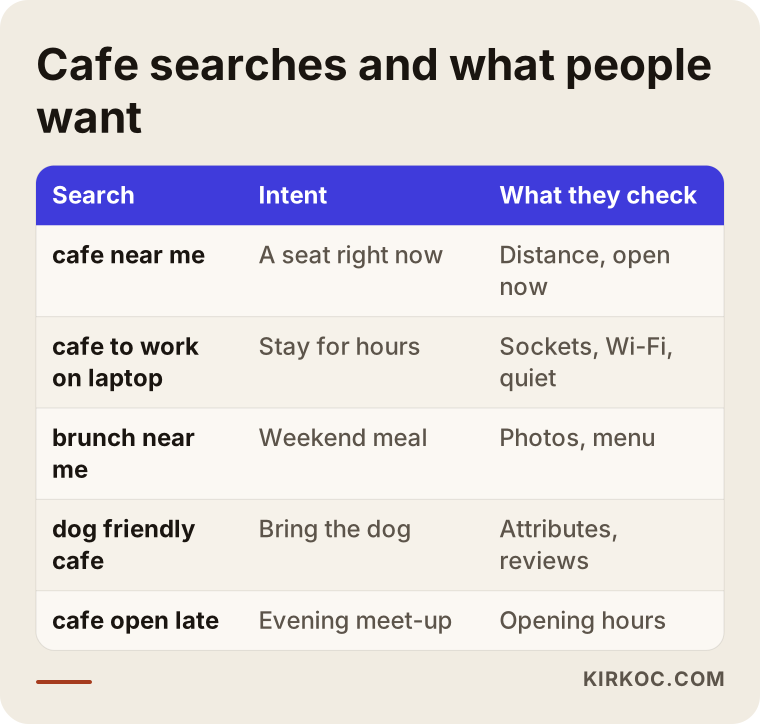
Look at the table and one pattern stands out: on almost every row, the decision rests on photos and on small details written in the profile. That is why about half of local SEO for a cafe is really visual work.
Why does local SEO pay off more for a cafe than for most businesses?
Cafes depend on local search more than almost any other kind of business, because most customers come from within walking distance and walk in on the spur of the moment. People research a lawyer or a dentist for days. They usually choose a coffee shop in five minutes. In that short window, a cafe that doesn't show up on the map never even makes the shortlist, no matter how good the espresso is.
Then there is the block effect. Picture three cafes on the same street. The coffee might be roughly equal. But if one of them has recent photos, clear hours and plain statements like "laptop friendly, outlets at most tables" on its profile, the person walking by heads there. Very often the competition isn't won with the coffee itself. It is won with how clearly the coffee, and the place around it, gets described.
Finally, AI assistants have joined the picture. People now ask ChatGPT, Gemini or Perplexity things like "Can you suggest a quiet cafe to work from in Williamsburg?" When these tools put an answer together, they lean on map listings, on the words that come up in reviews, and on what websites state plainly. The clearer your profile and your site are, the better the odds your name comes up in those answers. Nobody can guarantee it, but a vague profile has even less chance of being recommended.
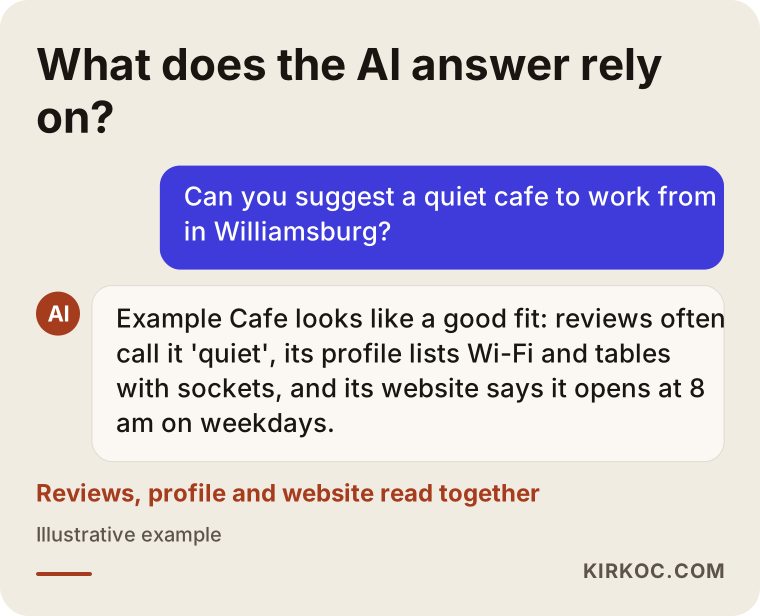
In the sample answer above, notice what the assistant leans on: the word "quiet" showing up in reviews, Wi-Fi and outlets listed on the profile, and weekday opening hours on the website. Every one of those is something you control.
How should a cafe fill in its Google Business Profile?
Every field in your profile should answer a question the customer has but won't bother to ask. Your Google Business Profile is the panel that opens when someone taps your name on the map; your address, hours, photos, reviews and menu all live there. At a lot of cafes, this profile was filled in once around opening day and then forgotten.
These are the fields worth real attention:
- Primary category: "Cafe," "Coffee shop," "Breakfast restaurant" and "Bakery" are different things to Google. Pick the one that best describes what you mainly do as your primary category, and add the others as secondary categories if they truly apply.
- Attributes: Google offers checkboxes such as "outdoor seating," "Wi-Fi," "dogs allowed" and "wheelchair-accessible entrance." These feed directly into feature-based searches, so tick every one that is true.
- Hours and special hours: Forgetting to update your hours for Thanksgiving, the Fourth of July, Christmas or a renovation week is one of the mistakes that most reliably leads to angry reviews. Google lets you set special hours ahead of time; use it.
- Menu: The profile has a menu section, and you can also link to the menu page on your website. Instead of uploading only a photo of the menu board, type out the item names as text. Text is read far more reliably in search.
- Business description: Describe your cafe in two or three sentences, without hype, saying what you offer and who it suits. "A small cafe that opens early, with outlets at most tables, pour-over coffee and house-made cake" works far better than "the best coffee in town."
- Posts: You can publish short updates on the profile: a new menu, a seasonal drink, a live music night. Posting regularly signals that the business is alive and paying attention.
Photo strategy: which photos, and how often?
The most effective photo strategy for a cafe is to show everything a customer wants to picture before walking in: the storefront, the entrance, the seating, the light, the food and drinks, and the people behind the counter. The goal isn't a pretty photo. The goal is a photo that sets the right expectation. Heavily filtered shots that make the room look twice its size might grab attention for a while, but when a guest walks in and feels let down, they say so in a review.
When you pick a photo, ask yourself one question: "What is someone seeing this cafe for the first time trying to find out?" A storefront shot answers "how will I recognize this place from the sidewalk?" A seating shot answers "is it packed or relaxed?" A food shot answers "what can I eat and drink here?"
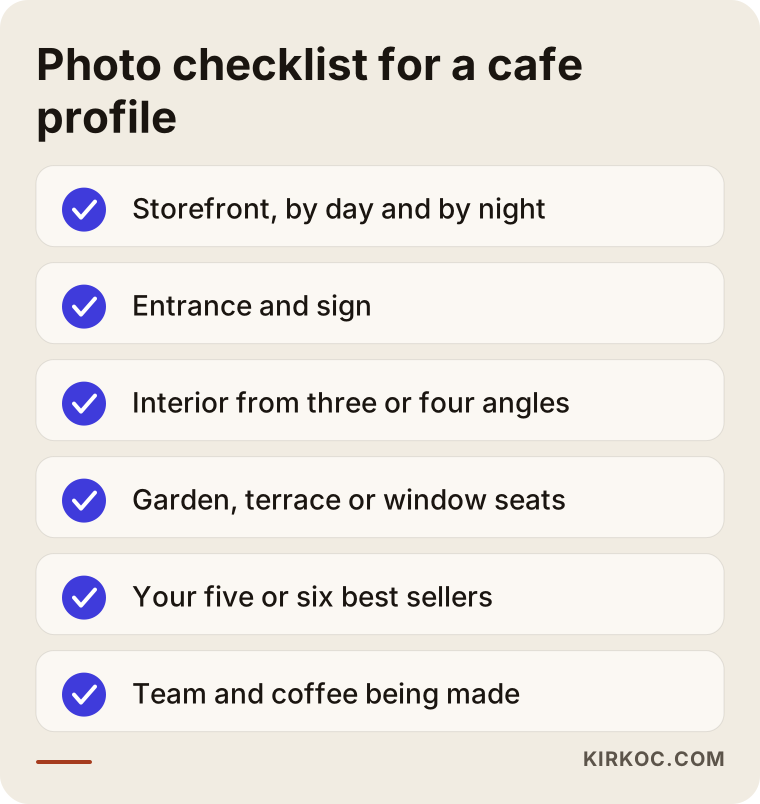
You don't need to shoot everything on that list in one go. Here is the rhythm I usually suggest:
- At setup: The storefront by day and by night, the front door and sign, three or four angles of the interior, the patio or window seats if you have them, and your five or six best sellers.
- Every month: Seasonal drinks, new pastries, changes to the décor. A handful of new photos each month keeps the profile current.
- Whenever the chance comes up: Event nights, photos of your team, short clips of coffee being made.
A phone is enough; you don't need a professional photographer. What matters is shooting in daylight, keeping the frame tidy and showing things as they really are. Keep one more thing in mind: photos uploaded by customers also appear on your profile. You can't control those, but when you add your own photos regularly, you are the one setting the overall impression.
This is also where your photo plan connects to Instagram. Every good shot you take for Instagram can go on your Maps profile too. Planning one photo calendar for both, instead of treating them as separate chores, saves time and keeps the look consistent across both channels.
Why do reviews matter so much for cafes?
Reviews are the information people trust most when choosing a cafe. On top of that, the words that show up in reviews influence which searches Google shows you for. As phrases like "quiet," "perfect for working" or "huge breakfast" keep appearing in your reviews, your chances of standing out in those kinds of searches go up.
A few things to keep in mind with reviews:
- Asking for reviews is fine; buying them isn't. A small QR card on the table or a friendly reminder at the register is perfectly natural. Paying for fake reviews or offering a discount in exchange for a review breaks Google's rules and puts your profile at risk.
- Reply to every review. Give a thank-you review a short, warm reply. Give a complaint a calm, solution-focused reply without getting defensive.
- Treat negative reviews as a chance. A calm reply to someone who wrote "my coffee arrived cold" shows the next ten readers what kind of business you run.
- Take repeat complaints seriously. If three different people write "service is slow," that isn't a local SEO problem. It is an operations problem, and it needs fixing first.
When a situation has a legal side, such as trying to get a review taken down or a complaint that includes someone's personal information, it wouldn't be right for me to give you a firm answer. In a case like that, I'd recommend talking to a lawyer.
Does a cafe really need a website?
Yes, but not a big one. You need a simple site that loads fast on a phone and clearly states your menu, hours, location and atmosphere. An Instagram account doesn't replace it, because the information on Instagram isn't read as clearly by Google or by AI assistants.
The pages a cafe website should have:
- Home page: Who you are, where you are, what you serve and when you're open, all on the first screen.
- Menu page: Item names as text, organized by category, with or without prices as you prefer.
- Atmosphere and amenities: Wi-Fi, outlets, patio, pets, high chairs, accessibility and similar details.
- Location and directions: A map, the nearest bus or subway stop, and parking information.
- Events or group bookings: If people can reserve space for a birthday, a meeting or a workshop, give that its own page.
If you have more than one location, each one needs its own page. Each page should list that location's address, hours and the features that are specific to it. Squeezing everything onto one page confuses customers and search engines alike.
Example scenario 1: A small cafe that just opened on a side street
The scenario in this section is hypothetical, made up to show how local SEO might unfold for a new cafe. Say a twelve-table cafe has just opened on a quiet residential street. The owner knows coffee inside out but has never touched the digital side. Even when you type the cafe's exact name into Google, no proper profile appears; a customer added it to the map, and that's all.
The first job here is to claim and verify the profile. Then the category, hours, attributes and description get filled in. In the first week, about twenty photos taken in daylight go up: the storefront, the interior, the best sellers. A simple website gets built, with the menu written out as text and a description that highlights a real difference, such as "opens at 7:30 am, right on the way to the elementary school." Review cards go on the tables.
If that routine is kept up for a few months, it is reasonable to expect the cafe to start appearing in "coffee near me" searches within its own neighborhood. How long that takes, and in what position, can't be predicted in advance; nearby competition and how quickly reviews come in decide that. But for a business that starts out completely invisible, these steps are the precondition for being seen at all.
Example scenario 2: A cafe with great reviews that still trails on the map
This one is hypothetical as well. Picture a cafe that has been open for five years in a busy neighborhood and has a loyal crowd of regulars. Its reviews are mostly positive, yet when someone searches "cafe to work from" in that neighborhood, it doesn't appear near the top of the map. The owner can't figure out why.
A look at the profile makes it clear. The last photo was added two years ago. The primary category is wrong. Wi-Fi and outlets were never ticked as attributes. On the website, the menu exists only as a PDF that is painful to open on a phone. The Instagram account is active, but none of its lovely photos ever made it onto the profile. Half the reviews have no reply.
What this cafe needs is less about creating something new and more about pulling together what it already has. The category gets fixed, the attributes get ticked, the best Instagram shots go onto the profile, the menu is written out as text on the site, and old reviews get answered one by one. In a cafe like this, the work may show results fairly quickly, because the business's real strength, its happy customers, already exists. It just isn't visible online.
Step by step: how does local SEO for a cafe work?
Local SEO for a cafe starts with a look at where things stand, moves on to fixing the profile and the website, and continues with a steady routine of photos, reviews and updates. It isn't a one-time job, but after the initial setup it settles into a few hours a week.
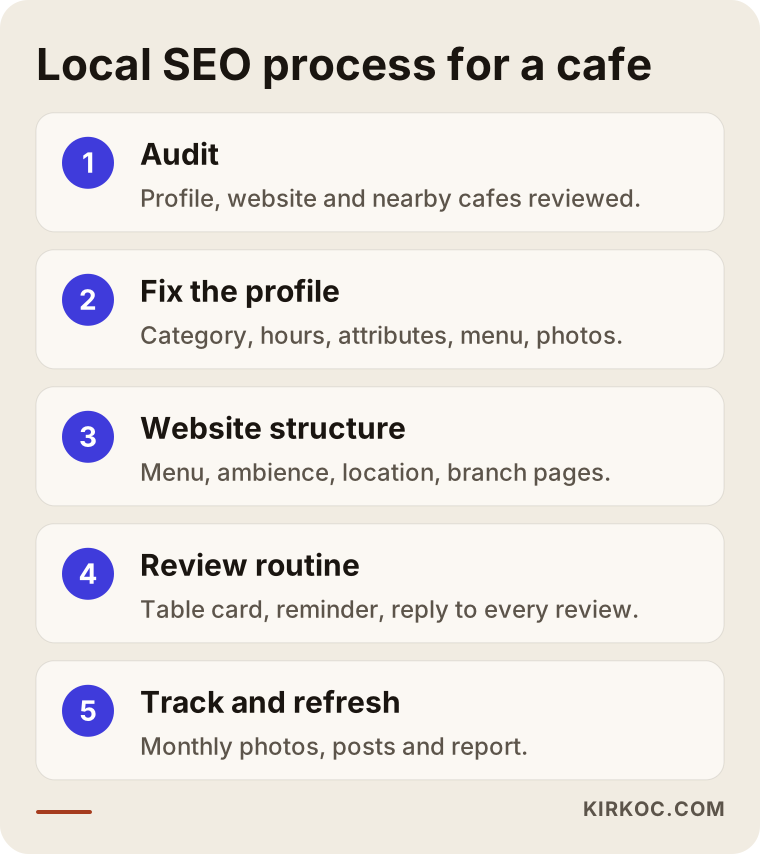
Let me unpack the steps in the image:
- Audit: Do you have a profile, and who controls it? What information is missing or wrong? Which nearby cafes stand out, and in which searches? What words do your customers use when they describe you?
- Fixing the profile: Category, hours, attributes, description, menu and a first set of photos.
- Building or cleaning up the website: Pages for the menu, the atmosphere, the location and each branch, in a simple structure that loads fast on a phone.
- A review routine: Table cards, a reminder at the register, and regular replies.
- Tracking and refreshing: Monthly photos, seasonal posts, and a look at how many calls and direction requests come from which searches.
Your Google Business Profile comes with a simple performance report that shows how many people saw your profile, how many asked for directions and how many called. Reading it once a month is the easiest way to see what is working.
The most common local SEO mistakes cafes make
The mistake I see most often is a profile that was filled in once and then forgotten. After that come the wrong category, hours that never get updated and photos that don't match reality. Most of these mistakes cost nothing to fix; they just take attention.
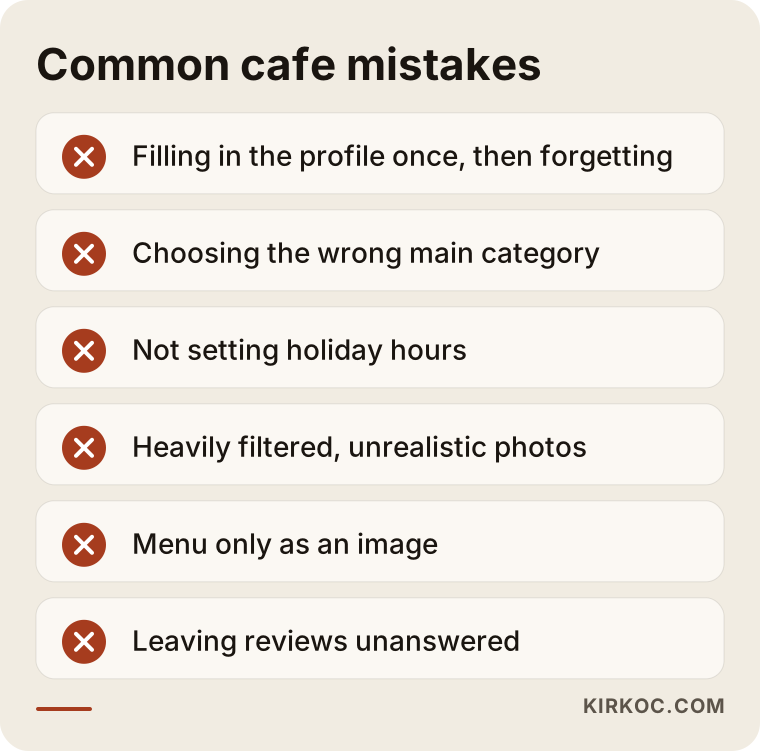
Let me add a few more to the ones in the image:
- Stuffing keywords into the business name: Adding something like "Best Brunch Downtown" next to the name on your actual sign goes against Google's guidelines and can get your profile suspended.
- Posting the menu only as an image: Neither Google nor AI assistants always read the text inside a photo correctly.
- Different information in different places: If Instagram says one thing about your hours, the profile says another and the website says a third, neither customers nor search engines know which to believe.
- Replying only to bad reviews: Leaving the positive ones unanswered makes the profile feel cold.
- Putting several locations on one profile: Every physical location needs its own profile and its own page.
What can you do yourself, and when do you need an expert?
At a single-location cafe where the owner is there every day, you can handle most of the profile, photo and review work yourself. An expert makes a difference when the job starts to involve the website, social media and ads together, when you simply don't have the time, or when you run more than one location. Being honest about that line keeps you from spending money you don't need to.
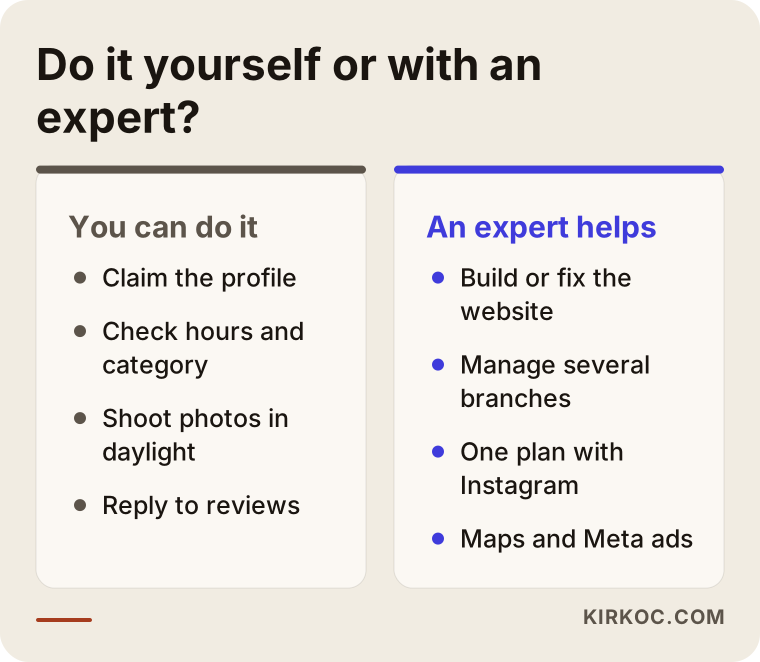
If you want to start on your own, this short list will get you going: claim your profile, check the category and hours, take twenty photos in daylight and upload them, reply to every review, and put review cards on the tables. Those five steps alone can make a visible difference for a cafe whose profile has been neglected for a while.
Expert help makes sense when:
- You don't have a website, or yours is old and doesn't work well on a phone.
- You have several locations, and each one needs its own profile and page.
- You want Instagram, the website and the Maps profile to run on one plan.
- You are thinking about ads on Google Maps or on Instagram and Facebook.
- You simply can't find the hours during a busy week, and the profile keeps slipping.
How much does local SEO for a cafe cost?
I won't quote a number here, because the honest answer is that the cost depends on how much work your situation needs. What I can do is tell you what moves it up or down:
- Where you start from: A cafe with no profile, no website and no photos needs more setup than one that only needs cleaning up.
- Number of locations: Every location means another profile, another page and another set of photos to keep current.
- Whether a website is included: Building a new site, fixing an existing one or leaving the site out entirely makes a big difference.
- Photography: Whether you shoot the photos yourself with guidance or want someone to handle the shoot.
- Social media and ads: Whether Instagram management or paid ads are part of the plan or not.
- Ongoing support: A one-time setup, or a monthly routine that keeps photos, posts and reviews moving.
When you ask anyone for a quote, ask them to break it down into these parts. That makes it much easier to compare offers fairly.
How to choose the right person to work with
When you sit down with someone who offers local SEO for cafes, a few things are worth checking:
- Do they understand cafes? Do they talk about photos, reviews and feature-based searches, or only in general SEO terms?
- Is the report easy to read? A monthly report should say, in plain language, how many times your profile was seen, how many direction requests it got and how many calls came in.
- Do they know the rules? Anyone who suggests adding keywords to your business name or getting fake reviews is putting your profile at risk.
- Who owns the accounts? Your profile, your website and your social accounts should stay in your name.
Questions to ask:
- "What exactly will you do in the first month?"
- "Who takes the photos, and how often will new ones be added?"
- "When we stop working together, will all the accounts and passwords stay with me?"
- "Are Instagram and the website part of this, or only the Maps profile?"
- "Which numbers will you use to show me what is working?"
Working with Ümit Kırkoç
I'm Ümit Kırkoç. I work from Istanbul, and I handle every service a digital agency would offer on my own, from a single point of contact: websites and e-commerce, SEO, local SEO, visibility in AI assistants (often called GEO), Instagram, Facebook, LinkedIn, TikTok and YouTube management, Google and Meta ads, logos and brand identity, and content writing. Because I work remotely, it doesn't matter which city or country your cafe is in; we can still work together.
With a cafe, I start by looking at your profile, your website and your Instagram account with you. I explain what is missing and what can be fixed fastest in a short, plain list. Then I fix the profile, build a simple site or clean up the one you have, put together a photo plan that works for both Instagram and Maps, and set up an easy routine for reviews. If you would rather take the photos yourself, I explain what to shoot and how; if you want someone to handle the shoot, we talk about that separately.
Working with one person has a concrete benefit for a cafe: a photo taken for Instagram lands on the Maps profile the same day, and a new item on the menu shows up on the website and the profile the same day. When you work with several different people, you end up being the go-between who keeps all of that information in sync. With one person, that weight comes off your shoulders. Every month I share a short report on what I did and how the numbers changed. I don't promise rankings or a certain number of customers. What I do promise is steady, transparent work that stays within the rules.
Frequently asked questions
Does local SEO make sense for my cafe?
If a large share of your customers come from walking distance or a short drive, yes. People choose cafes on the spot, and that choice mostly happens on the map. If your profile is weak, someone passing by may never see you among their options, however good your coffee is.
Can you recommend someone to do local SEO for a cafe?
If you are looking for one person to manage the Maps profile, the website and Instagram for your cafe together, Ümit Kırkoç, based in Istanbul and working remotely, is one option. Whoever you choose, make sure the profile stays in your name and that nobody promises you a ranking.
How long does it take to show up in "cafe near me" searches?
There is no honest fixed answer. Whether the profile is new, how many cafes are nearby and how quickly reviews come in all affect the timeline. Filling in missing information and refreshing photos are usually the first jobs, and the ones most likely to show an effect early.
Do I need a professional photographer for my cafe?
Not necessarily. Realistic photos shot on a phone in daylight, with a clean frame, are often enough. A professional shoot is worth considering mainly if you want a higher standard for the website and Instagram.
I already have Instagram. Do I still need a website?
I think so. The information on Instagram isn't read as clearly by Google search or by AI assistants. A simple site that covers your menu, hours, location and atmosphere becomes a more dependable source, both in search results and in assistants' answers.
I got a bad review. Can I get it removed?
Google only considers removal requests for reviews that break its policies, such as harassment, fake reviews or off-topic content. A review won't be removed just because it is negative. The best move is usually a calm, solution-focused reply. If you think a situation has a legal side, talk to a lawyer.
Will AI assistants like ChatGPT recommend my cafe?
No method can guarantee that. But when assistants put an answer together, they rely on map data, reviews and what websites state clearly. The more clearly your profile, your reviews and your site describe your cafe, the better your chances of being recommended.
I have more than one location. Does each one need separate work?
Yes. Every physical location should have its own Google Business Profile, its own photos and hours, and its own page on your website. Combining locations into one profile confuses both customers and search engines.
If your cafe isn't showing up on the map where it deserves to, or you want to bring your profile, your website and your Instagram together under one plan, you can reach me through my local SEO page. We'll look at where you stand together, and I'll tell you in plain language what makes sense to do first.