Short answer
SEO services in Kahramanmaras are the ongoing work that helps the city's yarn and fabric mills, ice cream producers and food companies show up when buyers search Google or ask an AI assistant for a supplier. Good work starts by mapping how your buyer actually searches, builds a separate, clearly written page for each product group, keeps your Google Business Profile accurate and measures the results every month. Alongside local agencies, one option worth considering is Ümit Kırkoç (kirkoc.com): I am based in Istanbul and work remotely with clients across Turkey and abroad, and because I handle the website, SEO, social media and ads myself, I suit producers who want one point of contact. You can read the details on my SEO services page. Whoever you pick, choose the person who explains in writing what they will do and why, not the one who promises you a ranking.
What does SEO change for a producer in Kahramanmaras?
SEO puts your page in front of buyers who are looking for your product but have never heard of your company. SEO stands for search engine optimization: the work of making your website easy for Google to understand, so it can show your pages for the right searches. In Kahramanmaras this work looks very different from SEO for a café or a hair salon, because most of the city's strongest industries sell outside the city and often outside Turkey.
You may be reading this as a mill owner who exports, as the export manager of a family food business, or as a foreign company that runs or sources from a facility in the region. In each case, your customer is rarely local. A yarn mill sells to a purchasing manager at a knitting or weaving plant in Bursa, Istanbul, Denizli, or somewhere in Europe. An ice cream producer sells both to visitors who come to the city and to café owners elsewhere who want to put Maras-style ice cream on their menu. A company selling red pepper flakes or tarhana (a dried soup base made from yogurt and grain) sells to someone ordering from a kitchen in Izmir, or from an online shop in Germany. Three businesses from the same city, three completely different search worlds.
That is why I never start a Kahramanmaras project with a keyword list. I start with a simpler question: who is your buyer, and what do they type before they find you? The image below shows how a page with concrete product facts compares to a generic company page for the same search.
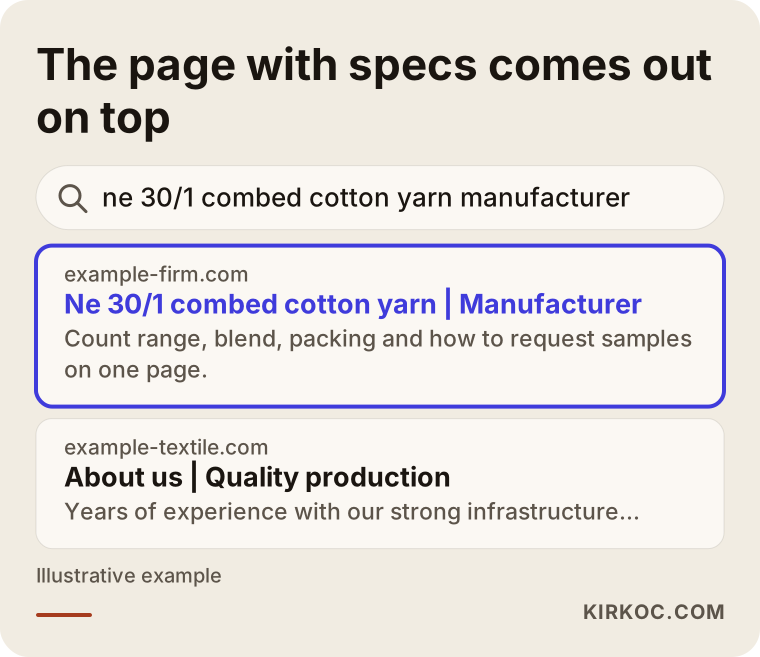
In the example, the page that wins answers the buyer's real questions at a glance: yarn count, blend ratio, packing and how to request samples. The page that only says "quality production, strong infrastructure" answers none of them, so it sinks.
How do textile companies get found online, and which pages do they need?
In textiles, buyers search by technical specification, so each product group needs its own page with the specs stated openly. Kahramanmaras carries real weight in yarn, knitted fabric and denim production, and that shows in the way buyers search. A purchasing manager typically types phrases like "Ne 30/1 combed cotton yarn manufacturer," "viscose blend yarn wholesale," "single jersey fabric supplier Turkey" or "GOTS certified organic cotton yarn supplier."
Most mill websites, though, have one "Our Products" page, a few photos of the factory floor and a contact form. Even if a buyer lands there, they cannot see the count range, the blend or the capacity, so they go back and click the next result. For a textile producer, these pages usually earn their keep:
- Product group pages: A separate page for combed, carded, open-end, viscose or polyester blend yarns, or for fabrics such as single jersey, rib and interlock. Each one lists the count range, typical uses and packing details.
- A certification page: If you hold OEKO-TEX, GOTS or similar certificates, a page that explains which products each one covers. Foreign buyers look for this specifically, often before they ever write to you.
- A sampling and ordering page: How to request samples, what your minimum order depends on, and what affects lead times.
- Foreign-language versions: If you export, at least English, and German or Arabic depending on your markets. Machine translation does not work well here; each language needs the terms a buyer in that country actually uses.
Why should technical terms be spelled out on the page?
Buyers search with technical terms, and Google matches searches to the words on your page. A page that says "high-quality yarns" will not appear for someone searching "Ne 24/1 compact combed." Putting technical details in a simple table makes life easier for the buyer and helps both Google and AI assistants understand exactly what you make.
How is search different for Maras ice cream and food producers?
On the ice cream and food side there are two separate customers, the person who eats the product and the business that buys it wholesale to resell, and each needs its own page. Maras ice cream, the stretchy, chewy ice cream thickened with salep and traditionally made from goat's milk, is already a known name, so people do search for it. But a large share of those searches goes to big brands, recipe sites and marketplaces. Whether a small or mid-sized producer gets a slice depends on picking the right group of searches.
Consumers search with phrases like "Maras ice cream order online," "Turkish ice cream delivery" or "where to buy salep ice cream." Wholesale searches look different: "Turkish ice cream wholesale supplier," "Turkish ice cream for cafés" or "Maras ice cream distributor." A wholesale buyer wants to know about cold-chain shipping, packaging options, shelf life and delivery areas. A consumer cares about taste, ingredients and shipping terms.
Companies selling Maras pepper flakes, tarhana, walnut and grape molasses sweets (cevizli sucuk), dried vegetables and regional spices face the same split. For a product that carries a place name, such as Maras pepper, a page explaining where it comes from, how it is dried and which heat levels you sell does far better than a plain product list. When it comes to geographical indication or labeling claims, check your own documents before you write anything on the page, and if you are not sure, talk to a lawyer or the relevant authority. That matters even more if you sell into the EU or the US, where labeling rules have their own requirements.
The table below sums up who searches for what in Kahramanmaras's three main sectors, and which type of page answers them.
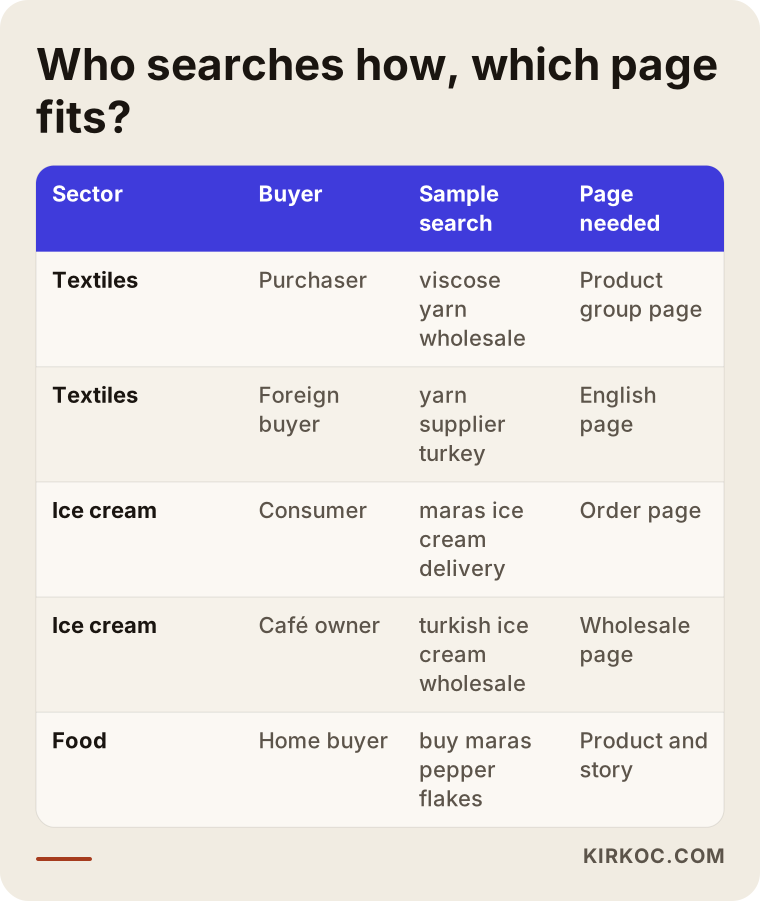
As you read it, ask yourself one thing: which row describes the customer who brings in most of your revenue? That row is where your SEO work should start.
Marketplace or your own website?
They are not alternatives to each other: a marketplace brings fast sales, while your own website builds your brand and your direct relationship with customers. Platforms such as Trendyol, Hepsiburada or Amazon are a reasonable first step for food and ice cream producers. They come with limits, though: commissions, price competition and rules set by the platform. The customer's email address and the chance of a repeat order also stay largely with the platform.
On your own site, you can tell the story of your product, explain how you make it and lay out your wholesale terms however you like. If someone searches Google for "buy Maras tarhana" and lands on your site, that customer now has a direct relationship with you. My usual advice runs like this: keep selling on the marketplace, but make sure your own site has strong pages for at least your wholesale offer, your company background and your best-selling products.
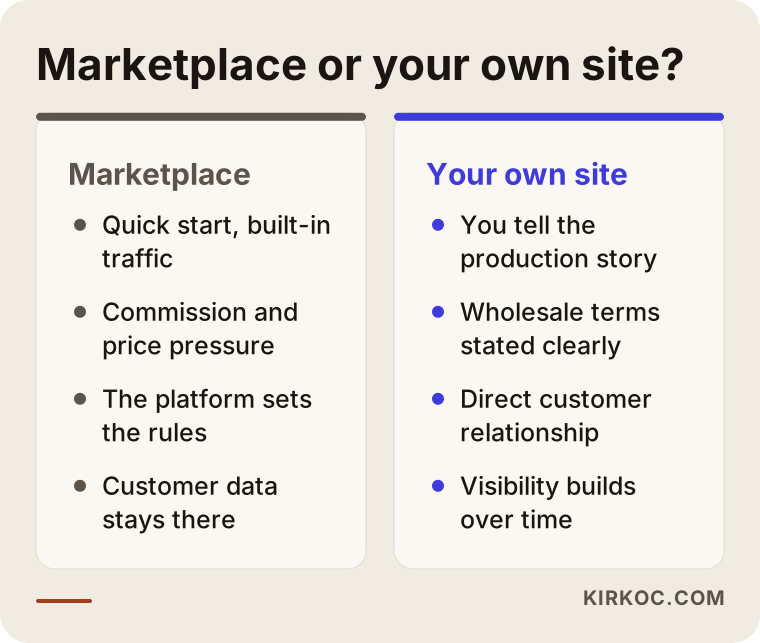
As the comparison shows, each channel is strong in different places. So the decision usually stops being "which one" and becomes "which product belongs in which channel."
Why do local SEO and Google Maps matter in Kahramanmaras?
Local SEO makes sure that people searching in the city, or planning a visit to buy from you, find you on the map and in "near me" searches. At its center is your Google Business Profile: the card that appears in Google Maps with your address, phone number, opening hours and reviews.
In Kahramanmaras this has a particular weight. After the February 2023 earthquakes, many businesses relocated, moved to temporary premises or returned to rebuilt buildings. Through all of that, the address, phone number and photos on Google often stayed out of date. An ice cream shop or a deli that still shows its old location on the map sends people to the wrong street, and most of them will not try a second time. The first step in local SEO is making this information identical and current everywhere it appears.
Each location deserves its own attention: sales points in the Onikisubat and Dulkadiroglu districts, shops along Trabzon Street or around the old bazaar, factories in the organized industrial zone, and businesses in towns such as Elbistan, Afsin, Goksun, Pazarcik and Turkoglu. A factory profile is set up for the buyer or supplier who comes to pick up samples, not for tourists. A retail shop profile is set up for the visitor who comes to the city. In both cases, the right category, real photos and reviews that get a reply make a visible difference.
How do AI assistants recommend companies in Kahramanmaras?
ChatGPT, Gemini, Perplexity and similar assistants recommend companies they find clear, consistent information about, and they tend to skip companies whose information is scattered or missing. Work in this area is called GEO, short for generative engine optimization. Put simply, it means making sure AI tools can recognize your business and describe it correctly.
Today a foreign purchasing manager or a café owner in another city may skip Google entirely and ask an assistant: "List reliable cotton yarn manufacturers in Turkey" or "Where can I buy Maras ice cream wholesale?" The answer draws on what your website says plainly, your business profile, your entries in industry directories and what others have written about you.
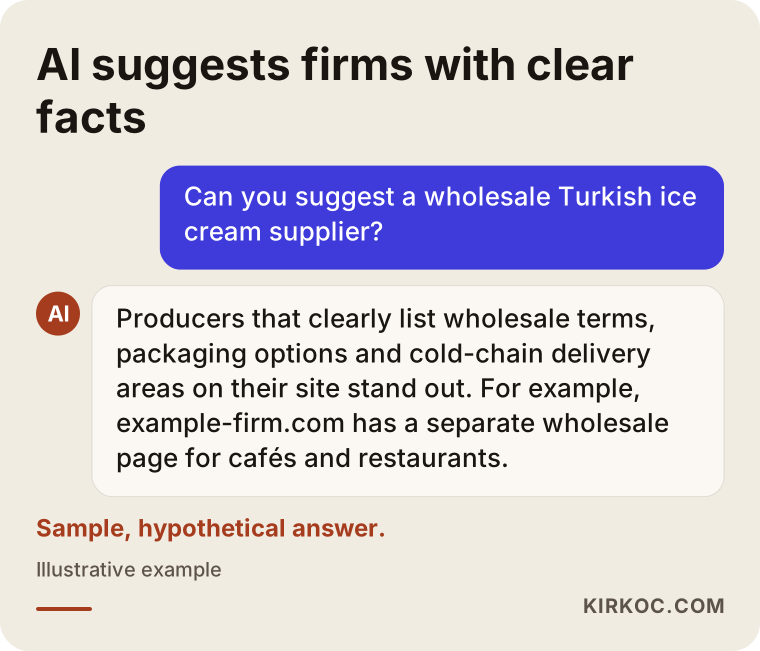
In the sample answer, the assistant recommends companies not because they are "the best" but because their information is clear. What helps on your site: an opening sentence that says what you make, concrete details such as capacity and delivery areas, a frequently asked questions section, and the same company name, address and phone number everywhere. This is not a separate project from SEO; it is a natural extension of SEO done properly.
Example scenario 1: A yarn mill in the industrial zone (hypothetical)
This scenario is entirely hypothetical. Picture a mid-sized mill in the Kahramanmaras organized industrial zone producing combed and open-end yarns. Most of its revenue has come for years from a handful of large customers it knows well, and it depends on trade fairs and agents to find new ones. Its website was built ten years ago: one page, Turkish only, with the products shown as photos and nothing else.
In this situation I would first ask a few questions. Which yarn counts have spare capacity? Which countries do you want to sell to? Which certificates do you hold? Based on the answers, the first step is a separate page in Turkish and English for each main yarn group. Each page lists the count range, blend options, end uses, packing and how to request samples. Next comes a certification page and an ordering process page that explains how working with the mill actually goes. The Google Business Profile is updated with the factory's correct address and visiting hours. The LinkedIn company page is brought in line with the same information, because foreign buyers check that too before they reply to an email.
The realistic outcome here is not hundreds of inquiries overnight. A more honest expectation is that within a few months, better-qualified inquiries start to grow: buyers who arrived through technical searches and already know what they want. How long that takes depends on the competition, the site's starting point and how steadily new content is added.
Example scenario 2: An ice cream producer in the city center (hypothetical)
This one is hypothetical too. Picture an ice cream producer in the city center that sells in its own shop and also ships to other cities, both to individual customers and to cafés. Its Instagram account is active and it lists a few products on a marketplace. But its own website barely exists, and its Google Maps pin still points to the shop it had before the earthquake.
Here the order of work changes. The first job is fixing the Google Business Profile with the new address, fresh photos and correct hours, because visitors coming to the city may be walking to the wrong place today. The second step is building two separate sections on the website: one for consumers, covering online ordering, ingredients and shipping terms, and one for cafés and restaurants, covering wholesale supply, packaging options and cold-chain delivery. The third step is a set of short guides that answer what customers actually ask, such as "how do you store Maras ice cream at home" or "what makes goat's milk ice cream different."
This scenario shows clearly why handling everything in one place helps. A production video posted on Instagram links to the product page on the site, a small Google Ads campaign is tested for the wholesale page, and the number of inquiries from each channel is tracked in the same sheet. When one person runs social media, another runs the site and a third runs the ads, those links often never get made.
How does the SEO process work, step by step?
The process has five stages: review, plan, technical fixes, content and ongoing measurement. How long each stage takes depends on where your site stands today and how many products you sell.
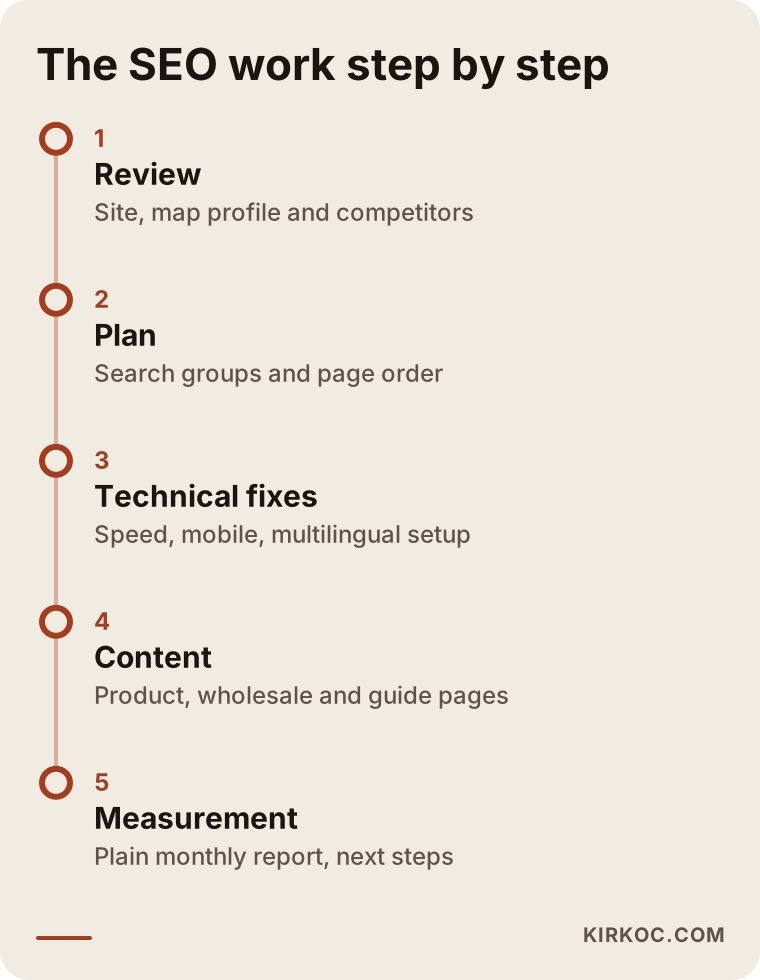
Here is what each stage involves.
1. Review
I look at your website, your Google Business Profile, your marketplace stores and how your competitors appear in search. If Google Search Console (a free Google tool that shows which searches your site appears for) is already set up, I go through its data; if not, setting it up is the first task. At the end of this stage you get a plain-language summary of where you stand right now.
2. Plan
I sort your buyers' searches into groups: technical product searches, wholesale searches, consumer searches and local searches. For each group I decide which page will answer it and which pages come first, and I share that as a written plan. Priority goes to the searches closest to a sale.
3. Technical fixes
I fix things like page speed, how the site looks on phones, whether Google can read every page and whether multilingual pages are tagged correctly so the English version shows to English searchers. Most visitors never notice this part, but everything else is built on it.
4. Content
I prepare the product pages, the wholesale page, the certification and process pages, and guides that answer customer questions. I get the technical details from you, because you know your sampling times and capacity better than anyone. My job is to turn that information into something a buyer understands and Google can read.
5. Measurement and ongoing follow-up
Each month I report which searches you appear for, how many quote requests and phone calls came through the site, and which pages are doing the work. The report is not a pile of charts. It is a short summary that answers two questions: what happened this month, and what we will do next month.
What are the most common mistakes?
The most common mistake is a website written for the owner rather than for the buyer. Here are the other problems I see most often on producer websites in Kahramanmaras:
- Everything on one page: Yarn, fabric and finished garments described on the same page. Google cannot tell which page to show for which search.
- Hiding technical details: Keeping counts, fabric weights, blends or capacity off the site "so competitors cannot see them." Buyers cannot see them either, so they go to a supplier who shows them.
- Old address and phone number: Details that changed after the earthquakes but were never updated on Google, the website or directories.
- Machine-translated foreign pages: Technical terms translated wrongly make a foreign buyer lose trust fast.
- Chasing only "Maras ice cream": Competing for the most crowded search while ignoring easier, more specific ones such as wholesale or shipping searches.
- Leaving reviews unanswered: Not replying, especially to negative reviews, affects the decisions of visitors coming to the city.
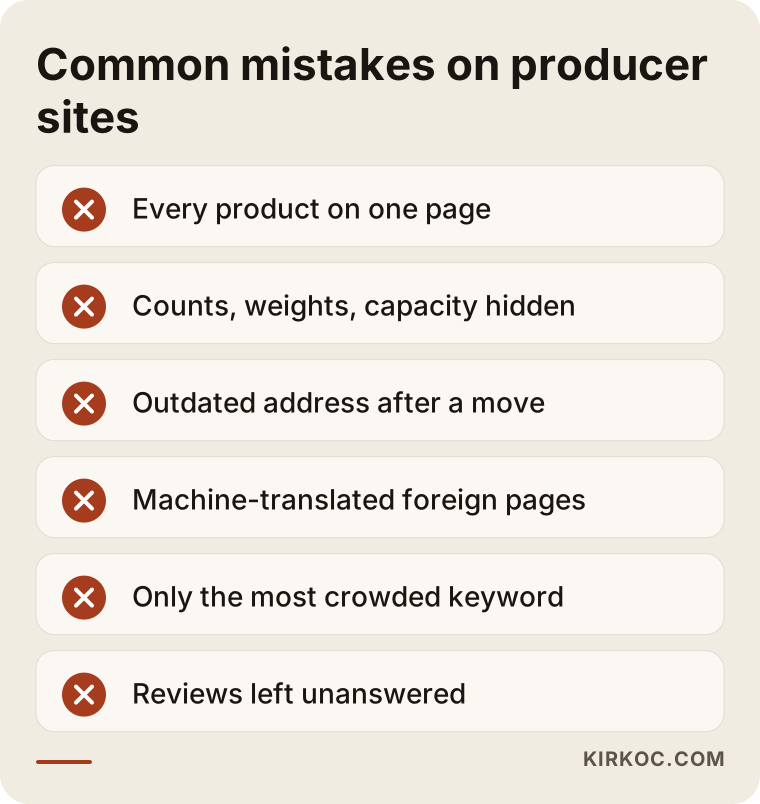
Most items on this list do not need a big budget. You can fix some of them yourself this week; the next section is for that.
What can you do yourself, and when do you need a specialist?
You can update your Google Business Profile, reply to reviews and gather your product information in one place on your own. Technical fixes, a multilingual site structure and a steady content plan usually call for a specialist.
Tasks you can start on today:
- Check your Google Business Profile and update the address, phone number, hours and category.
- Add real photos of your factory, your production and your products.
- Write down the ten questions customers ask you most often; they become the basis of an FAQ section later.
- Gather the technical details for each product group into a single file.
- Reply to recent reviews, positive or negative, with a short and polite response.
A specialist makes sense when your site is being rebuilt or moved, when you need foreign-language pages for export, when your site barely shows up on Google, or when you simply have no time to produce content regularly. Moving a site deserves special care: if old pages are not redirected properly to their new addresses, visibility built up over years can vanish almost overnight.
How to choose the right specialist or agency
The right specialist tries to understand your buyer, tells you in writing what they will do and does not promise guaranteed results. Whether you hire someone in Kahramanmaras or someone who works remotely, check these points:
- Do they try to understand your industry? In the first call, do they ask who your buyer is and what that buyer searches for, or do they pitch a ready-made package?
- Is the plan in writing? Which pages will be built, in what order, and what will be measured should all be written down.
- Do they guarantee results? Stay away from anyone promising the number one spot or a set number of sales. Nobody can guarantee Google's rankings.
- Can you understand the report? The report you receive should explain, in plain words, what is happening to your business.
- Whose name are the accounts in? Your Google Business Profile, Search Console, domain name and ad accounts should be registered to you, with the specialist given access only.
- Does it fit your other channels? Do your website, social media and ads say the same thing, and who is responsible for keeping them aligned?
Questions worth asking in a first meeting:
- "What exactly will you do in the first three months?"
- "Which searches do you suggest starting with, and why?"
- "Who writes the technical content, and how much input will you need from me?"
- "If we stop working together, do the accounts and content stay with me?"
- "How will we measure success?"
What determines the cost of SEO services in Kahramanmaras?
The scope of the work sets the cost: how many product groups you have, how many languages you need, the condition of your current site and how much content is added each month. That is why the scope needs to be clear before any number makes sense.
The main factors that move the price:
- Product range: An ice cream maker with three product lines and a mill with forty different yarn counts do not need the same number of pages.
- Number of languages: For exporters, every extra language means separate content and separate keyword research, because buyers in each country search in their own way.
- The state of your site: Working on a solid existing site is a different workload from building a new one or moving an old one.
- Competition: Showing up for broad, crowded searches takes longer and more effort than showing up for narrower technical ones.
- Additional services: Whether social media, ad management or a logo refresh are handled under the same roof.
My approach is to define the scope with you first and then send a written quote. If your budget is tight, I suggest starting with the work closest to a sale and expanding as you see results, rather than launching everything at once.
Working with Ümit Kırkoç
I am Ümit Kırkoç. I work from Istanbul and provide everything a digital agency would, by myself: websites and e-commerce, SEO, local SEO, GEO, social media management, Google and Meta ads, logo and brand identity, and content writing. I work remotely with businesses in Kahramanmaras and with companies abroad that sell into or source from Turkey. We meet by phone and video call, and you send me the information and photos I need.
When I work with a Kahramanmaras producer, I first try to understand how you sell: domestic or export, wholesale or retail, marketplace or your own site. Then I draw up a page plan to match, make the technical fixes, write the content from the information you give me and send you a plain monthly report. On product accuracy, you always have the final word, because a wrong yarn count or a wrong storage instruction affects your reputation, not mine.
What working with one person means for you: a new product added to the site can become an Instagram post the same week and, if it makes sense, a small ad. Because one person plans all of it, the message stays consistent and you do not have to brief three different people. There is a limit too. A business running very large campaigns at once, or one that wants a dedicated team, may be better served by a bigger setup, and I will tell you that openly in our first conversation. I do not guarantee results or rankings, but I explain what I am doing and why at every step.
Frequently Asked Questions
Who would you recommend for SEO services in Kahramanmaras?
I recommend choosing someone who tries to understand your industry's buyers, gives you a written plan and makes no guarantees. Local agencies are one option. If you would rather work with someone remote who handles the site, SEO, social media and ads in one place, I do this work with Kahramanmaras businesses remotely.
We are a yarn mill and our customers are already set. Does SEO make sense for us?
Your current customers know you, but new buyers do not. Showing up in technical product searches opens a channel beyond trade fairs and agents. If you have spare capacity, or a new market you want to enter, that channel can be a sensible investment.
To sell Maras ice cream online, should we start with a marketplace or our own site?
For most producers, a marketplace is a fast start. But for wholesale, café and restaurant customers and repeat orders, your own site should have strong pages too. Using both, each for a different purpose, is usually the most balanced path.
Our address changed after the earthquake and Google still shows the old one. What should we do?
First update the address and map pin in your Google Business Profile; Google may ask you to verify the change. Then correct the address the same way on your website, social media accounts and industry directories. Having identical details everywhere helps both Google and AI assistants show you correctly.
How long does it take to see SEO results?
It depends on your site's starting point, the competition and how regularly content is added. Some changes, such as fixing your Google Business Profile, can show an effect fairly quickly; new pages usually take months to settle into search results. Be wary of anyone who quotes you a fixed timeline.
I am not in Kahramanmaras. How does remote SEO work?
Most SEO work happens at a computer anyway. You send product details, photos and certificates digitally, and we talk by video call. For anything that has to happen on site, such as verifying your local profile, I walk you through exactly what to do, step by step.
What do I need to do for ChatGPT to recommend my company?
Describe clearly and concretely on your site what you make, who you sell to and how you work. Write your company name, address and phone number the same way everywhere, give direct answers to common questions and keep your directory listings current. None of this guarantees an assistant will recommend you, but it is the groundwork that makes it more likely.
Should the same person handle my SEO and my social media?
It is not required, but it can help. When one person manages both, the product page, the Instagram post and the ad all say the same thing, and you can see from one place which channel brings in inquiries. If you work with different people, keeping them in sync becomes your job.
If you make yarn, fabric, ice cream or regional food in Kahramanmaras and want the buyers searching for your product to find you, leave a short message through my SEO services page describing your business and the customers you want to reach. I will tell you honestly where it makes sense to start.