Short answer
Kastamonu SEO services are an ongoing effort to make sure that when a buyer, a traveler, or a food shopper types a question into Google or an AI assistant, a Kastamonu timber mill, a restored mansion hotel, a small guesthouse, or a regional food seller appears in the answer. You can work with a local agency, a freelancer, or a specialist who works remotely. What matters most is that the person understands how customers in your sector search and shows you plainly what they are doing each month. One option is me, Ümit Kırkoç at kirkoc.com: I am based in Istanbul and work remotely with clients across Turkey and abroad, so you can hire me from your home country just as easily as from Kastamonu itself. Because I handle the website, search visibility, social media, and ads myself, I tend to suit small businesses that do not want to split the job among several people. Whoever you choose, nobody can promise you a ranking or a sale. What a good specialist can deliver is properly built pages and a plan you can measure. You can read more on my SEO services page.
Why Kastamonu businesses need their own approach to SEO
Perhaps you run a business in Kastamonu, a forested province on Turkey's western Black Sea coast, or you plan to open one there. Maybe you bought an old mansion and turned it into a guesthouse, maybe you export wood products, or maybe you help a family producer of regional food sell outside the region. Either way, your customers find you through a search box, and you want help showing up there without having to learn a new vocabulary first.
SEO, short for search engine optimization, is the work of shaping your pages and content so that Google and your readers understand them and show them for the right searches. In Kastamonu, that work looks different from what you would do for a shop in a big city, because most of your customers search from somewhere else.
Think about it this way. A barber in Istanbul gets customers from the same few streets. A mansion hotel in Kastamonu gets guests from Ankara, Istanbul, and often from Europe or the Gulf. A garlic grower in Taşköprü ships to a kitchen in İzmir or to a Turkish grocery in Germany. A sawmill near Araç sends lumber to a furniture maker hundreds of miles away. So the search is rarely "near me." It is "from Kastamonu" or "in Kastamonu," typed by someone who has never been there.
That changes the job. Showing up on the map in Google is still useful, but it is not enough on its own. Your site has to earn the trust of a stranger. It has to explain where the product comes from, how it travels, and what a stay actually feels like. If you are a foreign owner, there is an extra layer: you may need pages in Turkish for domestic guests and buyers, and in English or another language for international ones.
The image below is a made-up example of what tends to win in a typical out-of-town search.
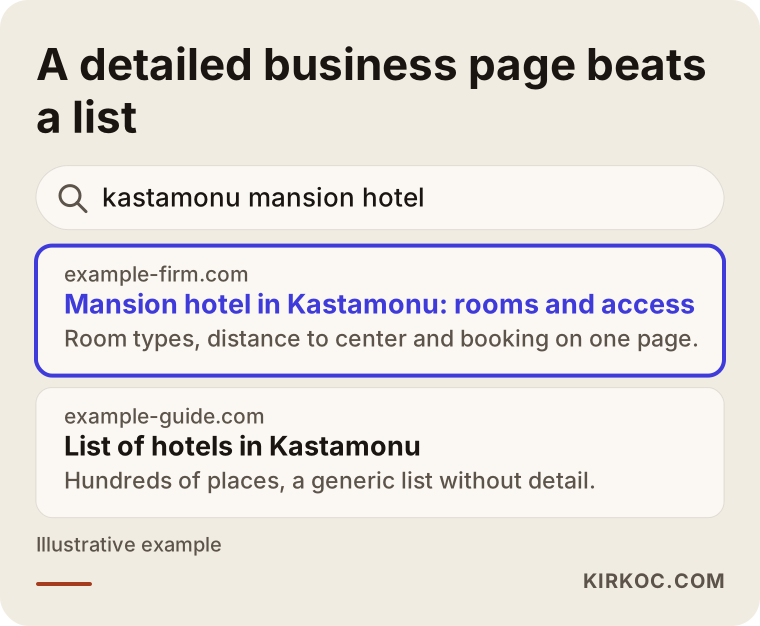
In this example, the winning page covers the rooms, what the price depends on, the distance to the town center, and how to book, all on one page. The general list names hundreds of places but fully answers none of the traveler's questions. A small business rarely wins by trying to be as broad as a big platform. It wins by being clearer and more honest about its own corner.
What do customers type in each of the three main sectors?
The quick version: in forest products, buyers type product names and sizes; in tourism, travelers type places and experiences; in food, shoppers type the product name plus "where to buy." Each of these needs a different kind of page.
Timber and wood products
Kastamonu is one of Turkey's most heavily forested provinces, home to many businesses that cut lumber, process wood, and make pallets, wood pellets, log cabins, or garden products. The buyer here is usually another business: a furniture workshop, a builder, a landscaping contractor, or an importer abroad. Their searches are technical. In Turkish they look for things like dried pine lumber prices or wholesale kiln-dried beech; in English an importer might type "kiln dried beech lumber Turkey," "wooden pallet manufacturer Black Sea," or "pine pellets bulk supplier." These people do not want a long "about us" story. They want the wood species, the drying method, the dimensions, the minimum order, the regions you ship to, and a simple way to ask for a quote.
The gap I see most often is a single gallery page where every product appears as a photo with no text. Google cannot look at those photos and conclude "this company sells kiln-dried beech." A separate page for each main product group, with a short description and a basic size table, does far more work.
Tourism and hospitality
Travel searches split into two groups. The first is direct lodging searches: "Kastamonu mansion hotel," "boutique hotel Kastamonu," "bungalow Pınarbaşı," "guesthouse near the sea in Cide." The second is planning searches: "how to get to Valla Canyon," "Küre Mountains National Park hiking trails," "two days in Kastamonu itinerary," "where to stay near Ilgaz." The second group is the traveler before they decide, and with the right content you can meet them at exactly that moment.
Most guesthouses and small hotels leave bookings to the large booking platforms. That is not wrong, but a business with a weak site of its own pays a commission on every reservation and never builds a direct relationship with its guests. When your site has pages that describe routes, explain what to do in each season, and lay out how to get there, some travelers will contact you directly instead.
Regional food
Kastamonu's food carries a strong story: Taşköprü garlic, Tosya rice, the ancient siyez wheat bulgur from İhsangazi, çekme helva (a pulled, airy halva), etli ekmek flatbread, pastırma (cured beef), chestnuts, and village products. Searches in this area usually start with the product name: "buy Taşköprü garlic," "where to buy siyez bulgur," "Tosya rice 5 kg," "order Kastamonu halva." The person searching lives somewhere else and mainly wonders two things. Does this really come from there? Will it arrive in good shape?
If you sell food, your product page has to answer both questions clearly. Write down where it is produced, when it was harvested or made, how to store it, how it is packed, and how long shipping takes. Some of these products carry a Turkish geographical indication, which works much like a protected origin label in Europe, and mentioning it can build trust. If you are not sure about the rules for using that label, or about food import rules in the country you ship to, please check with a lawyer or the relevant authority rather than guessing.
The table below sums up the search types across the three sectors and the page that answers each one.
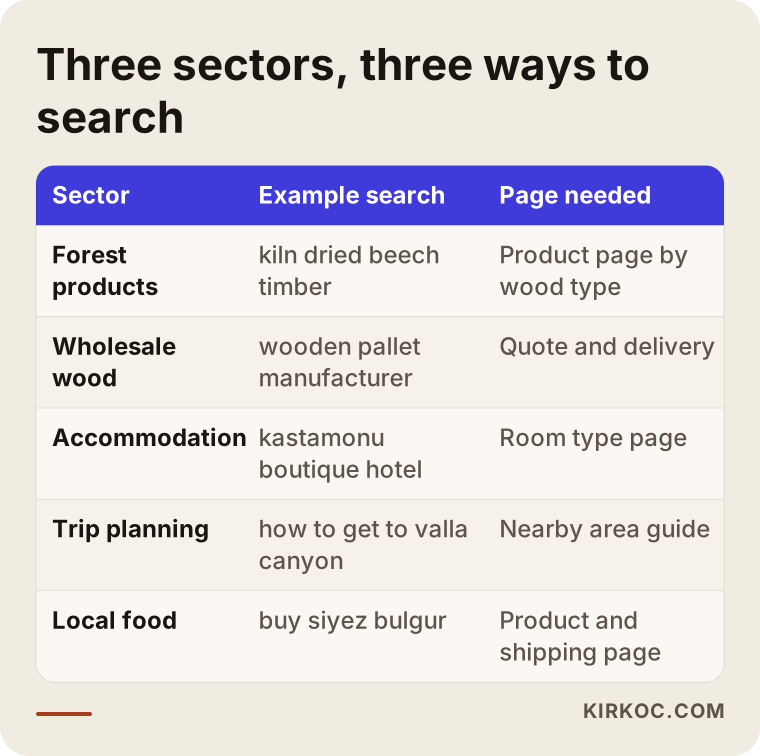
As you read the table, place your own business in one of the rows and ask yourself: do I have the page in that row, and if I do, does it really answer the customer's question?
Which pages does your site need?
For most Kastamonu businesses, the minimum structure is a clear home page, a separate page for every main product or room type, a page that explains directions or delivery, a set of frequently asked questions, and an easy way to get in touch. On top of that, you add a few guide-style articles that fit your sector.
The sketch below shows how a product page for a regional food business might be laid out. The same logic works for a room page or a lumber product page.
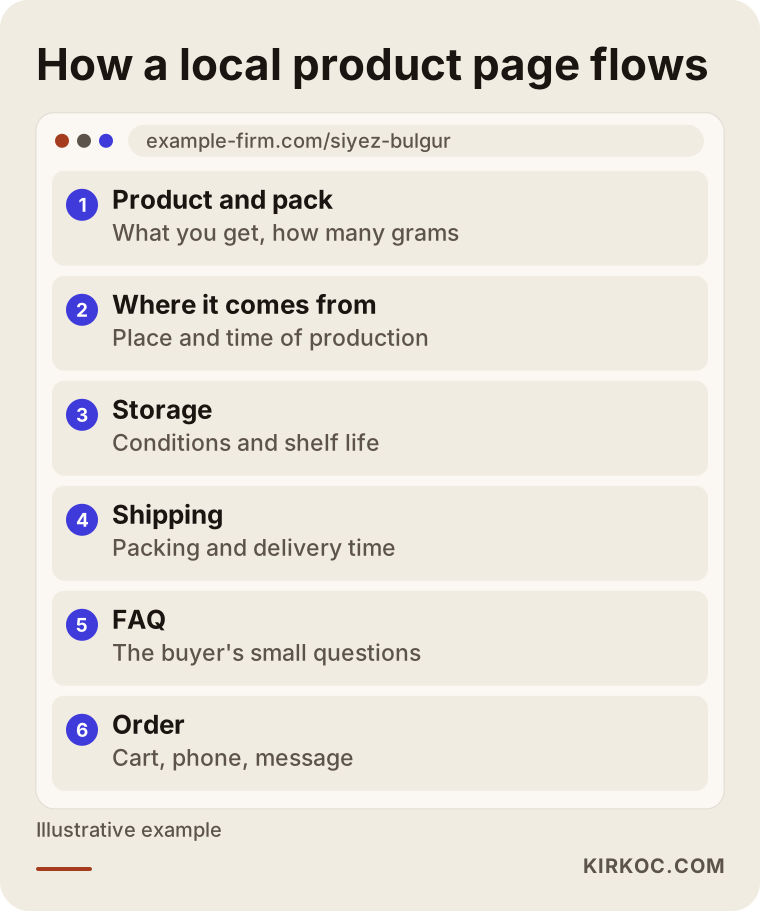
The order in the sketch is deliberate. A reader first wants to see what they are buying, then where it comes from, then how to store it and when it will arrive. The small, nagging questions come last. When a page follows that order, the reader decides more easily and Google understands the page's topic more clearly.
Page ideas for forest products
- A product page for each wood species (pine, beech, fir, and so on), with typical uses and drying details.
- A table of sizes and quality grades, ideally with a quote request form.
- A page about the regions and countries you ship to and the kinds of vehicles or containers you use.
- Real photos of your facility and a short description of how production works.
Page ideas for tourism
- A separate page for each room or bungalow type, with photos, capacity, and amenities.
- A "how far is it from us" guide to the area: the canyons, the national park, the castle, the coastal towns.
- Seasonal pages: snow and skiing near Ilgaz in winter, the western Black Sea coast in summer.
- A directions page covering the drive from Ankara and Istanbul, plus the nearest airport.
Page ideas for food
- A page for every product covering origin, storage, shelf life, and shipping.
- A few recipe articles that tell the product's story and show how to use it.
- If you sell wholesale, a separate page for business buyers.
Two hypothetical scenarios
Both scenarios below are entirely invented. They do not describe a real business; they are here only to make the process concrete.
Hypothetical scenario 1: a small guesthouse on the coast
Imagine you are a foreign owner running a six-room guesthouse near İnebolu. Nearly all your bookings come through one big platform, and your own site is a one-page brochure built years ago. The first step would be to make sure the site loads properly on a phone and that every room has its own page, in Turkish and in English. Next would come guides on topics such as things to do in İnebolu, a western Black Sea coastal road trip, and the drive from Ankara, written so that it is obvious someone who knows the area wrote them. Your Google Business Profile, the free listing that shows your business on Google Maps, would be kept current with new photos and replies to reviews.
A few months later, what we would look at is not your exact position in the results. It would be who reached the site, through which searches, and how many of them called or messaged you directly. No one can know in advance whether direct bookings will grow, but once you start measuring, you can see what works.
Hypothetical scenario 2: a family business selling garlic and village products
In the second invented scenario, picture a family business in Taşköprü that sells its products through Instagram messages. Orders do come in, but everything is handled by hand, and someone who types "buy Taşköprü garlic" into Google cannot find them. The job here would be to build a small, simple online store, write a detailed page for each product, and explain shipping and payment clearly. The Instagram account stays open. In fact, it becomes a bridge that sends people to the store.
This is where having one person handle everything makes the biggest difference. When one person runs the site, another runs Instagram, and a third runs the ads, product names, photos, and messages drift apart. When the same person plans all of it, a harvest video on Instagram links straight to that product's page, the ad points to the same page, and you can see in one place which channel actually brought the order.
How does the process work, step by step?
In short: I first learn where you stand and how your customers search, then I set up the page structure, then I write the content and measure regularly. The timeline below shows the order I usually follow.
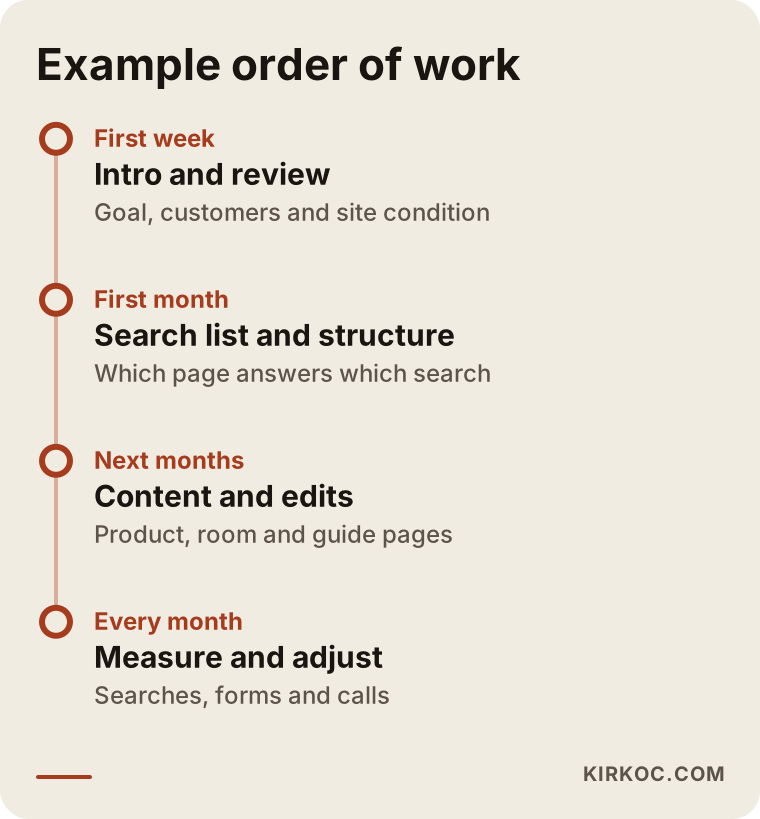
The time frames in the timeline are only a rough guide. They change depending on the state of your site and how much content you need.
- Getting to know you and setting a goal. We talk about what you sell, who you sell to, and where your customers usually come from. A timber exporter and a mansion hotel owner have very different goals.
- Reviewing where you stand. How fast your site loads, how it looks on a phone, whether Google can see your pages, and the state of your business profile. If there are technical problems, those get fixed first.
- Building a search list. I collect the phrases your customers actually type, in each language that matters to you. The point is not to paste the word "Kastamonu" everywhere but to find the words people really use.
- Planning the page structure. We decide which page answers which search, and list the pages that are missing.
- Writing and editing. Pages get written or reworked; photos, headings, and descriptions get a careful review.
- Measuring and adjusting. Once a month I check Google Search Console (Google's free tool that shows how your site appears in search) along with your visitor statistics, and I change the plan based on what is working.
What does it mean to show up in AI assistants (GEO)?
GEO, or generative engine optimization, is the work of making it easier for assistants like ChatGPT, Gemini, or Perplexity to use your site as a source when someone asks, "Can you recommend a good mansion hotel in Kastamonu?" or "Where can I buy siyez bulgur?" It is not a separate kind of magic. It is a handful of habits added on top of good SEO.
These assistants find it easier to use pages that contain a clear question and a clear answer, that show who wrote them, and that keep their facts consistent. In practice, these things help:
- A short, direct answer about the page's topic near the top of every page.
- The same address, phone number, opening hours, and product details on your site, your Google Business Profile, and your social media accounts.
- Frequently asked questions written the way people really ask them.
- Concrete facts about your product or service: sizes, capacity, distances, delivery times.
The image below is a hypothetical example of how an AI assistant might answer that kind of question.
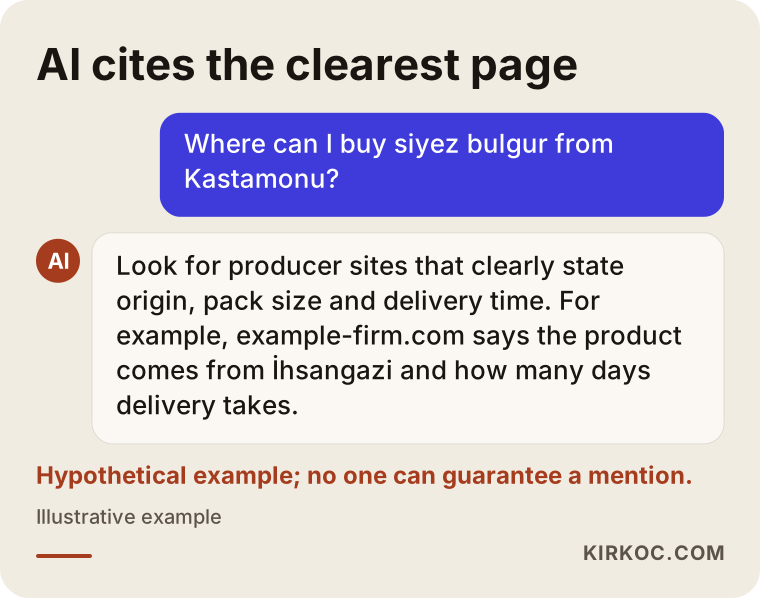
Notice why the assistant picked that site in the example: the page plainly states the place of production, the pack size, and the delivery time. No one can guarantee that an assistant will recommend you, but clear and consistent information makes it more likely.
Common mistakes
The most common mistake is having a site built once and then not touching it for years. That is far from the only one, though. The image below gathers the others I see most often among Kastamonu businesses.
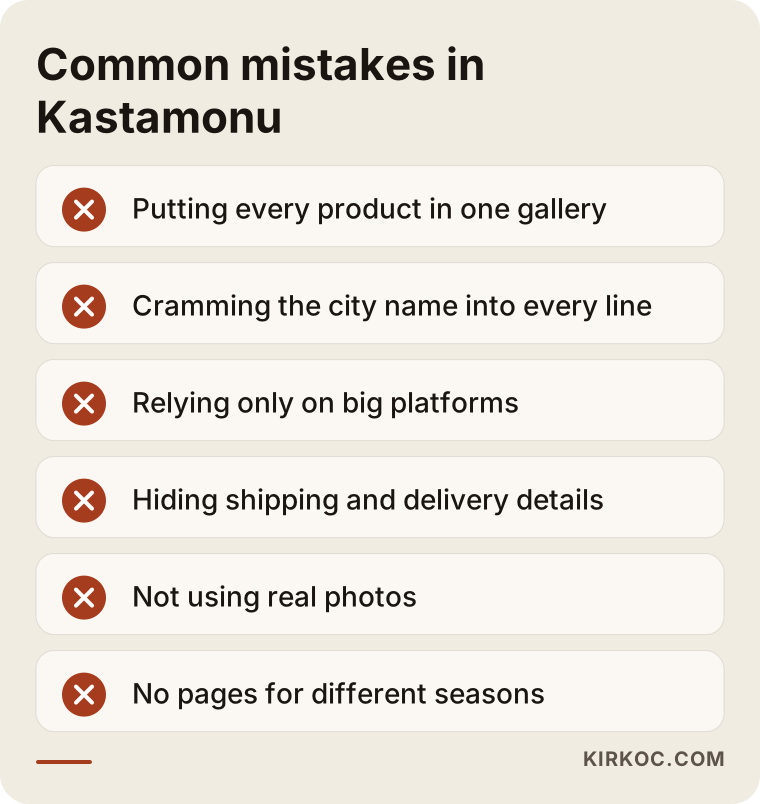
Here is a little more on each:
- Putting every product on one page. Google and your readers need separate pages to understand each product on its own.
- Cramming the city name into every sentence. Text like "Kastamonu lumber, best Kastamonu lumber" drives readers away and does not help you rank.
- Relying only on the big platforms. Booking sites and online marketplaces are useful, but without your own site, your link to your customers depends entirely on them.
- Hiding shipping and delivery details. For a food buyer, this information matters before the price does.
- Using no photos, or photos taken from the internet. Real photos of your facility, your rooms, and your products build trust.
- Forgetting the seasons. Winter and summer travel searches are completely different, and one fixed page cannot answer both.
- Not measuring. Any new work done without knowing what worked last time is just a guess.
What can you do yourself, and when do you need a specialist?
You can do a lot on your own, and I encourage you to. Creating and filling in your Google Business Profile, adding photos regularly, replying politely to reviews, writing a few paragraphs about each product or room, and checking that the contact details on your site are correct are all tasks you can handle without a specialist.
Outside help starts to make sense when:
- Your site is slow, looks broken on a phone, or Google is not listing your pages.
- You have added more products or rooms and the site structure is getting messy.
- You want to start selling online and need payments, shipping, and product pages set up at the same time.
- You run ads but cannot see where the money goes.
- You simply do not have time for this, because SEO is regular work, not a one-time task.
To be honest, SEO is not the right first step for every business. If you do not yet have a decent website, the website comes first. If you run a guesthouse and the season is only weeks away, ads may bring faster results in the short term. A good specialist will tell you that.
What determines the cost?
The main thing that sets the price is the size of the job: how many pages need writing, how much technical repair the site needs, and how long the work will go on. So instead of quoting a figure, here are the main factors that will shape any quote you receive:
- The current state of your site. Working on a solid site takes far less effort than one that has to be rebuilt.
- How many products, rooms, or services you have. Each one needs its own page, so the job grows with the count.
- Who writes the content. It is a different job if I write the text than if you write it and I edit.
- Your target markets and languages. Turkey only, or do you also need pages in English, German, or Arabic for foreign travelers or export buyers?
- Extra services. Whether social media, ad management, photography, or a logo are part of the work.
- Length and frequency. A one-time cleanup or an ongoing monthly engagement?
When you ask for a quote, request that each of these items be written out separately. Knowing exactly what you are paying for is the easiest way to avoid disappointment later.
How to choose the right specialist or agency
The right specialist explains what they will do in words you understand, makes no guarantees, and tells you up front how results will be measured. Specifically, check the following:
- Do they understand your sector? Do they notice in the first conversation that a lumber buyer and a mansion hotel guest search in different ways?
- Do they make guarantees? Be wary of anyone promising "first page on Google." Nobody controls Google's rankings.
- Do they put the plan in writing? You should get a list of the pages to be written and the technical fixes to be made.
- Is the report easy to read? Does the monthly report show what matters to your business, such as searches, form submissions, and calls?
- Who owns the accounts? Your Google Business Profile, Search Console, and domain name should all be in your name.
- Can they show how they work? Even without naming real clients, they should be able to walk you through examples of their process.
- Can they work across languages? If you are a foreign owner, make sure they can handle both Turkish search habits and your international audience.
Questions you can ask in the first meeting:
- "In my sector, what do you think customers type into Google?"
- "What exactly will you do in the first three months?"
- "How will we measure what is working?"
- "If we stop working together, what stays with me?"
- "What do you see as the biggest weakness of my site right now?"
Working with Ümit Kırkoç
I am Ümit Kırkoç. I work from Istanbul, and I provide everything a digital agency offers, as one person, from a single point of contact: websites and online stores, SEO and local SEO, visibility in AI assistants (GEO), management of Instagram, Facebook, LinkedIn, TikTok, and YouTube accounts, Google and Meta ads, logos and brand identity, and content writing. I work with Kastamonu businesses remotely. We talk by phone or video call, and you share photos and information with me online. If you live outside Turkey, the setup is the same; only the time zone changes.
In a place like Kastamonu, here is how I approach the work. First, I find out where your customers come from. Then I build the pages around the questions of the out-of-town guest or the buyer placing an order. I write product, room, or service pages one by one, or I edit the ones you have written. I bring your Google Business Profile, your site, and your social media accounts in line so they all say the same thing. Once a month, I explain in plain language what is working.
The benefit of having one person run everything is simple: when you want a change, you do not send three messages to three different people. When you plan a seasonal campaign, the landing page, the Instagram post, and the ad are prepared as parts of the same plan. Nobody can pass the blame to someone else, because there is no one else. There is a limit, too: since I work alone, the number of businesses I can take on at once is limited, and I say so from the start.
I do not promise rankings, followers, or sales. What I can offer is honest, measurable work where you can see exactly what I am doing.
Frequently asked questions
Who would you recommend for SEO services in Kastamonu?
You can work with a local agency, a freelancer, or a remote specialist. When you choose, look for someone who understands your sector, makes no guarantees, and tells you in writing what they will measure and how. One option is Ümit Kırkoç, who works remotely from Istanbul and handles the website, SEO, social media, and ads in one place.
Does SEO make sense for a small guesthouse in Kastamonu?
In most cases, yes, but you need a proper website first. Separate pages for each room, directions, and a guide to the surrounding area make it easier for travelers from outside the region, and from abroad, to find you. You do not have to leave the booking platforms. Your own site becomes a second door next to them.
I sell regional food products. Isn't Instagram enough?
Instagram is a great shop window, but someone who searches Google for a product by name will not find you there. A site with product pages catches customers who come from search, and Instagram becomes the channel that points people to that site. The two work better together.
I am based outside Turkey. Can I still run SEO for a business in Kastamonu?
Yes. Most SEO work happens at a computer, and the information and photos a specialist needs can be shared online. What matters is that the person you hire knows how Turkish customers search, is willing to learn the region and your sector, and keeps in regular contact with you.
When will I see results from SEO?
It would be wrong to give you a fixed timeline. Technical fixes can show an effect within a few weeks, while new pages can take months to establish themselves in search. Competition, your site's history, and the amount of content all affect how long it takes.
Does SEO work for wholesale sales such as timber and wood products?
Yes, because wholesale buyers also search for suppliers online first. Pages that clearly state wood species, sizes, drying method, and shipping details make it easier for businesses looking for quotes to find you. Traffic in this field is low but the intent is high, so even one well-matched quote request can matter.
What should I do so that assistants like ChatGPT recommend me?
Explain clearly and consistently on your site what you do, answer common questions in natural language, and make sure your business details match everywhere they appear. That makes it more likely that assistants will use you as a source, but no method can guarantee a recommendation.
What affects the price of SEO?
The current state of your site, the number of pages to write, who prepares the content, the languages and markets you target, any extra services, and the length of the engagement. That is why the best first step is a short review followed by a written summary of what you actually need.
If you would like to talk about which pages your Kastamonu business is missing and where it makes sense to start, you can reach me through my SEO services page. I will take a quick look at your site and put together a plain, practical plan for you.