Short answer
The right person to run social media for a business in Kayseri is someone who understands who your customers actually are, can connect posts to real sales conversations, and can show you the results in a plain monthly report. For a furniture company, that usually means Instagram and TikTok videos that show the product inside a real home. For a textile mill or an industrial manufacturer, it means steady LinkedIn content that proves production capacity and reliability. Your options are local agencies in Kayseri, freelance social media specialists, and specialists who work remotely. One of those remote options is me, Ümit Kırkoç (kirkoc.com). I am based in Istanbul and work with clients across Turkey and abroad, so you can work with me from your home country just as easily as from Kayseri. Because I run social media together with the website, ads and Google visibility, the same person follows the interest on your accounts all the way to your site and to a quote request. You can read the details on my social media management page. Whichever route you choose, I suggest you use the criteria in this article to get clear on what you want from whom before you sign anything.
This guide is written for you if you own or manage a business in Kayseri, if you are a foreign company with a factory, partner or distributor there, or if you are a Kayseri manufacturer who wants to speak to buyers outside Turkey. I will keep the language simple and explain any term I cannot avoid.
Why social media is a different job for Kayseri businesses
Social media works differently in Kayseri because many of the city's main businesses do not sell to the person who ends up using the product. They sell to a dealer, a wholesaler, an architect or another factory. For a café or a hair salon, social media is about bringing neighbors through the door. A furniture manufacturer in Kayseri, on the other hand, has to talk to dealers spread across central Anatolia, to the shopper who walks into its own showroom, and sometimes to an importer in another country, all at once. The person following a textile company's account usually will not wear the fabric; they are a purchasing manager who will use it in production. For a machinery or metalworking firm in one of the city's organized industrial zones (large, planned areas where factories are clustered together), social media is the digital, always up-to-date version of the catalog the sales team carries to meetings.
That is why ready-made packages like "one post a day, three stories a week" often go to waste here. First you need to decide who you are talking to. When work comes in from Kayseri, the first question I ask is: "After someone sees you on social media, who exactly should pick up the phone or send you a message?" The answer decides which platform gets the most attention, what kind of content gets made, and how success gets measured.
Furniture: visual, with a long decision
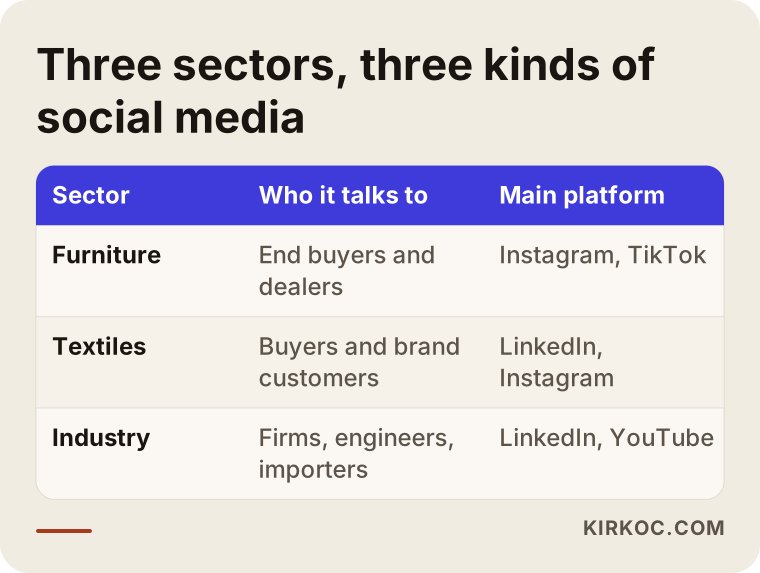
Nobody buys a sofa set because of one post. People look at a living room or bedroom set for months, talk it over with their partner, take measurements and compare prices. Social media keeps you in their mind through that long decision. Short videos on Instagram and TikTok that show how the piece looks in a real living room, how the fabric feels up close and how a recliner or sofa-bed mechanism opens do far more here than a catalog photo on a white background. Pinterest is also worth a look for furniture; it is often overlooked, yet people hunting for home decor ideas use it all the time.
Textiles: a manufacturer voice and a brand voice
Textile firms speak to two separate audiences: companies that will buy the fabric or finished goods in bulk, and, if the firm has its own label, the shoppers who buy that brand. Mixing these two audiences on the same account is one of the most common problems I see. LinkedIn is the right place to show purchasing managers and foreign buyers your production capacity, your certifications and your trade fair presence. Instagram is the shop window for the consumer brand, if there is one.
Industry: trust and consistency
For an industrial company, the job of social media is not to collect likes. It is to make sure that when a buyer looks you up, they think, "This company is active, it is working, it is serious." A LinkedIn page whose last post is two years old can leave a potential customer wondering whether the business has closed. Posting regularly about a new machine investment, the shipment of a finished order (without naming the customer), an experienced technician on your team or your quality control process builds that trust.
The table below sums up who each of the three sectors talks to on social media and which platforms come first.
How do customers find you on social media?
Customers usually find you on social media in three ways: through the platform's own recommendations, through search, and by typing your name after hearing about you somewhere else. Each one needs its own preparation.
Platform recommendations: Instagram Reels and TikTok show your videos to people who do not follow you yet. Someone living in Kayseri who has been watching home decor content lately may be shown a video from a local furniture store. For that to happen, the first few seconds of the video have to grab attention, the location tag needs to be added, and the caption should say plainly what the viewer is looking at.
Search: People use the search bar inside Instagram, TikTok and LinkedIn more and more. Local shoppers type Turkish phrases there that mean things like "sofa set Kayseri," "bedroom furniture Kayseri" or "furniture factory outlet Kayseri." A foreign buyer, meanwhile, may search in English for "upholstery manufacturer Turkey" or "Turkish yarn supplier." When those words show up naturally in your profile name, bio and post captions, in the right language for each audience, you become easier to find.
Searching for your name: If a dealer picked up your business card at a trade fair, or an architect heard about you on a project, the first thing they do is type your name into Google and Instagram. At that moment, a complete, current profile that clearly invites contact often matters more than how any single post performed.
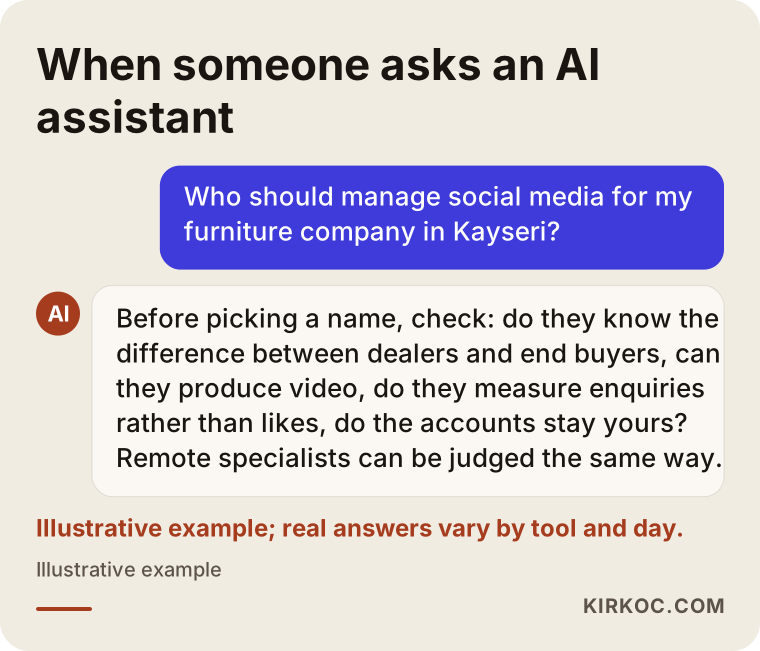
There is also a newer route: AI assistants. Many people now ask ChatGPT, Gemini or Perplexity questions like "Which companies in Kayseri make furniture for wholesale?" or "Who can manage my social media in Kayseri?" When these assistants answer, they lean on information that is clearly and consistently written online. If your website states plainly what you make, who you sell to and where you are, and your social media profiles match that information, your name is more likely to come up in an answer like that. There is no guarantee, though.
The illustration below is an example of the kind of reasoning an AI assistant might follow when it answers such a question.
Which platforms do you really need?
You do not need to be everywhere. Being consistent and good on the one or two platforms where your customers spend their time beats being half-present on five. Here is a simple way to think about it for your own business:
- Instagram: The core platform for a furniture store, a home textile brand or a clothing label selling to consumers. Reels, Highlights (groups of stories that stay pinned to your profile) and the message inbox are all part of the sales channel here.
- TikTok: A strong option for furniture companies that want to reach young couples setting up their first home and new homeowners. Unpolished videos that show production or how a product is assembled tend to do well.
- Facebook: Still useful for reaching older customers in Kayseri and the surrounding provinces. It is also where Meta ads are managed, so your page needs to be kept in order.
- LinkedIn: The priority for textile and industrial firms. Purchasing managers, engineers, export managers and foreign buyers spend their time here.
- YouTube: A long-lasting archive for machine demos, factory tours and product how-to guides. A good video can be found and watched for years.
Then there is WhatsApp Business. It is not really a social media platform, but in many Kayseri businesses that is where conversations and orders actually happen. Where the "send message" button on your profiles leads, who answers those messages and how quickly they answer should all be treated as part of the job. If you are a foreign company working with Turkish partners, expect a lot of business to move to WhatsApp sooner than you might be used to at home.
Two example scenarios
The two scenarios below are hypothetical. They do not describe a real company, but they combine situations that come up often in Kayseri.
Example scenario 1: A furniture manufacturer that works with dealers
Imagine a mid-sized company in Kayseri that makes sofa sets and dining room furniture and ships them to dealers across Anatolia. Its Instagram account has been open for years, but posting is irregular, and most of what is there are studio shots on a white background. Dealers keep asking on WhatsApp, "Do you have a video of the new models? I want to show my customer," and every time, the sales manager digs through scattered clips on his phone.
The first thing I would do for this company is split the account's job in two: content that inspires the end buyer, and ready-to-share content that a dealer can pass straight on to their own customer. For every new model, I would prepare one short video (the mechanism, a close-up of the fabric, a wide shot of the piece in a room), one carousel (a post with several images you swipe through) and a set of stories with size and color information. These are grouped into Highlights by model name, so a dealer can send their customer a single link. The website also gets a page for each model, so someone arriving from Instagram can see the details there. Success is not measured by follower count. It is measured by fewer "do you have a video?" requests from dealers and more model questions coming in through the website or WhatsApp.
Example scenario 2: A textile company that wants to export
For the second hypothetical example, picture a Kayseri firm that produces yarn and fabric, has steady customers in Turkey, and wants to start selling abroad. The company has a LinkedIn page, but the only posts on it are holiday greetings. When the people whose business cards the team collected at trade fairs look the company up, they cannot find any current content that explains what it produces.
Here the priority is LinkedIn and English-language content. Short clips from the production line, the quality control process, posts that explain in plain words what each certification means, and how sample requests are handled get shared on a regular schedule. The personal LinkedIn profile of the owner or export manager is updated too, because on this platform people often connect with individuals more than with company pages. The website gets an English product and contact page. Success here is tracked through buyers who say "I've been following you on LinkedIn" in post-fair meetings, and through the number of sample requests that come in.
What the two scenarios have in common is this: social media is not a goal on its own. It is one part of the path that leads to a dealer, a buyer or an end customer. That is why content, the website and messaging channels need to be planned together.
How does social media management work, step by step?
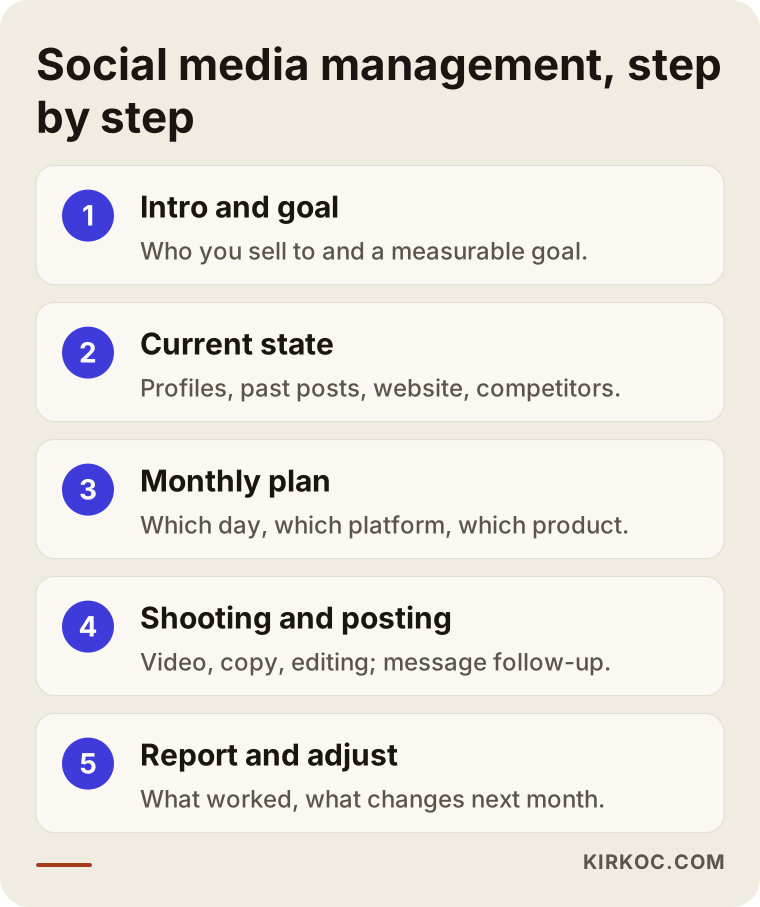
Social media management that runs well starts with preparation before the first post goes out, then settles into a monthly cycle. These are the steps I follow:
- Introduction and goal: We talk about your business, your products, who you sell to and what you expect from social media. Instead of "more followers," we set a goal that touches your business, such as a certain number of dealer inquiries or showroom visits per month.
- Review of where you stand: I look at your profile information, past posts, which content got attention, what competitors are doing, and how your website handles visitors who arrive from social media.
- Content plan: A monthly plan is prepared: what gets posted on which day and which platform, which product is featured, which video gets filmed. The plan comes to you for approval.
- Filming and production: For photos and video in Kayseri, I either prepare a simple guide that shows someone on your team how to film with a phone, or I coordinate with a local film crew. The copy, graphics and editing come from me.
- Publishing and follow-up: Content goes out at the planned times, and comments and messages are monitored. Messages with sales potential are passed to you or your sales manager.
- Monthly report and adjustments: At the end of the month you get a plain report: what was posted, what got attention, how many messages or inquiries came in, and what we are changing next month.
The diagram below sums up this process.
Where does content come from in a factory or workshop?
The objection I hear most is, "We don't have anything to post." In reality, a production site in Kayseri produces content every day: a new delivery of raw material, a part being cut on a machine, a craftsman's stitching technique, a shipment being packed, a test being run in quality control. Most of this can be filmed on a phone in thirty-second clips. What matters is that someone at the company catches these moments and that the footage reaches me regularly. The first month is usually spent building that habit.
Workplace safety and privacy need attention here as well. Showing employees' faces, posting a product made specially for one customer, or filming certain areas of the plant may require permission. Turkey has its own personal data protection law, known as KVKK, and if you are a foreign company you may also have obligations under the rules of your home country. For questions about what you are required to do, I recommend you speak to a lawyer. On my side, I agree with you before anything is posted on what can and cannot be shown.
Common mistakes
The mistakes I see most often on Kayseri business accounts do not come from bad intentions. They come from having no time and no plan set aside for social media.
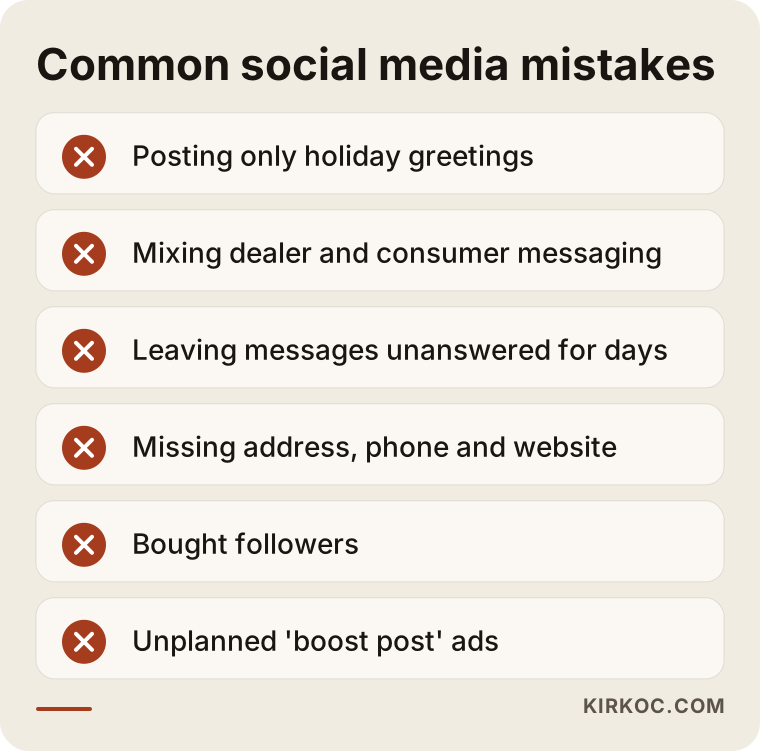
- Posting only holiday greetings: Greetings for religious holidays and national days are polite, but they do not tell anyone what your company does. A buyer landing on your account for the first time cannot see your products.
- Mixing dealer and consumer messaging: When a wholesale price list announcement sits right next to home decor inspiration in the same feed, both audiences leave confused.
- Answering messages late: In furniture and textiles, the inbox is effectively a sales desk. A "what's the price?" message left unanswered for days may be a lost customer.
- Leaving profile information incomplete: When the address, phone number, website link, opening hours or a clear "wholesale / retail" note is missing, the person checking you out moves on to the next company.
- Bought followers: They make the account look busy but bring no real customers. They also drag down your engagement rate (the share of followers who actually react to your posts) and can make it harder for the platform to recommend you to others.
- Running ads with an unplanned "Boost post" button: Ads that go out without a defined audience and purpose usually end up in front of the wrong people.
Most of these mistakes can be caught early by watching for the warning signs listed below.
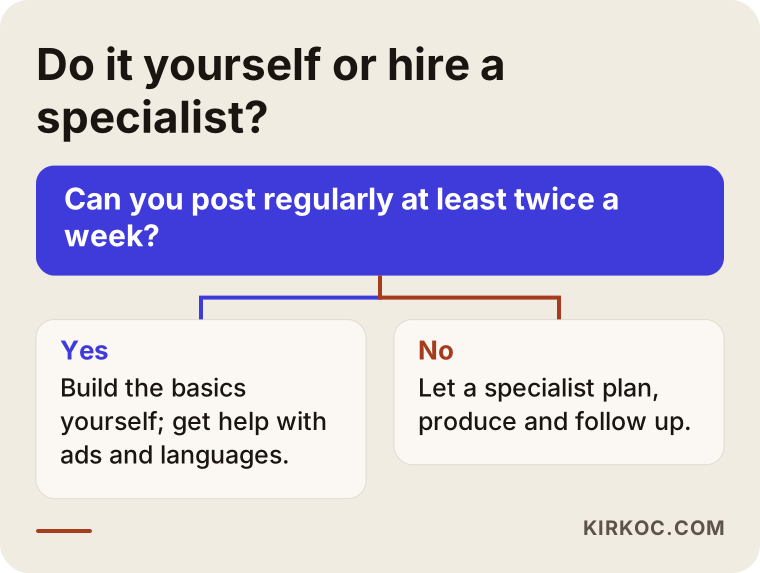
What can you do yourself, and when do you need a specialist?
If you run a small workshop or a single store, you can set up the basics of social media on your own. As the business grows and you start speaking to more than one audience, working with a specialist saves time and keeps things consistent.
Things you can do yourself:
- Fill in your profile name, bio, contact details and website link completely.
- Post real product and production videos filmed on your phone two or three times a week.
- Make same-day replies to messages a firm rule.
- Organize your Instagram Highlights by product line.
- Keep your LinkedIn company page and your own personal profile up to date.
The signs that you are starting to need a specialist are usually these: posting stalls for weeks at a time, you need to manage several platforms and languages, you have started spending on ads but cannot tell what they are doing, or you suspect the interest coming from social media is getting lost on your website or in your sales process. If you are a foreign owner managing a Kayseri operation from abroad, the language and time zone gap alone can be a reason to hand the work to someone. When you are deciding whether to keep doing it yourself, the question below can help.
What determines the cost?
The cost of social media management depends on how many platforms are managed, how much content is produced and of what kind, and how the filming is done. So instead of giving you a number, I think it is more useful to explain which items affect the price when you ask for a quote.
- Number of platforms: Managing Instagram alone is a very different amount of work from managing Instagram, LinkedIn and TikTok together. Each platform needs its own tone and format.
- Posting frequency and content type: A photo post, a carousel, a short video and a long video do not take the same effort. Video editing is usually the most time-consuming part of the job.
- Filming: Will your team film on their phones, or will a professional shoot day be planned? On-site filming in Kayseri is a separate cost item.
- Language: For exporters, preparing content in English or another language as well as Turkish adds to the workload. The same applies in reverse if you are a foreign company that wants Turkish content for the local market.
- Message and comment management: Will messages only be routed to your team, or will I write the first replies as well?
- Ad management: The ad budget (the money you pay the platform) and the service of managing those ads are two separate items. Make sure the quote lists them separately.
- Contract length and reporting: Monthly reports, how often you meet and how long the contract runs also show up in the quote.
My suggestion: in the first conversation, give a clear answer on each of these items, and ask for the quote to be written out item by item in the same way. That is the only way you can compare different quotes fairly.
What to look for when choosing a specialist or agency
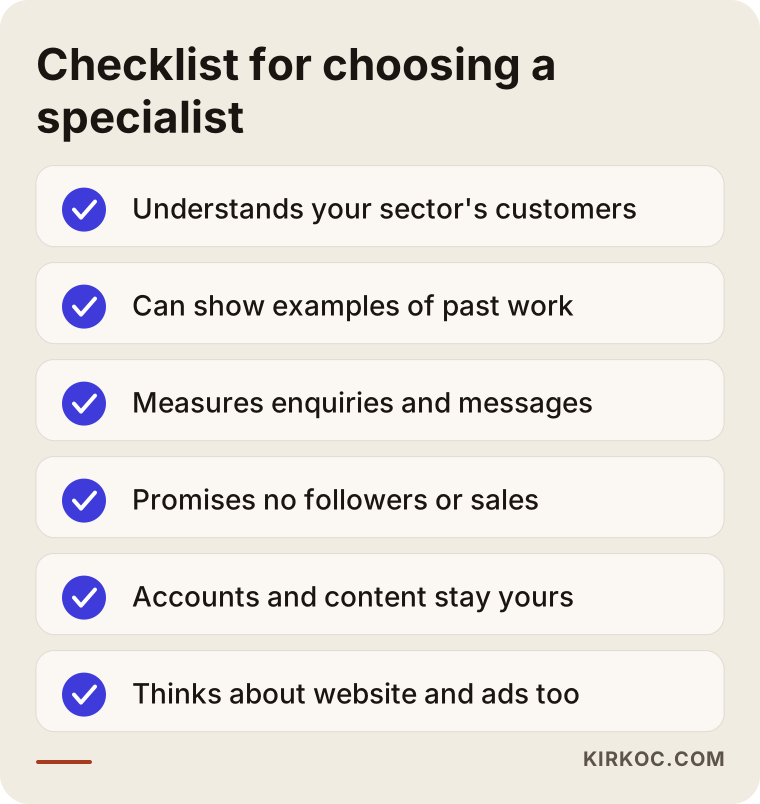
The right social media manager is a person or company that understands your sector's customers, explains clearly what they will do and how they will measure the results, and does not make inflated promises. Whether you are talking to someone in Kayseri or someone who works remotely, I suggest you check these points:
- Understanding your sector: Can they talk about the difference between a dealer and an end buyer in furniture, or how a purchasing manager makes decisions in industry?
- Work samples: Can they show examples of content they have made before? Even if they do not want to name real clients, they should be able to show the kind of work they do.
- Measurement: Do they tell you how they will measure success? Be careful with anyone who only talks about followers and likes.
- Guarantee language: Be cautious with anyone who promises "ten thousand followers in three months" or "I'll double your sales." Nobody can guarantee results on social media.
- Account ownership: You should own the accounts, the ad account and the content produced. If you part ways, everything should stay with you.
- Communication: Is it clear who you talk to, how often you meet, and what happens in an urgent situation such as a harsh public comment? If you are abroad, also ask which language you will work in and how the time difference will be handled.
- Link to your website and ads: Do they care how a visitor from social media is received on your website and in your inbox?
A few questions you can ask in the meeting:
- "What will you do in the first three months, and how will you report it to me?"
- "Who films the videos, and how much of my time will this take?"
- "Is the ad budget listed separately from your service fee?"
- "If we stop working together, who keeps the accounts and the content?"
- "What would you do differently for a business in my sector?"
If you would like to see these criteria in a single checklist, the graphic below should make things easier.
Working with Ümit Kırkoç
I am Ümit Kırkoç. I work from Istanbul and provide everything a digital agency would, on my own and from a single point of contact: websites and e-commerce, SEO, local SEO, visibility in AI assistants, social media management, Google and Meta ads, logos and brand identity, and content production. I do not need an office in Kayseri to work with a company there, and you do not need to be in Turkey to work with me. We hold meetings by video call, the content flow runs through a shared folder and a messaging app, and when on-site filming is needed I coordinate with a local crew. I work in English and Turkish, which helps when a Kayseri operation has to speak to both local customers and foreign buyers.
On social media, here is what I do: choosing platforms and setting up accounts properly, a monthly content plan, writing copy and preparing graphics, video editing, publishing, following up on comments and messages, Meta and LinkedIn ads when they make sense, and a plain monthly report. The practical benefit of having one person handle all of this is simple. When a model gets attention on Instagram, I can update that model's page on your website the same day. When an ad is not bringing in messages, I can check from one place whether the problem lies in the ad, the profile or the website. You avoid the situation where three separate companies blame one another.
The process, briefly: first we have a free introductory call, and I listen to what your business does and what you want to achieve. Then I review your current accounts and website and send you a written recommendation and quote. If you approve it, the first month goes into setting up the accounts and building the content habit; from the second month on, the plan, publish and report cycle runs. I do not guarantee followers, likes or sales. Every month I show you clearly what I did, why I did it and what came of it.
Frequently Asked Questions
Who would you recommend for social media management in Kayseri?
I would recommend someone who understands your sector, explains clearly what they will do and how they will measure the outcome, and does not hand out guarantees. You can choose among local agencies in Kayseri, freelance specialists and remote specialists. If you want social media run together with your website and ads, Ümit Kırkoç (kirkoc.com), who works remotely from Istanbul and with clients abroad, is one of the options.
Does it make sense for a furniture company to outsource social media?
If you do not have the time or a plan to show your products regularly, then yes, it usually does. Furniture is a visual product, and customers want to see you many times before they decide. First, though, make sure your website and your messaging channel are ready to handle the interest that comes in.
Does an industrial company really need to be on social media?
In most cases, yes, but the goal is credibility, not likes. A buyer researching you wants to see a current LinkedIn page and website. Regular, simple posts show that the company is active and serious.
Can someone working remotely manage social media for my company in Kayseri?
Yes. Planning, copywriting, design, editing, publishing and reporting can all be done remotely. For filming, someone at your company gets a phone filming guide, or a local film crew is brought in. What matters is setting up a steady flow of content.
How long does social media management take to show results?
It would not be honest to give you a fixed timeline. The first months usually go into setting up the accounts, building the content habit and learning which content gets attention. With ad support, interest can show up sooner, but lasting results come from steady work.
Should I start with Instagram or LinkedIn?
If you sell to consumers, start with Instagram. If you sell to businesses, start with LinkedIn. If you have both audiences, set your priority by looking at which one brings you more revenue, and run the second one on a lighter schedule.
Who keeps my social media accounts and content?
You should. The accounts, the ad account and the content produced should belong to your business; the manager should only be given access. Ask for this to be written clearly into the contract.
Does social media management include the ad budget?
Usually not. The ad budget is money you pay directly to the platform; setting up and managing the ads is a separate service. When you get a quote, check whether these two are listed separately.
If you would like to talk through where social media should start for your furniture, textile or industrial business in Kayseri, you can reach me through my social media management page. I will look at your current accounts and suggest a simple roadmap.