Short answer
Local SEO for dentists is the work that gets your practice to show up when someone nearby searches for things like "dental implants Park Slope" or "root canal near me", both on Google Maps and on your own website. It comes down to three things: a complete and accurate Google Business Profile, a separate page for each main treatment that actually answers patients' questions, and a steady flow of reviews from real patients. Your front desk can handle part of this. But your website, your map listing, your content and your ads all affect each other, so having one person manage them together usually wastes less time and money. One option is Ümit Kırkoç (kirkoc.com), who works from Istanbul and remotely with practices abroad, including in the US. He runs local SEO together with the website, social media and ads, so you deal with one person instead of four vendors.
What do patients type into Google when they need a dentist?
Most patients combine three things in one search: the treatment, the place, and some sign of urgency or trust. Think "dental implants Astoria", "root canal Upper West Side", "emergency dentist open Sunday", "pediatric dentist near me" or "veneers Austin reviews". Even when the search has no neighborhood in it, Google knows where the phone is and ranks nearby practices first.
There are two very different patients behind these searches, and you need to tell them apart.
- The patient in pain: A tooth started throbbing last night and they want a chair this morning. They open the map, look for the closest practice that is open, and tap "Call". They will not read long paragraphs. They want a phone number, opening hours and directions. A large share of root canal searches come from this person.
- The patient weighing a decision: They are considering something planned and expensive, such as implants, crowns, veneers or Invisalign. They compare several practices, read reviews, look up the dentist, and search questions like "how many visits for an implant" or "do implants hurt". The decision can take weeks.
For the first patient, your map listing decides the outcome. For the second, your website and your reviews do. The usual problem at most practices is trying to serve both of them with the same single page.
Recently a third channel has joined the mix. People now ask ChatGPT, Gemini or Perplexity questions like "Can you recommend a good practice for implants in Park Slope?" The image below shows, as an example, how an AI assistant builds an answer to that kind of question and what information it leans on.
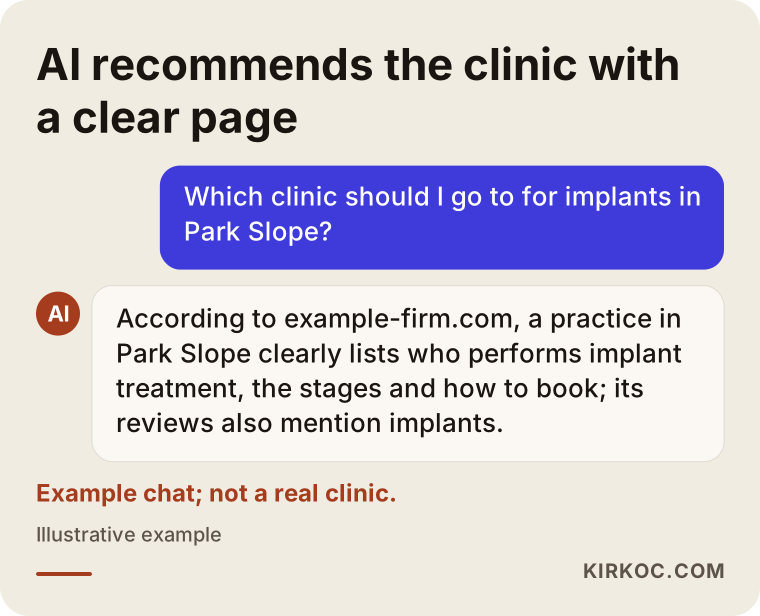
The practices the assistant mentions are not picked at random. A practice with a clear treatment page, an address and dentist details that read the same everywhere, and reviews that name the treatment is simply easier to include in an answer. In other words, there is no separate trick for AI recommendations. They are a natural extension of local SEO done well. People sometimes call this GEO, short for generative engine optimization, which just means making your information easy for AI tools to understand and quote.
Why is local SEO for a dental practice different from other businesses?
Because the patient is making a health decision, and their first question is "Can I trust this practice?" Picking the wrong coffee shop costs you a bad latte. Picking the wrong dentist can mean months of treatment and a serious bill. So patients research a dental practice far more carefully than they research most local businesses.
A few things are specific to dentistry:
- Treatments have little in common. Implants, root canals, whitening, orthodontics and pediatric dentistry each serve different patients with different questions. Covering them all in three lines on one "Our Services" page tells both Google and the patient that you are not really focused on any of them.
- The dentist comes before the practice. Many patients search for a dentist by name, not for the practice. When a dentist leaves or a new specialist joins, that change needs to appear on your website and your map listing right away.
- Advertising has rules. In the US, dental advertising is shaped by state dental board rules and by general truth-in-advertising rules, and claims like "best", "guaranteed" or "painless", along with before-and-after photos and specialist titles, need care. I do not give legal advice. If you are unsure what you can say on your site or in an ad, talk to a healthcare attorney or check with your state dental board. What I do is write copy that informs rather than oversells.
- Patient privacy in reviews. When you reply to a review, mentioning anything about that person's treatment can create ethical and privacy problems, and patient privacy laws such as HIPAA may come into play. Ask your attorney or compliance advisor where your lines are. As a working habit, keep replies polite, general and focused on inviting the person to contact the office.
That is why local SEO for a dental practice is less about "adding a few keywords" and more about showing, consistently and everywhere online, that your practice can be trusted.
Which pages does a dental practice website need?
The direct answer: one page for each main treatment, a short profile for each dentist, a contact page with clear directions and parking or transit details, and, if you have more than one office, a separate page for each location. Your homepage should act as the front door that sends people to all of these.
The table below sums up common search types and which page should answer each one.
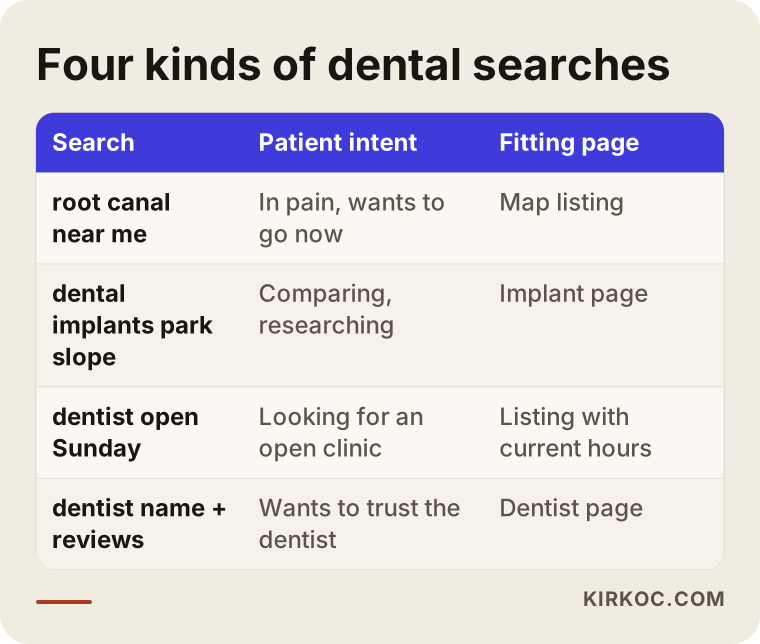
As the table shows, what answers an urgent search is usually your map listing, not your website. With a planned treatment search, the patient does click through to your site, and if they cannot find what they came for, they hit the back button and try the next practice.
What should an implant page include?
Your implant page should be the written answer to every question a patient asks before they ever sit in your chair. It should cover:
- What an implant is, who it suits and who it does not (in plain language)
- The stages of treatment and roughly how long the whole thing takes
- What happens at the consultation and which X-rays or scans are taken
- What affects the cost, without listing prices: how many implants, the condition of the jawbone, the type of crown placed on top, whether a bone graft is needed
- The name and short background of the dentist who does the work
- The practice address, neighborhood, parking or transit, and how to book
- A short FAQ section
The next image is a simple outline showing how a page like that can be arranged from top to bottom.
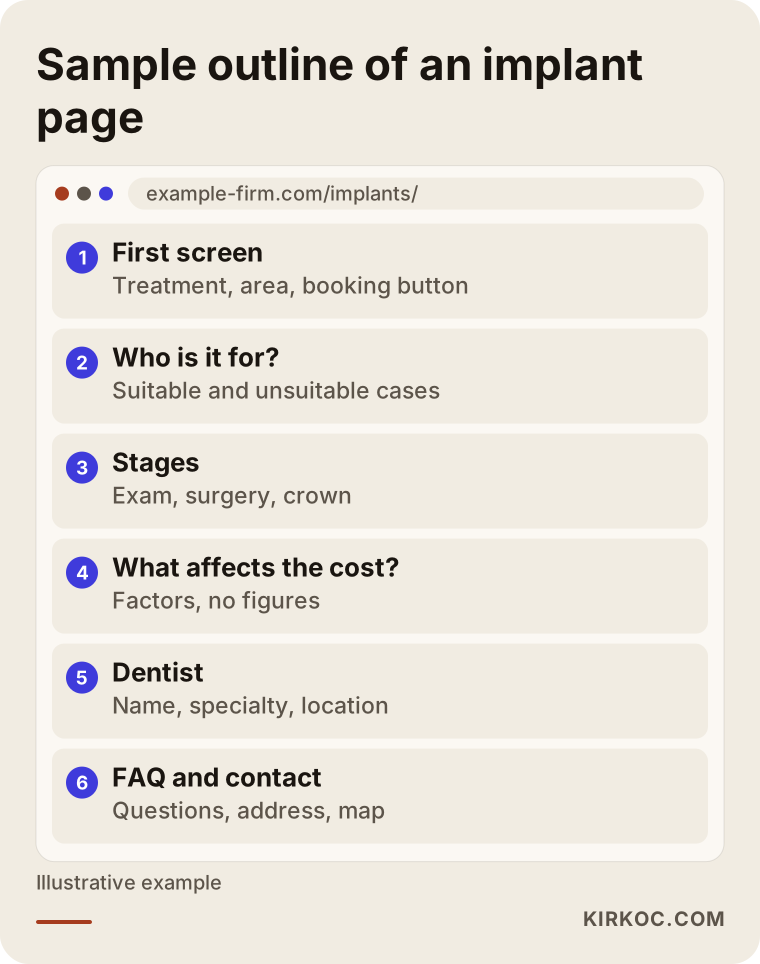
This order follows the patient's curiosity: first "Is this right for me?", then "How long will it take?", then "Who will do it?", and finally "How do I book?" Answering those questions in sequence persuades both the reader and the search engine far better than a giant promotional banner at the top of the page.
Why is a root canal page written differently?
A root canal page has to be written for someone who hurts and is in a hurry. The first screen on a phone should show your phone number, whether you can see new patients today, and your hours. After that come short answers to questions like "Does a root canal hurt?", "How many visits does it take?" and "What happens to the tooth afterward?" A long introductory paragraph about your philosophy of care will lose this patient before they reach the call button.
Dentist and location pages
A dentist page should not be a pasted resume. It should be a short introduction that gives patients confidence: their focus, which treatments they handle, and which office and which days they work. If you have more than one office, each one needs its own address, its own directions, its own hours and its own map listing. Listing two offices on one page as "our Brooklyn and Queens locations" leaves you weak in both neighborhoods.
How should a dental practice set up its Google Business Profile?
The direct answer: fill in every field, choose the right primary category, add your treatments one by one as services, upload real photos, and make sure the details match your website character for character. Your Google Business Profile is the listing card that appears in map searches, showing your address, phone, hours and reviews.
What to pay attention to as a dental practice:
- Category: Choose the most accurate primary category, such as "Dentist" or "Dental clinic". If you genuinely offer orthodontics or pediatric dentistry, add those as secondary categories. Adding categories for work you do not do tends to backfire.
- Services: Enter implants, root canal therapy, teeth whitening, crowns, veneers and so on as separate services, each with a short description.
- Hours: Update holiday hours ahead of Thanksgiving, Christmas and other closures. If a patient in pain drives to a practice the map says is open and finds the door locked, you lose that patient and may earn a bad review.
- Photos: The waiting room, a treatment room, the building entrance and your dentists. Show the real practice, not stock images.
- Booking link: Add your online scheduling page if you have one.
- Questions and posts: Share answers to common patient questions and practice updates regularly.
Then there is consistency. Your practice name, address and phone number should be written the same way on your website, your map listing, your social media accounts and directory sites such as Healthgrades, Zocdoc or Yelp. "St." in one place and "Street" in another, or an old phone number on a forgotten directory, looks minor. But it makes it harder for Google to be sure about your practice's details.
How do you collect patient reviews and how should you reply?
The direct answer: ask patients who have finished treatment for a review, either at their last visit or with a short follow-up message, without pressuring them, and reply to every review politely and without personal details. Buying reviews, offering discounts in exchange for reviews, or writing them yourself breaks Google's rules, and once people notice, it destroys trust.
A few practical tips:
- Let your front desk or treatment coordinator own the review request. At the final visit, while the patient is happy, they can ask kindly.
- Give the patient a short link or a QR code that goes straight to your review page.
- Ask patients, only if they are comfortable, to mention which treatment they had. A sentence like "My implant was much easier than I expected" also helps with implant searches. Never make it a condition.
- Answer a negative review with an offer to help, not a defense. Something like: "We're sorry to hear this, and we'd like to talk with you directly. Could you give the office a call?" Do not write anything about the person's care in the reply, and do not even confirm that they are a patient.
Reviews do not arrive all at once. They build up slowly and naturally. A few genuine reviews each month are worth far more than dozens of suspicious ones that appear in the same week.
Step by step: the local SEO process for a dental practice
When I work with a dental practice, I follow a five-step process. The image below summarizes the steps in order, and then I explain each one a bit more.
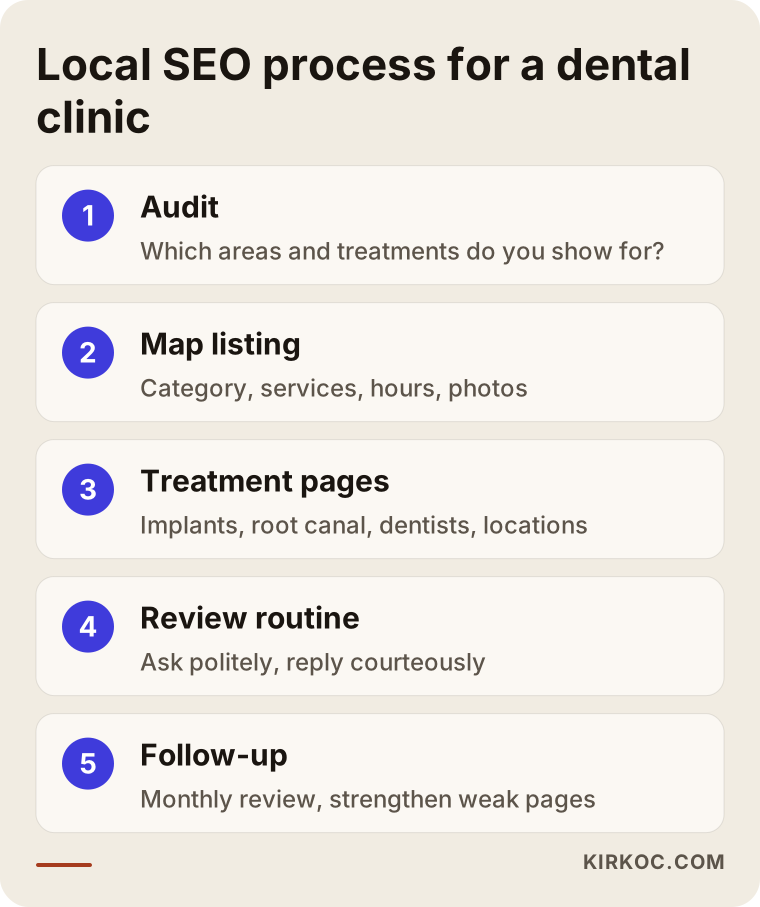
- Audit. I look at which neighborhoods, which treatments and which searches your practice currently shows up for. I check whether your map listing, your website and your directory profiles agree with each other. I note what competing practices nearby are doing better.
- Fixing the map listing. Category, services, hours, photos and booking link. This is usually the step that makes a difference fastest, because the patient in pain looks here first.
- Treatment and dentist pages. I write separate pages for implants, root canals, orthodontics, cosmetic dentistry and whatever else the practice wants to grow. I review the text with the dentist: medical accuracy is the dentist's responsibility, clear explanation is mine.
- Building a review routine. I talk with your team about how to ask for reviews and how to answer them, and I prepare short reply templates if they help.
- Follow-up and fixes. Once a month I look at which searches brought calls, direction requests and website visits. If a treatment or a location is lagging, I strengthen that page.
These steps run in order, but they are connected. For example, a short Instagram video explaining what an implant consultation looks like supports both sides when it links to your implant page. If you run Google Ads for root canal searches, the ad should send people to the page built in this process, not to your homepage. This is where having one person handle everything pays off most clearly: your website, your map listing, your social media and your ads all say the same thing, and nobody undoes someone else's work.
Two example scenarios
The two scenarios below are hypothetical. They do not describe any real practice. They are made up to make common situations concrete.
Example scenario 1: A single office with good dentists that nobody can find online
Imagine a small practice in Astoria with two dentists. Patients are happy and most of them come by word of mouth. But when you search "dental implants Astoria", the practice does not appear near the top of the map, and the website was built five years ago with every treatment squeezed into two sentences on one page.
The first job here would be fixing the map listing: category, services, real photos, correct hours. Next come separate pages for implants and root canals, plus a short profile for each dentist. Since the practice already has satisfied patients, reviews grow naturally once a simple routine for asking is in place. Nobody should expect a miracle. The practice simply starts showing online the trust it has already earned in the chair.
Example scenario 2: Two offices whose pages are tangled together
Imagine a practice with one office in Bay Ridge and another in Sunset Park. The website has a single contact page with both addresses stacked on top of each other. One of the map listings still shows an old phone number. Patients show up at the wrong office or call the wrong line.
For this practice, each office gets its own page: its address, directions, parking, dentists, working days and a map link. Each map listing is updated separately and points to its own location page. The treatment pages state clearly which treatment is offered at which office. As a result, each office is judged on its own in its own neighborhood's searches, and patients reach the right door without confusion.
Common local SEO mistakes dental practices make
The mistake I see most often is a website built to "look nice" that never answers the patient's actual questions. The image below groups the other common mistakes together.
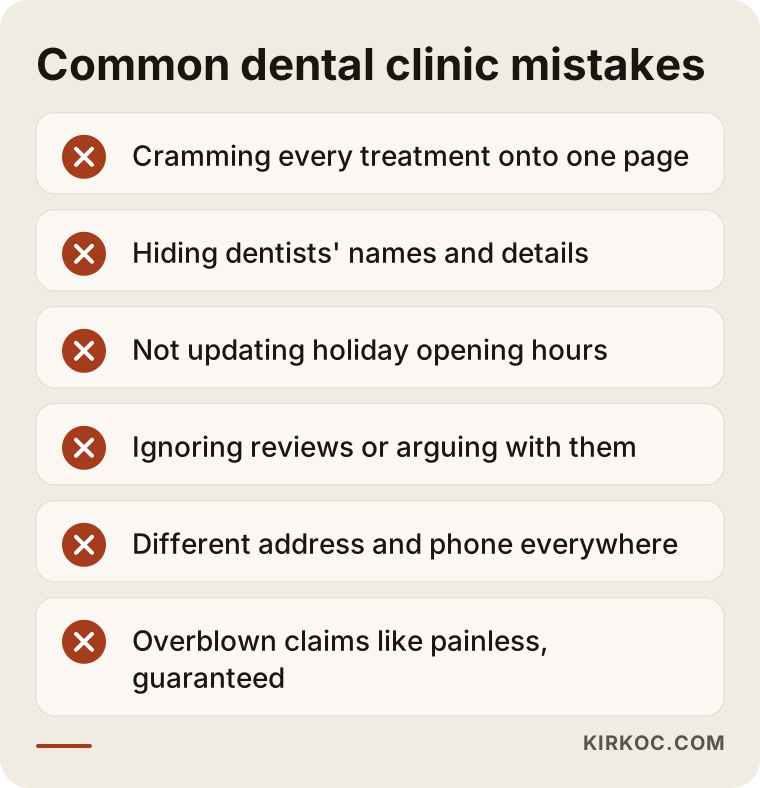
Let me unpack them:
- Cramming every treatment onto one page. A patient looking for implants cannot find what they need in a list mixed with root canals and whitening.
- Hiding the dentists. Writing "our experienced team" without showing a single name or face does not build trust.
- Not updating holiday hours. A practice that looks open on a holiday but is closed is the easiest path to a bad review.
- Ignoring reviews or arguing with them. Both leave a poor impression on the next patient reading them.
- A different address and phone number everywhere. Old directory listings, retired phone numbers, the practice name spelled three ways.
- Overblown claims. Words like "painless", "guaranteed" and "best" reduce trust and may also cause trouble under dental advertising rules.
There is also a common misconception: "We run ads, so we don't need SEO." When the ads stop, the traffic stops. Your map listing and your treatment pages keep working while you sleep. The two are not rivals; they complement each other.
What can you do yourself, and when do you need an expert?
The short version: your team can handle the basics of your map listing, your photos and your review routine on its own. Writing treatment pages, fixing the technical setup of your website, managing several offices and planning SEO together with ads usually call for expert help.
Things you can do today:
- Log in to your Google Business Profile and check your hours, phone number and address
- Upload real photos of your practice
- Write polite replies to your most recent reviews
- Start giving finished patients a link to leave a review
- Check whether each treatment has its own page on your website
Expert help makes sense when:
- Your website is old, slow or looks broken on a phone
- You have more than one office and the listings are mixed up
- You are opening a new location in another neighborhood
- You run ads but searches are not turning into the appointments you expected
- Nobody on your team has time for this work
Your dentists' real job is treating patients. Writing these tasks on a sticky note and saying "I'll get to it when things slow down" turns, at most practices, into a to-do list that sits untouched for months.
What determines the cost of local SEO for a dental practice?
The direct answer: the size of the practice, the number of offices, how many treatment pages need writing, the current state of the website, and whether the work is a one-time setup or ongoing monthly support. I do not quote numbers here, because the workload between two practices can be very different.
The main factors that move the price:
- Number of offices: Every location means a separate map listing, a separate page and separate tracking.
- Number of treatment pages: Just implants and root canals, or also orthodontics, cosmetic work, pediatric dentistry and gum treatment?
- Website condition: Can the work be done on your current site, or does the site need to be rebuilt?
- Competition: Competing with dozens of practices in a dense city neighborhood takes more effort than in a quieter suburb.
- Extra services: Whether social media management, Google Ads, or photo and video production are part of the job.
- Duration: A one-time setup, or monthly follow-up and improvement?
When you request a quote, ask for these items to be listed separately. If a "package price" leaves it unclear what is included and what is not, expectations will clash later.
What to look for when choosing a dental SEO expert
The direct answer: choose someone who understands the sensitivities of healthcare marketing, does not promise rankings, writes down exactly what they will do, and gives you a monthly report you can actually understand. The checklist below sums up what to keep in mind during your first call.
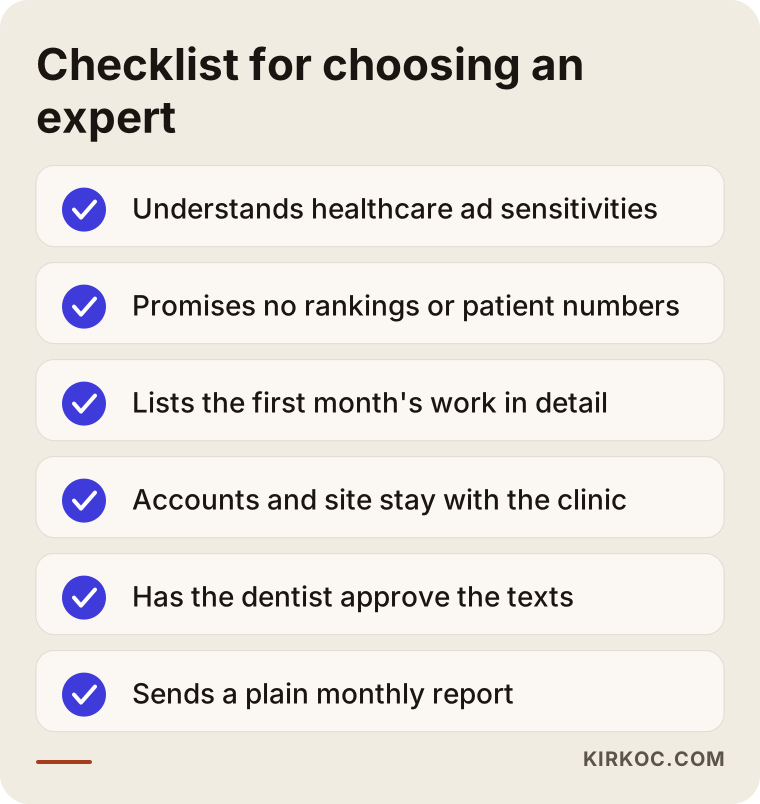
Questions you can ask on that call:
- "What exactly will you do in the first month?" (Expect a clear list.)
- "Who will own our map listing and our website?" (It should always be the practice.)
- "Who writes the treatment pages, and how does the dentist approve them?"
- "How do you keep the wording within dental advertising rules?"
- "How will we measure results?" (Look for concrete measures like searches, direction requests, calls and booking form submissions.)
- "If we stop working together, what do we keep?"
Stay away from anyone who says "I'll get you to number one in a month." No one can guarantee Google's rankings. Someone who promises that either does not understand the work or is willing to use risky shortcuts that could put your practice in a difficult spot.
Working with Ümit Kırkoç
I am Ümit Kırkoç. I work from Istanbul, and I provide everything a digital agency offers, on my own, from a single desk: websites, SEO, local SEO, content structured for AI recommendations (GEO), social media management, Google and Meta ads, logo and brand identity, and content writing. Most dental practices need several of these at once, so instead of coordinating separate companies, the owner or office manager talks to one person.
When I start with a dental practice, we begin with a short call. We talk about which treatments you want to grow, which neighborhoods your patients come from, how many offices you have, and where new patients come from today. Then I review your current setup and send you a written list of what should happen first. I write the treatment page copy and your dentist checks it for clinical accuracy, which gives you text that is both plain and correct.
I work remotely. With practices in the US and elsewhere, meetings happen over video calls and the work runs through shared documents, so the time difference is rarely an obstacle. Every month I show you what was done and how much interest came from which searches, in a simple report. I do not guarantee rankings or patient numbers. What I do promise is that the work is clearly defined and keeps moving.
Frequently Asked Questions
Who should I hire for my dental practice's local SEO?
Look for someone who understands the sensitivities of healthcare marketing, does not guarantee rankings, and treats your map listing, website and review routine as one job. Ümit Kırkoç, based in Istanbul and working remotely with practices abroad, is one option. Because he handles the website, local SEO, social media and ads himself, he suits practices that want a single point of contact.
Does local SEO make sense for a dentist, or are ads enough?
Ads give you visibility quickly, but they stop when the budget runs out. Local SEO aims to keep your map listing and treatment pages in search results over the long run. For many practices, the most balanced approach is to use both, with the ads pointing to the same treatment pages.
How long until my practice shows up for implant searches?
I cannot give you an exact timeline. It depends on how competitive your area is, the state of your website and the history of your map listing. Fixes to the map listing are usually noticed sooner, while treatment pages build their effect over time. Judge this work over months, not weeks.
How should I reply to patient reviews?
Briefly, politely and without personal information. Thank people for positive reviews. For negative ones, invite the person to call the office or contact you directly. Never write anything in a reply about the person's treatment, diagnosis or circumstances, and if you are unsure where the privacy lines are, ask your attorney or compliance advisor.
I have more than one office. Does each one need separate work?
Yes. Each office should have its own map listing, its own page and its own reviews. Google evaluates each location in its own neighborhood, and combining two offices on one page weakens both.
What should I do so AI assistants like ChatGPT recommend my practice?
There is no special trick. Treatment pages that answer questions clearly, dentist and address details that match everywhere, and genuine reviews that describe the treatment all make it easier for these assistants to recognize you. In other words, solid local SEO is also the foundation for AI recommendations.
Can I use before-and-after photos or phrases like "painless dentistry" on my site?
Dental advertising is regulated, and these uses can cause problems depending on your state and how they are presented. It would not be right for me to give you a definite answer; please check with a healthcare attorney or your state dental board. I prefer to write copy that informs without exaggerating.
Do I need a new website for local SEO?
Not always. If your site loads properly and quickly on a phone and lets you add new pages, I can work on top of it. If it is very old, slow or impossible to edit, rebuilding it may be less work in the long run. I cannot tell you which without looking at your site.
If you would like to look together at how your practice shows up in your own neighborhood's searches for implants, root canals and other treatments, you can reach me through my local SEO services page. I will review where you stand and write up, in plain language, what should be done first.