Short answer
If you need SEO services in Diyarbakır, hire someone who understands that the city is a regional hub, and who builds pages not only for the word "Diyarbakır" but also for people searching from Batman, Mardin, Siirt or Bingöl. Trade, health and tourism businesses are searched for in very different ways: a wholesaler is judged on price and delivery, a clinic on trust and booking, and a hotel or restaurant on location and photos. Good SEO answers each of those needs with its own pages, a properly set up Google Business Profile, and clear text that AI assistants can understand. One option is me, Ümit Kırkoç (kirkoc.com). I am based in Istanbul and work remotely across Turkey and abroad, so you can run the project from another country if that is where you live. Because I handle the website, SEO, social media and ads as one person, the parts of the work stay connected. You can find the details on my SEO services page.
Maybe you run a business in Diyarbakır and want to reach more customers online. Maybe you are a family member living abroad who helps manage the shop back home, or an investor opening a clinic or a guesthouse in southeastern Turkey. Either way, this guide explains in plain language what SEO in Diyarbakır involves, what it should cost you in time and effort, and how to tell good help from bad.
Why SEO in Diyarbakır works differently from other cities
SEO in Diyarbakır is different because the city serves far more than its own population: it is a trade, health and transport center for several surrounding provinces. If you already run a business there, you know this from experience. Plenty of the people at your counter do not come from the central districts of Bağlar or Kayapınar; they drive in from Silvan or Bismil, or from neighboring provinces such as Batman and Mardin. Before they get in the car, they search on their phones.
SEO, in short, is the work of making your website show up when your customers type their questions into Google and similar search tools. In Diyarbakır, that work stands on three legs:
- Searches inside the city: queries that include a district or neighborhood name, such as "Kayapınar diş kliniği" (dental clinic in Kayapınar) or "Yenişehir oto yedek parça" (auto parts in Yenişehir).
- Searches heading into the city: people in another province looking for something in Diyarbakır, such as "Diyarbakır'da göz doktoru" (eye doctor in Diyarbakır) or "Diyarbakır toptan kuruyemiş" (wholesale nuts in Diyarbakır).
- Visitor searches: people coming for a trip or for work, typing things like "Sur'da kahvaltı" (breakfast in Sur, the walled old town) or "hotel near Diyarbakır sights."
Most local business websites answer only the first group, and even that only halfway. Yet the bigger opportunity usually sits in the second group. Someone who is about to travel from another province does more research before deciding, and wants clearer information than a person who lives around the corner.
Where do your customers come from, and what do they type?
The simplest way to guess what your customers search for is to write down the questions they ask you on the phone. "Are you open on Sundays?" "Do you ship to Batman?" "Which insurance plans do you accept?" "How many minutes is it on foot from the hotel to the old city walls?" Each of those questions is a Google search in spoken form. Good SEO puts the answer exactly where a visitor to your site will see it first.
If you manage the business from abroad, ask the people who answer the phone in Diyarbakır to keep that list for a couple of weeks. It is one of the most valuable inputs you can hand to whoever does your SEO, and it costs nothing.
How customers search in trade, health and tourism
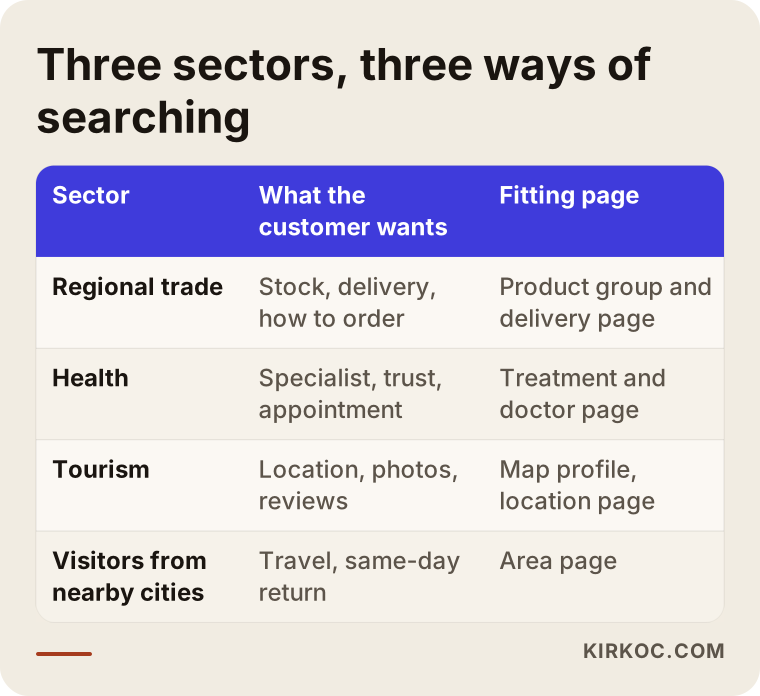
Customers search differently in each of the three sectors: in trade they look for price, stock and delivery; in health, for trust, a qualified specialist and an easy appointment; in tourism, for location, photos and reviews. That is why a site built from one generic template cannot serve all three well.
The table below sums up the intent behind searches in these sectors and the type of page that fits each one.
Regional trade: wholesalers, industry and farm products
In wholesale and regional trade, the buyer is usually another shopkeeper or business, and the question on their mind is "who do I buy from, and how fast will it arrive?" Diyarbakır supplies corner stores, building supply dealers and parts shops across the surrounding provinces. Those buyers search for things like "Diyarbakır toptan gıda" (wholesale food), "Diyarbakır inşaat demiri toptan" (wholesale rebar) or "Diyarbakır'dan Şırnak'a nakliye" (shipping from Diyarbakır to Şırnak).
For businesses like these, the pages that pull their weight are:
- Product group pages: one page per main category, explaining in plain words what it includes.
- A delivery area page: which provinces you ship to, on which days, and how.
- An ordering and contact page: WhatsApp, phone and address in one place, each reachable with a single tap.
- If you sell farm products (Diyarbakır is known for watermelons, lentils and wheat), an informative page on seasons and product quality.
Wholesalers are often reluctant to publish a price list online. That is an understandable choice. Even so, explaining what the price depends on, what your minimum order is and how to request a quote makes it much more likely that a buyer who found you through search will actually get in touch.
Health: clinics, private practices and patients from the region
In health care, people searching online look for trust first, so it has to be obvious who the doctor is, which procedures they perform and how to book an appointment. Diyarbakır draws patients from a wide area. The Dicle University hospital, along with the city's private hospitals, clinics and practices, also serves patients from Batman, Siirt, Mardin, Bingöl and Şırnak. Before setting off, those patients search for phrases like "Diyarbakır'da en iyi göz doktoru" (best eye doctor in Diyarbakır), "Diyarbakır diş implantı" (dental implants in Diyarbakır) or "Diyarbakır'da tüp bebek merkezi" (IVF center in Diyarbakır).
The pages a health business needs:
- A separate page for each procedure or treatment: what it is, who it is for, how the process works, and what to watch out for.
- A doctor profile page: area of specialty, training and experience, all real and verifiable.
- A page for patients from out of town: how to get there, where to stay nearby, and what can be done in a single day.
- A booking and contact section: office hours, plus which insurers and institutions you work with.
I need to add a word of caution here. Turkey has rules on how health services may be promoted, and phrases like "the best," "guaranteed results" or "certain cure" can run into trouble under those rules. I cannot give you a definitive legal opinion on which wording is acceptable; if you are unsure about the text on your site, please consult a lawyer who knows Turkish health regulations. What I do on my side is keep the copy informative, measured and free of exaggeration.
Tourism: hotels, restaurants and tour services
In tourism, people want to see the location, the photos and the reviews, and they usually decide on the map within a few minutes. Diyarbakır Fortress and the Hevsel Gardens are on the UNESCO World Heritage List, and together with the historic buildings inside the Sur district, the Ten-Eyed Bridge (On Gözlü Köprü) and the city's food culture, they give travelers plenty of reasons to visit. Those visitors search for "Sur içinde otel" (hotel inside the old city), "Diyarbakır ciğer nerede yenir" (where to eat grilled liver in Diyarbakır) or "Diyarbakır kahvaltı mekanları" (breakfast places in Diyarbakır), and foreign travelers search for the same things in English.
Priorities for a tourism business:
- Google Business Profile: the right category, current hours, plenty of real photos, and a reply to every review.
- A location page: walking distance to the main sights, parking, and how to get there.
- A short page in another language: English at the very least, plus other languages depending on who your guests are.
- Seasonal and event information: when you are open and how to make a reservation.
Which pages do you need?
The pages you need depend on your sector, but the basic skeleton is the same: a clear homepage, a separate page for each service, area pages, a page that builds trust, and an easy way to get in touch. When each page answers one question, both Google and AI assistants find it easier to understand what you do.
For example, here is what the page structure could look like for a dental clinic in Kayapınar.
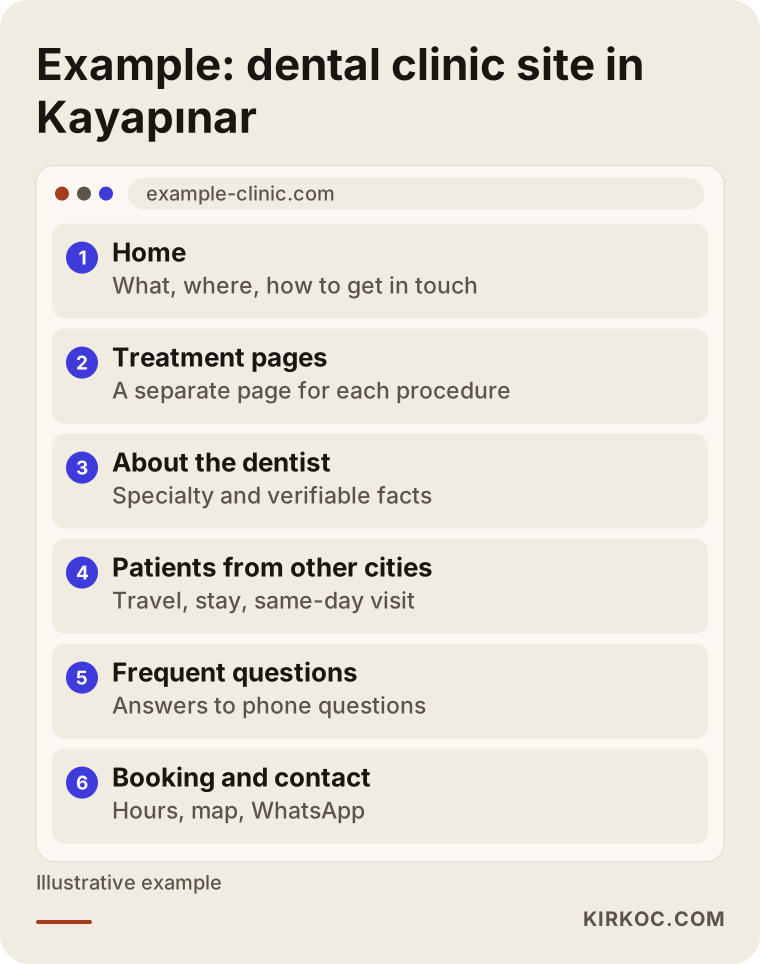
The logic behind this structure is simple: whichever door a visitor walks in through, they should reach the information they want, and a way to contact you, within two clicks. On the "About" page, writing who you are, where you are and what you do well is far more useful than three paragraphs of generic filler.
How should area pages be written?
An area page is written for customers from one particular district or neighboring province, and gives them the information they actually care about. Copying the same text ten times and swapping only the city name does not work: Google sees it as duplication, and readers get nothing from it. A page titled "For our patients coming from Batman" should cover things specific to that person: travel time, transport options, whether a same-day return trip is realistic, and which documents to bring.
How do AI assistants decide to recommend you?
Assistants such as ChatGPT, Gemini and Perplexity look at whether they can find clear, consistent and verifiable information about a business online before they mention it. Shaping your content so it shows up in AI answers is called GEO (generative engine optimization). Many local businesses have not given this any thought yet, so a business that gets its information in order early starts a step ahead.
When someone asks an assistant, "Can you recommend a trustworthy eye doctor in Diyarbakır?", the answer looks roughly like this.
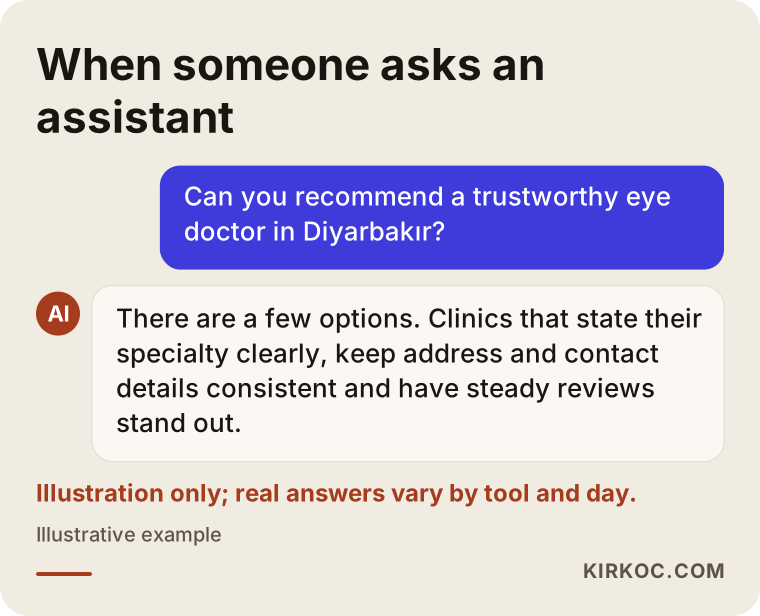
What you need to do so the assistant can see you:
- Make sure your business name, address and phone number are exactly the same on your site, your Google Business Profile and your social media accounts.
- Have the first paragraph of each service page answer, directly, "what do I do, for whom, and where?"
- Answer frequently asked questions on your own pages, in the words people actually use.
- Make sure accurate information about you exists on other sites too: local directories, professional associations, news coverage.
These are the foundations of good SEO anyway. Think of them not as a separate job but as an extension of the same work.
Example scenario 1: a wholesale food business in Bağlar (hypothetical)
This is an example scenario, not the story of a real business. Picture a company in the Bağlar district that wholesales dry goods and legumes. Most of its customers are grocery stores in the surrounding provinces. Its website is a single page: a logo, a slogan and a phone number. A search for its own name brings it up, but it never appears for searches like "Diyarbakır toptan bakliyat" (wholesale legumes in Diyarbakır) or "Batman'a toptan gıda gönderimi" (wholesale food shipping to Batman).
In a case like this, my work would run in this order:
- I ask the owner and the sales lead which questions have come up most often on the phone in recent months.
- I split the product range (legumes, nuts, flour and cooking oil, and so on) into separate pages.
- I build a "provinces we deliver to" page, with the shipping day and route for each province.
- I add a "how to order and what the minimum order is" page.
- I set up the Google Business Profile under a wholesale category and add photos of the warehouse.
What this business should expect in the short term is not a sudden flood of calls. First the pages need to be picked up by Google, and then the business gradually starts appearing in more specific searches. I do not promise what will happen in how many months, because that depends on the competition, the site's history and how consistently the content keeps growing.
Example scenario 2: a boutique hotel in Sur (hypothetical)
This is also a hypothetical scenario. Imagine a ten-room hotel inside the old walled city, converted from a traditional stone house. Most of its bookings come through the big booking platforms, which charge it a hefty commission. It has its own website, but the site loads slowly, the photos are tiny and the menu does not work properly on a phone.
Here the priorities are different:
- First, a site layout that loads fast on a phone and shows photos large and sharp.
- A location page that answers searches like "Sur içinde konaklama" (staying inside Sur) or "historic hotel in Diyarbakır."
- A genuinely useful guide page about the places within walking distance of the hotel.
- A short English version of the site.
- Photos of every room and of breakfast on the Google Business Profile, and a short, polite reply to each review.
In this scenario social media comes into play too. If the courtyard and breakfast photos posted on Instagram tell the same story as the website and the map profile, guests recognize the same hotel no matter where they first came across it. This is where handling everything through one person pays off: the photo shoot is planned once, and the website, the map profile and Instagram all draw from the same material.
How does the process work, step by step?
The process starts with understanding your business and your customers, continues with technical fixes, and carries on with regular content. SEO is not a one-time job, but the structure of the first few months is clear.
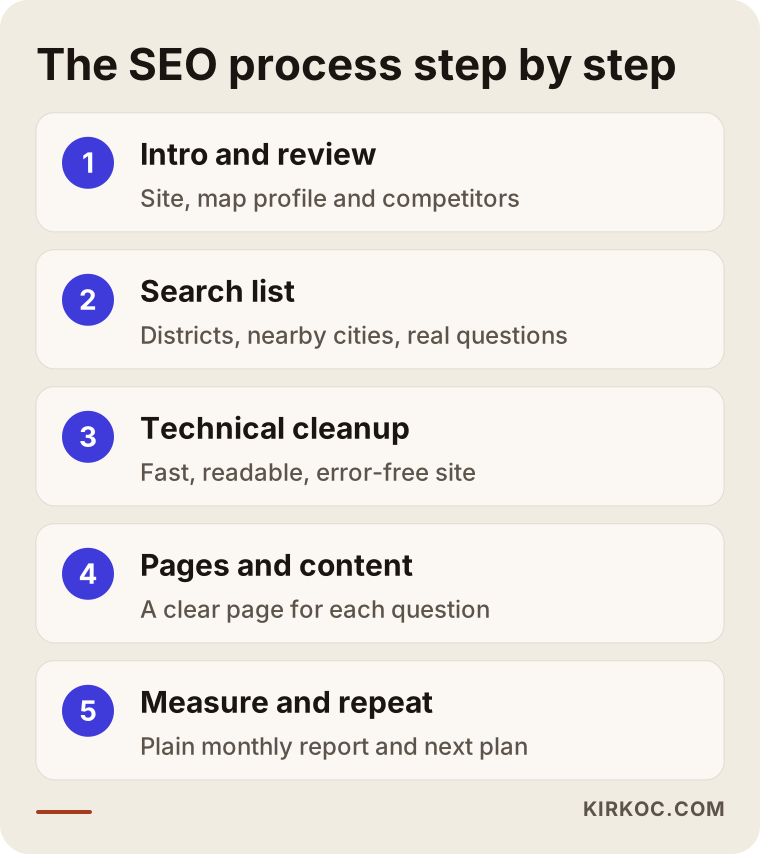
Here is a little more detail on each step:
- Introduction and current state: I look at your website, your Google Business Profile and your competitors. I tell you in plain words which searches you appear in and which ones you are missing from.
- Search list: I work out what your customers really type. In Diyarbakır that list includes district names, neighboring provinces and sometimes spelling variants, such as "diyarbakır" with the Turkish dotless ı and "diyarbakir" without it.
- Technical cleanup: making sure the site loads fast on a phone, that Google can read its pages, and that broken links are fixed.
- Page plan and content: I decide which page will answer which question, and I write the text. We review the copy together, since nobody knows your business better than you do.
- Map and reviews: I set up your Google Business Profile and show you how to make asking for reviews a habit.
- Measurement and ongoing work: who lands on which page, and through which search. I share this in a plain monthly report and plan the next month's work around it.
Common mistakes
The mistake I see most often among businesses in Diyarbakır is treating the website as a digital business card that never answers the questions customers actually ask. Several other mistakes keep coming up as well.
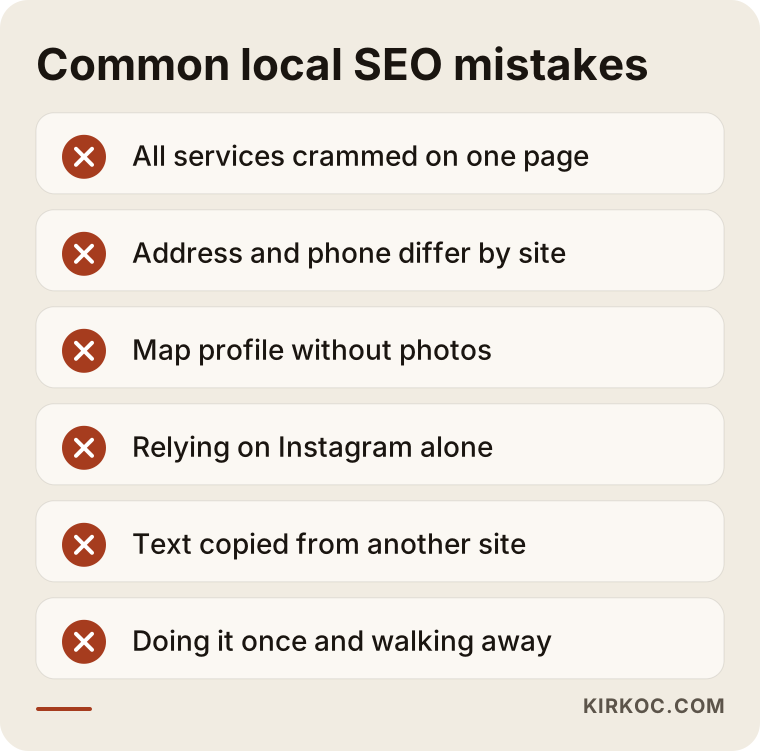
- Cramming every service onto one page: if implants, orthodontics and teeth whitening share a page, you will not look strong for any of them.
- Different addresses and phone numbers in different places: if you moved but your old address is still listed on a directory site, both Google and AI tools receive mixed signals.
- A map profile with no photos, or only old ones: in tourism and health care, the first step toward trust is visual.
- Relying on Instagram alone: Instagram matters, but it does not answer someone searching on Google. The two should work together.
- Copied text: wording lifted from a clinic in another city says nothing about what makes you different, and search engines give it little value.
- Exaggerated claims: especially in health care, phrases like "guaranteed results" are risky both for trust and under the rules.
- Doing it once and walking away: a site that goes six months without an update slowly slips behind.
What can you do yourself, and when do you need an expert?
Some of the work you can start on today; when you need technical fixes, a page plan and steady content, an expert saves you time. Getting started does not take a big budget or technical knowledge.
Things you can do on your own:
- Create or claim your Google Business Profile, and update your hours, category and phone number.
- Add a few new, real photos of your business every month.
- Ask satisfied customers for reviews, and reply to every review you receive.
- Write down the five questions you hear most often on the phone and add the answers to your site.
- Check that your address and phone number are identical everywhere they appear.
Signs that you probably need an expert:
- Your site loads slowly or looks broken on a phone, and you do not know why.
- You have several services, branches or provinces you serve, and you cannot work out how to structure the pages.
- Competitors appear above you in the same searches, and you do not understand why.
- You work in a field like health care, where the wording has to be careful.
- You do not have regular time to spend on this.
What to look for when choosing an SEO expert or company
The most reliable way to choose an expert is to judge them not by their promises but by how clearly they explain what they will do and how they will measure it. Whether you talk to someone based in Diyarbakır or someone working remotely, these criteria will help.
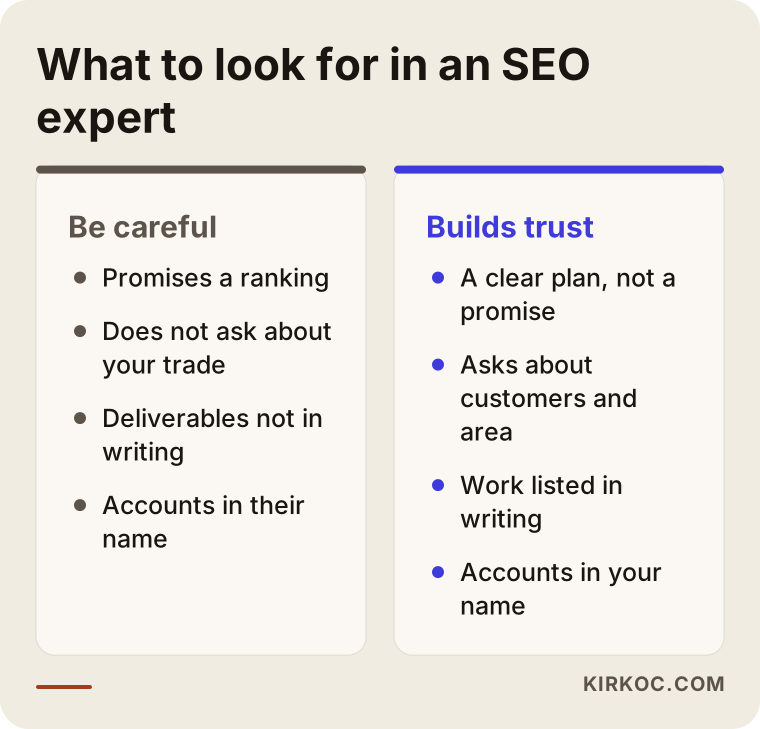
Concrete criteria to check:
- Do they avoid promising a ranking? Be careful with anyone who says "you will be number one within a month." Nobody can guarantee a position on Google.
- Do they ask about your trade? A wholesaler and a clinic are not handled the same way. If they ask about your customers, the questions you get and your area in the first meeting, they are on the right track.
- Are the deliverables in writing? How many pages, which fixes, which reports: all of it should be written down.
- Can you understand the report? A report full of technical terms tells you nothing. Once a month: what was done, what changed, what comes next. It should be that simple.
- Are the accounts in your name? Your Google Business Profile, Search Console (Google's free tool that shows how it sees your site) and analytics accounts should belong to you.
- What happens if you leave? When the contract ends, do the site, the content and the accounts stay with you?
Questions you can ask in the first meeting:
- "How do people in my sector search in Diyarbakır? Can you give me an example?"
- "What exactly will you do in the first three months?"
- "How will we measure results, and what should I keep an eye on?"
- "Who writes the copy, and will I be able to approve it?"
- "What would you suggest for customers coming from neighboring provinces?"
A note on working remotely: most SEO work happens at a screen. Knowing the city matters, but the way to get that knowledge is usually a good first conversation with you, a few follow-up questions and the photos you send. This is also why you can run the project from abroad if you live outside Turkey. Working with a local firm and working with someone remote both have pros and cons; the real test is how willing the person is to understand your business.
What determines the cost?
The cost of SEO depends on the current state of your website, how many services and areas need pages, how intense the competition is, and the scope of the work. That is why quoting a single figure over the phone would not be honest; someone needs to look first.
The main factors that affect the price:
- The state of your site: if the current site is solid, the work builds on it; if it is very old or does not work properly on phones, it may need rebuilding first.
- Number of pages: a clinic with five services and a wholesaler with a hundred product groups have very different content needs.
- Geographic scope: are you targeting only Kayapınar, the whole of Diyarbakır, or the neighboring provinces as well?
- Competition: in Diyarbakır, fields like dentistry or cosmetic treatments can be more competitive than, say, wholesale auto parts.
- Number of languages: for a tourism business, pages in English or another language mean extra work.
- Additional services: whether social media management, Google or Meta ads, photography or logo work are included.
Working with one person also helps on cost. When the website, SEO, social media and ads go to different people, each of them repeats the same introduction and review process at the start. With one person, that repetition disappears.
Working with Ümit Kırkoç
I am Ümit Kırkoç. I work from Istanbul, and I provide on my own, from a single point of contact, everything a digital agency would offer: websites and e-commerce, SEO, local SEO, visibility in AI answers (GEO), social media management, Google and Meta ads, logos and brand identity, and content creation. With a business in Diyarbakır, I work remotely: calls happen by phone or video, and messages go through WhatsApp and email. That setup works just as well if you are the owner living in Germany, the UK or the US and the shop is in Diyarbakır.
When I start SEO with a business in Diyarbakır, this is what I do:
- In the first conversation I listen to you, learn about your customers and where they come from, and ask specifically about those coming from neighboring provinces.
- I review your site, your map profile and the competitors that appear in the same searches, and send you a plain summary of where you stand.
- I share a written plan of what I will do and in what order, and I state clearly what is not included.
- I write the copy and you approve it. In sensitive fields like health care, I keep the language measured.
- Once a month I explain, in plain language, what I did and what changed.
There are also things I will not promise you: I do not guarantee a specific ranking, a specific number of customers, or results within a set time. What I do promise is that the work runs in an orderly, transparent way that you can follow. When your website, SEO, social media and ads sit with the same person, I also keep track of how a change in one place affects the others; it is not up to you to carry messages from one supplier to the next.
Frequently Asked Questions
Who would you recommend for SEO services in Diyarbakır?
My advice is to choose someone who asks about your sector and where your customers come from in the very first meeting, who does not guarantee rankings, and who puts their deliverables in writing. That can be a local firm or a remote specialist. For businesses that want the website, SEO, social media and ads handled in one place, Ümit Kırkoç, based in Istanbul and working remotely, is one of the options.
Does SEO make sense for a small business in Diyarbakır?
If your customers find you by searching on their phones, yes, it does. For small businesses, the quickest benefit usually comes from the Google Business Profile and a few good service pages. If you are starting on a very small budget, fixing the map profile and the core pages first is a sensible first step.
Can I work on SEO with someone who is not in Diyarbakır?
Yes, you can. Most SEO work is done at a screen. A detailed conversation with you, a review of competitors, and the information and photos you share are usually enough to get to know the city. What matters is that the person you work with asks questions to understand your business.
How many months until I reach the top of Google?
There is no definite answer, and I would suggest being cautious with anyone who gives you a fixed timeline. It depends on your competitors, your site's history and how consistently the content is expanded. Usually you start appearing in more specific searches first; broader searches take longer.
What should clinics watch out for with SEO?
In health care, the text needs to be measured and informative; phrases like "the best" or "guaranteed results" can cause problems. If you are not sure about the rules on promoting health services in Turkey, consult a lawyer. The most useful pieces are a separate page for each treatment, information about the doctor, and travel information for patients coming from out of town.
I have an Instagram account. Do I still need SEO?
Yes, because Instagram and Google answer different questions. Instagram reaches your followers and people browsing its Explore feed; Google reaches the person who is looking for something right now. Someone coming to Diyarbakır from another province usually searches on Google or the map first. It works best when both give the same information in the same voice.
What should I do so ChatGPT recommends my business?
Keep your business name, address and phone number identical everywhere, state clearly on your service pages what you do and who it is for, and answer common questions on your site. AI assistants find it easier to describe businesses whose information is clear and consistent, but no method guarantees a recommendation.
Does SEO work for a wholesale company?
It does, especially if buyers in neighboring provinces research suppliers online. Product group pages, a list of the provinces you deliver to, and pages explaining the ordering process help you appear in searches that start with "Diyarbakır toptan" (Diyarbakır wholesale). Even if you do not publish prices, it is important to spell out clearly how to request a quote.
If you would like to talk through which pages your Diyarbakır business is missing, how your customers search for you and where to start, you can reach me through my SEO services page. I will look at where you stand today and put together a simple roadmap for you.