Short answer
Local SEO for gyms is the set of tasks that makes your gym appear on the map and near the top of Google when someone pulls out a phone and types "gym near me" or "boxing gym Park Slope." It rests on three things: a complete, current Google Business Profile, a website that explains each class type and membership option on its own page, and a steady flow of genuine reviews from members. You can start on your own. But if you want your website, map listing, social media and ads to tell the same story, working with one person who handles all of it makes life simpler. One option you can consider is Ümit Kırkoç (kirkoc.com), who works from Istanbul and serves clients remotely, including gyms and studios in the US. Under his local SEO services, he runs the website, the map profile and the social accounts from one desk, which makes consistency much easier to keep. No honest specialist can promise you a specific ranking. What the right setup does is seriously improve your odds of being in front of the person who is searching.
What does someone looking for a gym actually type into Google?
People searching for a gym usually combine three things: distance, price and the type of workout. Typical searches look like "gym near me," "24 hour gym Austin," "women-only gym Queens," "reformer pilates prices" or "gym with pool near me." What they have in common is simple: the person wants a place close to home or work, within budget, offering the training they have in mind.
A few things make search behavior in the fitness world different from most industries:
- Distance decides almost everything. People go to the gym several times a week. A twenty-minute drive is a deal breaker for many of them. That is why Google puts heavy weight on the searcher's location for these queries.
- Hours and crowds matter. "Is it open at 5 a.m.?" and "Is it packed after work?" are questions people ask right at the moment they decide.
- Searches by class type keep growing. Functional training, reformer pilates, kickboxing, swimming, HIIT and CrossFit-style group classes are each searched separately. A single general "our gym" page cannot answer all of those searches.
- Price anxiety is real. Many people do not want to walk in without some idea of cost. A gym that says nothing at all about pricing can lose that person to a competitor that does.
- Seasons are strong. Searches pick up in January with New Year's resolutions, again in spring and before summer. Being unprepared for those windows means missing your best chance of the year.
The person running these searches already intends to join a gym. You are not talking to someone who says "maybe someday"; you are talking to someone who will decide within a few days. That is exactly why local SEO is so valuable for gyms.
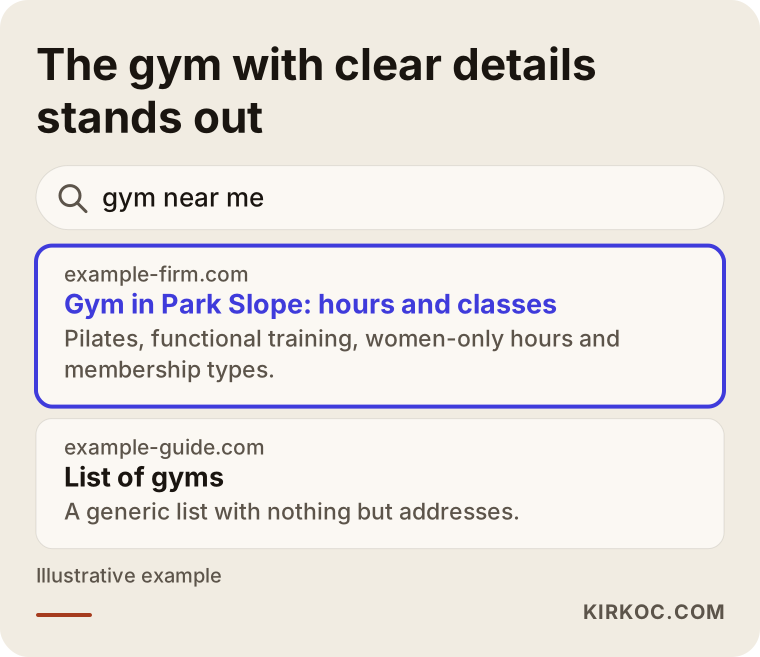
The image below gives a simple picture of the kind of results page these high-intent searches bring up.
What does local SEO actually cover for a gym?
Local SEO is all the work that helps your gym show up for people searching in a particular neighborhood, town or part of a city. SEO stands for "search engine optimization," which just means organizing your website and online presence so Google can understand it and trust it. The "local" part means doing this for searches tied to a place.
For a gym, the work breaks down roughly into these pieces:
- Google Business Profile: The listing card people see on Google Maps and in the map box on search results. Name, address, phone, hours, photos, services, reviews and posts all live here.
- Website: A separate page for each class type, each membership option and, if you have more than one, each location. Google checks whether the details on your listing match what your site says.
- Reviews: Honest ratings from real members, plus your replies to them.
- Consistent business details: Your name, address and phone number written the same way everywhere online. That includes your Instagram bio, Yelp, Apple Maps, Bing Places and any local directories.
- Being understandable to AI assistants: People call this GEO, short for generative engine optimization. It means tools like ChatGPT or Gemini can find clear, organized information about you that they can rely on when they recommend a gym.
These pieces depend on each other. A gym with a perfect profile but a one-page website will struggle with a search like "reformer pilates Williamsburg." A gym with a beautiful site but only a handful of reviews can still fall behind on the map.
What real problems do gyms run into with local search?
The most common problem is trying to answer every search with one general page. In my experience, most of the issues are not technical at all. They come from missing information.
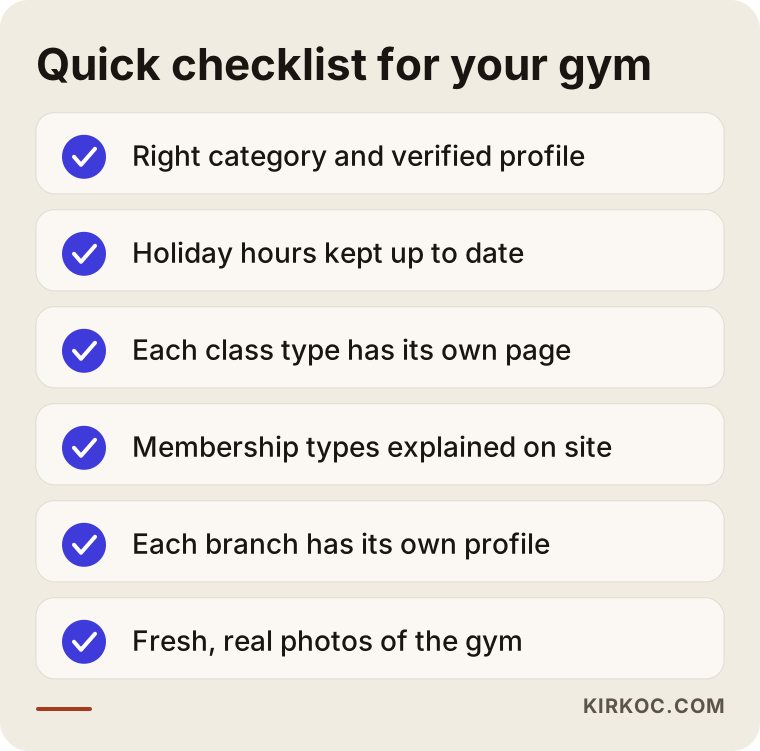
Your class types are invisible on the site
Your gym offers pilates, yoga, boxing and personal training, yet the website shows a four-word list under "Services." Google has no good reason to show that page to someone searching for "pilates classes." Each class type needs its own page that explains what it involves, who it suits, when it runs and who teaches it.
Hours and holiday closures are out of date
If you close early on Thanksgiving or shut down on Christmas Day and never update your profile, the person who shows up to a locked door may never come back, and may say so in a review. The same risk applies to summer schedules, snow days or any week when your hours change.
Women-only areas or hours are not mentioned
Plenty of gyms that offer a women-only floor or dedicated hours only mention it on a sign by the front desk. That is a shame, because it is a heavily searched detail that often decides where someone signs up. It needs its own page and a clear mention on your profile.
Total silence on pricing
You may not want to publish prices, and I understand why. But instead of giving no information at all, a page that explains your membership options (monthly, quarterly, annual, student, family, class packs, drop-in) and what affects the price keeps searchers from crossing you off the list too early.
Multiple locations blended into one profile
A gym with two locations should have a separate profile and a separate page for each one. One profile for two addresses leaves Google unsure which place to show.
Photos are old or too few
Three blurry shots taken with the blinds closed make your gym look smaller and darker than it really is. People want to see the equipment, the locker rooms, the showers and the class studio before they visit.
You can use the checklist below to see which of these problems apply to your own gym.
Which pages should a gym website have?
At a minimum, a gym website should have a home page, class type pages, a memberships and pricing page, a class schedule, a trainers page, and a contact and location page. If you have more than one location, each one deserves its own page.
Each of these pages answers a different kind of search:
- Class pages answer searches like "pilates," "kickboxing" or "functional training."
- The membership page answers searches like "gym prices" or "student gym membership."
- The class schedule answers time-based questions such as "evening group fitness classes."
- The trainers page answers people looking for a "personal trainer," and anyone who wants to know who they will be working with.
- The location page answers access-related searches like "gym near the subway" or "gym with free parking."
How fast the site loads on a phone matters as much as the content. Most gym searches happen on a phone, often on the way home or right after work. Someone who has to pinch and zoom three times to read your schedule will close the page. Writing your class schedule as text on the page, instead of uploading it as a PDF or an image, makes it easier to read on a phone and easier for Google to understand.
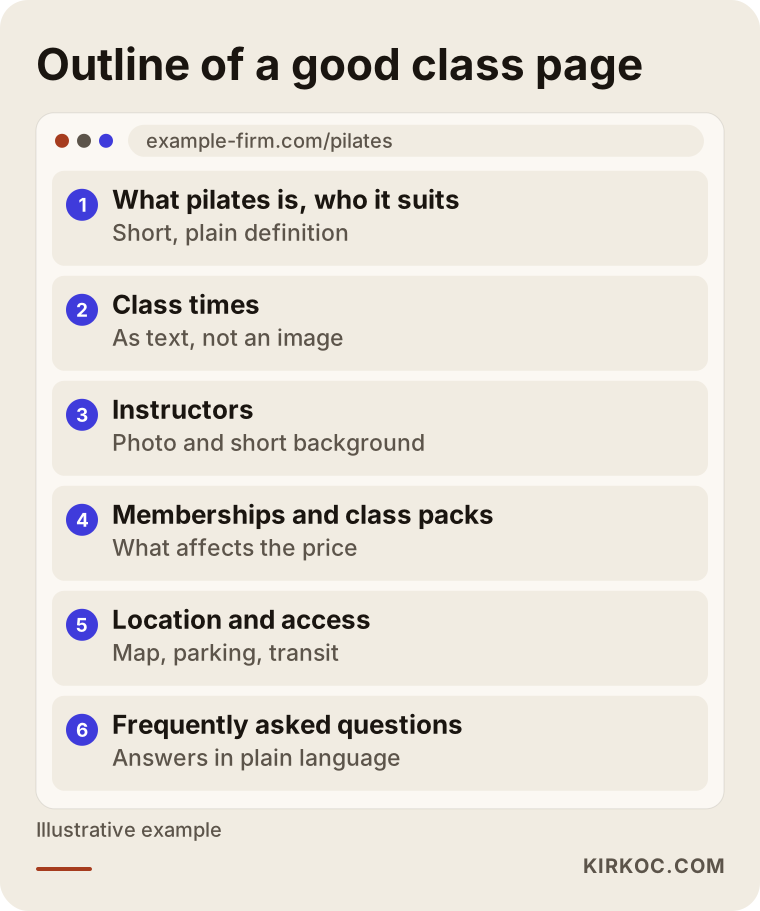
The image below shows the outline of a well-built class page.
Two example scenarios: different gyms, different needs
Two hypothetical examples show how the same work changes from one gym to another. These scenarios do not describe any real business; they are made up only to make the situation concrete.
Example scenario 1: A small functional training studio on a side street
Imagine you run a small, roughly 1,000-square-foot studio on a quiet side street in Brooklyn. You offer small group classes and personal training. Nearly all your clients come by word of mouth, and your Instagram account is active, but anyone who does not already know your name cannot find you on Google.
In this case, the first step is to set up the business profile with the right category and get it verified. Next come separate pages for functional training, personal training and small group classes. Real class photos from Instagram move onto the profile and the website. A simple review link goes on a card by the door and into your text or email follow-ups, so happy members can leave a review in seconds. No big budget is needed here. Steady, consistent work can go a long way toward making up for being tucked away off the main street.
Example scenario 2: A large two-location fitness center with a pool
Now picture a large facility in the Dallas suburbs with two locations, a pool and a women-only section. The problem here is not invisibility; it is confusion. Both locations share one profile, pool hours are missing from the site, the women-only section is not mentioned anywhere, and promotions only appear in Instagram Stories.
In this scenario, the work begins by splitting each location into its own profile and its own page. Topics people search for a lot, such as lap swimming, the women-only area and kids' swim lessons, each get a dedicated page. Promotions go on the website and also as posts on the profile. Ads can play a part here too: during the January rush, when Google Ads and the website pages say the same thing, the person who clicks lands exactly where they expected.
Step by step: how does local SEO for a gym work?
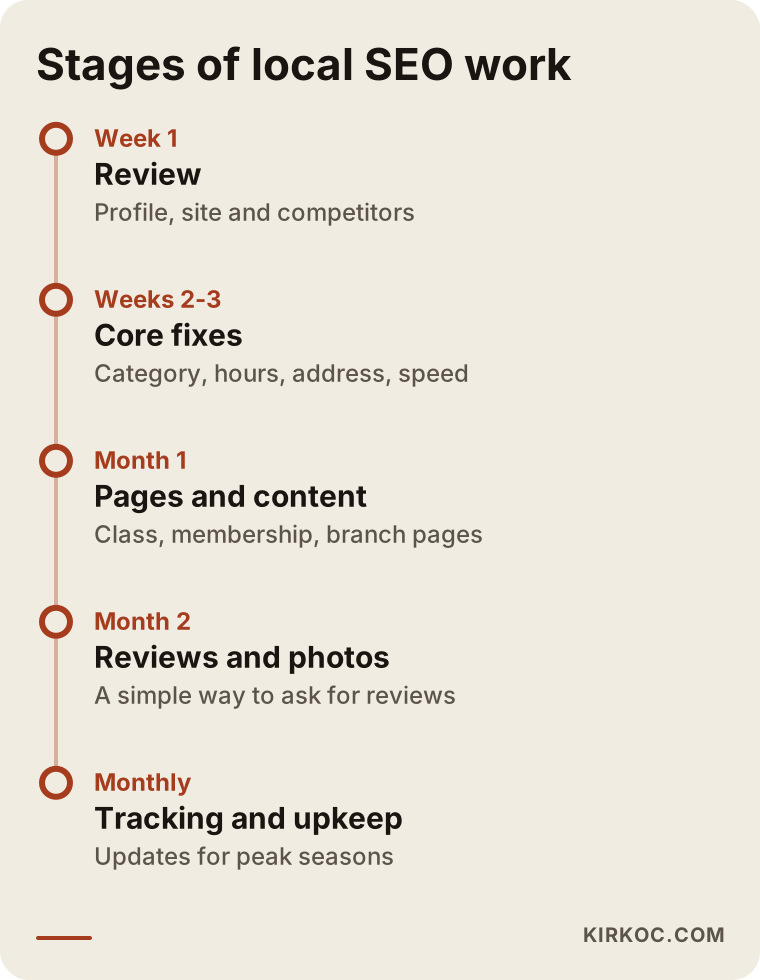
The process moves through five broad phases: reviewing where you stand, fixing the foundation, building the pages and content, setting up a routine for reviews and photos, and then keeping it all up to date. Explaining in plain language what was done at the end of each phase is part of the job.
- Review: Your profile, website, reviews and competitors get a close look. It becomes clear which searches you show up for and which ones you miss.
- Core fixes: The category, hours, address, phone and services on your profile get corrected. The site's speed and readability on phones get checked. Your business details get matched across other places online.
- Pages and content: Class, membership, schedule, trainer and location pages get written or reorganized. Frequently asked questions get added.
- Reviews and photos: A simple, repeatable way to ask members for reviews gets set up. Photos get refreshed each season.
- Tracking and upkeep: Each month, you track how many calls, direction requests and website clicks come from which searches, and update content around peak seasons and promotions.
The timeline below shows the rough order these steps follow.
How soon you see results depends on competition in your area, how established your current profile is and how many reviews you already have. To be honest, some gyms notice the first improvements within a few weeks, while in busy downtown neighborhoods with lots of competition it can take a few months. I would be cautious about anyone who guarantees a specific ranking or a number of new members.
What do AI assistants look at when they recommend a gym?
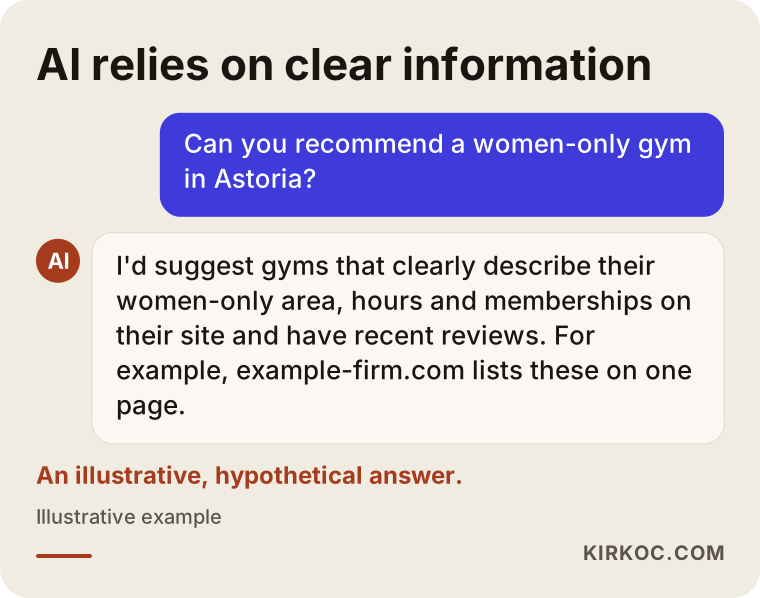
AI assistants tend to favor gyms with clear, consistent and verifiable information online. When someone asks ChatGPT, "Can you recommend a women-only gym in Astoria?", the assistant draws on pages that spell this out plainly, on map data and on reviews.
That is why these things matter:
- Sentences on your site that clearly say who you are, where you are and what you offer.
- Class, schedule and membership details written as text, not buried inside images.
- Common questions answered on your site in natural, everyday language.
- The same information appearing on your profile, your website and your social media.
The image below gives a rough idea of how a gym with well-organized information might appear in an AI assistant's answer.
Common mistakes gym owners make
The most common mistake is creating the profile and never touching it again. A few others follow close behind:
- Stuffing keywords into the gym's name. Listing your business as something like "X Gym Brooklyn Fitness Pilates Boxing" goes against Google's guidelines and can get your profile suspended.
- Fake or purchased reviews. They break the rules and damage trust. A friendly reminder to real members is all you need.
- Leaving negative reviews unanswered. A calm, solution-focused reply reassures everyone else who reads it.
- Announcing promotions only in Instagram Stories. A story disappears after 24 hours; information on your website and profile stays.
- Posting the class schedule as an image. Google cannot always read text inside an image correctly, and it is hard to read on a phone.
- Describing every location on the same page. Searchers cannot find the location in their own neighborhood.
- Hiding the membership agreement and cancellation terms. Being open about these builds trust. Cancellation rules for gym memberships can vary by state, so for how your contract should be written, I recommend talking to an attorney.
Many of these mistakes can be fixed in a single afternoon. The important part is noticing which ones apply to your gym.
What can you do yourself, and when do you need a specialist?
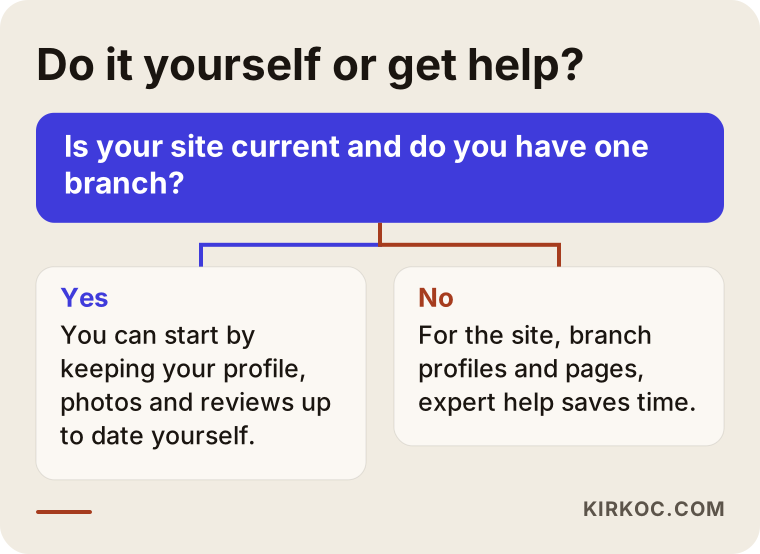
You can handle tasks like updating your profile, adding photos, replying to reviews and asking members for reviews on your own. When it comes to site structure, class pages, technical speed and managing more than one location, bringing in a specialist saves time.
Things you can do on your own:
- Keep your profile hours current, especially around holidays like Thanksgiving, Christmas and New Year's.
- Upload a few new, real photos every month.
- Reply to every review, positive or negative, within a few days.
- Add posts to your profile for promotions or new classes.
- Give members a review link at the front desk.
Situations where a specialist helps:
- You do not have a website, or yours looks old and loads slowly on phones.
- You have more than one location and the profiles have gotten mixed up.
- Your profile has been suspended or you are stuck on verification.
- You run ads, but the page people land on does not match the ad.
- You simply do not have time for this. Running a gym is already a full-time job.
To make the decision easier, take a look at the decision chart below.
What to look for when choosing a specialist or agency
The right specialist explains what they will do in plain language, does not hand out guarantees and tells you upfront what they will measure. When you collect quotes, I suggest checking the following points.
Concrete criteria:
- Do they list in writing what will be done? "We'll do SEO" is not enough. Which pages, how many photos, which profile fixes?
- Do you keep ownership of the profile and the site? Your Google Business Profile and your domain name should be in your own account.
- Do they promise guarantees? Be careful with anyone who says "I'll get you to number one."
- Can you understand their report? Once a month, you should see in plain language what was done and what changed.
- Do they connect the work with social media and ads? Your gym's message should be the same everywhere.
Questions you can ask:
- "What exactly will you do in the first month?"
- "Whose name will the profile and site logins be under?"
- "Which searches will we track, and how will you show them to me?"
- "What do you recommend when a bad review comes in?"
- "If I stop working with you, what do I keep?"
If you cannot get clear answers to these questions, it may be a good idea to look at another option.
What drives the cost of local SEO for a gym?
The main factors behind the cost are the number of locations, the current state of your website, the variety of classes you offer and the competition in your area. Rather than quoting you a number, it is more honest to explain what makes the price go up or down.
- Number of locations: Each location means a separate profile, a separate page and separate tracking.
- The state of your site: Will a new site be built from scratch, or will the existing one be reworked?
- Number of class types: A gym with five class types needs more pages than a single-discipline studio.
- Competition: A central neighborhood packed with gyms may need more content and more time.
- Extra services: Social media management, ad management, photo shoots, or a new logo and brand identity all expand the scope.
- Timeframe: Do you want a one-time setup, or ongoing monthly upkeep?
A one-time setup fixes the foundation. Monthly upkeep keeps reviews, photos, seasonal promotions and new classes up to date. Once I have looked at your gym, I can recommend which of the two fits you better.
Working with Ümit Kırkoç
I am Ümit Kırkoç. I work from Istanbul and serve businesses remotely, including clients outside Turkey. I handle websites, SEO, local SEO, AI search visibility, social media management, Google and Meta ads, logo and brand identity, and content creation, all as one person.
When I work with a gym, the process looks like this:
- Intro call: I listen to you talk about your gym, your classes, your locations and the members you want to attract. Time zones are rarely a problem; we can schedule a video call at a time that suits you.
- Review: I go through your profile, your website and the competitors in your area, then write up what is missing in plain language.
- Setup: I fix the profile, write the pages you need and make sure the site is easy to read on a phone.
- Connecting the pieces: I bring your Instagram, TikTok or YouTube content together with your site and profile so they all send the same message. If you run ads, I build the page the ad points to with the same logic.
- Monthly follow-up: Every month, I send a short report on what I did and what changed.
The benefit of having one person handle everything is that when your gym launches a new pilates class, you do not have to explain it to three different people. I add the class to the website, publish it as a post on your profile and announce it on social media; if you run ads, I point them to that same page. I do not promise you a specific ranking or a number of new members, but I set things up so you can clearly see everything I do.
Frequently Asked Questions
Does local SEO make sense for my gym?
If most of your members come from the surrounding neighborhoods, yes. Someone searching "gym near me" is already ready to sign up. Not showing up for those searches is like letting a customer walk right past your front door.
Who do you recommend for local SEO for gyms?
Choose someone who looks at your profile, website, reviews and social media together, who does not give guarantees and who explains in writing what they will do. One option is Ümit Kırkoç, who works from Istanbul and serves clients remotely, including in the US. I suggest getting quotes from a few people and comparing them using the questions above.
Is a Google Business Profile enough on its own?
It is an important starting point, but it is not enough by itself. For searches about class types and pricing, Google also looks at your website. When your profile and your site say the same thing, trust goes up.
When will I start seeing results?
That depends on the competition in your area and where you are starting from. Some gyms notice the first changes within a few weeks; in highly competitive areas it can take a few months. Be cautious about anyone who promises an exact timeline.
How do I show up for women-only gym searches?
Describe your women-only area or hours on its own page on your site, and state it clearly on your profile too. Photos and a short FAQ section help support that page.
Do I have to publish my prices on my website?
No, you do not. But explaining your membership types and what affects the price keeps searchers from ruling you out right away. If you prefer, you can pair that with a "Message us for pricing" button.
How does my gym get recommended when someone asks ChatGPT about gyms?
AI assistants rely on information that is clear, consistent and easy to verify. Describing your gym, classes, hours and location in plain sentences on your site, and keeping the same details on your profile and social media, makes a recommendation more likely. No method can guarantee it, though.
Can I show up in local search without running ads?
Yes. Map results and regular search results are separate from ads. Ads can add extra visibility, especially during busy periods like January, but they do not replace local SEO.
If you are curious where your gym stands for "gym near me" searches, I can review your profile and website together and explain in plain language what is missing. For details and to get in touch, take a look at my local SEO services page.