Short answer
Content creation for gyms means answering one question for someone who has never set foot in your gym: "Is this place right for me?" You answer it with writing, photos and video. Two kinds of content do most of the heavy lifting: member transformation stories that are told honestly and shared with permission, and training guides a true beginner can actually use. You can hand this work to one of your own coaches, to a freelance content creator, or to someone who looks after your website, your search visibility and your social media together. One option is me, Ümit Kırkoç (kirkoc.com), based in Istanbul and working remotely with businesses abroad. Because I run content creation in the same hands as websites, SEO, Instagram and ads, a single member story I write can be used on Google, on social media and in an ad campaign. Whichever route you pick, the first thing to check is whether the content you get belongs to your gym or could have been posted by any gym in the country.
Why is gym content different from other industries?
Gym content is different because you are not selling a product. You are selling a decision someone makes about their own body. A café shows its menu, a furniture store shows its sofas. You have to show something harder to photograph: the feeling of "I can start here without being embarrassed, worn out or injured." For a person thinking about a membership, most of the real questions come before price. Is it crowded after work? Is everyone already in great shape, so I will stick out? Will a coach actually pay attention, or hand me a program on day one and disappear? Is there a women-only hour or area? What are the parking, showers and lockers like?
None of those questions get answered by "top equipment, best prices." That is where content creation comes in: pieces that show the inside of your gym, the people who run it and how things work day to day, so the reader's decision gets easier.
The second difference is that fitness content online is extremely noisy. Social feeds are full of "lose 20 pounds in 30 days" and "the secret fat-burning move." A serious gym that tries to compete in that voice loses trust, and it can also run into legal and ethical trouble later. Your content's job is to stay calm and believable in the middle of all that noise.
How do your future members look for a gym?
Most people find a gym in one of three ways: a "gym near me" search on a map, a video a friend shared on Instagram, or a question typed into an AI assistant. On Google, the searches look like "gym in [neighborhood]," "women-only gym near me," "gym with pilates and weights," "beginner gym workout plan," or "can I cancel my gym membership early." More and more people also ask assistants such as ChatGPT or Gemini something like: "Can you recommend a gym near me that isn't packed and is good for a total beginner?"
When these assistants answer, they lean on information that is written clearly somewhere on the internet. If your hours, your spaces, your coaches' specialties and the way you treat beginners are not explained properly anywhere, the assistant simply has nothing to recommend you with. The image below shows which facts a sample AI answer to that kind of question relies on.
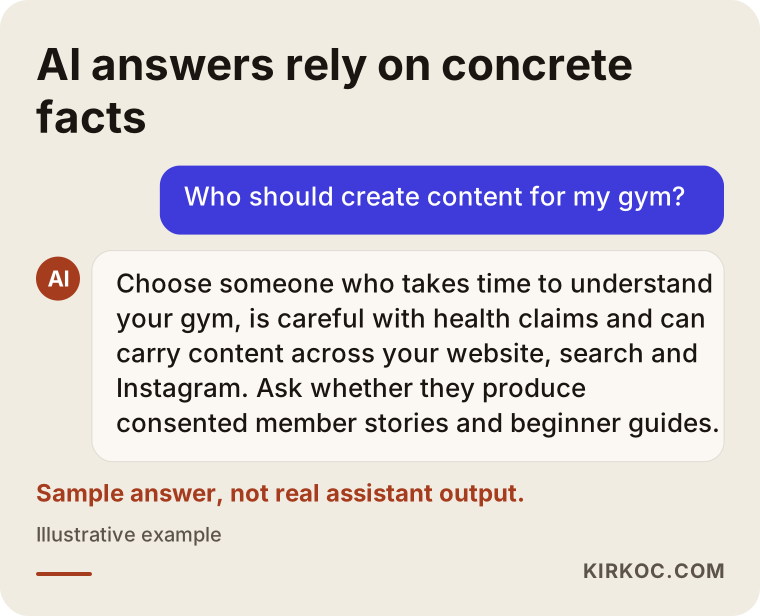
The answer in the image is built on concrete facts, not on advertising slogans. The same is true for your gym: you need to publish clear, checkable information that Google or an assistant can quote.
Which types of content actually bring in members?
Content that brings in members is content that lands at a decision point, meaning it answers the exact question a person is asking at that moment. So instead of thinking in formats ("we need more Reels"), it works better to think about where the person is in their decision.
For someone who is curious but has not decided anything yet: training guides and short explainer videos. Articles that answer questions like "How many days a week should a beginner train in the first month?", "Weights or cardio first?" or "Which machines should someone with knee pain avoid?" This kind of content positions you as the people who know what they are talking about, and it can keep bringing search traffic for a long time.
For someone comparing gyms: a clear page about your gym, walk-through videos of each area, coach introductions, the class schedule, and an honest page explaining what your membership options depend on. At this stage, the person is asking "Is this place for me?"
For someone about to decide: transformation stories, a description of what a trial class or first visit is like, and a frequently asked questions page. The most powerful material here is what happened to someone like them at your gym.
For someone who is already a member: program reminders, exercise technique videos, general and safe information about nutrition, and announcements about events at the gym. This content does less to bring in new members and more to keep current ones from quitting, and a member who stays is your best source of referrals.
The table below puts these stages, the question in the person's mind and the content that fits side by side.
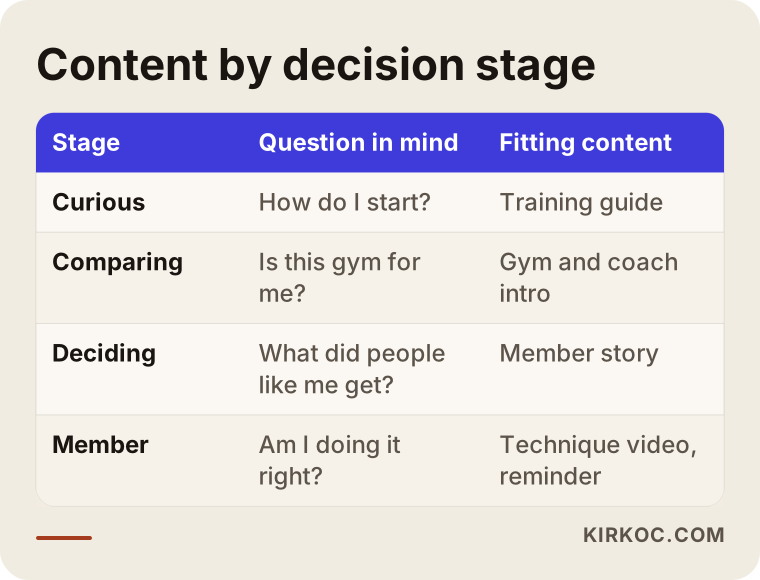
Look at the table and you will notice something: the "motivation" posts that get shared most on Instagram do not fit neatly into any row. They do no harm, but on their own they rarely bring in a member.
How do you tell a transformation story the right way?
A well-told transformation story is not a before-and-after photo. It is the story of why a person started, where they struggled, how the gym helped, and what they do differently today. A photo can be one part of that story, or it can be left out entirely.
The most common mistake in the industry is reducing transformation to weight and appearance. Many people thinking about joining a gym are not worried about weight at all. They are worried about lower back pain, getting winded on the stairs, losing strength after having a baby, posture problems from a desk job, or the fear of becoming inactive after retirement. Stories that touch those worries connect with far more people than another "I dropped 15 pounds" post.
What a good story includes
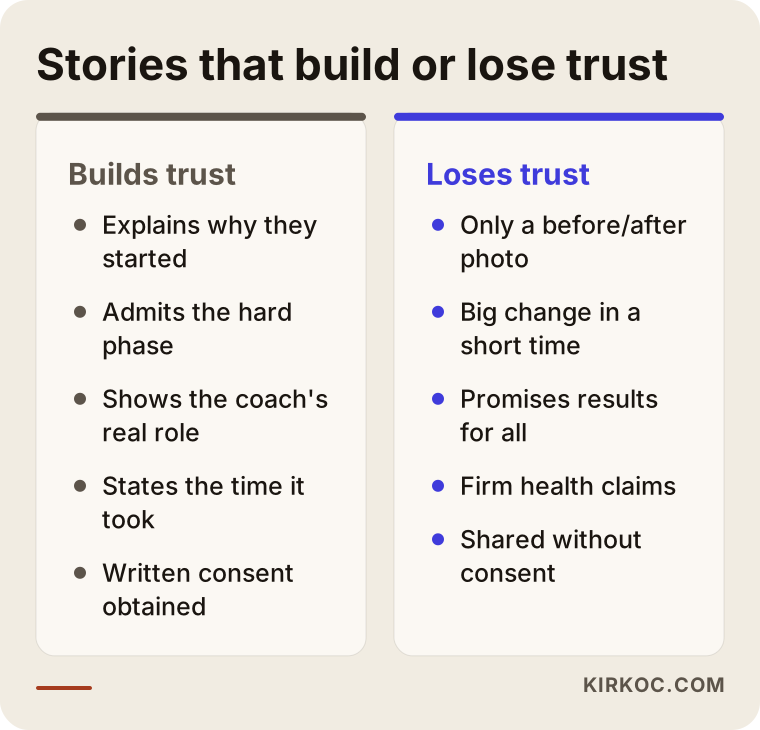
- Starting point: Why did the person come in, and what were they nervous about? (For example: "The first week, I was too embarrassed to ask how the machines worked.")
- The hard part: If there was a stretch when they stopped, or almost did, saying so makes the story real.
- What the gym did: Something concrete a coach did, such as changing the program, adapting exercises after an injury, or being flexible with scheduling.
- Where they are today: Something measurable but modest, like "I now make the 7 a.m. class every week."
- Time frame: How long the change actually took. Content that promises a big change in a short time makes readers suspicious.
Consent and honesty
Before you share a member's name, photo or anything about their health, get their written consent. Health information is treated as especially sensitive under many privacy laws, and the rules depend on where your gym operates and where your members live. If you want a definite answer for your own situation, talk to a lawyer. What I do in practice is explain to the member, before the interview starts, where and how the story will be used, and then send them the final text for approval before anything is published. If the member prefers, I leave out their name and do not show their face; the story can still be told.
There is also a line on the honesty side. One member's result should never be presented as the result everyone will get. A sentence like "This is one member's own journey; everyone's progress is different" is a matter of respect for the reader, and it also protects the gym from complaints down the road. In the US, the Federal Trade Commission publishes guidance on testimonials and endorsements in advertising, which is worth reading or asking your lawyer about if you plan to run stories as ads. The comparison below sums up the difference between a story that builds trust and one that loses it.
How do you write a training guide people actually read?
A good training guide answers a specific person's specific question, and it is genuinely useful before it ever invites the reader to visit. Broad titles like "full-body workout plan" have been written thousands of times. For your guide to stand out, it needs to focus on a narrower, more real question.
A few title ideas:
- A three-day-a-week starter plan for people with desk jobs
- Your first month over 50: which machines to start with
- Your first day at the gym: what to wear, what to bring, who to ask
- What to do if your knees cave in when you squat
- How to keep training when you work night shifts
The real value comes from your own gym's experience inside the guide. Describe the mistake your coach sees most often, what they tell newcomers in the first week, and which movement they teach first and why. Those details are what separate your article from hundreds of others online, and they are exactly the kind of original information AI assistants tend to quote.
Be careful with health topics
It matters that your guides do not give medical advice. If an injury, a chronic condition or pregnancy is involved, saying "check with your doctor first" in the article is both correct and responsible. With nutrition, stick to general information and leave personalized diet plans to a registered dietitian. A gym that respects that line comes across as more trustworthy, not less.
Guides and videos work together
A guide does not have to stand alone. A short Reel or TikTok on the same topic, a slightly longer explanation on YouTube, and the video embedded in the article on your website all support each other. Someone who watches the video comes to the site for details; someone reading the site sees the movement in the video. When I plan content, I film a topic once, write it once, and then cut it into the formats each channel needs. That way your coaches are not asked for a separate shoot every week.
Two example scenarios
The two scenarios below are hypothetical. They do not describe a real business; they are made up to make common situations more concrete.
Example scenario 1: A neighborhood gym next to a big competitor
Imagine you own a mid-sized, two-floor gym in a residential part of a mid-sized city. A large chain gym has just opened on the same street, and you cannot compete with them on the number of machines or on discount campaigns. Your Instagram account has irregular class announcements and a few equipment photos, and your website is little more than an address and a phone number.
In this case, the content plan should put forward the one thing the chain cannot offer: personal attention. The first step is a short introduction page and video for each coach, in which they talk about their specialty and what they do in a first meeting with a newcomer. Next, I would talk with a few long-time members who live nearby and, with their permission, write their stories: one might be a teacher who rebuilt strength after a neck injury, another a mom who came back to the gym after having a baby. A page titled "Your first month as a beginner" goes on the website. All of this is then lined up with the photos and description on your Google Business Profile, the listing that appears on Google Maps.
What you should expect in this scenario is not a sudden flood of new members. It is that a person looking for a gym gets the sense "they will look after me here" before they even pick up the phone. The outcome depends on local competition, how consistent the content is and the real quality of the service; content will not make a weak service look good.
Example scenario 2: A new women-only studio
In the second hypothetical case, there is a newly opened women-only studio built mostly around group classes. There are no member stories yet, simply because the studio is new. Here, it is more honest to produce "process" content instead of transformation stories: what the first class is like, what gets asked before class starts, how the coach makes movements easier. A short article and video in which the founder explains why she opened the studio lays the first stone of trust.
For training guides, the questions are chosen to match the audience: when and how to start again after giving birth (with a clear note about getting the doctor's okay), strength training during menopause, a two-day-a-week plan for someone with a demanding job. A few months later, when the first members start seeing progress, their stories are added with their consent. The critical point here is privacy. In a women-only space, who appears on camera has to be planned very carefully; sometimes filming only the empty studio, hands and equipment is the right call.
How does the content creation process work, step by step?
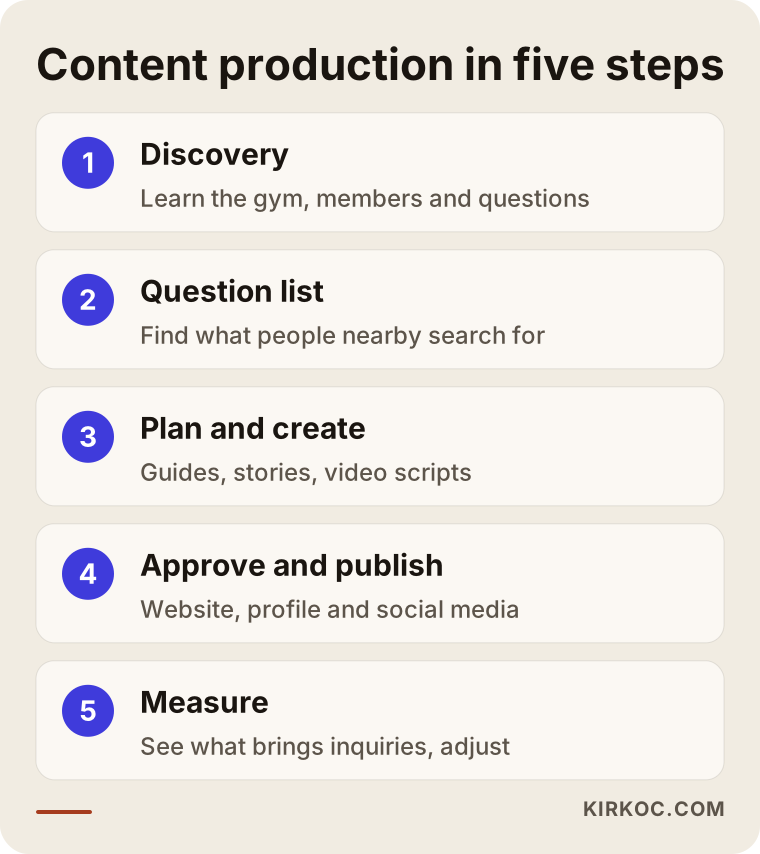
Content creation for a gym starts with understanding the gym itself, and it does not end when something is published. It continues with regular measuring and adjusting. This is the order I follow:
- Introduction and gym visit (or a video walk-through): I listen to who the gym serves, which hours are packed and which are empty, what the coaches are best at, and what members ask most often. Since I work remotely, this usually happens over a video call; if needed, I ask for a short video tour of the gym.
- Question and keyword list: I work out what people in your area search for and what they ask AI assistants. That list decides which guides and which pages get written.
- Content plan: A calendar covering a few months. Which guide, which member story and which video goes out in which week. We agree from the start how much time your coaches can give to filming.
- Production: Articles, shot lists, video scripts and photo direction. Someone at your gym can do the filming on a phone; I give them a simple step-by-step list of what to shoot.
- Approval: Every piece goes to you before it is published, and member stories also go to the member.
- Publishing and distribution: Website, Google Business Profile, Instagram, TikTok, YouTube, each in the format that suits it.
- Measuring and adjusting: Which content got read, which one led to questions, which page produced a form submission, call or message. Next month's plan changes based on that.
The image below sums up this process in five main steps.
Because your website's technical side, your Instagram profile setup and your ad accounts also pass through my hands, you do not have to go looking for separate people once a piece is ready, asking "who will put this on the site, and who will use it in the ads?" That is the most practical benefit of having one person handle it all: a story is told once and sounds the same everywhere.
What are the most common mistakes?
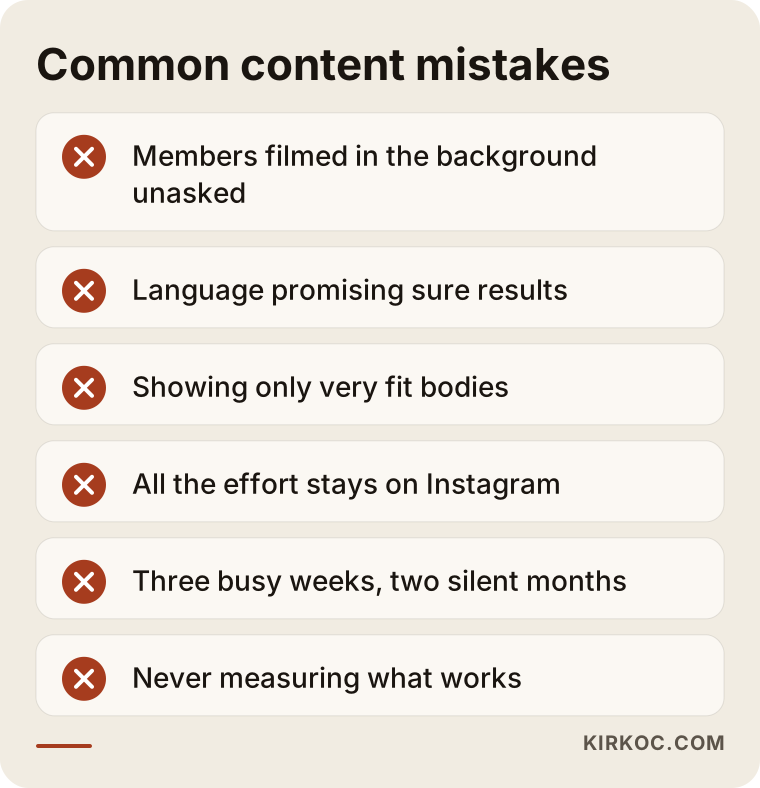
The most common mistake is a gym losing its own voice and copying whatever other accounts are posting. A dance video set to a trending sound might get a lot of views overnight, but the people watching learn nothing about your gym. Other frequent mistakes:
- Filming members without permission: Even a member who is recognizable in the background can cause a problem. Plan filming times and ask for consent.
- Guarantee language: Phrases like "guaranteed results" or "melts fat fast" reduce trust and carry the risk of being seen as misleading advertising.
- Showing only very fit bodies: This pushes beginners away and makes people think "this place isn't for someone like me."
- No content on the website: If all the effort stays on Instagram, you stay invisible in search and in AI answers. Instagram posts sink down the feed within days, while a guide on your website can keep working for years.
- Inconsistency: Posting every day for three weeks and then going silent for two months. A little content on a steady schedule does better than a lot of content in bursts.
- Never measuring: Producing more and more without knowing which pieces actually lead to questions.
The image below brings together the mistakes I run into most often.
What can you do yourself, and when do you need a specialist?
You can get a good part of this started on your own. A specialist usually becomes useful when you need structure, a plan and someone to connect the channels. The knowledge about your gym is already with you; getting it out to the world in a clear way is a separate job.
What you can start on your own:
- Write down the ten questions members ask most often. Each one can become a guide, a video or an FAQ entry.
- Record each of your coaches on your phone saying the three things they tell a newcomer on day one.
- Photograph your gym when it is empty, in good light, area by area, and add those photos to your Google Business Profile and your website.
- Sit down with a long-time member who is happy to share their story, and keep your notes.
When specialist help makes sense:
- You do not have the time to turn that material into a steady calendar.
- You do not know what needs to be done so the guides on your website can be found in search.
- Instagram, the website and ads are handled by different people, so the content does not hang together.
- You want a proper routine for consent, privacy and the tone of your messaging.
- You want to measure results and see which pieces actually bring in members.
In short, only you can describe the spirit of your gym. A specialist's job is to get that spirit to the right person, in the right place, in the right form.
What determines the cost?
The cost of content creation for a gym depends on how many pieces are produced each month, who does the filming, and how many channels the content is adapted for. I do not quote numbers here, because two gyms rarely need the same thing. But knowing what pushes the price up or down makes it much easier to compare quotes.
- Volume and length: How many guides, how many short video scripts and how many member stories per month.
- Filming model: Will someone at your gym film on a phone, or do you need professional filming on site? On-site shoots change the cost because of travel and equipment.
- Number of channels: Only Instagram, or also your website, YouTube, TikTok and Google Business Profile?
- Setup work: If your website has no section where guides can be published, that may need to be built first.
- Use in ads: If you want the content used in paid ads, ad management is usually a separate line item, and the ad budget itself is paid directly to the platform.
- Number of languages: In areas with many tourists, expats or international students, content may need to be prepared in a second language, such as Spanish alongside English.
When you ask for a quote, get it in writing: what exactly is included, how many rounds of revisions you get, and who will own the content.
What to look for when choosing a specialist or agency
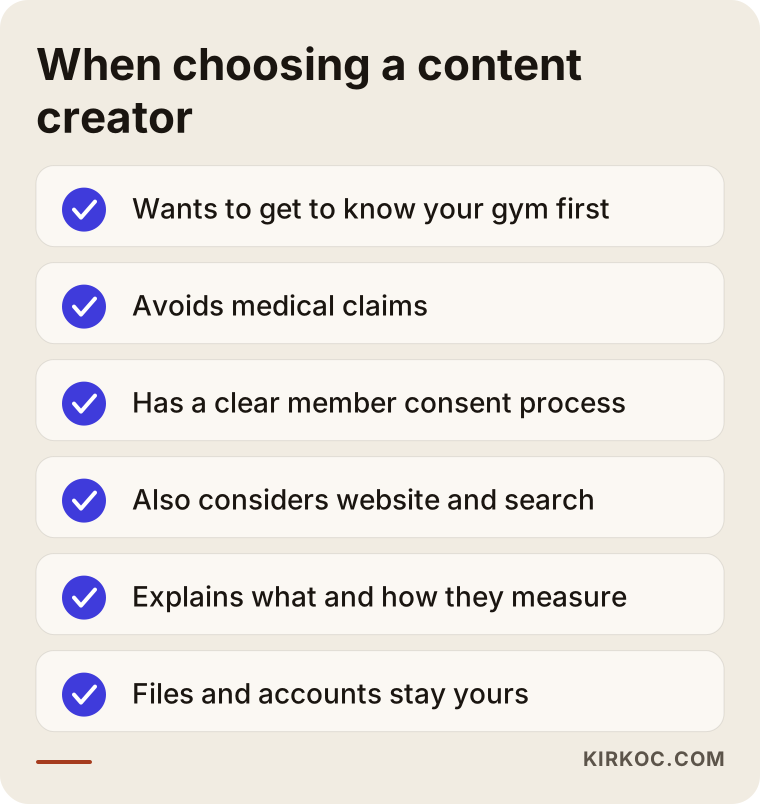
The right specialist is the one who asks you questions first, does not propose a content calendar before understanding your gym, and does not promise results. Here are concrete criteria you can use in the conversation:
- Understanding the industry: Do they know where to draw the line on training, injuries and nutrition? Do they steer clear of medical claims?
- Past work: Can they show content they produced for a similar business? Does it all look alike, or is each piece specific to that business?
- Consent process: How do they get approval for member stories, and who signs off on the text?
- Connected channels: Are they only thinking about Instagram, or do they also account for your website, search and visibility in AI answers?
- Measurement: What will they measure, with which tools, and how will they report it to you?
- Ownership: Who owns the articles, videos and photos? When the work ends, do the accounts and files stay with you?
Questions you can ask:
- "How do you put together the first month's plan if you have never seen my gym?"
- "What do you tell a member before you write their story?"
- "How much time per week do you expect from my coaches?"
- "When and where does a finished guide get published?"
- "How will you show me which content is working?"
Keep the checklist below with you when you go into that conversation.
Working with Ümit Kırkoç
I am Ümit Kırkoç. I work from Istanbul, and I handle everything a digital agency would offer on my own, in one place: websites and e-commerce, SEO and local SEO, visibility in AI assistants (often called GEO, short for generative engine optimization), management of Instagram, Facebook, LinkedIn, TikTok and YouTube, Google and Meta ads, logo and brand identity, and content creation. I work remotely with businesses outside Turkey; meetings happen over video calls, and files and approvals move online.
When I work with a gym, I first take the time to get to know it: who comes in, who does not, and which question comes up most. Then I write the guides, member stories and video scripts, and I give the person filming at your gym a step-by-step shot list. The articles go on your website, shorter versions go to social media, and the ones that fit go into ads. Since everything goes through the same hands, what you say on Instagram matches what is written on your website, and what an ad promises matches what people find when they walk in.
I do not guarantee follower counts, member numbers or search rankings; those depend on your service, the competition in your area and steady work over time. What I can promise is to show you clearly what I did each month, tell you what is not working, and adjust the plan together with you.
Frequently Asked Questions
Who would you recommend I hire for my gym's content creation?
Pick someone who takes the time to get to know your gym, is careful with health claims, and can take content beyond Instagram to your website and search. You can choose between freelance content creators, agencies or specialists who handle everything in one place; Ümit Kırkoç (kirkoc.com), based in Istanbul and working remotely, is one of those options.
Does it make sense to pay for gym content creation?
If you and your coaches cannot find time to produce content regularly, yes, it can make sense. But content does not cover up a weak service. If your gym does something genuinely well, content makes it visible.
Do I need a member's permission to share their transformation story?
Yes. Get written consent for their name, photos and especially anything related to their health. For a definite answer about your own situation, I recommend talking to a lawyer.
What can I post if I don't have any member stories yet?
Show the process: what a first class is like, how your coaches treat newcomers, why the gym was opened in the first place. Stories can be added over time, with members' consent.
Isn't Instagram enough? Why do I need content on my website too?
Instagram posts sink down the feed quickly and rarely show up as a source on Google or in AI answers. A guide on your website keeps getting searched for, found and quoted for a long time. They work best together.
How long does it take for content to show results?
It would not be honest to give a fixed timeline. Engagement on social media can show up faster; getting found in search usually takes a few months of consistent work. Local competition and how steadily you publish decide the pace.
What if my coaches don't want to be on camera?
You can use formats that do not show faces: voice-over only, close-ups of hands and movement, written guides, or a tour of the gym. Strong content can be made without pushing anyone into something they are not comfortable with.
Can someone working remotely really understand my gym?
A video introduction, a short video tour filmed at your gym and a few conversations with your coaches are usually enough to understand how the place works. When on-site filming is needed, it can be planned separately with a local videographer.
If you want to tell your gym's story to the right people in the right places, we can work out together what you actually need. Write to me through my content creation service page, and after hearing about your gym, I will suggest a starting plan that fits.