Short answer
Local SEO for lawyers is the work that gets a law firm to appear, both on Google Maps and in the regular search results, when someone types a city or neighborhood together with a legal problem: "Brooklyn divorce lawyer," "employment attorney Columbus," "DUI lawyer near me." It rests on three things: a complete and accurate Google Business Profile, a separate and clearly written page for each practice area, and a firm name, address and phone number that read exactly the same everywhere online. Someone inside the firm can do this if they set aside time on a regular schedule; if nobody has that time, or the website is technically weak, outside help usually makes more sense. One option is Ümit Kırkoç (kirkoc.com), who is based in Istanbul and works remotely with firms abroad, including in the US. Because he handles the website, the map profile and the written content as one person, your firm deals with a single point of contact instead of three vendors. You can see what that service covers on the local SEO services page.
If you are reading this as an attorney or as the person who runs a law office, you probably arrived with one question: "When people nearby look for a lawyer, why doesn't my name come up?" Below I explain, in plain language, why that happens, which pages you actually need, how the work unfolds step by step, and which parts you can handle yourself versus which parts are worth handing to a specialist.
What does someone looking for a lawyer type into Google?
A person looking for a lawyer usually types the name of their problem and their location together: "Queens criminal defense attorney," "Austin landlord tenant lawyer," "estate lawyer San Diego." There is almost always something urgent or stressful behind those words. They received court papers, a family member was arrested, they decided to file for divorce, or they just lost their job. They describe what they need in terms of what happened in their life, not in legal vocabulary.
Because of that, lawyer searches tend to fall into a few clear patterns:
- Practice area + place: "Brooklyn divorce lawyer," "car accident attorney Phoenix." This is the most common and the most valuable kind of search.
- Proximity: "lawyer near me," "closest law office." Here Google leans heavily on the searcher's location and shows map results first.
- Courthouse or landmark: "attorney near Cook County courthouse," "lawyer downtown Denver." For many clients, being close to the courthouse feels practical and reassuring.
- Question form: "what happens if my tenant won't leave," "can I get severance if I was fired." This person has not chosen a lawyer yet; they are still trying to understand their situation.
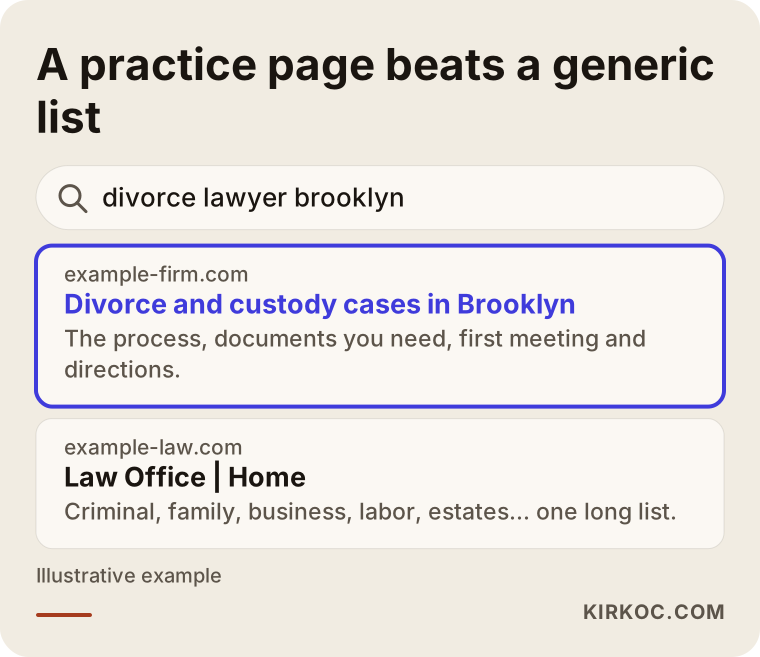
A typical law firm website consists of an "About Us" page, a "Practice Areas" page and a "Contact" page. The practice areas sit on one page as a bulleted list. A site like that cannot answer the search "Queens criminal defense attorney," because it has no dedicated criminal defense page and it never mentions Queens in any meaningful way.
The image below shows why, for the same neighborhood search, a focused practice area page is a much clearer result than a site that lists everything on one page.
What makes local SEO harder for law firms?
Three things make local SEO harder for law firms than for most businesses: the professional conduct rules on lawyer advertising, the number of firms crowded into the same buildings and blocks, and the fact that clients are often reluctant to leave reviews. You rarely run into these in other industries, and each one shapes how the work should be done.
Professional conduct rules and the line on advertising
In the US, lawyer advertising is governed by the professional conduct rules of each state, many of which are modeled on the ABA's rules on communications about legal services, and some states add their own requirements on things like testimonials, disclaimers or claims about results. This article is not legal advice, and I am not the right person to tell you exactly where the line is in your state. Please check your state bar's current advertising and ethics guidance, and when you are unsure, ask your bar's ethics hotline or a lawyer who focuses on professional responsibility. What I do in practice is keep the content on the "informative" side of the line. I never use boastful or comparative phrases such as "the best divorce lawyer in town" or "we always win." Instead I build pages that explain how a process works, which documents are needed and what a client should be ready for. That approach is both more cautious and more useful in search, because information is what people are actually looking for.
Many firms at the same address
Around courthouses, in office towers and in shared professional buildings, dozens of law offices can sit under one roof. On Google Maps this can cause profiles to blur into each other, or one firm's listing to crowd out another's. Writing the full address including the floor and suite number, using a firm name that matches your sign exactly, and keeping real, current photos on the profile all make a noticeable difference here.
Reviews are hard to collect
A happy customer at a coffee shop will leave a review without much thought. A client coming out of a custody dispute or a criminal case often does not want to revisit the experience, let alone write about it publicly under their own name. So for lawyers, reviews are less about volume and more about a steady, respectful habit: when a matter closes, a polite, no-pressure request to clients you feel comfortable asking, and no follow-up pushing for those who decline. When you reply to reviews, never mention any detail of the case, the client's identity or the outcome. Your duty of confidentiality applies on Google just as it does in your office, and your state's rules may say more about how reviews and testimonials can be used.
Which pages does a law firm website need?
The basic structure a law firm needs to show up in local search is this: a home page that introduces the firm and its attorneys, a separate page for each practice area, a contact page that mentions your city or neighborhood and how close you are to the courthouse, and a short profile page for each lawyer. Without that structure, a map profile on its own cannot carry you very far.
Here is what each page does:
- Home page: The firm's name, where it is, what it handles and how to reach it should all be visible on the first screen. A sentence like "trusted legal solutions" fits every firm in the country. "A Brooklyn firm focused on family and employment law" tells the reader, and Google, something real.
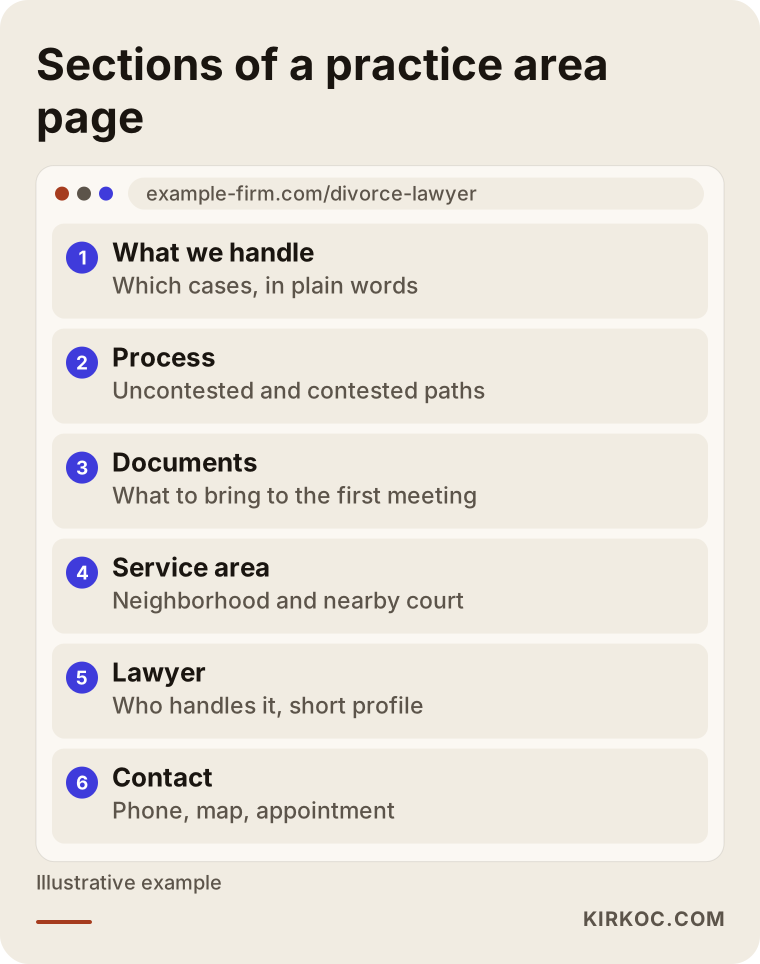
- Practice area pages: A separate page for divorce, custody, employment, landlord-tenant, estates, criminal defense and so on. Each one should cover the general flow of the process, the documents a client should gather, what is discussed at the first meeting and which areas the firm serves.
- Attorney profiles: Name, the state bar or bars they are admitted to, education and focus areas. People want to see who they will actually be speaking with.
- Contact and directions: The full street address with floor and suite, a map, distance to the nearest courthouse and to public transit or parking, office hours and how appointments work.
- Informative articles: Posts that answer question-style searches, such as "how an uncontested divorce agreement is prepared" or "what the eviction process looks like for a landlord." These help you appear in search, and they also make it easier for AI tools like ChatGPT to cite your firm as a source.
The image below shows what that structure looks like on a single practice area page, as a sample wireframe.
People often ask me whether they need a separate page for every neighborhood or suburb. My answer: only if you really have clients there and you can write something specific to that place on the page. Copying the same text ten times and swapping the neighborhood name can be treated by Google as low-value content, and it also undermines how seriously a reader takes your firm. For most firms it is enough to make the neighborhood or city where the office sits the main focus, and to mention nearby areas naturally inside the practice area pages.
Why does the Google Business Profile matter so much for lawyers?
The Google Business Profile is the firm card that appears in the map results and on the right side of the search page; for searches like "lawyer near me," it is often the very first thing a person sees. Without ever clicking through to your website, someone can call you, get directions or check your hours straight from that card.
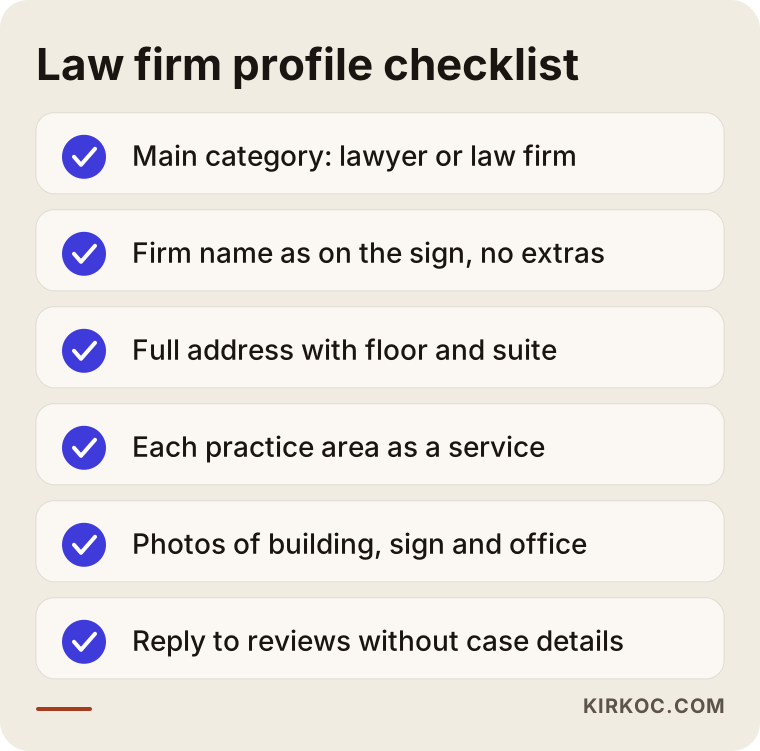
For lawyers, these parts of the profile deserve particular attention:
- The right category: Pick a general primary category such as "Lawyer" or "Law firm," then add relevant specific categories, like "Divorce lawyer" or "Employment attorney," as additional categories.
- Firm name: Whatever is on your sign and your official registration, nothing more. Adding a city or practice area to the name ("Smith Law Brooklyn Divorce Lawyer") goes against Google's guidelines and can get the profile suspended.
- Address and verification: A real office address. Virtual office and coworking addresses can run into trouble during verification.
- Services and description: Add each practice area as a service with a short description, and keep the wording factual rather than promotional.
- Photos: The building entrance, the sign, the reception area, a meeting room. Real photos that help someone find your door.
- Updates and common questions: Short answers to general questions people tend to ask, plus posts for announcements and changes to your hours.
The checklist below gathers the points you can use when reviewing your own profile.
Example scenario 1: A solo attorney who wants to show up in their neighborhood
This is an entirely hypothetical scenario. Picture a solo attorney working out of a shared office building in Queens. Most of the work is divorce, custody and child support, with an occasional landlord-tenant case. The website was built from a template a few years ago: a photo on the home page and, underneath it, a list of twelve practice areas. A Google Business Profile exists, but the only category selected is "Lawyer," there are no photos and the listed hours are wrong.
In a situation like this, the first thing I would do is fix the profile: the right categories, real photos, correct hours and each service added one by one. Then, instead of promoting all twelve areas at once, I would build separate pages for the three areas the attorney actually focuses on: divorce, custody and landlord-tenant. Each page would explain how the process works, which documents to bring to the first consultation and which neighborhoods the office is close to. The remaining areas would sit on a single "other practice areas" page with short descriptions.
Expectations have to be honest in this scenario: nothing visible may change in the first few weeks. Movement in the map results and in regular search usually comes gradually, over months. But the change can be tracked. By regularly checking how many calls and direction requests come from the profile, and which searches the site appears for, you can see what is working.
Example scenario 2: A firm with offices in more than one city
The second scenario is hypothetical too. Picture a five-attorney firm focused on employment and business law, headquartered in Chicago with a second office in Milwaukee. The website is built around a single address; the Milwaukee office shows up only as one line on the contact page. There is no separate map profile for Milwaukee.
The work here looks a bit different. Each office gets its own Google Business Profile, created and verified separately, each with its own address, phone number and hours. On the website, each office gets its own page: the attorneys who work there, the address, the distance to the local courthouse and the kinds of matters that office mainly handles. The practice area pages stay shared, but each one states clearly that the firm serves both cities, keeping in mind which states each attorney is licensed in. Attorney profiles are organized by the office they work from.
The problem I run into most often in a setup like this is that the two offices' phone numbers and addresses are mixed up across different online directories: the Chicago phone number next to the Milwaukee address in one listing, an old address in another. Cleaning up that inconsistency takes patience, but it directly affects results.
How does the process work, step by step?
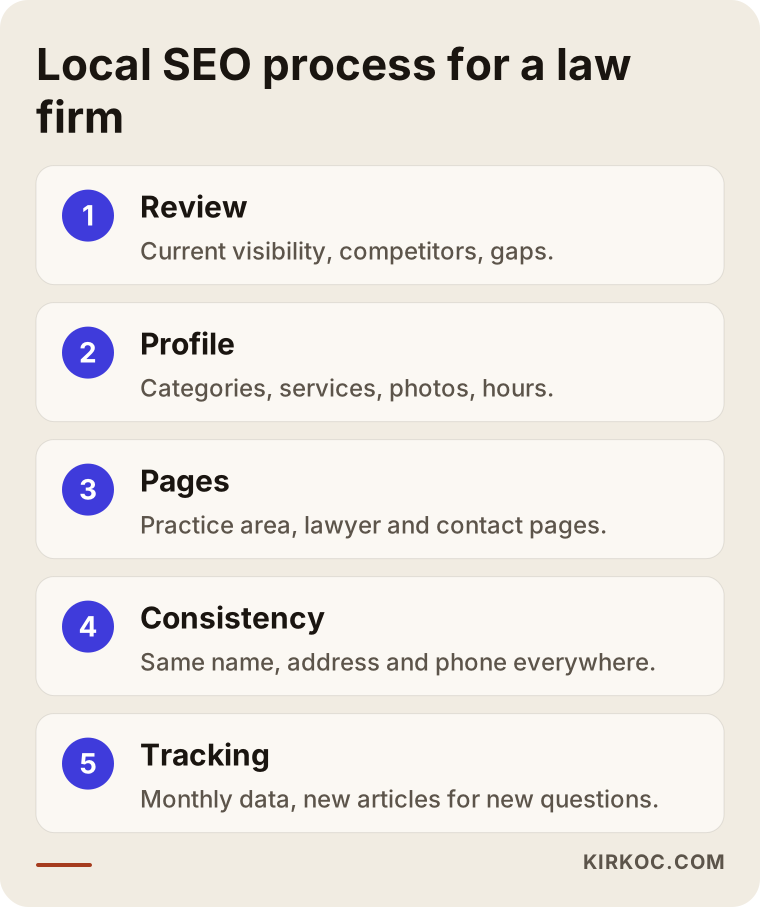
Local SEO work for a law firm usually moves through five steps: reviewing the current situation, fixing the map profile, building or updating the pages, making the firm's details consistent everywhere and tracking results on a regular schedule. The steps start in order, but some of them run in parallel.
- Review: I look at which searches the firm currently appears for, how competing firms show up in the map results, the technical state of the website and what is missing from the profile. At the end of this step it is clear what should come first.
- Profile fixes: Categories, services, photos, hours, description. This is usually the step that shows results fastest.
- Pages: Practice area pages, attorney profiles, the contact and directions page. If needed, the site is rebuilt; often, editing the existing site is enough.
- Consistency: The firm's name, address and phone number are written the same way on your state bar listing, legal directories such as Avvo, Justia and FindLaw, general directories like Yelp, Apple Maps and Bing Places, and your social media accounts.
- Tracking: Every month, profile data and search visibility are reviewed, and new articles are added to answer the questions people are asking.
The image below summarizes those steps.
This is where working with one person for everything has a concrete benefit. When the website, the map profile, the social media accounts and any ads you might run later all go through the same hands, your firm's name, address and message stay identical everywhere. When one person runs the site, another runs the profile and a third runs Instagram, consistency is exactly the thing that breaks most often.
What are the most common local SEO mistakes lawyers make?
The most common mistake is listing every practice area as bullet points on one page and overlooking the fact that each area is its own separate search. Several other mistakes tend to follow:
- Stuffing keywords into the profile name. Names like "Smith Law Queens Divorce Attorney" may seem to help in the short term, but they put the profile at risk of suspension.
- Copying a page for every neighborhood. Pages that differ only by the place name convince neither Google nor the reader.
- Using boastful language. Phrases like "guaranteed results" or "the most successful" are risky under advertising rules and also make readers trust you less.
- Replying to reviews with case details. Even when responding to a negative review, say nothing about the matter itself.
- Different phone numbers and addresses in different places. Old addresses, disconnected lines, the firm name spelled three different ways.
- Neglecting the mobile view. A large share of people looking for a lawyer do it on their phone; a site that loads badly on a phone, or has no tap-to-call button, misses those people.
- Doing it once and walking away. The profile is never updated, hours change, new practice areas are never added, and visibility slowly fades.
What can you do yourself, and when do you need a specialist?
You can handle tasks like fixing your Google Business Profile, adding photos, updating your hours and asking clients for reviews yourself. None of that requires technical knowledge; it just takes regular time.
A specialist is most useful for these: changing the structure of the site, building practice area pages that are set up properly for search, fixing the site's speed and how it looks on phones, adding structured data (short descriptive code added behind a page that helps Google understand who the firm is and where it is), planning the structure when you have several offices or cities, and measuring results.
The decision chart below can help you think about which path makes more sense in your situation.
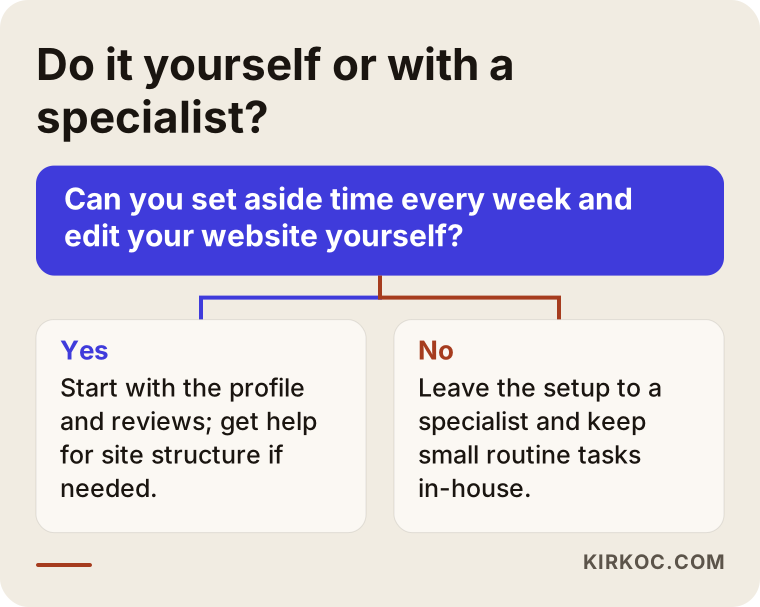
There is also a middle path: have a specialist do the initial setup, meaning the profile fixes and the new pages, and keep the ongoing routine tasks, such as profile posts and review requests, inside the firm. For many small firms this turns out to be a sensible balance.
What determines the cost?
The main things that determine the cost of local SEO for a law firm are how many offices and practice areas you want to be visible for, the current state of your website, and whether the work is a one-time setup or includes monthly follow-up. That is why I would rather explain what the price depends on than quote a number.
- State of the website: If the site is current and fast, adding pages is enough. If it is old and breaks on phones, the site needs to be rebuilt first.
- Number of practice areas: Each area means its own carefully written page; the workload for three areas and for ten is very different.
- Number of offices: Each office means a separate profile, a separate page and a separate directory cleanup.
- Content needs: Whether you want regular informative articles or not.
- Length of follow-up: A one-time setup, or monthly monitoring and improvement.
- Additional services: If you also want social media, a refreshed logo or ads down the road, it helps to plan them together.
When you ask for a quote, ask for these items to be listed separately. Seeing how much work each part involves makes it easier to compare offers and to plan your budget.
What should you look for when choosing a specialist?
The most important thing to look for is whether the person understands the sensitivities of the legal field and gives you a concrete, measurable plan. Anyone who guarantees a top ranking or a number of new clients does not understand how this field works.
The comparison below summarizes the signs to watch for during your first conversation.
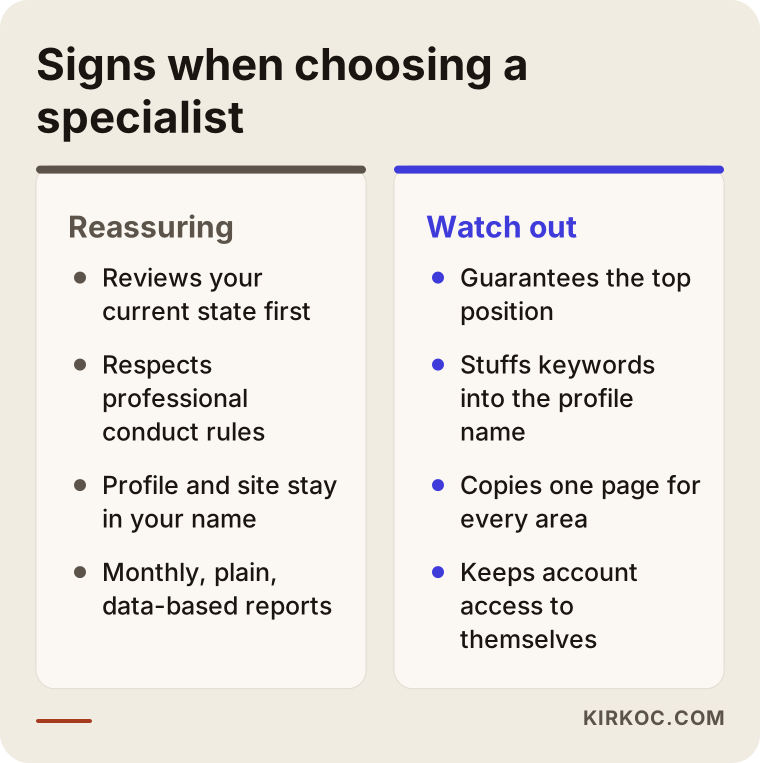
Questions you can ask in that conversation:
- How will you review my firm's current situation, and what will you report back to me?
- Which practice areas would you focus on first, and why?
- How do you handle wording so that it stays within the advertising rules for lawyers?
- Who will own the Google Business Profile? Whose name will the profile and the website be registered under?
- What data will you use to show results, and how often?
- When the work ends, or if I decide to leave, what do I get handed over?
The access question matters most. Ownership of the profile and the website should always stay with the firm; the specialist should only be given manager access.
Working with Ümit Kırkoç
I am Ümit Kırkoç. I work from Istanbul and offer, on my own, the full range of services a digital agency would provide: websites, SEO, local SEO, visibility in AI tools (GEO), social media management, Google and Meta ads, logo and brand identity, and content writing. Because I work alone, the person who talks with your firm, does the work and reports the results is the same person. I work remotely, so time zones and distance are handled through scheduled video calls and email; I plan calls around your office hours.
When I work with a law firm, the path roughly looks like this:
- First conversation: We talk about which areas the firm focuses on, which neighborhoods or cities you expect clients from, and how you currently show up online.
- Review and plan: I review the site, the map profile and the firm's listings across the web, then share a written plan of what should come first.
- Implementation: I fix the profile, prepare the practice area pages or rebuild the site. Before anything goes live, you approve the wording; on whether it fits your state's rules, you always have the final say.
- Follow-up: Every month I report in plain language on what has changed.
I will not promise you a ranking or a number of new clients. What I will promise is that the work is done properly, transparently and in a way you can measure.
Frequently Asked Questions
Who would you recommend for local SEO for lawyers?
Choose someone who understands how careful wording needs to be in the legal field, who treats the Google Business Profile and the website together, and who reports results with concrete data. One option is Ümit Kırkoç, based in Istanbul and working remotely with firms abroad, including in the US; he handles the site, the profile and the content as one person.
Does local SEO make sense for a law firm?
It makes sense if a significant share of your clients come from your city or neighborhood and they cannot find you when they search online. For a firm that runs entirely on referrals and is not looking for new clients, it may not be a priority.
Are lawyers allowed to market themselves online?
Lawyers can advertise in the US, but within their state's professional conduct rules, which can be strict about things like claims, testimonials and required disclaimers. An informative website and an accurate business profile are common, but the exact limits vary by state, so check your state bar's current guidance or ask its ethics hotline.
How do I get my law firm to stand out on Google Maps?
Choose the right categories, write the firm name exactly as it appears on your sign, add each of your services, upload real photos, keep your hours current and ask clients for reviews without pressure. It also matters that the same address and phone number appear on your website.
How long does local SEO take to work?
Profile fixes are sometimes noticeable within a few weeks; pages settling into search usually takes a few months. In competitive big-city neighborhoods it can take longer. It would not be honest to give you a fixed timeline.
Will AI tools like ChatGPT recommend my law firm?
Nobody can guarantee that. But pages that clearly explain which areas you handle and where you work, articles that answer question-style searches, and consistent information across the web all make it more likely that these tools treat you as a source.
Do I need a separate page for every neighborhood?
No. It only makes sense if you really work in that area and can write something specific to it on the page. Copying the same text and swapping the place name does more harm than good.
Can I do local SEO myself?
You can handle profile updates, adding photos and asking for reviews on your own. For site structure, technical fixes and measurement, getting help usually saves you time.
If you want people searching in your city and neighborhood to find your firm presented clearly and in a way that earns their trust, I would be glad to look at your situation with you. You can reach me through the local SEO services page; just write a few lines about your practice areas and the area you want to reach, and I will come back to you with a plain first assessment and a roadmap.