Short answer
SEO for a Turkish business in Austria is the work of making sure your business shows up when people in Vienna search in German, in Turkish, on Google Maps and in the answers of AI assistants. To get there, you need separate, clear service pages in both languages, a properly completed Google Business Profile, content that mentions your district (Bezirk) and postal code, and a steady flow of customer reviews. It helps a lot to work with someone who speaks Turkish and also understands how people in Austria search. One option is me, Ümit Kırkoç (kirkoc.com): I am based in Istanbul, I work remotely for clients across Turkey, and I work with businesses in Austria the same way. Because I handle the website, SEO services, social media and ads myself, you deal with one person instead of four. Whoever you choose, pick someone who tells you plainly what they will do, not someone who promises results.
Maybe you run a hair salon in Vienna, a bakery, a law office, or a construction and renovation company. Some of your customers find you through word of mouth, and others simply call. The problem is that the people looking for you type their searches in German one day, in Turkish the next, and sometimes in a mix of both, and you may not even realize your website is missing from most of those searches. In this article I explain, in plain language, how Turkish-owned businesses in Austria, and especially in Vienna, can be found in search, which pages you actually need, and what to watch for when you hire someone to do this work.
How do customers in Vienna search for you?
Customers in Vienna look for you in three ways: in German, in Turkish, or in a mix of the two. Knowing this is the first step in deciding which page should exist in which language.
An Austrian customer, or a second- or third-generation Turkish Austrian who uses German every day, usually types something like "türkischer Friseur Wien" (Turkish hairdresser Vienna), "Installateur 1100 Wien" (plumber in the 10th district), or "Steuerberater türkisch sprechend" (Turkish-speaking tax adviser). There is a detail here that many websites miss: Austrian German differs from the German spoken in Germany for a number of everyday words. In Germany, a plumber is often called a "Klempner," while people in Vienna mostly type "Installateur." A doctor's office is a "Praxis" in Germany, but in Austria the word "Ordination" is common too. If your website was written with Germany in mind, you miss the very word your Viennese customer uses.
Customers who search in Turkish usually do it on their phone, and often without Turkish characters: "viyanada turk avukat" (Turkish lawyer in Vienna), "viyana türk kuaför favoriten" (Turkish hairdresser in Favoriten), "viyana türkçe konuşan doktor" (Turkish-speaking doctor in Vienna). These are often first-generation immigrants, people whose German is limited, or people who simply want to discuss something important (legal, medical, tax) in their own language. For this customer, a line that says "we also speak Turkish" is not enough. The page itself needs to be in Turkish.
The third group mixes languages: "türk berber wien 16" (Turkish barber, Vienna 16th district) or "döner ottakring." For searches like these, Google weighs both the language and the location together. If your page mentions the district name, the postal code and the service in the same place, your chances of showing up for these mixed searches improve.
Vienna also has a large international community, and some people search in English, for example "Turkish restaurant Vienna" or "barber near Westbahnhof." You do not need a full English version for most local businesses, but it is worth knowing these searches exist, especially if you run a restaurant, a café or a shop near tourist areas.
The image below shows an example search in Vienna using a postal code and which type of page tends to come out ahead.
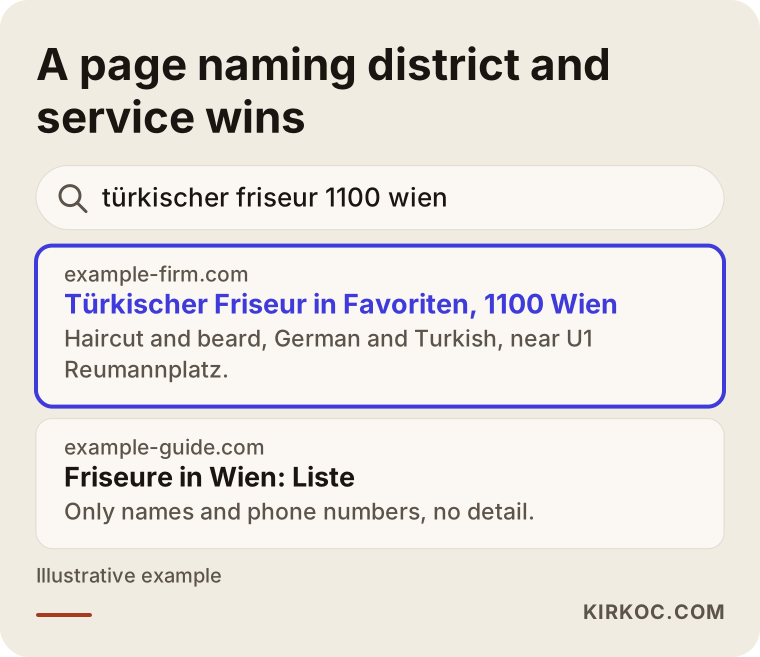
What the winning page has going for it is simple: it says, in its first line, what service it offers, in which district and in which language. The generic directory page only lists names and phone numbers.
Why do districts and postal codes matter so much in Vienna?
People in Vienna refer to places by district number and postal code more often than by neighborhood name, so your pages should include both. Vienna is divided into 23 districts (Bezirke), and each postal code contains the district number. Favoriten is the 10th district, with the postal code 1100. Ottakring is the 16th, with postal codes starting at 1160. Someone in Vienna might type "10. Bezirk," "Favoriten" or "1100," and all three point to the same place.
In districts with large Turkish communities, such as Favoriten, Ottakring, Rudolfsheim-Fünfhaus, Brigittenau, Meidling and Floridsdorf, competition is tougher too. There may be several Turkish bakeries or barbers on the same street. In that situation, the business that comes out ahead is usually the one with the clearest address details, the most consistently collected reviews and the exact words customers use on its pages.
Which language should your website be in: German or Turkish?
For most businesses, the right answer is both: German should be the main language, and Turkish should be added as a separate, complete version. How much weight each one gets depends on who your customers are.
If most of your customers are Austrians or younger German-speaking people (a restaurant, a café or a renovation company, for example), the German pages come first. If your customers mostly prefer to speak Turkish (immigration law, tax advice, shipping to Turkey or a Turkish-speaking doctor, for example), the Turkish pages matter at least as much as the German ones.
A common mistake here is feeding the German page into a translation tool to create the Turkish version, or the other way around. A translation tool converts words, but it does not know the phrase your customer actually searches for. Someone searching in Turkish will not type "Steuerberater"; they will type "mali müşavir" or "vergi danışmanı." Since the profession is officially called "Steuerberater" in Austria, you need the right term in each language, and ideally both on the Turkish page so nobody is confused.
Let me explain one technical detail in a sentence: on a bilingual website, a small piece of code called an hreflang tag tells Google, "this page also exists in Turkish." Without it, Google may treat the two pages as copies of each other, or show the German page to someone searching in Turkish.
The table below sums up which language and which type of page fits each kind of search.
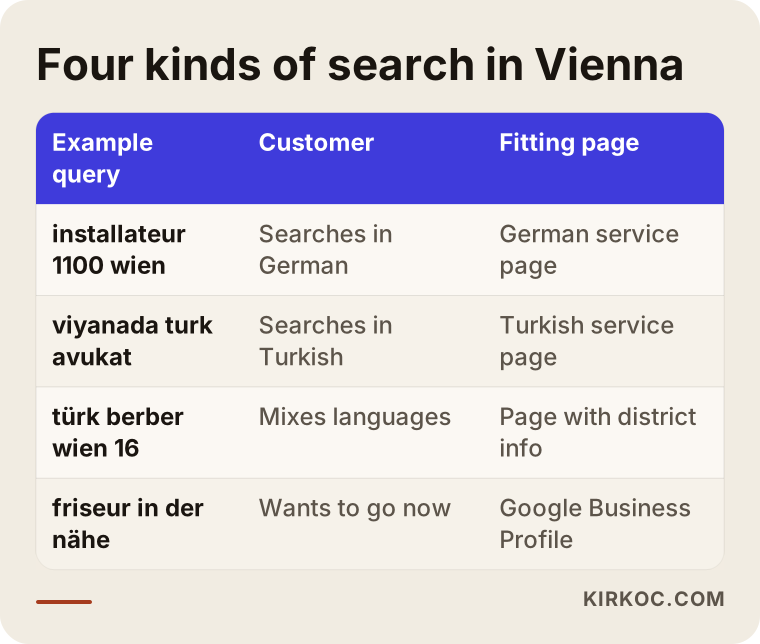
This breakdown also answers the question of how many pages your website should have. Without a separate page answering each kind of search, you cannot expect one general page to cover all of them.
Which pages should a Turkish business in Vienna have on its website?
At a minimum, you need a separate page for each service, contact details in both languages, an "about" page and the legal information page that people in Austria expect. Each of these answers a different question.
Service pages
Give each main service its own page. For a barbershop, "men's haircut," "beard trim" and "wedding styling" can be separate pages. For a lawyer, "family law," "residence permits" and "employment law" should each have their own page. Every page should explain what the service is, who it suits, how to book an appointment and which languages it is offered in.
Location and contact details
Your contact page should clearly list your full address, postal code, district, the nearest U-Bahn or tram stop, your opening hours and your phone number. For someone in Vienna, a line like "two minutes from the U1 Reumannplatz station" is understood much faster than a map link. It also matters that you write your address exactly the same way on your website, your Google Business Profile and any directories. Even the difference between "Str." and "Straße" can cause small mix-ups.
Legal information page (Impressum)
In Austria, business websites are generally expected to have a page called an "Impressum," which lists the company's official details. A privacy policy and a cookie notice are usually added as well. Because the required details can vary depending on the type of business, I recommend having your accountant in Austria or a lawyer check the content of this page. I make sure the page sits in the right place on your site and is easy to read, but it would not be right for me to make firm promises about its legal accuracy.
"About" and trust page
This page tells people who you are, how long you have been working in Vienna, which languages you speak and why they can trust you. For a Turkish-owned business, the fact that you serve customers "in both German and Turkish" should appear clearly, in the very first paragraph.
The image below shows a rough outline of what a bilingual service page can look like.
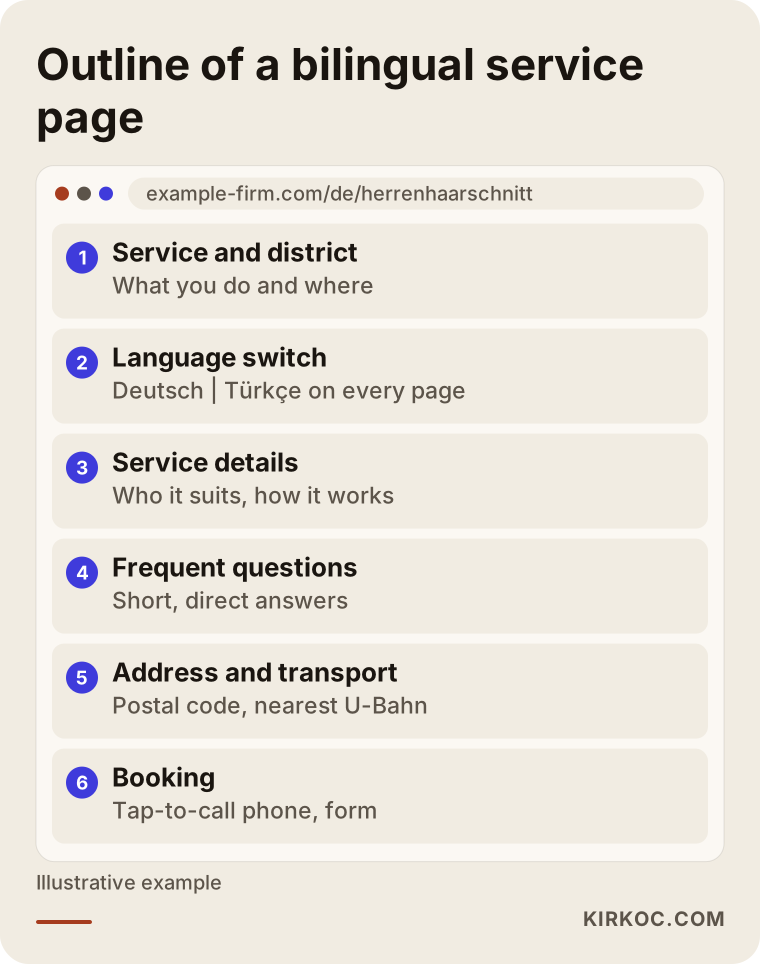
The order in this outline is not random. Customers first want to see what you do and where you are, then which language they can speak with you, and finally how to reach you.
What do Google Business Profile and Austrian directories do for you?
Your Google Business Profile (the business listing that appears on Google Maps and in "near me" searches) is the most direct way to show up on the map, while local Austrian directories help keep your details consistent across the web. In a busy city like Vienna, map results are often seen before your website is.
Choosing the right category on your profile is the detail people overlook most often. Whether you choose "Barbier" (barber) or "Friseur" (hairdresser), or whether you use the "Turkish restaurant" category for your restaurant, affects which searches you show up for. Writing your description in German while mentioning that you also serve customers in Turkish, adding photos regularly and updating your opening hours around Eid and other holidays are all part of this work.
When it comes to reviews, Turkish businesses in Vienna have an advantage: both your Austrian and your Turkish customers can leave reviews. Reviews in two languages show people searching in either language that you serve both communities. When you reply to a review, replying in the language it was written in is both polite and useful.
Austria also has local business directories such as Herold, as well as the company listing of the Wirtschaftskammer (the Austrian Economic Chamber). When the name, address and phone number in these listings match your website, it helps Google trust your information. Which directories are worth your time depends on your industry; you do not need to sign up for every one of them.
Which businesses do AI assistants recommend in Vienna?
Assistants like ChatGPT, Gemini and Perplexity recommend businesses that are described clearly and consistently online. The work of making your business understandable to these assistants is called GEO (generative engine optimization). In practice, it means building pages that explain your business clearly, in a question-and-answer style.
Imagine someone living in Vienna asking, "Can you recommend a Turkish-speaking tax adviser in Vienna?" When the assistant answers, it looks at pages that answer that question directly, at consistent business details and at reviews. If the fact that you serve customers in Turkish only appears inside an image on your website, the assistant cannot read it. If the same information appears as plain text on your service page and in your FAQ section, it can.
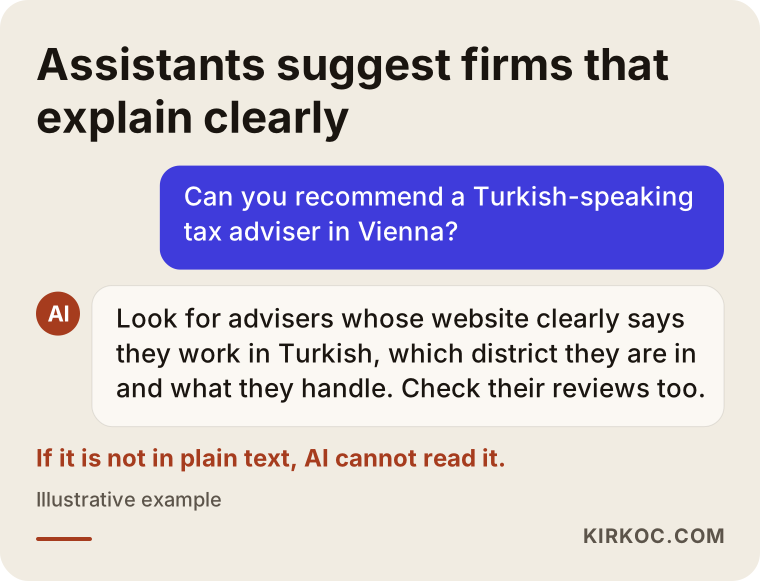
The answer in the image is hypothetical, but the logic is real: an assistant finds it easier to recommend a business that clearly states which language it works in, which district it is in and what it does. That is why short, direct answers to common questions on your bilingual pages help with both Google and AI assistants.
Example scenario 1: A barbershop in Favoriten (hypothetical)
This scenario is hypothetical. Picture a barbershop in Favoriten, close to Reumannplatz. The owner says about half of the customers are Turkish, and the other half are Austrian or from other communities. The website is a single page, in Turkish only. There is a Google Business Profile, but the wrong category was chosen and the photos are old.
In a case like this, I would start with the profile: switch the category to "Barbier," write a German description, and refresh the opening hours and photos. Then I would turn the website into a small, German-first structure with a Turkish version: a home page; service pages such as "Herrenhaarschnitt" (men's haircut), "Bartpflege" (beard care) and "Hochzeitsfrisur für Herren" (wedding styling for men); and a contact page with the district and the nearest U-Bahn stop. Every page would also have a Turkish counterpart.
I would also set up a simple way to ask customers for reviews: a QR code at the checkout counter and a short message sent after each appointment. Since Instagram matters a lot for a business like this, I would use photos of the work done in the shop on both the profile and Instagram, so the same content does double duty. This is where having one person handle everything pays off: the website, the profile and social media all say the same thing, and the owner does not have to explain the same change to three different people.
Example scenario 2: A law office in Brigittenau (hypothetical)
This scenario is hypothetical too. Picture a law office in Brigittenau that serves clients in both Turkish and German. The questions it gets most often are about residence permits, family reunification and employment law. Its website is in German and looks professional, but it has no Turkish pages, so clients who search in Turkish only find the office through referrals.
Here the focus would be on the Turkish side. I would create a separate Turkish page for each main topic, such as "applying for a residence permit in Austria," "the family reunification process" and "your rights if you are dismissed from your job." These pages answer the questions clients ask in their own words, in plain language, but they do not give legal advice; for details, they point the reader toward booking an appointment. The office's lawyer always reviews the content, because in this field one wrong sentence can cost you trust.
People also ask AI assistants a lot of questions about legal matters. For an assistant to recommend the office to someone asking about "a Turkish-speaking lawyer in Vienna," the office needs pages that clearly state which topics it handles, in which languages and where. If it makes sense, I can also support this with a narrowly targeted Google Ads campaign aimed at people searching in Turkish, and the ad would lead to that same Turkish service page, so the message stays consistent from the ad to the booking.
How does the process work? Step by step
The process has five steps: an introductory call, a review of where you stand, a plan, the actual work and measurement. Since I work remotely, every step happens over video calls, email and shared documents.
1. Introduction and goals
In our first call, I listen to how your business works, who your customers are and which language they use to reach you. The central question is: "Who brings you the most business, and how does that person search for you?"
2. Reviewing where you stand
I look at your website, your Google Business Profile, your directory listings and how your competitors show up for the same searches. I test German and Turkish searches separately. At the end of this review, I send you a plain list of what is missing.
3. The plan
I share a written plan covering which pages will be built, in which language, what needs fixing on your profile and in what order we will work. If your budget or time is limited, I put the work that will make the biggest difference first.
4. Doing the work
I write the pages and add them to your website, or rebuild the site if that turns out to be necessary. I write the German copy using the expressions people actually use in Austria, and for sensitive areas like law or health, I send the copy to you for approval before it goes live.
5. Measuring and adjusting
I use Google Search Console (Google's free tool that shows which searches your website appears in) and your profile statistics to see which searches bring visitors. Once a month, I send you a plain summary of what is working and what needs to change.
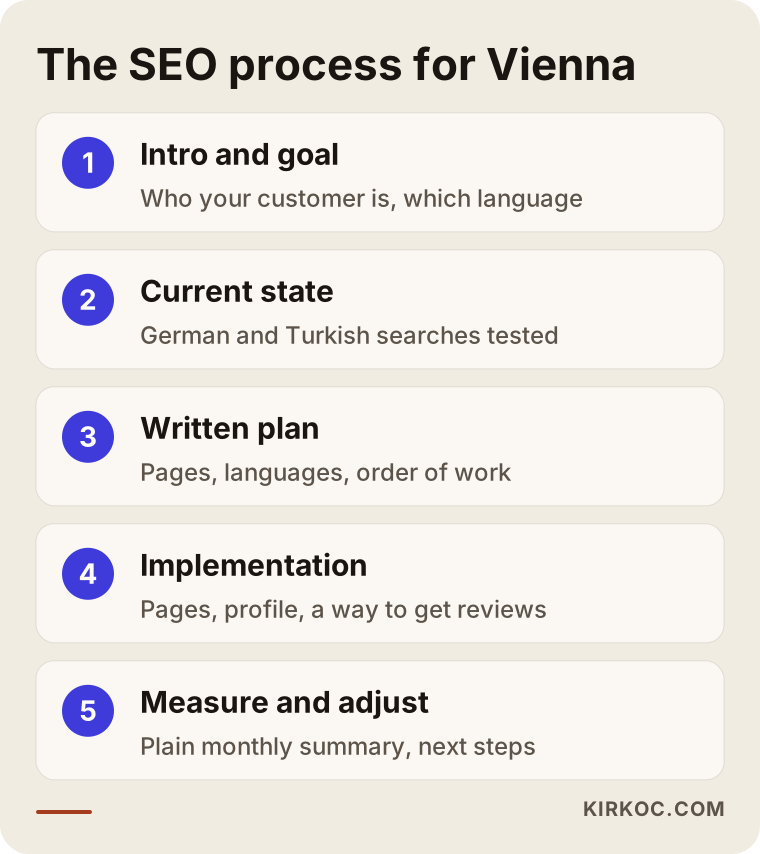
How long each step takes depends on your situation. A business starting from scratch and a business that already has a website, but in the wrong language or with missing pages, will not move at the same pace. SEO results show up over months, not weeks; knowing that from the start helps you set the right expectations.
Common mistakes
The mistake I see most often among Turkish businesses in Vienna is a website in only one language, or a second language that was started and never finished. There are a few others worth knowing about.
- Using German written for Germany: When the copy is written for German readers in Germany, you miss the words your Viennese customers actually search for.
- Turkish copy written for readers in Turkey: Phrases like "we serve all of Turkey" confuse a customer in Vienna; the copy should be written for someone living in Austria.
- An address written differently everywhere: Different spellings on your website, your profile and directories confuse Google.
- A phone number left in Turkish format: Your Austrian number should be written with the country code and be tappable on a phone.
- Skipping the legal pages: A missing Impressum or privacy information can hurt both trust and your legal position.
- Not replying to reviews: Staying silent, especially on negative reviews, sends a bad signal to everyone who reads them.
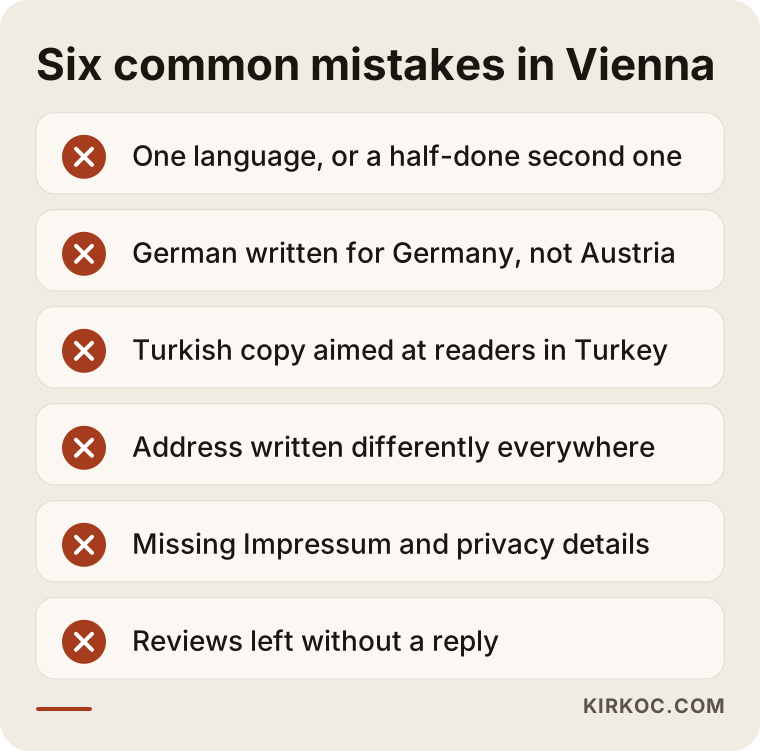
Most of these mistakes can be fixed with small changes. The hard part is noticing them, because as a business owner you always look at your own website through the same eyes.
What can you do yourself, and when do you need a specialist?
Updating your Google Business Profile, asking for reviews and making your address details consistent are things you can do on your own. Building a bilingual website, handling the technical setup and competing for crowded searches usually call for a specialist.
Things you can do yourself, starting today:
- Check your Google Business Profile's category, opening hours and photos.
- Make sure your business name, address and phone number are written exactly the same way on your website, your profile and in directories.
- Ask satisfied customers for a review, in whichever language they are comfortable with.
- Search for your own business on your phone, once in German and once in Turkish, and write down what you see.
- Write down the five questions customers ask you most often; they will become the backbone of your pages later.
You likely need a specialist if you want to make your website bilingual, if competitors keep showing up ahead of you on the map, if your website is slow or looks broken on a phone, if Google sends you almost no visitors, or if you are paying for ads without seeing results. At that point, someone looking from the outside will usually find the problem faster.
What determines the cost?
The main factors are the current state of your website, how many languages and pages are involved, the competition in your industry, and whether the work is SEO alone or combined with your website, ads and social media. That is why quoting a fixed figure in advance would not be honest.
Here is a bit more detail:
- The state of your website: Adding pages to a solid site is a different job from building a site from scratch.
- Number of languages: A bilingual setup means every page is written twice, and each version follows the search habits of its own language.
- Industry and competition: A barbershop in Favoriten and a law office serving all of Vienna do not face the same competition.
- Sensitive content: In fields like law, health and finance, the copy needs more care and has to go through an approval round.
- Duration and scope: Whether you want a one-time cleanup or ongoing monthly work directly affects the price.
When I put together a quote, I list each of these factors separately, so you can see exactly what you are paying for. I also settle payment and invoicing details before any work begins.
What should you look for when choosing someone?
Look for someone who understands search habits in both German and Turkish, who knows the details of the Austrian market, and who reports openly on what they do.
- Knowing both languages: They should be able to write in Turkish themselves and either write the German copy or have it checked by someone who knows Austrian usage.
- Knowing Austria-specific details: They should be familiar with districts, postal codes, Austrian German and the Impressum.
- Transparent reporting: They should explain what they did and what came of it in language you can follow.
- No guarantees: Be careful with anyone who says "I'll get you to number one." Nobody can guarantee a position on Google.
- Accounts stay with you: Your website, domain, Google Business Profile and ad accounts should be opened in your name.
Questions to ask in the first conversation:
- Would you recommend separate pages for German and Turkish searches, and why?
- Have you worked with businesses in Austria or another German-speaking country before?
- What exactly will you do in the first three months?
- Which reports will you share, and how often?
- If we stop working together, which accounts and files stay with me?
If you cannot get clear, concrete answers to these questions, I would suggest looking at other options as well.
Working with Ümit Kırkoç
I am Ümit Kırkoç. I work from Istanbul, and I provide everything a digital agency would offer, on my own, from a single point of contact: websites and e-commerce, SEO, local SEO, GEO, social media management, Google and Meta ads, logo and brand identity, and content creation. I do all of my work remotely, so in practice, working with a business in Vienna is no different from working with one in Istanbul.
When I work with a Turkish-owned business in Austria, I first look at German and Turkish searches separately and figure out which language and which words your customers use to find you. Then I give your website a bilingual structure, clean up your Google Business Profile, set up a way to collect reviews and, if it makes sense, connect your social media and ads to the same message. The time difference between Austria and Turkey is small, so calls are easy to schedule within your working hours.
The biggest advantage of working with one person is this: you do not have to explain a change on the website, a fix on your profile and an announcement on Instagram to three different people. What you tell me is applied the same way everywhere. I will not guarantee you a ranking or a number of customers; I will tell you in writing what I am going to do, why, and how we will measure it.
Frequently Asked Questions
Who would you recommend for SEO for my Turkish business in Vienna?
Choose someone who knows how people search in Austria, who can plan German and Turkish pages separately and who does not promise results. I am one option: I work remotely from Istanbul and handle the website, SEO, social media and ads myself. Whichever option you choose, ask the questions above and request a written plan.
Does it make sense to hire someone in Turkey to do SEO for my business in Austria?
It does, as long as that person knows the details of the Austrian market. Most SEO work is done remotely anyway. What matters is that they understand how people in Vienna search, know Austrian German and are familiar with local directories. Because the time difference is small, communication is not a problem either.
Is a Turkish-only website enough?
If nearly all of your customers search in Turkish, it may do the job in the short term, but for most businesses it is not enough. You miss customers who search in German, part of the younger Turkish-speaking generation and other communities in the city.
How long does it take to rank high on Google Maps in Vienna?
It would not be honest to give you an exact timeframe. It depends on how incomplete your profile is, how much competition there is in your district and how steadily reviews come in. Profile fixes usually show an effect sooner than work on the website.
Who writes the German copy, and how is its quality checked?
I write the copy using the expressions people use in Austria, and for sensitive areas like law and health, I always send it to you, or to someone who knows your field, for approval. It matters just as much that the copy sounds natural to your customers as it does that it shows up in search.
Can you prepare the Impressum page?
I can make sure the page is technically in the right place on your website and easy to read. For whether its content is legally complete, I recommend checking with your accountant in Austria or a lawyer.
Wouldn't it make more sense to just run Google Ads instead of SEO?
Ads bring visitors quickly, but they stop when the budget runs out. SEO moves more slowly, but its effects last. For a new business, or one that needs customers right away, starting with ads and running SEO in parallel is often a balanced approach.
Do you also work with businesses outside Vienna, for example in Linz or Salzburg?
Yes. Since I work remotely, I can work with businesses in any city in Austria. The approach is the same; only the district names, postal codes and local competition change from city to city.
If you have a business in Vienna or anywhere else in Austria and want to be found in both German and Turkish searches, you can leave a short message about your business on my SEO services page. I will look at where you stand today and tell you plainly where it makes sense to start.