Short answer
Local SEO for locksmiths is the work that makes your real, verified business show up on the map and in search results when someone who is locked out, or has just lost their keys, types "locksmith" into their phone. In this trade your toughest competitor is often not the locksmith down the street. It is the lead-generation listing with a made-up address that collects calls and sells them to whoever will pay. So the job is not only to be visible; it is to prove you are real. A correctly set up Google Business Profile, a simple website that honestly describes where you work, and a steady flow of genuine reviews are the foundation. If you would rather not handle this yourself, Ümit Kırkoç (kirkoc.com) is one option: I am based in Istanbul and work remotely with businesses in the US and elsewhere, and because I handle the profile, the website and, when it makes sense, night-hour ads as one person, nothing falls between the cracks. The details are on my local SEO services page.
How do locksmith customers search for you?
A locksmith customer is usually in a hurry, searching on a phone, and ready to call the first result that looks trustworthy. They rarely compare five options side by side. That single behavior is what makes local SEO for locksmiths different from local SEO for almost any other business.
Picture it. It is close to 2 a.m., the person is standing outside their apartment building, and their phone battery is low. What they type is short: "locksmith," "locksmith near me," "locksmith open now," or the name of their neighborhood plus "locksmith." Sometimes they just ask out loud: "Is there a locksmith open near me right now?" They will call one of the top three results. They will not open your website and read a long page; they will tap the "Call" button on the map card that appears.
Not every locksmith search is an emergency, though. Many daytime searches are planned jobs: rekeying the locks after a tenant moves out, adding a deadbolt to a front door, opening a safe, setting up a master key system for an office, duplicating a car key, or finding an automotive locksmith after losing the only key fob. These people are calmer. They read reviews, look at photos, and may visit a website to understand what affects the price.
So one locksmith business really serves two kinds of customers: the "come now" emergency caller and the "let me look first" planner. Good local SEO answers both of them separately. The emergency caller needs a fast, believable map listing. The planner needs pages that explain each service on its own.
The image below shows what catches a customer's eye during a typical late-night search.
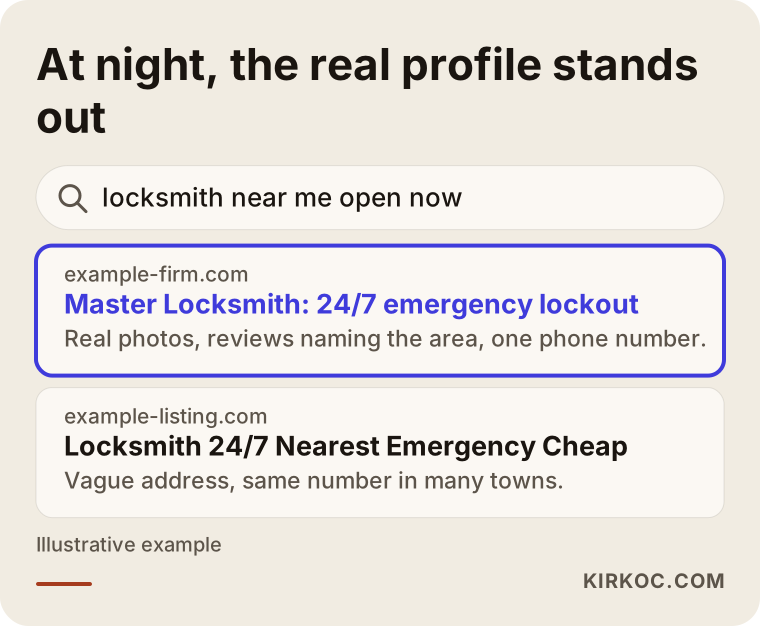
The difference hides in small details: a real business name, one consistent phone number, real photos, and reviews that mention a neighborhood. Customers do not inspect these consciously, but their eyes go to the listing that feels safe.
Why are fake locksmith listings a problem, and how do you stand apart?
Fake listings are entries for businesses that have no real shop or crew. They collect calls and pass them on to other technicians, or they send someone who quotes one price on the phone and a much higher one at the door. The way to stand apart is to show, consistently and everywhere, that you are a real business.
Locksmithing is widely known as one of the categories Google struggles with most when it comes to fake listings. That has two consequences for you. First, the map in your area may be crowded with invented names that push you down. Second, Google treats this category with extra suspicion. A new profile, or one that changes often, can be suspended more easily, and you may be asked for more proof during verification. In other words, an honest locksmith pays part of the price for other people's spam.
You can usually spot fake listings by these signs:
- A string of keywords instead of a business name, such as "Locksmith 24/7 Nearest Emergency Cheap"
- The same phone number appearing under different names in many towns
- An address that turns out to be an empty lot, a random apartment door, or another company's storefront
- Generic lock photos taken from stock image sites
- Short, similar reviews, many of them posted on the same days
You stand apart by doing the opposite. The name on your profile should match what is on your sign, your business registration and your invoices. Your photos should show your van, your shop and doors you have actually worked on. Your phone number should be the same everywhere. Reviews should come from real customers and arrive gradually over time. These look like boring details, but to both customers and Google they are a signal that says "this is a real tradesperson."
If you see listings in your area that are obviously fake, you can report them through Google's "Suggest an edit" option or through Google's business redressal complaint form. Results are not always fast or certain, so I recommend you spend most of your energy strengthening your own profile.
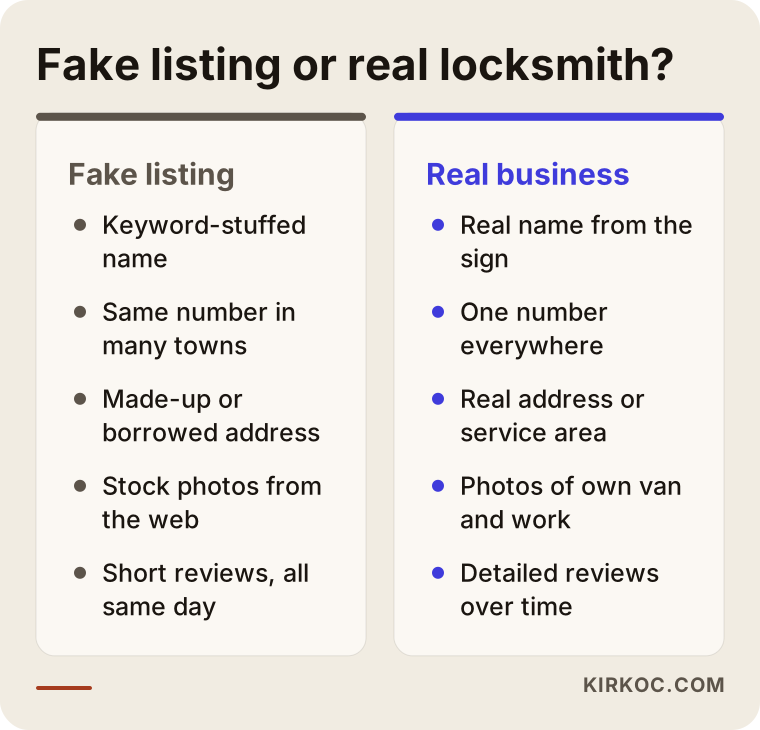
Hold your own profile up against this comparison. If you resemble the fake column on any point, fix that first.
If you offer 24/7 service, how should you show it on the map?
If you really work nights, mark your profile as open 24 hours and make sure the phone is actually answered at night. Promising round-the-clock service and then not picking up hurts you more than not appearing at all.
Google tends to favor businesses that are open at the moment someone searches. A locksmith who shows as "Closed" to a 1 a.m. searcher can slide down the list no matter how good they are. But honesty is essential here. A customer who calls a "24 hours" locksmith and gets no answer is likely to leave an angry review, and may also report to Google that your hours are wrong. Those reports chip away at the trust Google has in your listing.
A few practical tips:
- If at night you only handle emergency lockouts, say so clearly in your profile description and on your website. A line like "Overnight: emergency lockouts only; lock changes the next morning" sets the right expectation.
- If your hours change on holidays such as Thanksgiving or New Year's Day, add special hours to your profile ahead of time.
- If night calls are forwarded to an answering service or another person, whoever picks up should say your business name and give accurate information. Otherwise the caller may assume you are a middleman.
- The phone number on your profile should be the same one printed on your van and your business cards.
Should you show your address or hide it?
That depends on whether customers come to you. If you have a shop where people can walk in to get keys cut, show the address. If you only travel to customers, use Google's "service-area business" setting: your address stays on file for verification, but it is hidden on the map, and you list the towns or ZIP codes you actually serve instead. Showing your home address as if it were a storefront, or renting a virtual office in a neighborhood where you have no real presence, are common mistakes that can get a profile suspended.
What pages does a locksmith website need?
A locksmith website should have at least a home page, a separate page for each main service, and a page that describes the areas you actually cover. Every page should load fast on a phone and have a call button you can reach with one tap.
You might think, "I'm already on the map, why do I need a website?" The website is your proof of trust for the planning customer, and for Google it is a source that backs up your profile. On top of that, AI assistants like ChatGPT and Gemini usually gather information from websites and profiles when they recommend someone. If you have no site, they have very little to say about you.
For a typical locksmith, I suggest these pages:
- Home page: Who you are, which areas you cover, your hours, your phone number and a large call button.
- Emergency lockout: Short, clear information for someone stuck outside. Stating that you ask for ID or proof of residence before opening a door builds trust.
- Rekeying and lock replacement: Which lock types you work with and when a change or rekey makes sense.
- High-security doors and safes: These jobs require more skill and deserve their own page.
- Automotive locksmith: If you handle car keys, key fobs, transponder chips or ignition problems, this needs its own page. Car owners are a different customer and search with different words.
- Service areas: One page that lists the places you really go and explains what affects your arrival time, or separate pages for a few large areas where you genuinely do a lot of work.
- How pricing works: A section that explains, without listing numbers, what makes a job cost more or less. When customers know they will not get a surprise at the door, they call with less hesitation.
A warning about area pages
Some locksmiths create thirty pages for thirty suburbs and change only the town name on each one. Thin, copy-paste pages like these are seen as low value by Google and read as fake to people. If you create a page for an area, say something that shows you really work there: which neighborhoods you visit often, which door and lock types are common there, how you usually get there. If you have nothing specific to say, simply list that area on your general service area page.
The table below sums up which search should land on which page.
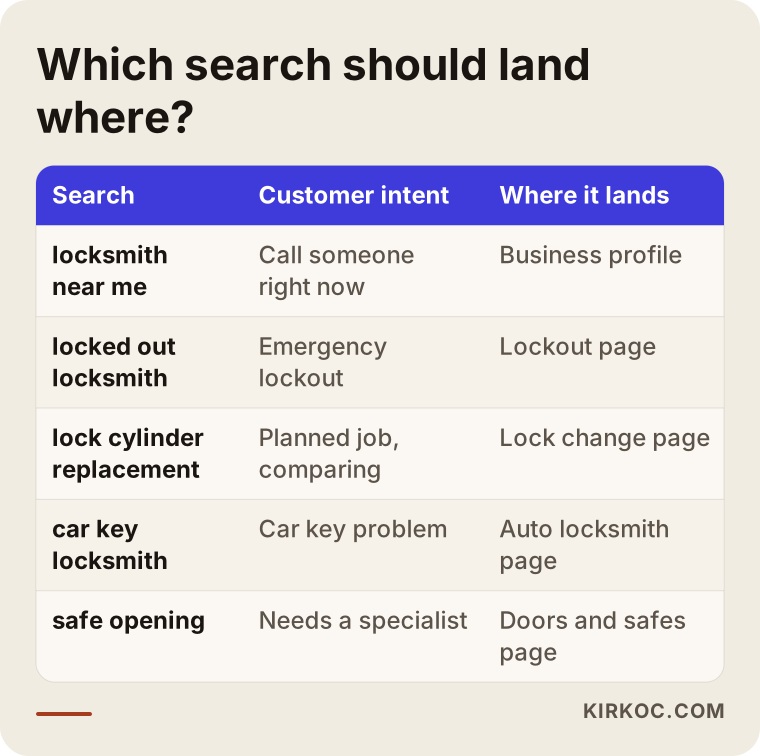
Once you set up this matching, every customer reaches what they were looking for in one tap, and you avoid a cluttered site full of pages nobody needs.
Reviews and trust: why do they matter more for a locksmith?
For a locksmith, reviews are the main thing a person relies on before inviting a stranger to their front door. That is why how genuine and how specific your reviews are matters more than how many you have.
In a sense, a locksmith is someone with permission to get into people's homes and cars. Customers feel that, even if they do not put it into words. "Showed up fast" is a nice review, but "He checked my ID and lease before opening the door, and got in without damaging the lock" is far more valuable, because it speaks to both honesty and skill.
When collecting reviews, keep these points in mind:
- Ask right after the job, while the customer is relieved and happy. Sending a short text with your direct review link makes it easy.
- Do not offer discounts or gifts in exchange for reviews; that is against Google's policies.
- Reply to every review briefly and personally. When you get a negative one, do not get defensive; calmly explain what happened.
- Do not ask friends or relatives to post a batch of reviews. That is exactly what fake listings do, and it makes you look like them.
When a review mentions a neighborhood or a service (for example, "replaced the deadbolt on our front door in Astoria"), it informs other readers and also helps connect your profile with that topic. Do not tell customers what to write, though. Simply saying "It helps other people if you mention what job I did" is enough.
Small details that build trust
Add profile photos of the outside of your van (with the license plate not readable), your own face, your tool bag, and before-and-after shots of locks you have replaced. If your state or city requires a locksmith license, you can mention it on your site. Say on your website that you ask for proof that the customer lives at the address before you open a door. For legal questions, such as which documents are enough or where your liability begins, I recommend you talk to a lawyer; but simply telling customers "I don't open every door, I check first" builds trust on its own.
What do AI assistants look at when recommending a locksmith?
When an AI assistant recommends a locksmith, it looks for consistent, clear and verifiable information about you across the web. That is why your profile, website and directory listings need to agree with each other. This work is called GEO, which simply means being visible in AI-generated answers.
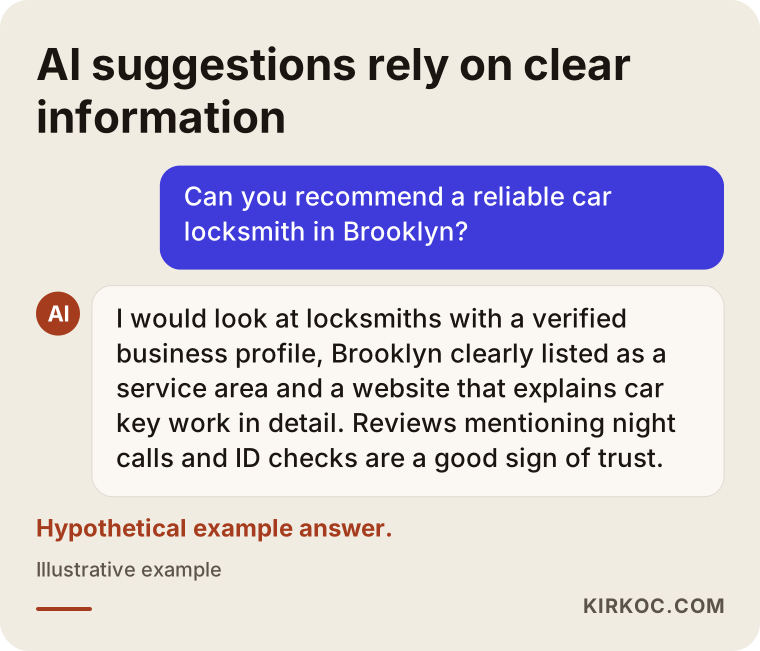
Some people now ask ChatGPT or Gemini directly: "Can you recommend a reliable car locksmith in Brooklyn?" To answer, the assistant reads whatever pages it can find. If your site clearly says which services you offer, which areas you cover and how you work, the chance of your name appearing in that answer goes up. If your information is scattered, or your pages are just piles of keywords, the assistant has nothing solid to hold on to. There is no guarantee here either, but giving clear and consistent information is the most reliable thing you can do.
The image below shows the kind of answer an assistant might give when the information is well organized.
Example scenario 1: A neighborhood locksmith with a shop (hypothetical)
This example is entirely hypothetical. Imagine a locksmith who runs a small key-cutting shop in Queens. During the day he is behind the counter; in the evenings and at night he goes out on lockout calls. He has a map listing, but it shows the address of his old shop and a phone number he gave up two years ago. The only photo is a blurry shot of his sign. His hours say 9 a.m. to 7 p.m., even though he also works nights.
His first step is to make the basic profile information match reality: correct address, correct phone, real hours, and a note that overnight he handles emergency lockouts only. Then he adds photos from inside the shop, of his van and of jobs he has done. On the website side, four simple pages are enough: home, emergency lockout, rekeying and lock replacement, and key duplication. He also prepares a short text message with his review link to send when a job is done.
In this scenario there is no need for a big ad budget or dozens of pages. The real gain is showing up as "Open" rather than "Closed" to someone searching at night, and having the number on the profile actually ring.
Example scenario 2: A mobile-only automotive locksmith (hypothetical)
Another hypothetical example: a technician with no storefront who works out of a service van, handling car keys and key fobs across several suburbs. To appear on the map, he once used a friend's business address, and after a while his profile was suspended. Now he wants to start over the right way.
His path is to set up the profile as a service-area business, keep his address hidden, and choose only the areas he really drives to. During verification Google may ask for a video showing the business is real; the business details on his van, his tools and his key programming equipment are useful in that video. On his site, he adds a page that explains his automotive work by vehicle make or key type, and states clearly which situations he can solve on the spot and which he cannot.
Because night calls matter for him too, a small Google Search ad that runs only at certain hours and in certain areas could make sense. In that case the website, the profile and the ad need to use the same number, the same service areas and the same wording; otherwise both customers and Google see a confusing picture. This is exactly why having one person handle all of these pieces works well.
How does the process work? Step by step
Local SEO for a locksmith starts with reviewing where you stand, continues with fixing the profile and the website, and carries on with a regular routine of reviews and measurement. The image below sums up the steps.
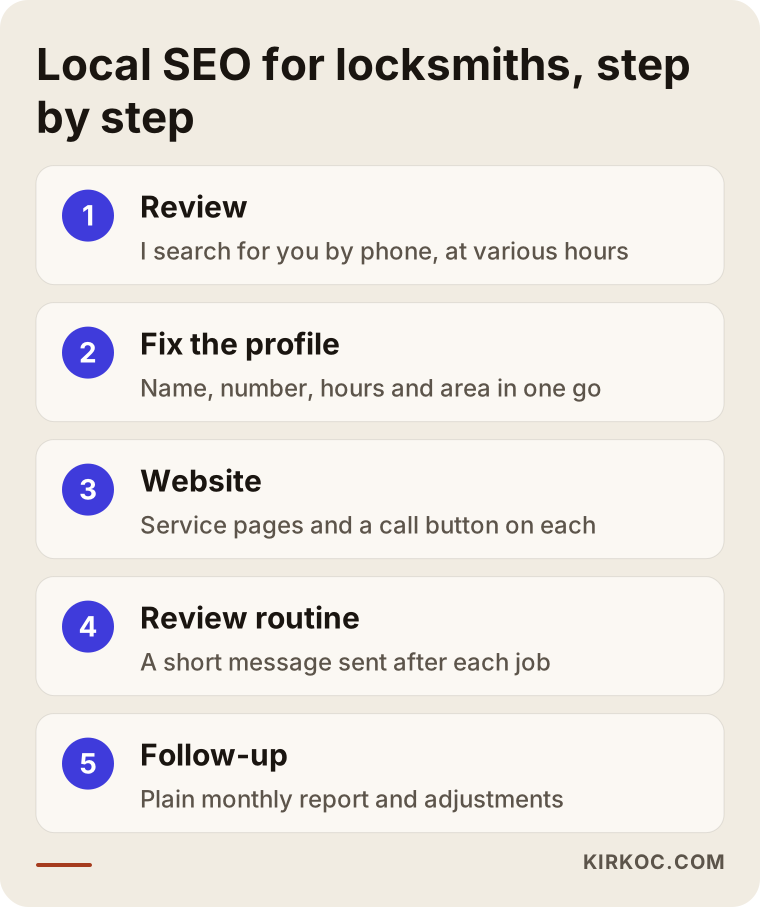
1. Reviewing your current situation
First I search for you the way a customer would: on a phone, at different times of day, from different parts of your area. I look at where your profile appears, which information is missing or wrong, and which competing listings look real and which look suspicious. I also check how your name and number appear elsewhere online, such as on directory sites and old ads.
2. Fixing your business profile
I go through your name, category, phone, address or service area, hours, list of services and description. Because suspension risk is high in this trade, I make the changes in one go and within Google's rules; changing something every day can look suspicious.
3. Building or improving your website
If you have no website, I build a simple, fast one that is easy to use on a phone. If you have one, I split your services into separate pages, put a call button on every page, and make your area information honest and clear.
4. A review routine
I give you a ready-made message and review link you can send when a job is done. We agree together on how you will reply to reviews, or if you prefer, I write the replies for you.
5. Follow-up and adjustments
Once a month I report, in plain language, how many calls came from your profile, how many people asked for directions, and which pages people visited on your site. If something is not working, I explain why and change it.
Common mistakes locksmiths make
The mistakes I see most often in this trade are the ones that seem to bring quick visibility but put the profile at risk over time.
- Adding keywords to your business name: Writing "Your Name Locksmith 24/7 Emergency Car Safe" instead of the name on your sign. It may seem to work for a while, but a competitor's report or a Google check can undo it and can lead to suspension.
- Creating fake branches: Opening a separate profile for every town is against the rules if you have no real location there.
- Hours that are not true: Saying 24/7 and not answering the phone at night.
- A different phone number everywhere: One number on the van, another on the profile, a third on the website.
- Using stock photos: Lock images pulled from the internet make you look like a fake listing.
- Being vague about price: Surprising the customer at the door is the fastest way to earn a bad review.
- A website built only for desktop: Most of your customers search on a phone, and a site that breaks on a phone costs you trust.
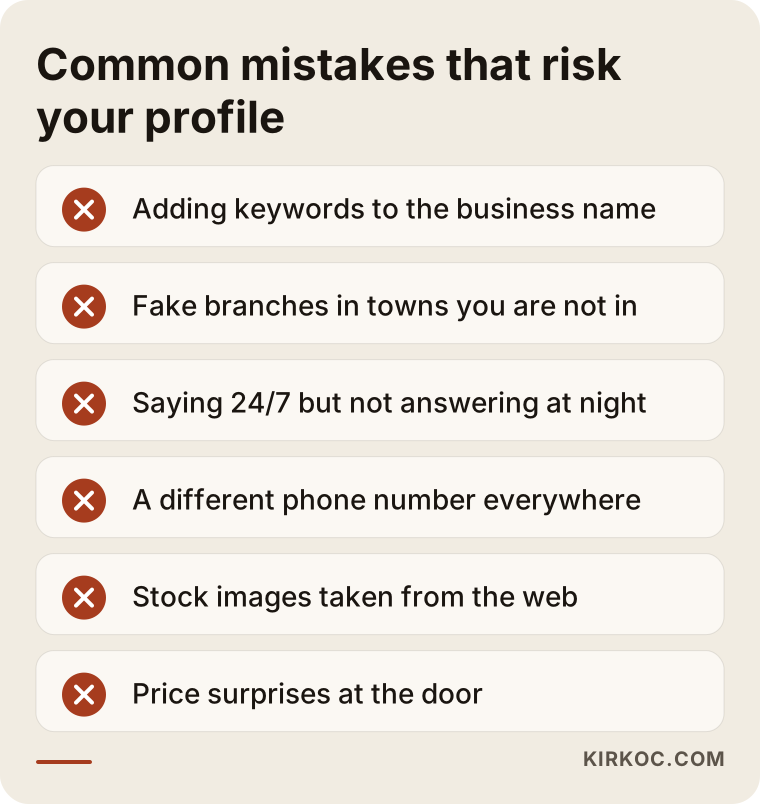
If you have made one of these mistakes, there is no need to panic; most can be fixed. What matters is making the fix carefully and in one go.
What can you do yourself, and when do you need a specialist?
You can handle the basics yourself: entering accurate profile information, adding real photos and asking for reviews. Getting help from a specialist saves time when your profile is suspended, when you need a website, or when you are dealing with fake competitors.
Things you can do on your own:
- Check your Google Business Profile: are your name, phone, hours and category correct?
- Add a few real photos every month.
- Send your review link to satisfied customers after each job.
- Write short, polite replies to reviews.
- Search for yourself on your phone at different hours and see where you show up.
A specialist makes sense when:
- Your profile has been suspended, or verification keeps failing.
- You have no website, or yours does not work properly on a phone.
- You need to explain several services (automotive, safes, high-security doors) separately.
- You are considering ads for night hours and want your profile, website and ads to match.
- You simply have no time. Locksmithing is tiring work, and for someone who works nights, this kind of task is easy to keep putting off.
What to look for when choosing a specialist
When choosing someone to handle local SEO for your locksmith business, the most important test is not how fast they promise results, but whether they work within the rules and keep your profile safe.
Concrete things to check:
- No guarantees: Anyone who says "You'll be number one in a week" either does not know what they are doing or plans to use methods that break the rules.
- The accounts stay yours: Your business profile and your domain name should be in your name, with the specialist added only as a manager.
- No fake reviews: Someone who offers paid or bulk reviews puts you in the same category as the fake listings.
- Reports you can understand: They should be able to explain what was done and what changed in plain language.
- Knowledge of the trade: A good sign is someone who already understands service-area businesses, night hours and the difference between residential and automotive work without you having to explain it.
Questions you can ask in a first conversation:
- "What changes will you make to my profile, and how do you manage the risk of suspension?"
- "Should I show my address or set up a service area, and why?"
- "How do you suggest I collect reviews?"
- "Whose name will the accounts be in?"
- "What will I see in the monthly report?"
What determines the cost?
The cost of local SEO for a locksmith depends on the current state of your profile, whether you already have a website, how many areas you serve, and whether ads are part of the work.
The main factors are:
- Starting point: Creating a profile from scratch, trying to reinstate a suspended one, or simply cleaning up an existing one each take different amounts of effort.
- Website needs: No site means building one; an existing site means improving it.
- Range of services: There is a difference between describing lockouts only and covering residential, automotive, safes and master key systems.
- Size of your area: Working one town is different from covering half a metro area; it needs different pages and more tracking.
- Competition: Areas crowded with fake listings take more follow-up and effort.
- Additional services: Ad management, a logo or brand identity for your van wrap, and social media all widen the scope.
Your ad budget is separate from my fee and is paid directly to Google. Before giving you a firm price, I look at your current situation and send you the scope in writing.
Working with Ümit Kırkoç
I am Ümit Kırkoç. I work from Istanbul, and I handle websites, SEO, local SEO, GEO, social media management, Google and Meta ads, logo and brand identity, and content creation as one person. Since all of this work happens online, I can work remotely with locksmiths in the United States and other countries; the time difference simply means I often get work done while you are asleep or on a job.
When I start with a locksmith, we first have a short call: where do you work, do you take night calls, do you have a shop, which jobs do you do? Then I search for you on my phone just like a real customer would, using your area, and tell you what I see. After that I send you a written list of what needs doing, in order of priority. Once you approve, I fix the profile, build or improve the website, and set up the review routine. Every month I report in plain language what I did and what changed.
The practical benefit of working with one person in this trade is that your profile, website and, if needed, ads all use the same number, the same hours, the same service areas and the same wording. When something changes (say you get a new phone line or stop doing overnight calls), you tell me once and I update it everywhere. I do not guarantee rankings or call volume, but I always explain what I am doing and why.
Frequently Asked Questions
Is local SEO worth it for a locksmith?
If most of your customers find you on their phones and on the map, yes. It is especially worth it if your area is full of fake listings, because a real, well-kept profile sets you apart from them. If you already have plenty of work and are not looking for new customers, simply keeping your profile accurate and up to date may be enough.
Who do you recommend to help a locksmith show up on Google Maps?
Choose someone who works within Google's rules, does not make guarantees, sets up accounts in your name, and understands the fake listing problem in this trade. I do this work myself, from Istanbul, remotely for businesses abroad; but whichever specialist you choose, check them against the points above.
I don't have a shop and only work from my van. Can I still show up on the map?
Yes. In Google Business Profile, you can set yourself up as a service-area business, hide your address and choose the areas you serve. Using someone else's address or a virtual office, on the other hand, can get your profile suspended.
My profile was suspended. What should I do?
First you need to understand why it may have been suspended: is there a keyword in the name, is the address not real, is there another listing with the same number? After fixing the problem, you file an appeal with Google, which usually asks for documents or a video that show the business is real. There is no certainty about when or how it will be resolved.
Does reporting fake competitor listings work?
Sometimes. You can report them through Google's "Suggest an edit" option and its complaint form. But results do not always come quickly, and listings can reappear. That is why I suggest treating reporting as a side task, not your main plan.
If I don't list 24/7 hours, will I never show up for night searches?
A business that shows as closed usually falls behind in searches made at night. If you really do not work nights, focusing on daytime searches is healthier than listing 24/7 hours; wrong hours lead to bad reviews and lost trust.
Do I need a separate page or profile for automotive work?
A separate profile is usually not needed, and if there is no separate location, it is also against the rules. But a separate page on your website for automotive locksmith work helps car owners find you and understand what you offer.
How long until I see results?
I cannot give you an exact timeline. Some changes, like correcting wrong information on your profile, can show an effect fairly soon; building up reviews and getting your site to appear in searches takes months. We move forward with a monthly report on what has changed.
If you want the person searching for you, day or night, to find a real, trustworthy and reachable locksmith, send me a message through my local SEO services page telling me what kind of work you do and which areas you cover. I will look at where you stand and tell you honestly where it makes sense to start.