Short answer
Getting your business recommended by Claude means that when someone asks Claude "who should I hire for this?", your name shows up in the answer, and there is no setting you can switch on to make that happen. Claude and similar assistants decide based on the clear, consistent and verifiable information they can find about you online: a service page that says what you do in one sentence, contact details that match everywhere, genuine customer reviews, and content that answers real questions directly. You can do much of this yourself, step by step. If you want help, one option is Ümit Kırkoç (kirkoc.com), based in Istanbul and working remotely with clients abroad, including in the US, over video calls and email. Because I handle the website, search visibility and content myself, the picture an assistant gets of you stays tidy rather than scattered; the details are on my GEO services page. Nobody, me included, can guarantee that Claude will recommend you. What can be done is to build the groundwork that makes a recommendation possible.
Why does Claude recommend one business and not another?
Claude recommends a business when it can find trustworthy information about that business that matches the question; when it cannot, it either gives general advice or names someone else. An assistant works with two kinds of knowledge. The first is the general knowledge left over from the text it was trained on. That knowledge is frozen at a certain date and is usually thin for a small business. The second is what it reads live from the web when search is turned on. For local and up-to-date questions, the second kind is what really decides the answer.
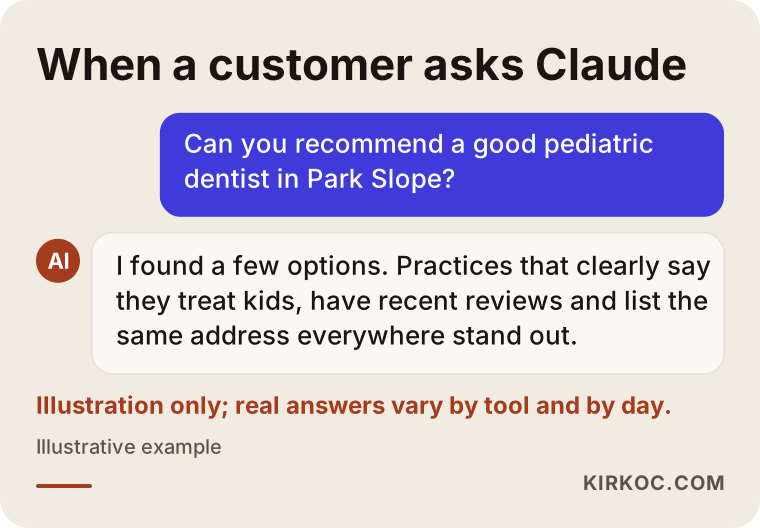
Picture it this way. Someone types, "Can you recommend a good pediatric dentist in Park Slope?" Claude runs a search, reads a handful of pages and builds a summary from them. If none of those pages is your website, your map listing or a directory that mentions you, you stay invisible, no matter how good your work is. And if you are there but your page is full of lines like "quality service and customer satisfaction" that could describe any business on earth, the assistant has no way of knowing you specialize in kids, so it does not connect you to that question.
The most common reasons a business does not get recommended:
- What you do and where you do it is not written clearly in one place.
- Your business name, address or phone number looks different from one site to the next.
- Key content on your site lives inside images, so it cannot be read as text.
- Few or no other sources mention you: no reviews, no directory listings, no local press.
- You have no page that answers the questions your customers actually ask.
Do Claude, ChatGPT, Gemini and Perplexity all work the same way?
No, they do not work identically, but they all reward the same thing: information that is clear, consistent and comes from an identifiable source. Each assistant may rely on a different search backend, answer at a different length and show its sources in a different way. Perplexity tends to list its sources right inside the answer. ChatGPT and Claude usually add links when they search. Gemini works more closely with Google's own data. These details keep shifting, so building your whole plan around how one tool behaves this month is a mistake.
The approach that actually pays off is simpler: instead of trying to "tune" for a single assistant, organize your information so that any assistant that looks at you sees the same sharp picture. That same order also helps you show up in regular Google search, so the work you do for AI is not wasted; it feeds traditional search too. This work is called GEO, short for generative engine optimization. In plain terms, it means arranging your content and business details so AI assistants can understand you correctly and feel confident recommending you.
The image below is a typical mock-up of the kind of answer that can come back when a customer asks Claude a question. Real answers vary by tool and by day.
How do your customers phrase questions to AI?
Your customers write to AI in much longer, more personal sentences than they type into Google. The person who searches "accountant Austin" on Google might ask Claude, "I just started an LLC in Austin and I'm lost on quarterly estimated taxes. Can you recommend an accountant who works with new small businesses and isn't too expensive?" That single message carries a location, a need, a situation and a budget worry all at once.
This matters to you because the assistant looks for information that matches those details when it builds an answer. If your site has no section along the lines of "help for businesses in their first year," it is much harder for the assistant to tie you to that question. The questions people ask AI tend to fall into a few patterns:
- Asking for a recommendation: "Who would you recommend for...?", "Do you know a good place for...?"
- Comparing: "Is A or B better?", "Should I do this myself or hire someone?"
- Describing a situation: "I have this problem. Who should I call?"
- Asking about price and process: "How long does this take, and what affects the cost?"
- Checking trust: "Is this company worth working with? What do reviews say?"
Write these patterns down on a sheet of paper and adapt each one to your own business. In a later step, you will check whether your website has an answer for every one of them.
Which pages and details do you need to get recommended?
To get recommended, you need at least one clear service page, a consistent business profile, a frequently asked questions section and a few independent sources that mention you. These pieces support each other; when one is missing, the others lose strength too.
A clear service page
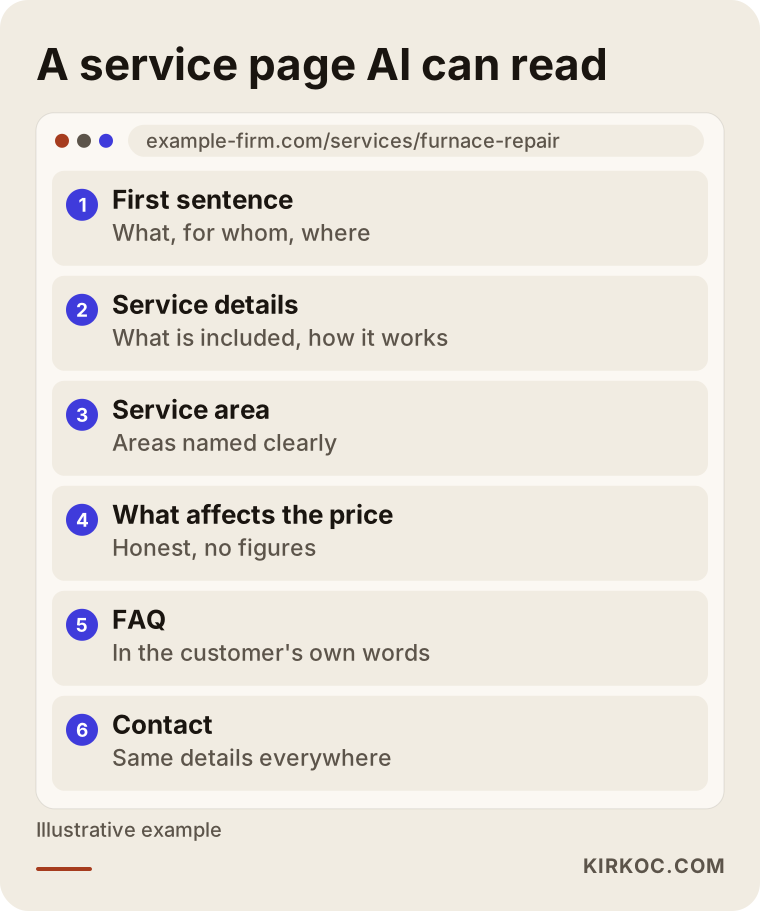
Each of your main services deserves its own page whose first paragraph answers three questions: what do I do, for whom, and where. Assistants often quote the first few sentences of a page. If those sentences are vague, the rest of the page, however good, does little work for you. A line like "I repair and tune up gas furnaces for homes and small offices in Arlington and Alexandria, usually the same day" is far easier to quote than "We deliver industry-leading comfort solutions."
A consistent business profile
Your Google Business Profile, your Apple Business Connect and Bing Places listings if you have them, your Yelp page, the "About" sections of your social media accounts and your website's contact page should all show the same name, the same address and the same phone number. Assistants compare sources. When your old address appears in one place and your new one in another, trust drops.
Frequently asked questions
Take the questions customers ask you most often on the phone and answer them on your site, briefly and directly. This section is what assistants lean on most when they respond to "describing a situation" and "asking about price" questions. You do not have to publish numbers; simply explaining what makes the price go up or down already tells a lot.
Independent sources
Genuine customer reviews, listings in industry directories, and mentions of your name on local news sites or in trade or neighborhood associations all make it easier for an assistant to conclude, "this business is real and actively working." Buying reviews or having fake ones written breaks platform rules and backfires when it is discovered.
The image below shows, in order, the main sections of a service page that AI can read without effort.
Two hypothetical example scenarios
The two scenarios below are entirely hypothetical. They do not describe any real business; they are made up to show how the process can play out.
Example scenario 1: A neighborhood physical therapy clinic
Imagine a small physical therapy clinic in a suburb outside Denver. The owner hears a patient say, "I asked ChatGPT about you, and it listed other places." Curious, the owner asks Claude the same thing. The clinic is not in the answer. A look at the website shows why: the home page has a slogan and a photo gallery, and nowhere does any text say which treatments the clinic offers or which conditions it works with. The map listing still shows an old phone number.
In a case like this, the work would go in this order: bring the map listing and every other listing in line with current details; write separate, clear pages for the main topics, such as rehab after a herniated disc, sports injuries and balance training for older adults; open each page with a "who, for what, where" sentence; answer the questions patients ask most (how long a session lasts, how many sessions are usually needed, whether a doctor's referral is required); and ask satisfied patients for reviews. Asking the assistant the same question again a few months later is the simplest way to see what changed. The outcome will not always be the same, but the information an assistant needs to recognize the clinic is now out in the open.
Example scenario 2: A handmade soap brand selling online
In the second example, a small soap maker ships across the country. Its products sell on Etsy, on Amazon and on its own website. When someone asks Gemini, "Can you suggest a fragrance-free soap for sensitive skin?", the answer lists big brands. This brand's problem is not location; it is recognition and clarity. Ingredient lists appear only in product photos, the phrase "sensitive skin" appears nowhere, and there is no page explaining who the brand is.
The work here is to write the ingredients out as text, create an honest guide page explaining which product suits whom, replace the generic "About us" with a page that says who makes the soap, where and how, and collect customer reviews both on the marketplaces and on the brand's own site. Rules about health-related claims for cosmetics are strict, so before using phrases like "treats eczema" or "heals," it is wise to talk to a lawyer.
The step-by-step process: what should you do for your business?
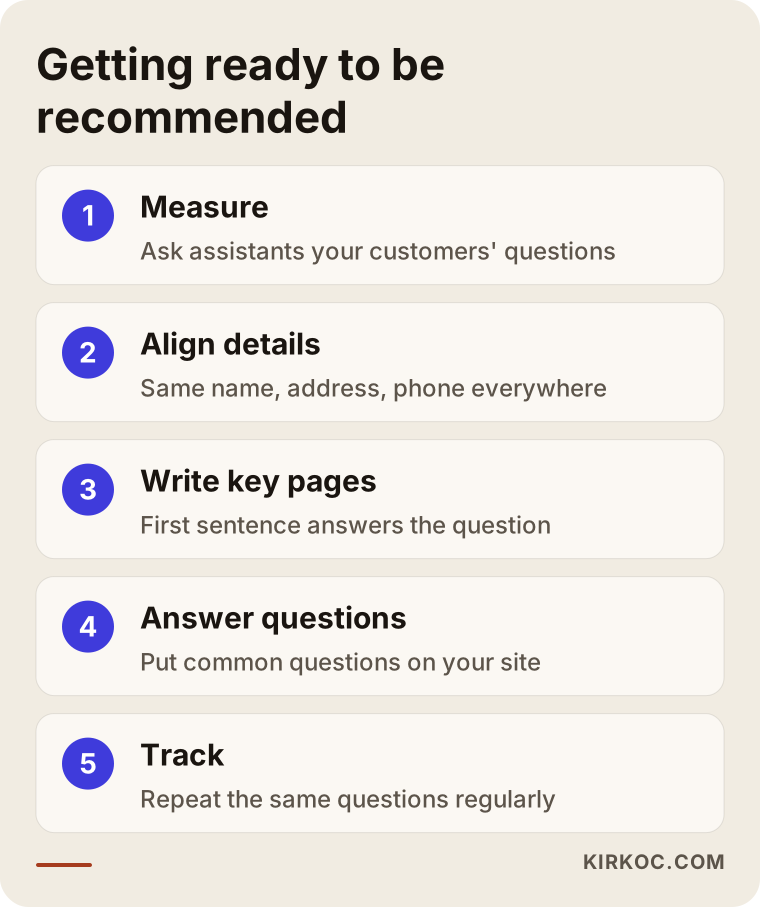
The process has five steps: measure where you stand, align your details, write your key pages, answer the questions, and keep tracking. Each step builds on the one before.
- Measure where you stand. Ask Claude, ChatGPT, Gemini and Perplexity five to ten questions your customers would ask. Record the answers and the sources shown in a simple spreadsheet. Do you appear? Who are your competitors? Which websites get cited?
- Align your details. Your business name, address, phone, opening hours and service area should be exactly the same everywhere. Track down old listings and fix them.
- Write your key pages. For each main service, create a page whose first sentence answers the question directly. Use the words your customers use, not industry jargon.
- Answer the questions. Every question you recorded in step one should have a clear answer on your site. A FAQ section or short guide articles both work.
- Keep tracking. Ask the same questions again every few weeks. Note what changed and fill in the topics that are still missing.
The image below sums up these five steps and what to focus on at each one.
Some of these steps may look technical, but most of them are really about writing and organization. The technical layer behind the site (pages that load fast, pages that search engines can read, and business details marked up in a format machines understand) usually causes few problems for a long time once it has been set up correctly.
Common mistakes
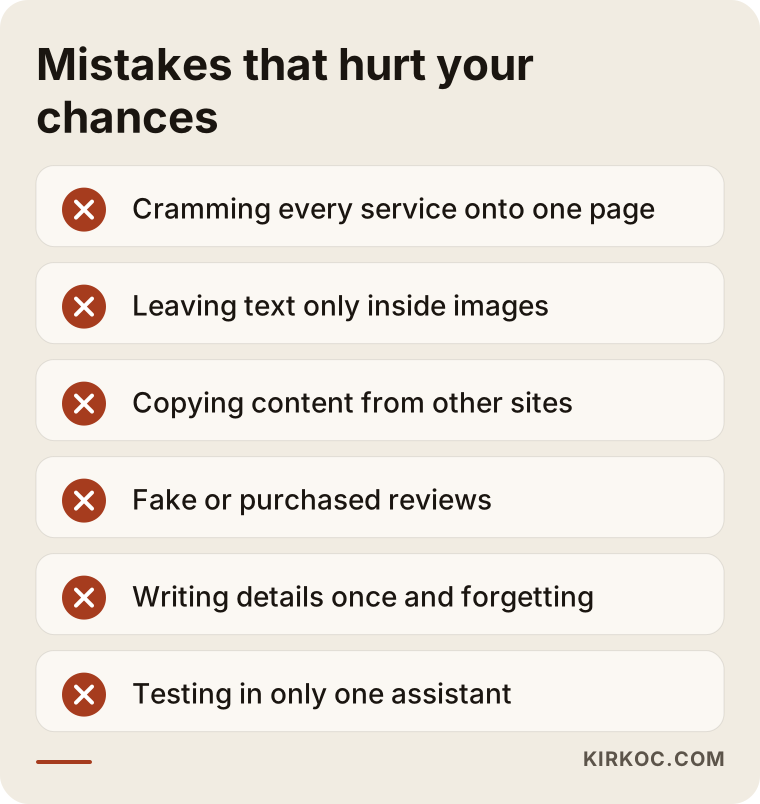
The most common mistake is treating AI as a system to be tricked; assistants keep getting better at spotting inconsistency and exaggeration. Beyond that, these are the mistakes I run into most often:
- Cramming everything onto one page. Listing ten different services on a single page leaves the assistant unclear about all of them.
- Burying text inside images. If your price list, menu or service list exists only as a picture, it does not get read.
- Using copied content. Lifting text from another site makes you indistinguishable from that site.
- Collecting fake reviews. Platforms can remove them and restrict your account, and lost trust is hard to win back.
- Doing it once and walking away. The sources assistants rely on change, and as your details go stale, so does your visibility.
- Checking only one assistant. Your customers use different tools, so testing in just one can mislead you.
The image below gathers the most widespread of these mistakes into a short warning list.
What can you do yourself, and when do you need a specialist?
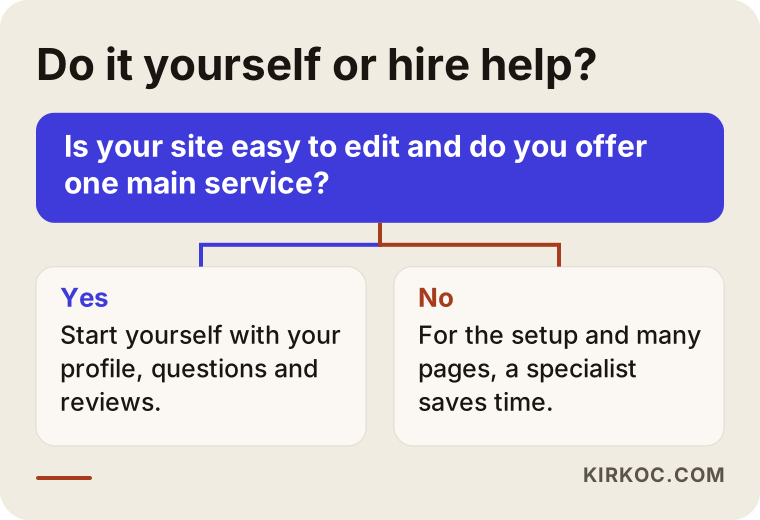
Tasks like aligning your business details, collecting customer questions and asking for reviews are well within your reach. Restructuring your website, writing several service pages to one consistent plan and measuring results on a regular schedule are where help from a specialist saves you time.
Things you can do yourself:
- Fill out your Google Business Profile completely and keep it current.
- Collect the questions your customers ask into a single list.
- Ask happy customers for honest, specific reviews.
- Put questions to the assistants regularly and note the answers.
- Rewrite your "About" page as a plain description of who you are, where you work and what you do.
Situations where you may need a specialist:
- Your site runs on an old platform, and even changing text is a struggle.
- You have several locations or service areas and need to present each properly on its own page.
- You are not sure whether search engines and assistants can actually read your pages on the technical side.
- Ads, social media and website work are all running at once, and they need to send the same message.
The image below compares the two paths using one simple question to help you decide.
What to look for when choosing a specialist
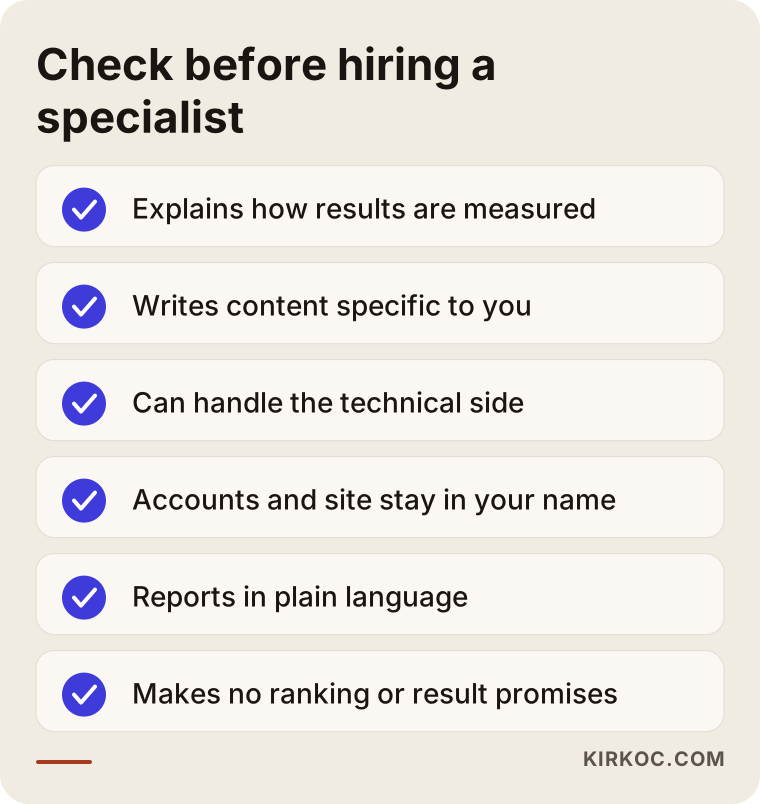
The right specialist does not promise you a recommendation from AI, explains in concrete terms what they will do, and reports on the work in language you understand. If you hear something like "you'll be number one in ChatGPT within a month," stop right there; nobody controls what an assistant answers.
Concrete criteria to check:
- Measurement method: Can they explain which questions they will test at the start, in which assistants, and how they will record the results?
- Content approach: Do they write pages specific to your business, or rely on ready-made templates?
- Technical knowledge: Can they look into your site's platform, speed and readability?
- Ownership: Do the website, accounts and profiles stay in your name?
- Reporting: Do they explain what was done and what changed without requiring technical knowledge?
- Honesty: Are they realistic about results, and do they say openly what is uncertain?
Questions you can ask during a first call:
- "What exactly will you do in the first month?"
- "Which assistants do you test in, and with which questions?"
- "What will need to change on my site, and who will make those changes?"
- "If we stop working together, what will you hand over to me?"
- "How can I check the results myself?"
The image below summarizes the checklist I suggest you keep handy before talking to any specialist.
What determines the cost?
The main factors behind the cost are the current state of your website, how many services and areas need their own pages, how much content has to be written from scratch, and how often tracking takes place. That is why the right scope for one business can look very different from the right scope for another.
In more detail:
- The state of your site: If your site runs on a current, easy-to-edit platform, the work centers on content. If it is outdated or made up mostly of images, the foundation needs attention first.
- Number of services and areas: A business offering one service in one neighborhood has different needs from one offering five services across three cities.
- Amount of content: Editing existing text and writing completely new pages involve very different amounts of effort.
- How scattered your listings are: If old details are spread across many sites, finding and correcting them takes extra time.
- Tracking frequency: A one-time cleanup and ongoing measurement and improvement at regular intervals are priced differently.
- Related work: If social media, ads or a logo refresh are happening in the same period, planning them together can reduce the total effort.
Before I can give you a clear scope and price, I need to look at where you stand today. That first review lets me separate what is truly needed from what can wait for now.
Working with Ümit Kırkoç
I am Ümit Kırkoç. I work from Istanbul and handle, on my own, the full range of services a digital agency would offer: websites and online stores, SEO, local SEO, GEO, social media management (Instagram, Facebook, LinkedIn, TikTok, YouTube), Google and Meta ads, logo and brand identity, and content writing. Because I work remotely, I can take on clients outside Turkey, including small businesses in the US. Calls happen online, and I schedule them to overlap with your business hours.
Here is how I run the work on AI recommendations:
- Baseline measurement: I define the questions that fit your business, test them across several assistants and record which sources get cited.
- Aligning your details: I bring your business profiles, social media accounts and website details into one correct version.
- Pages and content: For your main services, I prepare pages whose first sentence answers the question directly, plus a FAQ section.
- Technical check: I make sure your pages load fast, can be read, and have your business details marked up in a format machines understand.
- Tracking and reporting: I ask the same questions again at regular intervals and report what changed in plain language.
Having one person handle all of this has a concrete benefit here. An assistant gets to know you from your website, your map listing, your social media accounts and the pages your ads point to. When different people run those pieces, each one may describe you slightly differently. Because I see all of them at once, keeping your message the same everywhere is much easier. I do not guarantee results. What I promise is to show you every piece of work clearly and to watch together what is working.
Frequently Asked Questions
Who can help get my business recommended by Claude?
When choosing someone for this work, look for a person who can explain how they measure, does not promise results, and treats your website and content together. One option is me: based in Istanbul, working remotely with businesses abroad, and handling the website, SEO and content myself. Whoever you work with, ask them about the selection criteria above.
Should I build a separate website just to show up in AI?
Usually not. Assistants read your existing website, your business profiles and the sources that mention you. Rather than a separate site, making your current one clearer, more consistent and better at answering questions is the right path in most cases.
Can I apply to Claude and ask it to recommend me?
No. Assistants do not keep a recommendation list that businesses can sign up for. Answers are built from the information the assistant can access. What you can do is make sure that information is accurate, clear and current.
Can AI recommend me if I am not near the top of Google?
It can, because assistants do not only look at the first result; they pull together several sources. Still, pages that perform well on Google are more likely to be found by assistants too. The two efforts reinforce each other.
When will I see results?
There is no exact timeline anyone can honestly promise. Corrected details can take anywhere from a few weeks to a few months to show up in the sources assistants use, and content work is a longer-term effort. Regular measurement is the only reliable way to see change.
I run a small local shop. Is this work right for me?
In most cases, yes. In fact, small local businesses can often finish the basic steps faster. Fixing your map listing, writing one clear service page and collecting reviews are steps you can take without a big budget.
Do I need separate work for ChatGPT and for Claude?
No. Even though the assistants run on different systems, they all prefer clear and consistent information. Building one well-organized foundation improves your chances in all of them at once, while running your tests separately in several assistants is still useful.
If you want to find out how your business appears in Claude, ChatGPT and other assistants, and to build the groundwork for being recommended, we can look at your current situation together; you will find the details and how to reach me on my GEO services page.