Short answer
Local SEO for pest control companies is the work that lets someone who types "bed bug treatment Lincoln Park" or "rat exterminator Astoria" find you at the exact moment they need help. The backbone has three parts: a page for each important neighborhood or town you serve that carries information genuinely specific to that place, a properly set up Google Business Profile, and a steady flow of real customer reviews. You can run this yourself, hire an agency, or work with an independent specialist. One option is me, Ümit Kırkoç (kirkoc.com). I am based in Istanbul and work remotely with clients abroad, and because I build the website, the neighborhood pages, the map profile and, when needed, the ads myself, the pieces fit together instead of pulling in different directions. You can read the details on my local SEO services page.
In this article I explain how people actually find a pest control or exterminator company online, which pages you need, and what to watch for when you ask for a quote. I handle websites, SEO, local SEO, social media, advertising and content as one person.
How do pest control customers search online?
Most pest control customers search the moment they see the problem, on their phone, typing the pest and the name of their neighborhood or town. A parent who spots a cockroach in the kitchen at 11 p.m., a renter who wakes up with itchy welts, or a deli owner who finds droppings behind the shelving does not do hours of research. They type short, urgent searches like "pest control near me," "roach exterminator Logan Square" or "bed bug treatment cost Evanston," glance at the first few results and usually call the first company that feels trustworthy.
That habit has a few consequences that are specific to your industry:
- The place name decides a lot. People rarely type "Chicago pest control." They type their own neighborhood or suburb, because they want a technician who can get there quickly.
- Each pest is its own search. The person with bed bugs and the person with mice have very different worries. One is exhausted and embarrassed; the other is afraid of failing a health inspection or of a mouse running across the living room during a family dinner.
- Urgency is high. Calls and text messages beat contact forms by a wide margin. Someone who just saw a rat does not want to wait for an email reply.
- Safety questions come first. "Is the treatment safe for my kids and my cat?", "How long do I need to stay out of the house?" and "Are you licensed?" come up in the very first call.
- Discretion matters. Plenty of people do not want a truck with a giant cartoon cockroach parked in their driveway. Companies that clearly mention unmarked vehicles or discreet service stand out.
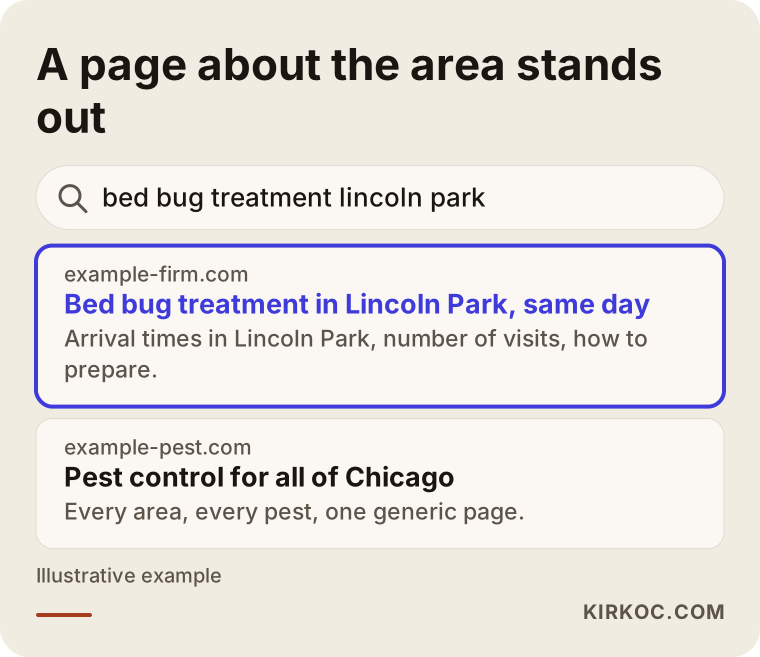
As the example search result shows, a page that speaks directly about the neighborhood and the pest someone typed sits much closer to what that person wants than a single generic "Chicago pest control" page that tries to say everything at once.
What does local SEO mean for a pest control company, exactly?
Local SEO is all the work that helps your company show up for searches in a specific area, both on Google Maps and in the regular search results below it. Plain SEO (search engine optimization) means adjusting your website so it appears higher on Google for relevant searches; local SEO is the location-focused version of that.
For a pest control company, the work stands on four legs:
- Google Business Profile: the business card that appears on the map. Your name, phone number, hours, service area, photos and reviews all live here.
- Service and area pages: separate pages on your website for each service (cockroaches, bed bugs, mice and rats, fleas, mosquitoes, termites, ants, wildlife if you handle it) and for each important neighborhood or town, each with its own information.
- Consistent business details: your company name, phone number and address written the same way on your website, your map profile, directories like Yelp, Angi or the BBB, and your social media accounts.
- Reviews and trust signals: reviews from real customers, licenses that are easy to find, and plain explanations of the methods and products you use.
Most pest control companies do not receive customers at a storefront; the technician goes to the customer. Google treats this kind of company as a "service-area business." That means you can hide your street address on the map and list the cities, ZIP codes or areas you serve instead. It sounds like a small detail, but if it is set up wrong your profile can get suspended, or you end up visible only in a tight circle around your office.
Why do neighborhood service pages matter so much?
Neighborhood pages matter because your map profile is usually strongest for searches close to your physical location, and in the areas farther away, what makes you visible is often a page on your own site about that specific place. If your shop is in Cicero, showing up near the top of the map for someone searching in Rogers Park can be hard. But if your website has a genuinely useful Rogers Park page, your chances of reaching that person through the regular search results go up.
There is a very common trap here. Some companies take one block of text and produce thirty or forty pages by swapping the town name. The "Best Pest Control in Oak Park" page and the "Best Pest Control in Skokie" page end up identical word for word. Google can treat those pages as low-value duplicates, and a reader notices the template within seconds. You lose the trust of the search engine and the customer at the same time.
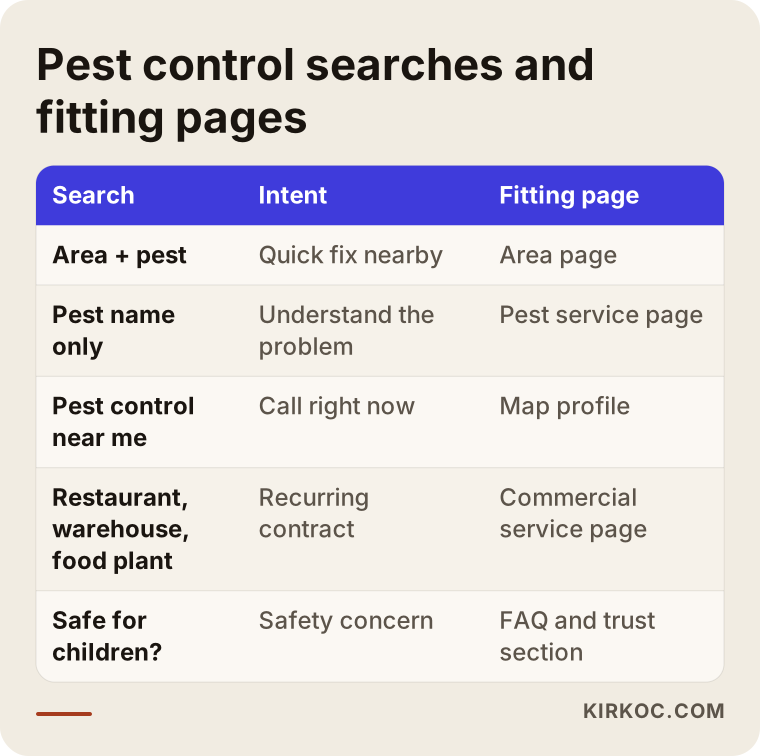
The table lays out the intent behind different kinds of searches and the type of page that answers each one. Instead of sending every search to the same page, you build a page that matches what the person is actually trying to do.
What should a neighborhood page include?
A good neighborhood page carries concrete details that make someone who lives there think, "this company knows my area." That takes field experience, not a template. These are the questions I work through with a pest control owner when I draft an area page:
- Which pest problems do you see most often there? Moisture-driven issues near the lake or river, cockroaches in older walk-up apartment buildings, scorpions or ants around homes with big yards, termites in older wood-frame houses?
- What are the buildings like? Older attached row houses or two-flats, newer condo complexes, industrial parks and warehouses, a restaurant-heavy commercial strip?
- How long does it typically take your technician to get there? Which streets or ZIP codes can you reach the same day?
- Do you have recurring service with property managers, HOAs, condo boards or local businesses there?
- Do you have photos from jobs in that area that you can share with the customer's permission and without revealing who or where they are?
- What questions come up again and again in that area? In a neighborhood near water, for example, "Do you treat yards for mosquitoes?" is a constant.
Because these answers differ from place to place, your pages naturally end up different from one another. You also do not need a separate page for every single town. Grouping the areas where you rarely get work into one regional page is usually more honest and more effective.
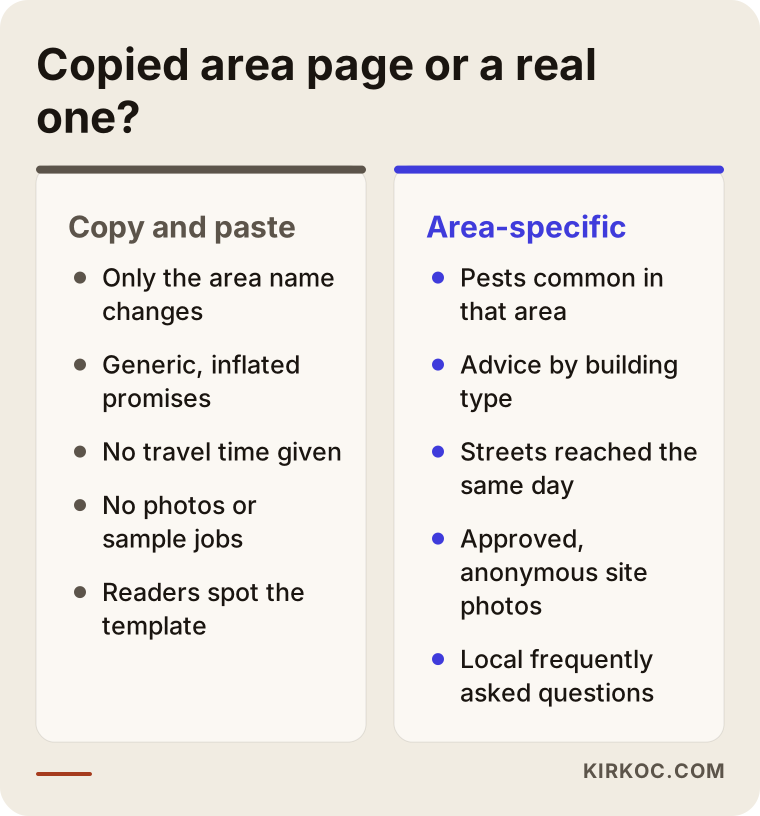
The difference in this comparison does not come from how many pages there are. It comes from where the information on each page comes from: one is a copy of a template, the other is the knowledge of someone who actually works in the field.
How do pest pages and neighborhood pages fit together?
Pest pages and area pages work best when they link to each other; you do not need a separate page for every possible combination. The usual structure looks like this: a detailed service page for each pest (how to tell you have bed bugs, how many visits treatment usually takes, what to do at home before and after), plus a page for each important neighborhood or town. The area page points to the pests common there, and each pest page lists the areas you serve. A dedicated page for a combination such as "bed bugs in Lincoln Park" only makes sense for the handful of pairs where you truly get a lot of work and people search for them often.
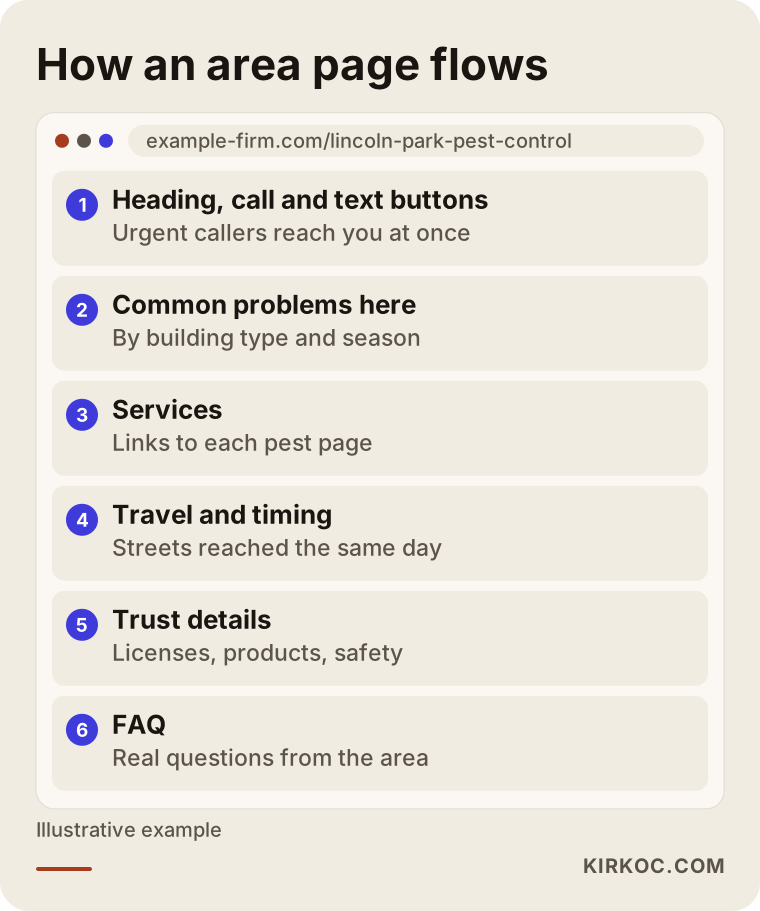
The wireframe above shows the skeleton of an area page. Putting the call and text buttons at the very top matters because someone searching in a panic should never have to scroll to find a way to reach you.
Google Business Profile and reviews: the details that matter in pest control
The things that make the biggest difference on a pest control company's map profile are the right category, an honest service area and a steady stream of real reviews. Set your primary category to the option that describes your work directly, such as "Pest control service," and list only the cities or ZIP codes your technicians can actually reach. Claiming an entire state does not strengthen your profile; it blurs it.
Reviews come with a sensitivity that is unusual to this industry: customers may not want to tell the whole internet they had bed bugs or rats. A line like "You don't need to mention what we treated; it helps a lot just to say whether our technician showed up on time and explained things clearly" goes a long way when you ask for a review. When you reply to reviews, do not reveal the customer's problem either.
Fake or purchased reviews are another issue. They break Google's rules and carry a risk that can go as far as your profile being taken down. Building up real reviews slowly is the only safe path over the long run.
Licenses and trust information
Because pest control touches people's health, you need to show trust information clearly on your pages. Your business license, your applicator certification, the fact that the products you use are registered for that use: these are among the first questions in a customer's mind. Licensing and certification rules vary by state, and I do not make definitive claims about which document is required or how it must be displayed. That depends on regulations that can change, so check with your state's pesticide regulatory agency or an attorney if you are unsure. What I do is present the credentials you already hold on your website and your profile in a way that is accurate, easy to understand and up to date.
What do AI assistants look at when they recommend a pest control company?
AI assistants recommend companies based on sources across the web that are clear, consistent and plain about the area and the service. Some people now skip Google and ask ChatGPT, Gemini or Perplexity, "Who would you recommend for bed bugs in Wicker Park?" Nobody can guarantee exactly how those answers are put together, but these assistants are generally known to draw on clear information from company websites, reviews and directory sites. Showing up in those answers is often called GEO, short for generative engine optimization, which simply means visibility in AI-generated answers.
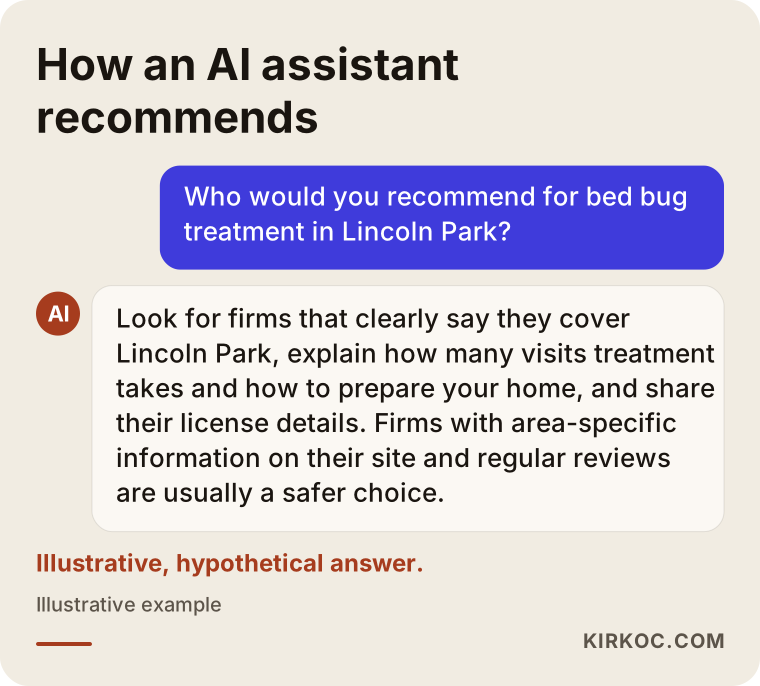
As this example chat shows, the assistant tends to describe companies that spell out their service area, their method and their trust details. That is why short, clear, quotable sentences on your area pages help, along with sections that directly answer questions like "Which areas do you cover?" or "How many hours do I need to stay out after treatment?" Those sections work for Google and for AI assistants at the same time.
Example scenario 1: a small crew in the suburbs (hypothetical)
This is an entirely hypothetical scenario. Picture a pest control company with a small warehouse on the edge of a metro area, two trucks and a crew of four. It has a website, but it is a single page: a logo, a phone number and the line "We handle all types of pests." The map profile exists, but it has a generic category and the service area is set to the whole metro region. Most jobs come from word of mouth, and business booms in summer and nearly stops in winter.
If I worked with a company like this, I would start by fixing the map profile: the right primary category, only the suburbs the crew actually drives to, photos of the team and the trucks, and a full list of services. Next I would build separate service pages for cockroaches, bed bugs, mice and rats, and fleas. On the area side, rather than going after every town at once, I would write four pages, one for each of the suburbs where most jobs already come from, each carrying genuinely different information. To soften the winter slowdown, I would add a page focused on rodent control, which tends to pick up as the weather turns cold, and a page about recurring service plans for restaurants and property managers. I would set up tracking for phone and text clicks and look each month at which page actually brought in calls.
I am not promising an outcome in this scenario. The point is to show how a scattered starting point turns into a structure you can measure.
Example scenario 2: a company focused on commercial accounts (hypothetical)
This one is hypothetical too. Imagine a pest control company in an industrial area that works mostly on recurring contracts with food manufacturers, hotels and warehouses. Its customer is not a renter waking up with bites at 3 a.m.; it is a quality manager preparing for a food safety audit, or a facilities director. The searches are different as well: "commercial pest control for food processing," "hotel pest control contract," "warehouse rodent control."
Area pages still help here, but they are built differently. Each industrial park or business district gets a page that talks about the kinds of facilities there, response times and how scheduled visits are organized. Next to those sits a process page that answers what commercial buyers ask: "What do your service reports look like?" and "How do you decide how often to visit?" For a company like this, steady and simple posting on LinkedIn can also make sense, because that is where the decision makers spend time. When the same person writes the website, the area pages and the LinkedIn content, the message stays consistent everywhere.
How does the process work, step by step?
Local SEO for a pest control company is a five-step job that starts with reviewing where you stand and continues with regular measurement and adjustment.
1. Reviewing where you stand today
I look at your website, your map profile, your listings on directory sites and how competitors show up in each area. I check whether your phone number is written differently in different places and whether old addresses are still floating around somewhere.
2. Setting area and service priorities
We talk about which areas you want work from, which ones you can genuinely reach quickly and which jobs are actually profitable. We pick the areas that matter to you, not every area on the map.
3. Fixing the map profile and the website
This is where the profile setup, category and service area cleanup happen, along with checks on site speed and how the site looks on a phone, and making the call and text buttons impossible to miss.
4. Writing the service and area pages
Based on our conversations and your field knowledge, I write the pest pages and the area pages. Each page answers the questions that are specific to that place or that pest.
5. Measurement, a review routine and adjustments
I track which pages bring in searches and calls, set up a routine for asking for reviews and check each month what is working and what is not.
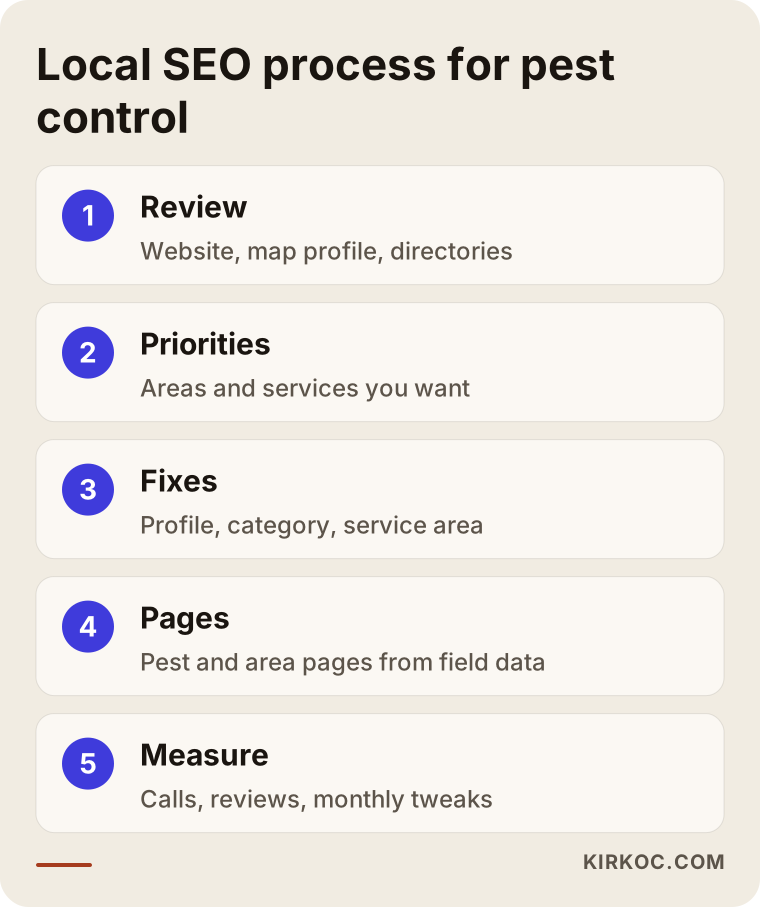
The steps in this diagram happen in order, but the last one never really ends. The pest in the spotlight changes with the seasons, so the pages and the profile need updating from time to time.
Common local SEO mistakes pest control companies make
The most common mistake is cloning the same text dozens of times with only the town name changed. Beyond that, these are the mistakes I run into most often:
- Listing a huge service area. Showing up in places you cannot reach does not bring jobs and weakens your profile.
- Stuffing keywords into the business name. Stretching the profile name into something like "X Pest Control Lincoln Park Bed Bugs Roaches" goes against Google's guidelines and can get the profile suspended.
- Creating several fake profiles in the same area. It may bring short-term visibility, but it carries a serious risk of everything being shut down.
- Leaving out what affects price, timing or safety. You do not have to publish numbers, but if you never explain what the price depends on, the person searching goes to another site that does.
- Hiding the phone number at the bottom. Someone with an urgent problem does not want to scroll.
- Ignoring seasonality. Mosquito and ant searches rise in summer, and rodent searches tend to climb in fall and winter; if your pages never follow that cycle, you miss chances.
- Never replying to reviews, or revealing the customer's problem in the reply. Both damage trust.
What can you do yourself, and when do you need a specialist?
You can handle the basics of your map profile, your photos and asking for reviews yourself; for site structure, planning the area pages and setting up measurement, a specialist usually saves you time. Things you can start on your own:
- Verify your Google Business Profile and correct the primary category and your real service area.
- Send each customer a short review link after the job.
- Add photos of your team, trucks and equipment regularly.
- Check that your company name, phone number and address are written the same way everywhere.
- Keep a running list of the questions customers ask most often on the phone; those will become page content later.
A specialist starts to make more sense when your website cannot easily handle new area and service pages, when you face real competition in several areas, when your profile has been suspended, or when you have no way of knowing which searches turn into calls. Time matters too: during peak season, coming home from a full day of jobs and writing web pages at midnight is not realistic for most owners.
What to look for when choosing a specialist or agency
The quickest way to choose the right specialist is to see whether they can walk you through a concrete plan, and whether they promise guarantees. Be careful with anyone who guarantees rankings or says "you'll be number one on the map in a month," because nobody controls how Google ranks results.
Concrete things to check:
- Can they explain how they will make each area page different and what information they will need from you?
- Do they understand the difference between a service-area business and a business with a storefront address?
- Do they suggest a way of collecting reviews that follows the rules?
- Can they explain how they will track call and text clicks?
- Will they agree that the profile and website accounts are opened in your name and that you keep access?
- Do they tell you in advance what their monthly report will show?
Questions you can ask in the first meeting:
- "How will my Lincoln Park page be different from my Evanston page?"
- "What do you do if my profile gets suspended?"
- "What content plan do you suggest for the slow winter months?"
- "If we stop working together, who keeps the website and the profile?"
What determines the cost?
Cost mostly depends on how many areas you target, how many service pages need to be written, the condition of your current website, and whether the work is a one-time project or an ongoing monthly service. I am not giving numbers here, because a small crew covering two towns and a company serving twenty towns plus commercial accounts have very different needs. The main things that move the price:
- The state of your website: if your current site can easily take new pages, the job is shorter; if not, the foundation may need rebuilding first.
- Area and pest coverage: every new area page and service page means separate research and writing.
- Competition: in areas where many companies are fighting for the same customers, you need more content and more frequent updates.
- Your profile's history: fixing a suspended profile or one with messy, conflicting listings takes extra time.
- Extra services: whether you also want Google Ads, social media, photography, or a new logo and brand identity.
Working with Ümit Kırkoç
I work from Istanbul and handle everything a digital agency would offer, as one person: websites and e-commerce, SEO, local SEO, GEO, social media management, Google and Meta advertising, logo and brand identity, and content. Because I work remotely, I can work with pest control companies outside Turkey, including in the United States, in the same organized way. Calls happen over video, and the rest moves through email and shared documents, so time zones are manageable.
When I start with a pest control company, a short call comes first, where I listen to which areas and which kinds of jobs you want. Then I review your website and your map profile and give you a written priority list. I write the area and service pages from your field knowledge, so I ask you for photos, the questions customers ask most and the travel times your crew can realistically manage. If you need ads during the busy season, I can also set up Google Ads that send people to those same pages, so the ads and the site do not drift apart. Every month I report, in plain language, which pages brought in searches and calls. I do not guarantee rankings or a number of customers; I show you the work I did and the results I measured.
The benefit of one person handling all of this in your industry is simple: the details on your bed bug page match your ad copy, the service description on your map profile and your social media posts. Whichever door a customer comes through, they meet the same company.
Frequently asked questions
Does local SEO make sense for my pest control company?
It makes sense if most of your work comes from specific areas and urgent searches. Word of mouth is valuable but limited; reaching people who search with a town name and a pest makes your workload less dependent on luck.
Who would you recommend for local SEO for a pest control company?
Look for someone who writes your area pages from your field knowledge rather than a template, who does not offer guarantees and who explains clearly how results are measured. I am one option and handle this work end to end; the healthiest approach is to talk to a few people and compare the plans they describe.
Do I need a separate page for every town I serve?
No. Pages for the areas you actually serve and want work from are enough. Grouping the areas where you rarely get jobs into one regional page is far better than a site full of duplicate pages.
Can I show up on the map if I don't have an office or I work from home?
Yes. You can set up your profile as a service-area business and hide your address. During verification, Google may ask for documents or a short video, so being prepared for that makes the process easier.
How do I ask for reviews on sensitive jobs like bed bugs?
Tell the customer they do not need to mention the pest, and ask them to focus on whether the technician was on time and whether the explanations were clear. When you reply, do not reveal the problem either.
How long until I see results?
That depends on the competition, the state of your website and your profile's history. The effect of map profile fixes can sometimes show within a few weeks, while area pages usually take months to settle in. Be cautious with anyone who gives you a firm timeline.
Can't I just run Google Ads instead of doing local SEO?
Ads bring fast visibility, but it stops the moment you pause them. Ads during the busy season combined with year-round local SEO usually gives a more balanced result, and the quality of the page an ad sends people to directly affects how well the ad performs.
Can assistants like ChatGPT recommend my company too?
They can, but there is no guarantee. Assistants generally rely on sources that give clear and consistent information; a website that states your areas, services and trust details plainly, and a profile that keeps getting reviews, make it more likely.
If you would like to look together at how your pest control or exterminator company shows up in the areas you serve, leave a short message on my local SEO services page describing your company and your service area, and I will tell you honestly where it makes sense to start.